
Judge, 1923-02-24 · page 24 of 36
Judge — February 24, 1923 — page 24: what you’re looking at
What you’re looking at
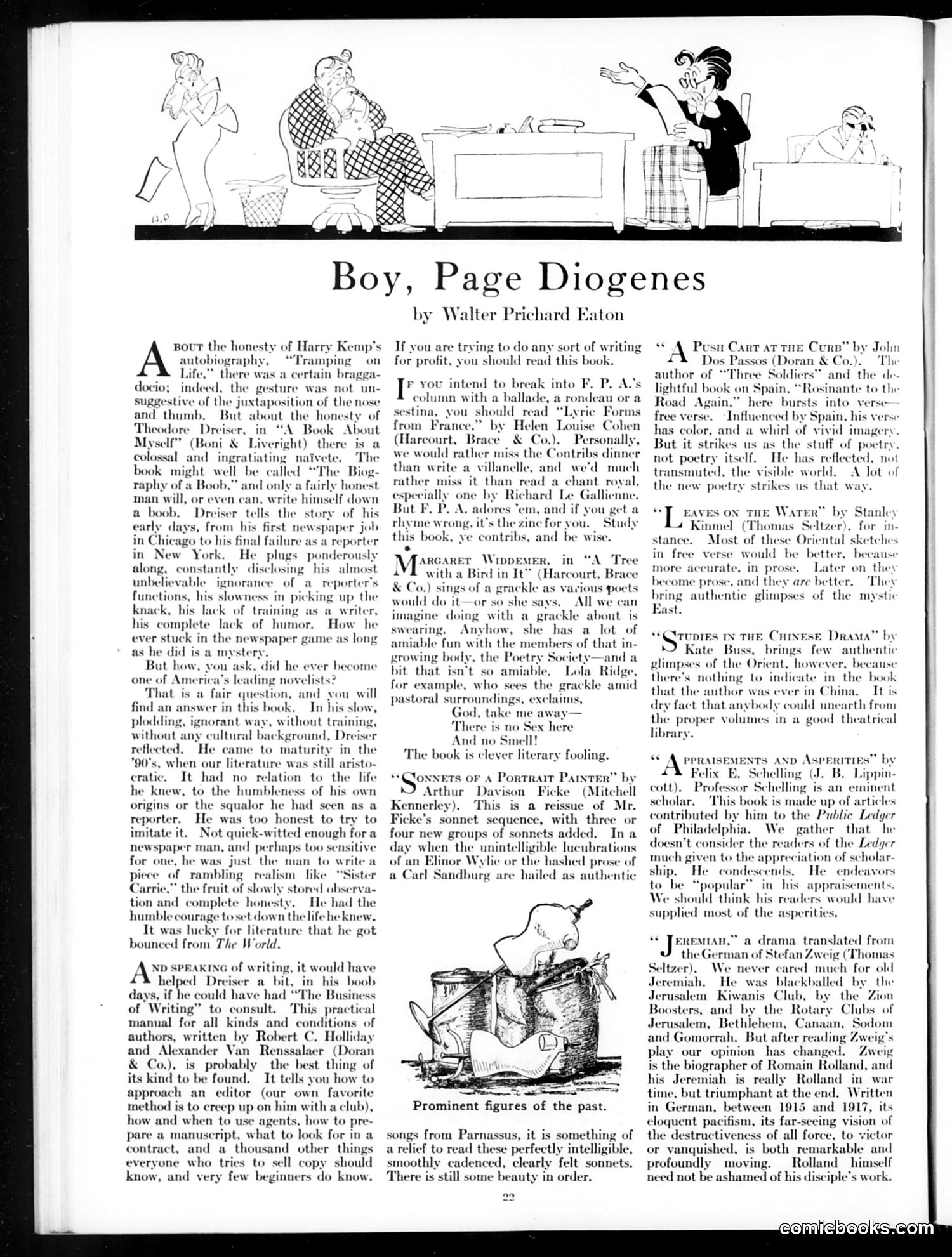
This is a book review column, not a political cartoon. The illustration at top is decorative, showing a domestic scene unrelated to the content below. **What's Being Discussed:** Walter Prichard Eaton reviews several literary works, primarily Theodore Dreiser's autobiography. The key point: Dreiser succeeded *despite* lacking conventional training or cultural sophistication. Writing in the 1920s, Eaton praises Dreiser's honest, unpolished realism—his willingness to write about working-class life he actually knew rather than imitating the aristocratic literature that dominated earlier American letters. **The Satire:** The subtle humor targets literary pretension. Eaton mocks precious poetry trends (Elinor Wylie, Carl Sandburg) while defending Dreiser's ungainly but truthful approach. He jokes about approaching editors "with a club" and pokes fun at overly clever modernist poetry. **Historical Context:** This reflects 1920s debates about American literature's shift from genteel tradition toward realism and modernism—Dreiser represented authenticity over refinement.
📄 Transcribed text from this page (OCR, searchable)
Machine-transcribed from the original scan — historical spelling and the odd misread are preserved.
Boy, Page Diogenes by Walter Prichard Eaton Bout the honesty of Harry Kemp's autobiography, ‘“Tramping on s a certain bra; indeed, the gesture was not un- suggestive of the juxtaposition of the nose and thumb, But about the honesty of Theodore Dreiser, in “A Book About * (Boni & Liveright) there a sal and ingratiating naivete. The book might well be ca The Biog- raphy of a Boob,” and only a fairly honest man will, or even can, write himse! own a boob. Dreiser tells the story of his s, from his first newspaper job inC hie go to his final failure as a reporter in New York. He plugs ponderously along, constantly disclosing his almost unbelievable ignorance of a reporter's functions, his slowness in picking up the knack, his lack of training as a writer, his complete lack of humor. How he ever stuck in the newspaper game as long as he did is a mystery. But how, vou ask, did he ever become one of America’s leading nov Tha fair question, and you will find an answer in this book. In his slow, plodding, ignorant way, without training, without any cultural background, Dreiser reflected. He came to maturity in the "90's, when our literature was still aristo- cratic. It had no relation to the life he knew, to the humbleness of his own origins or the squalor he had seen as a reporter. He was too honest to try to imitate it. Not quick-witted enough for a newspaper man, and perhaps too sensitive for one, he was just the man to writ piece of rambling realism like“! Carrie,” the fruit of slowly stored observa- tion and complete honesty. He had the humble courage to set down the life he knew. It was lucky for literature that he got bounced from The World. f writing, it would have A ND SPEAK helped Dreiser a bit, in his boob days, if he could have had “The Business of Writing” to consult. This practical manual for all kinds and conditions of authors, written by Robert C. Holliday and Alexander Van Renssalaer (Doran Co.), is probably the best thing of its kind to be found. It tells you how to approach an editor (our own favorite method is to creep up on him with a club), how and when to use agents, how to pre- pare a manuscript, what to look for in a contract, and a thousand other things everyone who tries to sell copy should know, and very few beginners do know. If you are trying to do any sort of writing for profit, you should read this book. P, AL's uora Forms. Cohen [208 intend to break into F lumn with a ballade, a ror sestina, y “Lyric from France,” by Louise (Harcourt, Brace & Co.). Perse we would rather miss the Contribs ¢ than write a vill nelle and we'd much 1 a chant roy: especi But F. P. A. adores “em, and if you g Alvine dota t "sthezine for you. Study this book, ye contribs, and be wise. . Meecsre Wippemer, in “A Tree with a Bird in It (Harcourt, Brace & Co.) sings of a grackle as vacious poets would do it—or so she says. All we can imagine doing with a grackle about is swearing. Anyhow, she has a lot of amiable fun with the memt of that in- growing body, the Poetry jety—and bit that isn’t so ami Ric for example, who sees the grackle amic pastoral surroundings, exclaims, God, take me ‘There is no Sex here And no Smell! The book is clever literary fooling. Sonnets oF A Portrait Painter” by Arthur Davison Ficke (Mitchell Kennerley ). This a reissue of Mr. Ficl sonnet sequence, with three or groups of sonnets added. In a y when the unintelligible lucubrations: an Elinor Wylie or the hashed prose of a Carl Sandburg are hailed as authentic Prominent figures of the past. songs from Parni s, it is something of a relief to read these perfectly intelligi smoothly cadenced, clearly felt sonnets. ‘There is still some beauty in order. A Pusn Cart at THE Cur” by Jolin Dos Passos (Doran & Co. ).. “Ey author of “Thre tie rs” and the de lightful book on $ “Rosinante to the Road Again,” here bats into verse free verse. Influenced by Spain, his vers has color, and a whirl of vivid imagery. But it strikes us as the stuff of poetry, not poetry itself. He has reflected, not transmuted, the visible world. A lot of the new poetry strikes us that way. “T EAVES ON THE Water” by Stanley 4 Kinmel (Thomas Seltzer), for in- Most of these Oriental sketches in free verse would be better, be more accurate, in prose. Later on they become prose, and they are better. They bring authentic glimpses of the mystic East. stance. aLUUSe Kate Buss, glimpses of the Orient, : there's nothing to indicate in the book that the author was ever in China, It is dry fact that anybody could unearth from the proper volumes in a good theatrical library. brings howe PPRAISEMENTS AND ASPERITIES” by Felix E. Schelling (J.B. Lippin- cott). Professor Schelling is an eminent tholar. ‘This t s made up of articles contributed by him to the Public Ledger of Philadelphia. We gather that he doesn’t consider the readers of the Ledger much given to the appreciation of scholar- ship. He condescends. He rs to be “popul in his appraisements. We should think his readers would have supplied most of the asperities. Eremian,” a drama translated from ierman of Stefan Zweig (Thomas We never cared much for old th. He was blackballed by the Jerusalem Kiwanis Club, by the Zion Boosters, and by the Rotary Clubs of Jerusalem, Bethlehem, Canaan, Sodom and Gomorrah. But after reading Zweig’s play our opinion has changed. Zweig is the biographer of Romain Rolland his Jeremiah is really Rolland in war time, but triumphant at the end. Written in Gert tween 1915 and 1917, its ism, its far-seeing the destructiveness of all force, or vanquished, is both remarkab profoundly moving. — Rolland himself need not be ashamed of his disciple’s work.