
Judge, 1923-02-24 · page 17 of 36
Judge — February 24, 1923 — page 17: what you’re looking at
What you’re looking at
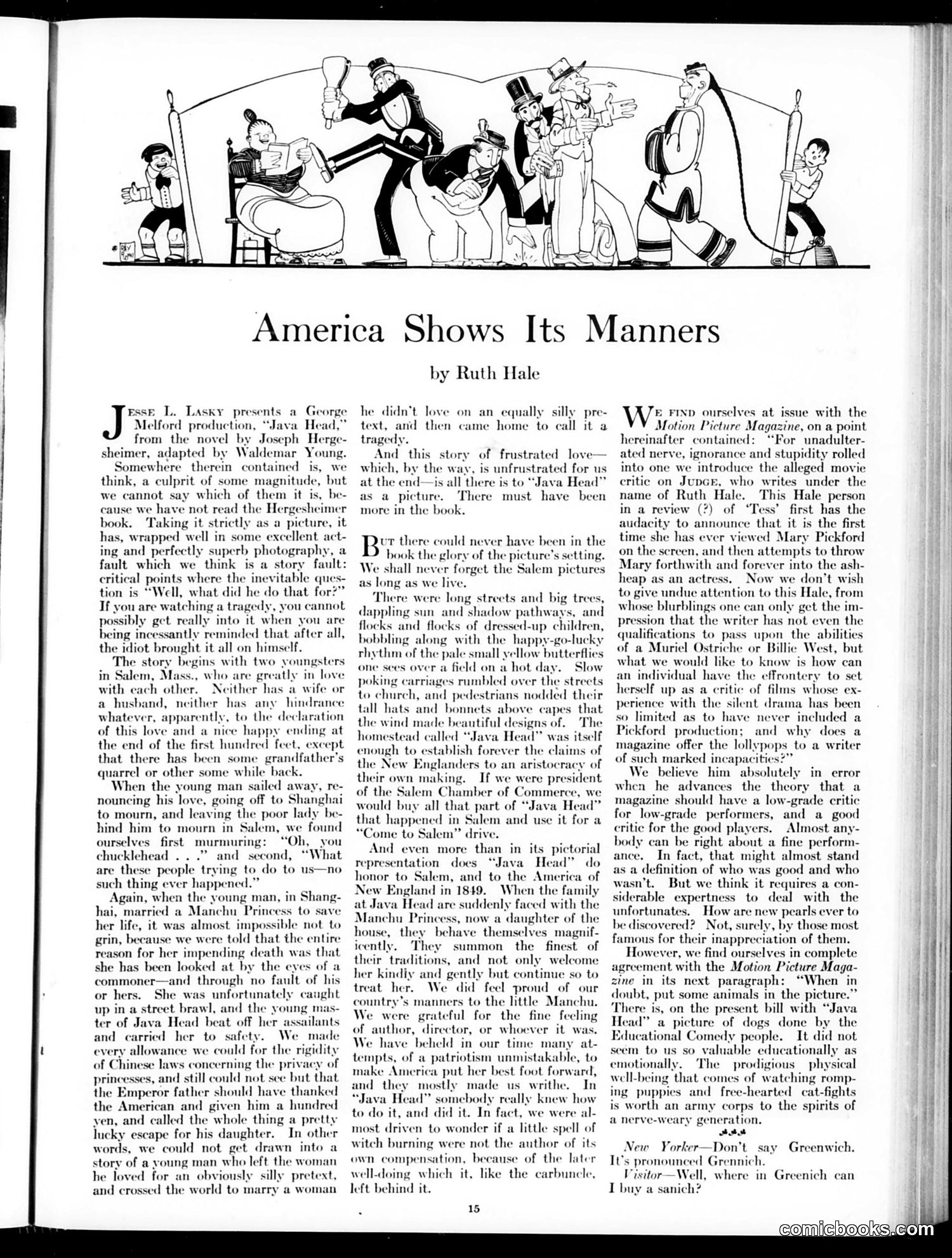
This is a film review by Ruth Hale of "Java Head," a 1921 Paramount production. The cartoon header depicts various figures engaged in chaotic behavior—fighting, drinking, playing instruments—illustrating American social conduct. Hale critiques the film's melodramatic plot (a man abandons his Salem, Massachusetts sweetheart to marry a Manchu princess in Shanghai, then returns) as unintentionally comedic. She finds the lovers' separation and his prejudiced reasoning laughably unconvincing, noting audiences cannot emotionally invest when characters act irrationally. However, Hale praises the film's *actual* achievement: its beautiful cinematography of 1849 Salem and—notably—its depiction of New England aristocrats graciously welcoming the Asian princess into their home. She frames this acceptance as reflecting America's best manners and traditions, appearing to position the film as a progressive statement about cross-cultural hospitality, regardless of its melodramatic failings.
📄 Transcribed text from this page (OCR, searchable)
Machine-transcribed from the original scan — historical spelling and the odd misread are preserved.
EssE L. Lasky presents a George Melford production, “Java Head,” from the novel by Joseph Herg sheimer, adapted by Waldemar Young. Somewhere therein contained is, we think, a culprit of some magnitude, but we cannot say which of them it is, be- cause we have not read the Hergesheimer book. Taking it strictly as a picture, it has, wrapped well in some excellent ac ing and perfectly superb photography fault which we think is a story points where the inevitable q Well, what did he do that for? If you are watching a tragedy, you cannot possib Iy get really into it whe you are being incessantly reminded that after all, the idiot brought it all on himself. The story begins with two youngsters alem, Mass., who are greatly in love h other. Neither has a wife or id, neither has any hindrance cr, apparently, to the declarati of this love and a nice happy ending at the end of the first hundred feet, except that there has been some gi andfather's quarrel or other some whil When the young man sailed away, nouncing his love, going off to Shi to mourn, and leaving the poor lady be- im to mourn in Salem, we found first’ murmuring: “Oh, you d * and md, “What people trying to do to us—no g ever happened.” Again, when the young man, in § hai, married a Manchu Prin her life, it was almost impossible not to grin, because we were told that the entire on for her impending death was that she has been looked at by the eyes of a commoner—and through no fault of his or hers. She was unfortunately caught up in a street brawl, « ter of J. Head be and carried her to safety; : every allowance we could for the ri of Chinese laws concerning the priv: pri and still could not see but that the Emperor father should ¢ thanked the American and given him a hundred yen, and called the whole thing a pretty lucky escape for his daughter. In other words, we could not get drawn into a story of a young man who left the woman he loved for an obviously. silly pretext, and crossed the world to marry a woman tion is re- America Shows Its Manners by Ruth Hale he didn’t love on an equally silly pre- text, and then came home to call it a tragedy. And this story of frustrated love— which, by the way, is unfrustrated for us at the end—is all there is to “Java Head” as a picture. There must have been more in the book. Bu there could never have been in the book the glory of the picture's setting. We shall never forget the Salem pictures as long as we live. There were long strects and big trees, dappling sun and shadow pathways, and flocks and flocks of dressed-up children, bobbling along with the happy-go-luck rhythm of the pale small yellow butterfli field on a hot day. Slow ages rumbled over the streets to church, and pedestrians nodded their tall hats and bonnets above capes that the wind made beautiful designs of. The homestead called “Java Head” was itself enough to establish forever the claims of the New Englanders to an aristocracy of their own making. If we were president of the Salem Chamber of Commerce, we would buy all that part of “Java Head” that happened in Salem and use it for a “Come to Salem” drive. And even more than in its pictorial representation does ava Head” do honor to Salem, and to the America of New England in 1849. When the family at re suddenly faced with the Manchu Princess, now a daughter of the house, they behave themselves magnif- icently. ‘hey summon the finest of their traditions, and not only welcome her kindiy and gently but continue so to treat her. We did feel proud of our country’s manners to the little Manchu, We were grateful for the fine feeling of author, director, or whoever it . We have beheld in our time m; tempts, of a patriotism unmistakable make America put her best foot forward, and_ the stly made us writhe. In “Java Head” somebody really knew how to do it, and did it. In fact, we were most driven to wonder if a little spell of witch burning were not the author of its own compensation, because of the later well-doing which it, like the carbuncle, left behind it. 15 V E FIND ourselves at issue with the Motion Picture Magazine, on a point hereinafter contained: ‘For unadulter- ated nerve, ignorance and stupidity rolled into one we introduce the alleged movie critic on JupGe, who writes under the name of Ruth Hale. This Hale person in a review (?) of s’ first has the audacity to announce that it is the first time she has ever viewed Mary Pickford on the sereen, and then attempts to throw Mary forthwith and forever into the ash- heap as an actress. Now we don’t wish to give undue attention to this Hale, from whose blurblings one can only get the im- pression that the writer has not even the qualifications to pass upon the of a Muriel Ostriche or Billie West, but what we would like to know is how can an individual have the effrontery to set herself up as a critic of films whose ex- perience with the silent drama has been so limited as to have never included a Pickford production; and why does a magazine offer the lollypops to a writer of such marked ine: We believe him absolutely in_ error when he advances the theory that a magaz hould have a low-grade critic for low-grade performers, and a good critic for the Imost any- body can be right abc fine perform- In fact, that might almost stand a definition of who was good and who n't. But we think it requires a con- siderable expertness to deal with the unfortunates. How are new pearls ever to he discovered? y those most ion of them. However, we find ourselves in complete agreement with the Motion Picture Maga- zine in its next paragraph: ‘When in doubt, put some anima the picture.” There is, on the present bill with “Java Head” a picture of dogs done by the Educational Comedy peoy It did not seem to us so valuable edu ally emotionally. The prodigious physi well-being that comes of watching romp- ing puppies and free-hearted cat-fights is worth an army corps to the spirits of a nerve-weary generation. Ry New Yorker—Don’t say It’s pronounced Grennich. Visitor—Well, where in Greenich can I buy a sanich? Greenwich.