
A complete issue · 36 pages · 1922
Judge — May 6, 1922
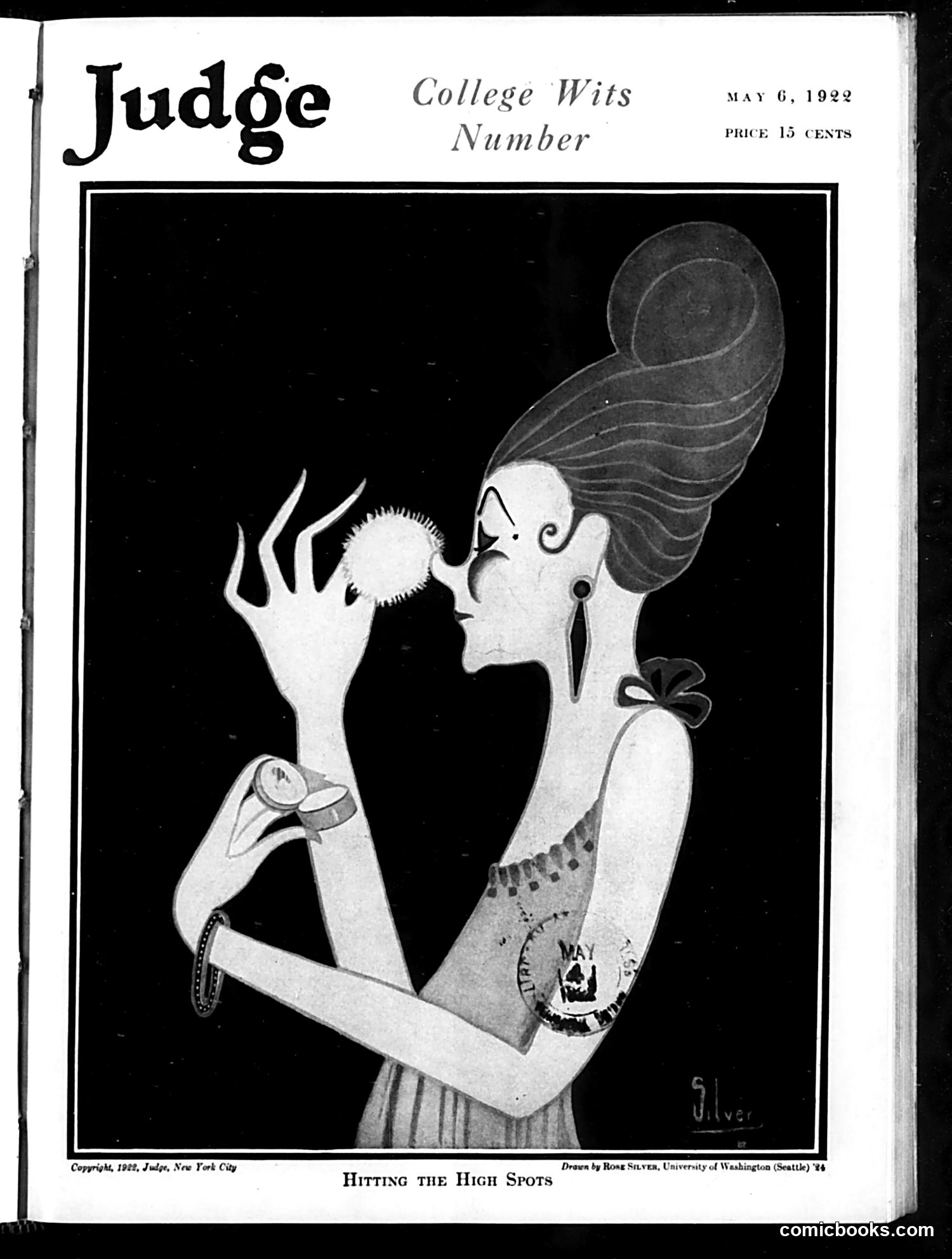
This 1922 Judge magazine cover satirizes fashionable women's leisure activities during the Jazz Age. The illustration, drawn by Rose Silver, depicts a stylishly dressed woman with an exaggerated 1920s bob hairstyle and elaborate jewelry examining what appears to be a powder compact or cosmetic item. The title "Hitting the High Spots" refers to frequenting exclusive social venues and nightlife destinations—a popular pastime for wealthy women during Prohibition. The cartoon likely mocks the era's emphasis on superficial consumption, glamorous appearance, and conspicuous socializing among the upper classes. The woman's elongated features and the emphasized cosmetics reflect period artistic caricature conventions used to critique vanity and materialism in post-WWI American society.
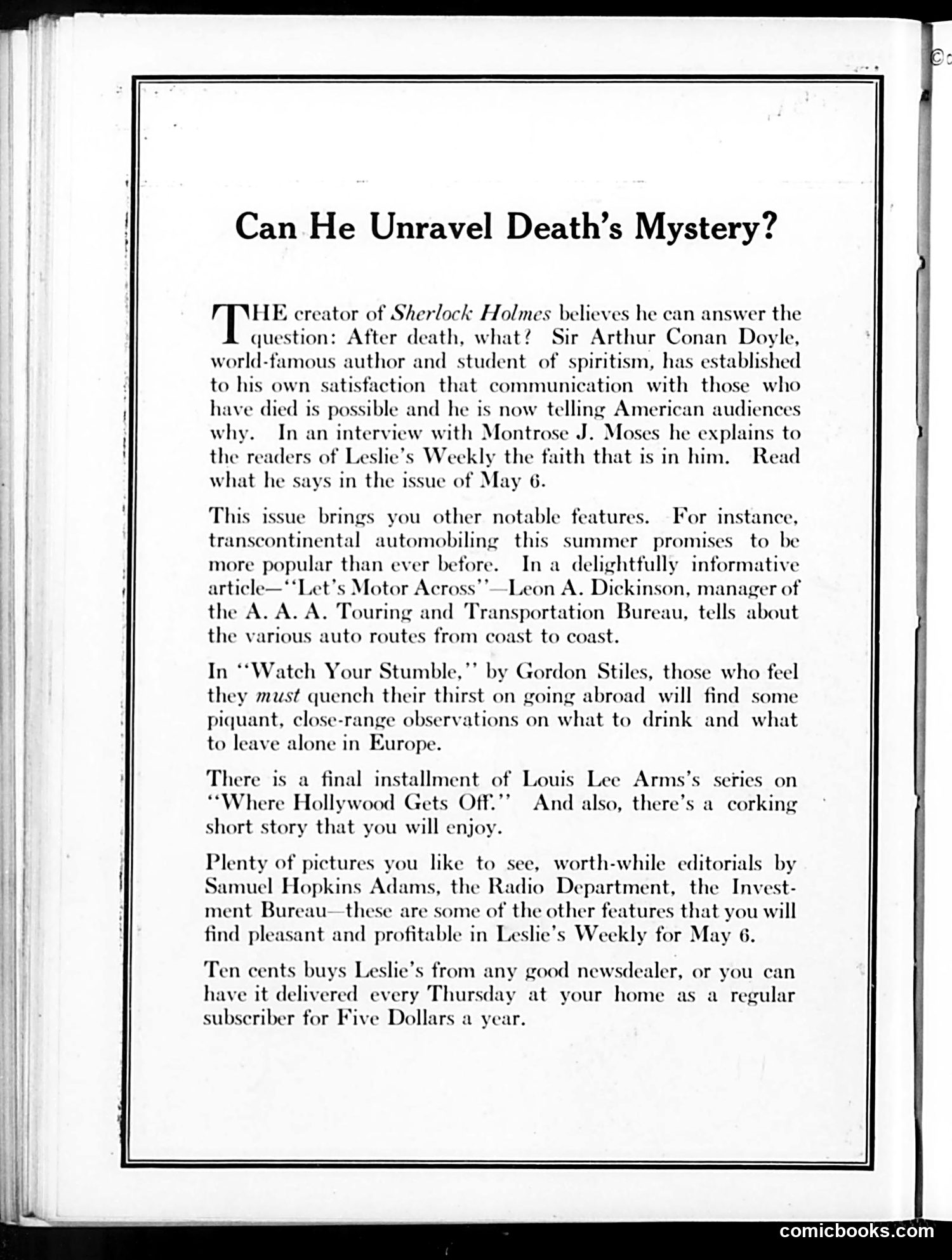
This page is **advertising copy, not a cartoon**. It promotes the May 6 issue of Leslie's Weekly magazine. The main feature advertised is an interview where **Sir Arthur Conan Doyle** (creator of Sherlock Holmes) discusses spiritualism and the afterlife with interviewer Montrose J. Moses. Doyle was a famous spiritualist who believed in communicating with the deceased. Other advertised content includes articles on transcontinental automobiling, travel advice about drinking abroad, and a Hollywood story series. The page reflects early 20th-century interests: Doyle's spiritualism was culturally significant then, automobile tourism was novel, and Leslie's positioned itself as an entertaining, informative weekly magazine. The ten-cent newsstand price and five-dollar annual subscription reflect the era's affordability.
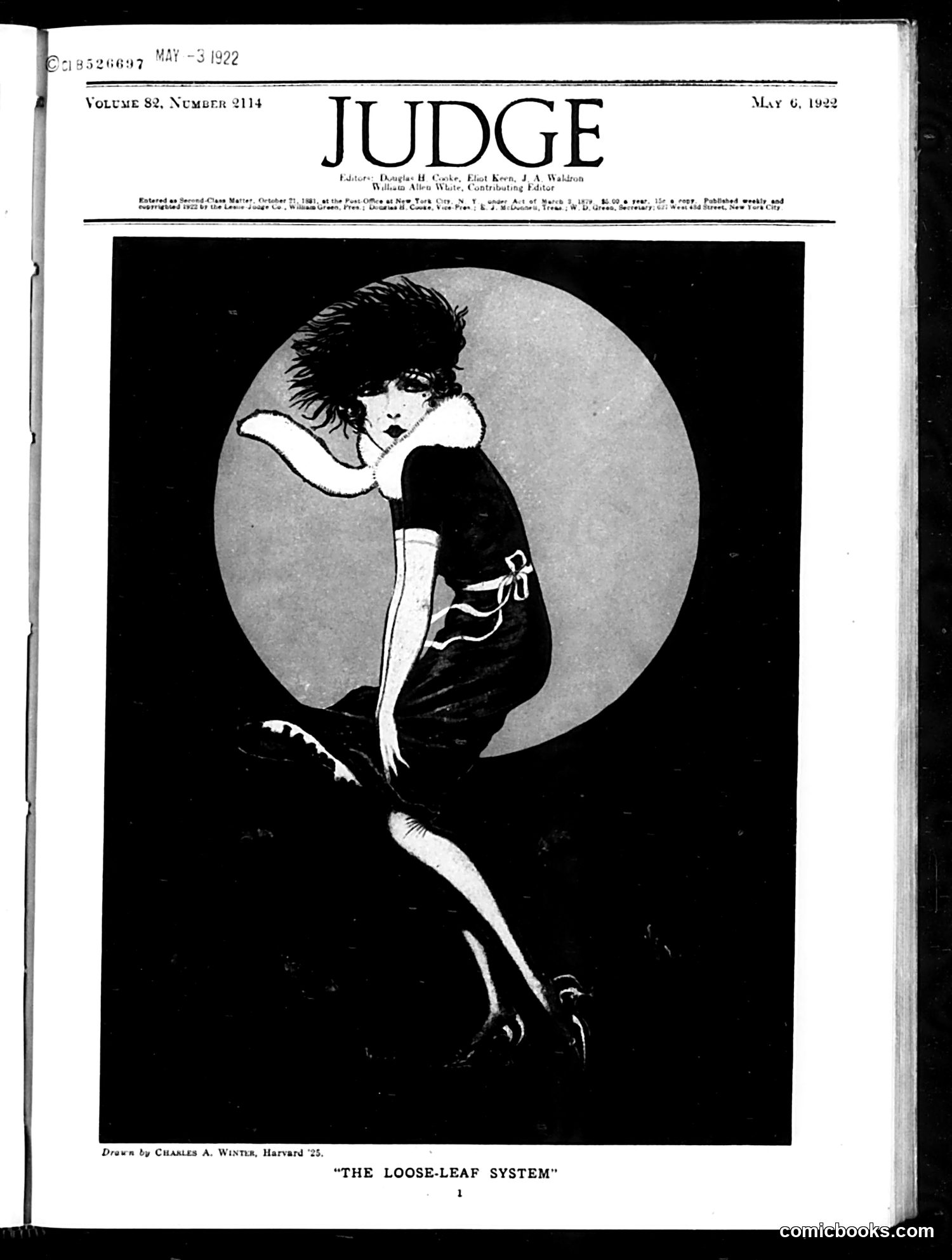
This cartoon by Charles A. Winter satirizes the "loose-leaf system"—a business filing method popular in the early 20th century that used removable pages in binders rather than bound books. The image depicts a woman in 1920s fashion striking a suggestive pose against a large moon. The satire appears to be a double entendre: just as the loose-leaf system allowed pages to be easily removed and rearranged, the cartoon implies a woman using this "system" can similarly change her appearance or presentation—swapping out different "pages" of herself. The joke relies on period humor about women's changing social roles and the era's fascination with modern business efficiency applied to human relationships or appearance.
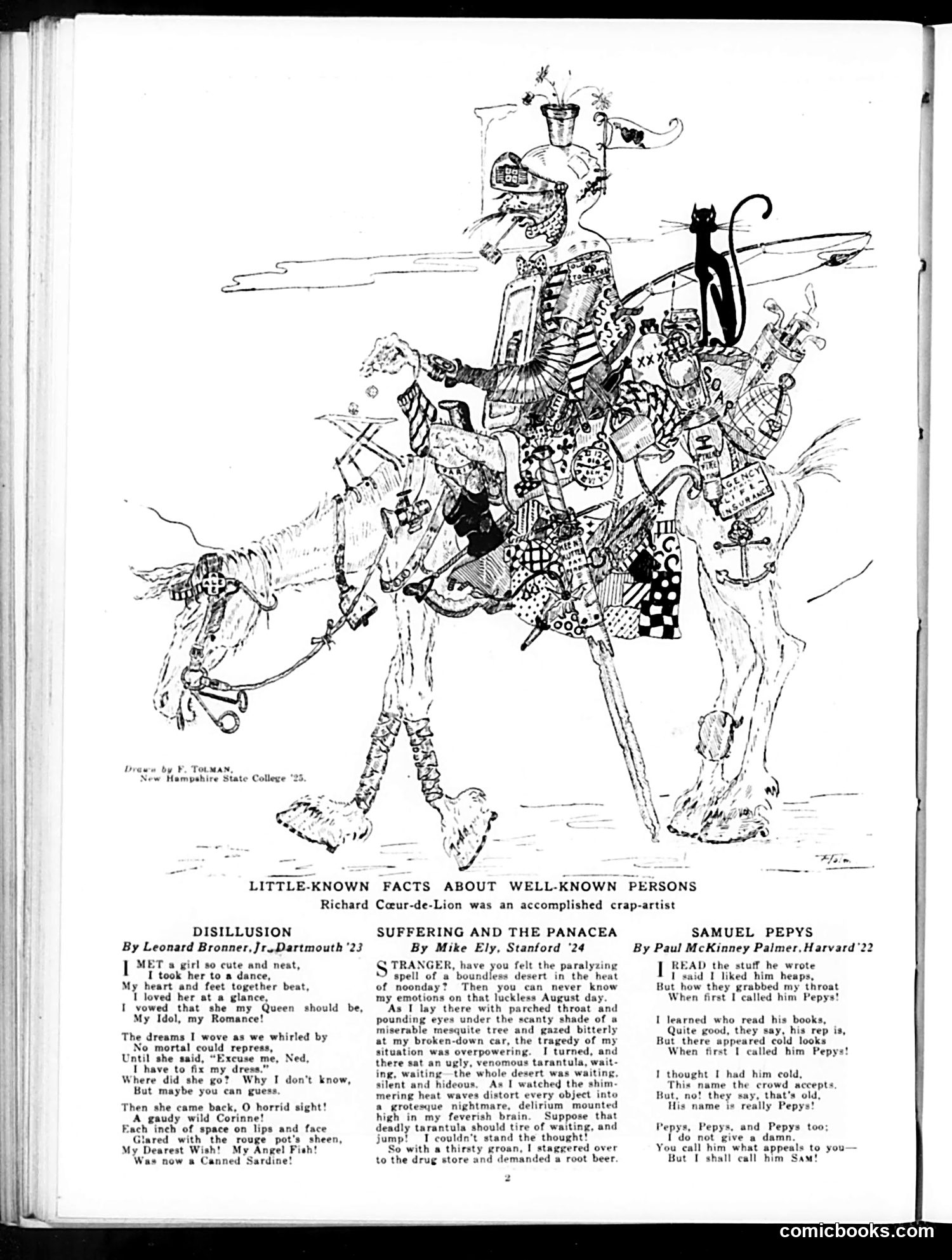
The main illustration depicts an ornately decorated camel carrying a richly dressed figure seated atop it—a visual reference to "Richard Coeur-de-Lion was an accomplished crap-artist," according to the caption. This appears to be a satirical commentary on Richard the Lionheart, presenting him as a charlatan or fraud ("crap-artist"). Below are three separate humorous poems addressing "Little-Known Facts About Well-Known Persons": one about disillusionment with romance, another about desert suffering and the pancreas, and a third mocking Samuel Pepys's literary reputation. The satire uses exaggeration and absurdist humor to deflate historical figures' legacies, suggesting their public images don't match reality. The overall tone is irreverent mockery of famous historical and literary figures.
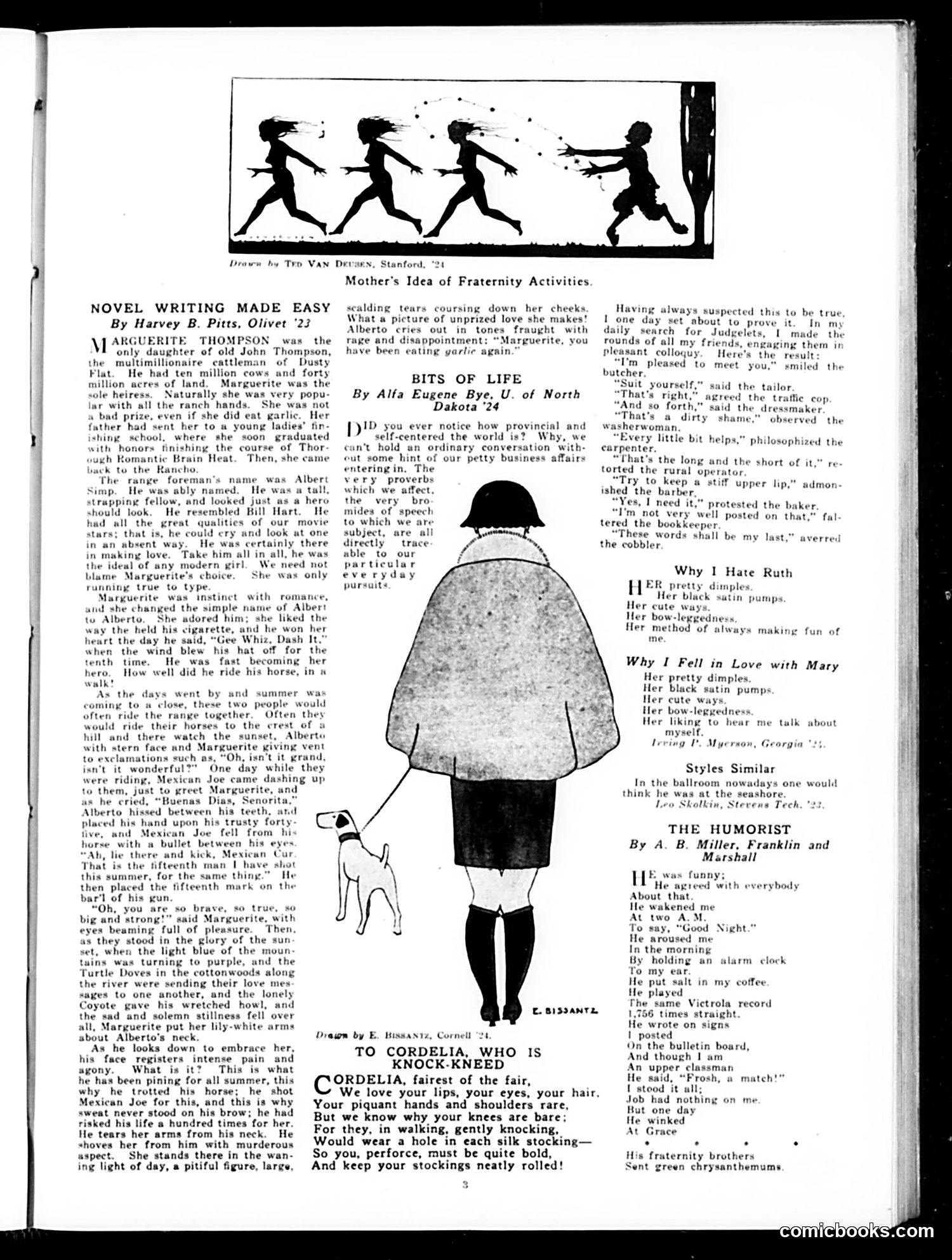
This page from Judge magazine contains primarily **literary content rather than political satire**. The main feature is "Novel Writing Made Easy" by Marguerite Thompson, a short story about a rancher named Alberto and a young woman named Marguerite. The narrative emphasizes romantic themes typical of early 20th-century fiction. The page includes several brief humorous poems and observations titled "Bits of Life," "Why I Hate Ruth," and "The Humorist" — these appear to be light social commentary on contemporary manners and relationships rather than political satire. The illustration by E. Rissanelli shows a fashionably-dressed woman with a small dog, accompanying a poem about "Cordelia, Who Is Knock-Kneed" — social humor targeting women's fashion and physical appearance conventions of the era. Overall, this represents Judge's lighter, entertainment-focused content rather than hard political commentary.
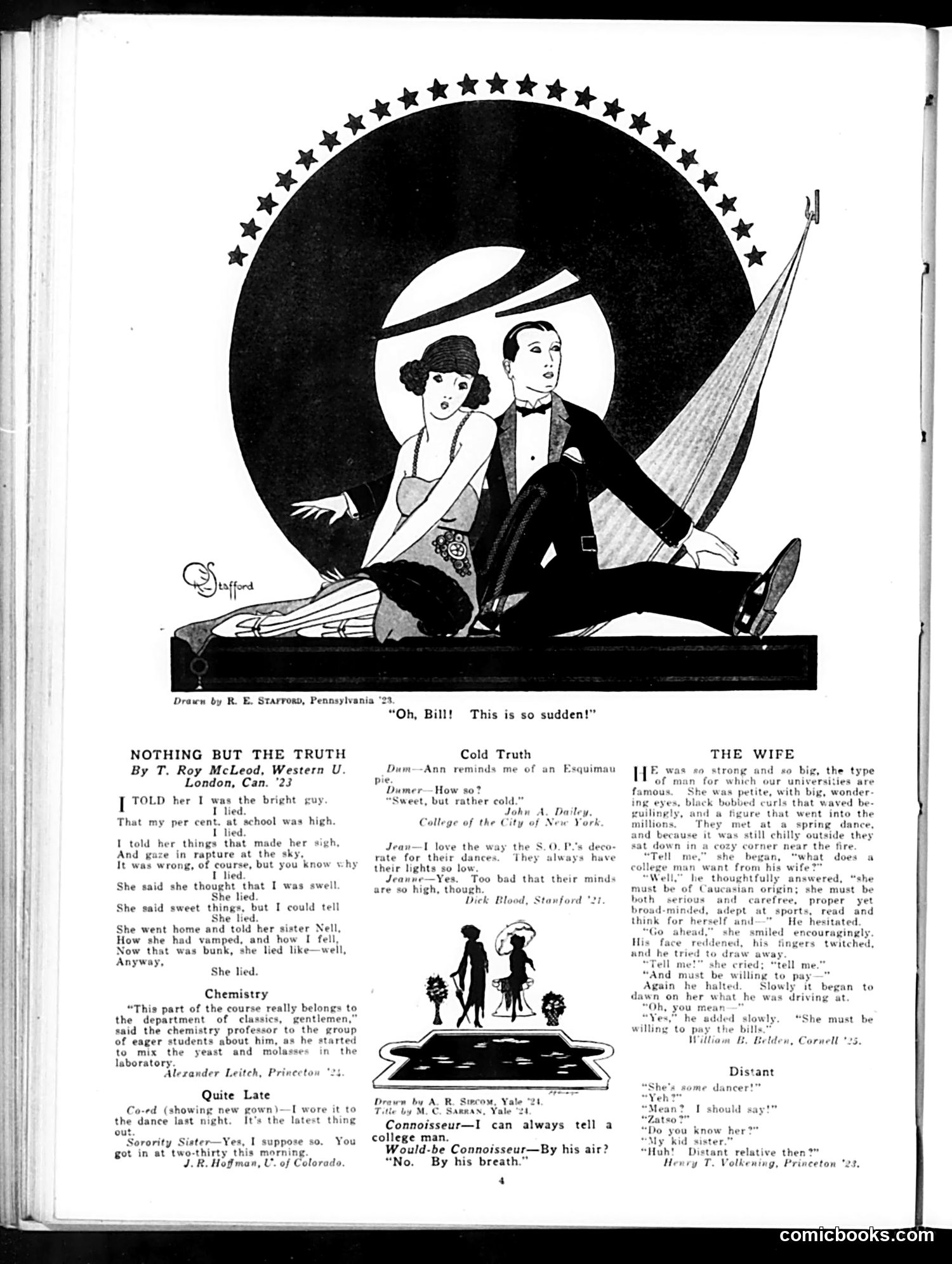
The main cartoon, titled "Oh, Bill! This is so sudden!" shows a couple in formal attire positioned playfully against a large "Q" backdrop decorated with stars. The image appears to be satirizing sudden marriage proposals or romantic declarations, given the woman's surprised exclamation and the couple's theatrical pose. The page contains several short humorous pieces and poems about college life, romance, and social observations from contributors at various universities (Princeton, Yale, Stanford, Cornell). These include brief jokes about chemistry professors, dancing, and courtship etiquette typical of 1920s college culture. The overall content reflects Judge magazine's focus on lighthearted social satire aimed at educated, collegiate audiences of the era.
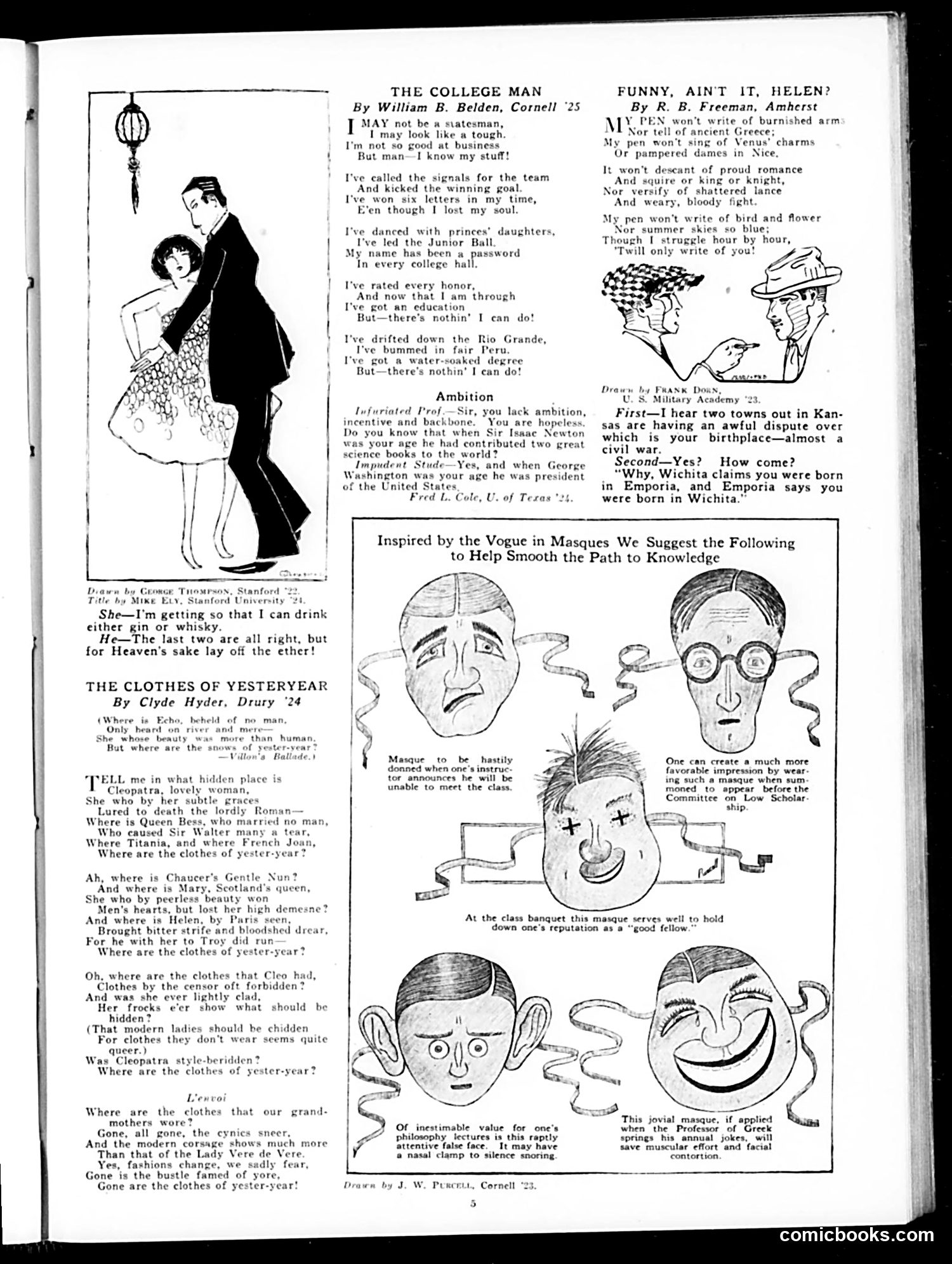
This page from Judge (a 1920s college humor magazine) contains three main satirical pieces: **"The College Man"** by William B. Belden critiques the hollowness of collegiate achievement. The speaker boasts of campus accomplishments—winning letters, dating well-connected women, leading dances—yet admits: "there's nothin' I can do!" The satire exposes the gap between college prestige and actual post-graduation employability, a concern likely heightened by post-WWI economic adjustment. **"The Clothes of Yesteryear"** by Clyde Hyder laments modern women's fashion, comparing contemporary dress unfavorably to historical figures (Cleopatra, Helen of Troy). It's conservative satire on 1920s "flapper" culture—women wearing less restrictive clothing. **The masque illustrations** mock academic pretense: absurd theatrical masks suggest students could improve their reputation by hiding incompetence from professors. The minor pieces joke about drinking prohibition ("gin or whisky"), academic ambition, and romantic rivalry—typical college humor of the era.
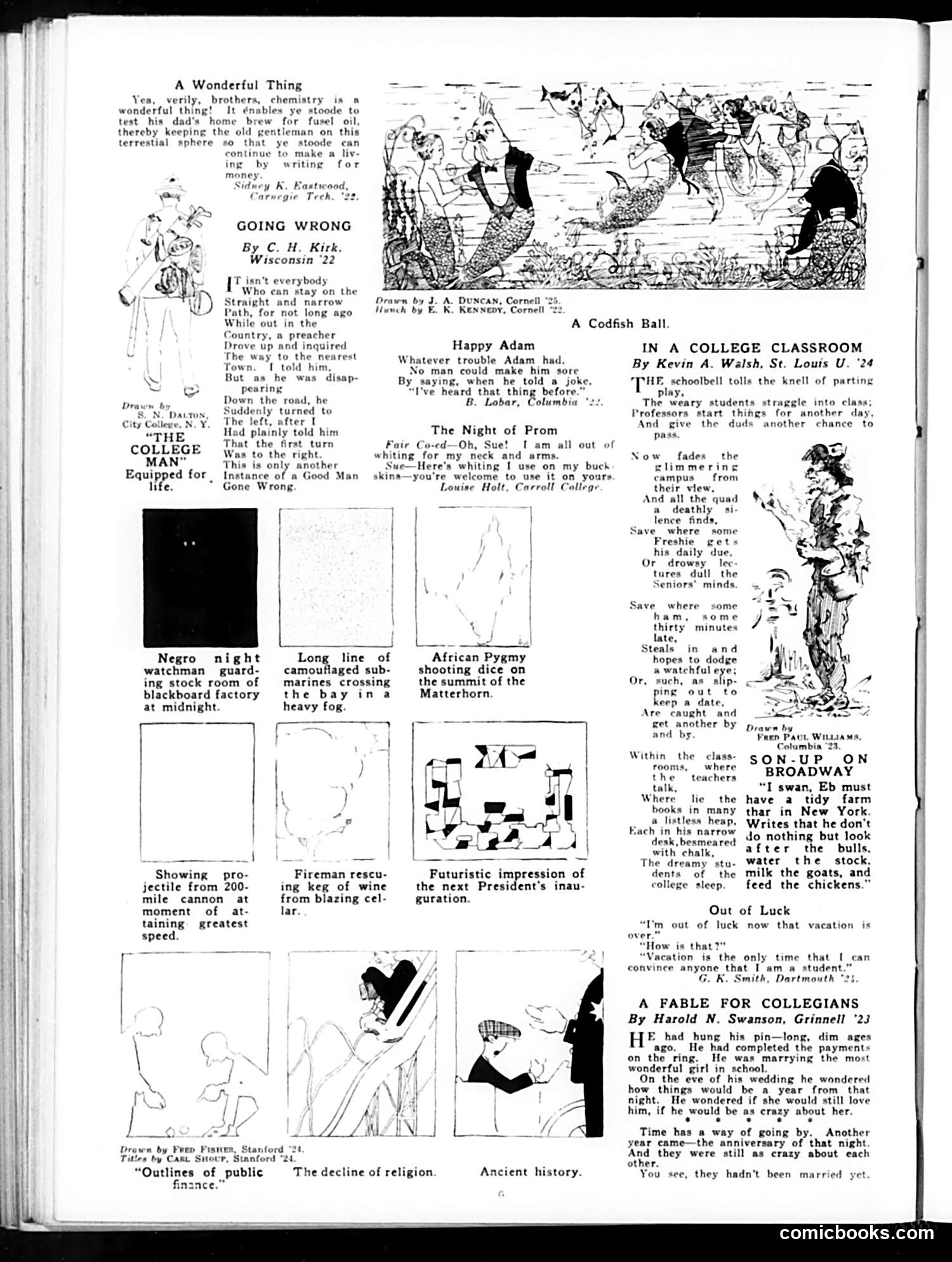
This page compiles humorous college-themed submissions from student writers and cartoonists, circa 1922-1924. The humor reflects early 1920s campus life and social anxieties. Key pieces include satirical takes on Prohibition (a chemistry student testing homemade beer), courtship rituals (the "Night of Prom" depicting flirtation and deception), and academic ennui ("In a College Classroom" portraying lazy, distracted students). "A Fable for Collegians" jokes about engagement anxiety—a young man worries his fiancée will stop loving him after marriage, then realizes they haven't actually married yet, so the anxiety is premature. The absurdist cartoons (submarines, cannons, futuristic inaugurations) appear to be non-sequiturs typical of college humor magazines, where surrealism was fashionable. Overall, the page satirizes student pretensions, romantic confusion, academic disengagement, and the gap between college life's promises and realities.
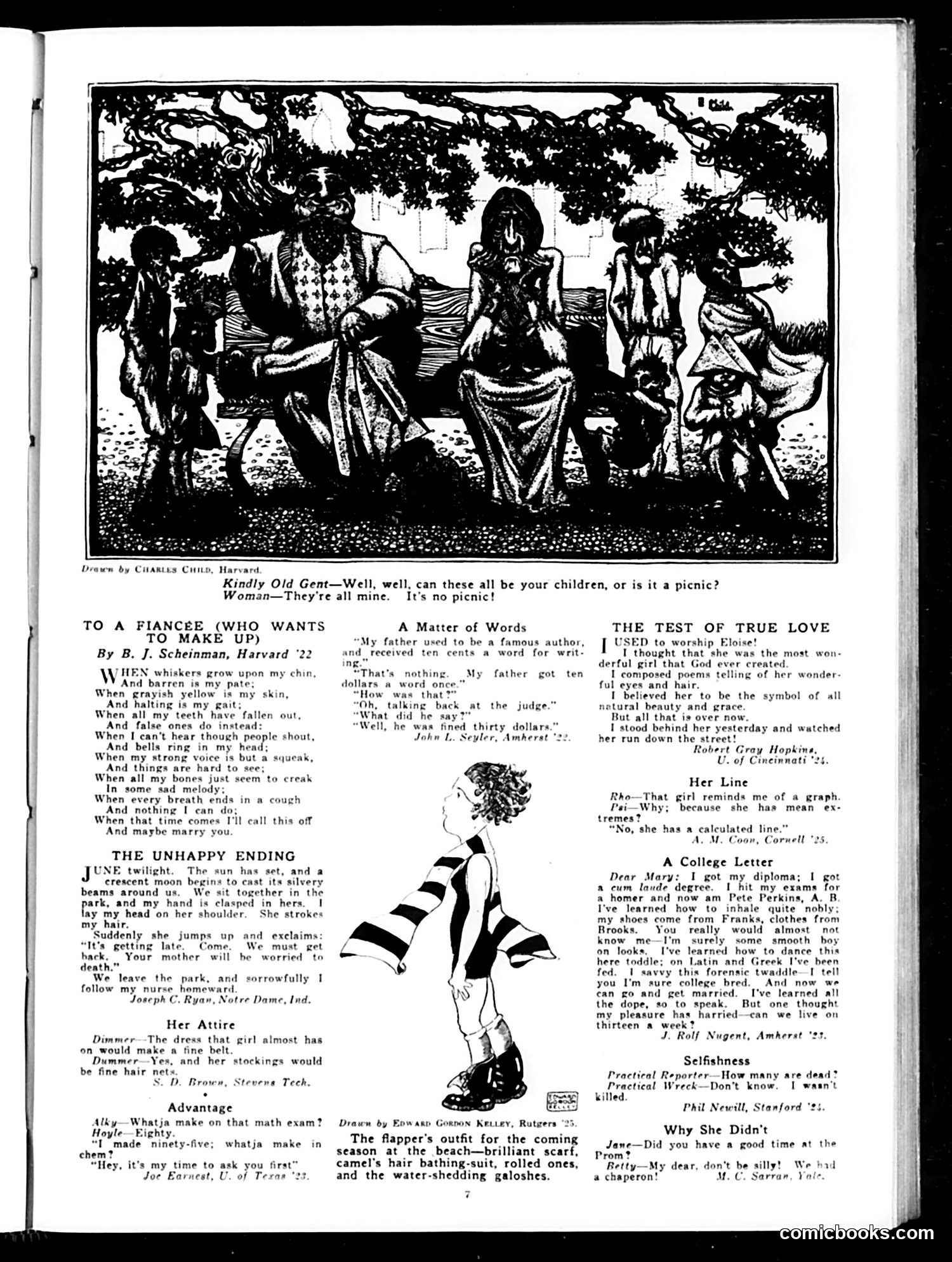
This page from Judge (circa early 1920s) contains multiple satirical pieces targeting college students and social conventions: **Main Cartoon (top):** A well-dressed older gentleman encounters a woman with multiple children. His naive question—"can these all be your children?"—meets her pragmatic reply: "They're all mine. It's no picnic!" This satirizes the gap between romantic idealization and harsh domestic reality, particularly criticizing men's ignorance of motherhood's burdens. **Written Pieces:** The page includes humorous student submissions mocking courtship ("To a Fiancee"), modern fashion (the "flapper's outfit" with rolled stockings and galoshes), and gender dynamics. "The Unhappy Ending" uses dark comedy: a romantic park scene is deflated when the woman reveals she's actually his nurse, infantilizing the male narrator. **Overall Theme:** The satire targets post-WWI youth culture—particularly college men's immaturity, superficial romanticism, and obliviousness to women's actual experiences. The fashion and "flapper" references indicate this addresses 1920s social anxieties about changing gender roles.
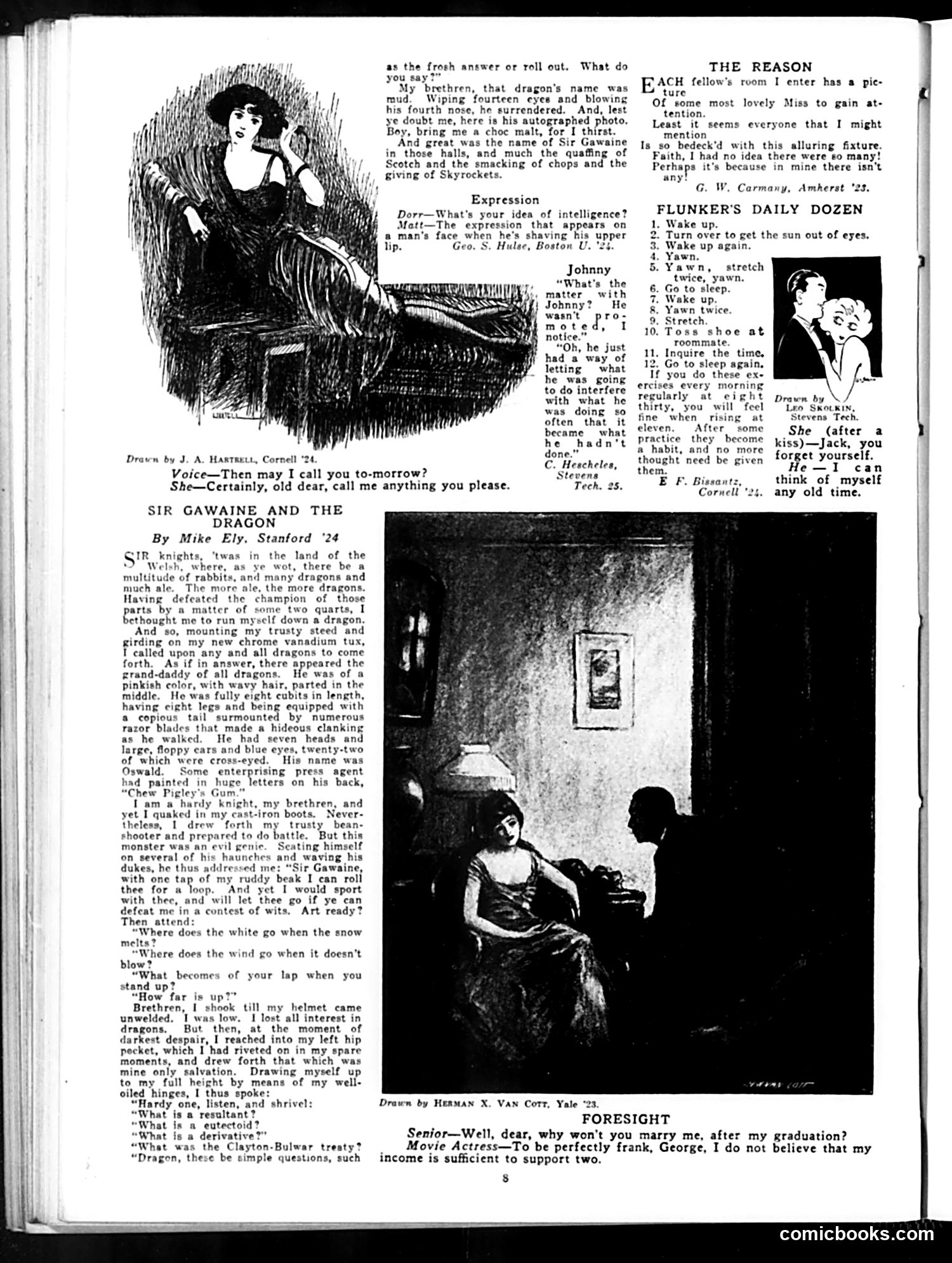
This page contains several college humor pieces from the 1920s: **"Sir Gawaine and the Dragon"** is a comedic fantasy parody where a knight defeats a dragon—not through combat, but by asking it engineering and history questions ("What is a eutectoid?" "What was the Clayton-Bulwer treaty?") that stump the creature. The joke targets college freshmen: the dragon, unable to answer questions a freshman could answer, surrenders in shame. This satirizes the gap between educated people and those without learning, while gently mocking college curricula. The other pieces are brief collegiate humor: - **"Expression"** jokes about concentration during shaving - **"The Reason"** humorously notes most dorm rooms display pictures of attractive women—except the author's - **"Flunker's Daily Dozen"** is a comedic list mocking lazy, hungover college students who repeatedly yawn and sleep instead of rising All are illustrated by college students (noted in bylines: Stanford '24, Yale '23, etc.), reflecting Judge's practice of publishing undergraduate contributions. The humor reflects 1920s college life: drinking, romance, and academic struggles.
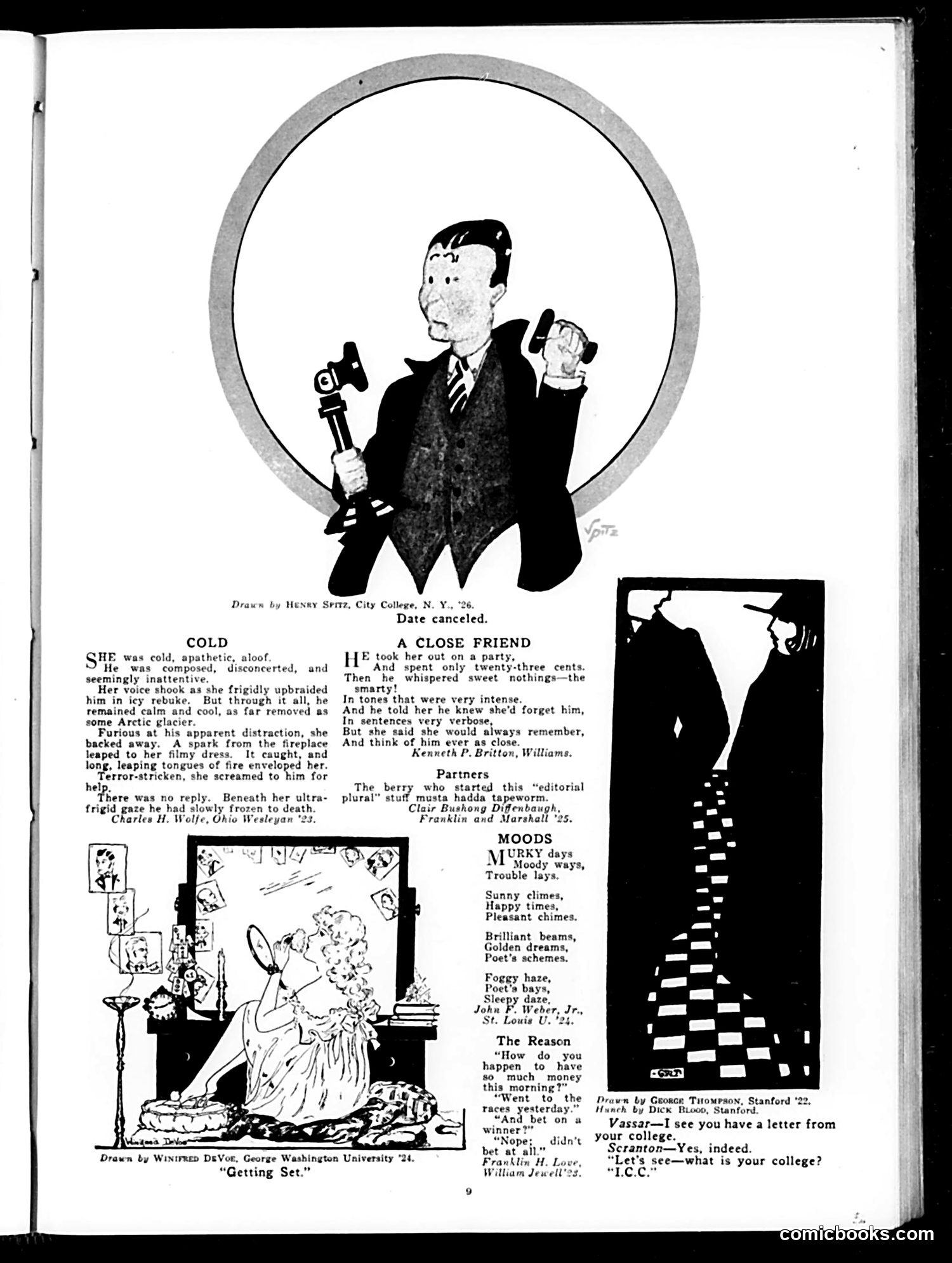
This page contains student-written humor and cartoons from circa 1925, likely from a college issue. The content reflects 1920s social attitudes: **"Cold"** depicts a domestic quarrel where an emotionally detached man ignores his wife even as her dress catches fire—dark satire on marital coldness and masculine indifference. The punchline is that he "froze to death" from her icy gaze. **"A Close Friend"** mocks a cheap date (23 cents) where a man sweet-talks a woman while admitting she'll forget him—yet she insists she'll remember him "as close," creating ironic humor about self-deception in romance. **"Getting Set"** (illustration) shows a woman at her mirror, likely satirizing female vanity or preparation. **"Moods"** is light verse about poetic sentimentality. **"The Reason"** jokes about gambling winnings at horse races. **"Vassar/Scranton"** is a brief dialogue joke, likely playing on regional college stereotypes. Overall, the page represents typical 1920s college humor: cynicism about romance, class consciousness, and gentle social satire aimed at young readers.
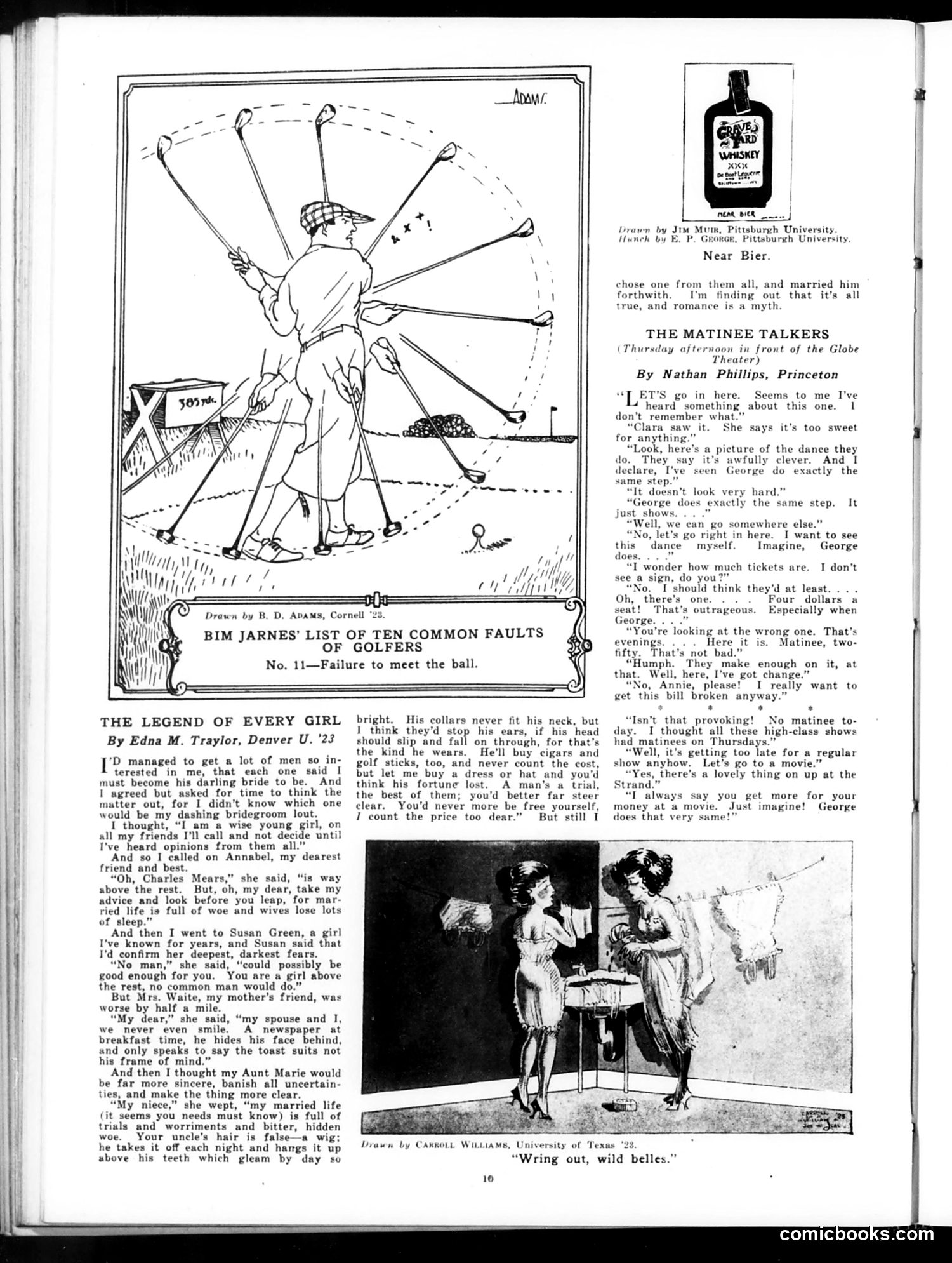
This page contains three separate humor pieces typical of Judge's style: **"Bim James' List of Ten Common Faults of Golfers"** (top cartoon): A satirical drawing by B.D. Adams showing a golfer failing to connect with the ball, illustrated as a spider-like figure with multiple golf clubs extended. Golf was a popular upper-class pursuit in the 1920s, and this series pokes fun at common player mistakes. **"The Legend of Every Girl"** (left): Edna M. Traylor's story satirizes the romantic illusions young women hold. The narrator consults various married women seeking advice before choosing a husband, only to discover through their complaints that "romance is a myth." This reflects 1920s anxieties about marriage and gender expectations. **"The Matinee Talkers"** (right): Nathan Phillips' dialogue piece mocks theater-goers who chat loudly before shows, discussing ticket prices (matinee seats cost $2.50), gossiping about the plot, and generally being annoying audience members. All three pieces target familiar social behaviors of the era with gentle, collegiate humor.
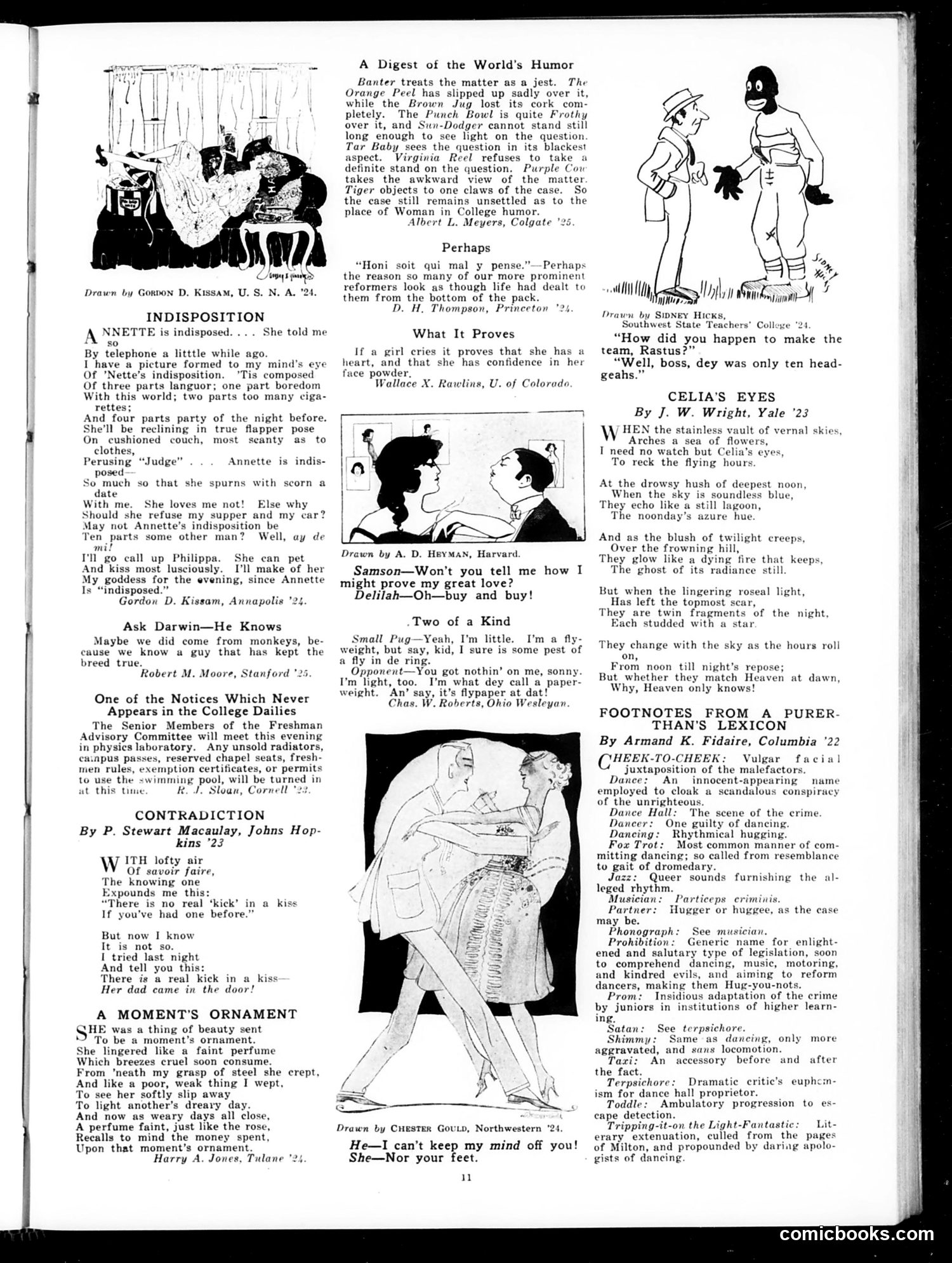
This page from *Judge* magazine (circa 1924) contains several short humorous pieces reflecting 1920s college life and dating culture: **"Indisposition"**: A young man complains that his date "Annette" refuses him, attributing her unavailability to a hangover from partying—mocking the carefree "flapper" lifestyle of modern women who smoked, drank, and socialized openly. **"Ask Darwin"**: A brief joke implying someone hasn't evolved beyond monkey ancestry, reflecting popular (if crude) contemporary references to Darwinian evolution. **"Contradiction"**: A poem about kissing that plays on the double meaning of "kick"—initially suggesting repeated kisses lose novelty, then revealing the real "kick" comes from a girl's father interrupting. **"A Moment's Ornament"**: A sentimental poem about a fleeting romantic encounter, mourning both the lost relationship and wasted money. **The cartoon "He—I can't keep my mind off you!"**: A dating couple where the woman corrects the man—his feet (presumably wandering) betray his actual attention, not his mind. These pieces satirize courtship conventions, gender relations, and youthful behavior of the Jazz Age.
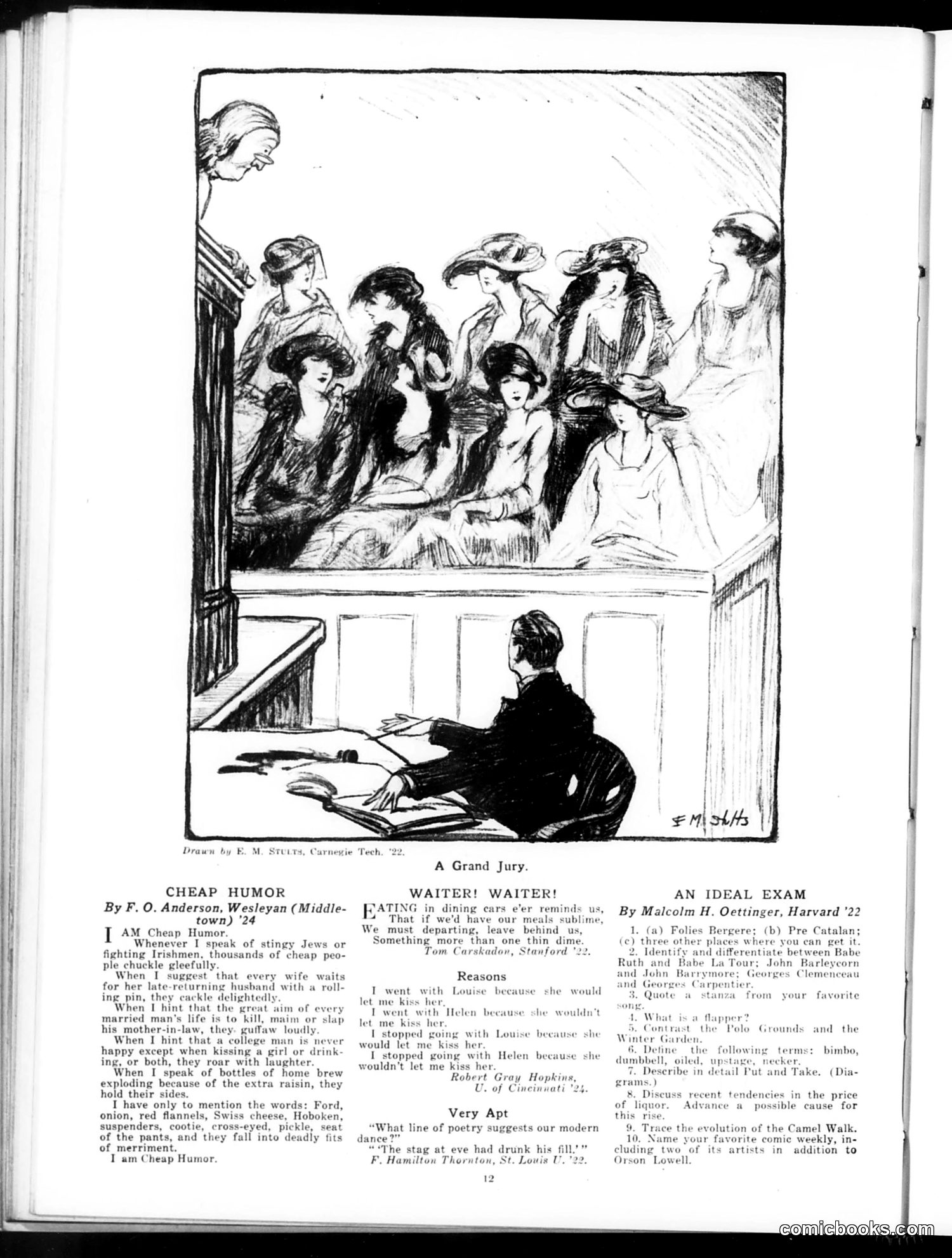
This cartoon satirizes college students' romantic behavior and examination standards. The image shows a male student at a desk (lower portion) being observed by a jury of fashionably dressed women in a gallery above—literally staging his romantic life for judgment. The accompanying poem mockingly lists reasons for dating: the student went with different women solely based on whether they would or wouldn't allow kissing. The "ideal exam" questions below parody both frivolous 1920s culture (the Folies Bergère nightclub, boxer Babe Ruth, "flappers") and student social obsessions. The satire targets college men's shallow romantic motivations and the era's casual attitude toward dating and physical intimacy. The "grand jury" of women judges this behavior, inverting typical power dynamics—women become the evaluators of male conduct rather than passive objects of pursuit. This reflects post-WWI attitudes about changing gender relations and youth culture in the 1920s.
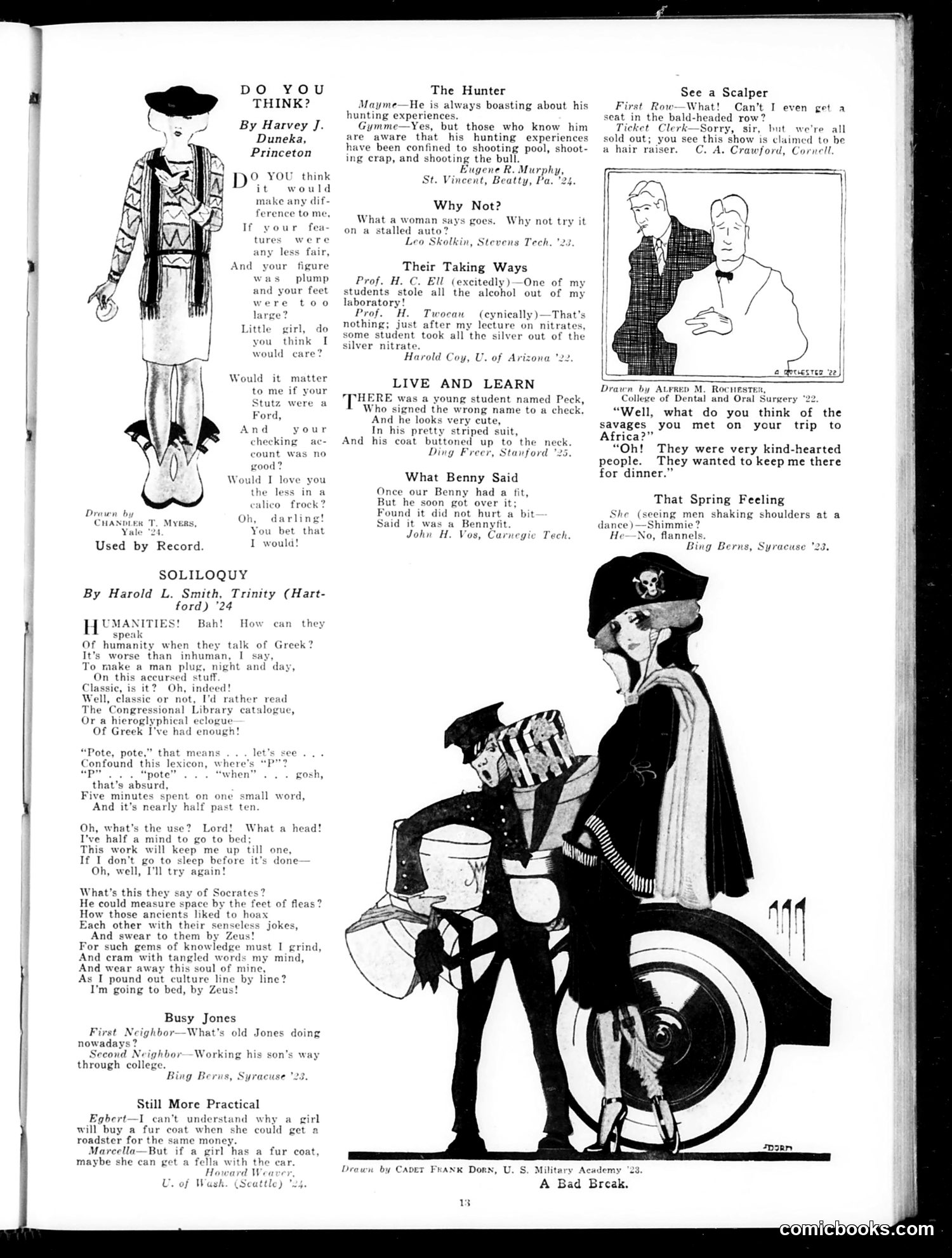
This page from Judge contains collegiate humor and satirical commentary typical of early 1920s student publications. Key content includes: **Main cartoons and jokes:** - "Do You Think?" — a sentimental poem about loving someone regardless of wealth or appearance - "Soliloquy" — a student's frustrated complaints about studying humanities and Greek, satirizing classical education as tedious and impractical - Various brief quips mocking student life: a "hunter" who only shoots pool/craps (not real game), jokes about stealing laboratory chemicals, a student who forged a check and went to prison ("striped suit") **The social satire:** The page ridicules both pretentious classical education and practical materialism. Students complain humanities study wastes time; others joke about crime and shortcuts. The "Africa" cannibalism joke reflects period-typical stereotypes. **Context:** This reflects 1920s college culture—skepticism toward traditional academics, materialism, and casual ethnic stereotyping considered acceptable humor then.
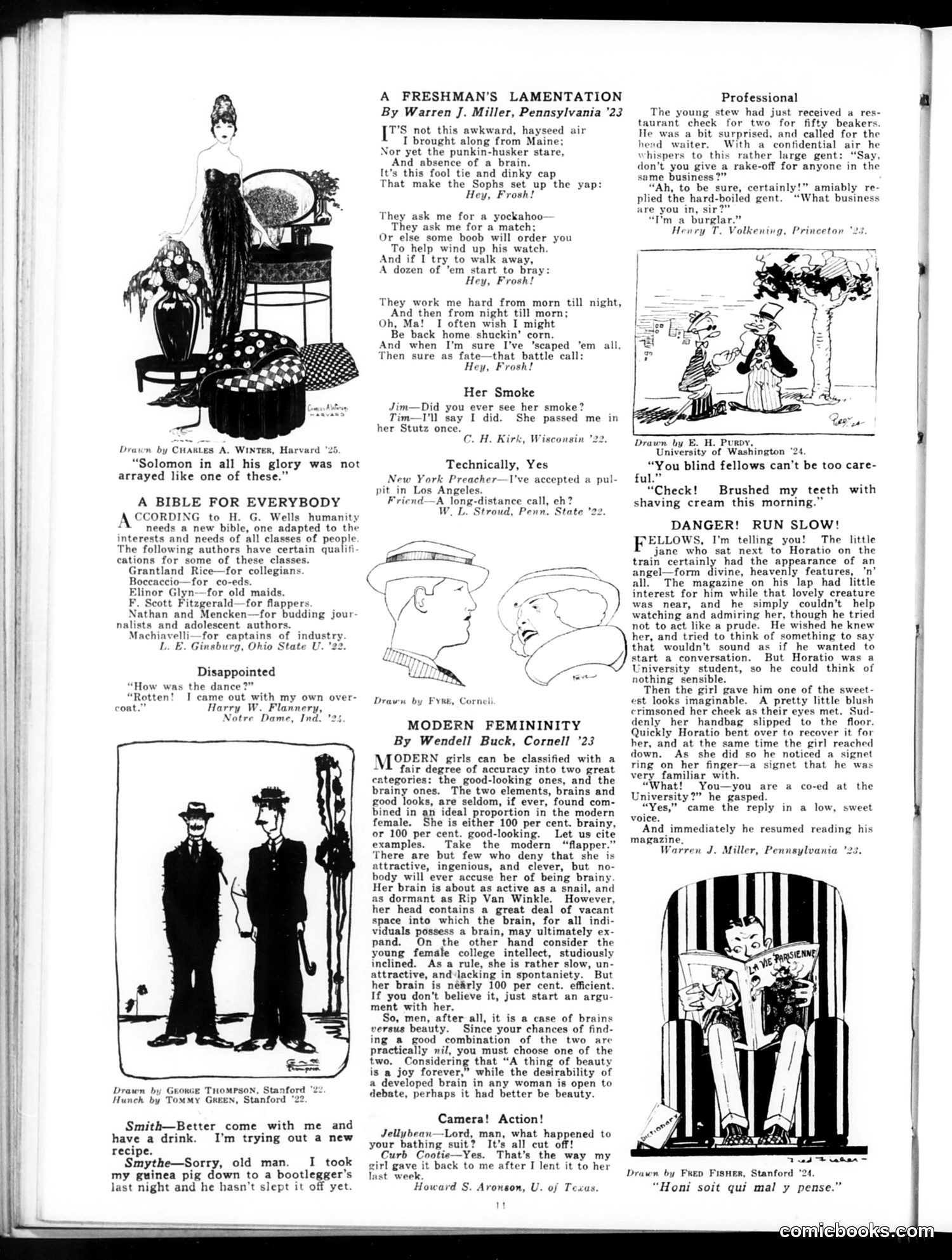
This page from Judge (circa 1923) contains several college-humor pieces satirizing 1920s youth culture and social trends: **"A Bible for Everybody"**: Mocks H.G. Wells's proposal for a modern bible by suggesting contemporary authors as spiritual guides for different groups—Grantland Rice for college students, F. Scott Fitzgerald for "flappers," etc. The satire targets both Wells's idealism and the era's youth subcultures. **"A Freshman's Lamentation"**: A poem about college hazing, where freshmen endure mocking ("Hey, Frosh!") and demeaning tasks from sophomores. Reflects actual initiation practices of the period. **"Modern Femininity"**: A lengthy piece arguing women are either beautiful or intelligent, never both—a dated, sexist trope typical of 1920s commentary. Uses "flapper" (the era's rebellious young women) and "college intellect" as contrasting types. The remaining jokes reference Prohibition-era bootleggers and contemporary dating customs. Throughout, the tone reflects college magazine humor: irreverent, status-conscious, and focused on youth social hierarchies and gender dynamics of the Jazz Age.
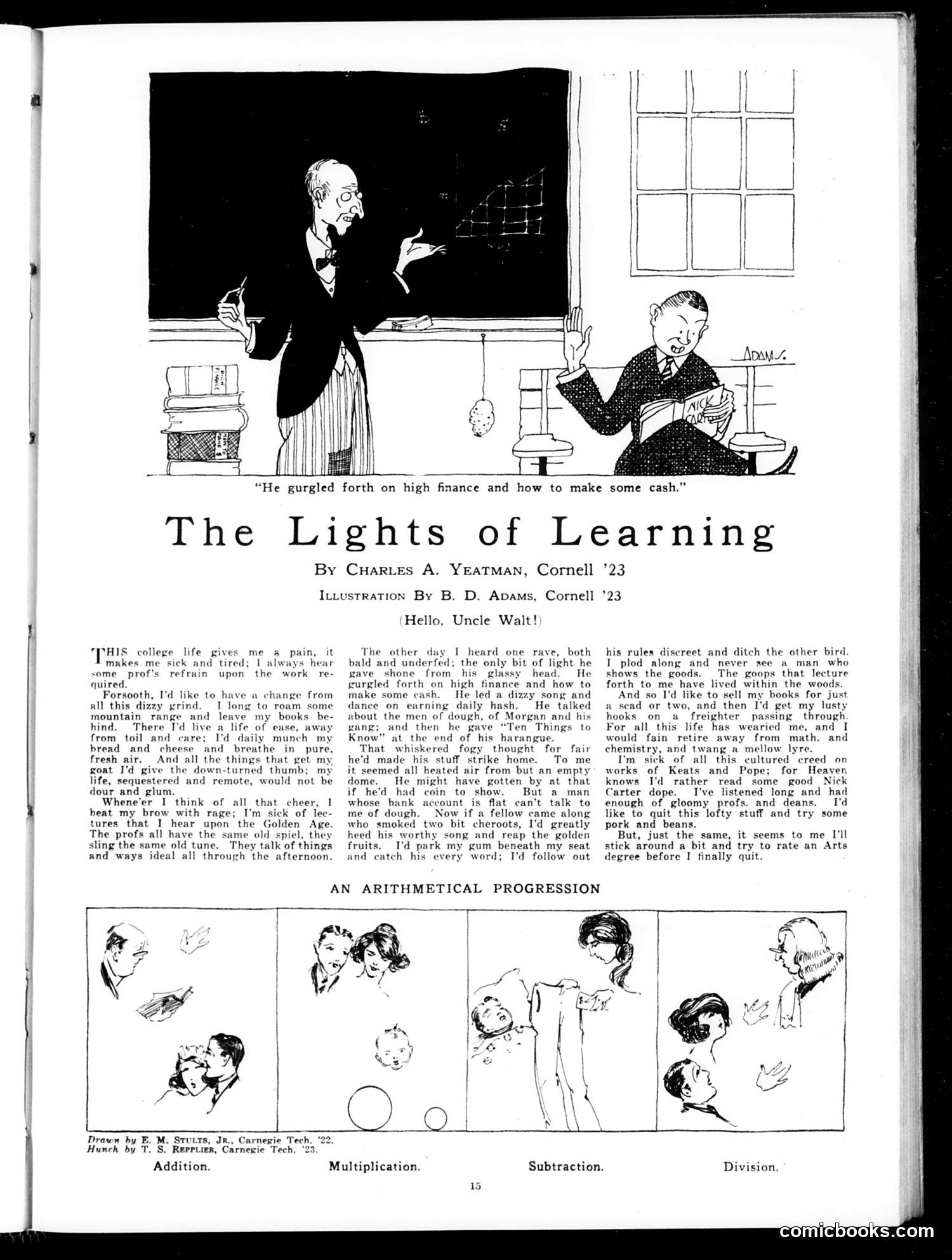
This piece satirizes the disconnect between academic learning and practical life. The main cartoon shows a professor lecturing about "high finance and how to make some cash" while a bored student reads. The accompanying essay, attributed to a Cornell student, presents a first-person complaint: college is tedious and disconnected from real interests. The narrator mocks professorial lectures on idealistic subjects (the "Golden Age," classical literature like Keats and Pope) while yearning for practical knowledge or even pulp fiction ("Nick Carter dope"). He's exhausted by mathematics, chemistry, and lofty culture, preferring simpler pleasures like "pork and beans." The satire targets the gap between what universities teach and what students actually value or need. The "Arithmetical Progression" comic strip below likely continues this theme, showing life's journey through mathematical operations. This reflects 1920s generational frustration with traditional humanities education amid rapid industrialization and changing social values.
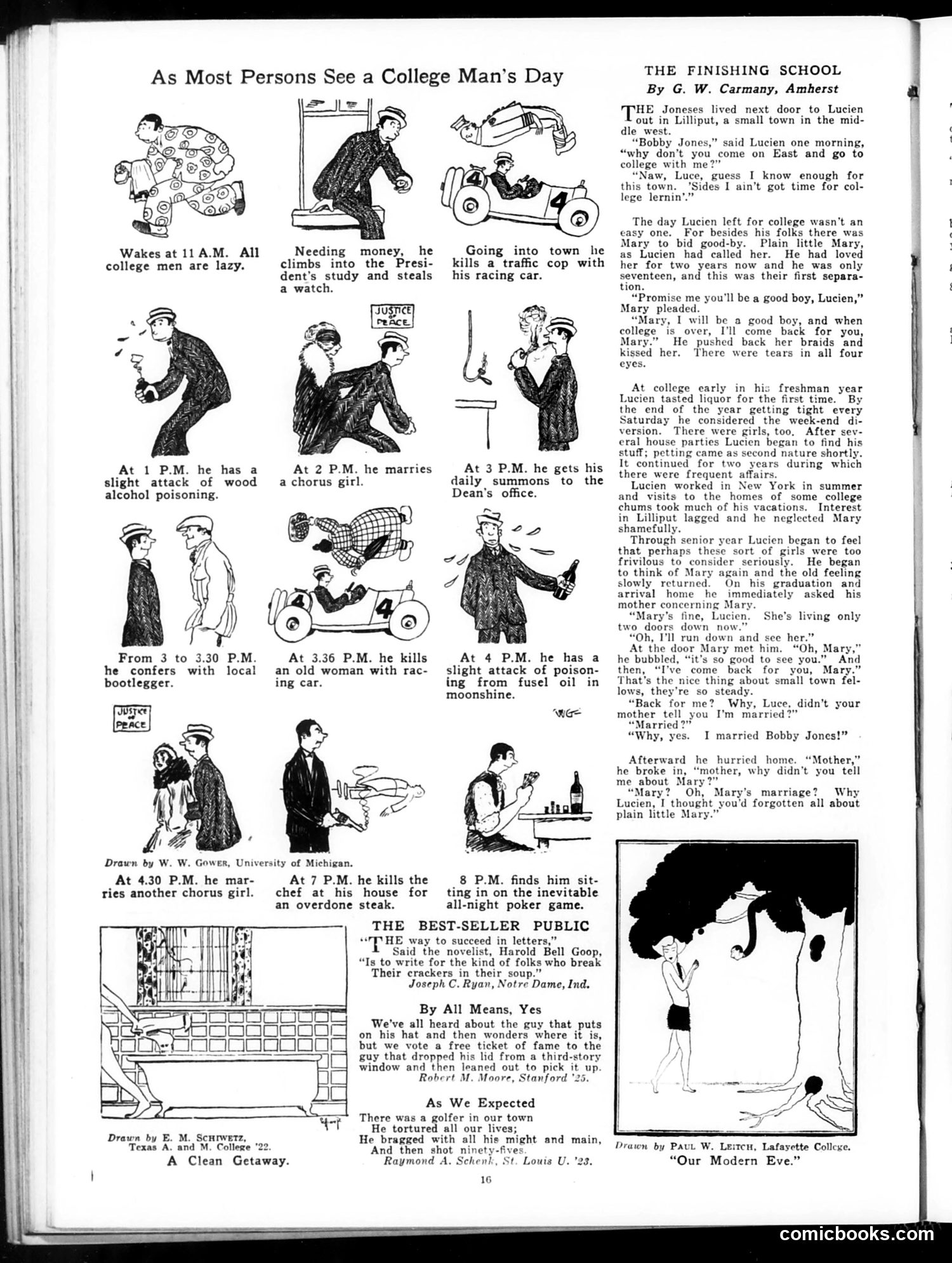
This is a satirical comic strip mocking the stereotypical college man of the 1920s. The top half presents an exaggerated daily schedule showing the lazy, dissolute lifestyle supposedly typical of college students: waking at 11 AM, stealing watches, marrying chorus girls on impulse, getting drunk, and generally causing chaos. The accompanying story by G.W. Carmany provides moral counterpoint: Lucien leaves his hometown sweetheart Mary to attend college, where he becomes corrupted by drinking, casual relationships with "frivolous" girls, and urban vice. When he returns home after graduation, he learns Mary has married Bobby Jones—the working-class boy who stayed put. The satire targets not just college students' actual behavior but the *perception* of them as idle, irresponsible layabouts. The contrast between Lucien's assumed sophistication and his emotional immaturity—returning expecting Mary to wait—suggests that college education doesn't guarantee maturity or good judgment. The page ultimately presents college culture as morally corrosive to young men.
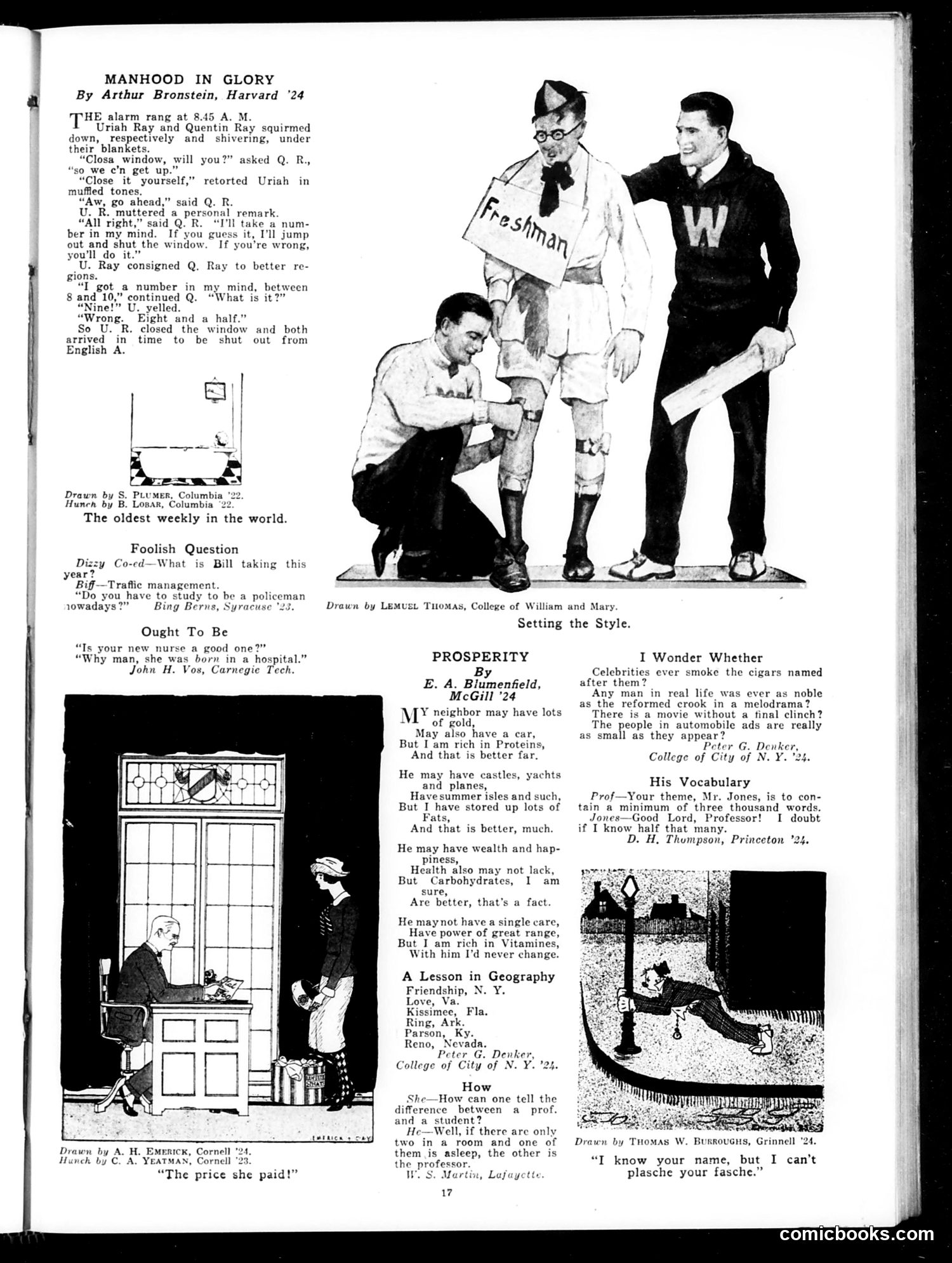
This is a humor/satire page from Judge magazine featuring several short comedic pieces aimed at college-educated readers circa 1924. **"Manhood in Glory"** depicts two college roommates (Uriah and Quentin Ray) using a guessing game to avoid closing a cold window—a joke about male laziness and avoidance of responsibility disguised as wit. **"Foolish Question"** mocks the "traffic management" major as impractical—likely satire on frivolous academic programs of the era. **"Prosperity"** ironically celebrates being "rich" in proteins, fats, and vitamins rather than actual wealth—social commentary on economic inequality, perhaps post-WWI, framed as celebration of basic nutrition. **"A Lesson in Geography"** is wordplay: place names that sound like emotions (Love, Va.; Reno, Nevada—associated with divorce). **"How"** jokes that sleeping is the only difference between professors and students—standard academic satire. The drawings depict college life scenarios. The humor targets upper-class, educated audiences familiar with university culture and contemporary social anxieties.
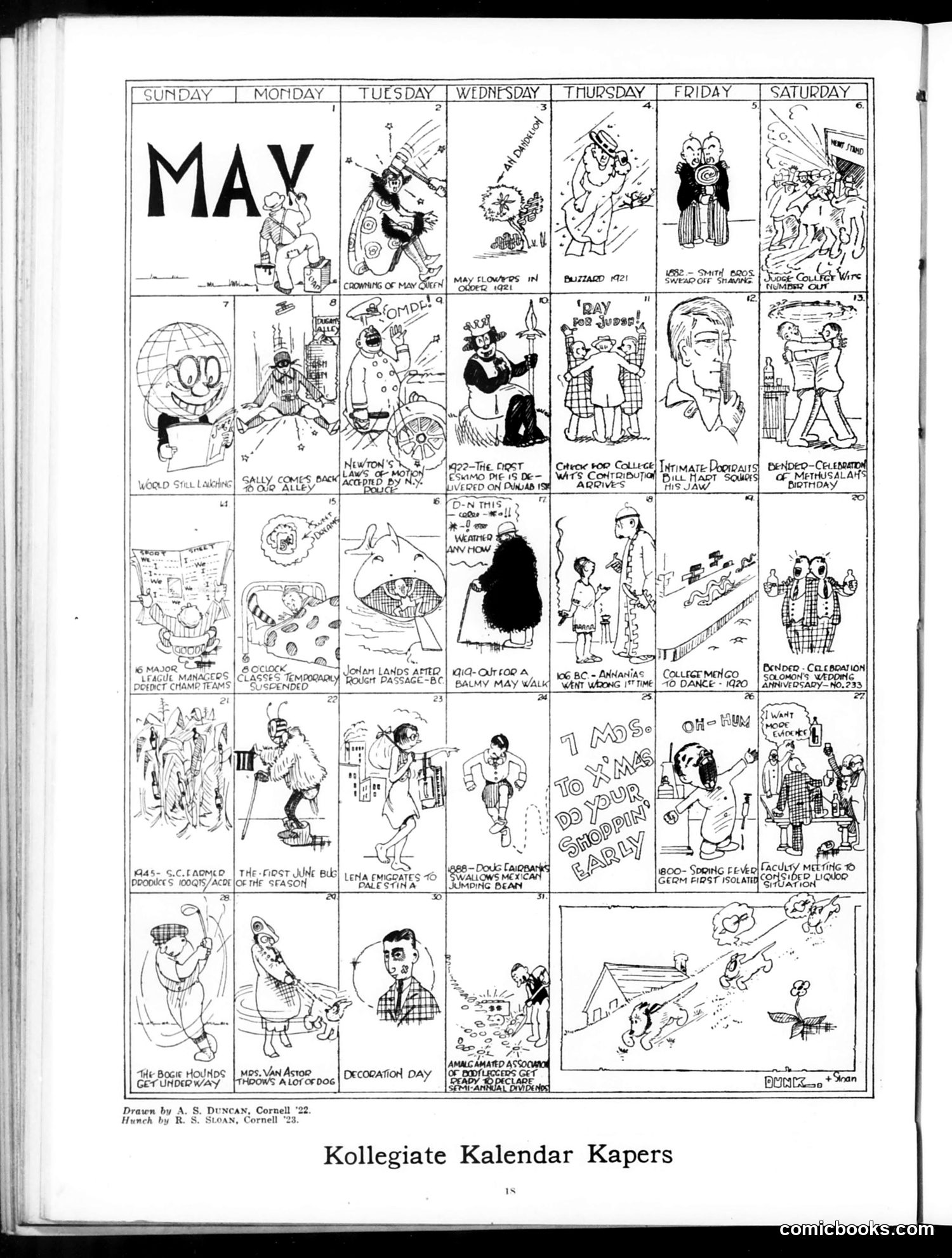
This is a humorous calendar page depicting typical college life and social events in May, drawn by A.S. Duncan (Cornell '22) with "hunches" by R.S. Sloan (Cornell '23). The strip uses daily vignettes to satirize undergraduate experiences: fraternity shenanigans ("Sir Roche Hounds Get Under Way"), romantic mishaps, athletic competitions, academic struggles, and seasonal pastimes like spring fever. References include topical 1920s college culture—baseball, dances, decoration day observances, and social clubs. The cartoons mock student stereotypes: loafers, athletes, romantics, and those dodging responsibilities. The style reflects Judge magazine's collegiate humor aimed at student readers, capturing period-specific campus traditions and slang. The overall tone gently ridicules the frivolous, pleasure-seeking aspects of college life rather than critiquing serious social or political issues.
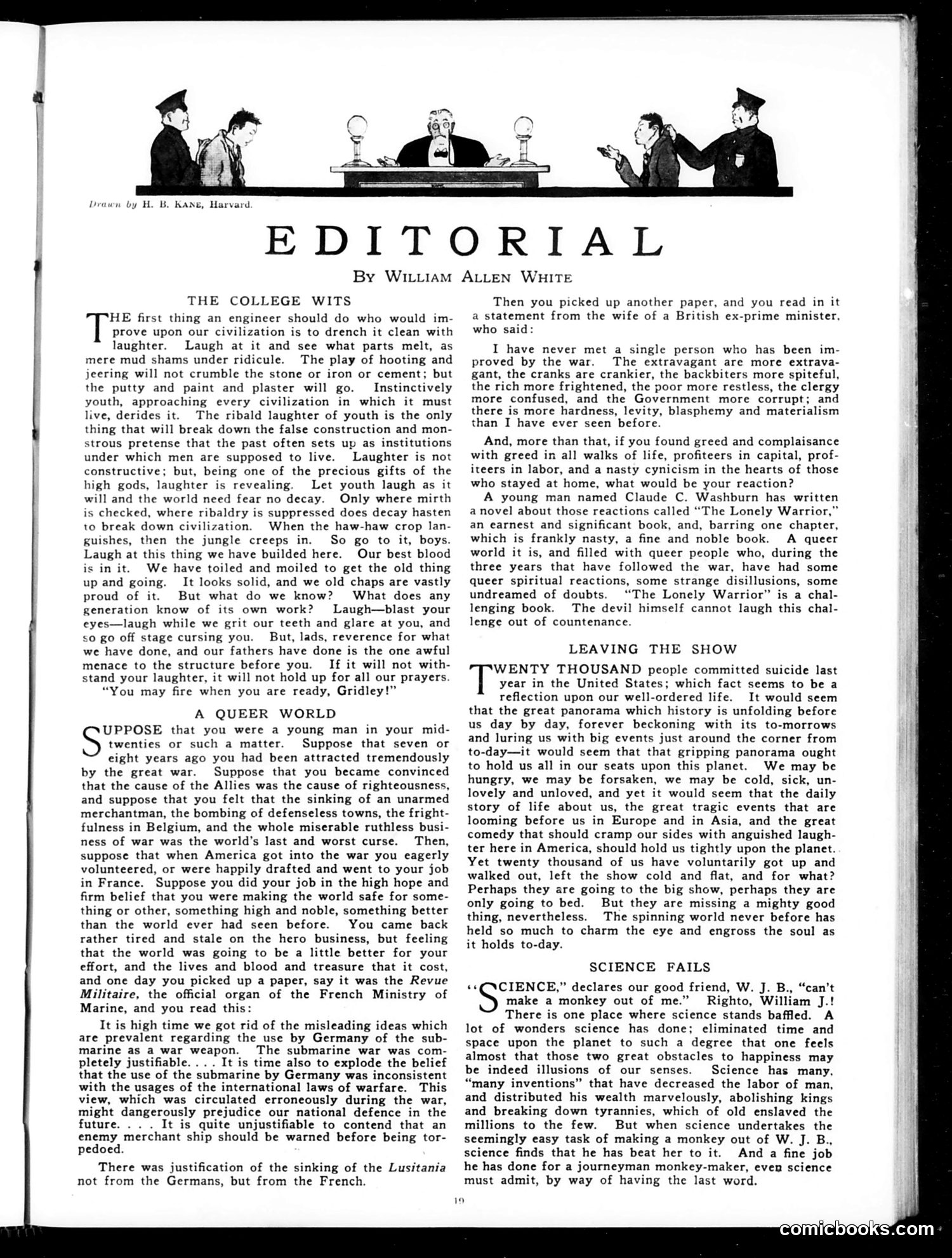
The cartoon header depicts a courtroom or judicial scene with figures in formal dress, illustrating the editorial's satirical tone about critique and institutional examination. William Allen White's editorial argues that **youth's ribald laughter and mockery are essential for exposing societal flaws**—that civilization needs irreverent criticism to prevent decay. He encourages young people to mock established institutions without reverence, claiming this scrutiny strengthens rather than weakens them. The second piece, "A Queer World," presents a bitter post-WWI scenario: A young American volunteer fights believing the Allies represent righteousness against German "ruthlessness," only to discover the French military publication justifying Germany's submarine warfare (including the *Lusitania* sinking) as legitimate. The satire highlights the **disillusionment of WWI veterans**—they sacrificed believing in moral absolutes, only to find post-war governments endorsing the very atrocities they fought against. This exposes the hypocrisy and moral relativism that characterized post-war geopolitics.
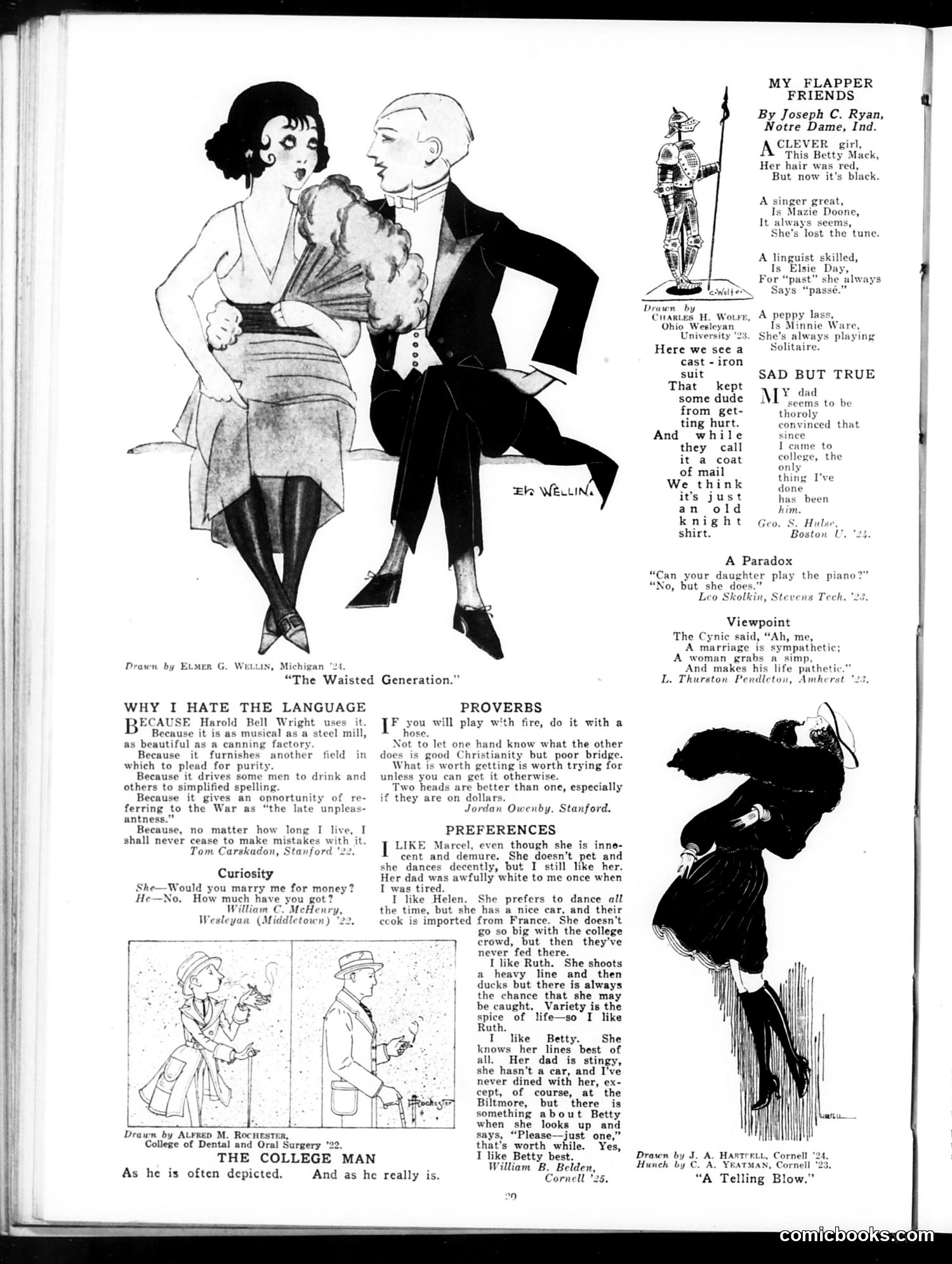
This page from Judge magazine (appears to be early 1920s based on dates cited) collects humorous college-themed content reflecting post-WWI attitudes among American university students. **Main Cartoon ("The Waisted Generation"):** Shows a flapper-era couple—a woman in a short dress with bobbed hair and a man in formal wear. The title references F. Scott Fitzgerald's 1926 novel and satirizes the younger generation's perceived moral laxity and changing social norms around dating and fashion. **Supporting Content:** Multiple short humor pieces mock college life: - "Why I Hate the Language" critiques English grammar's illogical rules - Various student "preferences" describe dating choices based on material advantage (cars, imported cooks, family wealth) rather than character—satirizing materialistic values - "The College Man" contrasts romanticized versus realistic depictions **Context:** The satire targets 1920s youth culture—flappers, jazz age attitudes, simplified morality, and commercial materialism. The frequent references to drinking ("drives some men to drink") allude to Prohibition-era defiance. Overall, the page expresses older generations' anxiety about post-war social changes among college students.
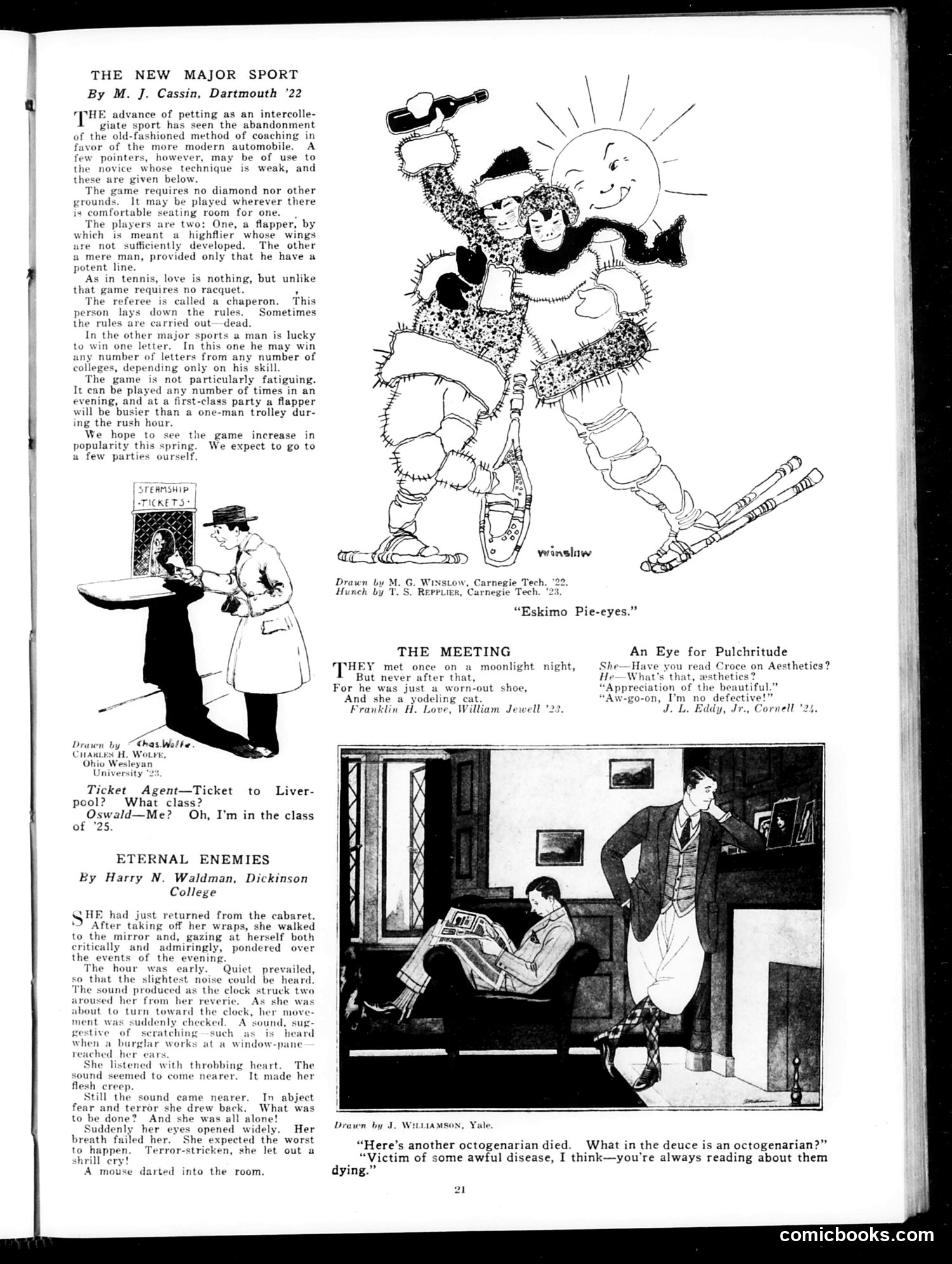
This page satirizes 1920s youth culture, particularly the emerging practice of "petting" (intimate physical contact short of intercourse) among young people. The article mockingly treats petting as a competitive sport with rules, referees ("chaperons"), and scoring systems ("letters"), mirroring established sports terminology. The illustration depicts a "flapper" (the liberated young woman of the era, shown with bobbed hair and modern dress) and her male companion engaged in this activity. The satire targets both the casualness with which young people approached physical intimacy and the apparent helplessness of adult chaperons to enforce proper behavior. The other cartoons on the page—including "Eternal Enemies" about a woman frightened by a mouse—represent typical Judge humor of the period: lighthearted domestic and romantic situations played for comedic effect. The overall tone reflects anxious adult commentary on rapidly changing sexual and social mores among post-WWI youth.
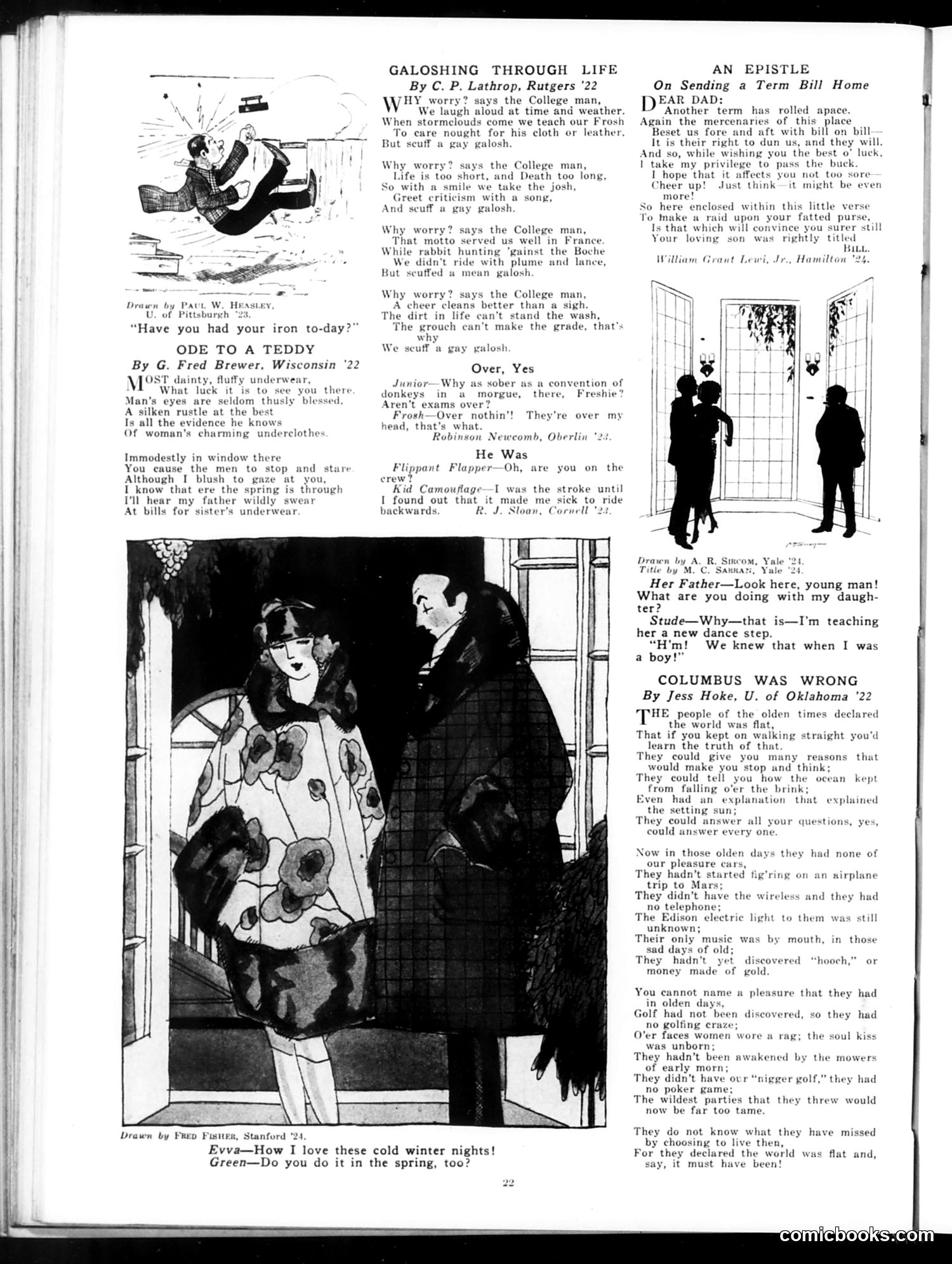
This page collects student humor and verse from college literary magazines (circa 1922), reflecting post-WWI campus culture. **"Galoshing Through Life"** satirizes the casual, devil-may-care attitude adopted by college men—particularly those who served in WWI (the "Boche" reference). The repeated refrain about "scuffing a gay galosh" mocks their affected nonchalance toward life's difficulties, suggesting they hide serious concerns behind performative cheerfulness. **"Ode to a Teddy"** is risqué humor about men's attraction to women's lingerie ("teddy" undergarments), culminating in the joke that fathers ultimately pay for these indulgences through clothing bills. **"Columbus Was Wrong"** contrasts ancient peoples' supposed ignorance with modern conveniences—automobiles, airplanes, wireless, electric lights, golf, "hooch" (Prohibition-era alcohol), and the "soul kiss." The irony: despite "progress," modern people arguably enjoy life less than those simpler times. The cartoon illustrations and dialogue snippets support similar themes: youthful romance, generational conflict, and the absurdities of post-war American college life.
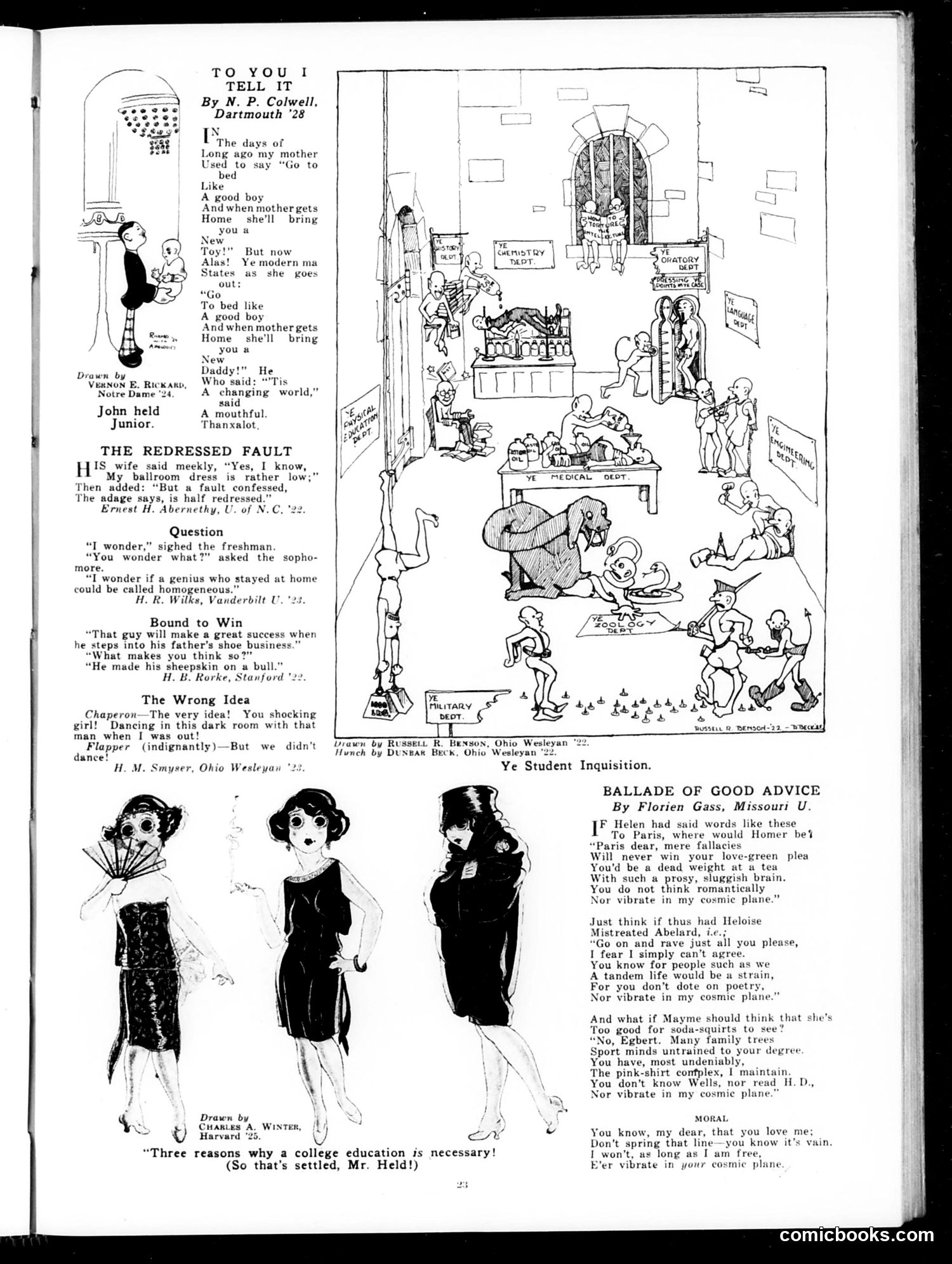
This page from Judge (a 1920s college humor magazine) contains several short satirical pieces about modern life and college culture: **"To You I Tell It"** contrasts old parenting with modern parenting—mothers once promised toys for obedience; now they state facts about going out. The satire targets changing gender roles and mothers' increased independence. **"The Redressed Fault"** jokes about a wife's low-cut ballroom dress; she justifies it by saying "a fault confessed is half redressed," playing on the proverb. **"Bound to Win"** makes a pun: a young man will succeed in his father's shoe business because he "made his sheepskin on a bull"—meaning he earned his diploma through deception. **"The Wrong Idea"** depicts a shocked chaperon catching a couple dancing alone, though they claim they weren't actually doing anything improper. **"Ballade of Good Advice"** is a poem satirizing romantic rejection lines—women lecturing suitors about lacking poetry, romance, or proper social standing. The recurring refrain "vibrate in my cosmic plane" mocks pseudo-intellectual romanticism popular among college youth of the era.
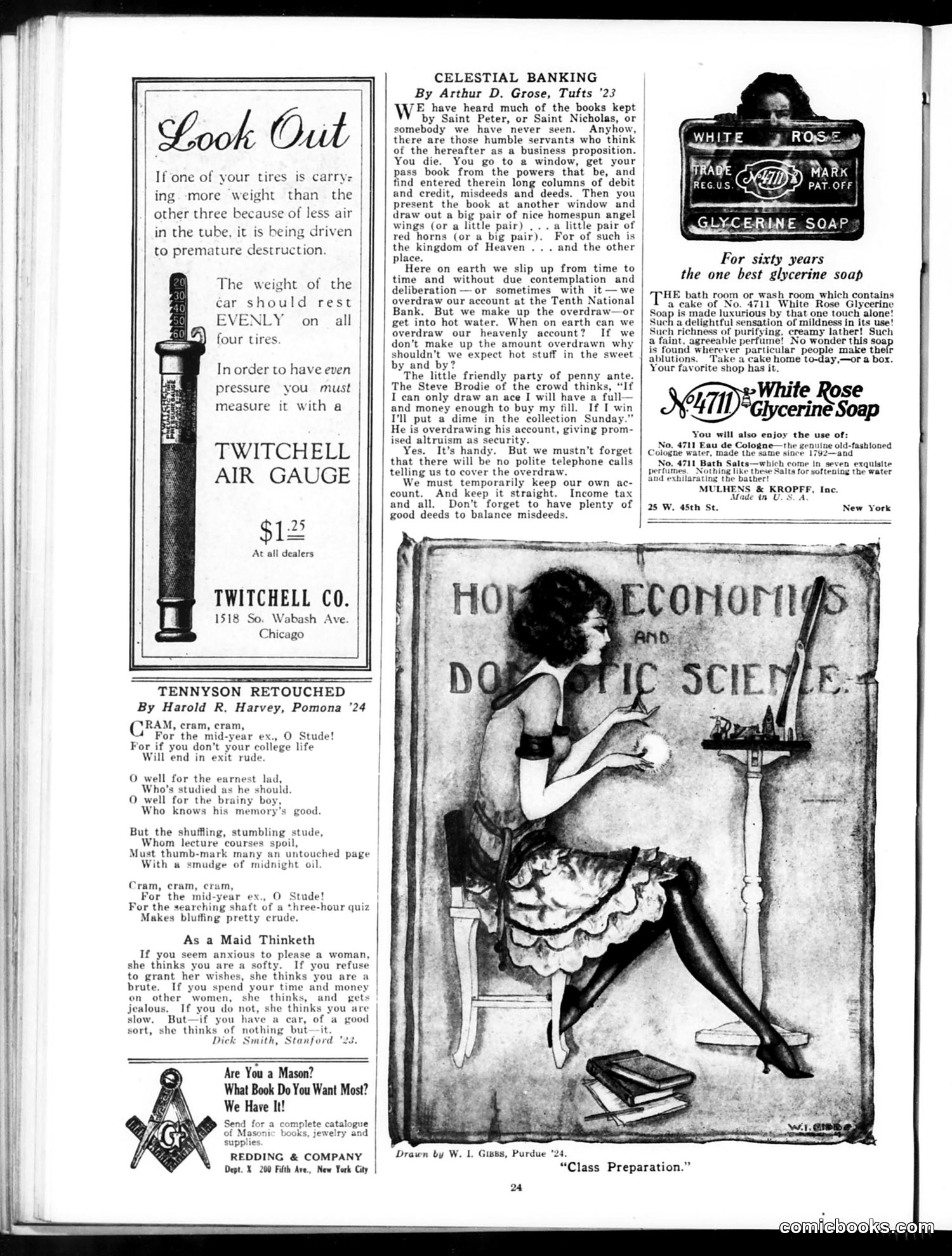
This cartoon satirizes college students inadequately preparing for exams. The illustration shows a young woman at a desk surrounded by study materials—books stacked haphazardly, papers scattered—appearing frazzled and overwhelmed. The title references the accompanying poem "Tennyson Retouched," which mocks students who cram last-minute instead of studying consistently throughout the term. The satire targets the "shuffling, stumbling stude" who relies on bluffing rather than genuine learning. The cartoon's central joke is visual irony: despite the chaotic "class preparation" depicted, such cramming produces poor results. The accompanying text warns that mid-year exams expose those who haven't actually learned the material—"Makes bluffing pretty crude." This reflects early 20th-century college culture anxieties about academic rigor and student work ethic, a recurring theme in Judge magazine's student-written humor sections.
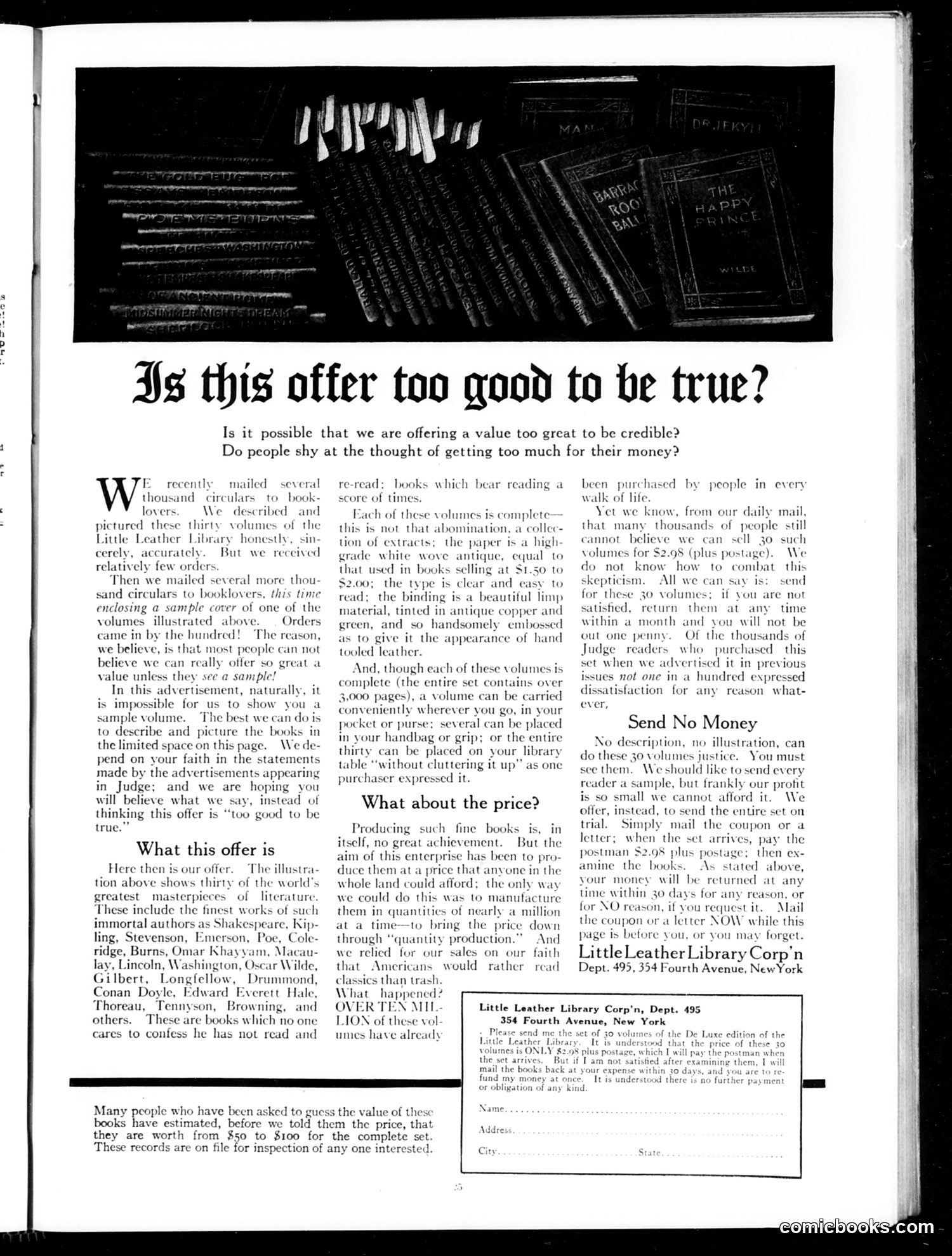
This is primarily a **mail-order advertisement** for the Little Leather Library Corporation, disguised as editorial content in *Judge* magazine. The satire is subtle: the company acknowledges consumer skepticism about their offer (30 classic literature volumes for $2.98) by framing the problem itself. They note that when they mailed plain descriptions, few ordered—but when they enclosed a *sample* of the actual product, orders "came in by the hundred." The joke targets **consumer psychology and advertising credibility**: people instinctively distrust "too good to be true" offers and need tangible proof. By confessing this dynamic openly in a humor magazine, the advertiser attempts to build trust through seeming honesty. The page shows actual book spines in the photograph, reinforcing quality. The small profit margin admission adds credibility. This represents early **direct-mail marketing** and **psychology-based sales tactics**—selling the consumer on why they should believe the pitch, rather than simply making the pitch.
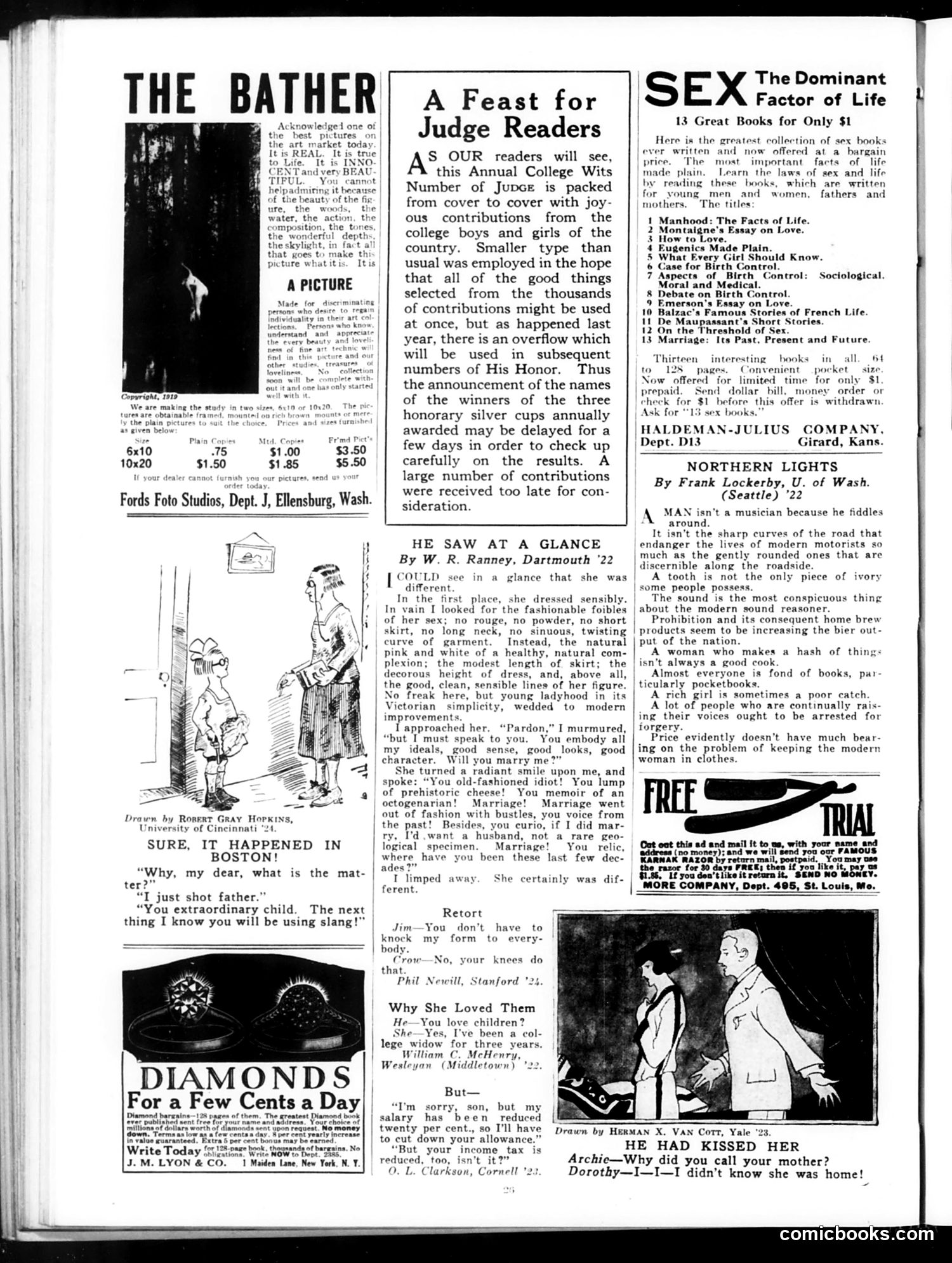
This page mixes advertising and satirical humor typical of Judge's college-oriented issue (early 1920s). The main cartoon "Sure, It Happened in Boston!" relies on social class humor: a young woman casually tells her wealthy father that she "shot" him, and her mother's shocked response focuses not on the violence but on her daughter's use of slang—implying that crude language is a more serious breach of propriety than murder itself. This inverts normal moral priorities for comedic effect. The text piece "He Saw at a Glance" satirizes changing women's roles in the 1920s. A man praises a woman for rejecting modern fashions (short skirts, makeup)—praising her "Victorian simplicity." When he proposes, she viciously mocks him as hopelessly old-fashioned, rejecting marriage itself as outdated. The joke targets men who romanticize traditional femininity while women have moved beyond those constraints. The advertisements for sex education books and diamonds reflect 1920s anxieties about sexuality and consumer culture.
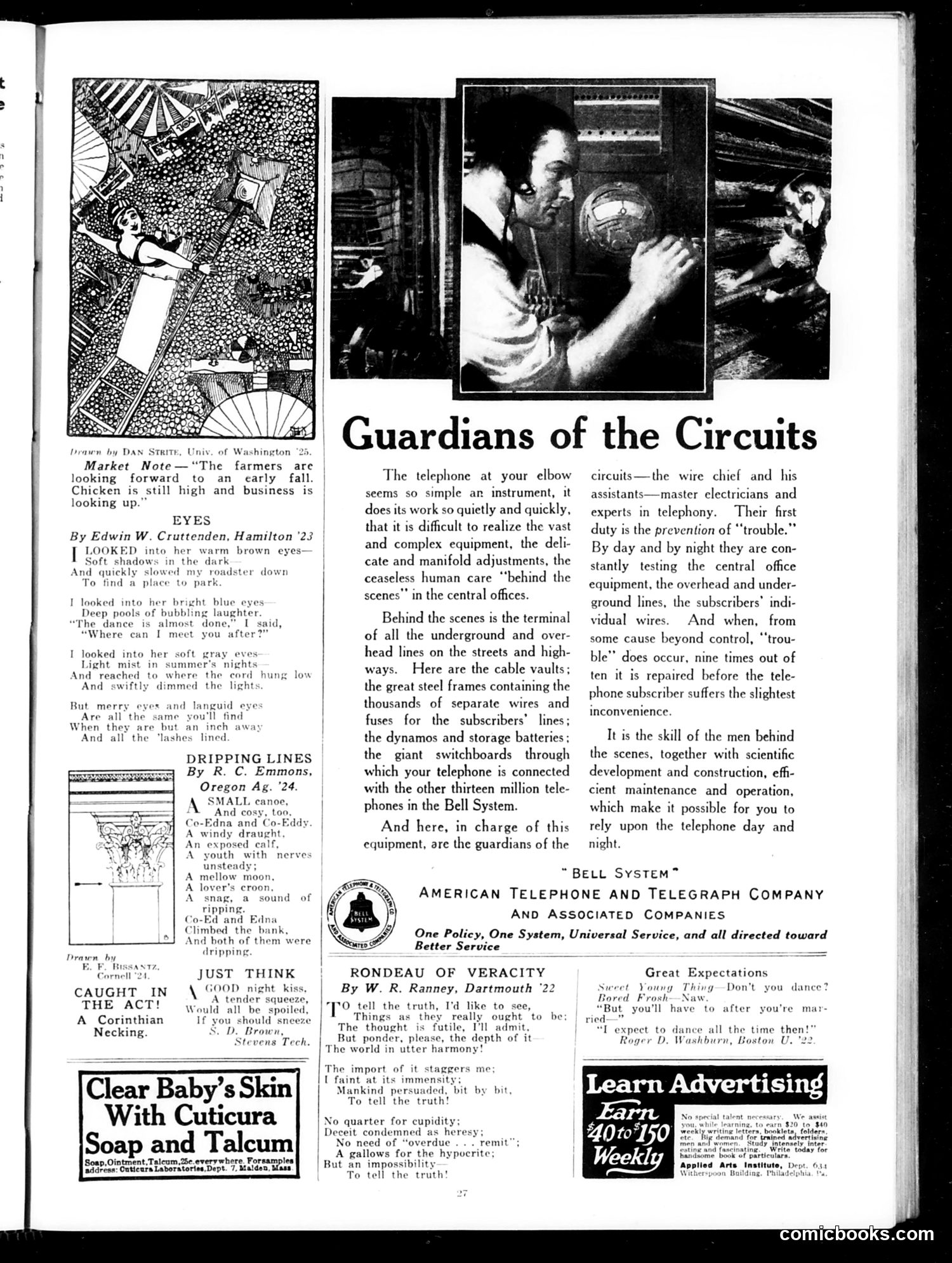
This page features a Bell System advertisement disguised as editorial content, promoting telephone infrastructure. The main article explains the complex work of telephone technicians—the "guardians" who maintain central office equipment, underground cables, switchboards, and lines serving thirteen million phones. For a modern reader: this reads as corporate PR celebrating invisible infrastructure workers. The accompanying student verses and cartoons are lighthearted college humor about dating and relationships—typical Judge magazine filler. The advertisement emphasizes Bell's reliability slogan: "One Policy, One System, Universal Service." The implicit message is that sophisticated machinery and skilled technicians work ceaselessly behind the scenes so subscribers never experience service interruptions. The drawings by university students (credited to Washington, Hamilton, Oregon, and Stevens Tech) suggest this was likely a sponsored college issue of Judge magazine, blending institutional promotion with student work.
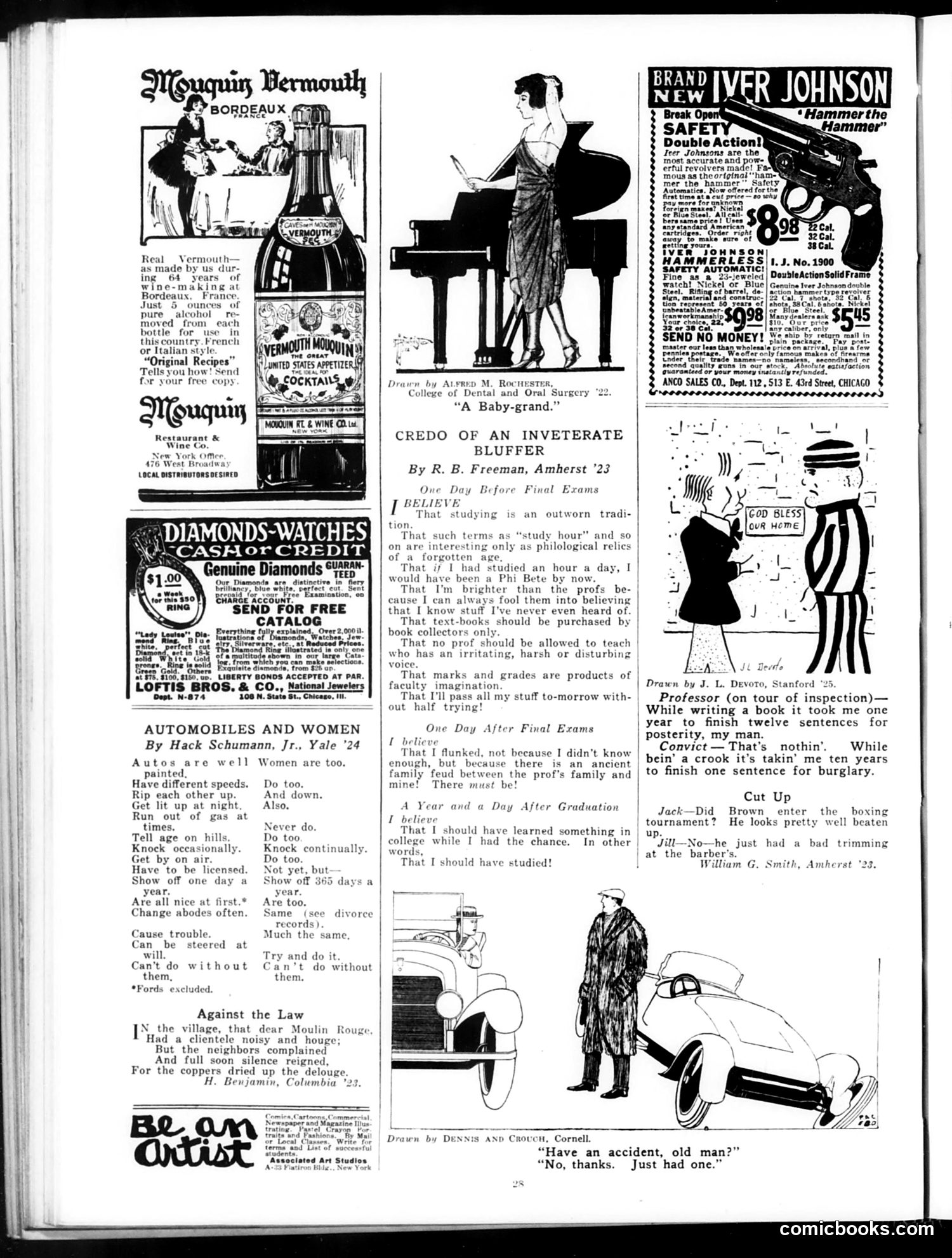
This page mixes advertisements with student-authored humor pieces from early 1920s college contributors. The main content includes: **"Automobiles and Women"** — A satirical comparison listing parallels between cars and women (both "painted," have "different speeds," "get lit up," need licensing, show off). This reflects 1920s attitudes toward women as objects, with a jab at Ford owners (*"Fords excluded"*) — suggesting even cheap cars were considered superior to some women. **"Credo of an Inveterate Bluffer"** — A student's humorous admission that he'll pass exams through deception rather than study, mocking academic pretense. **"Cut Up"** — A brief joke about boxing and barber mishaps. **Cartoons** show a woman at a piano and two men examining a broken toy car, with captions suggesting accidental damage. The **advertisements** (Moquin Vermouth, Iver Johnson revolvers, diamonds/watches) reflect period consumer culture. The revolver ad notably emphasizes it's "hammerless" and "safe" — reflecting early safety marketing for firearms to general consumers, particularly women.
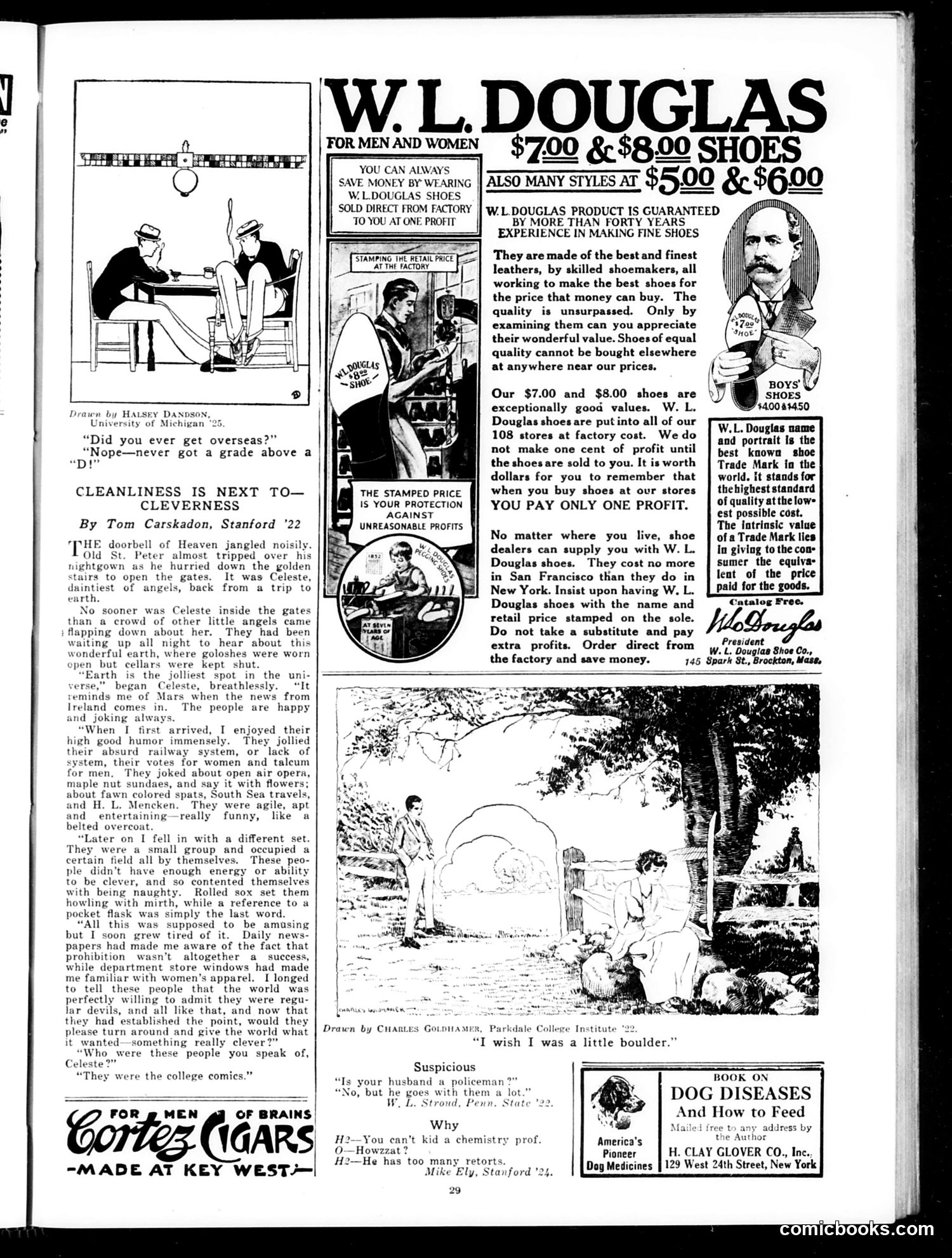
This page mixes advertisements with satirical fiction. The main cartoon/story is "Cleanliness Is Next to Cleverness" by Tom Carskadon (Stanford '22), a brief narrative where an angel named Celeste reports to St. Peter about Earth. **The Satire's Point:** Carskadon mocks 1920s college humor and youth culture. Celeste encounters two groups: initially, clever, witty people who joke about contemporary topics (prohibition's failure, women's voting rights, fads like rolled socks). Later, she meets "college comics"—young people who confuse mere *naughtiness* (references to hidden flasks, knowing about women's fashion) with actual cleverness. The satire suggests these college students mistake rule-breaking for wit, having no genuine cleverness to offer. **Context:** This reflects post-WWI anxiety about youth morality during Prohibition and changing social norms. The page also includes substantial W.L. Douglas shoe advertising and smaller ads for Cortez cigars and a dog medicine book.
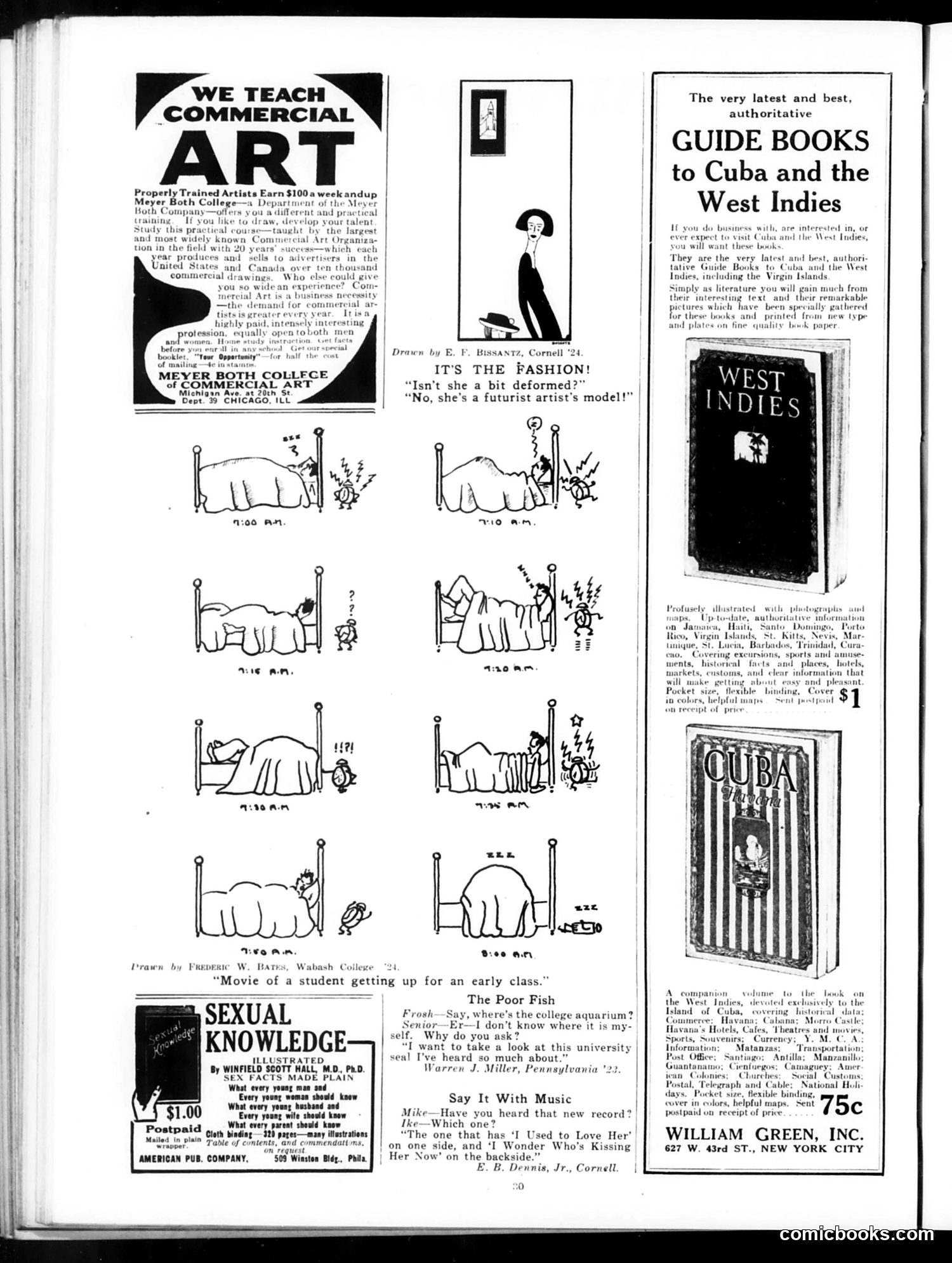
This page mixes advertisements with student humor. The central cartoon by E.F. Bissantz depicts a woman in an exaggerated, angular pose—described as a "futurist artist's model." The joke critiques modernist art movements (likely Cubism and Futurism), which were still controversial in American culture. When asked if she's "deformed," the response normalizes her distorted appearance as fashionable artistic practice rather than actual deformity, satirizing how avant-garde art justified unconventional human representation. Below, two student comics offer campus humor: "Movie of a student getting up for an early class" shows bedroom scenes depicting morning struggles, while "The Poor Fish" and "Say It With Music" contain collegiate jokes about university life and popular songs. The surrounding advertisements—for commercial art training, guide books to Cuba and the West Indies, and a sexual knowledge book—reflect 1920s consumer culture and educational offerings typical of Judge's audience.
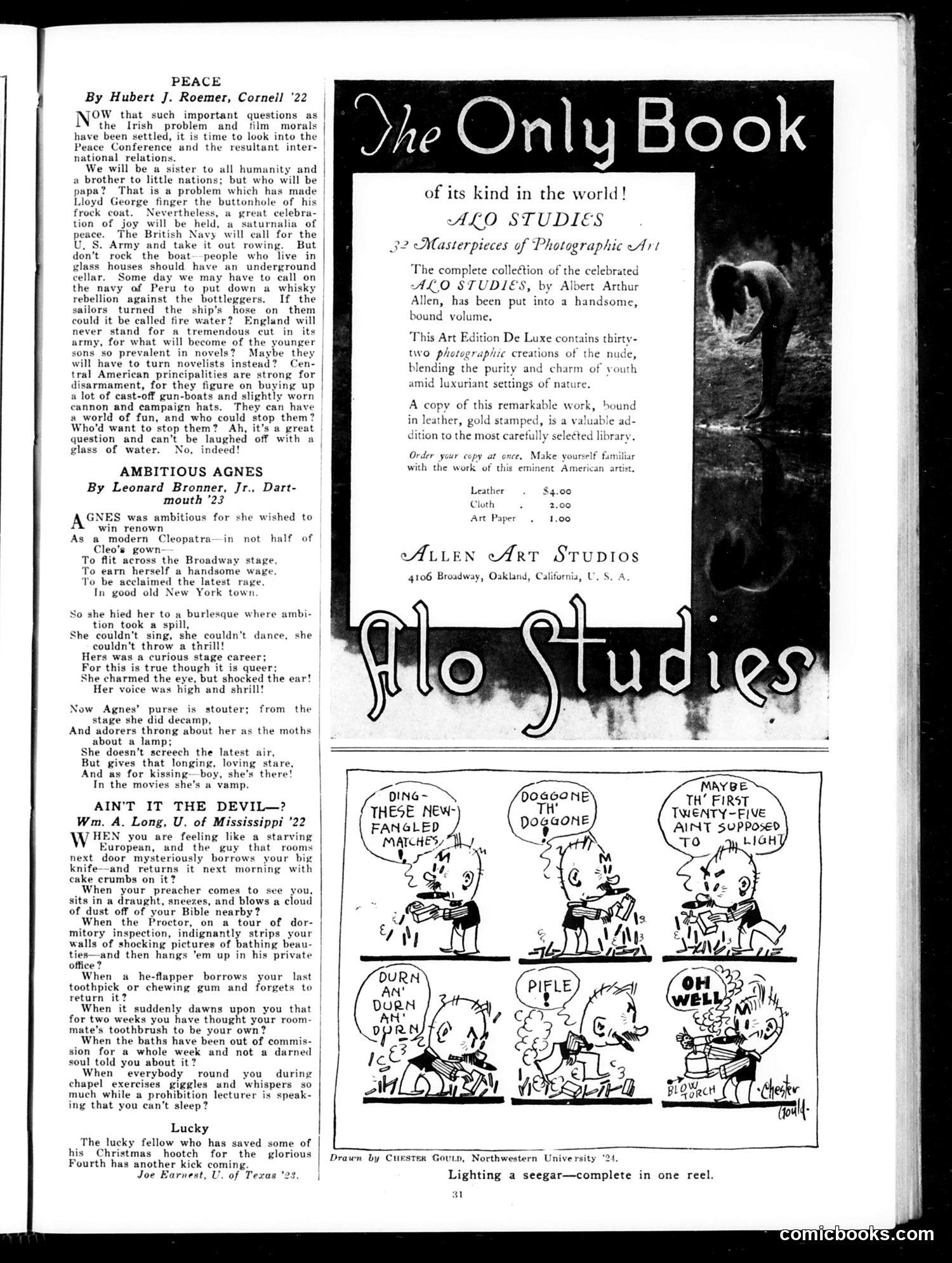
This page contains three distinct sections: **"Peace" Essay**: A satirical commentary on post-WWI peace negotiations, likely referencing the 1919 Paris Peace Conference. The author mocks the idealistic language about international cooperation while suggesting practical concerns dominate (Ireland, naval rivalry, disarmament). The tone is cynically humorous about whether genuine lasting peace is possible. **"Ambitious Agnes" Poem**: A humorous narrative about a woman who fails at legitimate theater (can't sing or dance) but succeeds in silent films by being attractive. This reflects 1920s attitudes about cinema—that physical appearance mattered more than talent, and that being a "vamp" (seductive character type) was lucrative. The implicit joke involves double standards around women's success. **"Ain't It the Devil?" Column**: Conversational complaints about annoying roommate/dorm behaviors—borrowed items not returned, intrusive visits, administrative inspections, petty annoyances. Standard college humor for the era. The page is primarily **advertising** for ALO Studies (art photography book) and college humor content rather than political satire.
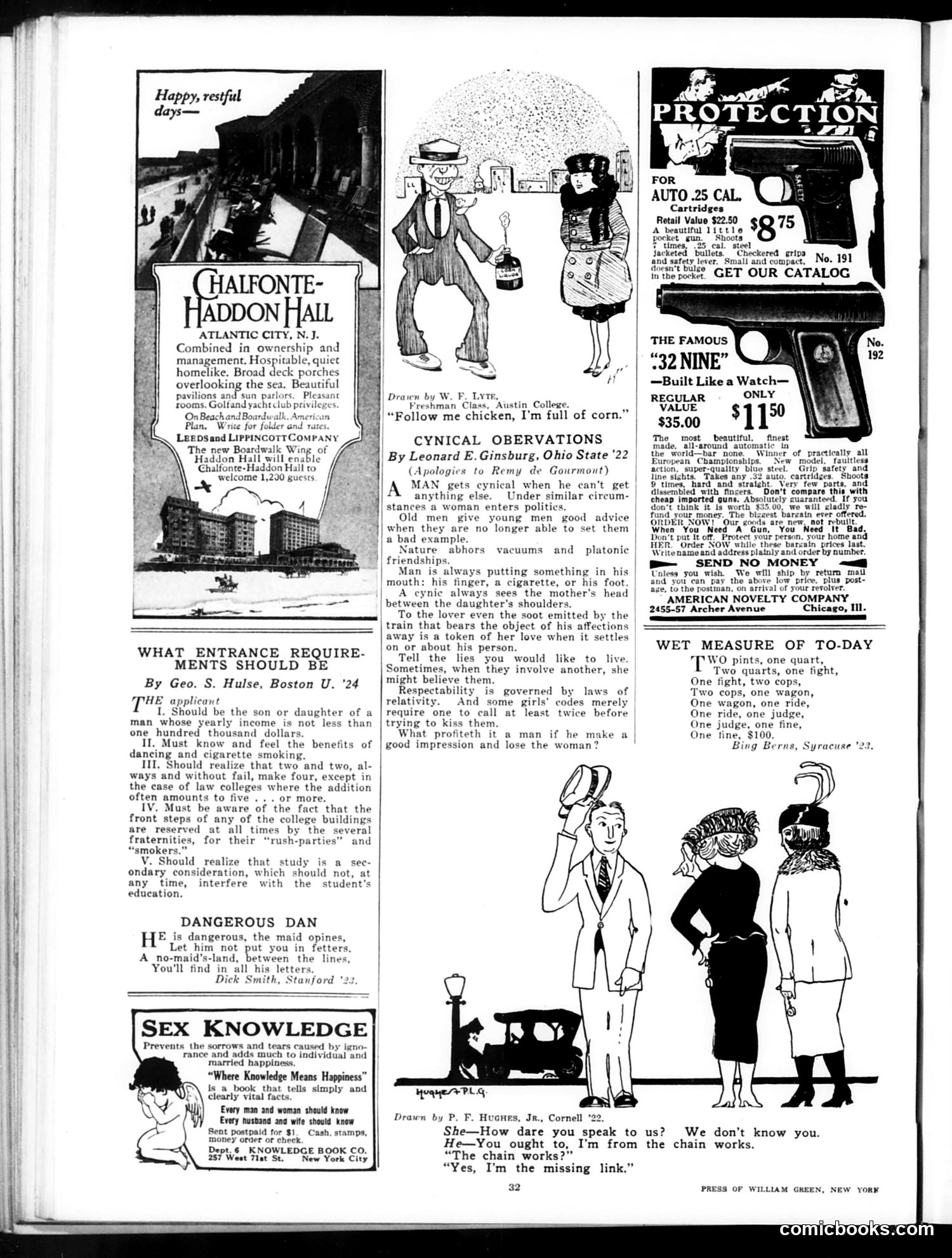
This page from *Judge* magazine contains satirical commentary on college life and social conventions, alongside advertisements and humor pieces typical of early 1920s collegiate publications. **Main Content:** The "Cynical Observations" by Leonard E. Ginsburg offers biting social commentary on male-female dynamics, respectability, and hypocrisy—targeting the gap between stated morals and actual behavior. Lines like "What profiteth it a man if he make a good impression and lose the woman?" mock men's confused priorities. The cartoon by W.F. Lyte depicts a man approaching a woman with the line "Follow me chicken, I'm full of corn"—a dated romantic overture that's presented as foolish. **Supporting Pieces:** "What Entrance Requirements Should Be" satirizes pretentious college admissions standards, suggesting wealth matters more than academic ability. "Dangerous Dan" jokes about flirtation in letters. **Advertisements:** The page prominently features gun advertisements (.32 and .25 caliber pistols) alongside a sexual education book ad—reflecting the era's casual marketing of firearms alongside intimate topics. The "Wet Measure of To-Day" satirizes Prohibition-era drinking consequences.
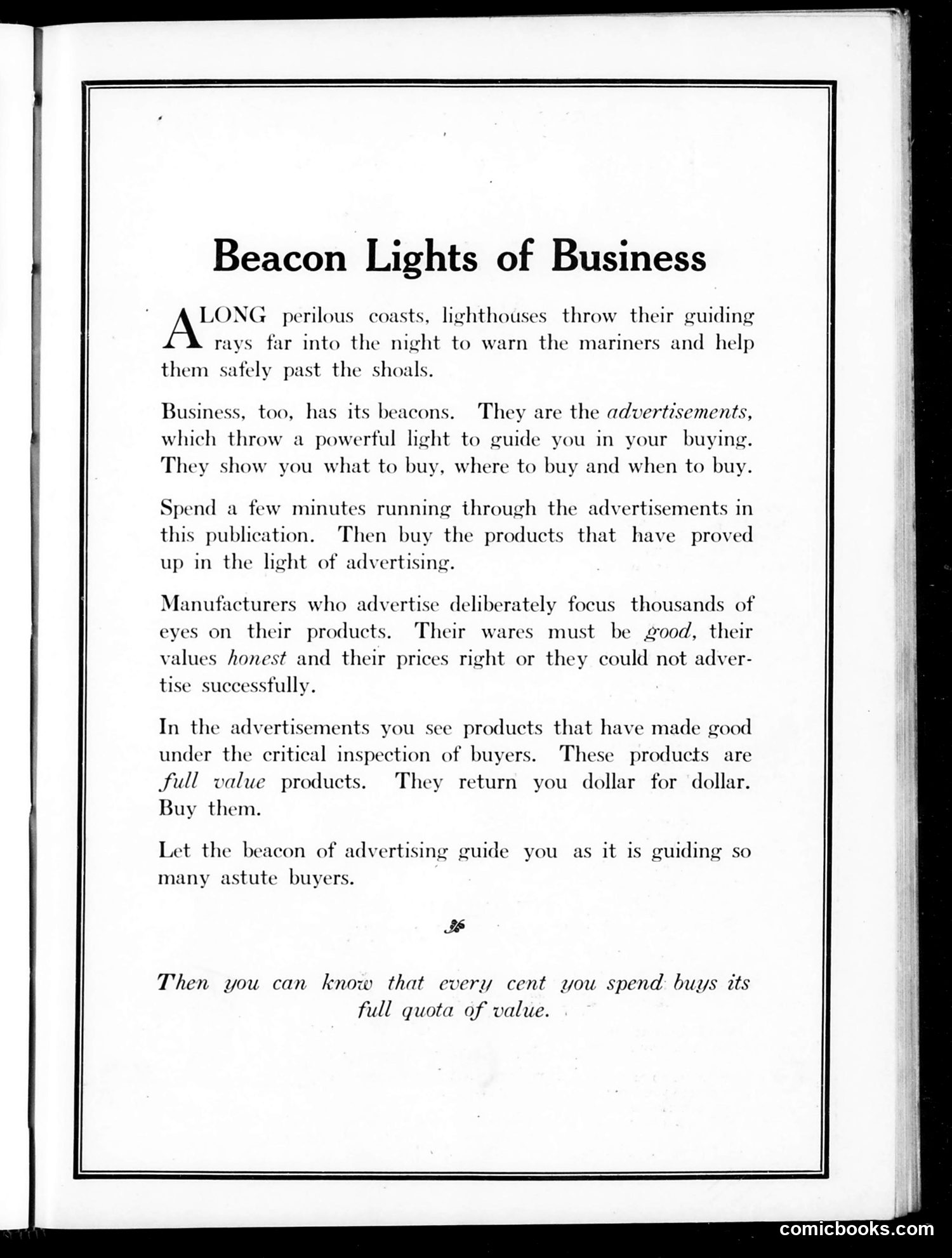
This is an editorial advertisement, not a cartoon. It's a **pro-advertising manifesto** published in *Judge* magazine itself—essentially the magazine promoting its own advertising pages to readers. The piece uses a metaphor comparing lighthouses guiding ships safely through dangerous waters to advertisements guiding consumers through marketplace choices. The argument claims that because advertisers invest heavily in promotion, their products must be genuinely good—otherwise advertising wouldn't be economically viable. Therefore, advertised products represent "full value." This reflects early 20th-century advertising philosophy: that advertising serves a protective, almost moral function for consumers. The piece essentially tells readers: trust ads because only quality merchandise can sustain costly advertising campaigns. It's propaganda for the advertising industry itself, presented as consumer guidance.
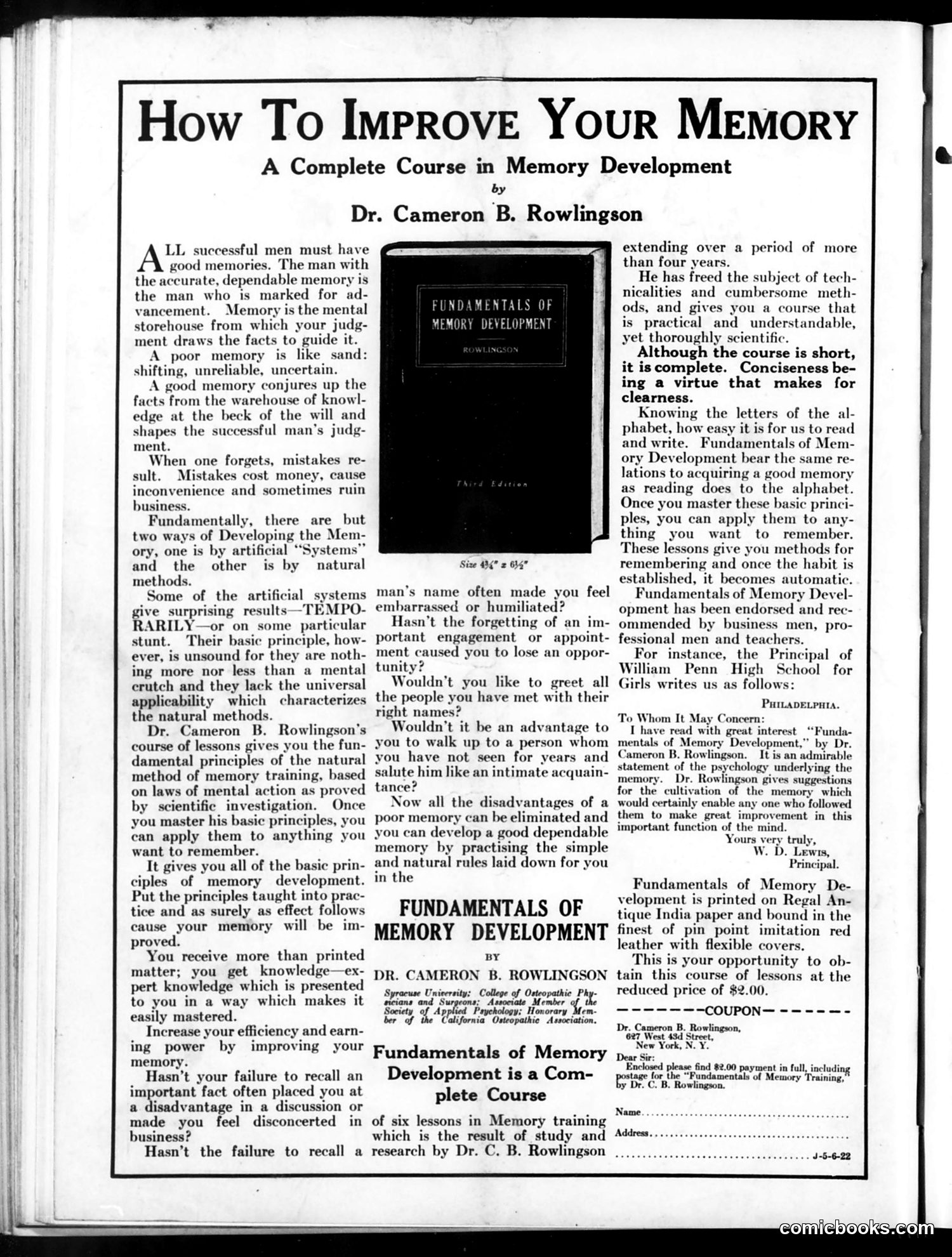
This is **not a cartoon or satirical content**—it's a full-page advertisement for a self-help course by Dr. Cameron B. Rowlingson on memory improvement. The page includes promotional text claiming the course teaches "natural methods" of memory development based on scientific principles of mental action. The advertisement emphasizes practical business applications: recalling names, remembering appointments, and avoiding embarrassing social failures. It positions poor memory as a professional liability that costs money and opportunities. A testimonial letter from W.D. Lewis at William Penn High School in Philadelphia endorses the course. An order coupon at the bottom offers the bound book at the reduced price of $2.00. This represents typical early 20th-century self-improvement marketing—positioning personal memory training as essential for business success and social competence.