
Judge, 1922-05-06 · page 21 of 36
Judge — May 6, 1922 — page 21: what you’re looking at
What you’re looking at
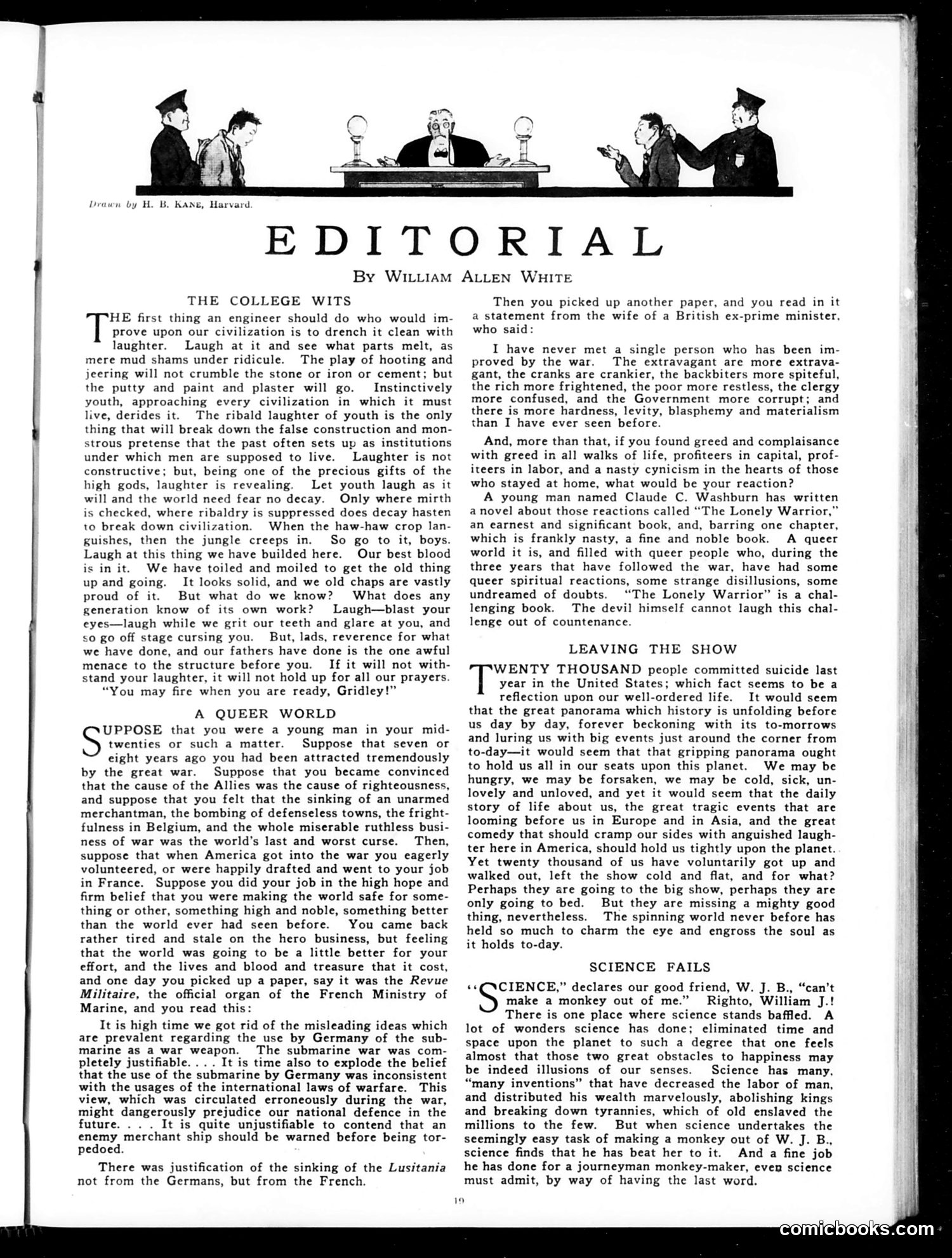
The cartoon header depicts a courtroom or judicial scene with figures in formal dress, illustrating the editorial's satirical tone about critique and institutional examination. William Allen White's editorial argues that **youth's ribald laughter and mockery are essential for exposing societal flaws**—that civilization needs irreverent criticism to prevent decay. He encourages young people to mock established institutions without reverence, claiming this scrutiny strengthens rather than weakens them. The second piece, "A Queer World," presents a bitter post-WWI scenario: A young American volunteer fights believing the Allies represent righteousness against German "ruthlessness," only to discover the French military publication justifying Germany's submarine warfare (including the *Lusitania* sinking) as legitimate. The satire highlights the **disillusionment of WWI veterans**—they sacrificed believing in moral absolutes, only to find post-war governments endorsing the very atrocities they fought against. This exposes the hypocrisy and moral relativism that characterized post-war geopolitics.
📄 Transcribed text from this page (OCR, searchable)
Machine-transcribed from the original scan — historical spelling and the odd misread are preserved.
Drawn by H. B. KANE, Harvard. EDITORIAL By WituiamM ALLEN WHITE THE COLLEGE WITS HE first thing an engineer should do who would im- prove upon our civilization is to drench it clean with laughter. Laugh at it and see what parts melt, as mere mud shams under ridicule. The play of hooting and jeering will not crumble the stone or iron or cement; but the putty and paint and plaster will go. Instinctively youth, approaching every civilization in which it must live, derides it. The ribald laughter of youth is the only thing that will break down the false construction and mon- strous pretense that the past often sets up as institutions under which men are supposed to live. Laughter is not constructive; but, being one of the precious gifts of the high gods, laughter is revealing. Let youth laugh as it will and the world need fear no decay. Only where mirth is checked, where ribaldry is suppressed does decay hasten to break down civilization. When the haw-haw crop lan- guishes, then the jungle creeps in. So go to it, boys. Laugh at this thing we have builded here. Our best blood is in it. We have toiled and moiled to get the old thing up and going. It looks solid, and we old chaps are vastly proud of it. But what do we know? What does any generation know of its own work? Laugh—blast your eyes—laugh while we grit our teeth and glare at you, and so go off stage cursing you. But, lads, reverence for what we have done, and our fathers have done is the one awful menace to the structure before you. If it will not with- stand your laughter, it will not hold up for all our prayers. “You may fire when you are ready, Gridley!” A QUEER WORLD UPPOSE that you were a young man in your mid- S twenties or such a matter. Suppose that seven or eight years ago you had been attracted tremendously by the great war. Suppose that you became convinced that the cause of the Allies was the cause of righteousness, and suppose that you felt that the sinking of an unarmed merchantman, the bombing of defenseless towns, the fright- fulness in Belgium, and the whole miserable ruthless busi- ness of war was the world’s last and worst curse. Then, suppose that when America got into the war you eagerly volunteered, or were happily drafted and went to your job in France. Suppose you did your job in the high hope and firm belief that you were making the world safe for some- thing or other, something high and noble, something better than the world ever had seen before. You came back rather tired and stale on the hero business, but feeling that the world was going to be a little better for your effort, and the lives and blood and treasure that it cost, and one day you picked up a paper, say it was the Revue Militaire, the official organ of the French Ministry of Marine, and you read this: It is high time we got rid of the misleading ideas which are prevalent regarding the use by Germany of the sub- marine as a war weapon. The submarine war was com- pletely justifiable... . It is time also to explode the belief that the use of the submarine by Germany was inconsistent with the usages of the international laws of warfare. This view, which was circulated erroneously during the war, might dangerously prejudice our national defence in the future... . It is quite unjustifiable to contend that an enemy merchant ship should be warned before being tor- pedoed. There was justification of the sinking of the Lusitania not from the Germans, but from the French. Then you picked up another paper, and you read in it a statement from the wife of a British ex-prime minister, who said: I have never met a single person who has been im- proved by the war. The extravagant are more extrava- gant, the cranks are crankier, the backbiters more spiteful, the rich more frightened, the poor more restless, the clergy more confused, and the Government more corrupt; and there is more hardness, levity, blasphemy and materialism than I have ever seen before. And, more than that, if you found greed and complaisance with greed in all walks of life, profiteers in capital, prof- iteers in labor, and a nasty cynicism in the hearts of those who stayed at home, what would be your reaction? A young man named Claude C. Washburn has written a novel about those reactions called “The Lonely Warrior,” an earnest and significant book, and, barring one chapter, which is frankly nasty, a fine and noble book. A queer world it is, and filled with queer people who, during the three years that have followed the war, have had some queer spiritual reactions, some strange disillusions, some undreamed of doubts. “The Lonely Warrior” is a chal- lenging book. The devil himself cannot laugh this chal- lenge out of countenance. LEAVING THE SHOW 'WENTY THOUSAND people committed suicide last year in the United States; which fact seems to be a reflection upon our well-ordered life. It would seem that the great panorama which history is unfolding before us day by day, forever beckoning with its to-morrows and luring us with big events just around the corner from to-day—it would seem that that gripping panorama ought to hold us all in our seats upon this planet. We may be hungry, we may be forsaken, we may be cold, sick, un- lovely and unloved, and yet it would seem that the daily story of life about us, the great tragic events that are looming before us in Europe and in Asia, and the great comedy that should cramp our sides with anguished laugh- ter here in America, should hold us tightly upon the planet. Yet twenty thousand of us have voluntarily got up and walked out, left the show cold and flat, and for what? Perhaps they are going to the big show, perhaps they are only going to bed. But they are missing a mighty good thing, nevertheless. The spinning world never before has held so much to charm the eye and engross the soul as it holds to-day. SCIENCE FAILS «*QQXCIENCE,” declares our good friend, W. J. B., “can’t make a monkey out of me.” Righto, William J.! There is one place where science stands baffled. A lot of wonders science has done; eliminated time and space upon the planet to such a degree that one feels almost that those two great obstacles to happiness may be indeed illusions of our senses. Science has many, “many inventions” that have decreased the labor of man, and distributed his wealth marvelously, abolishing kings and breaking down tyrannies, which of old enslaved the millions to the few. But when science undertakes the seemingly easy task of making a monkey out of W. J. B., science finds that he has beat her to it. And a fine job he has done for a journeyman monkey-maker, even science must admit, by way of having the last word. 9