
A complete issue · 36 pages · 1922
Judge — January 7, 1922
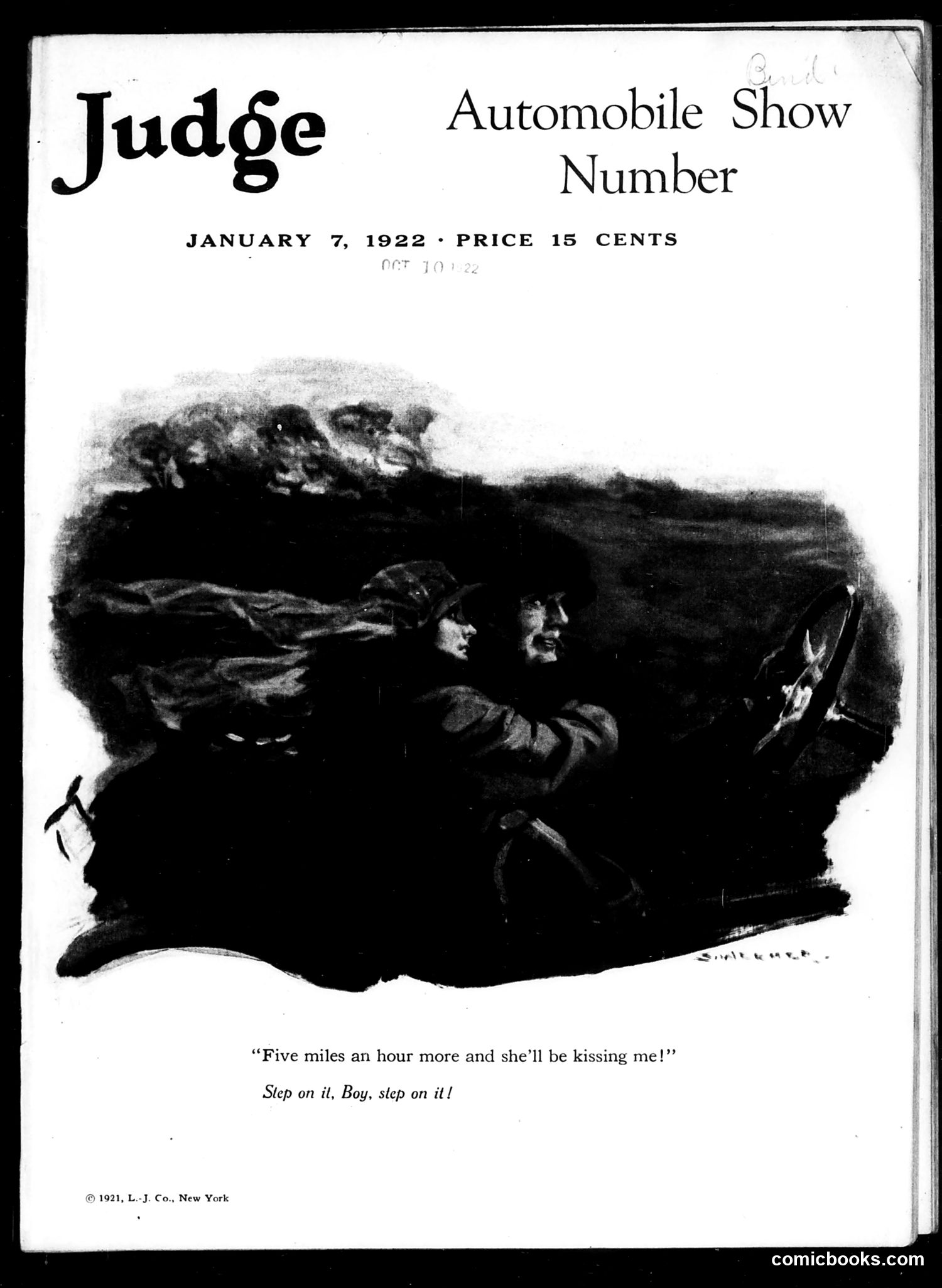
This is the cover of *Judge* magazine's Automobile Show special issue from January 7, 1922. The illustration shows people in a speeding car with wind-blown hair and clothing, depicting reckless driving. The caption reads: "Five miles an hour more and she'll be kissing me!" with the subtitle "Step on it, Boy, step on it!" The satire plays on contemporary anxieties about automobiles as dangerous, exciting modern technology. The joke targets young drivers' recklessness and the car as a venue for courtship/sexual impropriety—both controversial topics in the 1920s. The illustration suggests speeding as thrilling but perilous, mocking drivers who prioritize romance and excitement over safety. This reflects broader cultural tensions about automobiles' social impact during the early automotive era.
This page is **not a cartoon or satire**—it's a straightforward advertisement for Leslie's Weekly magazine, promoting their January 7 issue featuring an "Auto Show Number." The ad appeals to automobile enthusiasts by highlighting: - A comprehensive survey of new car developments from New York's Annual Automobile Show - An article by Harold W. Slauson, described as an automotive expert and prominent authority - Content on transcontinental auto touring routes to California - A color motor cover illustration by Werner - A regular "Motor Department" offering free advice to readers about vehicle problems The ad emphasizes that Leslie's Weekly has returned to its pre-war price of **10 cents per copy**, positioning affordable access to automobile information as a selling point for the growing motoring public of the era.
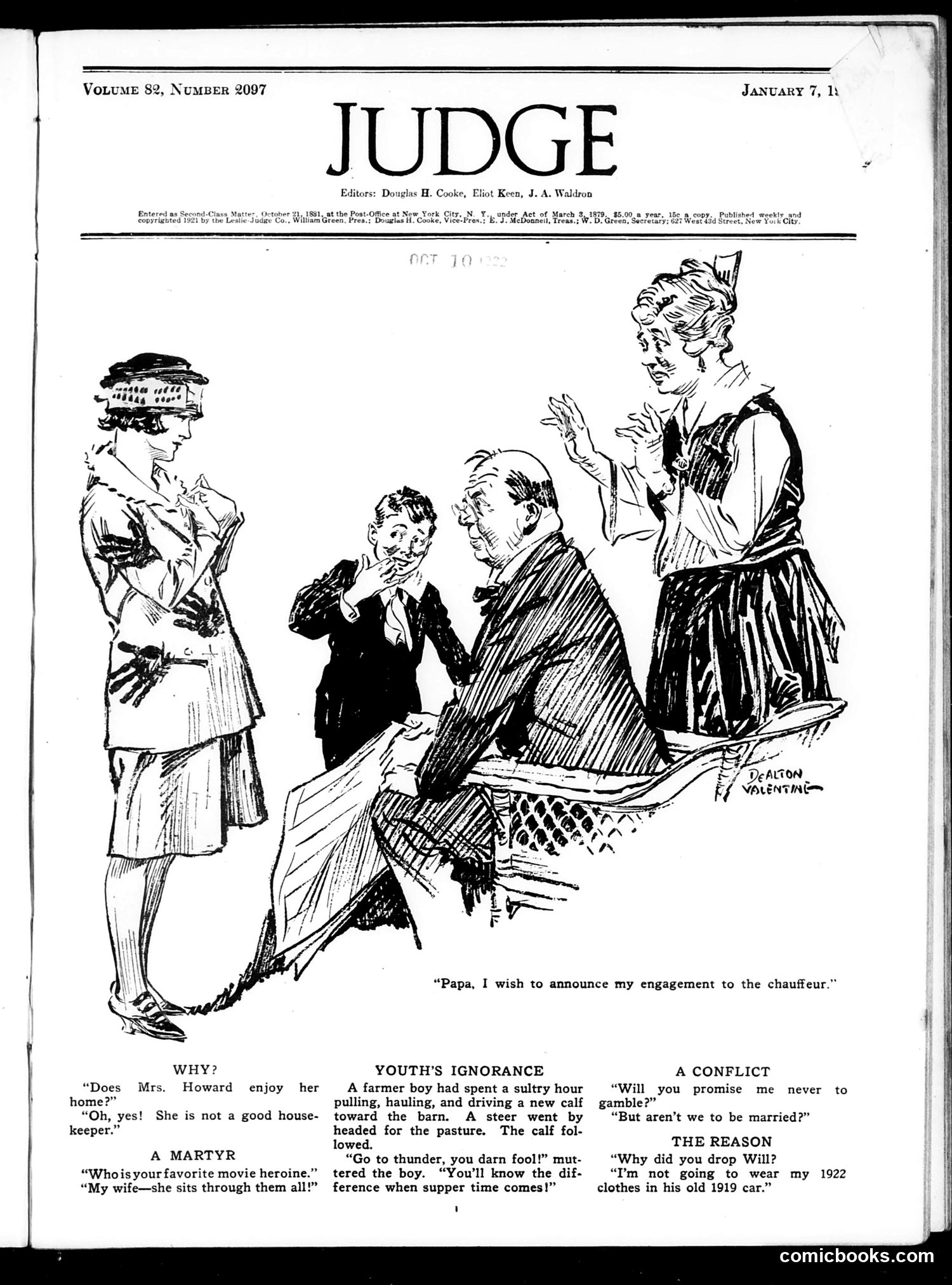
The main cartoon depicts a young woman announcing her engagement to "the chauffeur" to her disapproving family—a social scandal reflecting 1920s class anxieties. The joke hinges on the impropriety of marrying "below one's station," a concern that dominated period humor. Below are six separate satirical vignettes about domestic and social life: - A wife who's a poor housekeeper - A boy's destructive behavior ("pulling, hauling, and driving a new car") - A man refusing to promise marital fidelity - A wife sitting through entire movie reels - A woman refusing to wear 1919 fashion in a 1922 car These jokes reflect common marital grievances and social frustrations of the era, with humor derived from generational and class conflicts typical of post-WWI American magazines.
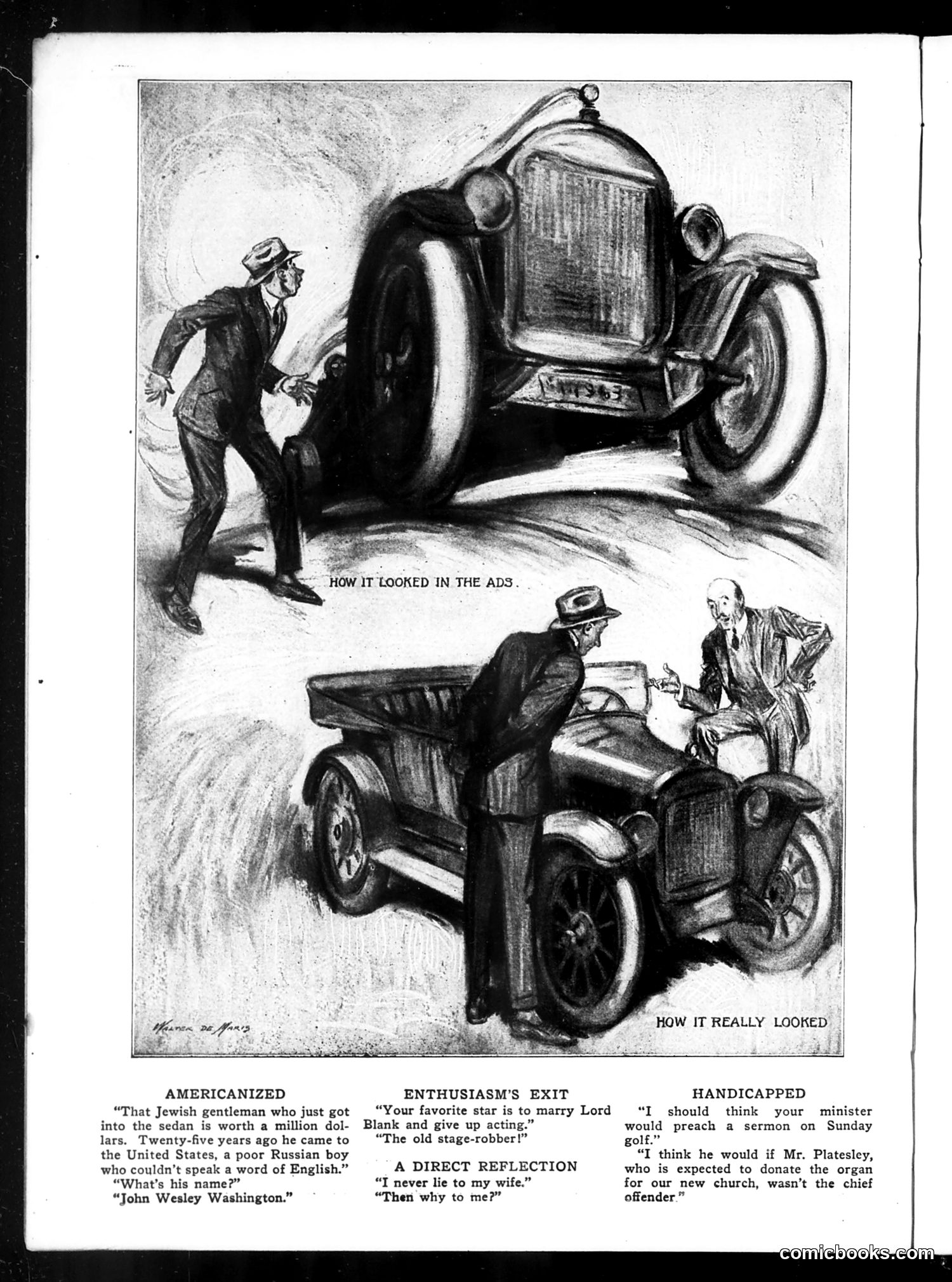
This Judge magazine page satirizes early automotive advertising versus reality through contrasting illustrations. The top panel, "How It Looked in the Ads," depicts an impossibly sleek racing vehicle that dominates the scene. The bottom panel, "How It Really Looked," shows the actual cramped, underpowered automobile with two men barely fitting inside. Below are six brief satirical captions mocking other social pretensions: "Americanized" jokes about immigrants, "Enthusiasm's Exit" mocks theatrical ambition, "Handicapped" pokes fun at clergy soliciting donations, "Enthusiasm's Exit" references stage-robbers, "A Direct Reflection" plays on marital discord, and another quip about church organ donations. The core joke: automobile advertisements grossly misrepresented their products' performance and appeal.
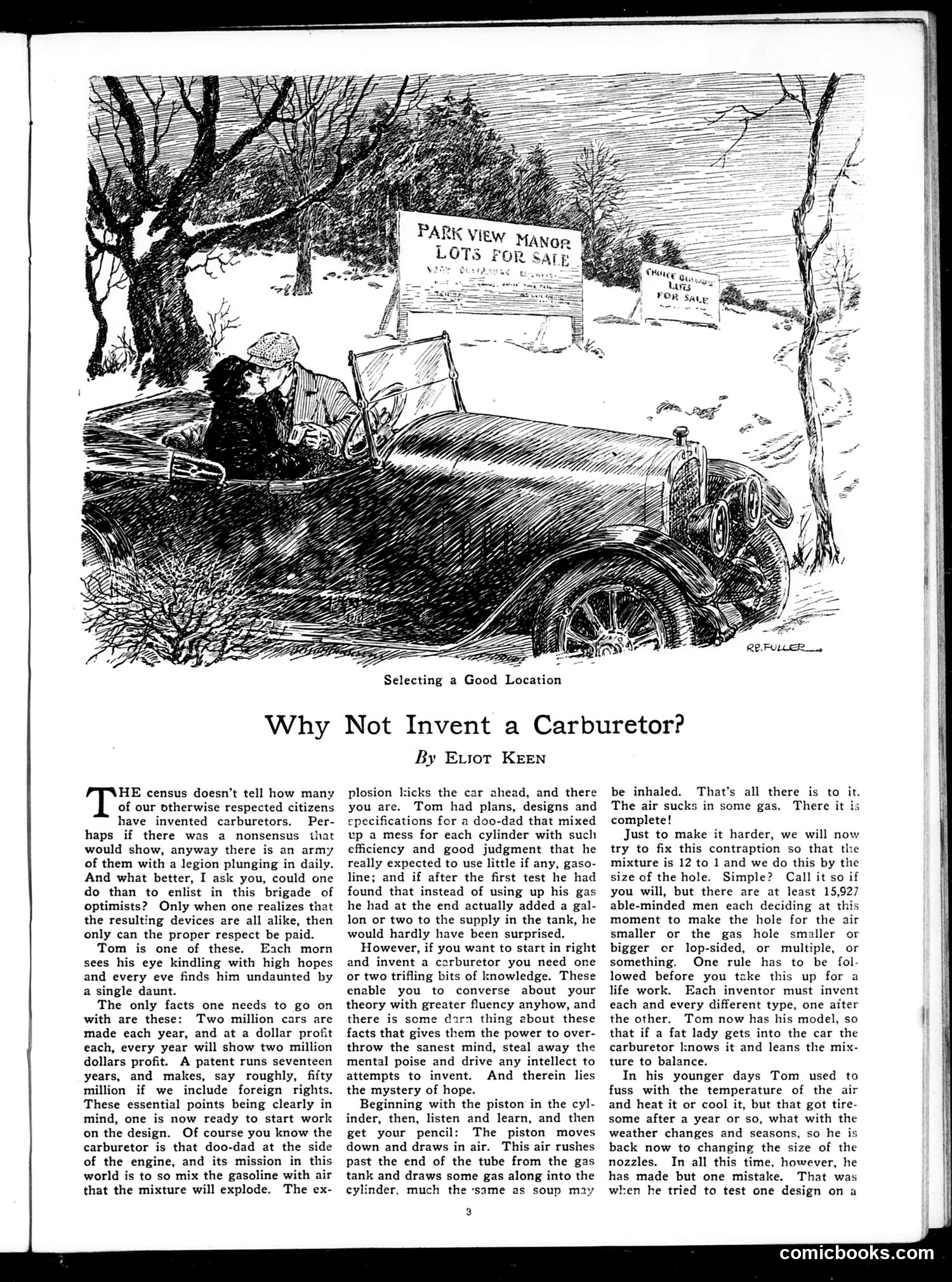
This article by Eliot Keen satirizes amateur inventors and their often misguided optimism. The cartoon shows a man examining a broken-down automobile near real-estate signs ("Park View Manor Lots for Sale"), apparently considering inventing a carburetor as a solution. Keen's text mocks the proliferation of amateur "inventors" who lack genuine expertise. He argues that successful carburetors require deep technical knowledge, not mere tinkering. The satire suggests that people casually propose mechanical inventions without understanding the complexity involved—a common attitude during the early automotive era when cars were still relatively novel technology. The cartoon illustrates this disconnect: a would-be inventor spotting a disabled vehicle and imagining himself as its savior-innovator, embodying the article's critique of unfounded inventive ambition.
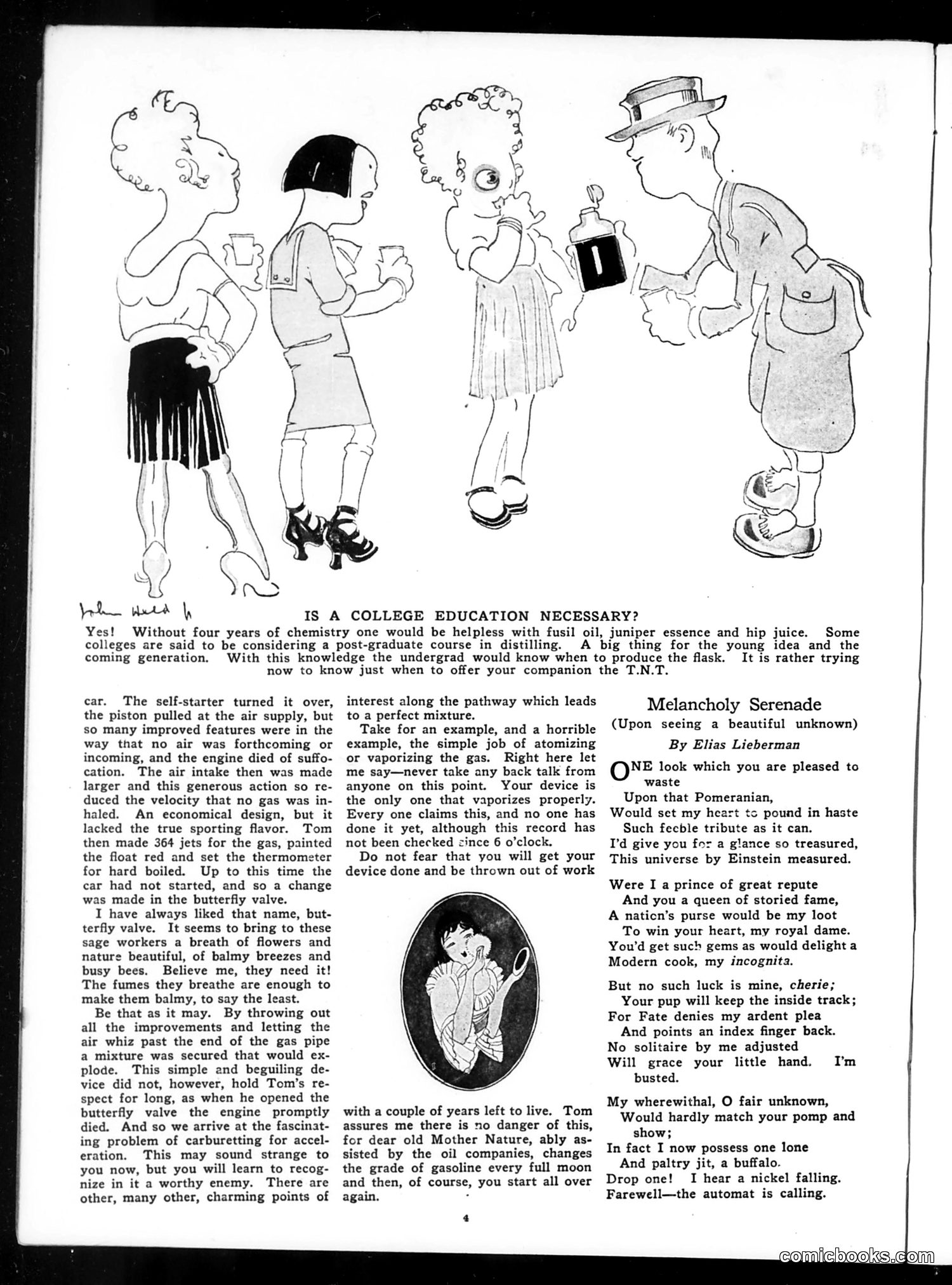
**Top Cartoon:** "Is a College Education Necessary?" depicts four figures arguing about whether chemistry requires formal education. The cartoon satirizes debates about practical vocational training versus traditional college degrees—relevant to post-WWI America when automotive and industrial work offered alternatives to academics. The text discusses engine design and the "butterfly valve," suggesting tension between self-taught mechanics and credentialed engineers. The cartoon mocks both positions: the figures' exaggerated features suggest foolishness on all sides. **Bottom Section:** "Melancholy Serenade" is a romantic poem by Elias Lieberman about unrequited love, illustrated with a man pining for an indifferent woman. This provides tonal contrast to the satirical content above. The page balances social commentary on education/class mobility with sentimental verse—typical of Judge's mixed editorial approach.
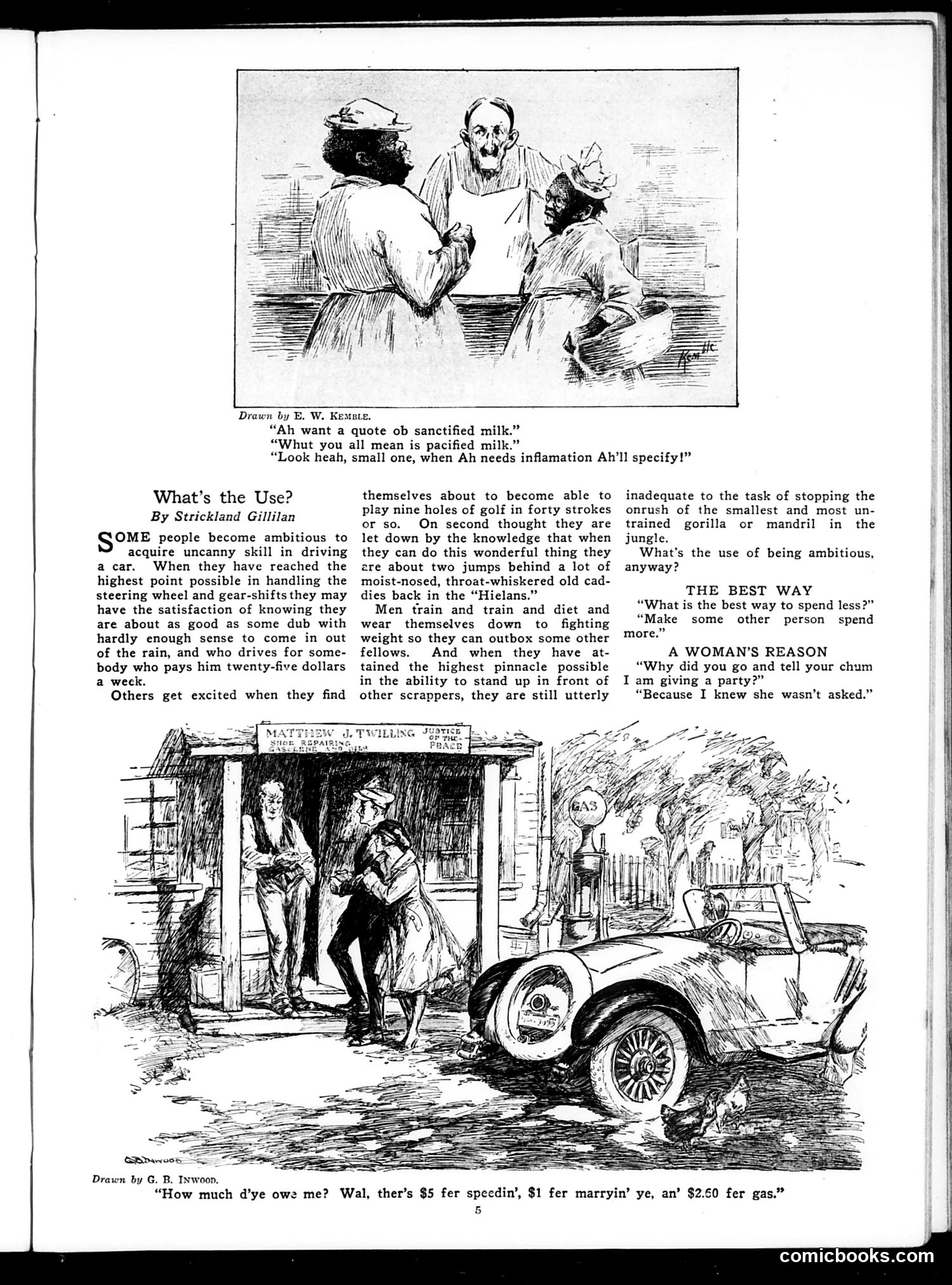
**Top Cartoon (Kemble):** A dialect humor piece depicting African American characters discussing "sanctified milk" versus "pacified milk." The humor relies on racial stereotyping and malapropism—a common, offensive comedic device of the era. **Main Article ("What's the Use?" by Strickland Gillilan):** A satirical essay mocking human ambition. It argues that ambitious pursuits (mastering car driving, golf, boxing) ultimately prove futile—drivers remain mediocre, golfers lag behind caddies, boxers can't outfight jungle animals. The satire targets the obsessive drive for self-improvement and competitive achievement that characterized early 20th-century American culture. **Bottom Cartoon (Inwood):** A rural/small-town scene where a mechanic bills a customer for speeding fines, marriage license, and gas—treating legal penalties as casual service charges. This satirizes rural justice systems and frontier lawlessness, suggesting authorities profit from infractions. The page reflects period attitudes: class anxiety about automobiles, racial caricature as humor, and skepticism toward progress narratives.
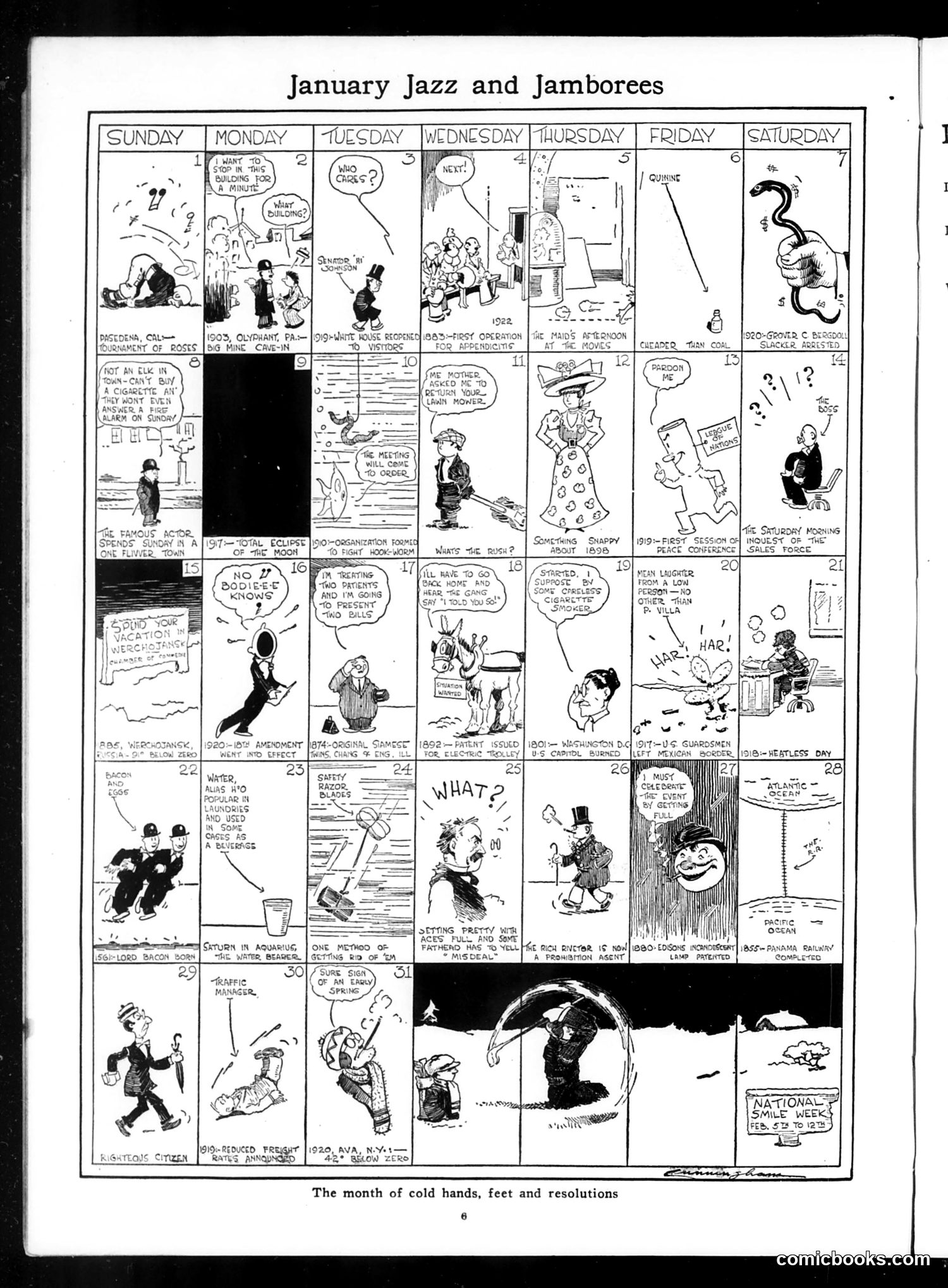
This is a full-month comic calendar for January from *Judge* magazine, presenting daily gags about winter hardships and New Year's resolutions. The cartoons satirize common January themes: cold weather misery, failed resolutions, financial strain after holidays, and the difficulty of maintaining self-improvement promises. The subtitle—"The month of cold hands, feet and resolutions"—signals the recurring joke that January combines physical discomfort with aspirational failure. Individual strips reference specific situations like staying warm indoors, keeping commitments, and economic concerns. The humor relies on recognizable social experiences rather than specific political figures, making it universal satire about human nature and seasonal struggle.
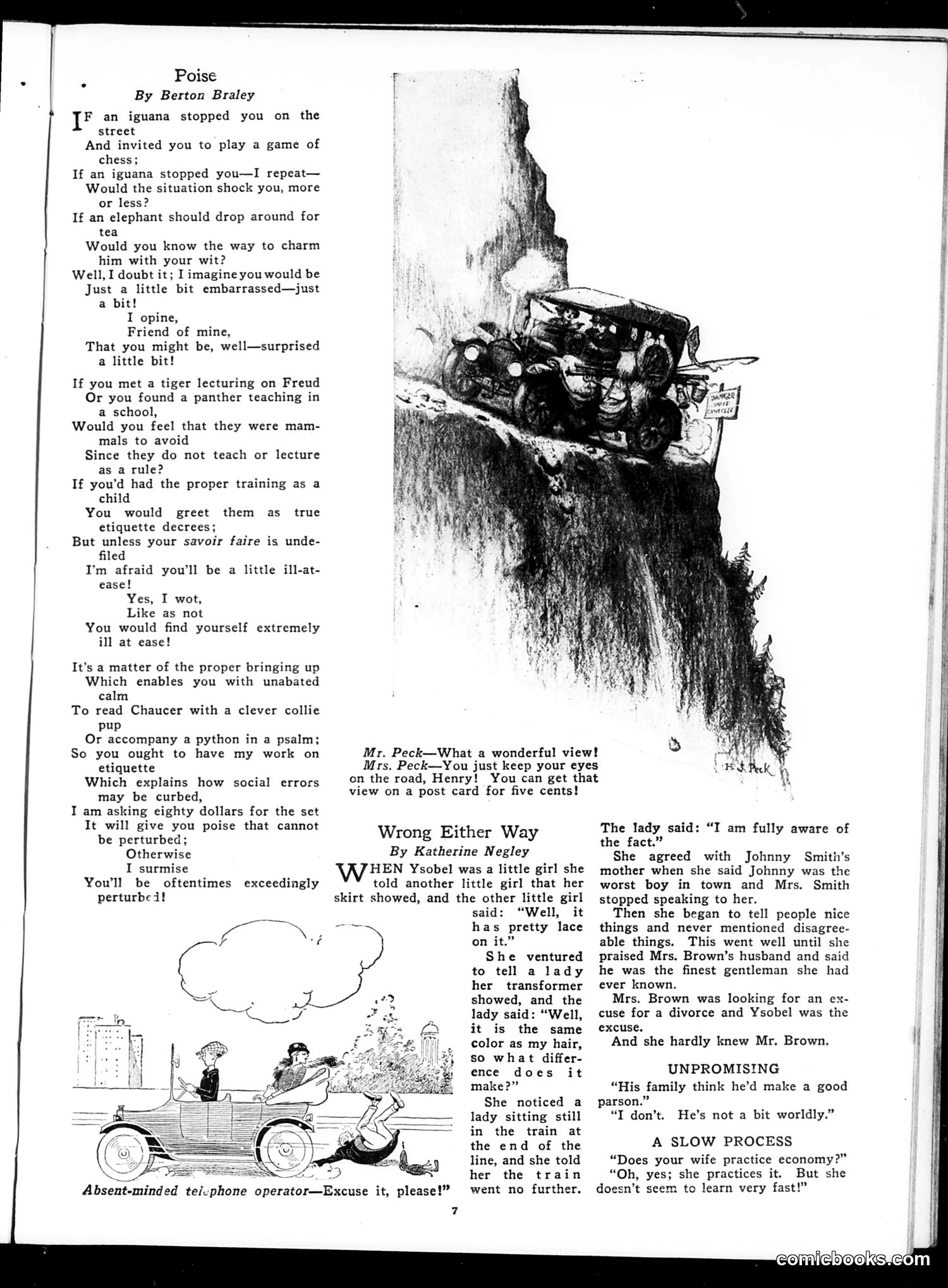
This page contains three pieces of light humor typical of 1920s-era American satire: **"Poise" by Berton Braley** is a humorous poem-advertisement disguised as social commentary. It uses absurdist scenarios (iguanas playing chess, elephants at tea, tigers lecturing on Freud) to mock people who lack proper etiquette training. The joke is self-referential: Braley is selling an $80 etiquette guide by suggesting readers would be hopelessly embarrassed in ridiculous social situations. It's satirizing both pretentious etiquette culture and advertising hype. **The cartoon** shows an absent-minded telephone operator and a couple in a car—gentle, domestic humor about everyday life's minor annoyances. **"Wrong Either Way" by Katherine Negley** depicts Ysobel, a well-meaning woman who can't win socially: when she points out wardrobe malfunctions, people defend themselves; when she compliments someone (Mrs. Brown's husband), it backfires into a divorce scandal. The satire mocks how impossible social navigation can be for even the conscientious. All three pieces reflect 1920s preoccupation with proper social conduct and the anxiety of navigating increasingly complex urban society.
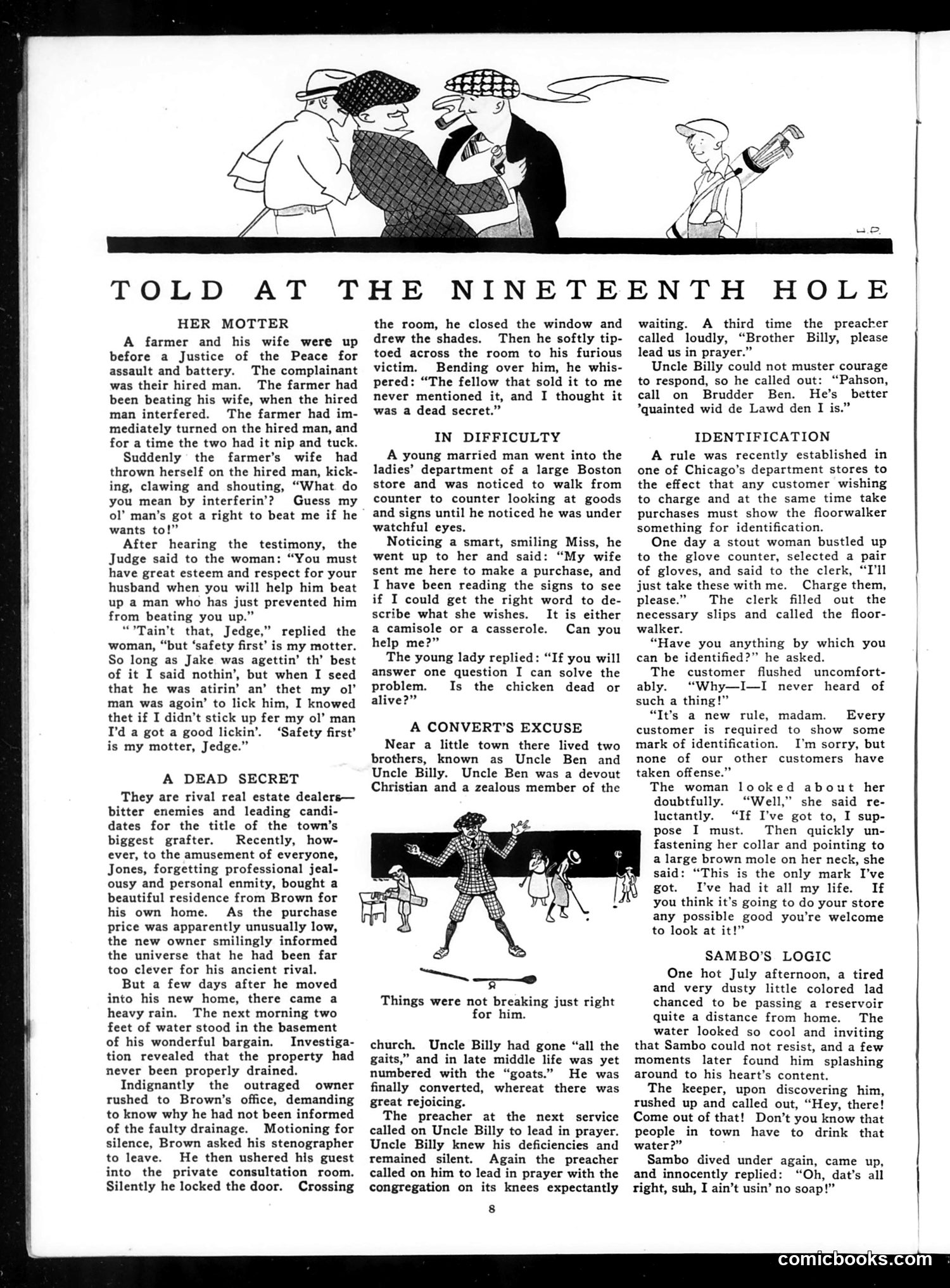
This page from Judge contains several humorous anecdotes satirizing American social attitudes and gender dynamics: **"Her Motter"** mocks working-class domestic violence, where a wife defends her abusive husband against interference—ironically citing "safety first" as her motivation. The satire targets both marital brutality and the woman's twisted loyalty. **"A Dead Secret"** satirizes real estate fraud and masculine greed. A sharp dealer buys property cheap, boasts of outwitting his rival, then discovers hidden drainage problems. The seller's conspiratorial confession suggests widespread business corruption accepted as clever—the joke being Jones got swindled despite thinking himself clever. **"In Difficulty"** plays on a husband's confusion between "camisole" (women's undergarment) and "casserole" (dish), mocking male ignorance of domestic/feminine matters. **"A Convert's Excuse"** depicts a reformed drunk (Uncle Billy) unable to lead church prayer due to his rough background, suggesting redemption's limits—satire on religious conversion sincerity. All reflect era attitudes: domestic violence as comedy, business fraud as acceptable cunning, and male incompetence in domestic spheres.
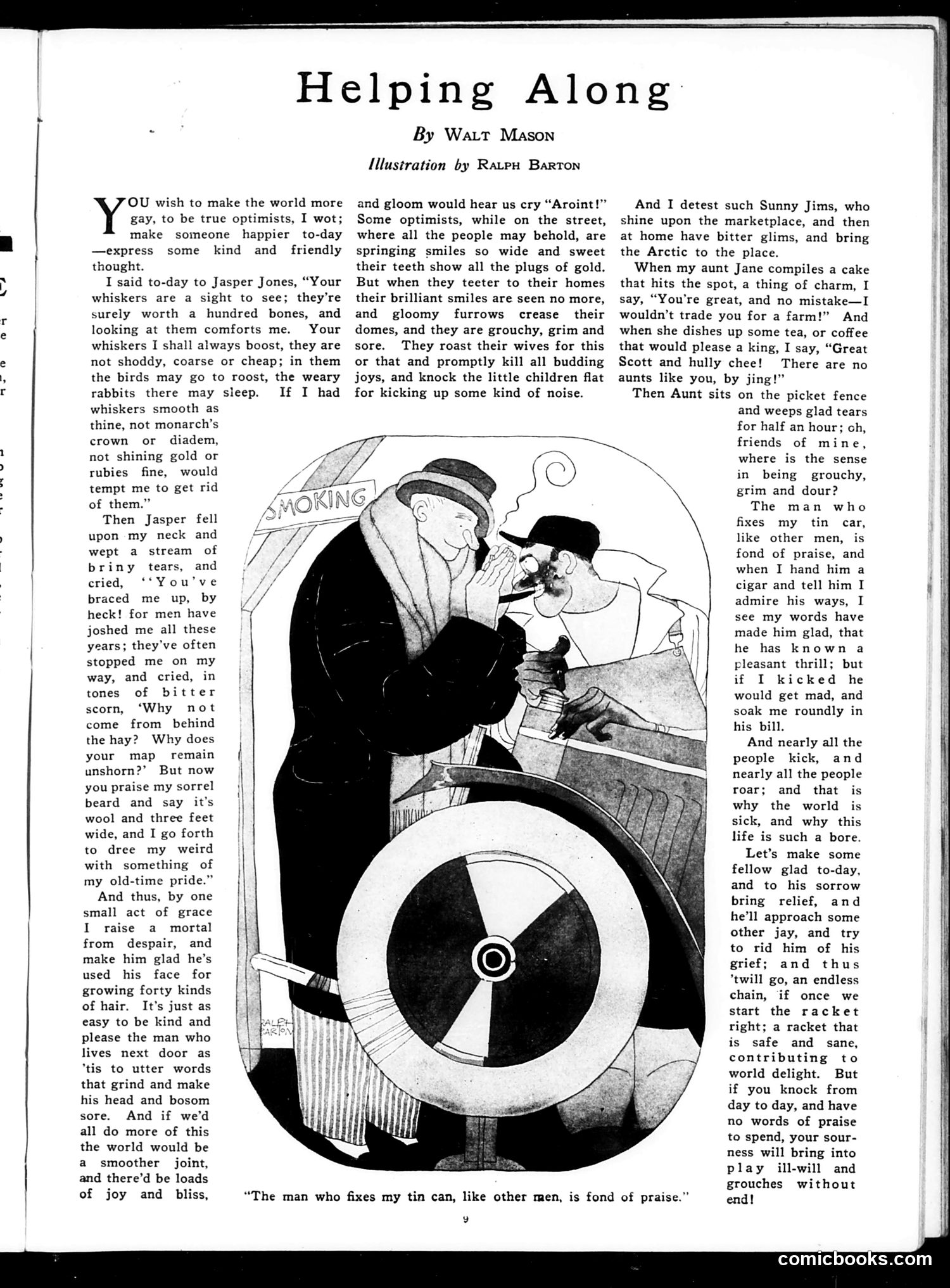
This is a moralizing poem about kindness and its ripple effects, illustrated by Ralph Barton. The narrative depicts the author complimenting Jasper Jones on his unkempt beard and whiskers—something others mock him for. Jones emotionally responds, having been habitually ridiculed. Mason uses this as a springboard for social criticism: he contrasts "Sunny Jims" who display cheerfulness in public but are "grouchy, grim and sore" at home, mistreating their families. The illustration shows a man working on a tin car—another example of someone who responds well to genuine praise and appreciation. The message is straightforward moral instruction for early-20th-century readers: small acts of sincere kindness create positive social chains, while habitual criticism and grouchiness perpetuate unhappiness. This reflects progressive-era optimism about human improvement through behavioral change and positive social influence.
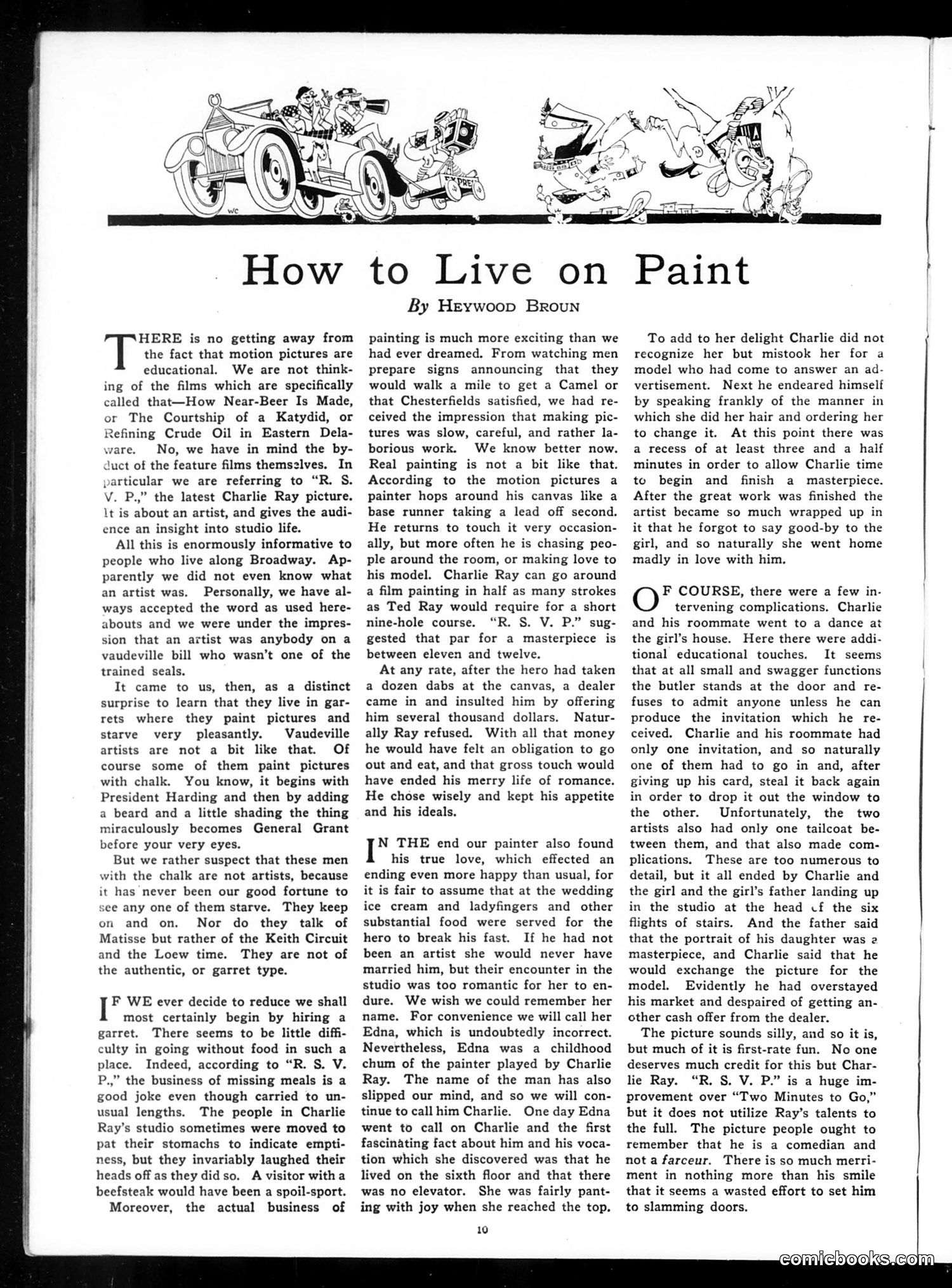
This is a humorous essay by Heywood Broun satirizing how motion pictures portray artists' lives—specifically Charlie Ray's film "R.S.V.P." about a painter. **The satire targets:** 1. **Romantic myths about artists**: Movies depict them starving happily in garrets, treating missed meals as jokes rather than hardship. 2. **Unrealistic depictions of artistic work**: The film shows painting as frenzied activity (hopping around the canvas "like a base runner") rather than careful, methodical labor—contrasting with real billboard advertisement painters Broun knows. 3. **Movie logic**: A dealer offers the hero thousands of dollars, which he refuses because accepting money would obligate him to eat, thus ending his "merry life of romance." **The broader point**: Movies present a glamorized fantasy of bohemian poverty that bears no resemblance to actual artistic life. Broun humorously suggests that if he ever became poor, he'd move to a garret—since apparently starvation is painless and comedic according to cinema. The humor relies on recognizing the gap between movie romanticism and reality.
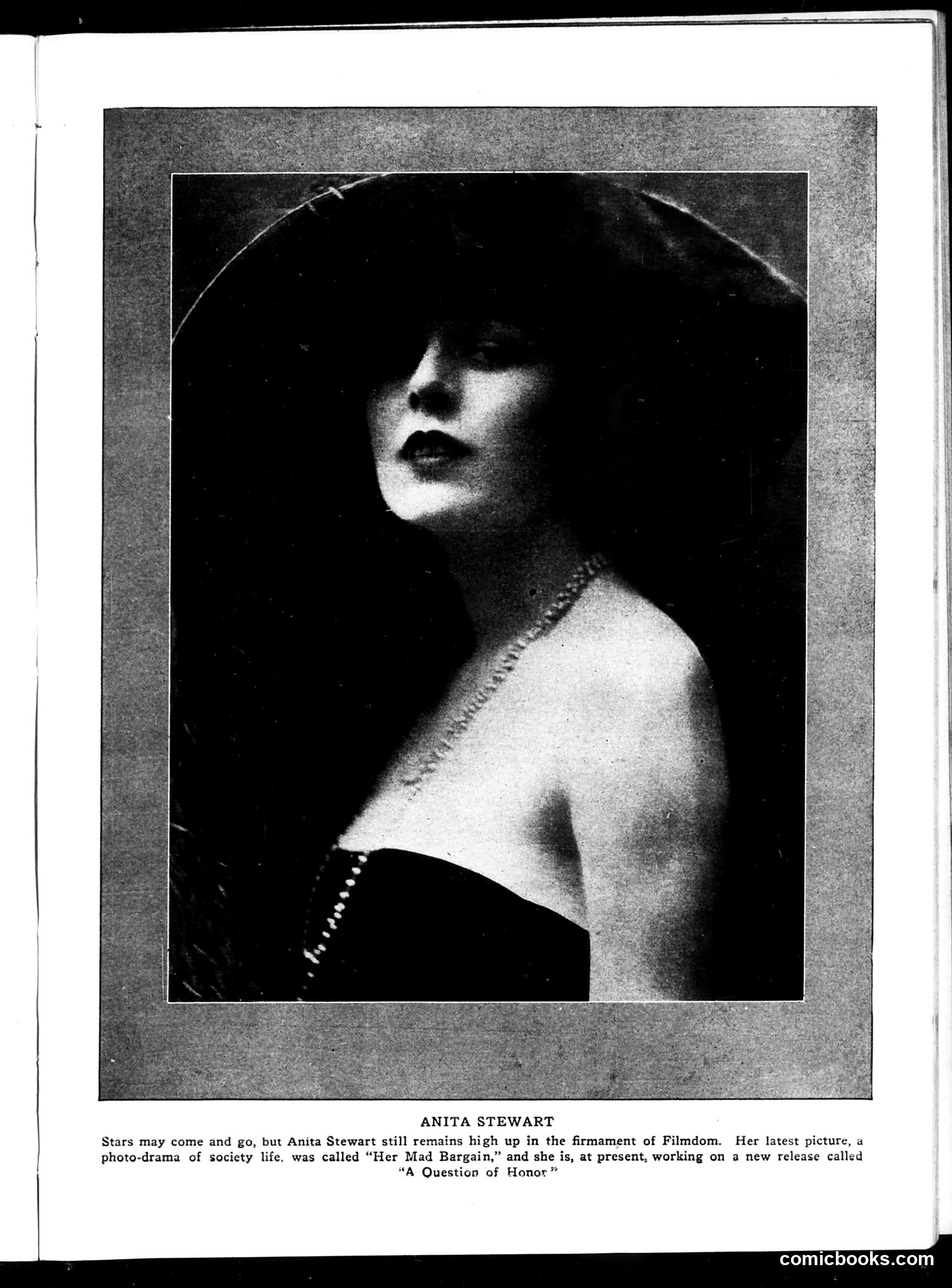
This page is a celebrity profile rather than a political cartoon. It features a glamorous portrait photograph of Anita Stewart, a silent film actress prominent in the 1910s-1920s. The accompanying text presents a promotional tribute, noting that despite changing tastes in cinema, Stewart maintains her star status. It references her recent films: "Her Mad Bargain" (a society drama) and her upcoming picture "A Question of Honor." The passage uses the metaphor of stars in the firmament to suggest her enduring prominence in "Filmdom." This appears to be entertainment journalism or studio publicity rather than satirical content, typical of Judge magazine's coverage of popular culture alongside its political humor.
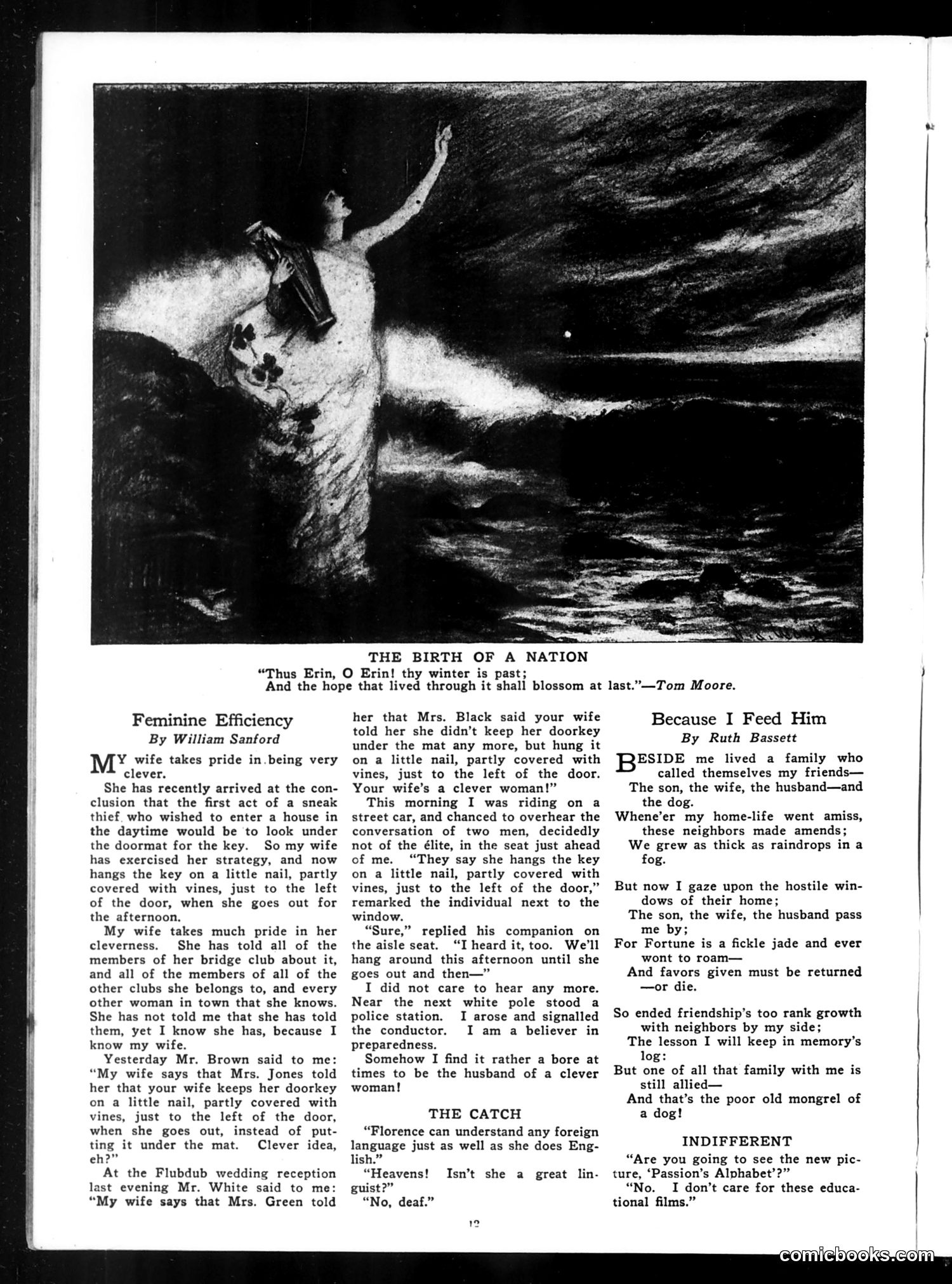
This page contains three satirical pieces reflecting early 20th-century social attitudes: ## "The Birth of a Nation" (illustration) The dramatic image depicts a classical female figure—likely representing Ireland or "Erin" (from the Tom Moore quote)—suggesting Irish independence or national awakening. ## "Feminine Efficiency" Sanford satirizes a wife's "clever" security strategy: hiding her house key on a nail rather than under the mat. The joke's irony: she broadcasts this "secret" throughout her entire social circle (bridge clubs, acquaintances), ultimately defeating its purpose. When street thugs overhear the plan at a trolley stop, the narrator rushes to call police. The satire mocks women's gossiping and the contradiction between intelligence and practical judgment—a common misogynistic trope of the era. ## "The Catch" A brief joke: "Florence" supposedly understands all foreign languages as well as English. The punchline reveals she's actually *deaf*—so she "understands" nothing, just appears intelligent. Both pieces mock women's competence through supposed "cleverness" undermined by fundamental flaws, reflecting period attitudes about female intellect.
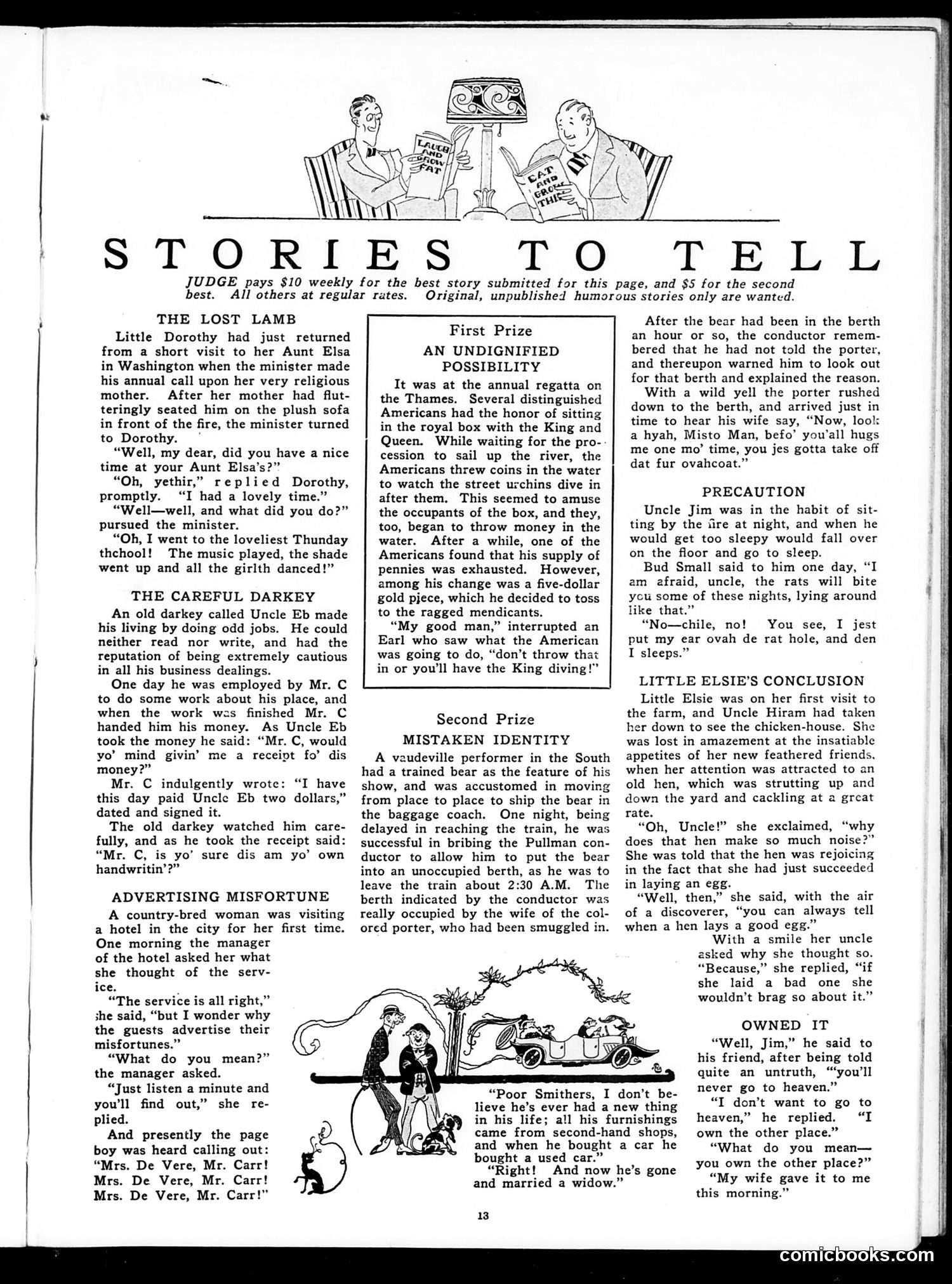
This page from Judge presents humor through three short stories, representing the magazine's satirical approach to early 20th-century American life. **"The Lost Lamb"** mocks religious hypocrisy: a minister interrogates a child about her visit, expecting moral improvement, but she innocently reports attending secular dancing—undermining his assumption that religious instruction should dominate her time. **"The Careful Darkey"** relies on period racial stereotypes, depicting an African American worker as overly cautious in requesting a receipt, played for laughs at his supposed illiteracy and suspicious nature. **"The Undignified Possibility"** satirizes American vulgarity abroad: wealthy Americans at a Thames regatta embarrass themselves by tossing coins to urchins, prompting a British Earl's quip that even royalty might undignified dive after money—mocking nouveau riche American behavior. **"Advertising Misfortune"** jokes about bellhops announcing guest names (De Vere, Carr) repeatedly—the country woman interprets repeated summons as guests publicly advertising their failures to appear. These stories reflect Judge's target audience: educated urbanites who viewed themselves as superior to rural folk, immigrant communities, and "uncultured" Americans.
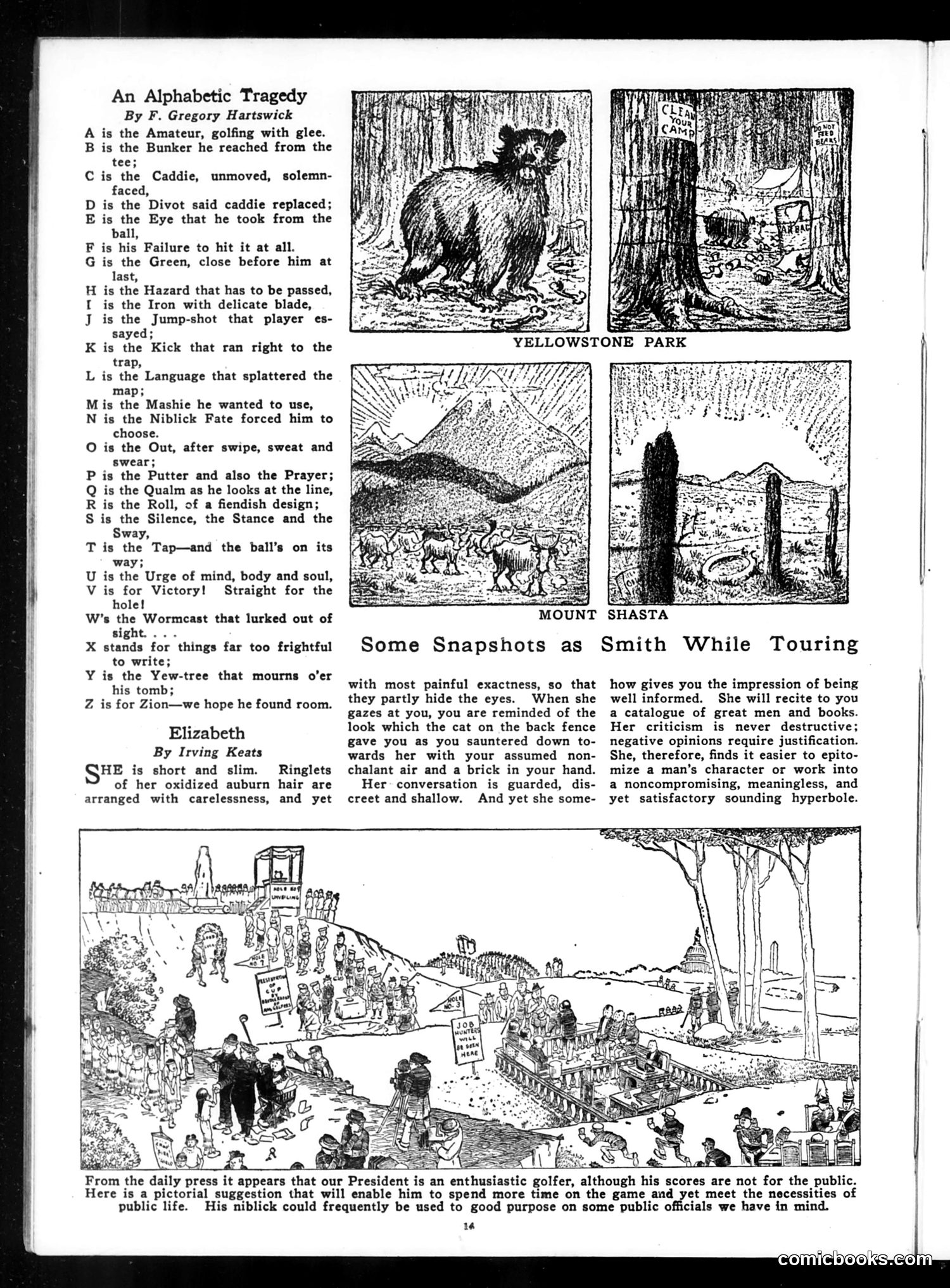
This page contains two main satirical pieces: **"An Alphabetic Tragedy"** is a humorous poem mocking amateur golfers. Using an alphabetical structure, it chronicles a golfer's frustrating round—from initial enthusiasm (A: "Amateur, golfing with glee") through mounting disasters (bunkers, missed shots, curses represented by "X stands for things far too frightful to write") to symbolic death (Y: "Yew-tree that mourns o'er his tomb"). The joke is golf's capacity to reduce players to profanity and despair. **"Some Snapshots as Smith While Touring"** satirizes the sitting U.S. President's golf obsession. The caption explicitly states he plays frequently despite poor scores, and the accompanying cartoon shows crowds at a tourist destination. The final paragraph's pointed suggestion that his "niblick could frequently be used to good purpose on some public officials" is a veiled criticism—implying the President should apply his apparent passion for golf to addressing corrupt or ineffective government officials instead. The satire mocks both amateur golfers generally and presidential priorities specifically.
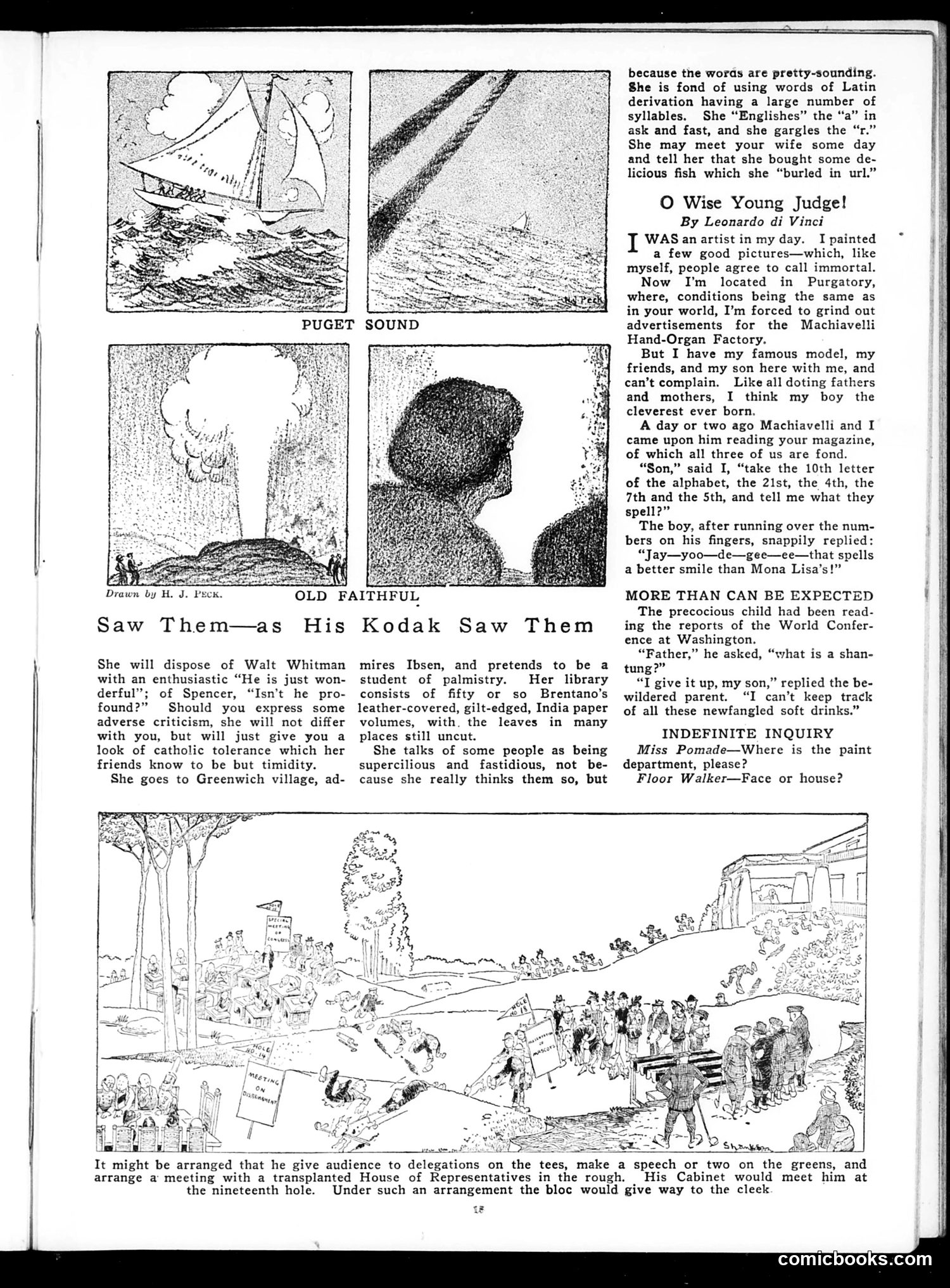
This page contains satirical social commentary targeting an affectation-prone woman who frequents Greenwich Village (then the bohemian art district). The main piece mocks her pretentious adoption of intellectual culture—she praises famous thinkers like Whitman and Spencer without genuine understanding, owns unread leather-bound books as status symbols, and affects affected speech patterns (pronouncing "a" in "ask," gargling her "r's," saying "burled in url" for "boiled in oil"). The humor lies in exposing the gap between her cosmopolitan pose and her actual shallow materialism. She uses Latin-derived words merely because they "sound pretty," not from comprehension. The page also contains humor columns unrelated to this main satire, including a Leonardo da Vinci sketch about a child solving a riddle, and brief jokes about paint departments and golf. The overarching target is upper-middle-class pretension and consumerism dressed as cultural sophistication.
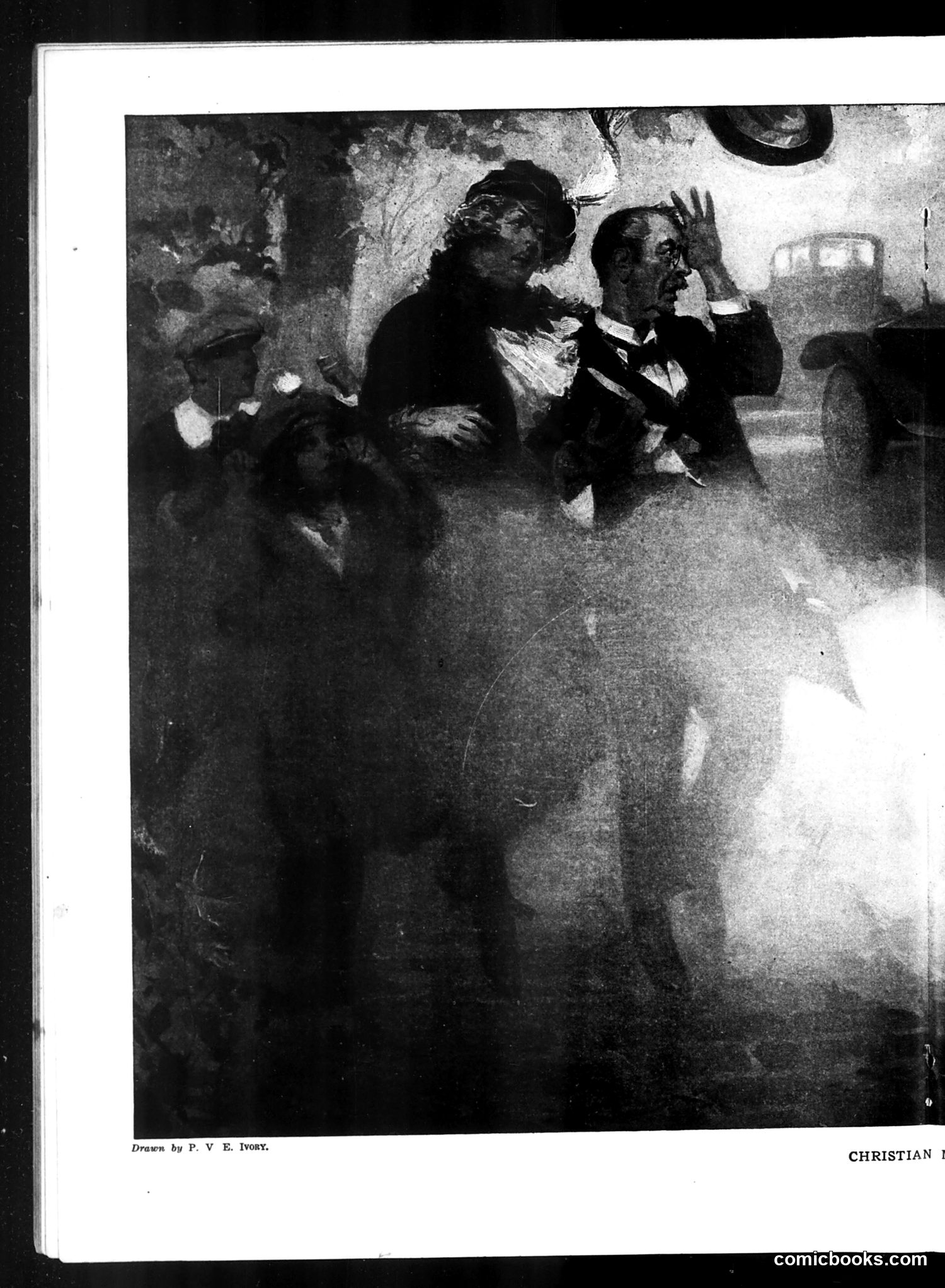
This appears to be a dramatic illustration rather than a traditional satirical cartoon. The image shows two men in formal 19th-century attire in what seems to be an agitated or confrontational scene, with additional figures visible in the background. The word "CHRISTIAN" at bottom-right suggests religious or moral commentary. The artist credit reads "Drawn by P.V.E. Ivory." Given the formal dress, indoor setting, and theatrical composition, this likely illustrates a narrative scene—possibly from a serialized story or dramatic piece featured in *Judge* magazine. Without additional context about the specific story or figures depicted, I cannot definitively identify the individuals or explain the exact satirical point. The image quality and partial page reproduction limit fuller interpretation.
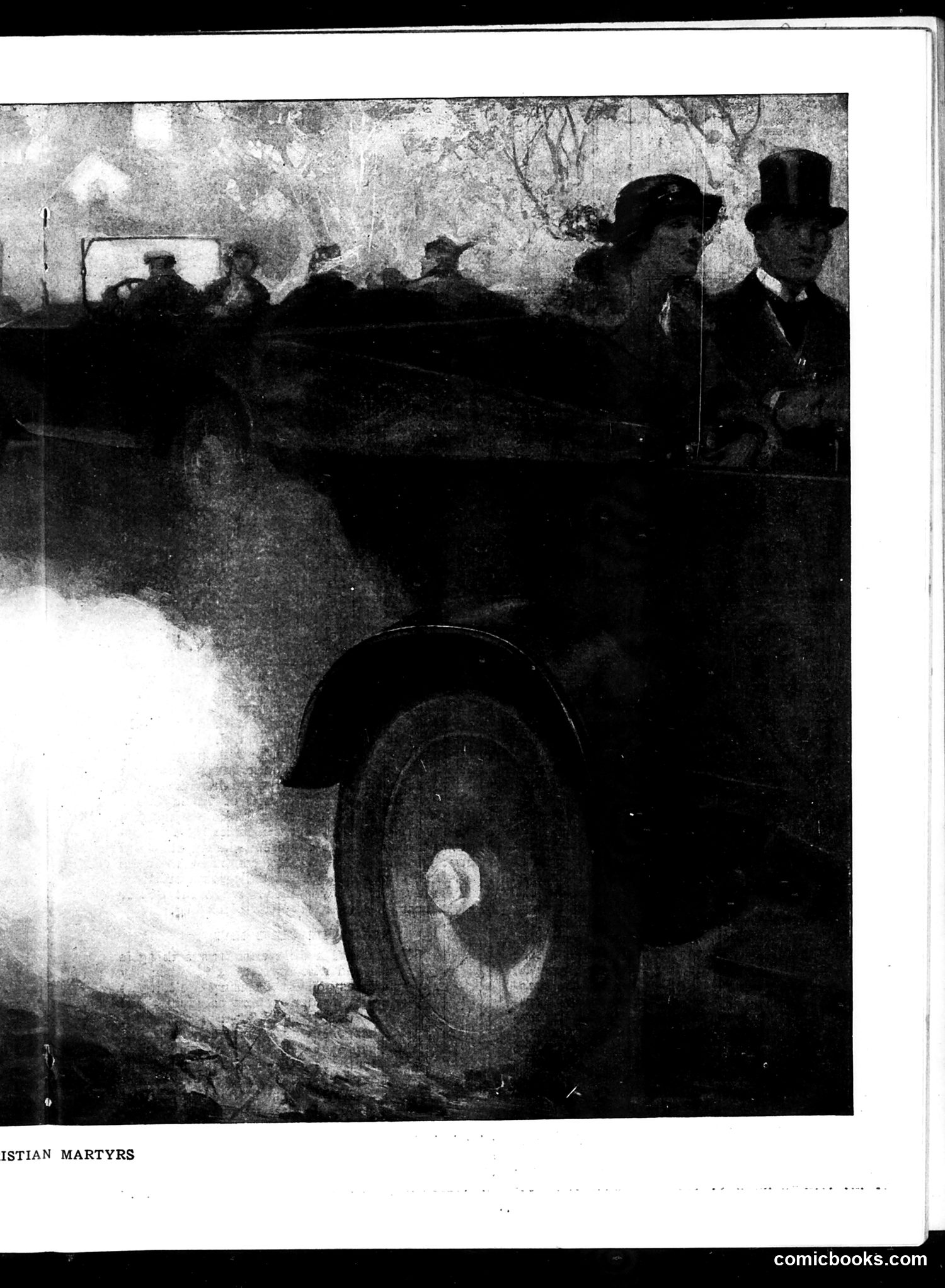
This appears to be a page titled "Christian Martyrs" from *Judge* magazine. The grainy black-and-white image shows what seems to be a vehicle or automobile with several formally-dressed men in top hats and coats standing nearby. The composition and title suggest this is political satire, likely depicting contemporary figures or groups being compared metaphorically to Christian martyrs—a common rhetorical device for satirizing those claiming victimhood or persecution. However, the image quality is too degraded and the visible text too minimal to identify specific figures, political targets, or the precise historical moment being satirized. Without additional context or clearer imagery, I cannot reliably explain what particular political or social situation this cartoon addresses.
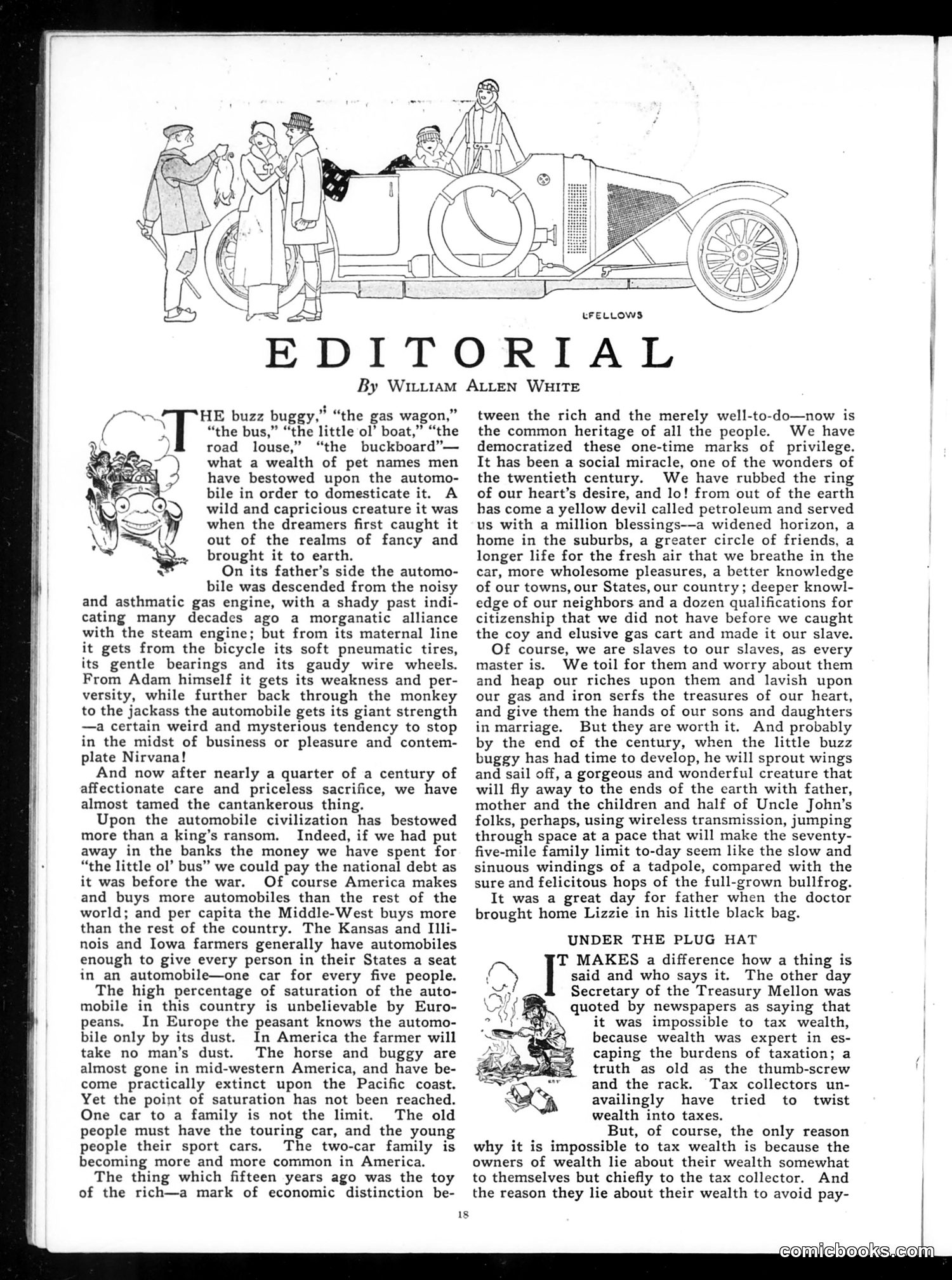
This is not primarily a cartoon but rather an editorial essay by William Allen White, a prominent early-20th-century American journalist and social commentator. The illustration shows men and children boarding an early automobile, depicting the vehicle's democratization. White's argument celebrates how automobiles—once luxury items marking wealth—have become commonplace possessions available to ordinary Americans, including farmers and working people. He frames this as a "social miracle" of the twentieth century, enabling suburban living, expanded social circles, and better citizenship through wider knowledge of one's country. The satirical edge appears in White's tongue-in-cheek admission that Americans have become "slaves to our slaves"—they labor to maintain and purchase automobiles, yet consider this servitude worthwhile. The tone is affectionate mockery of American car culture's rapid expansion and the public's willing economic sacrifice to fuel it.
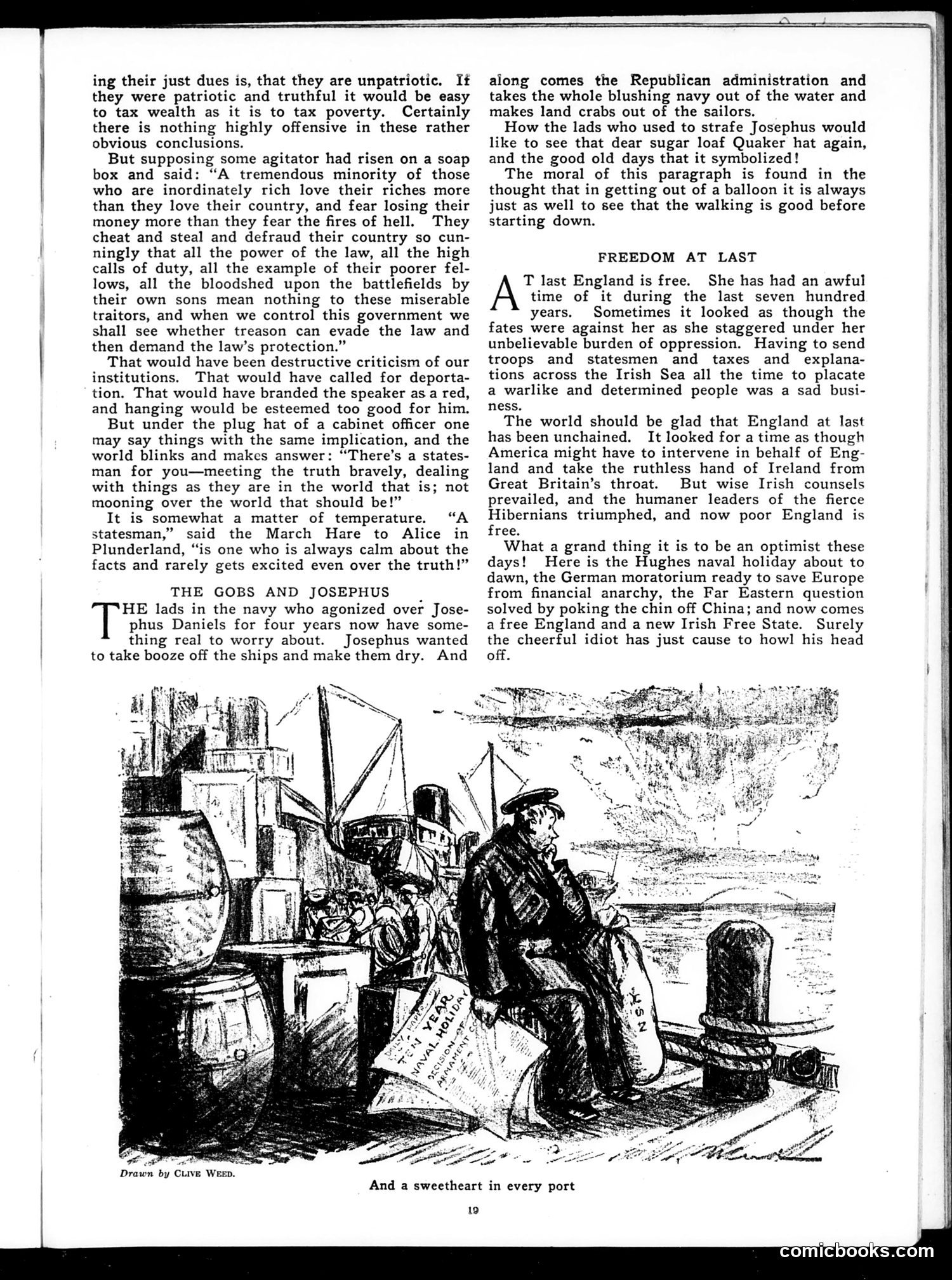
This page contains two distinct satirical pieces attacking Republican administration policies. **"The Gobs and Josephus"** (top section): Mocks the Republican Navy's decision to remove ships from active service, comparing it unfavorably to Josephus Daniels (the Democratic Secretary of the Navy who had imposed prohibition on naval vessels). The satire suggests that sailors who complained about Daniels's anti-alcohol policies now face worse—complete decommissioning. The "balloon" metaphor warns that celebrating one problem's solution without considering consequences is foolish. **"Freedom at Last"** (lower section): This is heavy irony about Ireland's independence and England's supposed "freedom." Judge sarcastically congratulates various Republican initiatives (Hughes naval holiday, German moratorium, Chinese policy, Irish Free State) as obviously successful, when the author clearly believes they're naive or ineffective. The drawing shows a sailor with documents at a dock—likely depicting the navy situation or maritime consequences of these policies. The overall message: Republican policies are shortsighted and self-defeating, presented with mock cheerfulness to expose their actual failure.
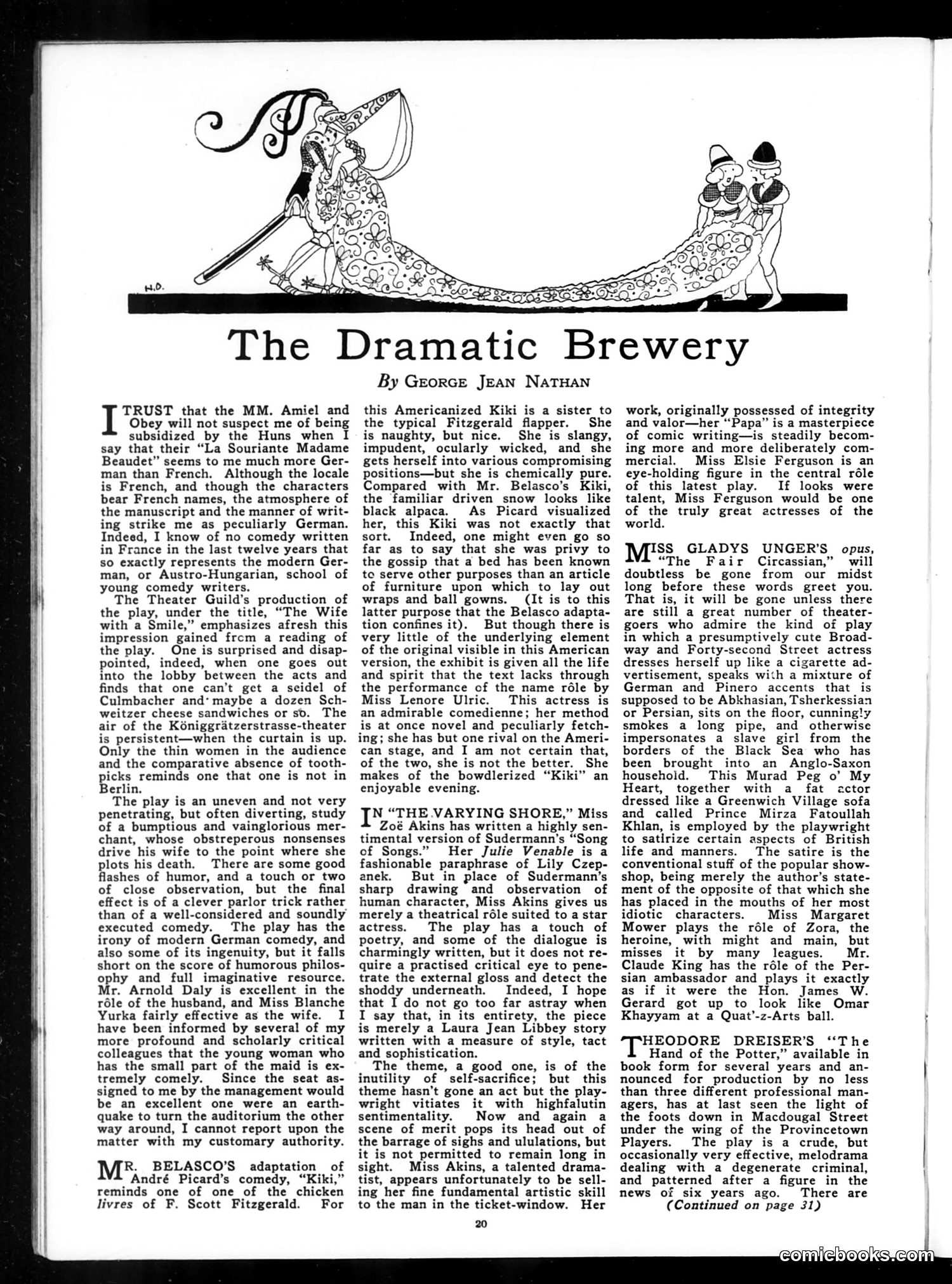
This is a theater review page by George Jean Nathan critiquing several Broadway productions. The ornamental header cartoon depicts a theatrical figure in elaborate costume presenting entertainment to an audience—a visual metaphor for the "dramatic brewery" producing theatrical fare. Nathan reviews three plays: 1. **"The Wife with a Smile"** (Theater Guild production)—he criticizes this adaptation of a French play for feeling German/Austrian in atmosphere, sardonically noting the lobby lacks German beer and cheese to complete the effect. 2. **"Kiki"** (David Belasco adaptation)—Nathan contrasts the original French comedy's morally loose character with Belasco's sanitized "Fitzgerald flapper" version, praising actress Lenore Ulric's performance despite the bowdlerization. 3. **"The Varying Shore"** by Zoé Akins—review appears to continue on another page. The review demonstrates Nathan's characteristic wit, mixing theatrical criticism with cultural commentary about American versus European dramatic sensibilities during the 1920s.
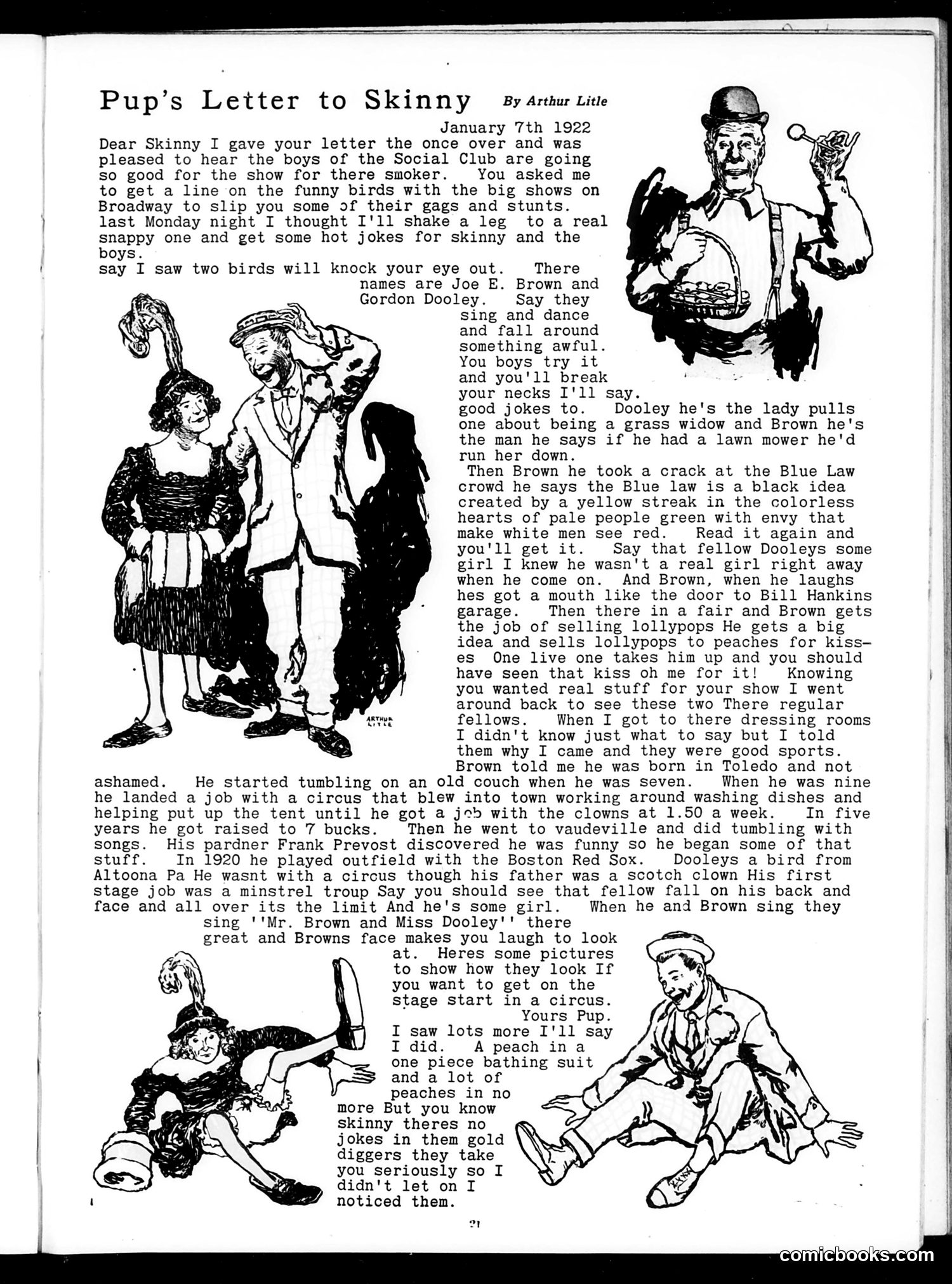
This is an entertainment column disguised as a letter, promoting vaudeville performers **Joe E. Brown and Gordon Dooley**. "Pup" describes attending their act and reports back to "Skinny" about their comedy routines and physical humor. The satire targets **Prohibition-era "Blue Laws"** (alcohol restrictions). Brown delivers a joke mocking these laws as created by envious, colorless people. The reference to "grass widow" and lawn-mower humor reflects 1920s domestic comedy conventions. The piece also reveals performers' humble origins—Brown started as a circus tumbler at age seven, worked with the Boston Red Sox, while Dooley came from a minstrel family. Both used physical comedy and cross-dressing (Dooley performing as "Miss Dooley"). The final joke about "gold diggers" (young women pursuing wealthy men) suggests the author's somewhat cynical view of female performers, though presented as lighthearted observation typical of the era's entertainment journalism.
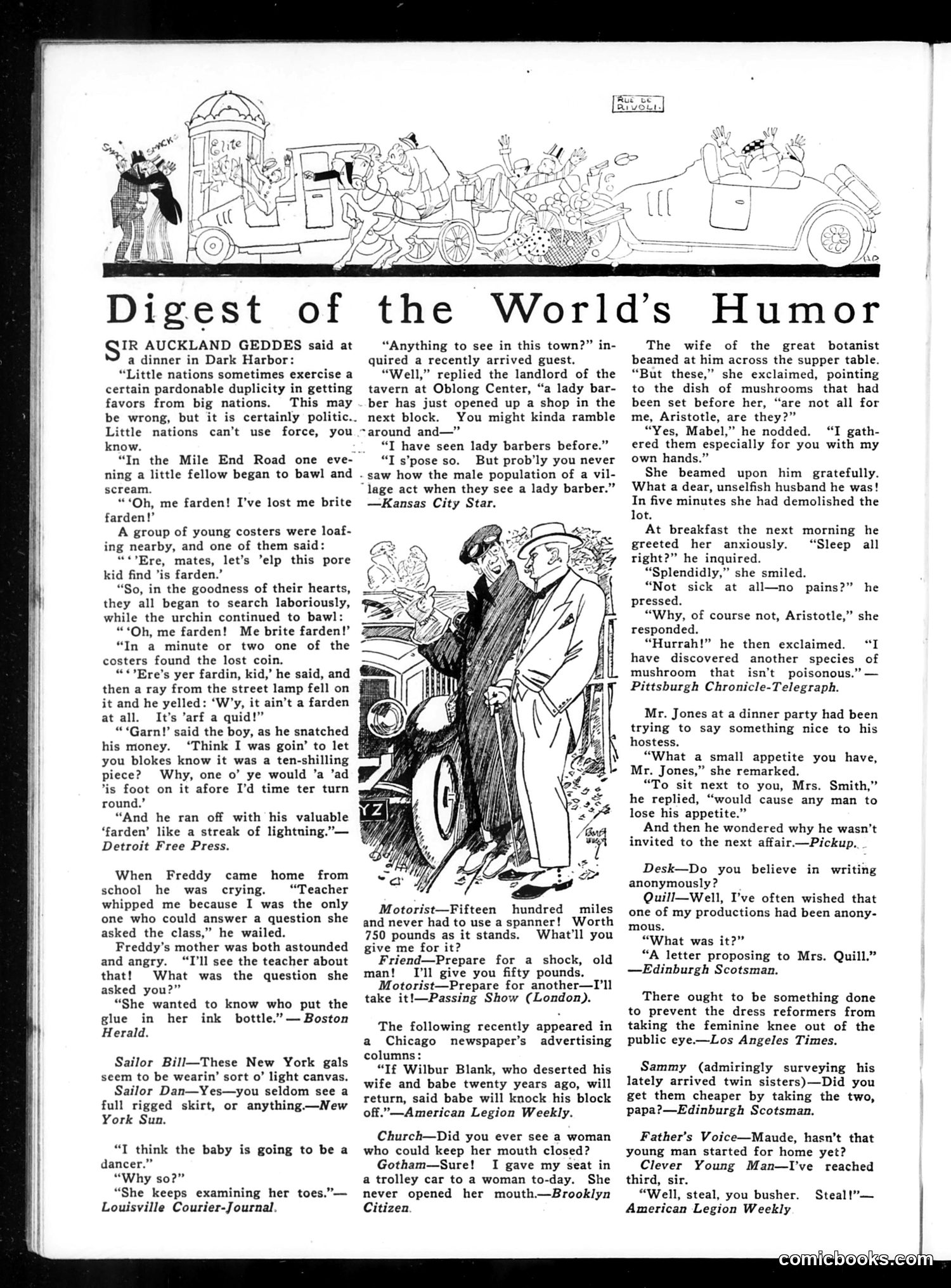
This is a **humor column** collecting jokes and anecdotes from various publications, not a political cartoon. The central illustrated piece depicts a street scene where a child pretends to lose a coin, costers (street vendors) help search, then the child reveals it was actually worth more—illustrating cunning deception. This anecdote, attributed to Sir Auckland Geddes, parallels his point about "little nations" using "pardonable duplicity" to extract favors from larger ones. The surrounding jokes are largely **domestic and social humor**: a teacher punished for not knowing who glued her ink bottle; a botanist husband who gathers mushrooms hoping they're poisonous to test his wife; New York women wearing light clothing; and various observations about gender behavior. The page reflects early-20th-century satirical sensibilities—emphasizing working-class wit, marital tensions, and mild misanthropy—with minimal political content beyond the opening anecdote's diplomatic metaphor.
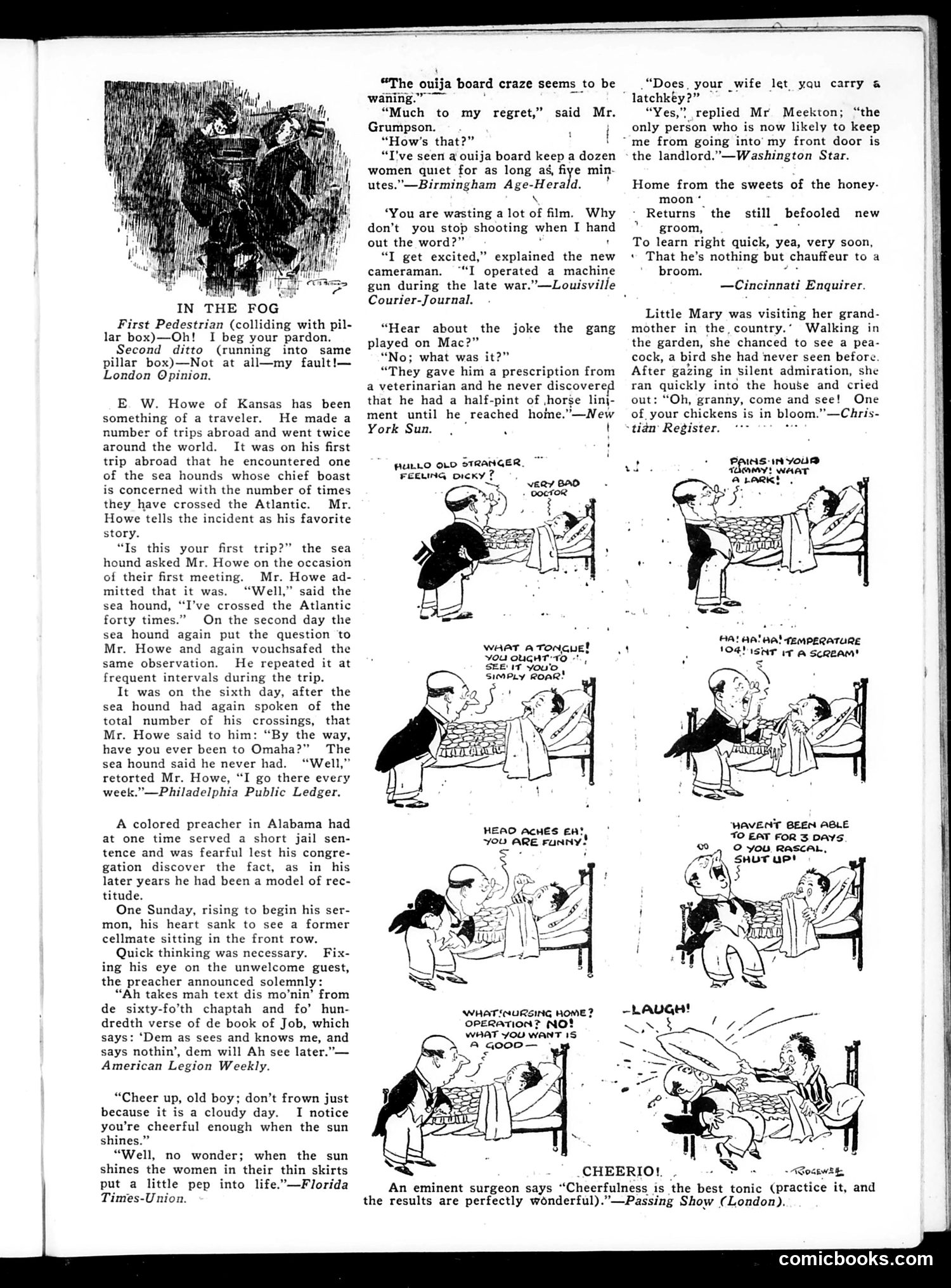
This page from the American satirical magazine *Judge* contains mostly humorous anecdotes and a multi-panel comic strip, rather than political cartoons. The comic strip (center-right) depicts a doctor's examination of a patient with various ailments—tongue problems, headaches, and general malaise. The doctor's repeated prescription is "Cheerio!" (enthusiasm/good cheer), humorously suggesting that optimism itself is medicinal. This satirizes both medical practice and the era's pop psychology about positive thinking. The surrounding text consists of brief jokes mocking contemporary social types: ouija board enthusiasts, newlywed husbands reduced to chauffeurs, boastful sea travelers, and a Black preacher using Biblical misdirection. The humor relies on common stereotypes and domestic situations recognizable to *Judge*'s early-20th-century readership. The final note attributes the "Cheerio" message to an unnamed surgeon, framing cheerfulness as therapeutic—a gentle satire of wellness trends.
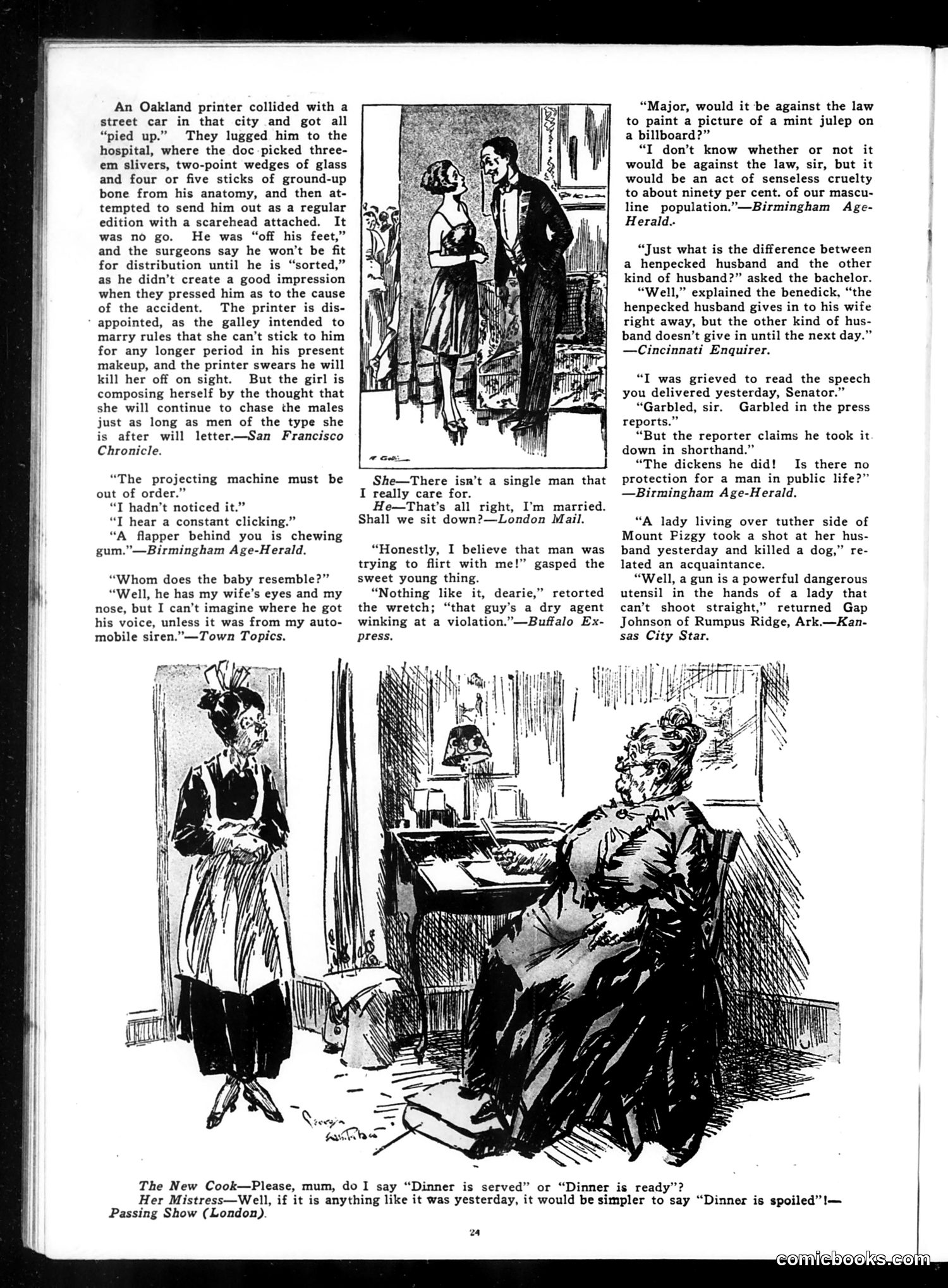
This page from the satirical magazine *Judge* contains multiple short humor pieces and two cartoons targeting early 20th-century social attitudes. **The cartoons and jokes mock:** 1. **Gender dynamics and marriage**: Several pieces ridicule both henpecked husbands and wives' domestic authority, reflecting anxieties about changing marital power structures. 2. **Prohibition era references**: One joke mentions a "dry agent" winking at alcohol violations, referencing the strict enforcement of Prohibition laws and public skepticism about them. 3. **Women's changing roles**: References to "flappers" (modern young women) and a woman shooting a gun suggest anxiety about women's independence and unconventional behavior. 4. **Domestic incompetence**: The cook cartoon mocks a new servant's poor cooking skills. 5. **Male vanity**: The top illustration depicts a flirtatious scene, while jokes about paternity and automobiles poke fun at masculine pride. The humor relies on stereotypes about gender roles, marital conflict, and social propriety typical of the 1920s-30s period.
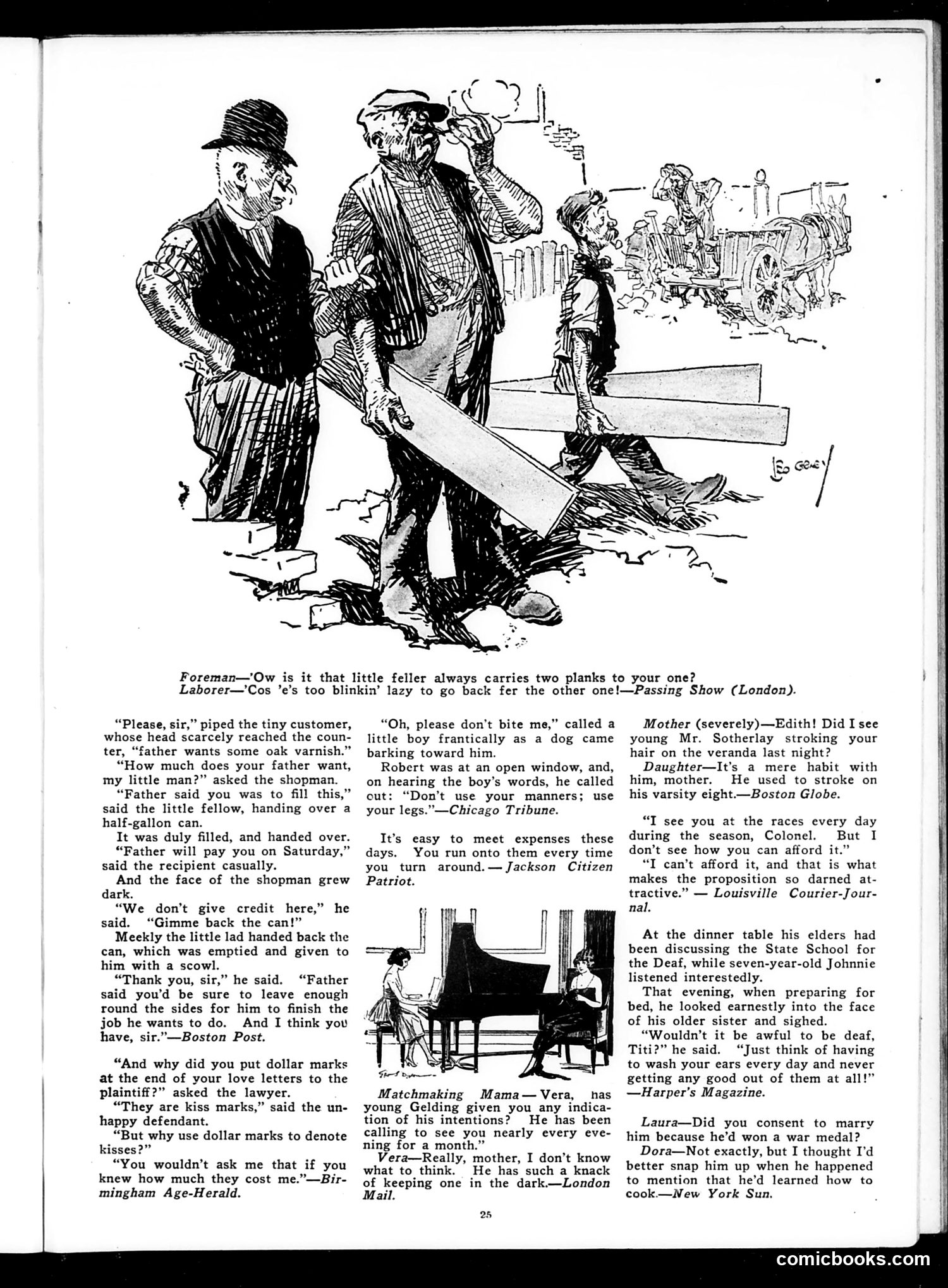
This page from *Judge* magazine contains multiple brief humorous anecdotes and jokes typical of early 20th-century American satirical publications. The top cartoon depicts two laborers with planks—a foreman questioning why the younger worker always carries two planks while others carry one. The punchline reveals the boy's laziness: he brings extras to avoid making return trips. The remaining content consists of short, standalone jokes addressing everyday situations: a child's resourcefulness in getting free varnish by exploiting a shopman's grudge; legal absurdity over "kiss marks" costing money; wordplay about meeting expenses; romantic misunderstandings; and post-war dating where cooking skills prove more valuable than military medals. These pieces reflect working-class and middle-class domestic life, with gentle mockery of human nature—greed, laziness, miscommunication, and vanity. The humor requires no specific historical context beyond understanding common social situations of the era.
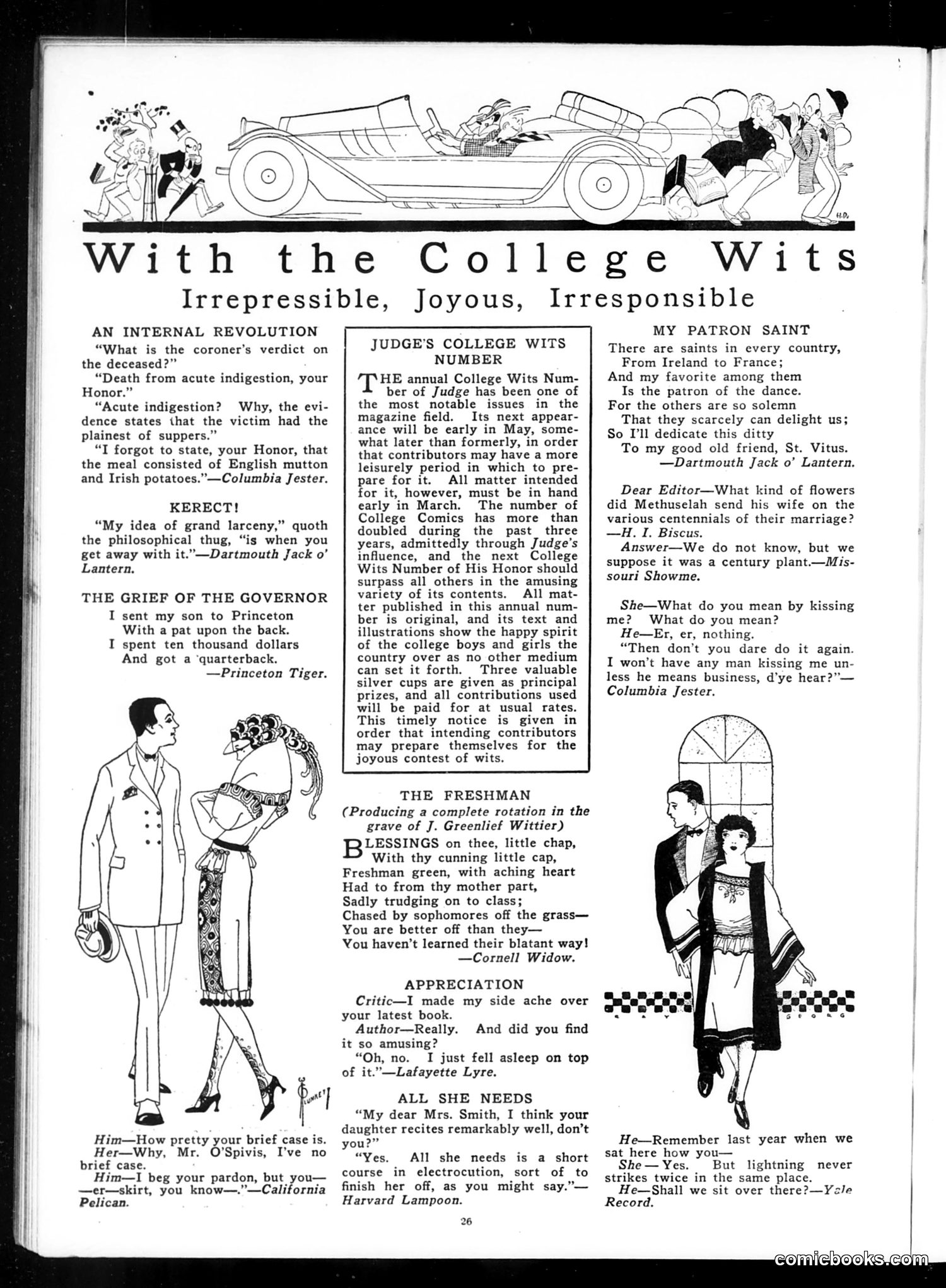
This page collects humorous submissions from college humor magazines (Cornell Widow, Harvard Lampoon, Yale Record, etc.). The jokes target familiar college experiences: freshmen homesickness, romantic miscommunication, academic disinterest, and generational friction between classes. Key satires include: a coroner's verdict blaming death on "English mutton and Irish potatoes" (ethnic stereotyping humor); a governor spending $10,000 on his son's Princeton education to get "a quarterback" (criticizing colleges' athletic priorities over academics); and a woman threatening electrocution as a finishing touch for her daughter's elocution lessons (dark, exaggerated parental desperation). The page announces Judge's annual "College Wits Number," soliciting original material from college writers. The illustrations show fashionable young people in 1920s dress. Overall, the content reflects early 20th-century college culture: lighthearted, occasionally caustic, and focused on youth's perceived foolishness and romantic entanglements.
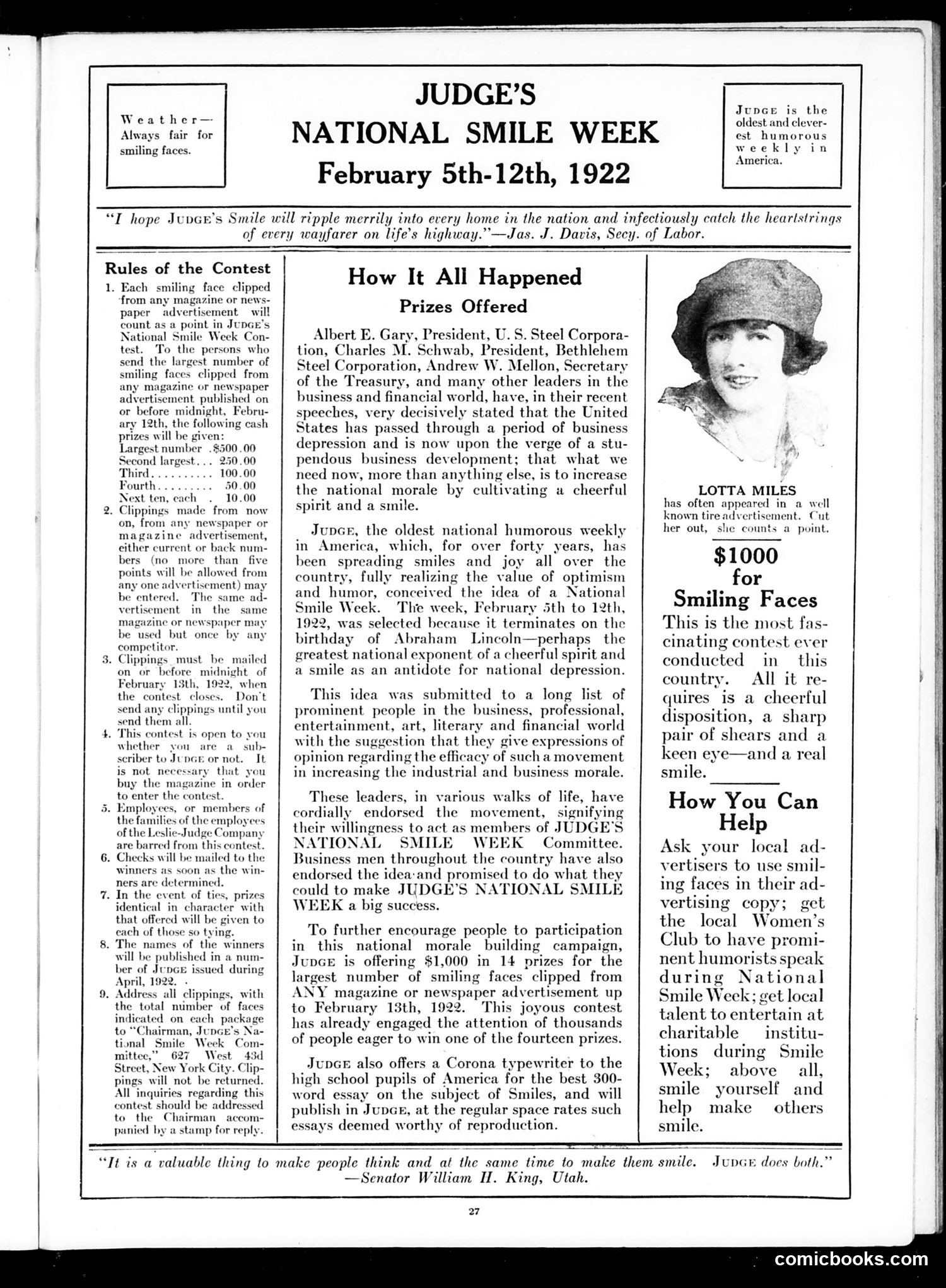
This is a **contest announcement and promotional page**, not a political cartoon. Judge magazine is organizing "National Smile Week" (February 5-12, 1922) as a morale-building campaign following America's post-WWI business recession. **The Context:** Business leaders like steel magnate Albert Gary and Treasury Secretary Andrew Mellon publicly argued that restoring national optimism was crucial for economic recovery. Judge, positioning itself as America's "oldest and cleverest" humor magazine, capitalizes on this sentiment by sponsoring a contest: readers submit smiling faces clipped from advertisements to win cash prizes ($300 for the largest collection). **The Satire:** The implicit joke is gentle—Judge is monetizing patriotic cheerfulness. By framing smile-clipping as a civic duty tied to Lincoln's birthday and national recovery, the magazine turns consumer culture (advertisements) into nationalism while profiting from reader participation. The featured contestant, "Lotta Miles," wins $1,000 for the best smiling faces, reinforcing that optimism literally pays.
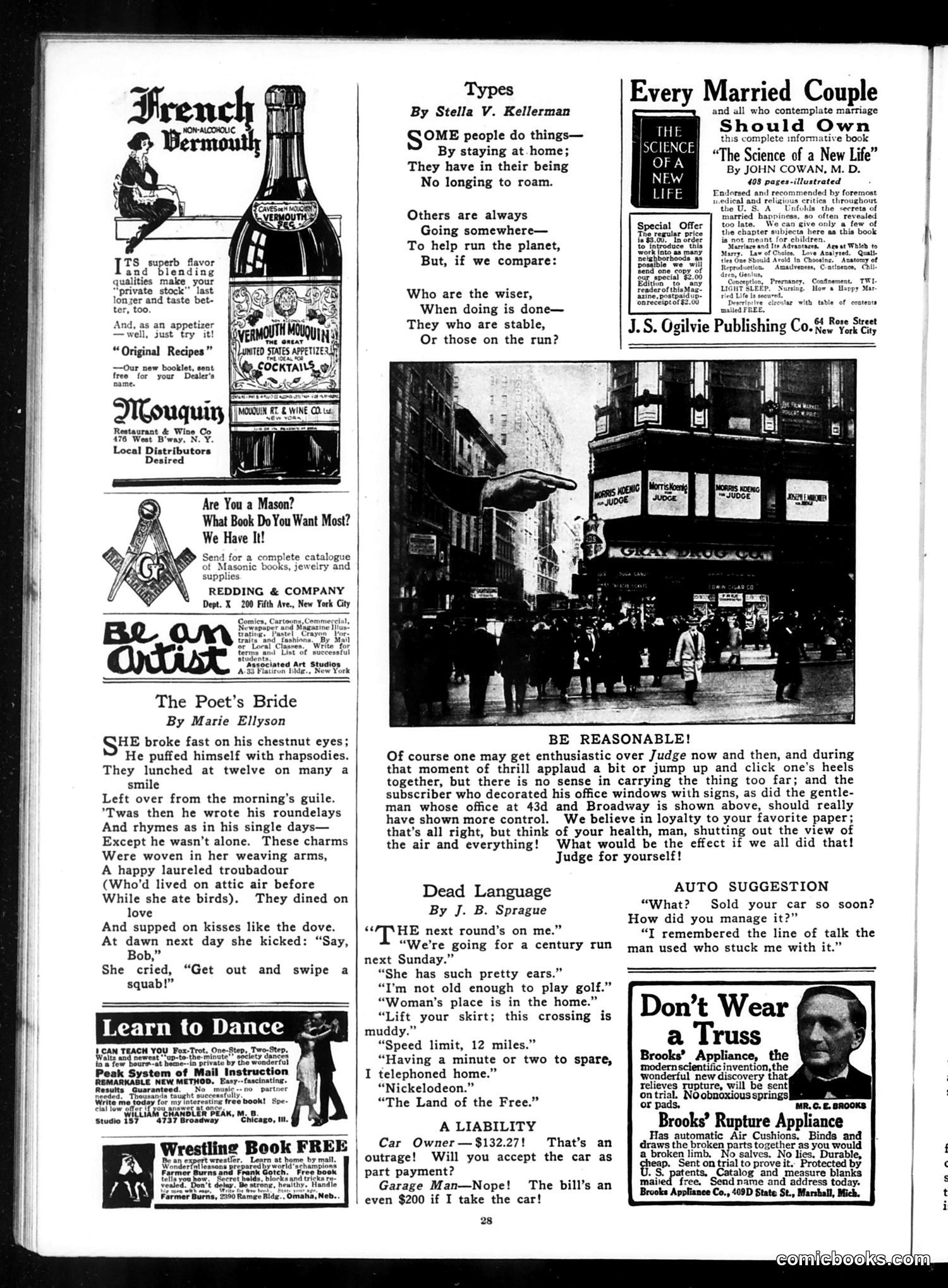
This page from *Judge*, a satirical American magazine, contains mostly **advertisements and light humor** rather than political cartoons. The content reflects early 20th-century concerns: **Main Features:** - **"Types"** by Stella V. Kellerman: A humorous poem contrasting homebodies versus restless travelers, asking who is "wiser"—those settled or those constantly moving. - **"Be Reasonable!"**: A satirical jab at an over-enthusiastic *Judge* subscriber who plastered his office windows (at 43d and Broadway) with magazine signs. The editor gently mocks excessive enthusiasm, pleading for restraint and consideration of others' views. - **Various minor pieces**: "The Poet's Bride," "Dead Language," and "Auto Suggestion" offer light social satire about marriage, dating, and consumerism. **Context:** The page is primarily **commercial**—filled with advertisements for dance lessons, Masonic supplies, medical books, and a rupture appliance—typical of period magazines that blended editorial content with aggressive advertising to readers. The satire targets **consumer enthusiasm and domestic life**, reflecting post-WWI American attitudes.
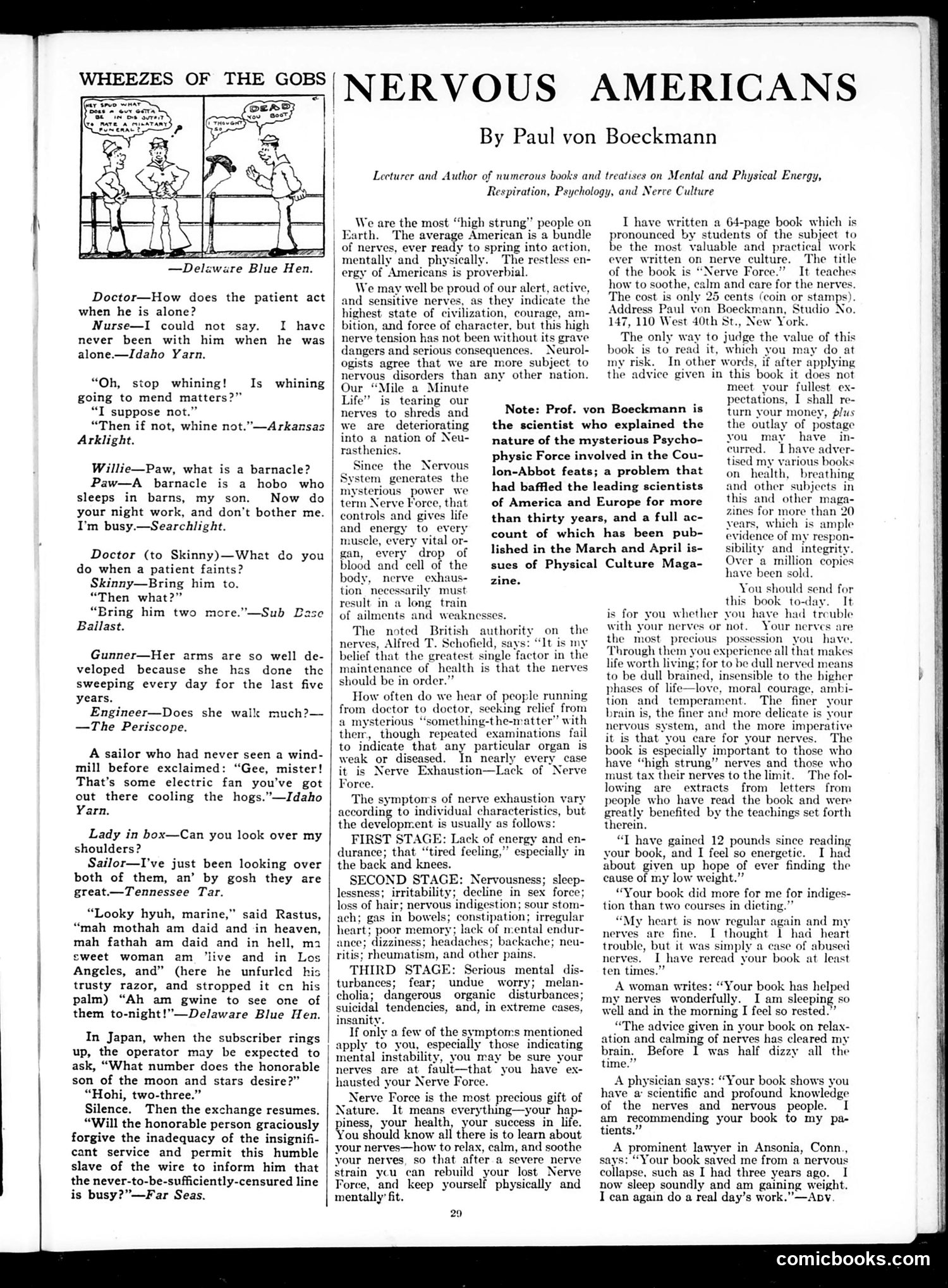
This page combines humor with self-help promotion. The left column features "Wheezes of the Gobs"—short jokes sourced from various regional newspapers, often involving rural stereotypes (sailors, farmers, dialect humor). These are gentle, observational gags about misunderstandings and literal interpretations. The right column promotes Paul von Boeckmann's book on nerve health. Boeckmann argues that Americans are uniquely "high-strung" due to their fast-paced lifestyle, making them prone to "nervous disorders" and "neurasthenia" (a popular diagnosis of the era describing nervous exhaustion). He outlines stages of nerve exhaustion and includes testimonial letters from readers claiming the book cured their ailments. The juxtaposition is ironic: the page mocks American nervousness through jokes while simultaneously selling a cure for the very condition it satirizes. This reflects the early 20th-century concern with "nerve force" as a medical concept and the era's booming self-help publishing industry.
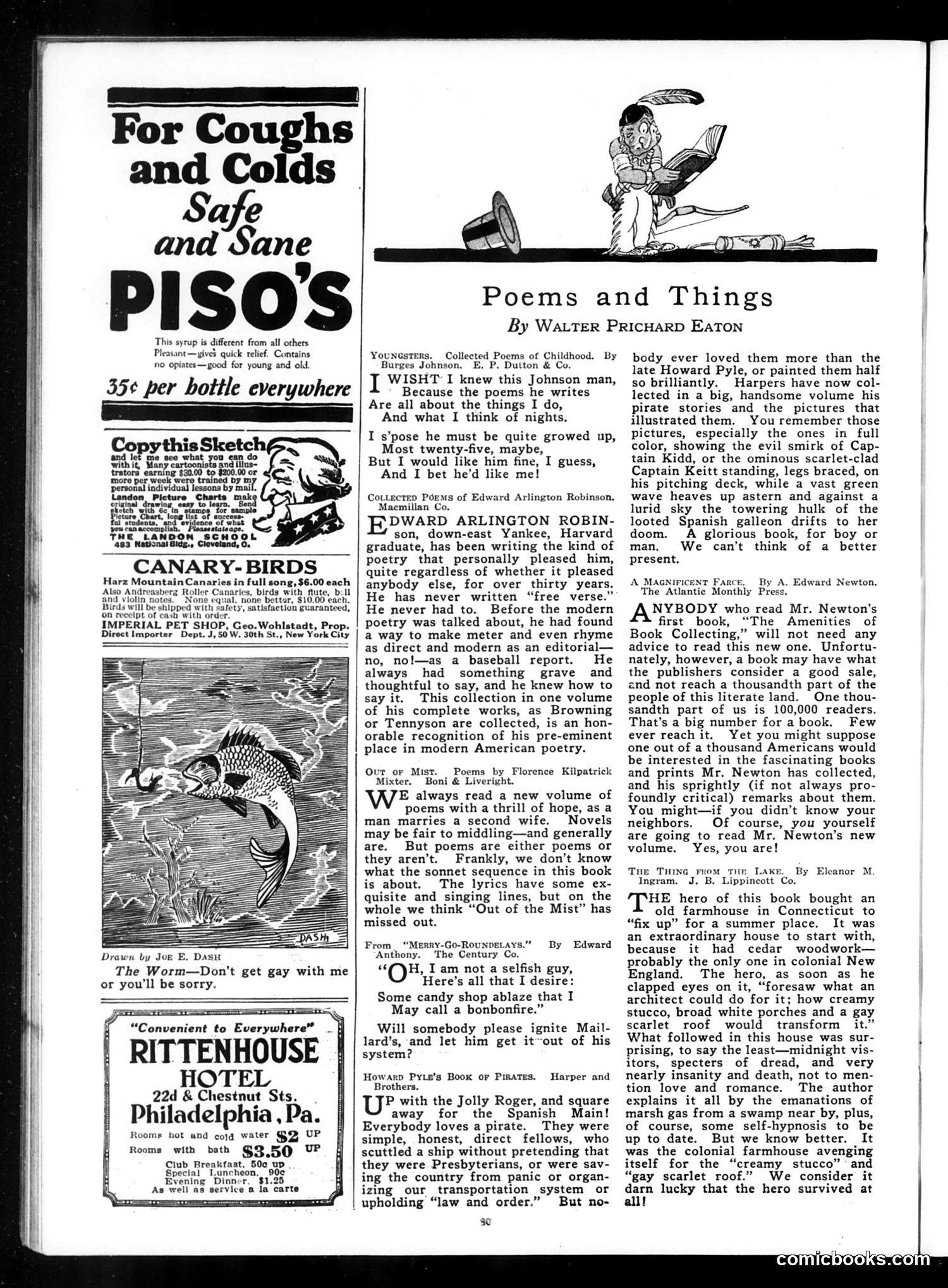
This page combines book reviews with period advertisements. The main content is Walter Prichard Eaton's literary column reviewing recent poetry collections. **The cartoon** (top right) shows a young child reading, illustrating the whimsical tone of reviewing children's poetry. **Key reviews discussed:** - A collection of childhood poems by Burgess Johnson—the reviewer humorously wishes he knew the adult author personally - Edward Arlington Robinson's complete works—praised as serious, metered poetry from a "down-east Yankee" who resisted modernist "free verse" trends - Florence Kilpatrick Mixter's "Out of the Mist"—dismissed as unsuccessful despite some pretty lines - Howard Pyle's pirate book—celebrated for brilliant illustrations and romanticized depictions of pirates as honest outlaws, contrasting them sarcastically with respectable figures who justify their actions through progressivism **The satire**: The pirate passage mocks early 20th-century reformers and business leaders who dressed up self-interest as social progress—pirates were at least honest about their villainy. **Advertisements** include cough syrup, canaries, and a Philadelphia hotel.
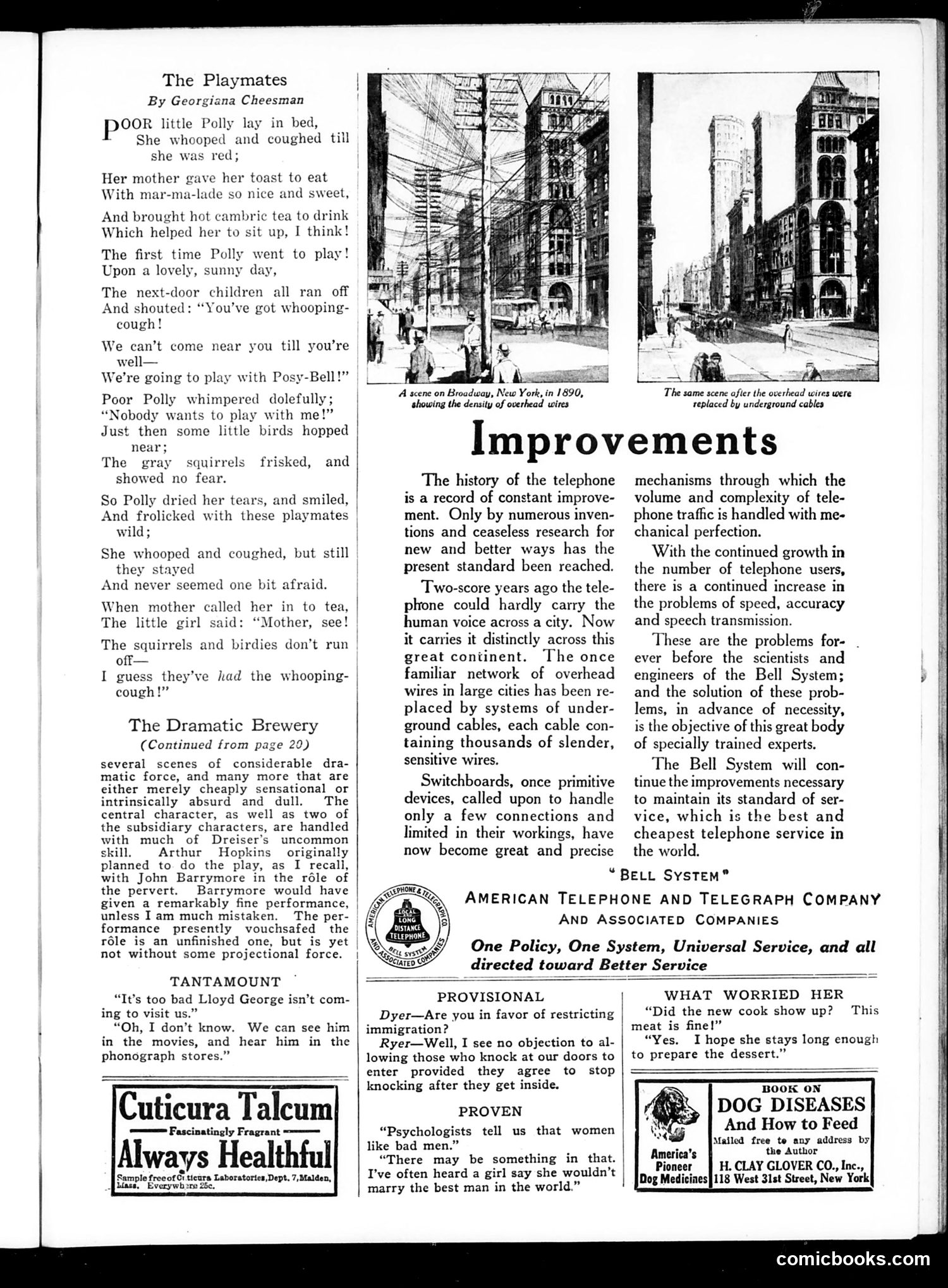
This Judge magazine page contains three distinct elements: **"The Playmates" poem** depicts a sick child with whooping cough ostracized by neighborhood playmates who fear contagion. The moral lesson: animals show no such prejudice, offering companionship where humans withhold it. This sentimentalizes nature's innocence versus human selfishness—typical of early-1900s children's literature. **"The Dramatic Brewery" continues theater criticism, discussing a play's performance quality. **The dominant content is a Bell System advertisement** showing urban infrastructure transformation: comparing Broadway's 1890 tangle of overhead telephone wires to the "improved" underground cable system. The ad celebrates technological progress and positions Bell as the responsible steward of modernization. The accompanying text emphasizes constant innovation, growing user demand, and Bell's commitment to "Better Service"—standard corporate self-promotion framing infrastructure improvements as both necessity and virtue. Small advertisements for Cuticura talcum powder and a dog disease book fill remaining space.
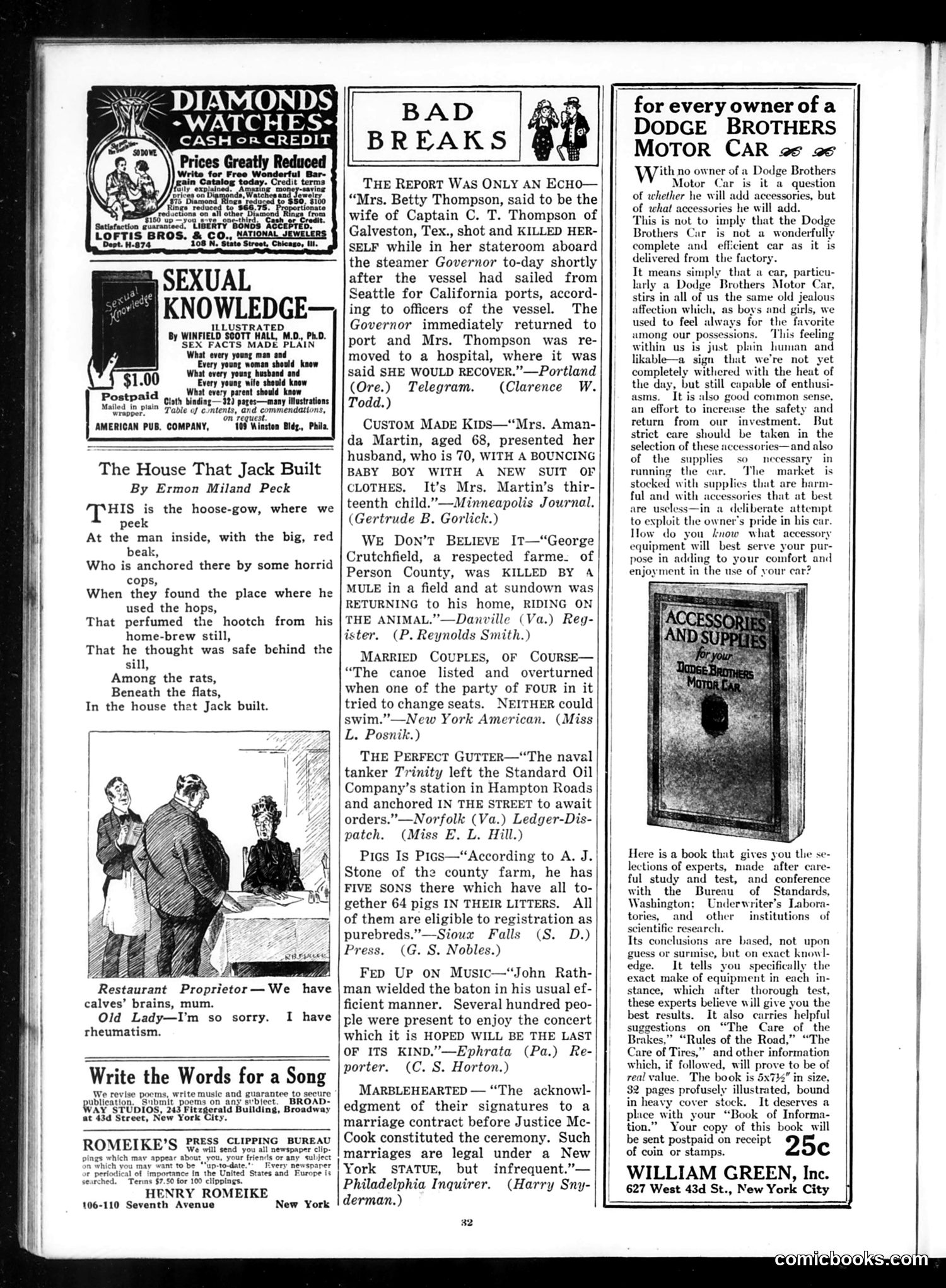
This page from *Judge* features a humor column titled "Bad Breaks" that mocks absurd or contradictory newspaper headlines. The satire works by reprinting actual clippings with obvious logical errors or impossible claims highlighted in capitals. Examples include: a woman who "shot and KILLED HERSELF" but "WOULD RECOVER"; a 68-year-old woman giving birth to her thirteenth child; a farmer killed by a mule but "RETURNING to his home, RIDING ON THE ANIMAL"; and a naval tanker "anchored IN THE STREET." The joke targets careless newspaper reporting and editing—these contradictions suggest either sloppy writing or absurd situations presented without irony. It's satire of the emerging mass media's unreliability and sensationalism. The credited editors (names in parentheses) appear to be *Judge* readers submitting ridiculous clippings they'd found. The page also includes period advertisements for books on sex education and song-writing services, typical of early 20th-century magazine content.
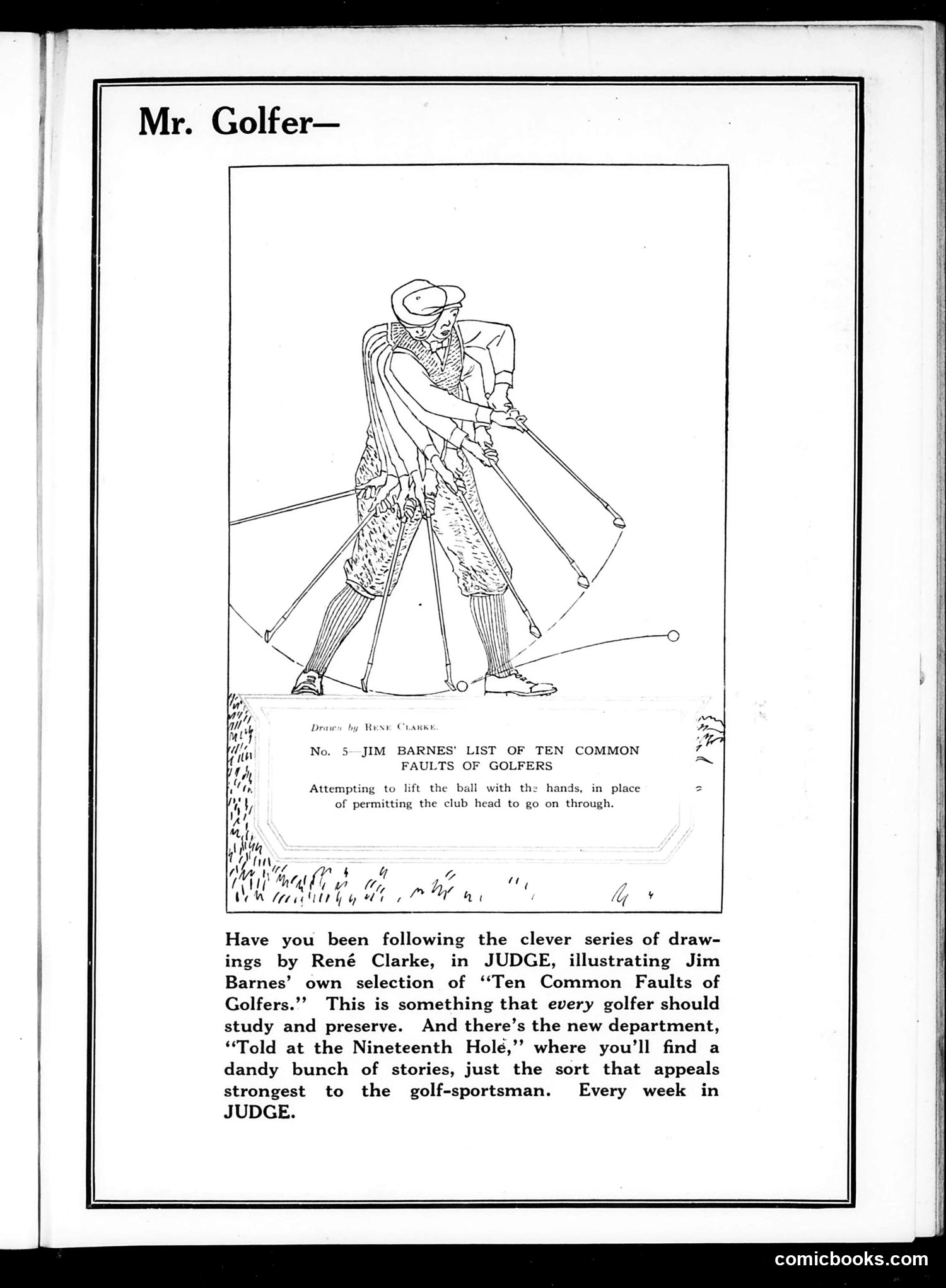
This page promotes an instructional cartoon series about golf technique. Illustration No. 5, drawn by René Clarke, depicts a common golfing error: a player attempting to manually lift the ball upward with his hands rather than letting the club head follow through naturally on its swing. The figure shows exaggerated body contortions—multiple arm positions radiating outward—to humorously emphasize this mistake. Jim Barnes, apparently a golf authority or instructor of the era, selected ten common faults for this educational series meant to help golfers improve their form. The accompanying text encourages *Judge* readers to follow this ongoing series and mentions a new golf-themed story department called "Told at the Nineteenth Hole." This combines instruction with entertainment for golf enthusiasts—positioning *Judge* magazine as essential reading for the golfing public during this period.
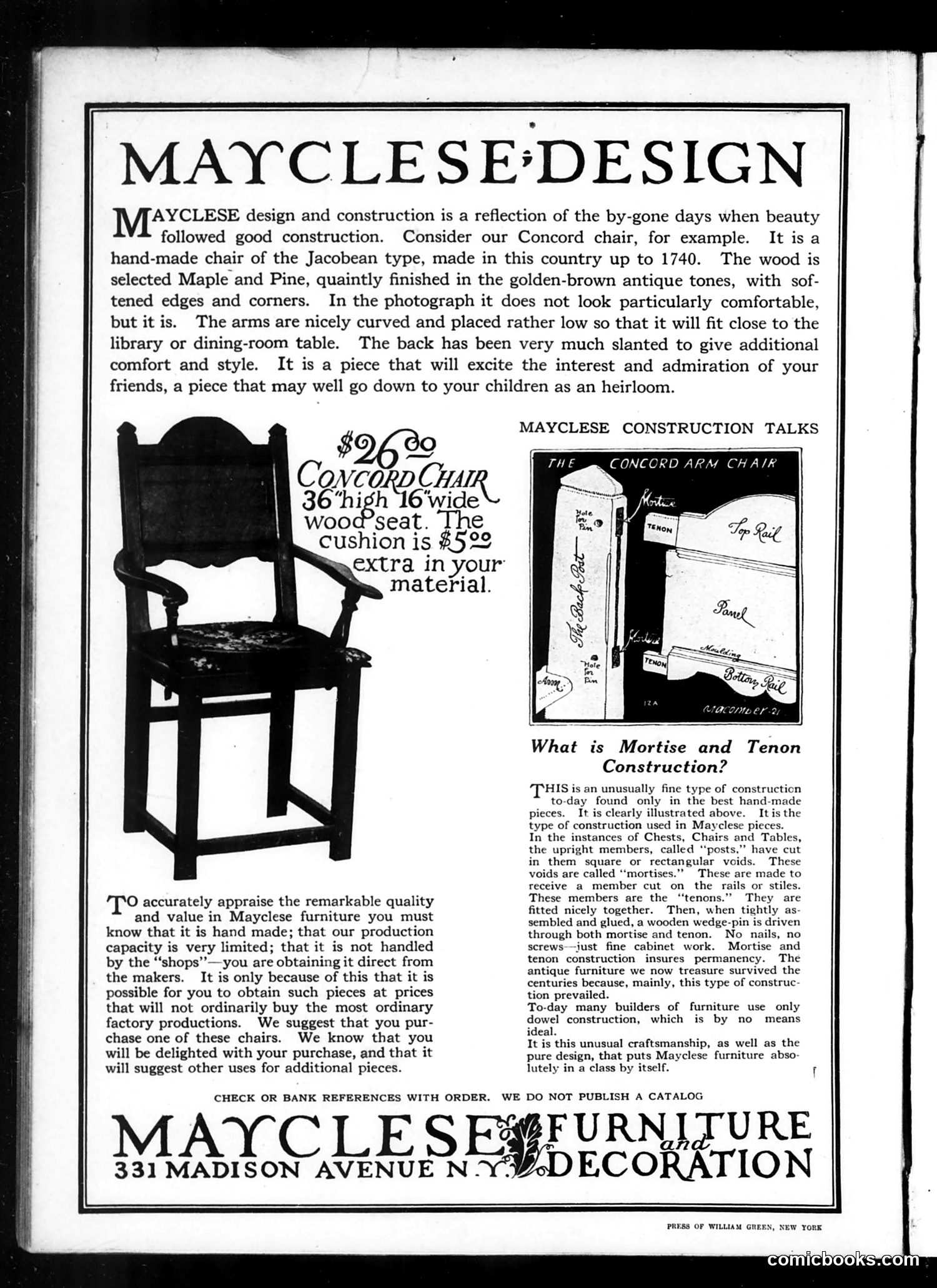
This is a furniture advertisement, not a political cartoon. The page promotes Mayclese Furniture and Decoration's "Concord Chair," a Jacobean-style hand-made chair priced at $26.80 (circa 1920s-1930s based on typography and styling). The ad appeals to consumers' nostalgia for pre-industrial craftsmanship, emphasizing that the chair is "hand made" using traditional "mortise and tenon construction"—joinery methods from antique furniture that predated factory mass production. The marketing strategy targets affluent buyers seeking heirloom-quality pieces and authentic Colonial aesthetics as status symbols. The text contrasts Mayclese's limited-production, direct-from-makers approach against mass-market "factory productions," positioning handcrafted goods as superior and more valuable than ordinary shop merchandise. This reflects early 20th-century consumer culture celebrating artisanal goods as antidotes to industrial manufacturing.