
Judge, 1922-01-07 · page 31 of 36
Judge — January 7, 1922 — page 31: what you’re looking at
What you’re looking at
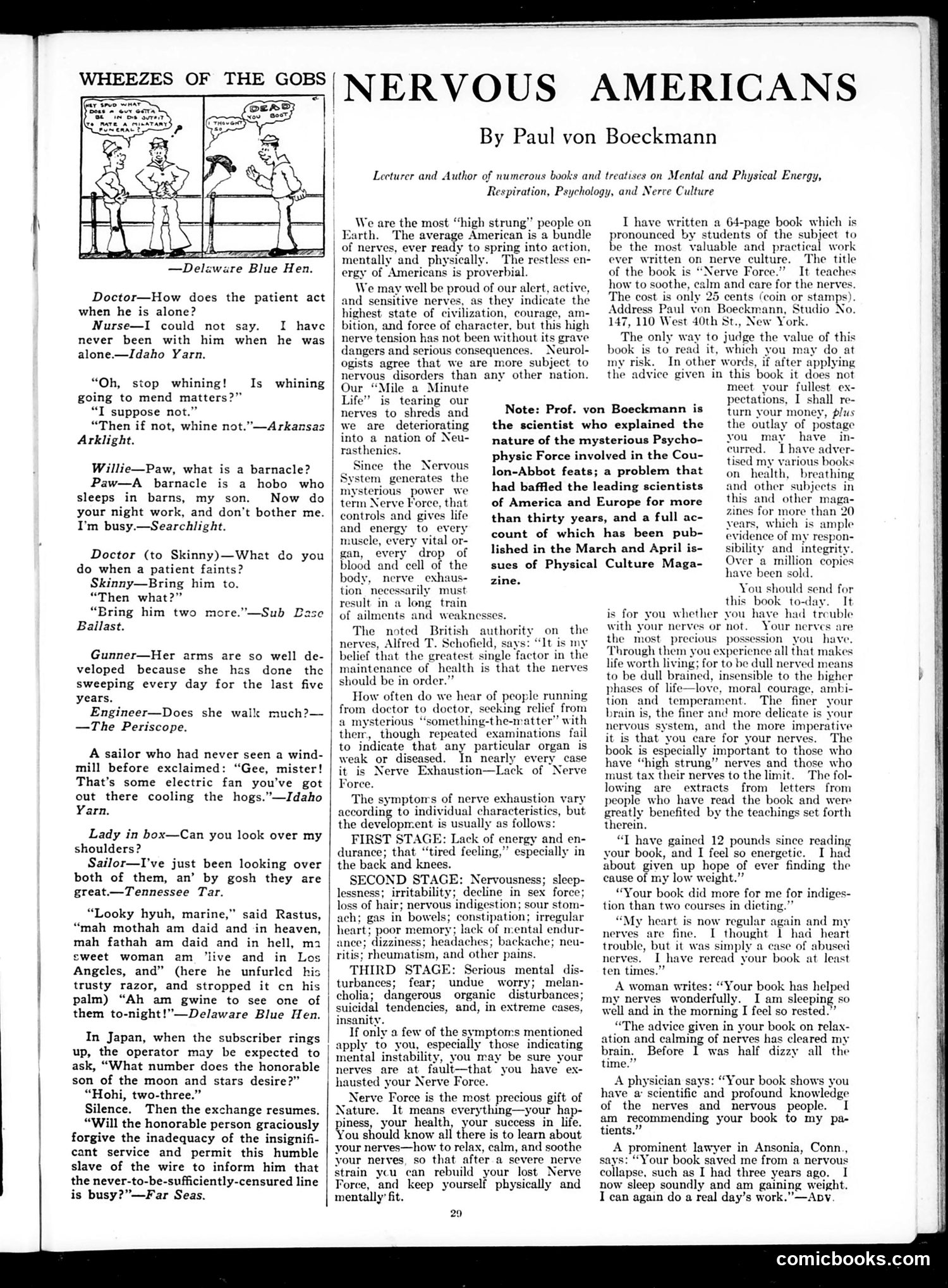
This page combines humor with self-help promotion. The left column features "Wheezes of the Gobs"—short jokes sourced from various regional newspapers, often involving rural stereotypes (sailors, farmers, dialect humor). These are gentle, observational gags about misunderstandings and literal interpretations. The right column promotes Paul von Boeckmann's book on nerve health. Boeckmann argues that Americans are uniquely "high-strung" due to their fast-paced lifestyle, making them prone to "nervous disorders" and "neurasthenia" (a popular diagnosis of the era describing nervous exhaustion). He outlines stages of nerve exhaustion and includes testimonial letters from readers claiming the book cured their ailments. The juxtaposition is ironic: the page mocks American nervousness through jokes while simultaneously selling a cure for the very condition it satirizes. This reflects the early 20th-century concern with "nerve force" as a medical concept and the era's booming self-help publishing industry.
📄 Transcribed text from this page (OCR, searchable)
Machine-transcribed from the original scan — historical spelling and the odd misread are preserved.
WHEEZES OF THE S| NERVOUS AMERICANS Cease —Delzware Blue Hen. Doctor—How does the patient act when he is alone? Nurse—I could not say. I have never been with him when he was alone.—Idaho Yarn. “Oh, stop whining! Is whining going to mend matters?” “T suppose not.” “Then if not, whine not.”—Arkansas Arklight. Willie—Paw, what is a barnacle? Paw—A barnacle is a hobo who sleeps in barns, my son. Now do your night work, and don’t bother me. I'm busy.—Searchlight. Doctor (to Skinny)—What do you do when a patient faints? Skinny—Bring him to. “Then what?” “Bring him two more.”—Sub Dase Bailast. Gunner—Her arms are so well de- veloped because she has done the sweeping every day for the last five years. Engineer—Does she walk much?— —The Periscope. A sailor who had never seen a wind- mill before exclaimed: “Gee, mister! That’s some electric fan you've got out there cooling the hogs.”—Idaho Yarn. Lady in box—Can you look over my shoulders? Sailor—I’ve just been looking over both of them, an’ by gosh they are great.—Tennessee Tar. “Looky hyuh, marine,” said Rastus, “mah mothah am daid and in heaven, mah fathah am daid and in hell, ma sweet woman am ‘live and in Los Angeles, and” (here he unfurled his trusty razor, and stropped it cn his palm) “Ah am gwine to see one of them to-night!”—Delaware Blue Hen. In Japan, when the subscriber rings up, the operator may be expected to ask, “What number does the honorable son of the moon and stars desire?” “Hohi, two-three.” Silence. Then the exchange resumes. “Will the honorable person graciously forgive the inadequacy of the insignifi- cant service and permit this humble slave of the wire to inform him that the never-to-be-sufficiently-censured line is busy?”—Far Seas. By Paul von Boeckmann Lecturer and Author of numerous books and treatises on Mental and Physical Energy, Respiration, Psychology, and Nerve Culture We are the most “high strung” people on rth. The average American is a bundle of nerves, ever ready to spring into action, mentally and physically. The restless en- ergy of Americans is proverbial. We may well be proud of our alert, active, and sensitive nerves, as they indicate the highest state of civilization, courag bition, and force of character, but this high nerve tension has not been without its grave dangers and serious consequences. Neurol- ogists agree that we are more subject to nervous disorders than any other nation. Our “Mile a Minute Life” tearing our nerves to shreds and we are deteriorating into a nation of Neu- rasthenics. Since the Nervous stem generates the mysterious power we term Nerve Force, that controls and gives life and energy to every musele, every vital or- gan, every drop of blood and’ cell of the body, nerve exhaus- zine. tion necessarily must result in a long train of ailments and weaknesses. The noted British authority | on the nerves, Alfred T. Schofield, s “It is my belief that the greatest ingle factor in the maintenance of health is that the nerves should be in order.” How often do we hear of people running from doctor to doctor, secking relief from a mysterious “something-the-matter’ with though repeated examinations fail to indicate that any particular organ is k or diseased. In nearly every case it is Nerve Exhaustion—Lack of Nerve Force. The symptorrs of nerve exhaustion vary according to individual characteristics, but the development is usually as follows: FIRST STAGE: Lack of energy and en- durance; that “tired feeling,” especially in the back and knees. SECOND STAGE: Nervousness; sleep- lessness; decline in sex force; indigestion; sour stom- H constipation; irregular of mental endur- ziness; headaches; backache; neu- is; rheumatism, and other pains. THIRD STAGE: Serious mental dis- turbances; fear; undue worry; melan- cholia; dangerous organic disturbances; idal tendencies, and, in extreme cases, insanity. If only a few of the symptoms mentioned apply to you, especially those indicating mental instability, you may be sure your nerves are at fault—that you have ex- hausted your Nerve Force. Nerve Force is the most precious gift of Nature. It means everything—your hap- iness, your health, your success in life. You should know all there is to learn about your nerves—how to relax, calm, and soothe your nerves, so that after a severe nerve strain ycu can rebuild your lost Nerve Force, ‘and keep yourself physically and mentally’ fit. irritabilit 29 Note: Prof. von Boeckmann is the scientist who explained the nature of the mysterious Psycho- physic Force involved in the Cou- lon-Abbot feats; a problem that = on, had baffled the leading scientists of America and Europe for more than thirty years, and a full ac- count of which has been pub- lished in the March and April is- sues of Physical Culture Maga- I have written a 64-page book which is pronounced by students of the subject to be the most valuable and practical work ever written on nerve culture. The title of the book is “Nerve Force.” It teaches how to soothe, calm and care for the nerves. The cost is onl; cents (coin or stamps). Address Paul von Boeckmann, Studio No. 147, 110 West 40th St., New York. The only way to judge the value of this book is to read it, which you may do at my ris! In other words, if after applying the advice given in this book it does not meet your fullest ex- pectations, I shall re- turn your money, plus the outlay of postage you may have_ in- curred. I have adver- tised my various books health, thing and other subjects in this and other maga- zines for more than 20 years, which is ample idence of my respon- sibility and_ integrity. Over a million copies have been sold. You should send for this book to-day. It is for you whether you have had treuble with your nerves or not. Your nerves are the most precious possession you have. Through them you experience all that makes life worth living; for to be dull nerved means to be dull brained, insensible to the higher phases of life—love, moral courage, ambi- tion and temperament. The finer your brain is, the finer and more delicate is your nervous system, and the more imperative it is that you care for your nerves. The book is especially important to those who have “high strung” nerves and those who must tax their nerves to the limit. The fol- lowing are extracts from letters from people who have read the book and were greatly benefited by the teachings set forth therein. “I have gained 12 pounds since reading your book, and I feel so energeti had about given up hope of ever finding the cause of my low weight.” “Your book did more for me for indiges- tion than two courses in dieting.” “My heart is now regular again and my nerves are fine. I thought 1 had heart trouble, but it was simply a case of abused nervy I have reread your book at least ten times.” A woman writes: “Your book has helped my nerves wonderfully. I am sleeping so well and in the morning I feel so rested.” “The advice given in your book on relax- ation and calming of nerves has cleared my brain. Before 1 was half dizzy all the time.” A physician says: “Your book shows you have a: scientific and profound knowledge of the nerves and nervous people. I am recommending your book to my pa- tients.” A prominent lawyer in Ansonia, Conn., says: “Your book saved me from a nervous collapse, such as I had three years ago. I now sleep soundly and am gaining weight. I can again do a real day’s work.” —Abv comicbooks.com