
Judge, 1922-01-07 · page 27 of 36
Judge — January 7, 1922 — page 27: what you’re looking at
What you’re looking at
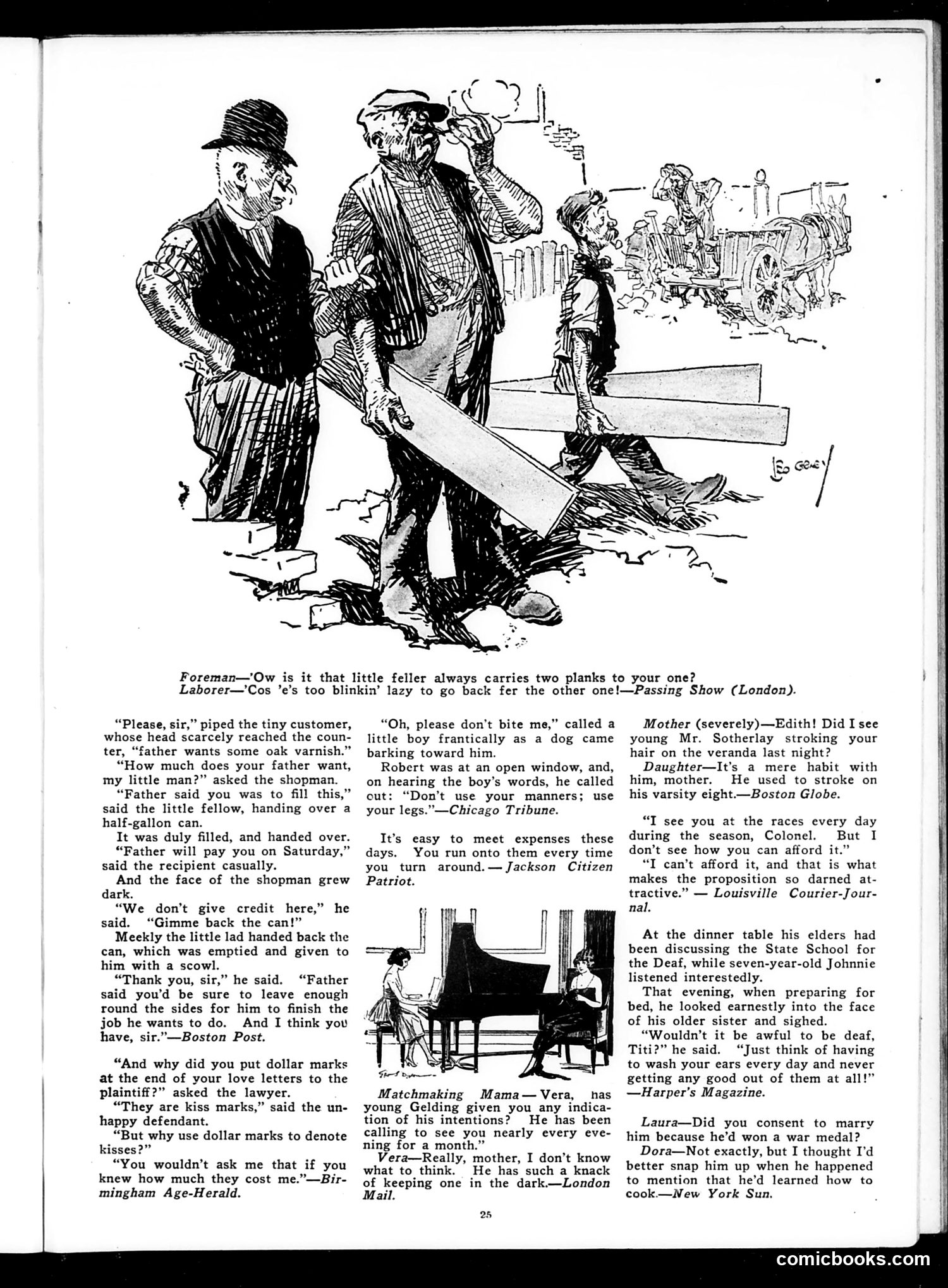
This page from *Judge* magazine contains multiple brief humorous anecdotes and jokes typical of early 20th-century American satirical publications. The top cartoon depicts two laborers with planks—a foreman questioning why the younger worker always carries two planks while others carry one. The punchline reveals the boy's laziness: he brings extras to avoid making return trips. The remaining content consists of short, standalone jokes addressing everyday situations: a child's resourcefulness in getting free varnish by exploiting a shopman's grudge; legal absurdity over "kiss marks" costing money; wordplay about meeting expenses; romantic misunderstandings; and post-war dating where cooking skills prove more valuable than military medals. These pieces reflect working-class and middle-class domestic life, with gentle mockery of human nature—greed, laziness, miscommunication, and vanity. The humor requires no specific historical context beyond understanding common social situations of the era.
📄 Transcribed text from this page (OCR, searchable)
Machine-transcribed from the original scan — historical spelling and the odd misread are preserved.
Foreman—’Ow is it that little feller always carries two planks to your one? Laborer—’Cos ’e’s too blinkin’ lazy to go back fer the other one!—Passing Show (London). “Please, sir,” piped the tiny customer, whose head scarcely reached the coun- ter, “father wants some oak varnish.” “How much does your father want, my little man?” asked the shopman. “Father said you was to fill this,” said the little fellow, handing over a half-gallon can. It was duly filled, and handed over. “Father will pay you on Saturday,” said the recipient casually. And the face of the shopman grew dark. “We don’t give credit here,” he said. “Gimme back the can!” Meekly the little lad handed back the can, which was emptied and given to him with a scowl. “Thank you, sir,” he said. “Father said you’d be sure to leave enough round the sides for him to finish the job he wants to do. And I think you have, sir.”"—Boston Post. “And why did you put dollar marks at the end of your love letters to the plaintiff?” asked the lawyer. “They are kiss marks,” said the un- happy defendant. “But why use dollar marks to denote kisses?” “You wouldn’t ask me that if you knew how much they cost me.”—Bir- mingham Age-Herald. “Oh, please don’t bite me,” called a little boy frantically as a dog came barking toward him. Robert was at an open window, and, on hearing the boy’s words, he called out: “Don’t use your manners; use your legs.”—Chicago Tribune. It’s easy to meet expenses these days. You run onto them every time you turn around.— Jackson Citizen Patriot. has Matchmaking Mama— Vera, young Gelding given you any indica- tion of his intentions? He has been calling to see you nearly every eve- ning for a month.” Vera—Really, mother, I don’t know what to think. He has such a knack of keeping one in the dark.—London Mail. 25 Mother (severely)—Edith! Did I see young Mr. Sotherlay stroking your hair on the veranda last night? Daughter—It’s a mere habit with him, mother. He used to stroke on his varsity eight—Boston Globe. “T see you at the races every day during the season, Colonel. But I don’t see how you can afford it.” “I can’t afford it, and that is what makes the proposition so darned at- tractive.” — Louisville Courier-Jour- nal. At the dinner table his elders had been discussing the State School for the Deaf, while seven-year-old Johnnie listened interestedly. That evening, when preparing for bed, he looked earnestly into the face of his older sister and sighed. “Wouldn’t it be awful to be deaf, Titi?” he said. “Just think of having to wash your ears every day and never getting any good out of them at all!” —Harper’s Magazine. Laura—Did you consent to marry him because he’d won a war medal? Dora—Not exactly, but I thought I’d better snap him up when he happened to mention that he’d learned how to cook.—New York Sun. comicbooks.com