
Judge, 1922-01-07 · page 15 of 36
Judge — January 7, 1922 — page 15: what you’re looking at
What you’re looking at
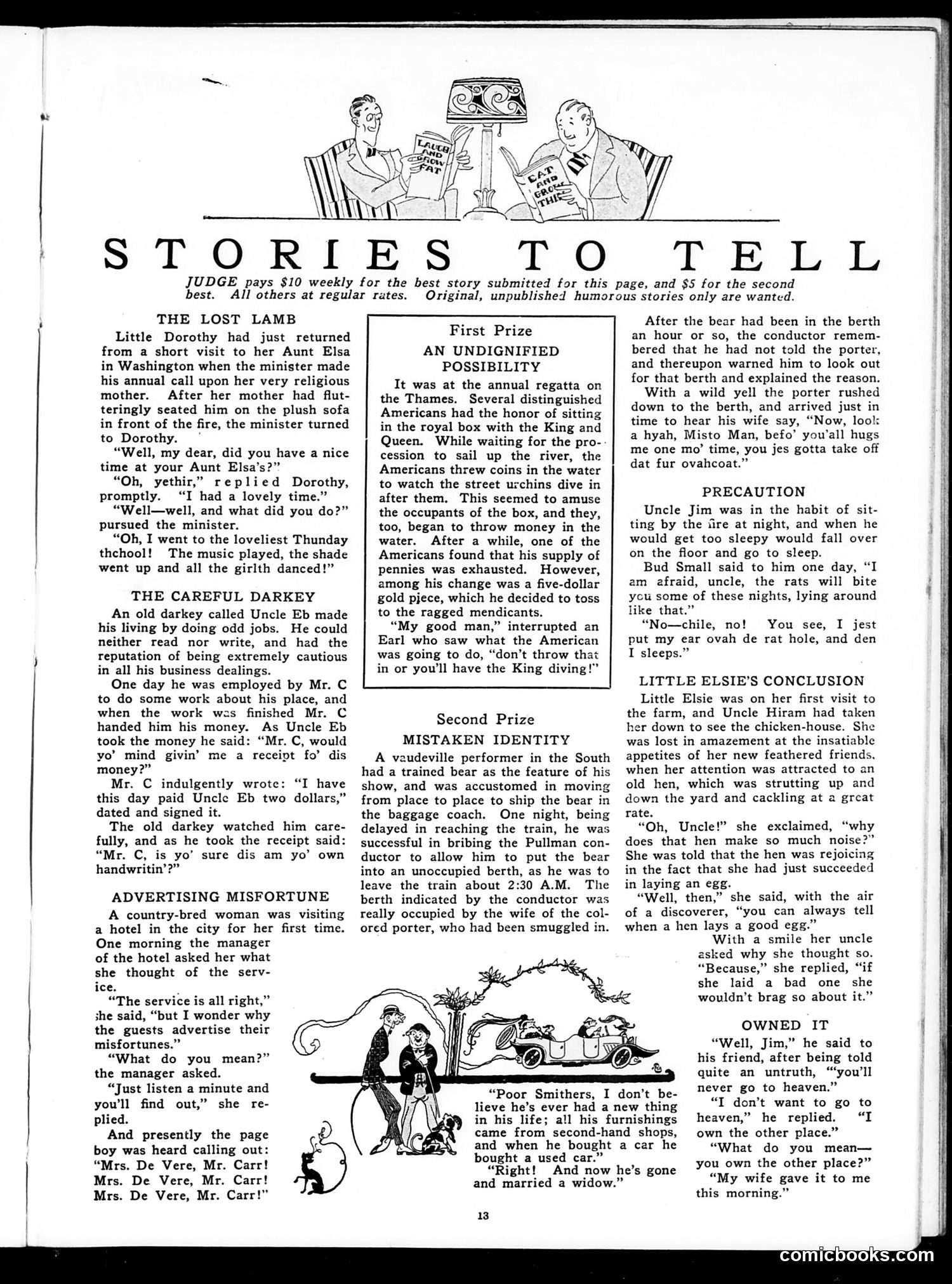
This page from Judge presents humor through three short stories, representing the magazine's satirical approach to early 20th-century American life. **"The Lost Lamb"** mocks religious hypocrisy: a minister interrogates a child about her visit, expecting moral improvement, but she innocently reports attending secular dancing—undermining his assumption that religious instruction should dominate her time. **"The Careful Darkey"** relies on period racial stereotypes, depicting an African American worker as overly cautious in requesting a receipt, played for laughs at his supposed illiteracy and suspicious nature. **"The Undignified Possibility"** satirizes American vulgarity abroad: wealthy Americans at a Thames regatta embarrass themselves by tossing coins to urchins, prompting a British Earl's quip that even royalty might undignified dive after money—mocking nouveau riche American behavior. **"Advertising Misfortune"** jokes about bellhops announcing guest names (De Vere, Carr) repeatedly—the country woman interprets repeated summons as guests publicly advertising their failures to appear. These stories reflect Judge's target audience: educated urbanites who viewed themselves as superior to rural folk, immigrant communities, and "uncultured" Americans.
📄 Transcribed text from this page (OCR, searchable)
Machine-transcribed from the original scan — historical spelling and the odd misread are preserved.
STORI ES JUDGE pays $10 weekly for the best story submitted for this page, and $5 for the second best. THE LOST LAMB Little Dorothy had just returned from a short visit to her Aunt Elsa in Washington when the minister made his annual call upon her very religious mother. After her mother had flut- teringly seated him on the plush sofa in front of the fire, the minister turned to Dorothy. “Well, my dear, did you have a nice time at your Aunt Elsa’s?” “Oh, yethir,” replied Dorothy, promptly. “I had a lovely time.” “Well—well, and what did you do?” pursued the minister. “Oh, I went to the loveliest Thunday thchool! The music played, the shade went up and all the girlth danced!” THE CAREFUL DARKEY An old darkey called Uncle Eb made his living by doing odd jobs. He could neither read nor write, and had the reputation of being extremely cautious in all his business dealings. One day he was employed by Mr. C to do some work about his place, and when the work was finished Mr. C handed him his money. As Uncle Eb took the money he said: “Mr. C, would yo’ mind givin’ me a receipt fo’ dis money?” Mr. C indulgently wrote: “I have this day paid Uncle Eb two dollars,” dated and signed it. The old darkey watched him care- fully, and as he took the receipt said: “Mr. C, is yo’ sure dis am yo’ own handwritin’?” ADVERTISING MISFORTUNE A country-bred woman was visiting a hotel in the city for her first time. One morning the manager of the hotel asked her what she thought of the serv- ice. . “The service is all right,” she said, “but I wonder why the guests advertise their misfortunes.” “What do you mean?” the manager asked. “Just listen a minute and you'll find out,” she re- plied. And presently the page boy was heard calling out: “Mrs. De Vere, Mr. Carr! Mrs. De Vere, Mr. Carr! Mrs. De Vere, Mr. Carr!” All others at regular rates. First Prize AN UNDIGNIFIED POSSIBILITY It was at the annual regatta on the Thames. Several distinguished Americans had the honor of sitting in the royal box with the King and Queen. While waiting for the pro- cession to sail up the river, the Americans threw coins in the water to watch the street urchins dive in after them. This seemed to amuse the occupants of the box, and they, too, began to throw money in the water. After a while, one of the Americans found that his supply of pennies was exhausted. However, among his change was a five-dollar gold pjece, which he decided to toss to the ragged mendicants. “My good man,” interrupted an Earl who saw what the American was going to do, “don’t throw that in or you'll have the King diving!” Second Prize MISTAKEN IDENTITY A vaudeville performer in the South had a trained bear as the feature of his show, and was accustomed in moving from place to place to ship the bear in the baggage coach. One night, being delayed in reaching the train, he was successful in bribing the Pullman con- ductor to allow him to put the bear into an unoccupied berth, as he was to leave the train about 2:30 A.M. The berth indicated by the conductor was really occupied by the wife of the col- ored porter, who had been smuggled in. Original, unpublished humorous stories only are wanted. After the bear had been in the berth an hour or so, the conductor remem- bered that he had not told the porter, and thereupon warned him to look out for that berth and explained the reason. With a wild yell the porter rushed down to the berth, and arrived just in time to hear his wife say, “Now, lool: a hyah, Misto Man, befo’ you’all hugs me one mo’ time, you jes gotta take off dat fur ovahcoat.” PRECAUTION Uncle Jim was in the habit of sit- ting by the fire at night, and when he would get too sleepy would fall over on the floor and go to sleep. Bud Small said to him one day, “I am afraid, uncle, the rats will bite you some of these nights, lying around like that.” “No—chile, no! You see, I jest put my ear ovah de rat hole, and den I sleeps.” LITTLE ELSIE’S CONCLUSION Little Elsie was on her first visit to the farm, and Uncle Hiram had taken her down to see the chicken-house. She was lost in amazement at the insatiable appetites of her new feathered friends, when her attention was attracted to an old hen, which was strutting up and down the yard and cackling at a great rate. “Oh, Uncle!” she exclaimed, “why does that hen make so much noise?” She was told that the hen was rejoicing in the fact that she had just succeeded in laying an egg. “Well, then,” she said, with the air of a discoverer, “you can always tell when a hen lays a good egg.” With a smile her uncle asked why she thought so. “Because,” she replied, “if she laid a bad one she wouldn’t brag so about it.” OWNED IT “Well, Jim,” he said to his friend, after being told quite an untruth, “‘you’ll “Poor Smithers, I don’t be- lieve he’s ever had a new thing in his life; all his furnishings came from second-hand shops, and when he bought a car he bought a used car.” “Right! And now he’s gone and married a widow.” 13 never go to heaven.” “I don’t want to go to heaven,” he replied. “I own the other place.” “What do you mean— you own the other place?” “My wife gave it to me this morning.”