
Judge, 1922-01-07 · page 20 of 36
Judge — January 7, 1922 — page 20: what you’re looking at
What you’re looking at
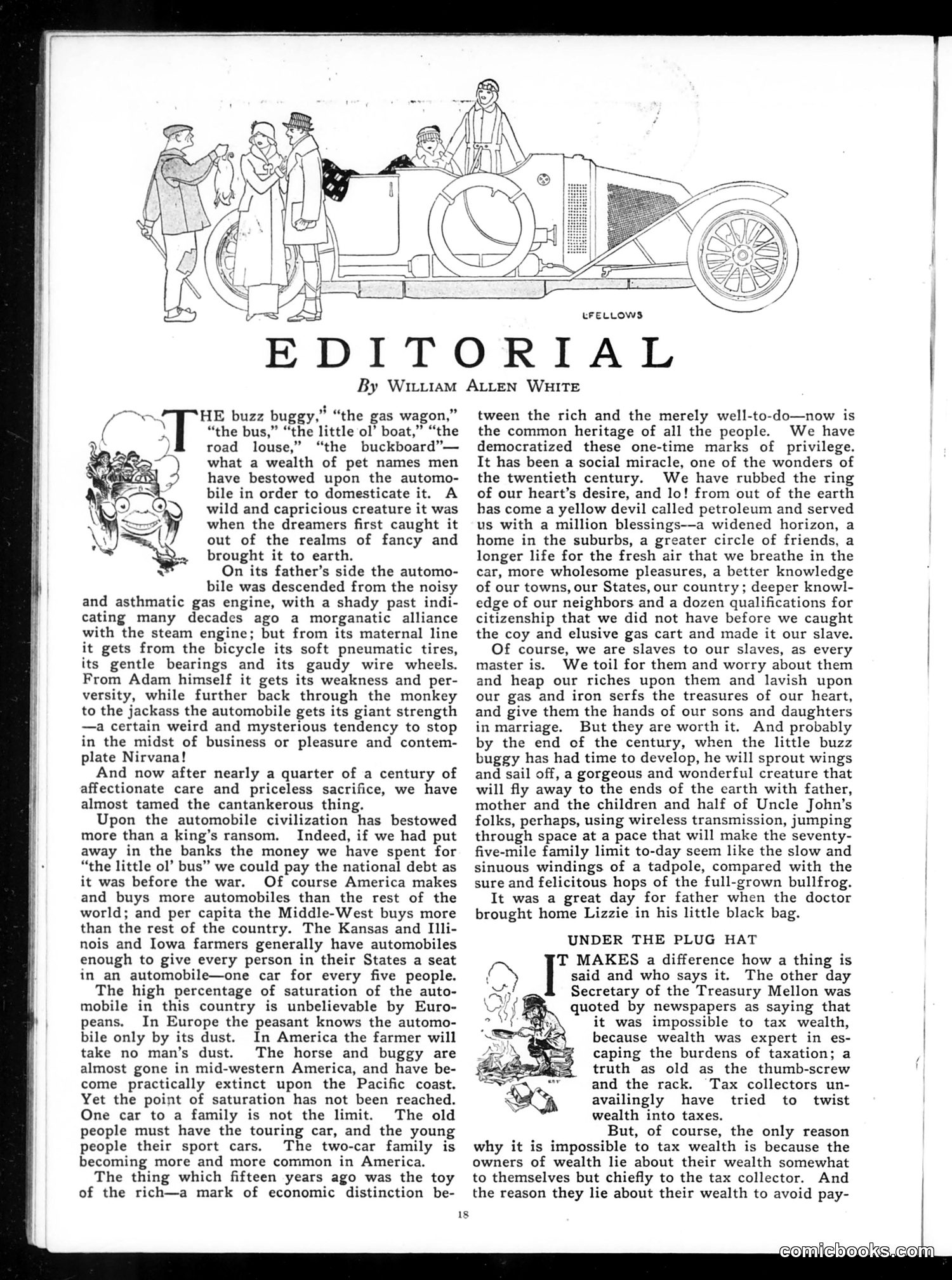
This is not primarily a cartoon but rather an editorial essay by William Allen White, a prominent early-20th-century American journalist and social commentator. The illustration shows men and children boarding an early automobile, depicting the vehicle's democratization. White's argument celebrates how automobiles—once luxury items marking wealth—have become commonplace possessions available to ordinary Americans, including farmers and working people. He frames this as a "social miracle" of the twentieth century, enabling suburban living, expanded social circles, and better citizenship through wider knowledge of one's country. The satirical edge appears in White's tongue-in-cheek admission that Americans have become "slaves to our slaves"—they labor to maintain and purchase automobiles, yet consider this servitude worthwhile. The tone is affectionate mockery of American car culture's rapid expansion and the public's willing economic sacrifice to fuel it.
📄 Transcribed text from this page (OCR, searchable)
Machine-transcribed from the original scan — historical spelling and the odd misread are preserved.
HE buzz buggy,” “the gas wagon,” “the bus,” “the little ol’ boat,” “the road louse,” “the buckboard”— what a wealth of pet names men have bestowed upon the automo- bile in order to domesticate it. A wild and capricious creature it was when the dreamers first caught it out of the realms of fancy and brought it to earth. On its father’s side the automo- bile was descended from the noisy and asthmatic gas engine, with a shady past indi- cating many decades ago a morganatic alliance with the steam engine; but from its maternal line it gets from the bicycle its soft pneumatic tires, its gentle bearings and its gaudy wire wheels. From Adam himself it gets its weakness and per- versity, while further back through the monkey to the jackass the automobile gets its giant strength —a certain weird and mysterious tendency to stop in the midst of business or pleasure and contem- plate Nirvana! And now after nearly a quarter of a century of affectionate care and priceless sacrifice, we have almost tamed the cantankerous thing. Upon the automobile civilization has bestowed more than a king’s ransom. Indeed, if we had put away in the banks the money we have spent for “the little ol’ bus” we could pay the national debt as it was before the war. Of course America makes and buys more automobiles than the rest of the world; and per capita the Middle-West buys more than the rest of the country. The Kansas and IIli- nois and Iowa farmers generally have automobiles enough to give every person in their States a seat in an automobile—one car for every five people. The high percentage of saturation of the auto- mobile in this country is unbelievable by Euro- peans. In Europe the peasant knows the automo- bile only by its dust. In America the farmer will take no man’s dust. The horse and buggy are almost gone in mid-western America, and have be- come practically extinct upon the Pacific coast. Yet the point of saturation has not been reached. One car to a family is not the limit. The old people must have the touring car, and the young people their sport cars. The two-car family is becoming more and more common in America. The thing which fifteen years ago was the toy of the rich—a mark of economic distinction be- “FELLOWS EDITORIAL By Wiiuram ALLEN WHITE tween the rich and the merely well-to-do—now is the common heritage of all the people. We have democratized these one-time marks of privilege. It has been a social miracle, one of the wonders of the twentieth century. We have rubbed the ring of our heart’s desire, and lo! from out of the earth has come a yellow devil called petroleum and served us with a million blessings--a widened horizon, a home in the suburbs, a greater circle of friends, a longer life for the fresh air that we breathe in the car, more wholesome pleasures, a better knowledge of our towns, our States, our country; deeper knowl- edge of our neighbors and a dozen qualifications for citizenship that we did not have before we caught the coy and elusive gas cart and made it our slave. Of course, we are slaves to our slaves, as every master is. We toil for them and worry about them and heap our riches upon them and lavish upon our gas and iron serfs the treasures of our heart, and give them the hands of our sons and daughters in marriage. But they are worth it. And probably by the end of the century, when the little buzz buggy has had time to develop, he will sprout wings and sail off, a gorgeous and wonderful creature that will fly away to the ends of the earth with father, mother and the children and half of Uncle John’s folks, perhaps, using wireless transmission, jumping through space at a pace that will make the seventy- five-mile family limit to-day seem like the slow and sinuous windings of a tadpole, compared with the sure and felicitous hops of the full-grown bullfrog. It was a great day for father when the doctor brought home Lizzie in his little black bag. UNDER THE PLUG HAT T MAKES a difference how a thing is | said and who says it. The other day Secretary of the Treasury Mellon was quoted by newspapers as saying that it was impossible to tax wealth, because wealth was expert in es- caping the burdens of taxation; a truth as old as the thumb-screw and the rack. Tax collectors un- availingly have tried to twist wealth into taxes. But, of course, the only reason why it is impossible to tax wealth is because the owners of wealth lie about their wealth somewhat to themselves but chiefly to the tax collector. And the reason they lie about their wealth to avoid pay-