
Judge, 1922-01-07 · page 32 of 36
Judge — January 7, 1922 — page 32: what you’re looking at
What you’re looking at
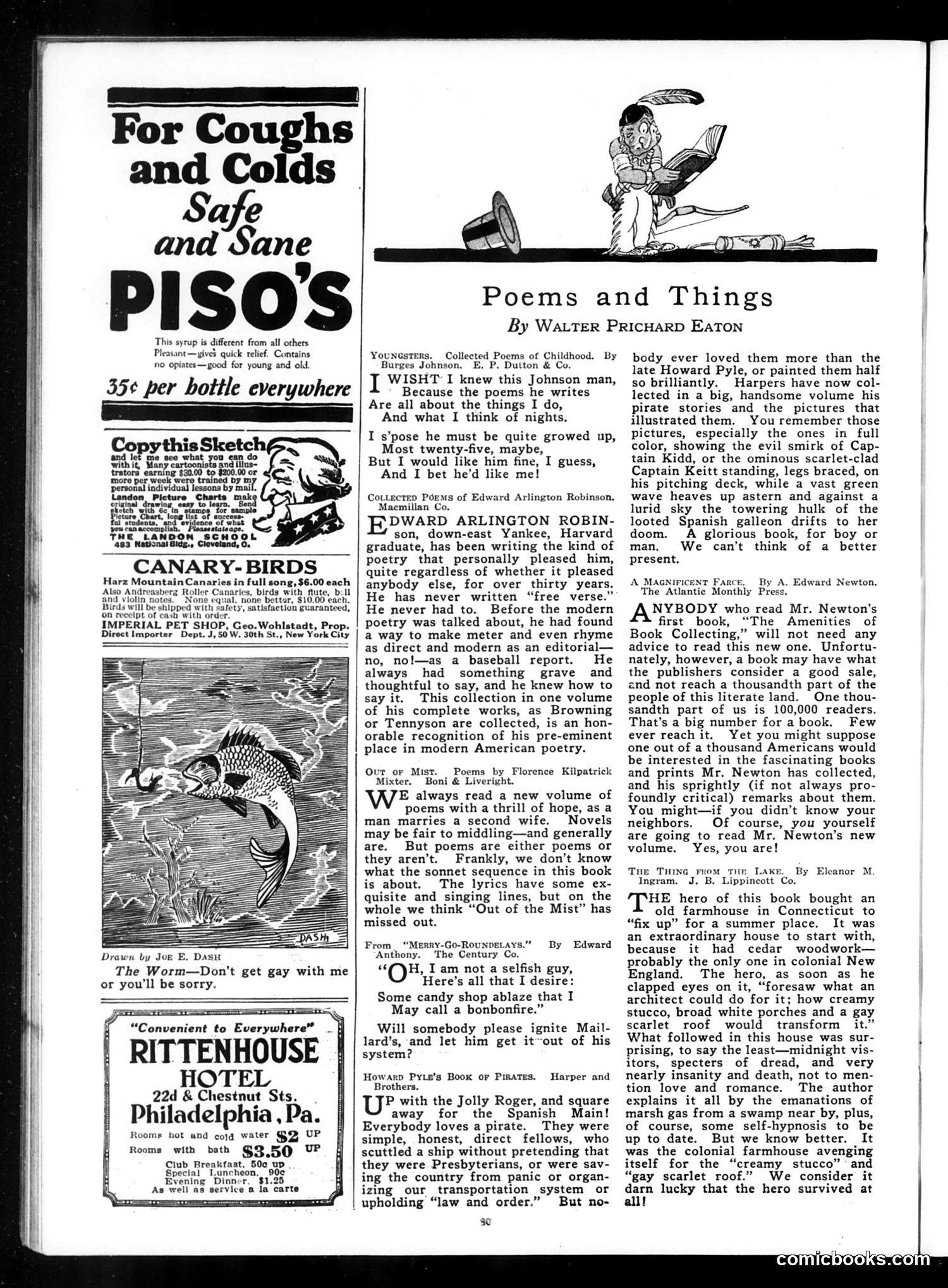
This page combines book reviews with period advertisements. The main content is Walter Prichard Eaton's literary column reviewing recent poetry collections. **The cartoon** (top right) shows a young child reading, illustrating the whimsical tone of reviewing children's poetry. **Key reviews discussed:** - A collection of childhood poems by Burgess Johnson—the reviewer humorously wishes he knew the adult author personally - Edward Arlington Robinson's complete works—praised as serious, metered poetry from a "down-east Yankee" who resisted modernist "free verse" trends - Florence Kilpatrick Mixter's "Out of the Mist"—dismissed as unsuccessful despite some pretty lines - Howard Pyle's pirate book—celebrated for brilliant illustrations and romanticized depictions of pirates as honest outlaws, contrasting them sarcastically with respectable figures who justify their actions through progressivism **The satire**: The pirate passage mocks early 20th-century reformers and business leaders who dressed up self-interest as social progress—pirates were at least honest about their villainy. **Advertisements** include cough syrup, canaries, and a Philadelphia hotel.
📄 Transcribed text from this page (OCR, searchable)
Machine-transcribed from the original scan — historical spelling and the odd misread are preserved.
For Coughs Safe and Sane PISO'S different from all others quick relief. Contains tno opiates—good for young and old 55¢ per bottle everywhere a CANARY- BIRDS Harz Mountain Canaries in full song, $6.00 each Also Andreasberg, r Canaries, birds with flute, bill And violin notes. None eqtal, none bettar, $10.00 each, Birds will be shipped with safety, satisfaction guaranteed, on receipt of cash with order, IMPERIAL PET SHOP, Geo.Wohlstadt, Prop. Direct Importer Dept. J, 50 W. 30th St., New York City The Worm—Don’t get gay with me or you'll be sorry. “Convenient to Everywhere” RITTENHOUSE | HOTEL 22d & Chestnut Sts. Philadelphia , Pa. Rooms hot and coa water GQ UP Rooms with bath G3 .5Q UP Club Breakfast, 50c up Special Luncheon, 900 Evening Dinner, ‘$1.25 As well as service a la carte and Colds | Poems and Things By Wa.terR PRICHARD EATON Youngsters. Collected Poems of Childhood. By Burges Johnson. E. P. Dutton & Co. I WISHT I knew this Johnson man, Because the poems he writes Are all about the things I do, And what I think of nights. I s’pose he must be quite growed up, Most twenty-five, maybe, But I would like him fine, I guess, And I bet he’d like me! Cottectep PorMs of Edward Arlington Robinson. Macmillan Co. DWARD ARLINGTON ROBIN- son, down-east Yankee, Harvard graduate, has been writing the kind of poetry that personally pleased him, quite regardless of whether it pleased anybody else, for over thirty years. He has never written “free verse.” He never had to. Before the modern poetry was talked about, he had found a way to make meter and even rhyme as direct and modern as an editorial— no, no!—as a baseball report. He always had something grave and thoughtful to say, and he knew how to say it. This collection in one volume of his complete works, as Browning or Tennyson are collected, is an hon- orable recognition of his pre-eminent place in modern American poetry. Ovr or Mist. Poems by Florence Kilpatrick Mixter. Boni & Liveright. WE always read a new volume of poems with a thrill of hope, as a man marries a second wife. Novels may be fair to middling—and generally are. But poems are either poems or they aren’t. Frankly, we don’t know what the sonnet sequence in this book is about. The lyrics have some ex- quisite and singing lines, but on the whole we think “Out of the Mist” has missed out. From “MERRY-Go-RounpELAys.” By Edward Anthony. The Century Co. “OH, I am not a selfish guy, Here’s all that I desire: Some candy shop ablaze that I May call a bonbonfire.” Will somebody please ignite Mail- lard's, and let him get it~out of his system? Howarv Pyte’s Boox or Pirates. Harper and Brothers. UP with the Jolly Roger, and square away for the Spanish Main! Everybody loves a pirate. They were simple, honest, direct fellows, who scuttled a ship without pretending that they were Presbyterians, or were sav- ing the country from panic or organ- izing our transportation system or upholding “law and order.” But no- body ever loved them more than the late Howard Pyle, or painted them half so brilliantly. Harpers have now col- lected in a big, handsome volume his pirate stories and the pictures that illustrated them. You remember those pictures, especially the ones in full color, showing the evil smirk of Cap- tain Kidd, or the ominous scarlet-clad Captain Keitt standing, legs braced, on his pitching deck, while a vast green wave heaves up astern and against a lurid sky the towering hulk of the looted Spanish galleon drifts to her doom. A glorious book, for boy or man. We can't think of a better present. A Maaniricent Farce. By A. Edward Newton. The Atlantic Monthly Press. NYBODY who read Mr. Newton's first book, “The Amenities of Book Collecting,” will not need any advice to read this new one. Unfortu- nately, however, a book may have what the publishers consider a good sale, and not reach a thousandth part of the people of this literate land. One thou- sandth part of us is 100,000 readers. That's a big number for a book. Few ever reach it. Yet you might suppose one out of a thousand Americans would be interested in the fascinating books and prints Mr. Newton has collected, and his sprightly (if not always pro- foundly critical) remarks about them. You might—if you didn’t know your neighbors. Of course, you yourself are going to read Mr. Newton’s new volume. Yes, you are! Tue TinG From THF Lake. By Eleanor M Ingram. J. B. Lippincott Co. (THE hero of this book bought an old farmhouse in Connecticut to “fix up” for a summer place. It was an extraordinary house to start with, because it had cedar woodwork— probably the only one in colonial New England. The hero, as soon as he clapped eyes on it, “foresaw what an architect could do for it; how creamy stucco, broad white porches and a gay scarlet roof would transform it.” What followed in this house was sur- prising, to say the least—midnight vis- itors, specters of dread, and very nearly insanity and death, not to men- tion love and romance. The author explains it all by the emanations of marsh gas from a swamp near by, plus, of course, some self-hypnosis to be up to date. But we know better. It was the colonial farmhouse avenging itself for the “creamy stucco” ‘and “gay scarlet roof.” We consider it oo lucky that the hero survived at