
Judge, 1922-01-07 · page 21 of 36
Judge — January 7, 1922 — page 21: what you’re looking at
What you’re looking at
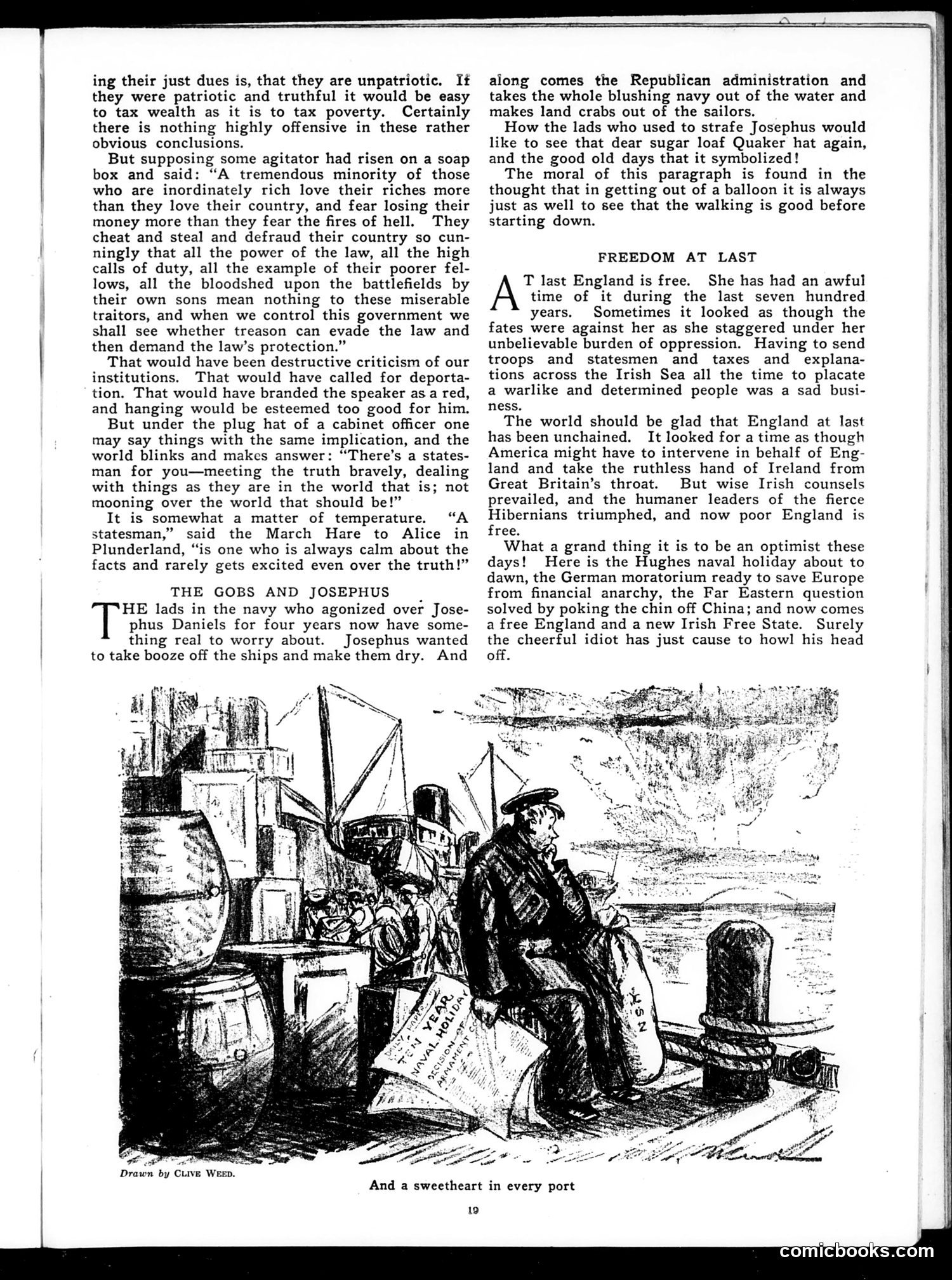
This page contains two distinct satirical pieces attacking Republican administration policies. **"The Gobs and Josephus"** (top section): Mocks the Republican Navy's decision to remove ships from active service, comparing it unfavorably to Josephus Daniels (the Democratic Secretary of the Navy who had imposed prohibition on naval vessels). The satire suggests that sailors who complained about Daniels's anti-alcohol policies now face worse—complete decommissioning. The "balloon" metaphor warns that celebrating one problem's solution without considering consequences is foolish. **"Freedom at Last"** (lower section): This is heavy irony about Ireland's independence and England's supposed "freedom." Judge sarcastically congratulates various Republican initiatives (Hughes naval holiday, German moratorium, Chinese policy, Irish Free State) as obviously successful, when the author clearly believes they're naive or ineffective. The drawing shows a sailor with documents at a dock—likely depicting the navy situation or maritime consequences of these policies. The overall message: Republican policies are shortsighted and self-defeating, presented with mock cheerfulness to expose their actual failure.
📄 Transcribed text from this page (OCR, searchable)
Machine-transcribed from the original scan — historical spelling and the odd misread are preserved.
ing their just dues is, that they are unpatriotic. It they were patriotic and truthful it would be easy to tax wealth as it is to tax poverty. Certainly there is nothing highly offensive in these rather obvious conclusions. But supposing some agitator had risen on a soap box and said: “A tremendous minority of those who are inordinately rich love their riches more than they love their country, and fear losing their money more than they fear the fires of hell. They cheat and steal and defraud their country so cun- ningly that all the power of the law, all the high calls of duty, all the example of their poorer fel- lows, all the bloodshed upon the battlefields by their own sons mean nothing to these miserable traitors, and when we control this government we shall see whether treason can evade the law and then demand the law’s protection.” That would have been destructive criticism of our institutions. That would have called for deporta- tion. That would have branded the speaker as a red, and hanging would be esteemed too good for him. But under the plug hat of a cabinet officer one may say things with the same implication, and the world blinks and makes answer: ‘“‘There’s a states- man for you—meeting the truth bravely, dealing with things as they are in the world that is; not mooning over the world that should be!” It is somewhat a matter of temperature. “A statesman,” said the March Hare to Alice in Plunderland, “is one who is always calm about the facts and rarely gets excited even over the truth!” THE GOBS AND JOSEPHUS . HE lads in the navy who agonized over Jose- phus Daniels for four years now have some- thing real to worry about. Josephus wanted to take booze off the ships and make them dry. And Ce i Drawn by Cuive Weep. along comes the Republican administration and takes the whole blushing navy out of the water and makes land crabs out of the sailors. How the lads who used to strafe Josephus would like to see that dear sugar loaf Quaker hat again, and the good old days that it symbolized! The moral of this paragraph is found in the thought that in getting out of a balloon it is always just as well to see that the walking is good before starting down. A time of it during the last seven hundred years. Sometimes it looked as though the fates were against her as she staggered under her unbelievable burden of oppression. Having to send troops and statesmen and taxes and explana- tions across the Irish Sea all the time to placate a warlike and determined people was a sad busi- ness. The world should be glad that England at last has been unchained. It looked for a time as though America might have to intervene in behalf of Eng- land and take the ruthless hand of Ireland from Great Britain’s throat. But wise Irish counsels prevailed, and the humaner leaders of the fierce Hibernians triumphed, and now poor England is free. What a grand thing it is to be an optimist these days! Here is the Hughes naval holiday about to dawn, the German moratorium ready to save Europe from financial anarchy, the Far Eastern question solved by poking the chin off China; and now comes a free England and a new Irish Free State. Surely FREEDOM AT LAST T last England is free. She has had an awful the cheerful idiot has just cause to howl his head off. And a sweetheart in every port 19