
Judge, 1922-01-07 · page 22 of 36
Judge — January 7, 1922 — page 22: what you’re looking at
What you’re looking at
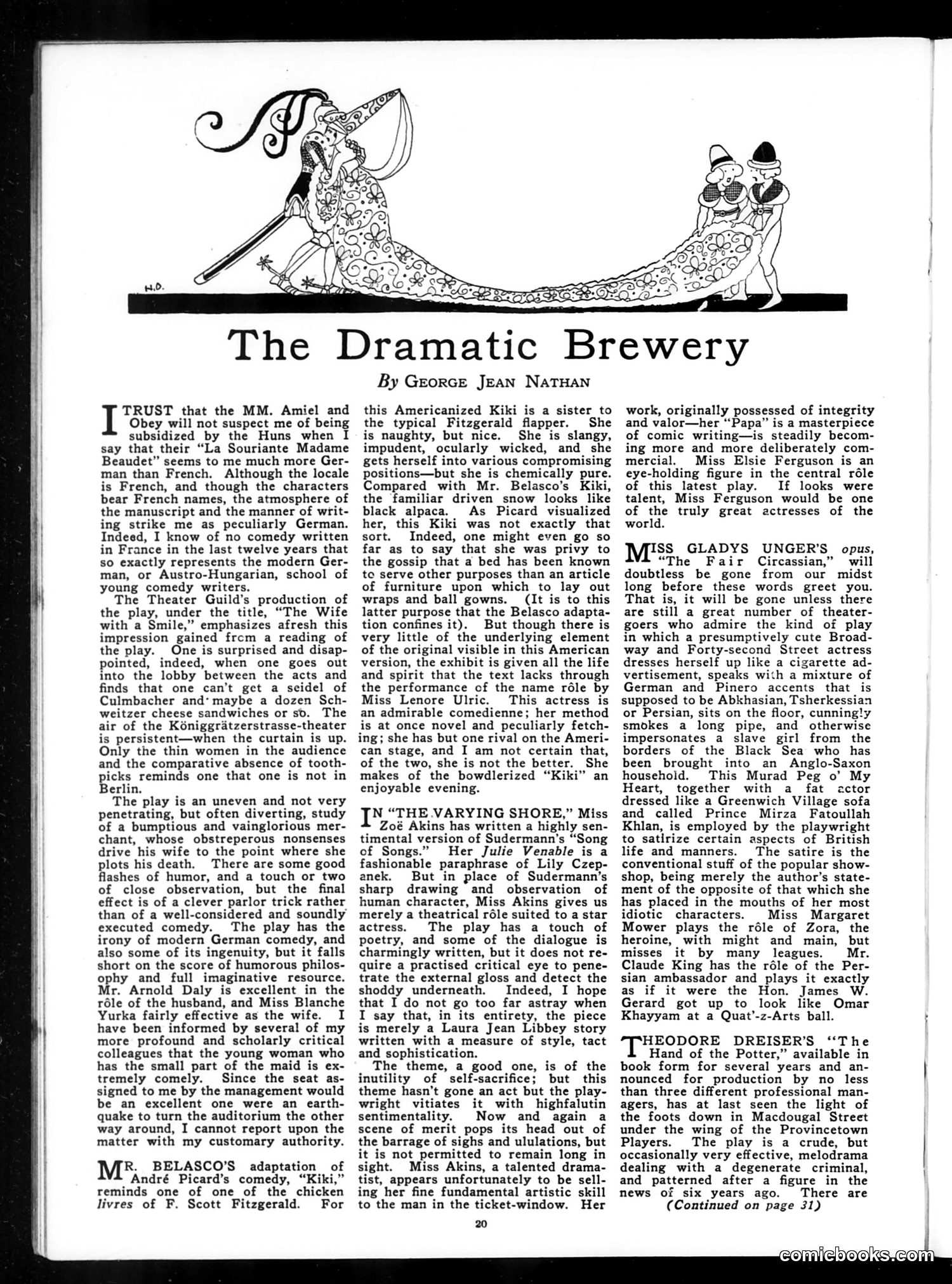
This is a theater review page by George Jean Nathan critiquing several Broadway productions. The ornamental header cartoon depicts a theatrical figure in elaborate costume presenting entertainment to an audience—a visual metaphor for the "dramatic brewery" producing theatrical fare. Nathan reviews three plays: 1. **"The Wife with a Smile"** (Theater Guild production)—he criticizes this adaptation of a French play for feeling German/Austrian in atmosphere, sardonically noting the lobby lacks German beer and cheese to complete the effect. 2. **"Kiki"** (David Belasco adaptation)—Nathan contrasts the original French comedy's morally loose character with Belasco's sanitized "Fitzgerald flapper" version, praising actress Lenore Ulric's performance despite the bowdlerization. 3. **"The Varying Shore"** by Zoé Akins—review appears to continue on another page. The review demonstrates Nathan's characteristic wit, mixing theatrical criticism with cultural commentary about American versus European dramatic sensibilities during the 1920s.
📄 Transcribed text from this page (OCR, searchable)
Machine-transcribed from the original scan — historical spelling and the odd misread are preserved.
TRUST that the MM. Amiel and Obey will not suspect me of being subsidized by the Huns when I say that their “La Souriante Madame Beaudet” seems to me much more Ger- man than French. Although the locale is French, and though the characters bear French names, the atmosphere of the manuscript and the manner of writ- ing strike me as peculiarly German. Indeed, I know of no comedy written in France in the last twelve years that so exactly represents the modern Ger- man, or Austro-Hungarian, school of young comedy writers. The Theater Guild’s production of the play, under the title, “The Wife with a Smile,” emphasizes afresh this impression gained frcm a reading of the play. One is surprised and disap- pointed, indeed, when one goes out into the lobby between the acts and finds that one can’t get a seidel of Culmbacher and‘ maybe a dozen Sch- weitzer cheese sandwiches or so. The air of the Kéniggratzerstrasse-theater is persistent—when the curtain is up. Only the thin women in the audience and the comparative absence of tooth- picks reminds one that one is not in Berlin. The play is an uneven and not very penetrating, but often diverting, study of a bumptious and vainglorious mer- chant, whose obstreperous nonsenses drive his wife to the point where she plots his death. There are some good flashes of humor, and a touch or two of close observation, but the final effect is of a clever parlor trick rather than of a well-considered and soundly executed comedy. The play has the irony of modern German comedy, and also some of its ingenuity, but it falls short on the score of humorous philos- ophy and full imaginative resource. Mr. Arnold Daly is excellent in the réle of the husband, and Miss Blanche Yurka fairly effective as the wife. I have been informed by several of my more profound and scholarly critical colleagues that the young woman who has the small part of the maid is ex- tremely comely. Since the seat as- signed to me by the management would be an excellent one were an earth- quake to turn the auditorium the other way around, I cannot report upon the matter with my customary authority. R. BELASCO’S adaptation of André Picard’s comedy, “Kiki,” reminds one of one of the chicken livres of F. Scott Fitzgerald. For The Dramatic Brewery By Greorce JEAN NaTHAN this Americanized Kiki is a sister to the typical Fitzgerald flapper. She is naughty, but nice. She is slangy, impudent, ocularly wicked, and she gets herself into various compromising positions—but she is chemically pure. Compared with Mr. Belasco’s Kiki, the familiar driven snow looks like black alpaca. As Picard visualized her, this Kiki was not exactly that sort. Indeed, one might even go so far as to say that she was privy to the gossip that a bed has been known to serve other purposes than an article of furniture upon which to lay out wraps and ball gowns. (It is to this latter purpose that the Belasco adapta- tion confines it). But though there is very little of the underlying element of the original visible in this American version, the exhibit is given all the life and spirit that the text lacks through the performance cf the name réle by Miss Lenore Ulric. This actress is an admirable comedienne; her method is at once novel and peculiarly fetch- ing; she has but one rival on the Ameri- can stage, and I am not certain that, of the two, she is not the better. She makes of the bowdlerized “Kiki” an enjoyable evening. N “THE VARYING SHORE,” Miss Zoé Akins has written a highly sen- timental version of Sudermann’s “Song of Songs.” Her Julie Venable is a fashionable paraphrase of Lily Czep- anek. But in place of Sudermann’s sharp drawing and observation of human character, Miss Akins gives us merely a theatrical réle suited to a star actress. The play has a touch of poetry, and some of the dialogue is charmingly written, but it does not re- quire a practised critical eye to pene- trate the external gloss and detect the shoddy underneath. Indeed, I hope that I do not go too far astray when I say that, in its entirety, the piece is merely a Laura Jean Libbey story written with a measure of style, tact and sophistication. The theme, a good one, is of the inutility of self-sacrifice; but this theme hasn't gone an act but the play- wright vitiates it with highfalutin sentimentality. Now and again a scene of merit pops its head out of the barrage of sighs and ululations, but it is not permitted to remain long in sight. Miss Akins, a talented drama- tist, appears unfortunately to be sell- ing her fine fundamental artistic skill to the man in the ticket-window. Her 20 work, originally possessed of integrity and valor—her “Papa” is a masterpiece of comic writing—is steadily becom- ing more and more deliberately com- mercial. Miss Elsie Ferguson is an eye-holding figure in the central réle of this latest play. f£ looks were talent, Miss Ferguson would be one of the truly great actresses of the world. SS GLADYS UNGER’S opus, “The Fair Circassian,” will doubtless be gone from our midst long before these words greet you. That is, it will be gone unless there are still a great number of theater- goers who admire the kind of play in which a presumptively cute Broad- way and Forty-second Street actress dresses herself up like a cigarette ad- vertisement, speaks with a mixture of German and Pinero accents that is supposed to be Abkhasian, Tsherkessian or Persian, sits on the floor, cunning!y smokes a long pipe, and otherwise impersonates a slave girl from the borders of the Black Sea who has been brought into an Anglo-Saxon household. This Murad Peg o’ My Heart, together with a fat actor dressed like a Greenwich Village sofa and called Prince Mirza Fatoullah Khlan, is employed by the playwright to satirize certain aspects of British life and manners. The satire is the conventional stuff of the popular show- shop, being merely the author’s state- ment of the opposite of that which she has placed in the mouths of her most idiotic characters. Miss Margaret Mower plays the rdle of Zora, the heroine, with might and main, but misses it by many leagues. Mr. Claude King has the réle of the Per- sian ambassador and plays it exactly as if it were the Hon. James Gerard got up to look like Omar Khayyam at a Quat’-z-Arts ball. THEODORE DREISER’S ‘The Hand of the Potter,” available in book form for several years and an- nounced for production by no less than three different professional man- agers, has at last seen the light of the foots down in Macdougal Street under the wing of the Provincetown Players. The play is a crude, but occasionally very effective, melodrama dealing with a degenerate criminal, and patterned after a figure in the news of six years ago. There are (Continued on page 31)