
Judge, 1922-01-07 · page 9 of 36
Judge — January 7, 1922 — page 9: what you’re looking at
What you’re looking at
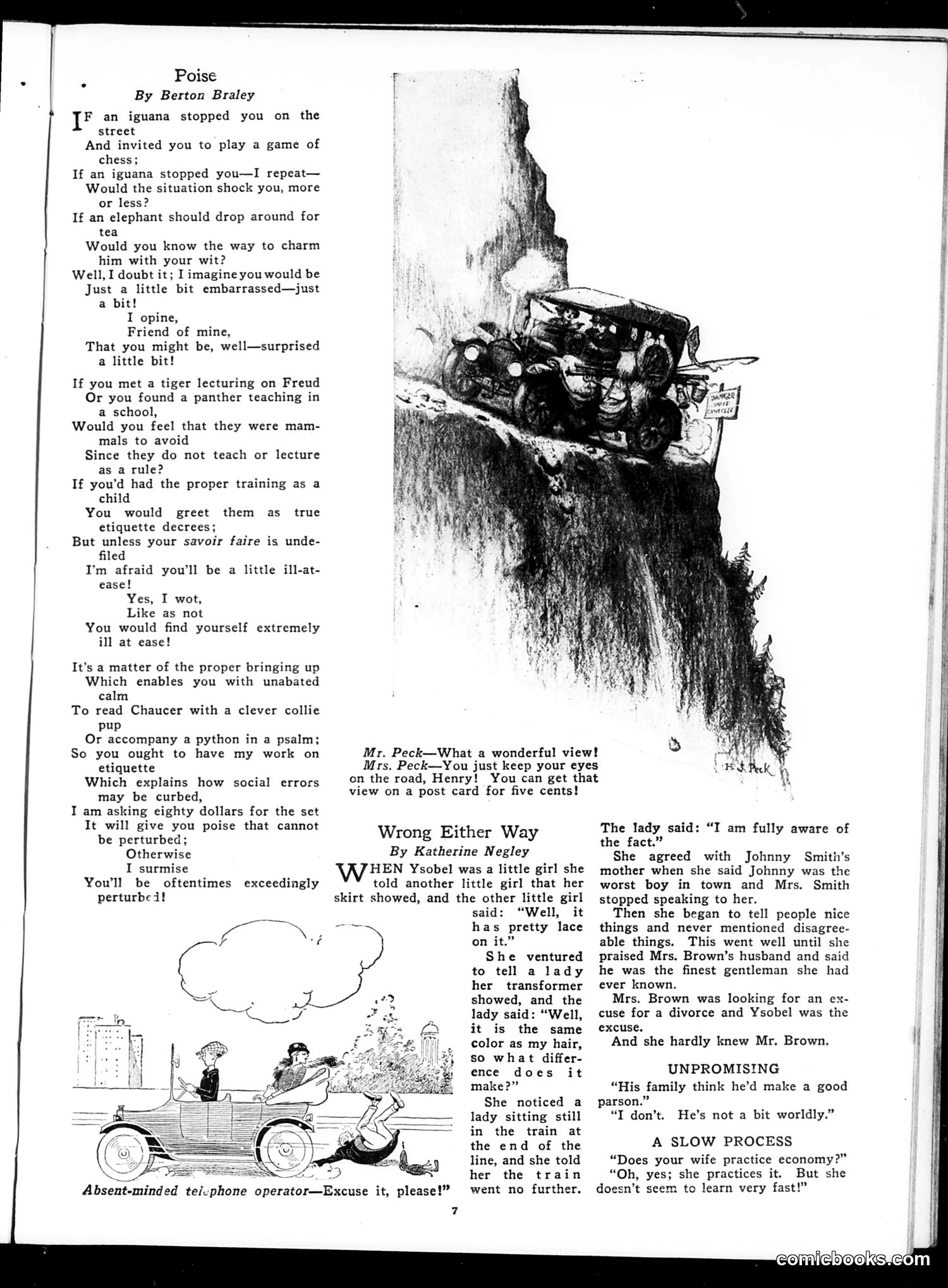
This page contains three pieces of light humor typical of 1920s-era American satire: **"Poise" by Berton Braley** is a humorous poem-advertisement disguised as social commentary. It uses absurdist scenarios (iguanas playing chess, elephants at tea, tigers lecturing on Freud) to mock people who lack proper etiquette training. The joke is self-referential: Braley is selling an $80 etiquette guide by suggesting readers would be hopelessly embarrassed in ridiculous social situations. It's satirizing both pretentious etiquette culture and advertising hype. **The cartoon** shows an absent-minded telephone operator and a couple in a car—gentle, domestic humor about everyday life's minor annoyances. **"Wrong Either Way" by Katherine Negley** depicts Ysobel, a well-meaning woman who can't win socially: when she points out wardrobe malfunctions, people defend themselves; when she compliments someone (Mrs. Brown's husband), it backfires into a divorce scandal. The satire mocks how impossible social navigation can be for even the conscientious. All three pieces reflect 1920s preoccupation with proper social conduct and the anxiety of navigating increasingly complex urban society.
📄 Transcribed text from this page (OCR, searchable)
Machine-transcribed from the original scan — historical spelling and the odd misread are preserved.
Poise By Berton Braley JF an iguana stopped you on the street And invited you to play a game of chess; If an iguana stopped you—I repeat— Would the situation shock you, more or less? If an elephant should drop around for tea Would you know the way to charm him with your wit? Well, I doubt it; I imagine you would be Just a little bit embarrassed—just a bit! I opine, Friend of mine, That you might be, well—surprised a little bit! If you met a tiger lecturing on Freud Or you found a panther teaching in a school, Would you feel that they were mam- mals to avoid Since they do not teach or lecture as a rule? If you’d had the proper training as a child You would greet etiquette decrees; But unless your savoir faire is unde- filed I’m afraid you'll be a little ill-at- ease! Yes, I wot, Like as not You would find yourself extremely ill at ease! them as true It’s a matter of the proper bringing up Which enables you with unabated calm To read Chaucer with a clever collie pup Or accompany a python in a psalm; So you ought to have my work on etiquette Which explains how social errors may be curbed, I am asking eighty dollars for the set It will give you poise that cannot be perturbed; Otherwise I surmise You'll be oftentimes perturbei! exceedingly Mr. Peck—What a wonderful view! Mrs, Peck—You just keep your eyes on the road, Henry! You can get that view on a post card for five cents! Wrong Either Way By Katherine Negley WHEN Ysobel was a little girl she told another little girl that her skirt showed, and the other little girl said: “Well, it has pretty lace on it.” She ventured to tell a lady her transformer showed, and the lady said: “Well, it is the same color as my hair, so what differ- ence does it make?” Absent-minded telephone operator—Excuse it, please!” She noticed a lady sitting still in the train at the end of the line, and she told her the train went no further. fac 7 The lady said: “I am fully aware of the fact.” She agreed with Johnny Smith’s mother when she said Johnny was the worst boy in town and Mrs. Smith stopped speaking to her. Then she began to tell people nice things and never mentioned disagree- able things. This went well until she praised Mrs. Brown’s husband and said he was the finest gentleman she had ever known. Mrs. Brown was looking for an ex- cuse for a divorce and Ysobel was the excuse. And she hardly knew Mr. Brown. UNPROMISING “His family think he’d make a good parson.” “I don’t. A SLOW PROCESS “Does your wife practice economy?” “Oh, yes; she practices it. But she doesn’t seem to learn very fast!” He’s not a bit worldly.”