
A complete issue · 36 pages · 1921
Judge — November 5, 1921
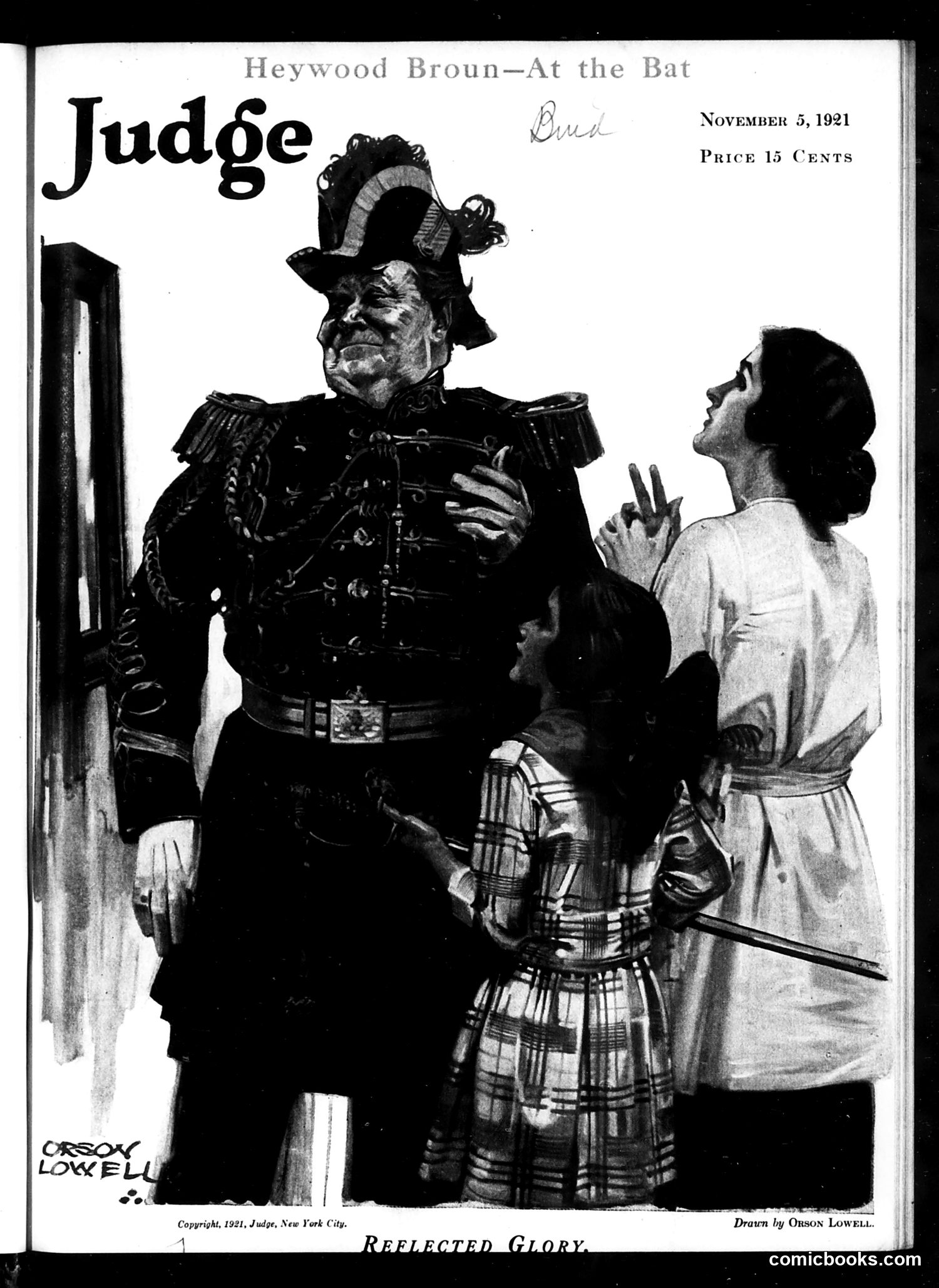
This cartoon satirizes social climbers and status-seeking. The illustration shows a pompous military officer in elaborate uniform and plumed hat confronting two civilians—a woman and child. The title "Reflected Glory" suggests the joke: the officer appears to be using his military rank and regalia to intimidate or impress ordinary people, basking in the reflected prestige of his uniform rather than possessing genuine character or accomplishment. The cartoon likely critiques post-WWI America, where some military men leveraged war service for social advantage. The child and woman's deferential body language contrasts with the officer's inflated self-importance, emphasizing the absurdity of valuing someone primarily for their uniform rather than their actual merit or conduct. This reflects broader 1920s satirical themes about American pretension and false status.
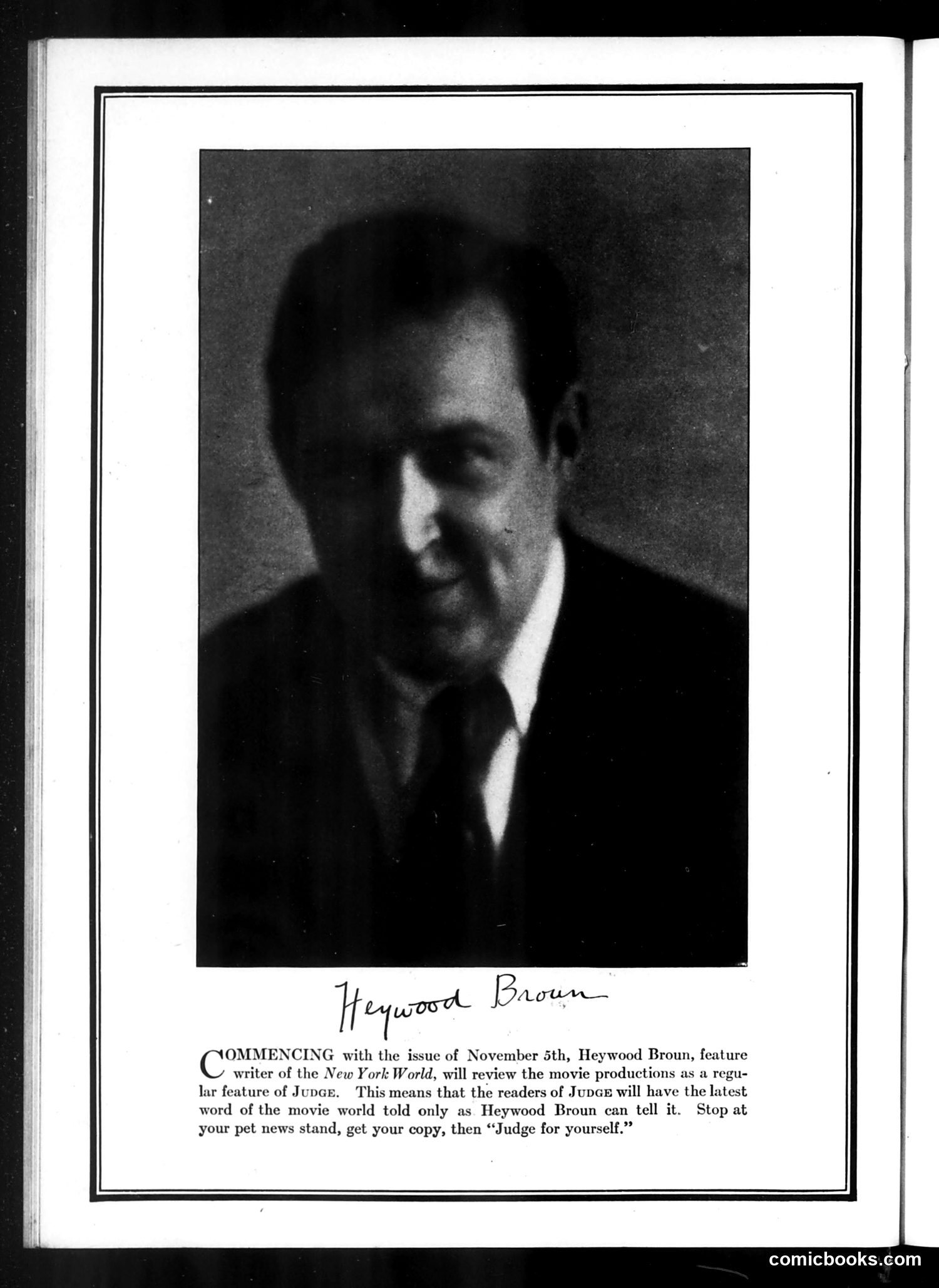
This page features a portrait photograph of **Heywood Broun**, identified by his handwritten signature below the image. The accompanying text announces that beginning November 5th, Broun—described as a "feature writer of the *New York World*"—will become a regular movie critic for *Judge* magazine. The announcement uses playful language ("Stop at your pet news stand, get your copy, then 'Judge for yourself'") to promote Broun's new column reviewing movie productions. This appears to be a straightforward professional announcement rather than political satire. *Judge* is leveraging Broun's reputation as a *New York World* writer to attract readers interested in film criticism during the silent or early sound film era.
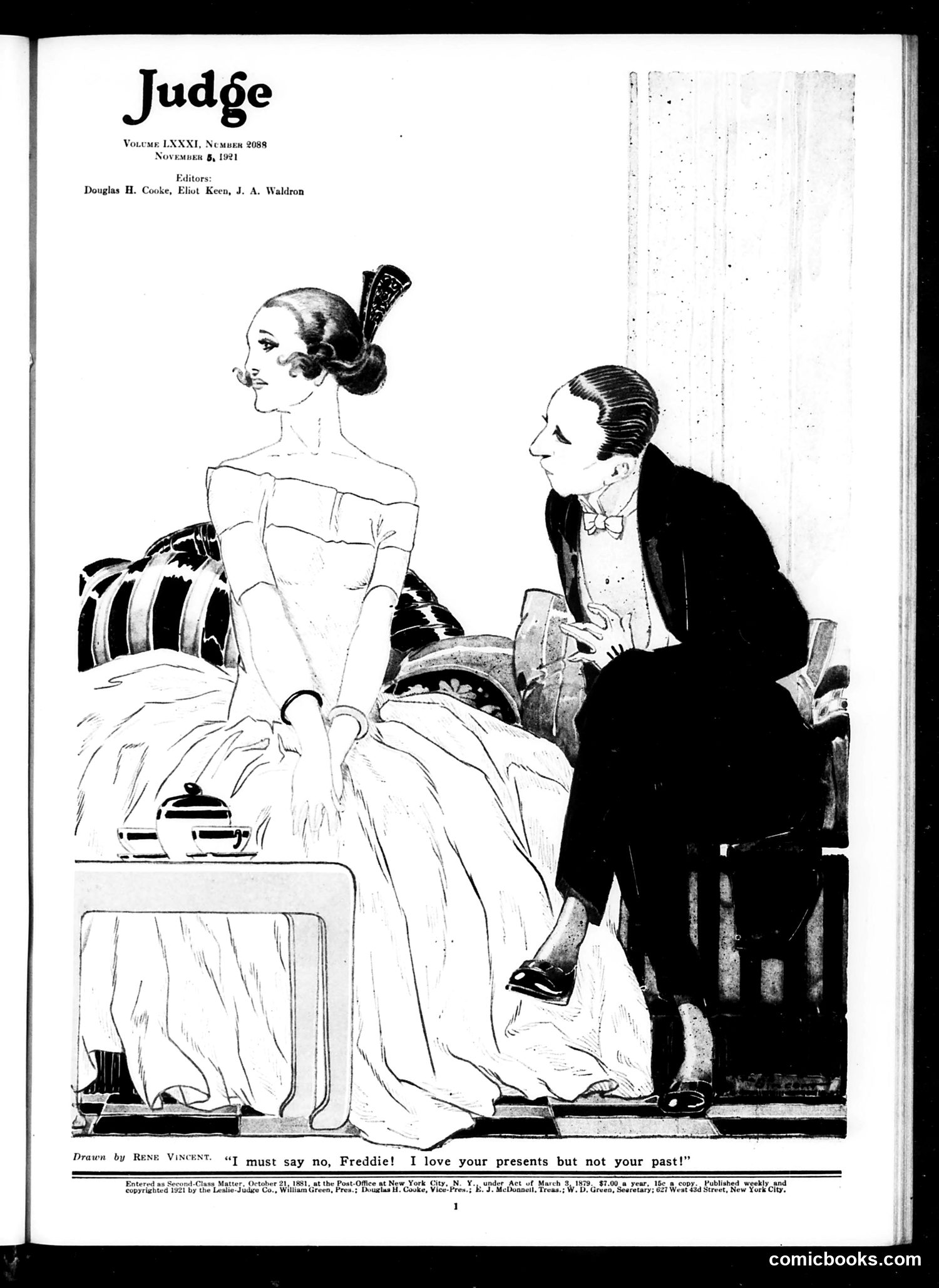
This illustration by René Vincent depicts a domestic scene with romantic/marital undertones. A woman in an elegant evening gown sits on a bed while a man in formal attire (tuxedo) sits beside her. The caption reads: "I must say no, Freddie! I love your presents but not your past!" The satire targets a common social anxiety of the era: wealthy suitors attempting to win affection through lavish gifts while their personal histories remain questionable. The joke plays on the tension between material generosity and moral character—suggesting that no amount of presents can overcome romantic complications or a dubious past. This reflects 1920s concerns about courtship, materialism, and feminine judgment in matters of romance and marriage.
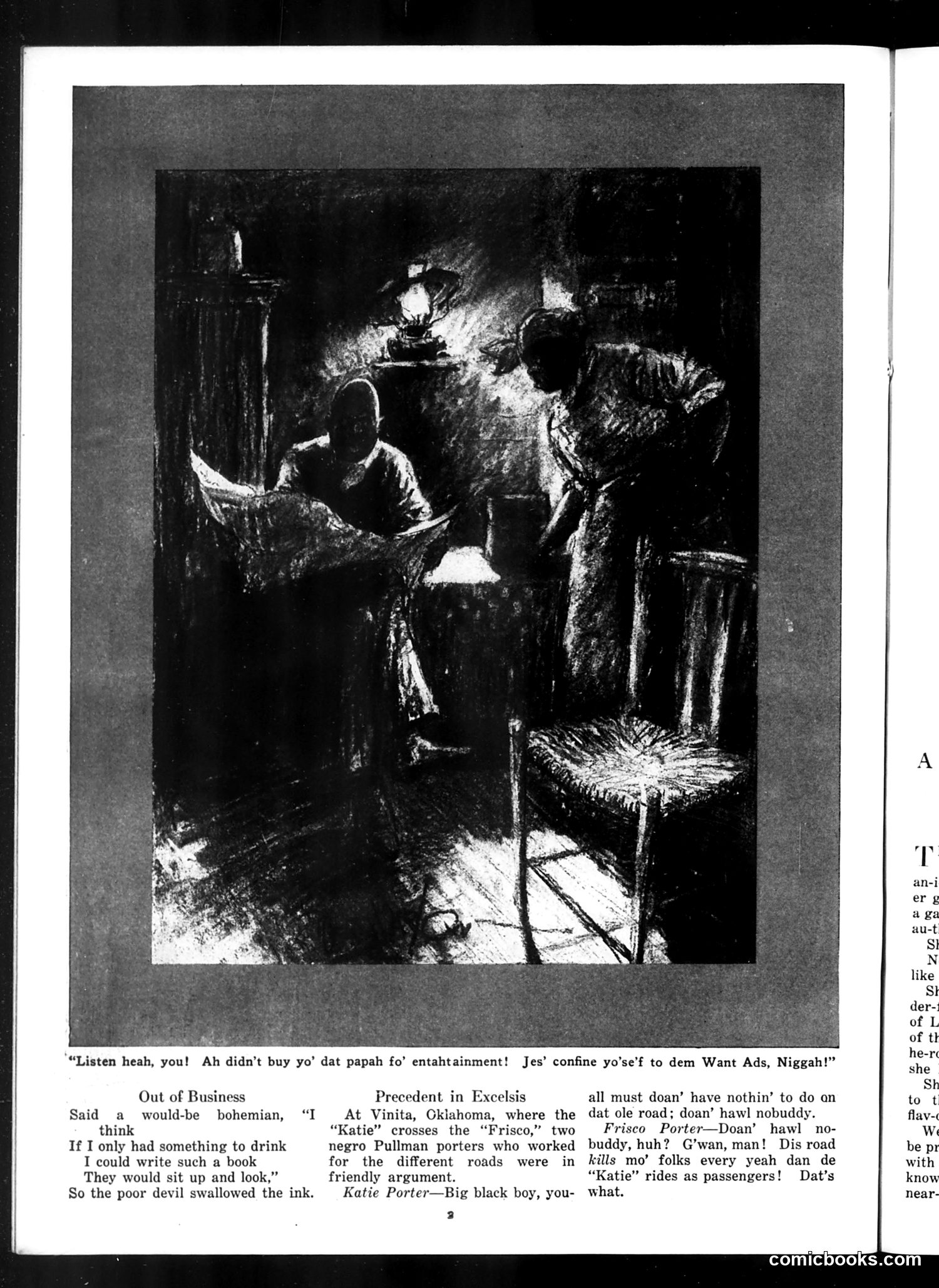
This page from *Judge* magazine contains a dark satirical illustration and accompanying racist dialogue mocking African American characters. The image depicts what appears to be a domestic scene with Black figures, while the caption uses heavy dialect and racial slurs typical of early 20th-century minstrelsy humor. The text sections "Out of Business" and "Precedent in Excelsis" reference fictional train porters named "Katie Porter" and "Frisco Porter," using caricatured speech patterns as the basis for jokes. The humor relies on racist stereotypes—portraying African Americans as illiterate, unreliable, and suitable only for servile work. This material reflects the deeply racist editorial standards of *Judge* during this era, when such dehumanizing content was considered acceptable magazine humor by white audiences.
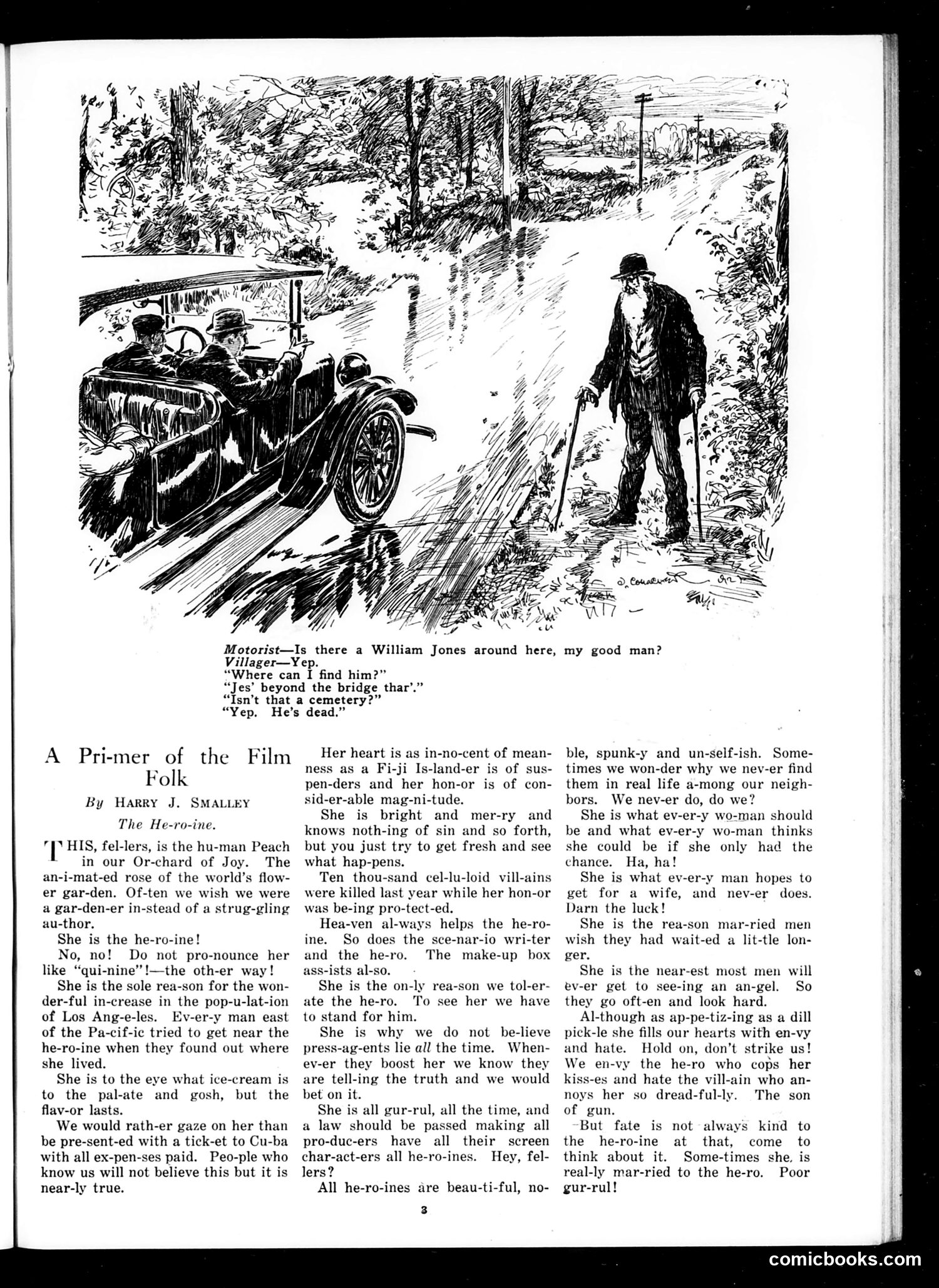
**The Cartoon:** An early automobile stops on a country road where an old man stands. The motorist asks a villager if he's seen "William Jones" around here, and receives directions to a cemetery "beyond the bridge," with the grim reply "He's dead." **The Joke:** This is a straightforward dark humor piece playing on the collision between modern technology (the automobile) and rural tradition. The implication is that William Jones died some time ago, yet the motorist's search suggests he was unaware—creating gallows humor about how isolated rural communities remain from news. **Social Context:** The cartoon reflects early-1900s attitudes toward automobiles as novel, urban inventions entering traditional countryside spaces, highlighting the cultural gap between modernizing cities and slower-changing rural areas.
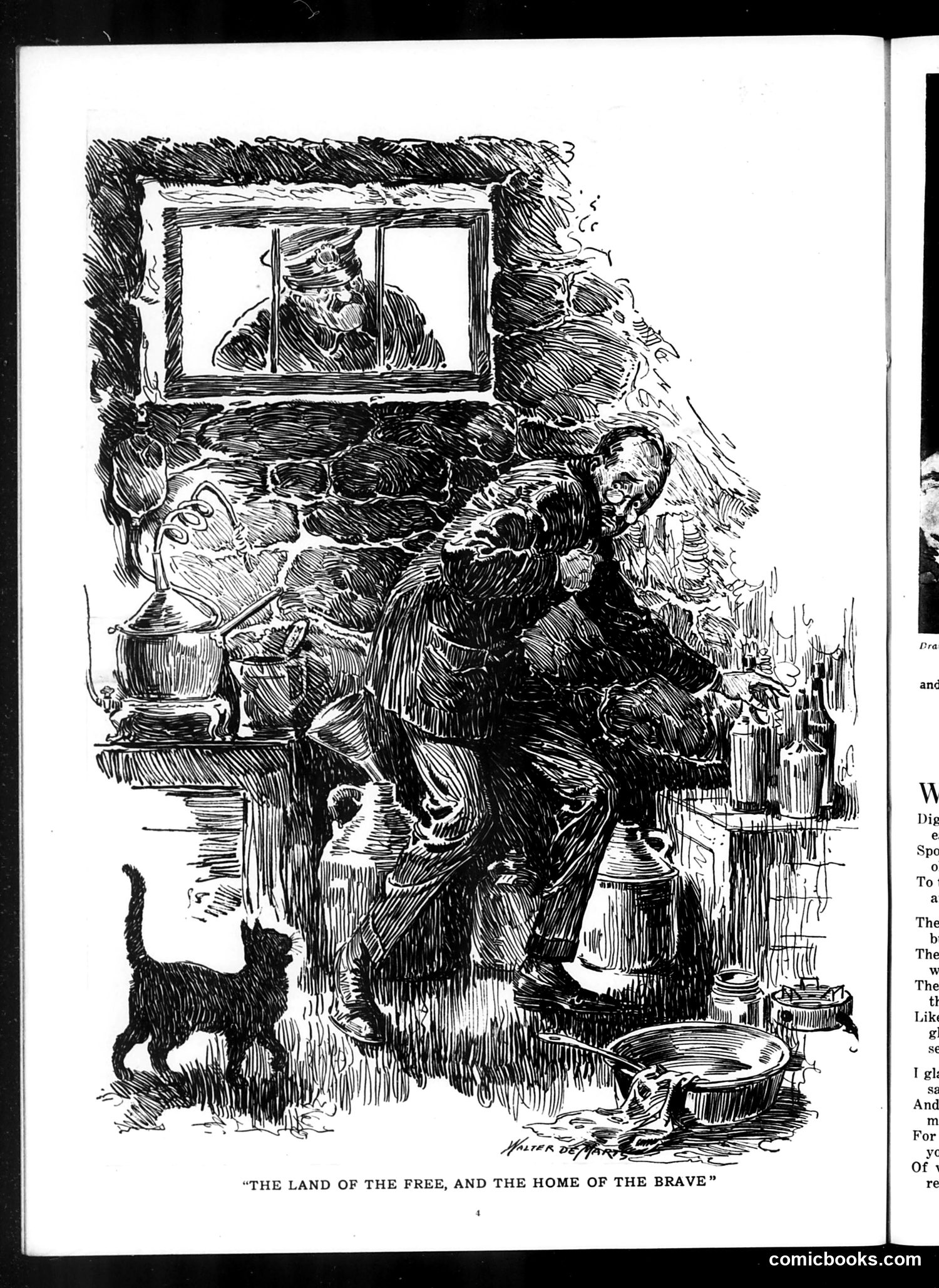
This Walter de Maris cartoon satirizes American domestic poverty and inequality through ironic juxtaposition. The caption quotes the U.S. national anthem, promising freedom and bravery, yet the image shows a cramped tenement dwelling where multiple impoverished figures—adults and children—are crowded together in squalid conditions. A cat in the foreground and cooking vessels suggest subsistence living. The satire targets the disconnect between American patriotic ideals and the grim reality of urban poverty, likely reflecting concerns about tenement housing and working-class conditions during Judge magazine's heyday (late 19th/early 20th century). The cartoon critiques how nationalist rhetoric obscures actual hardship experienced by poor Americans.
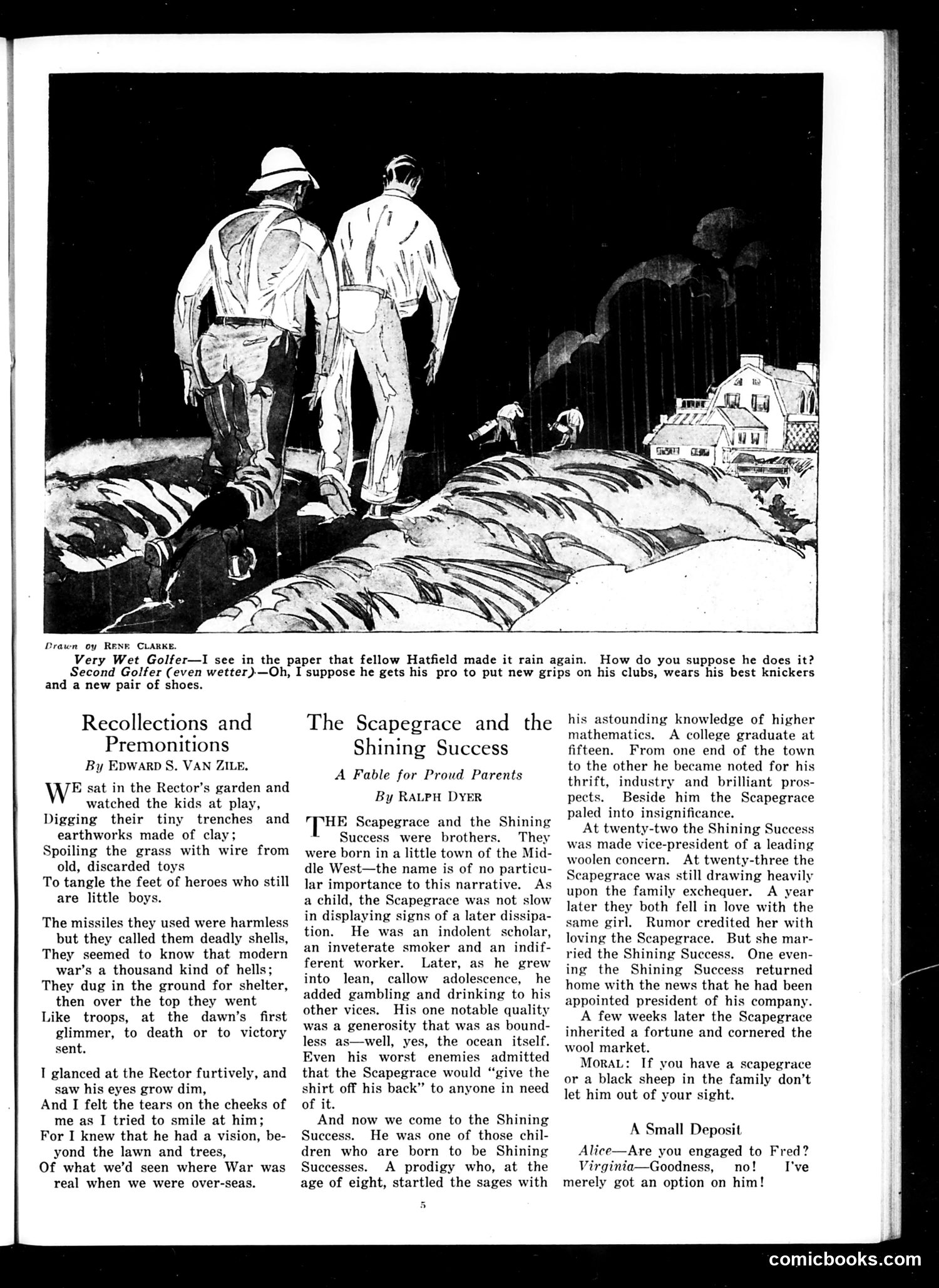
The cartoon jokes about a golfer named Hatfield who supposedly controls the weather. When one golfer notes that "Hatfield made it rain again," the second golfer humorously explains Hatfield's "method": wearing his best clothes and having his golf pro maintain his equipment. The joke is absurdist—the implication that proper attire and club maintenance might magically produce rain. This likely references **Charles Hatfield, a real "rainmaker"** who gained fame in the early 1900s claiming he could artificially induce rainfall through secret chemical methods. He famously attempted this in San Diego in 1916. Judge magazine satirizes public fascination with this dubious claim by suggesting such weather control requires nothing more than looking well-dressed on the golf course.
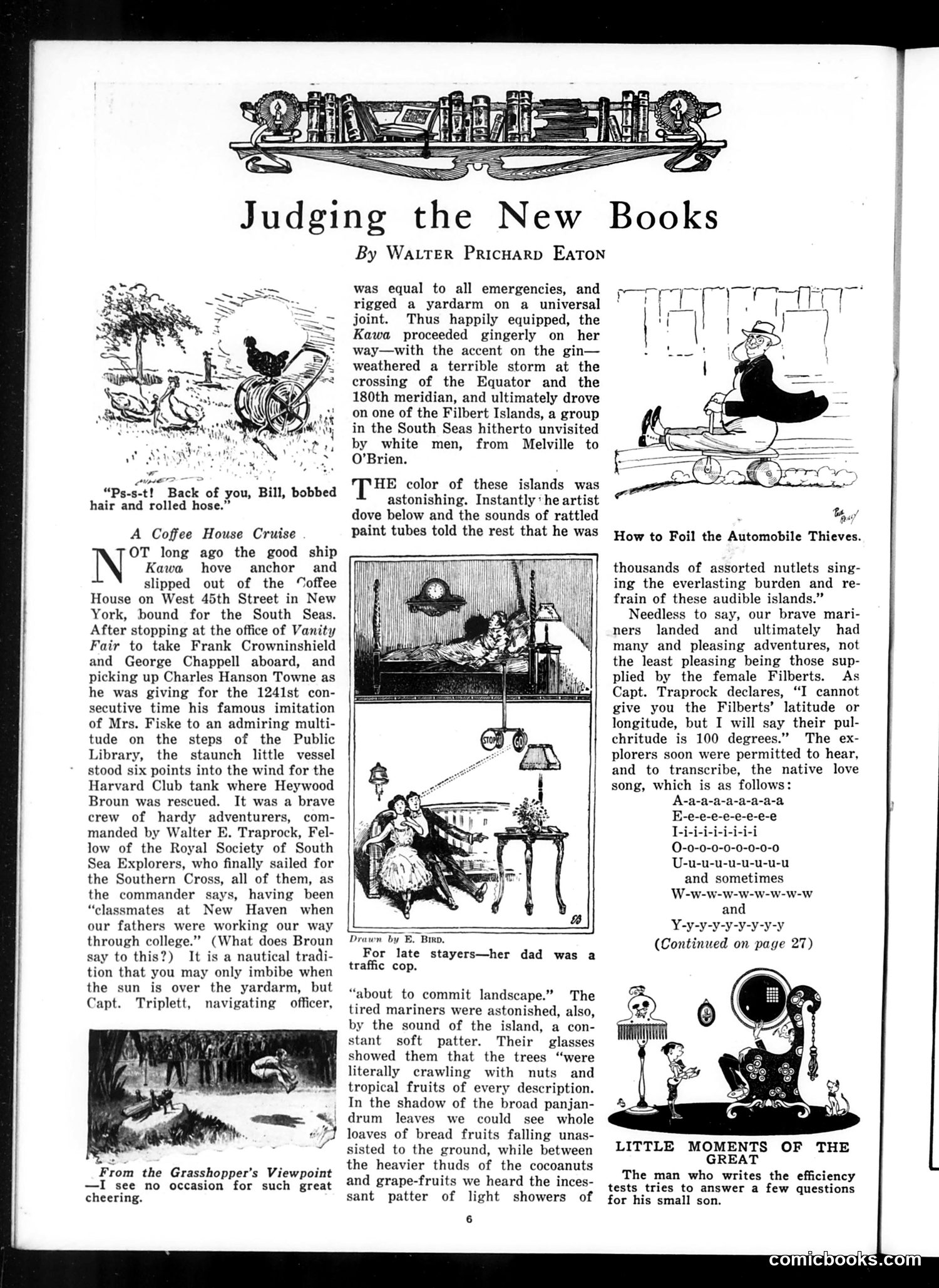
This page contains a satirical travel narrative titled "A Coffee House Cruise" by Walter E. Traprock, a fictional explorer-character. The piece mocks both adventure literature and the literary/cultural figures of 1920s New York. The narrative follows a ship called the *Kawa* departing from a coffee house on West 45th Street with a crew of recognizable Manhattan personalities: Frank Crowninshield and George Chappell (from *Vanity Fair*), Charles Hanson Towne, and Heywood Broun. The joke relies on readers recognizing these actual editors and writers. The satire targets exaggerated travel narratives—particularly South Seas adventure tales inspired by writers like Melville and O'Brien. The absurdist descriptions (trees "crawling with nuts," fruits "singing") parody overwrought exotic literature. The invented "native love song" (nonsensical vowel sequences) further mocks romanticized depictions of indigenous peoples. The cartoons and smaller pieces on the page are unrelated humor vignettes typical of *Judge* magazine's format.
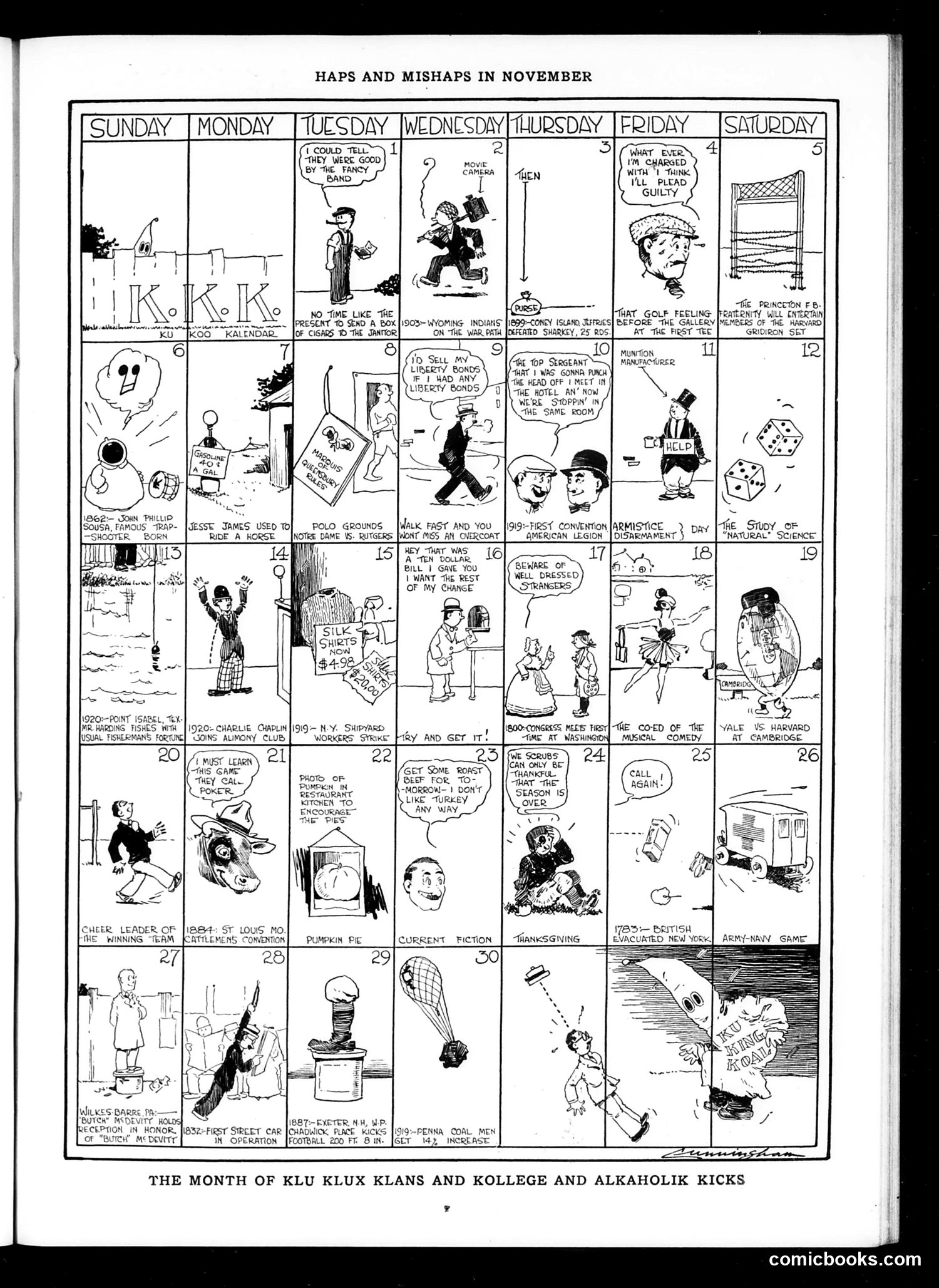
This is a daily calendar of satirical comic strips mocking various November events and social follies. The subtitle—"The Month of KLU KLUX KLANS and KOLLEGE and ALKAHOLIK KICKS"—signals the page's targets: the KKK (referenced through the "K" alliteration), college life, and Prohibition-era drinking culture. Individual panels satirize contemporary issues: Liberty Bonds (WWI financing), golf obsessions, Armistice Day observances, pumpkin pie, Thanksgiving preparations, and a Yale-Harvard football game. Several reference specific historical incidents (Wyoming Indians, a 1920 Charlie Chaplin alimony case, a 1932 streetcar debut). The cartoons employ crude visual humor typical of 1920s satire—exaggerated faces, slapstick scenarios—targeting middle-class American preoccupations and hypocrisies. The alliterative title mockingly suggests the KKK and college fraternities share similar trivial concerns with drinking, reflecting contemporary anxieties about these institutions.
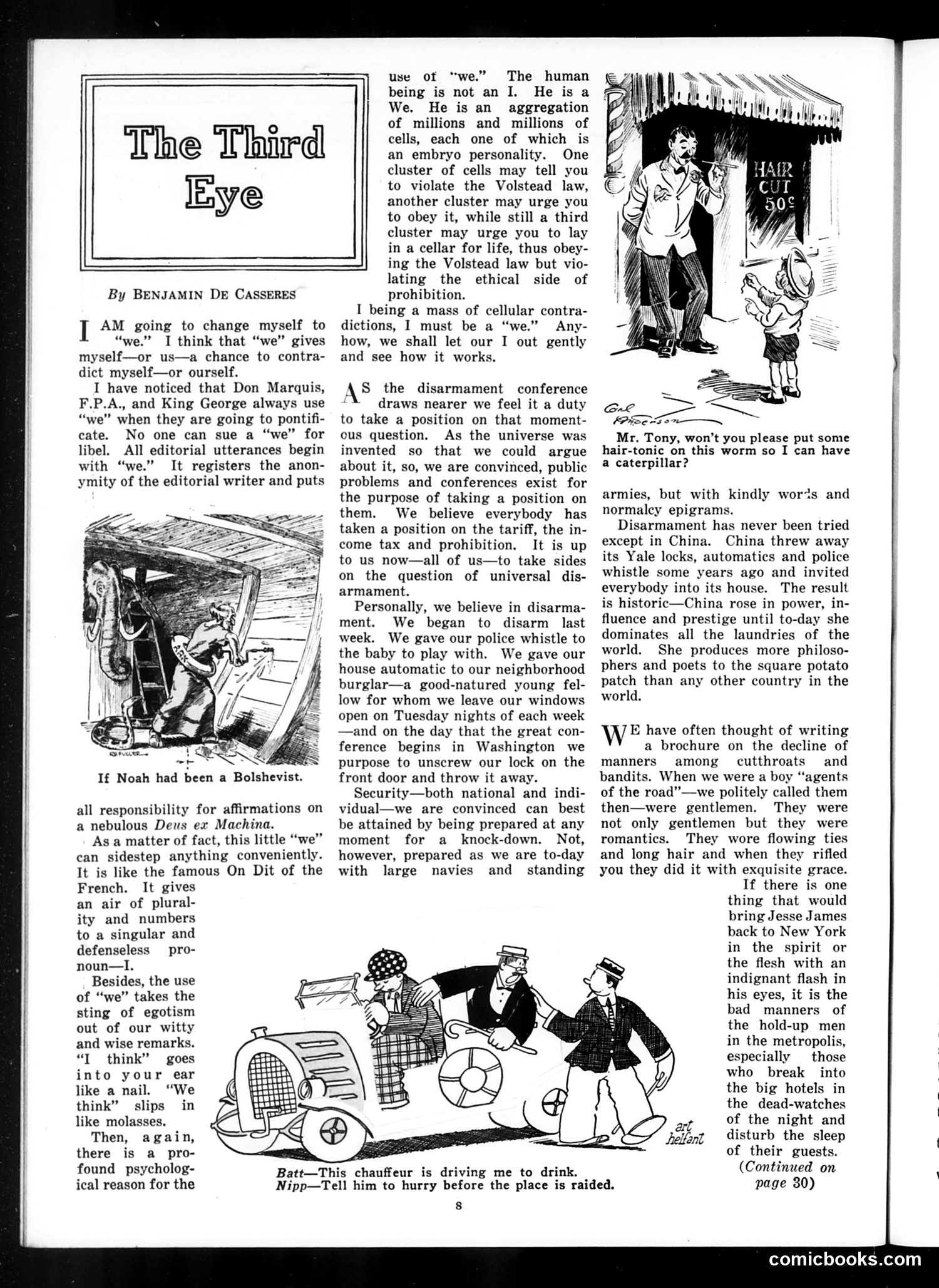
This satirical essay mocks editorial pretension and naive disarmament advocacy. De Casseres explains why writers use the collective "we" instead of "I"—it provides anonymity, diffuses responsibility, and sounds more authoritative while actually being evasive. The piece then ridicules the upcoming disarmament conference, ironically endorsing total disarmament by describing absurd personal examples: giving away his police whistle and house key, leaving his front door unlocked. He cites China as proof disarmament works, claiming it rose to dominance by surrendering defenses—clearly nonsensical, as China faced chaos and foreign exploitation after weakening. The cartoons reinforce the humor: one depicts Prohibition-era drinking ("chauffeur driving me to drink"), another shows a child requesting hair-tonic for a worm to create a caterpillar. The satire targets both editorial cowardice and what De Casseres sees as dangerous, idealistic disarmament proposals disconnected from reality.
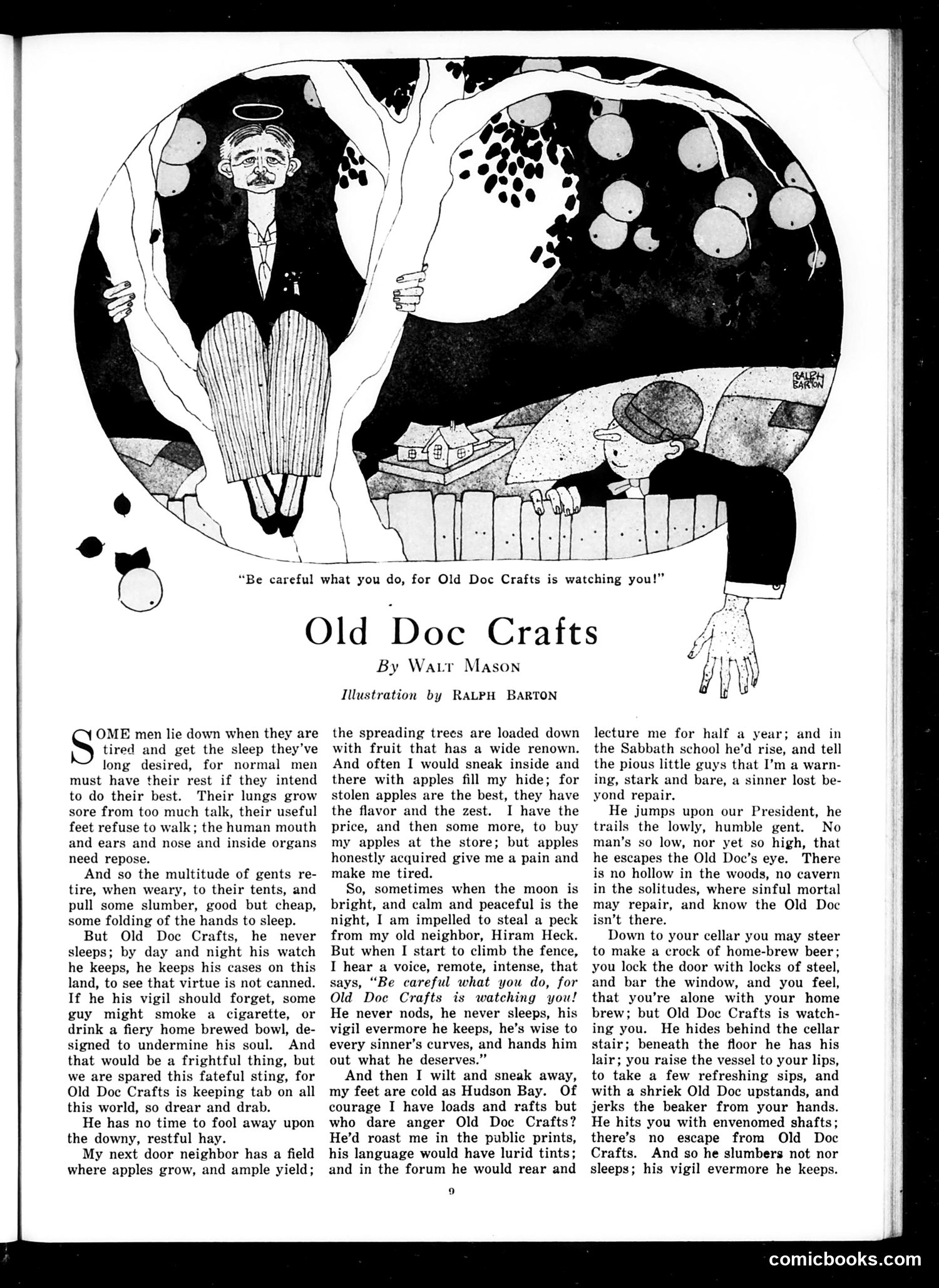
This is a humorous cautionary tale by Walt Mason, illustrated by Ralph Barton, satirizing prohibition-era moral enforcement and busybody vigilance. "Old Doc Crafts" is a personified figure representing self-righteous moral authority—the intrusive watchdog who never sleeps, constantly monitoring citizens for infractions. The narrative mocks how such figures police everyday behavior: stealing apples, brewing home beer in cellars, and other minor indiscretions. The satire targets both the paranoia created by prohibition enforcement and the exhausting omnipresence of moral policing in American life. The speaker fears Crafts will publicly shame him in newspapers and Sunday school if caught—exaggerating how severely such figures wielded social judgment. The cartoon shows Crafts as a skeletal, haunting presence literally watching from above, emphasizing the oppressive feeling of constant surveillance that the story describes. The piece mocks the culture of moral enforcement that characterized the Prohibition era.
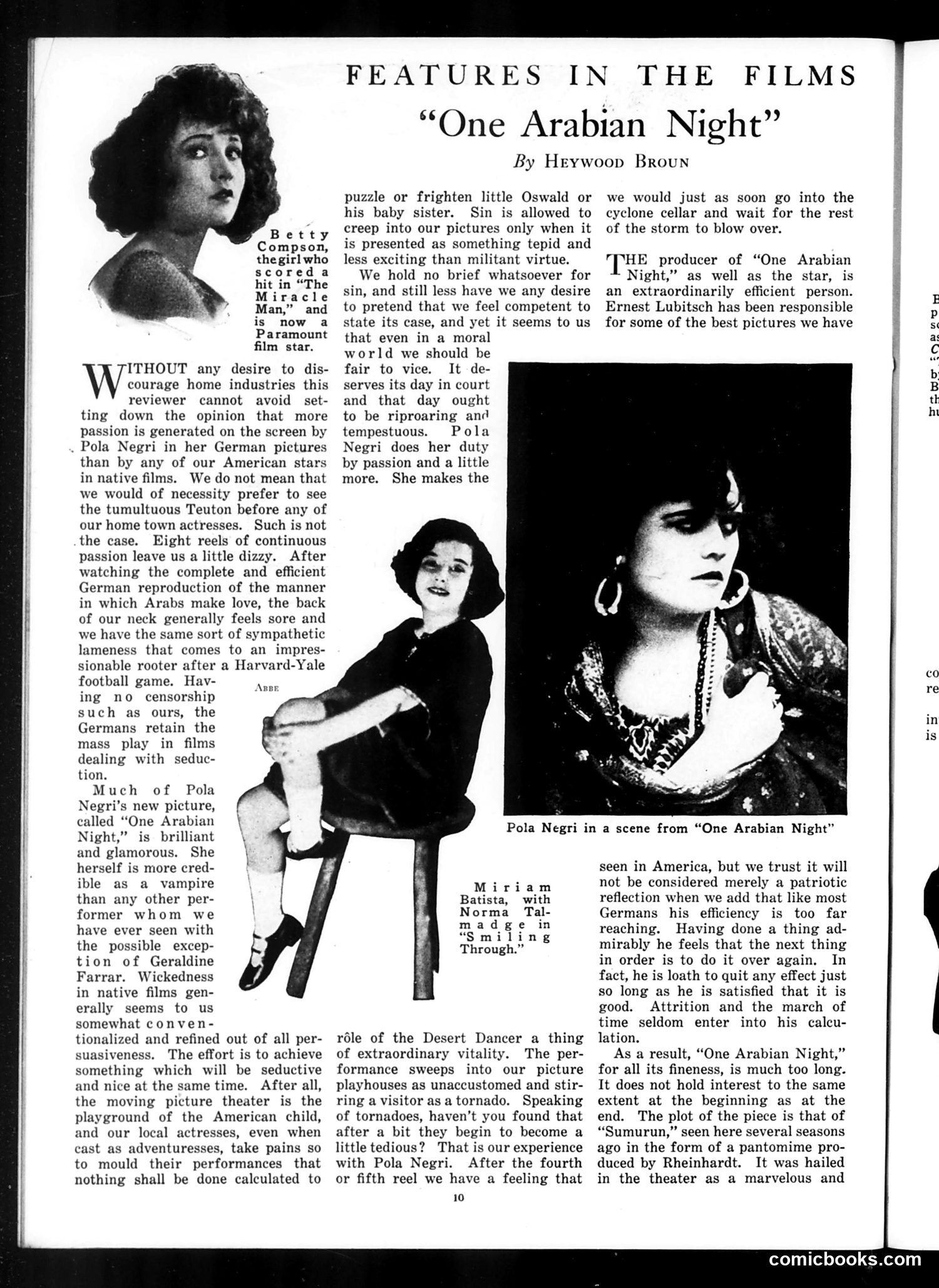
This is a film review by Heywood Broun of "One Arabian Night" starring Pola Negri, a German-Polish actress. The piece contrasts European and American filmmaking approaches to depicting vice and passion. **The Critique's Context:** The reviewer argues that German films (particularly those starring Negri) portray passion and seduction more authentically than sanitized American productions. He suggests American films tone down "sin" because moviehouses serve as children's playgrounds, while German cinema operates without equivalent censorship restrictions. **The Satire:** Broun admits admiring Negri's vampire roles while simultaneously criticizing the film's excessive length—a sly jab at German director Ernest Lubitsch's tendency to over-elaborate effects. The tornado metaphor humorously captures how Negri's intense performance becomes exhausting by the fourth or fifth reel. **Key Players:** Betty Compson and Miriam Batista appear as comparative American actresses; Lubitsch represents efficient but relentless German filmmaking. The piece reflects 1920s anxieties about censorship, European vs. American cultural values, and cinema's moral influence on audiences.
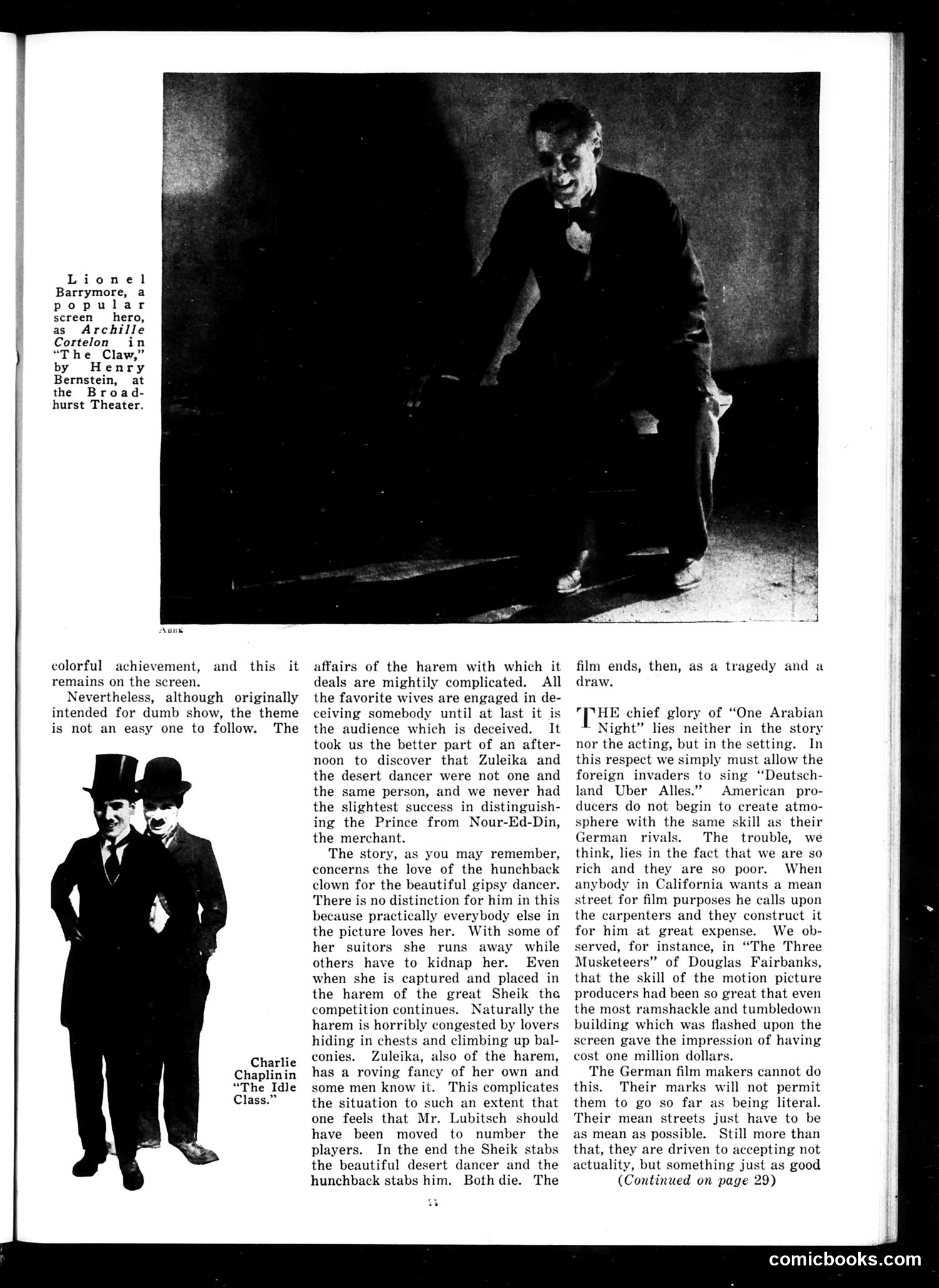
This page reviews two theatrical films. The top photograph shows **Lionel Barrymore** in "The Claw," a stage adaptation at the Broadhurst Theater. The review criticizes the plot's complexity—a harem tale where multiple suitors pursue the same dancer, making it difficult to follow which character is which. The small illustration shows **Charlie Chaplin** in "The Idle Class," mentioned without detailed commentary. The longer review discusses "One Arabian Night," likely a German production. The critic praises German filmmakers' superior ability to create authentic atmosphere on screen, attributing this to their economic constraints—German producers must create genuine-looking sets on limited budgets, while wealthy American producers can build expensive replicas that paradoxically look artificial. The review suggests American wealth actually *handicaps* cinematic realism, while German poverty forces creative authenticity. This is notably generous praise toward a foreign rival during the competitive early cinema era.
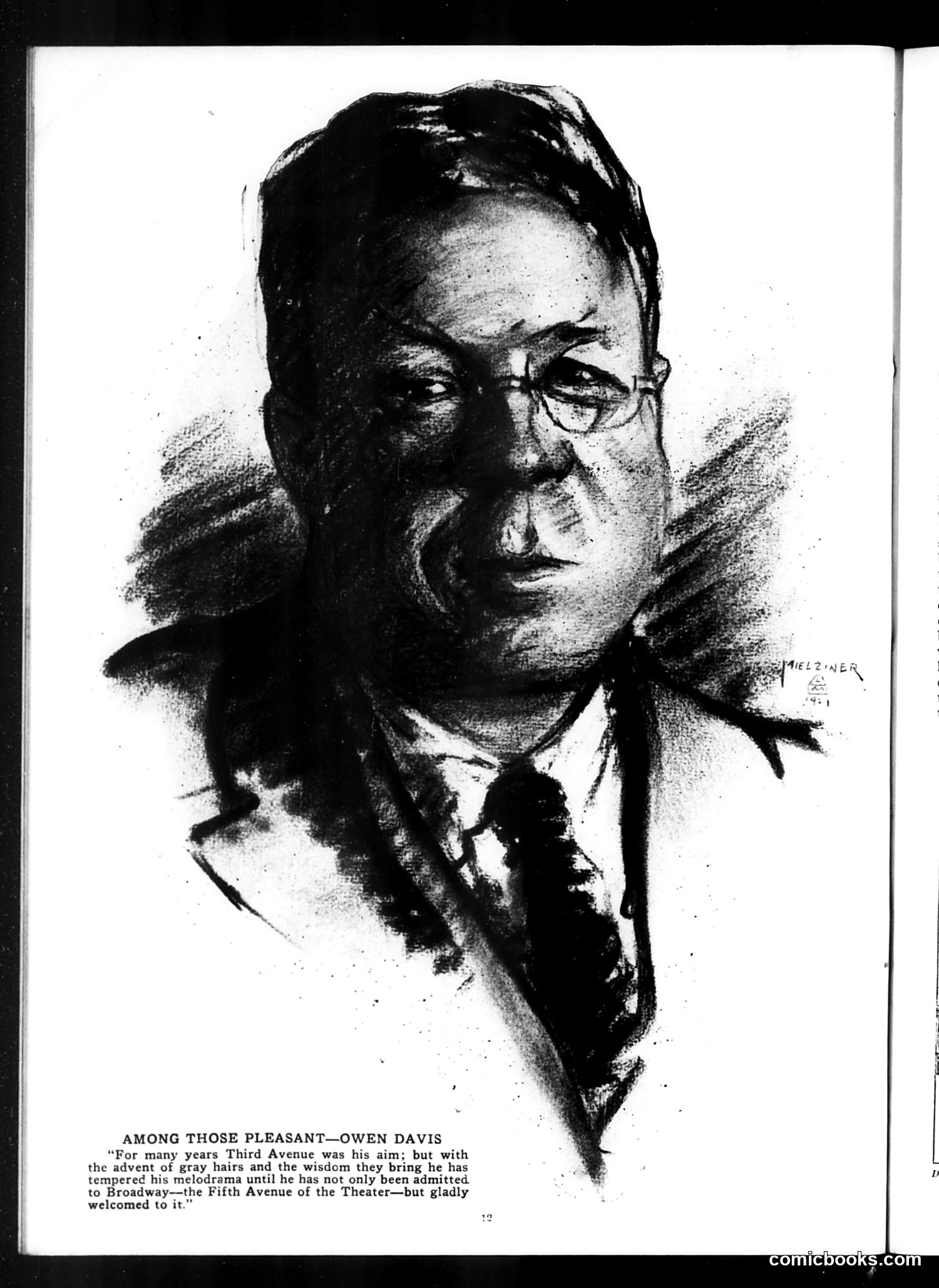
This page features a portrait sketch of playwright Owen Davis. The accompanying text uses social satire to celebrate his career trajectory. "Third Avenue" and "Fifth Avenue" are metaphorical references to theater venues—Third Avenue theaters represented lower-class, melodramatic entertainment, while Fifth Avenue (Broadway) represented elite, respectable theater. The satire's point: Davis spent years writing popular melodramas for working-class audiences on Third Avenue. As he matured (gaining "gray hairs and wisdom"), he refined his craft and gained acceptance into prestigious Broadway circles. The tongue-in-cheek tone suggests that respectability and artistic legitimacy come with age and a shift toward more sophisticated work. The piece celebrates his upward social and professional mobility through the theater world.
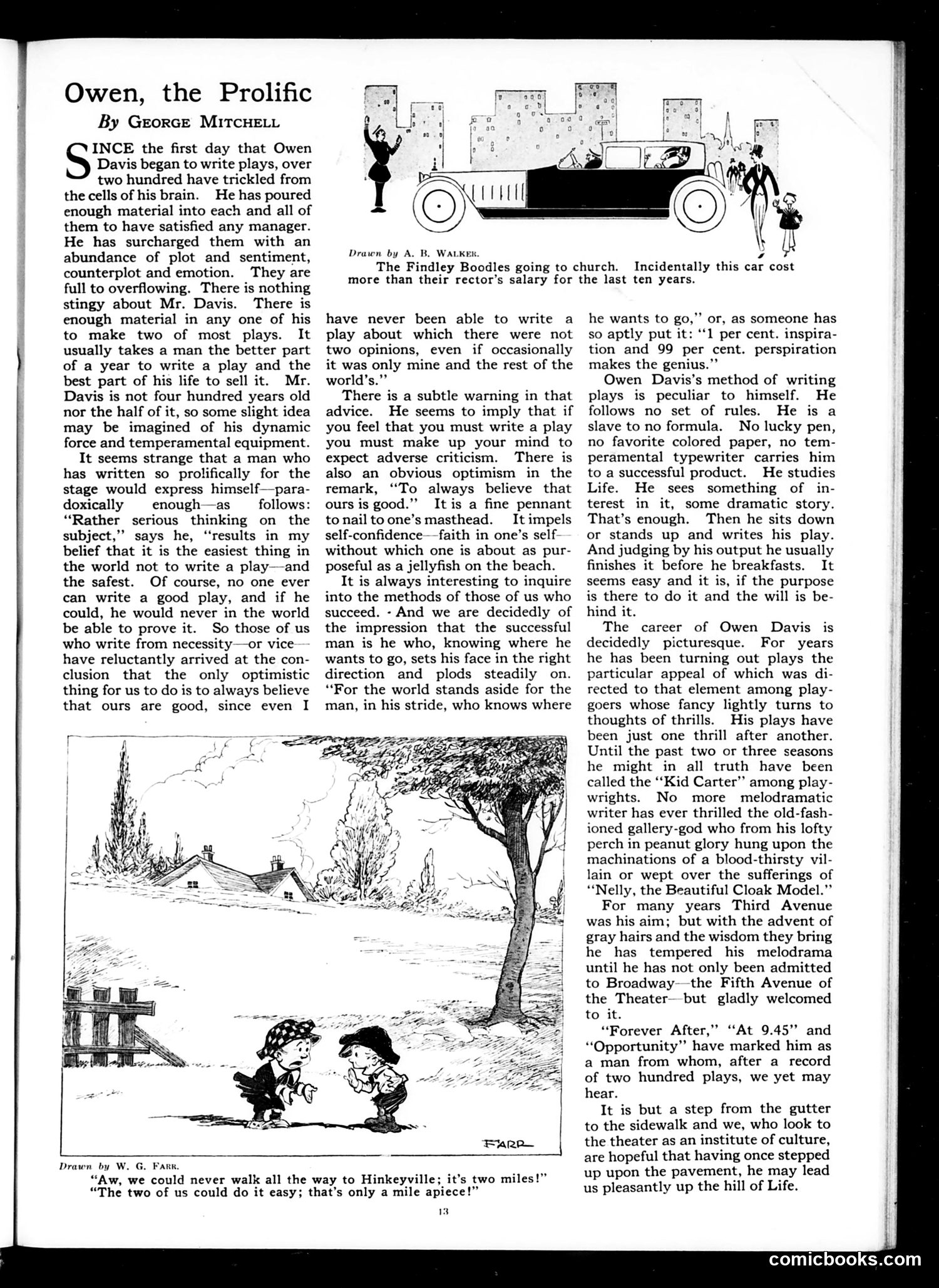
This article profiles Owen Davis, a prolific early 20th-century American playwright who had written over 200 plays by the time of publication. The piece celebrates his extraordinary productivity while quoting Davis's paradoxical admission that he believes writing plays is actually dangerous to one's career—since any play will face criticism and proving its quality is impossible. The article explains Davis's unconventional method: he observes life, finds a dramatic story, and writes rapidly (often completing plays before breakfast), following no rigid formula. Two cartoons illustrate the text: one shows a wealthy couple in an expensive car, captioned as "The Findley Boodles going to church"; another depicts two children discussing walking distance, with the joke playing on faulty arithmetic. The piece notes Davis previously wrote sensational "thrill plays" for popular audiences (earning him the nickname "Kid Carter") but has since shifted toward more respectable Broadway productions, suggesting his artistic evolution.
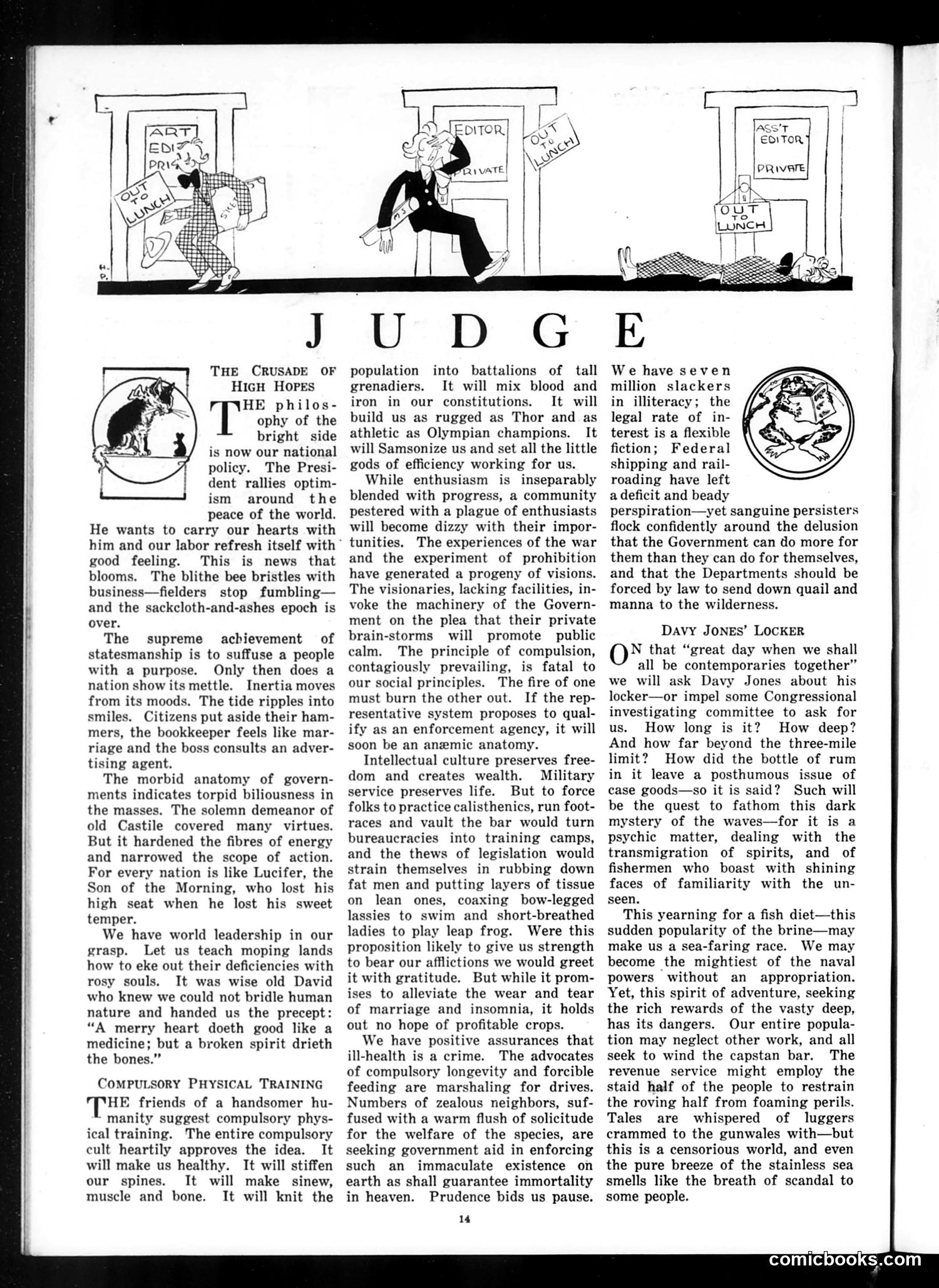
The top cartoon satirizes workplace hierarchies during the post-WWI optimistic period. It shows three office doors labeled "Art Editor Private," "Editor Private," and "Asst Editor Private"—each with progressively smaller figures receiving lunch privileges. The joke mocks how companies grant perks based on rank: only executives get "out lunch" while junior staff must eat at their desks. The accompanying text, titled "The Crusade of High Hopes," appears to critique President Wilson's post-war idealism and mandatory policies. The second article, "Compulsory Physical Training," satirizes government enforcement of fitness regimens. Judge argues that forced physical training—inspired by wartime and Prohibition experiments—represents dangerous overreach. The magazine warns that compulsion undermines individual liberty and social principles, suggesting such policies reflect naive utopianism rather than practical governance.
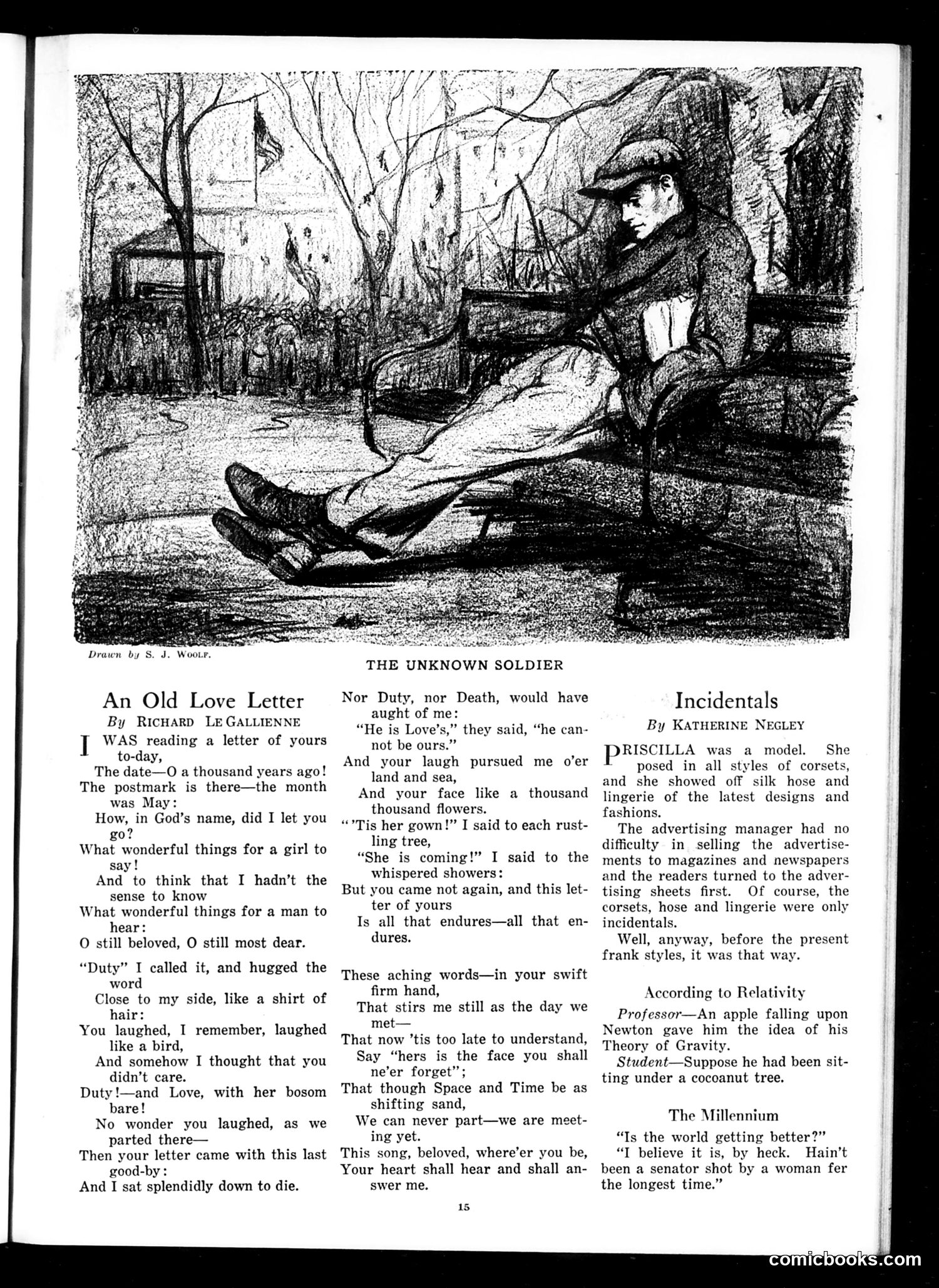
This page from *Judge* contains three distinct literary/humor pieces rather than political cartoons. **"The Unknown Soldier"** (top illustration): A sentimental poem by Richard Le Gallienne about a soldier rereading an old love letter, reflecting on choosing duty over love. The sketch shows a uniformed soldier in a park, lost in melancholy memory. **"An Old Love Letter"** (left column): A romantic poem about rediscovering a decades-old love letter and regretting the choice made long ago. **"Incidentals"** (right column): A brief satirical piece by Katherine Negley mocking advertising practices. It notes that before "frank styles" (presumably modern fashion), women models posed in corsets and lingerie that supposedly sold magazines—the actual products being merely "incidentals" to what readers actually wanted to see. **"The Millennium"** (bottom right): A short joke suggesting societal progress, ironically measuring it by the absence of female-perpetrated political assassinations—likely referencing anarchist violence of the early 20th century. The page lacks overt political satire; it's primarily sentimental poetry and light social humor.
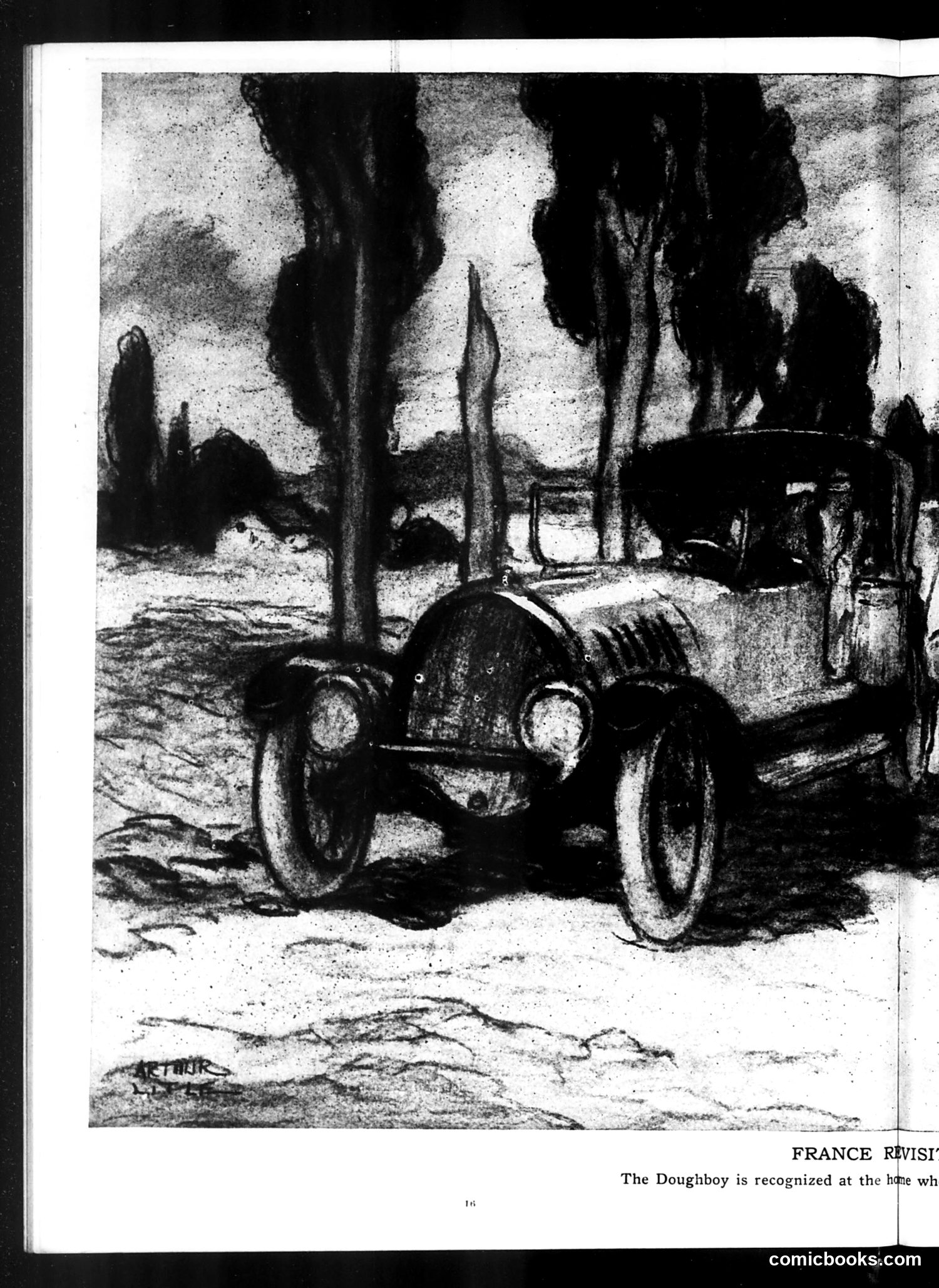
This page features an illustration titled "FRANCE REVISITED" with a caption referencing "The Doughboy" being recognized "at the [location - text cut off]." The image shows a vintage racing automobile parked among tall trees in what appears to be a French landscape. The car has prominent headlights and spoked wheels characteristic of early 20th-century design. The term "Doughboy" refers to American soldiers, particularly those who served in World War I in France. This appears to be post-WWI satire about American servicemen returning to or revisiting France. However, the specific satirical point is unclear due to the OCR error in the caption and the image's ambiguous relationship to the title. The illustration's connection to the political commentary likely relates to American military presence or nostalgia, but the exact meaning remains uncertain without the complete caption text.
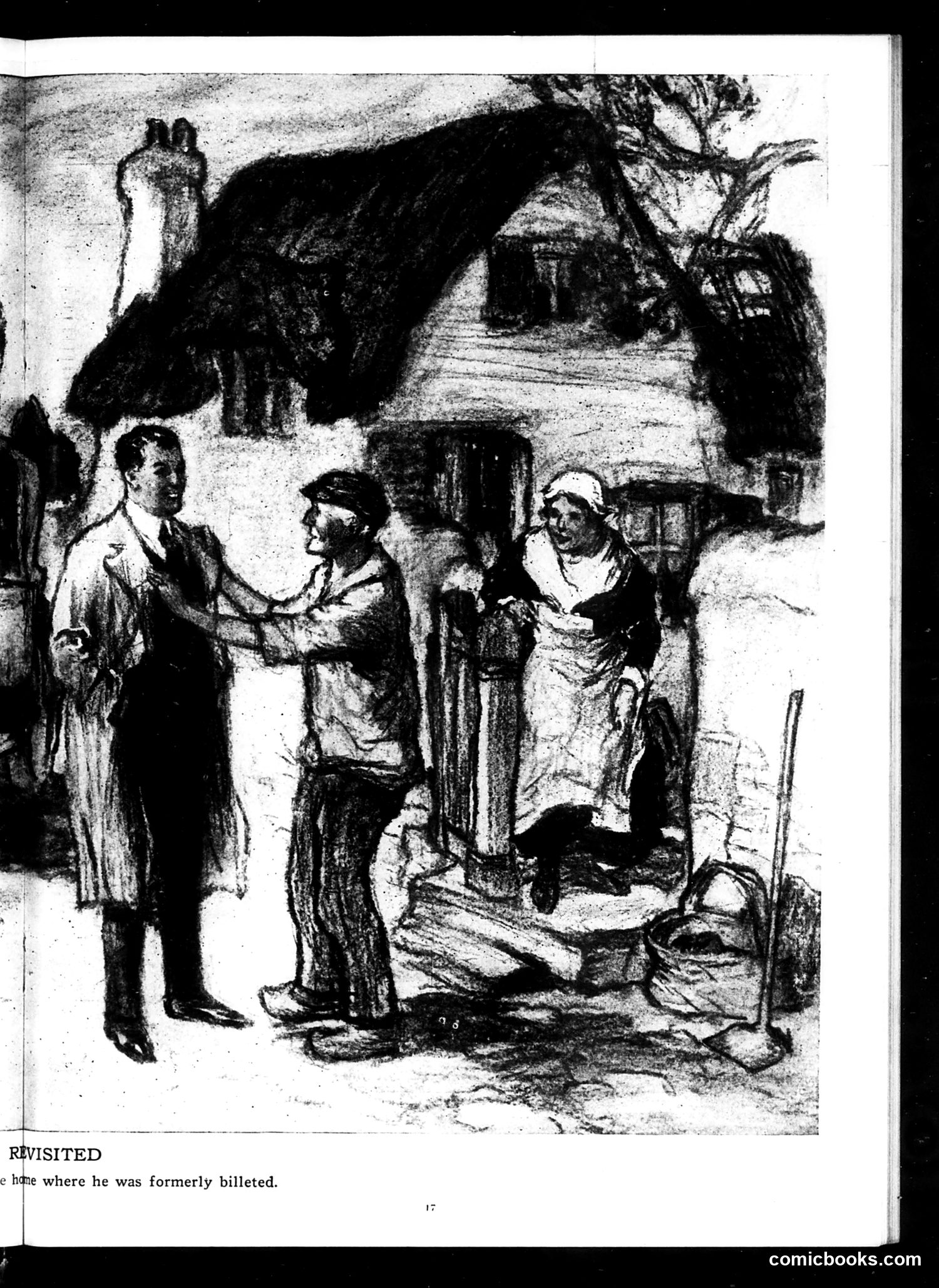
This sketch appears to depict a gentleman in formal dress visiting a modest cottage or rural dwelling where he was "formerly billeted" (lodged). The scene shows him greeting working-class inhabitants—a man and woman in period clothing near the cottage door, with farm implements visible. The satire likely plays on class contrasts: a well-dressed visitor returning to humble lodgings from his past, possibly evoking nostalgia or ironic reflection on changed circumstances. The title "Revisited" suggests returning to one's roots or former circumstances. Without additional context or byline visible, the specific political or social commentary remains unclear, though the humor appears centered on class differences and the awkwardness of revisiting a humbler past.
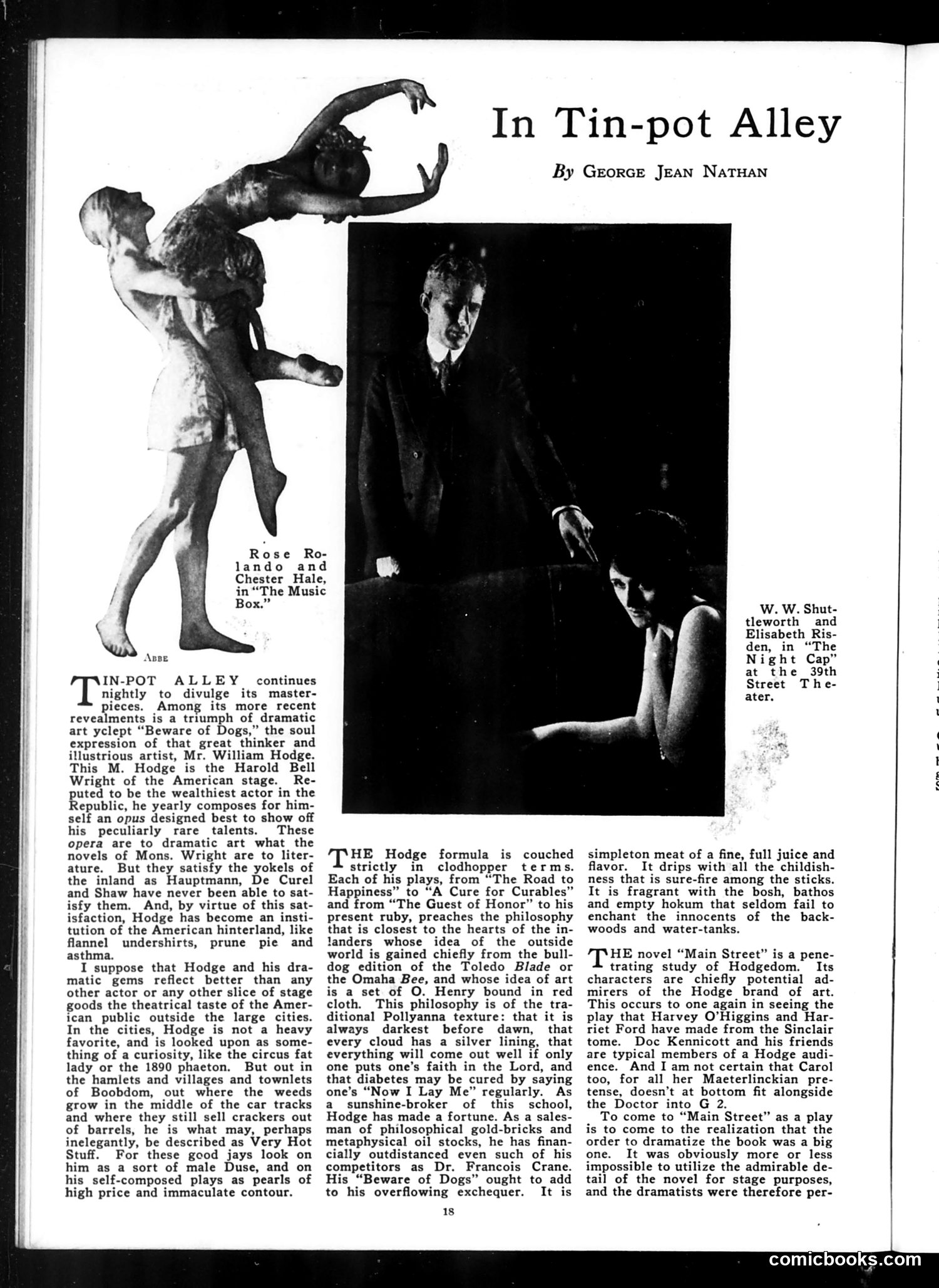
This is a theater column by George Jean Nathan satirizing William Hodge, a wealthy actor-playwright whose sentimental, moralistic plays appealed to rural American audiences but were dismissed by urban critics as lowbrow drivel. **The satire:** Nathan mocks Hodge's formula—simplistic Pollyanna philosophy, cornball humor, and false inspirational messages—comparing him unfavorably to serious playwrights like Hauptmann and Shaw. Nathan argues Hodge's work reflects the unsophisticated tastes of "Boobdom" (rural America), where audiences consume Toledo newspapers and O. Henry paperbacks. **The photos** show theatrical performers from current Broadway productions ("The Music Box," "The Night Cap") as examples of better stage work. Nathan's point: Hodge represents the gap between cosmopolitan urban theatrical standards and what he derisively calls "hinterland" America—a common 1920s intellectual prejudice against rural audiences and their cultural preferences.
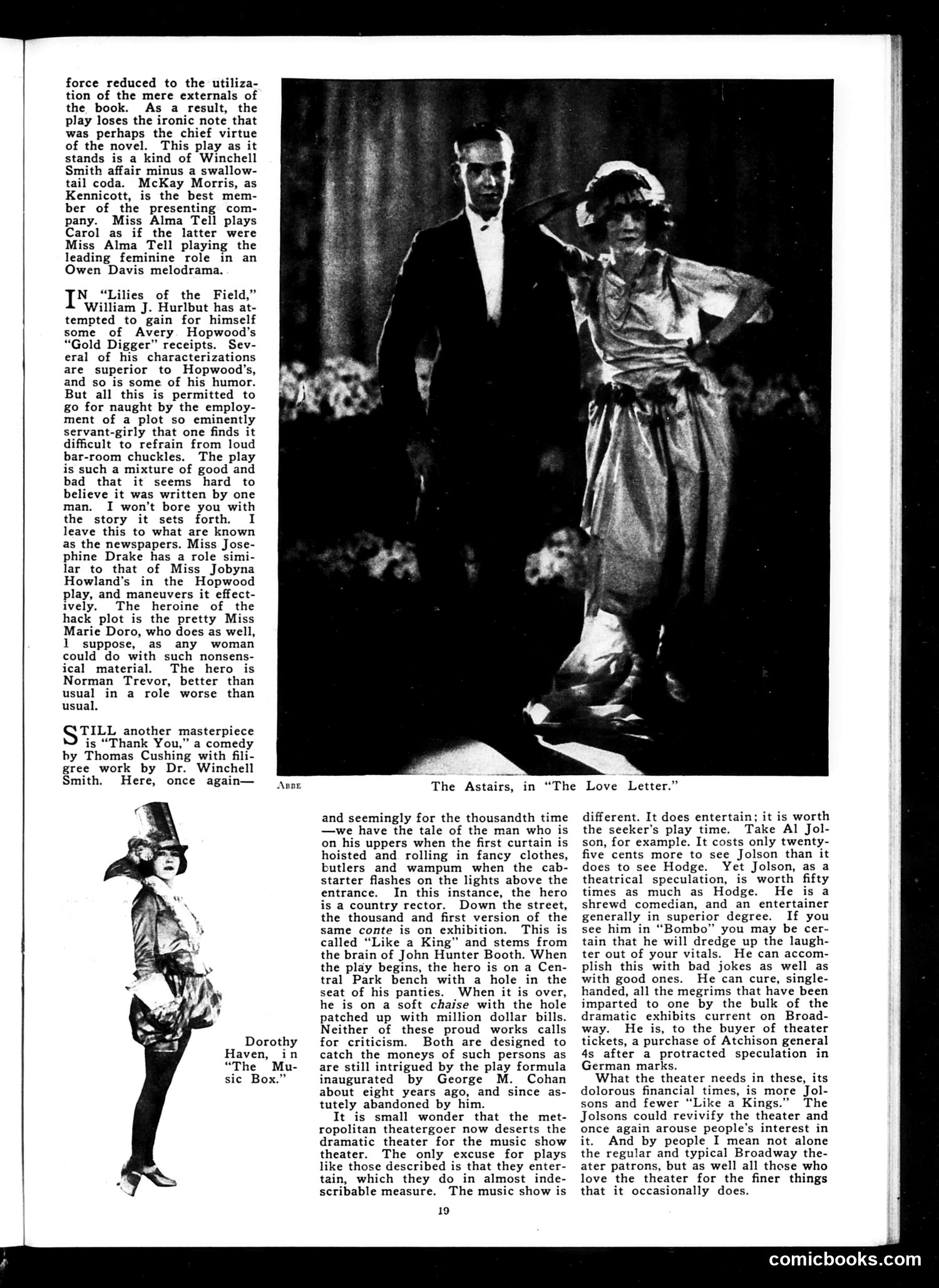
This page contains theater reviews comparing Broadway productions. The visible photograph shows actors in "The Love Letter," while the text discusses several plays including "Lilies of the Field" and "Thank You." The reviewer contrasts theatrical entertainment with music-hall performances, arguing that dramatic theater has declined because audiences prefer entertainers like Al Jolson in musical shows. The criticism suggests that contemporary plays rely on tired, formulaic plots (wealthy man/poor man schemes dating to George M. Cohan) rather than substance. The reviewer praises music-hall performers for their superior skill and value—Jolson costs only slightly more than dramatic theater but delivers far better entertainment and comedic ability. The implication is that Broadway theater is losing audiences to vaudeville and musical revues because playwrights recycle worn-out scenarios while music-hall performers offer genuine talent and originality.
This page contains humorous anecdotes rather than political cartoons. The header illustration shows classical figures in a frieze style, establishing the "Stories to Tell" format. The jokes satirize **early 20th-century American social anxieties and class distinctions**: 1. **"Beaten"**: Mocks English servants' accents and miscommunication ("het" vs. "heat") 2. **"Classified"**: The central satire—uses car ownership as proxy for religious/social class. Packard and Buick owners reach Heaven; Ford owners (cheapest mass-produced car) are classified with Christian Scientists (implying they aren't "real" Christians). This reflects period tensions about automobile wealth and religious hierarchy. 3. **"Helping Him Out"**: Jokes about Prohibition-era smuggling and gullibility. 4. **Other pieces**: Play on misheard words, drunkenness, and domestic servant mishaps. The humor relies on period-specific references (Prohibition, class anxiety, servant culture) that modern readers would find dated but whose underlying targets—pretension, miscommunication, social climbing—remain recognizable.
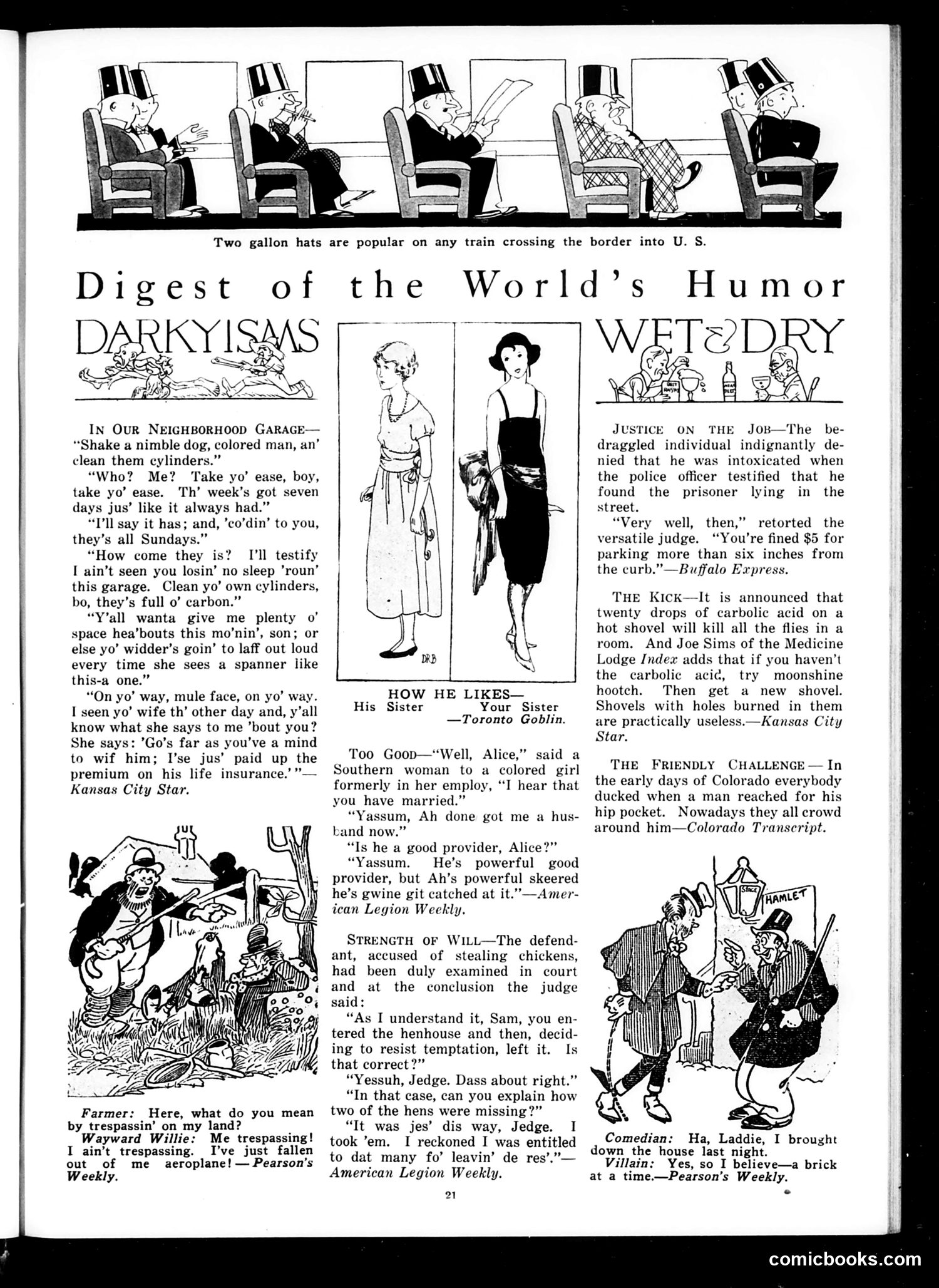
This page collects humorous anecdotes from various publications, organized into sections labeled "DARKYISMS" and "WET & DRY." The content relies heavily on racist stereotypes common to early 20th-century American humor. The "DARKYISMS" section presents jokes featuring African American characters depicted with exaggerated dialect and lazy, dishonest behavior—a garage worker refusing to clean cylinders, someone stealing chickens and lying in court. These pieces use racist caricature to portray Black people as shiftless and unreliable. The other sections include miscellaneous jokes: a farmer confronting a trespasser who's fallen from an airplane; a Southern woman noting her former employee's husband will likely be caught stealing; various puns and one-liners about intoxication, parking fines, and flies. The page's satirical intent appears limited to gentle social observation rather than meaningful commentary. The racist framing reflects the casual prejudice normalized in mainstream American publishing of this era.
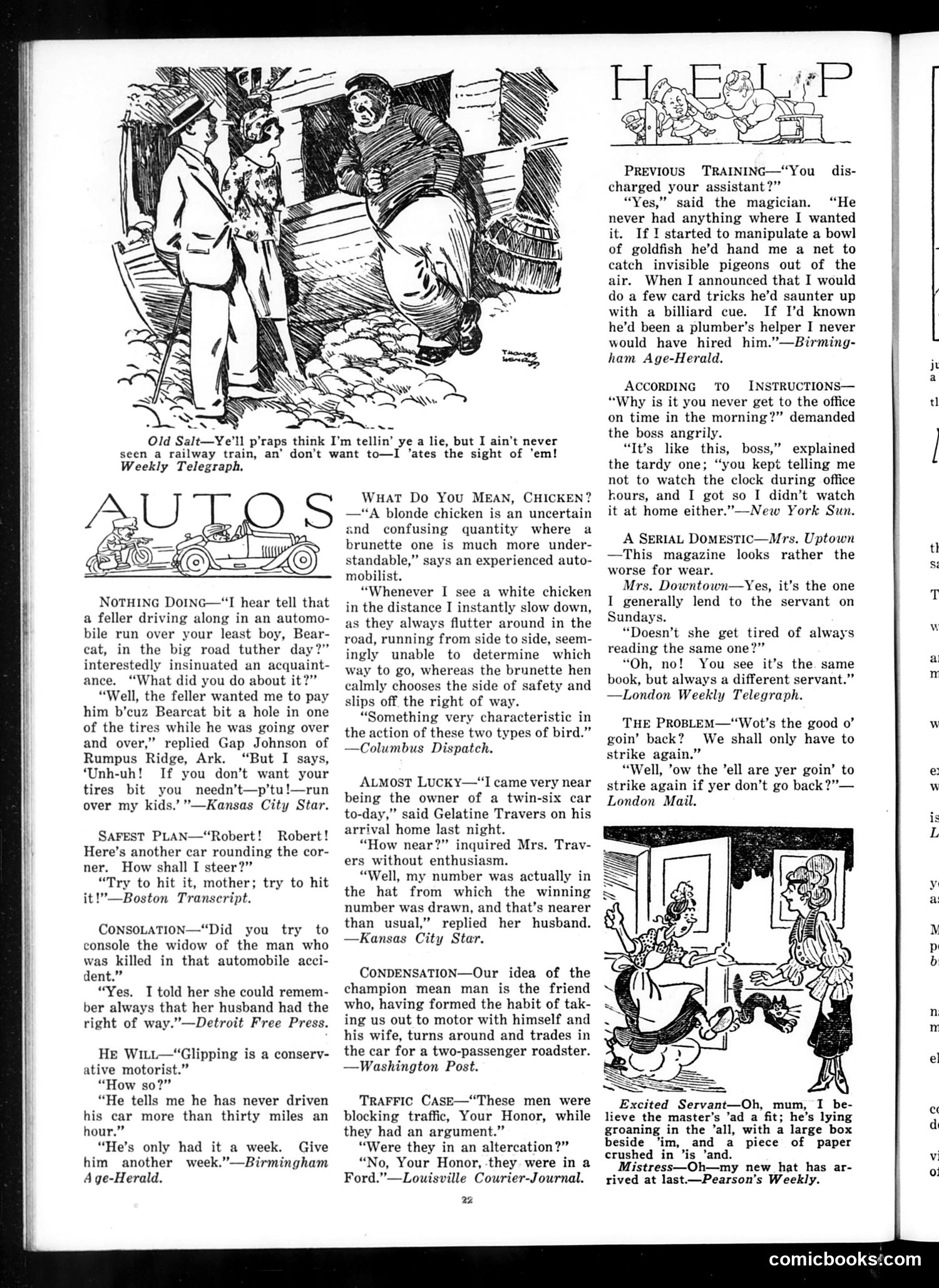
This page contains satirical humor pieces about early automobile culture and workplace dynamics, circa 1910s-1920s. **The automobile jokes** mock the novelty and unpredictability of cars: drivers hitting children and livestock, uncertainty about steering, the fragility of tires, and confusion over traffic laws. One piece jokes that a Ford causes "arguments" (a dig at Ford's affordability making them common but unreliable). Another references "blonde" versus "brunette" chickens—using poultry behavior as absurd metaphors for automotive hazards, mocking drivers' anxiety around unpredictable obstacles. **Other humor targets workplace hierarchy**: a magician complains his assistant was useless (hands him wrong props), and an employee claims he stopped watching clocks at work—then at home—creating workplace absurdity. **The servant joke** satirizes class relations: wealthy Mrs. Uptown lends worn magazines to servants, expecting they won't notice it's the same issue passed between different staff members. The cartoons depict period clothing and early 20th-century settings. The humor reflects anxieties about automobiles as new, dangerous technology disrupting rural and urban life.
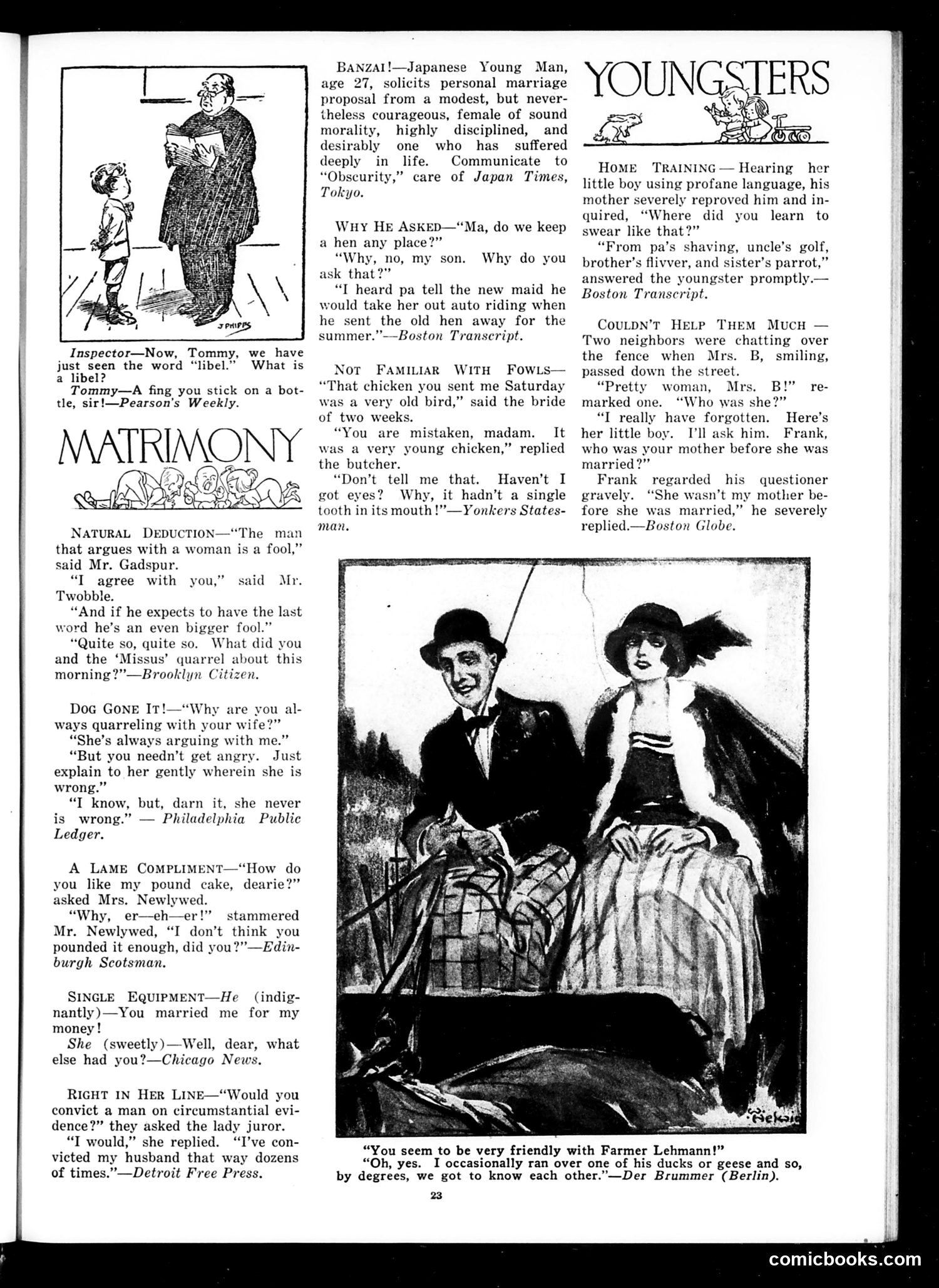
This page from *Judge* magazine contains humor sections typical of early 20th-century American satirical publishing. The content includes: **"Matrimony" section**: A series of short jokes about marriage conflicts, reflecting period attitudes that wives are argumentative and husbands cannot win disputes with them. The humor relies on stereotypes of marital discord. **"Youngsters" section**: Brief anecdotes about children's behavior and innocent misstatements. One joke implies a father's infidelity (calling the new maid "the old hen"). Another shows a child logically but rudely correcting an adult about his mother's pre-marital status. **Top illustration**: A simple pen-and-ink drawing of an adult and child, accompanying a joke about teaching children proper language—humorously blaming profanity on fathers' golf frustration, brothers' car ("flivver") problems, and pets. **Bottom photograph**: A romantic scene captioned with a Berlin publication's joke about a man and woman becoming friendly after repeatedly hitting her neighbor's livestock with his car—dark humor about inevitable acquaintance. The page reflects early-1900s attitudes toward gender roles, marriage, and child-rearing through light domestic comedy.
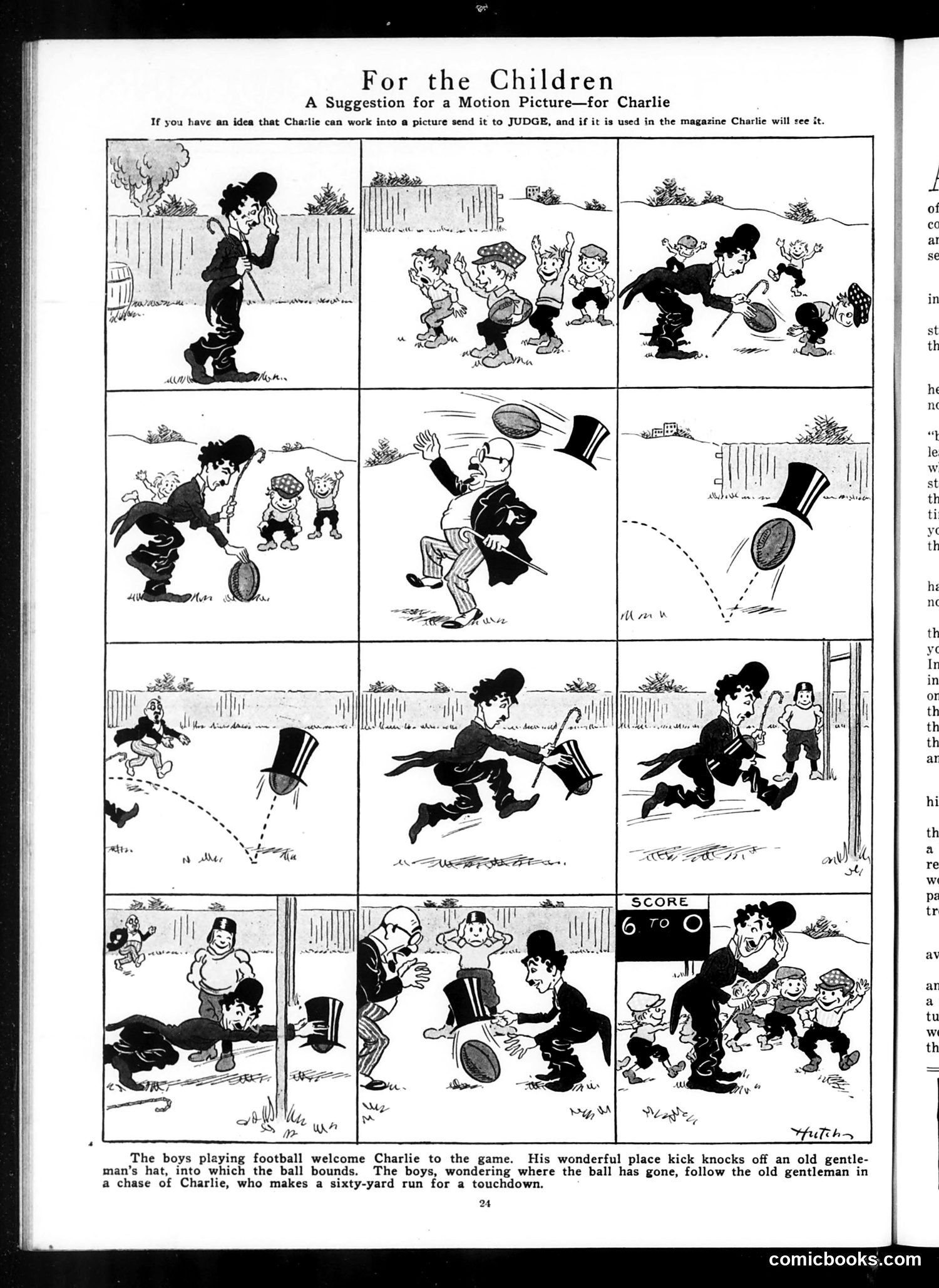
This is a comic strip proposal submitted by readers to *Judge* magazine, suggesting a slapstick scenario for Charlie Chaplin's films. The narrative follows Chaplin's iconic "Tramp" character (identifiable by his bowler hat and suit silhouette) playing football with boys. The joke unfolds through physical comedy: Chaplin kicks a football that accidentally knocks off an old gentleman's hat. The man chases after both Chaplin and the hat, leading to a chaotic sixty-yard pursuit culminating in a touchdown. This reflects early 1920s cinema culture, when *Judge* invited reader participation in creating Chaplin film ideas. The humor relies on silent-film conventions—exaggerated slapstick, mistaken pursuit, and absurd escalation—rather than dialogue. The "SCORE 6 to 0" panel emphasizes the comedic payoff of this physical gag sequence typical of Chaplin's era.
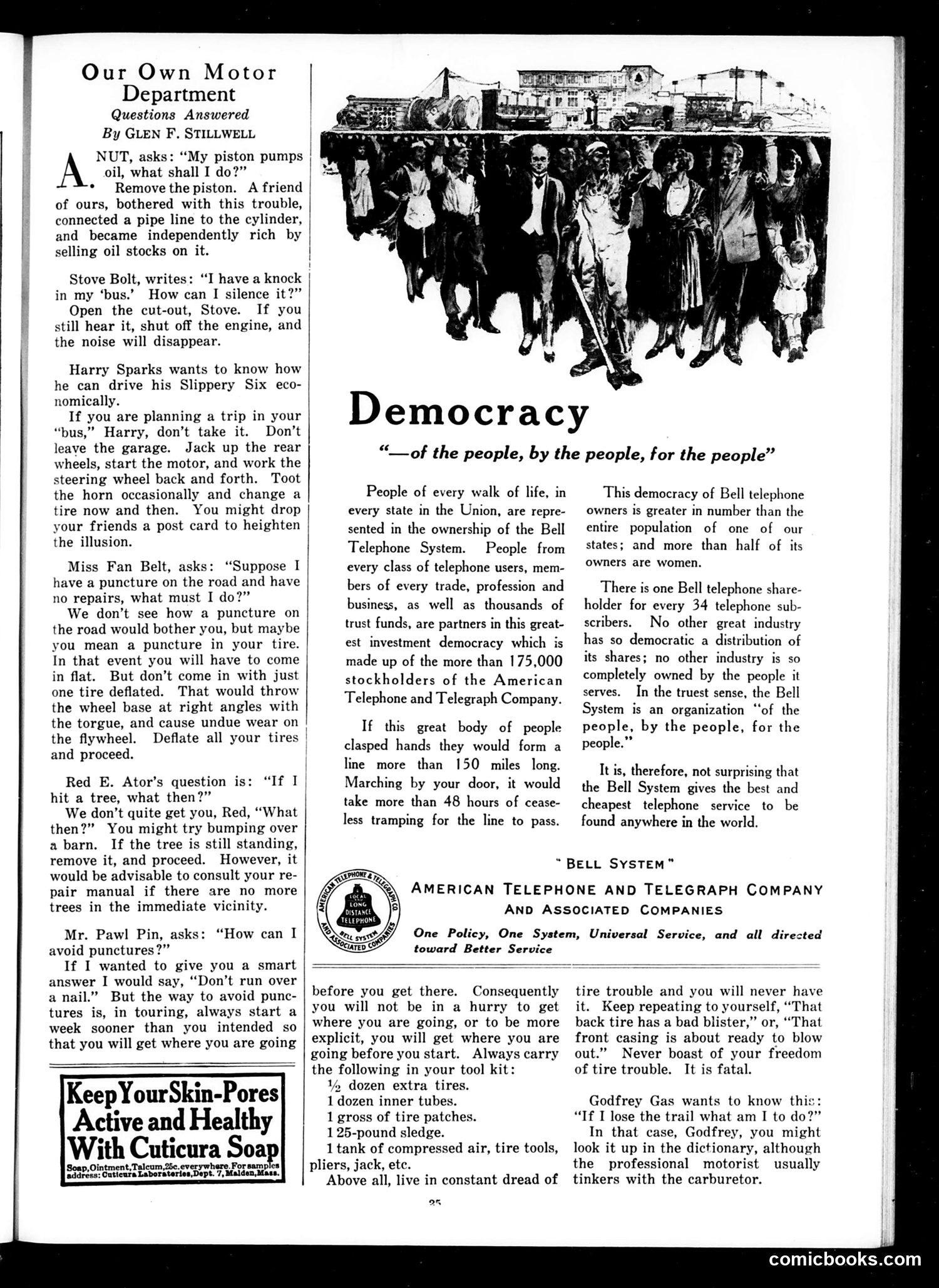
This page contains two distinct sections: **Left side - "Our Own Motor Department":** Humorous Q&A advice about early automobiles, written by Glen F. Stillwell. The jokes mock both common car problems (piston pumps, engine knocks, tire punctures) and drivers' foolishness. The humor relies on absurd "solutions"—like connecting a pipe to sell oil stocks, or deflating all tires instead of one. These satirize both automotive unreliability and gullible motorists of the early 1900s-1920s era. **Right side - "Democracy" advertisement:** A corporate PR piece by Bell Telephone claiming democratic virtue because 175,000+ stockholders own the company—including women and working-class people. By Lincoln's definition ("of the people, by the people, for the people"), Bell argues it embodies democracy. **The satire:** Judge's juxtaposition suggests irony: the earnest corporate "democracy" claim sits opposite automotive humor mocking consumer gullibility, implying Bell's populist rhetoric may be equally self-serving propaganda dressed in noble language.
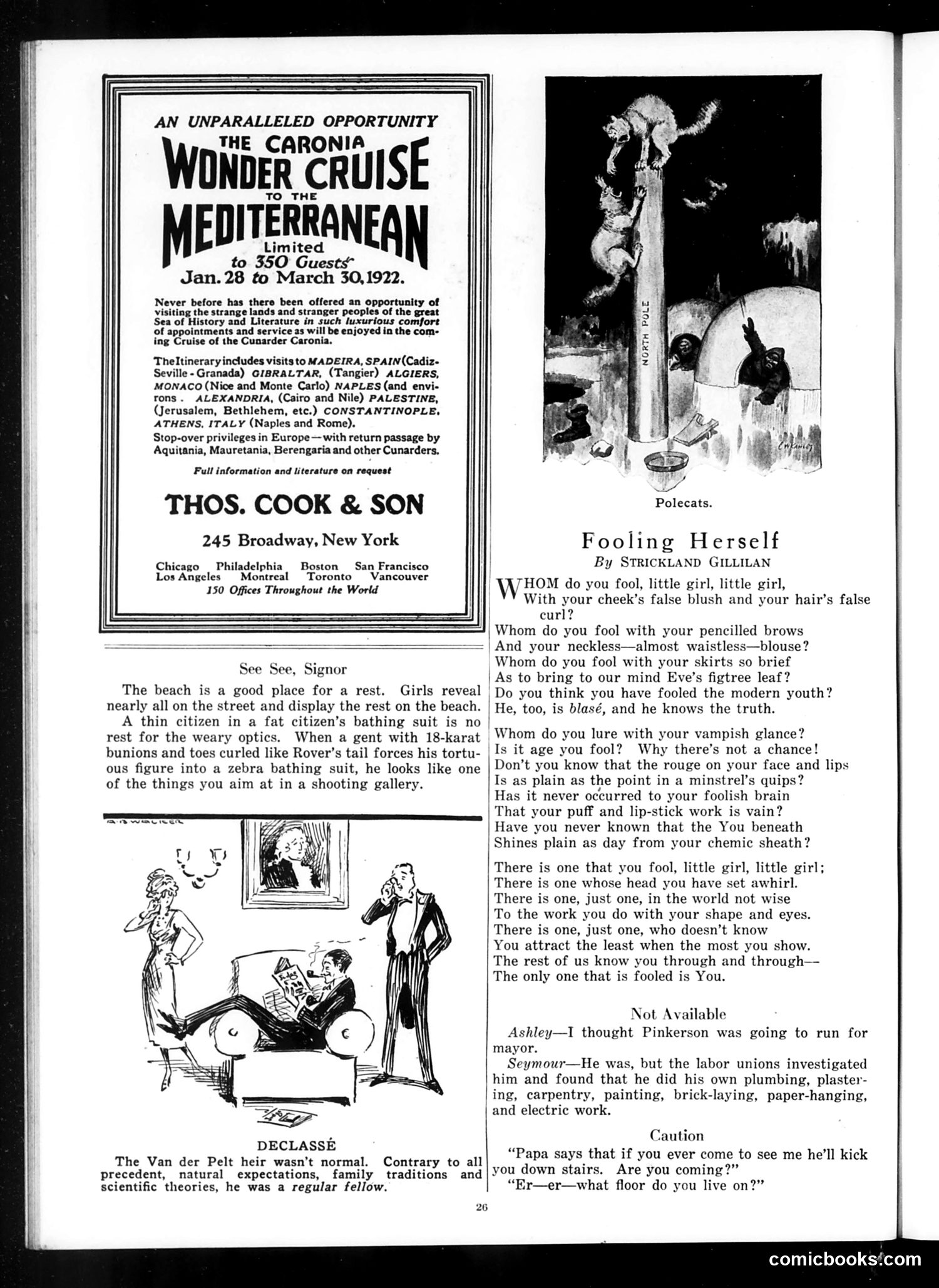
This page contains **advertisements and humor pieces** typical of Judge magazine. **Upper left:** A Thomas Cook & Son travel advertisement for a Mediterranean cruise on the Cunard liner Caronia (January-March 1922), listing exotic ports including Spain, Egypt, Palestine, and Constantinople—appealing to wealthy tourists seeking cultural tourism. **Center cartoon:** A brief satirical piece about beach behavior—mocking both scantily-dressed women and men in ill-fitting bathing suits, presenting beach-goers as ridiculous spectacles. **Right side poem** ("Fooling Herself" by Strickland Gillilan): A moralistic verse satirizing young women's cosmetics and fashion—their makeup, false curls, short skirts, and "vampish" behavior. The poem's twist: they only fool themselves, while others see through the artifice. This reflects 1920s anxieties about changing female appearance and the "modern girl." **Bottom jokes:** Brief comedic pieces on unrelated topics (political ambitions, parental disapproval). The page reflects Jazz Age attitudes toward women's increasing social visibility and changing styles.
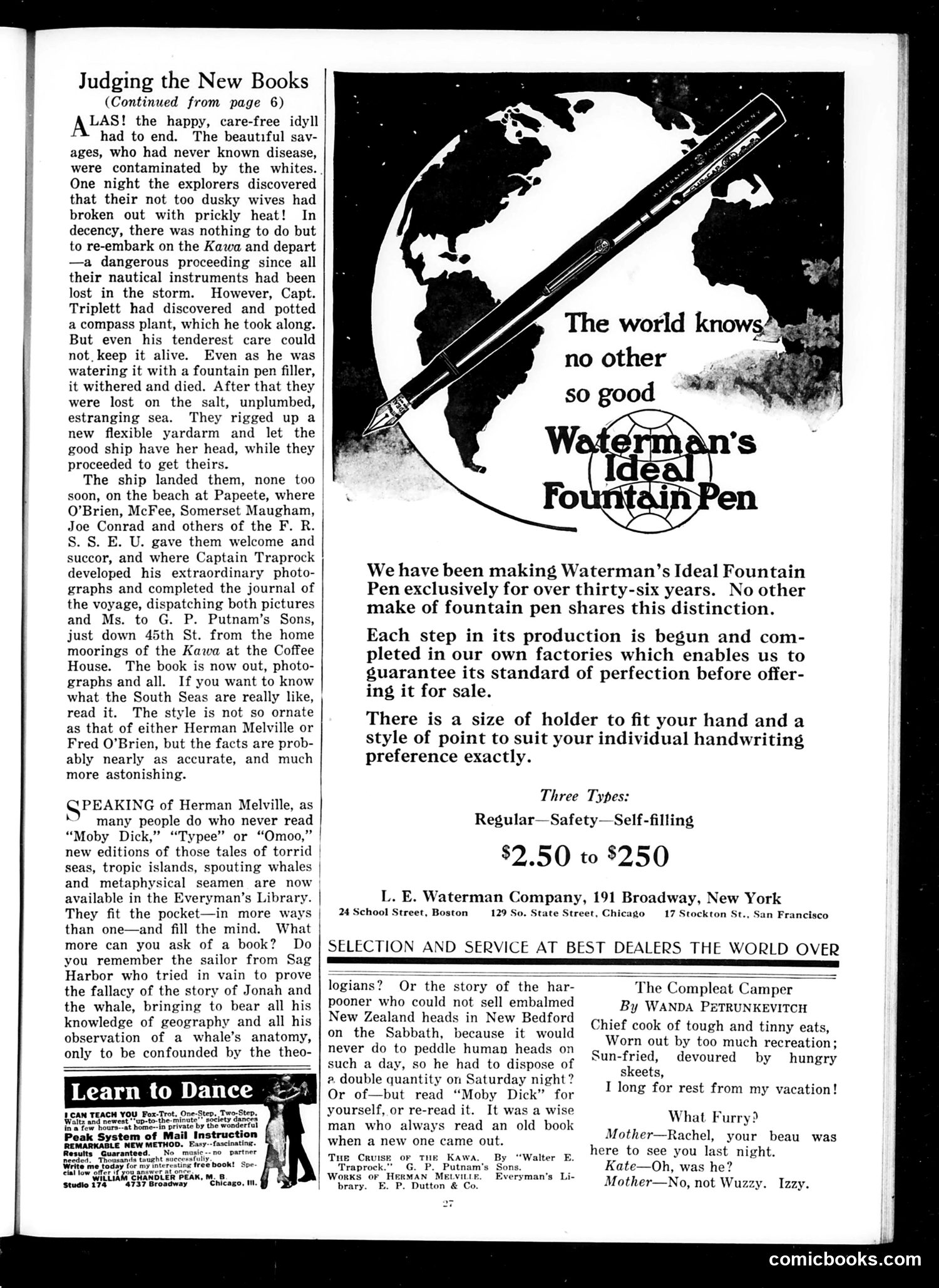
This page primarily consists of a **book review column** discussing literary works, particularly "The Cruise of the Kawa" by Walter E. Traprock—an account of South Seas exploration. The reviewer praises the book's accuracy and style while comparing it favorably to classic works by Herman Melville and Fred O'Brien. The satire is subtle: the review gently mocks adventure narratives by highlighting an ironic detail—explorers in paradise are undone not by exotic dangers but by "prickly heat" (a mundane skin condition), forcing their embarrassing departure. This deflates the romantic mythology of tropical exploration. The page also includes **advertisements** (Waterman fountain pens, dance lessons) typical of Judge magazine's revenue model. There is **no political cartoon** on this page—it's primarily editorial and advertising content from what appears to be a general-interest satirical publication from the early 20th century.
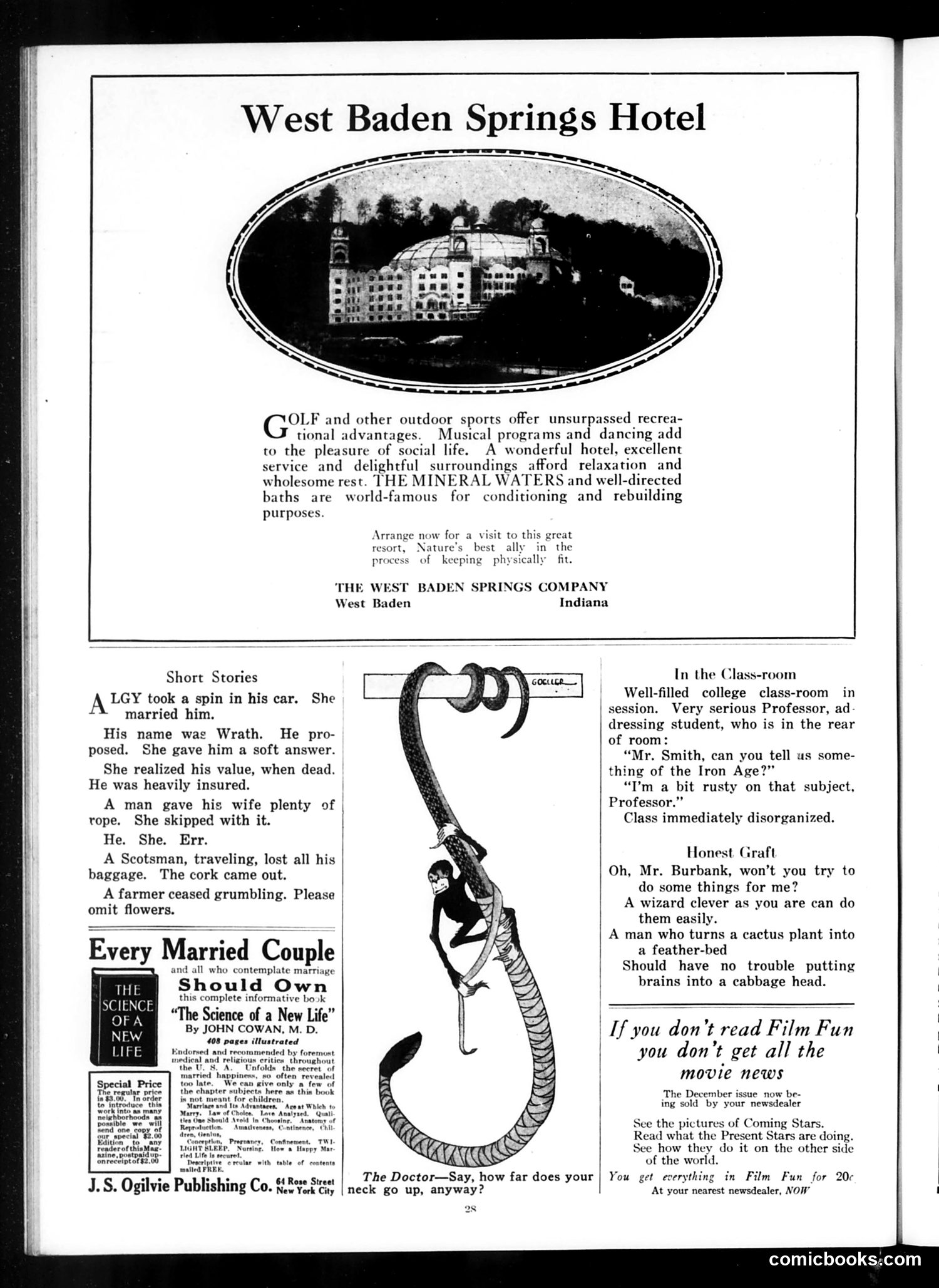
This page is primarily **advertising and light humor**, not political satire. The main content includes: **West Baden Springs Hotel ad** (top): A resort promoting golf, mineral baths, and social activities as health benefits—typical early-20th-century spa marketing. **"Short Stories"** (left): Brief joke vignettes playing on wordplay and marital discord—standard magazine filler humor of the era. Examples: a man named "Wrath" who gets married; a wife who takes "rope" literally. **"The Doctor" cartoon** (center): A simple visual gag about someone's exceptionally long neck, with no deeper meaning. **Classroom joke**: A student claims to be "rusty" on the Iron Age, causing class disruption—mild humor about student inattention. **"Honest Graft"**: A playful request to Luther Burbank (famous botanist) to improve cabbages by putting "brains" in them—light wordplay, not satire. **Film Fun and book advertisements** round out the page. Overall, this is a typical Judge page mixing ads with gentle, non-political humor.
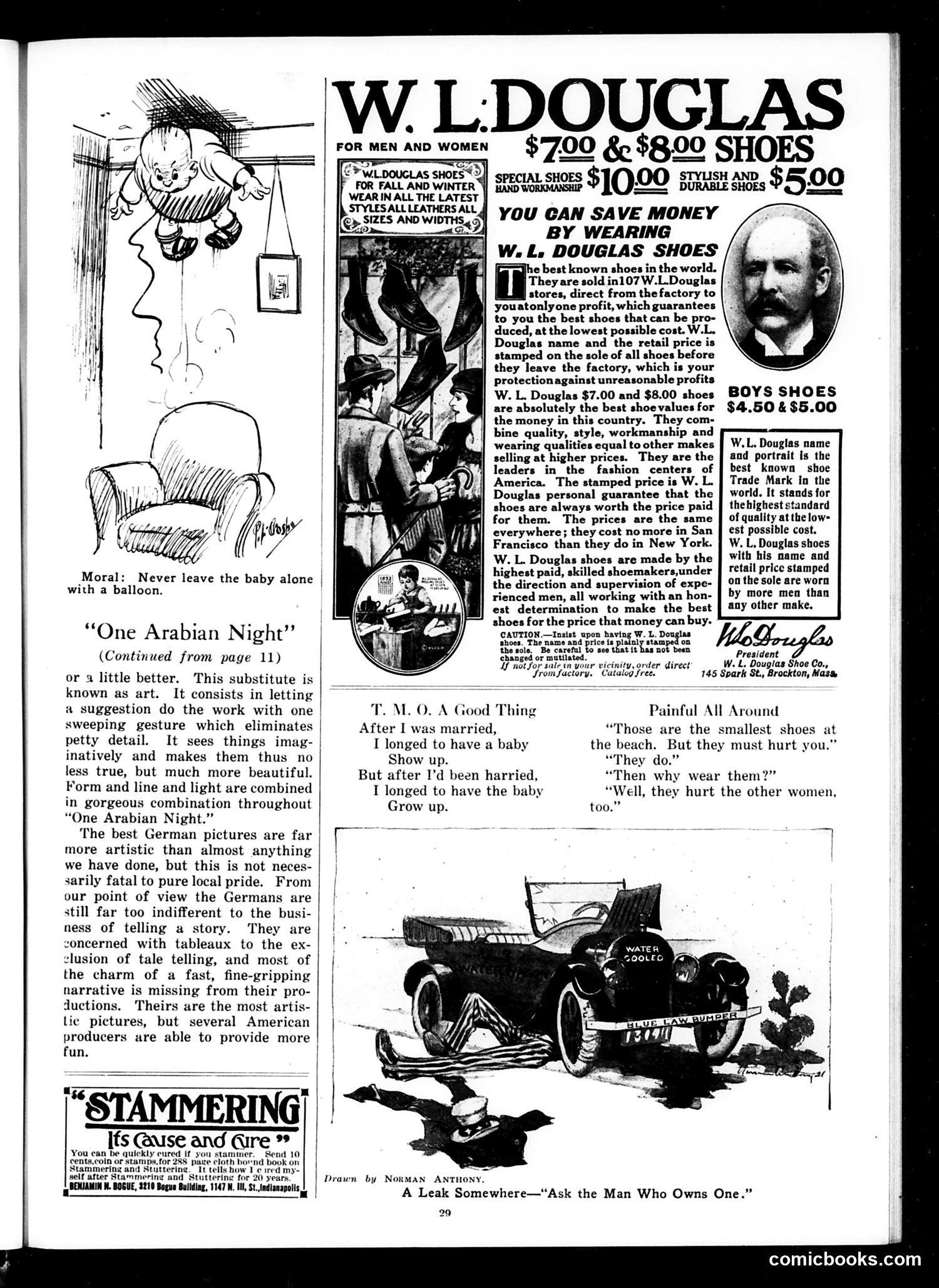
This page is primarily **advertising**, dominated by a large W.L. Douglas Shoes advertisement promoting men's, women's, and boys' footwear at prices ranging from $4.50 to $10.00. The small cartoons are: 1. **"One Arabian Night"** (top left): A moral lesson cartoon showing a baby floating away on a balloon with the caption "Never leave the baby alone with a balloon"—straightforward safety humor. 2. **"A Leak Somewhere"** (bottom): A car accident scene captioned "Ask the Man Who Owns One," a common advertising tagline. The joke appears to criticize automobiles as unreliable—the wreck illustrates why you shouldn't ask car owners for endorsements. 3. **"Painful All Around"** (right): A brief joke about women wearing small, painful shoes because they hurt rival women too—social satire on female fashion competition and vanity. The page reflects early 20th-century concerns: automobile reliability, consumer purchasing decisions, and gender-based fashion practices. These are minor filler content amid substantial product advertising.
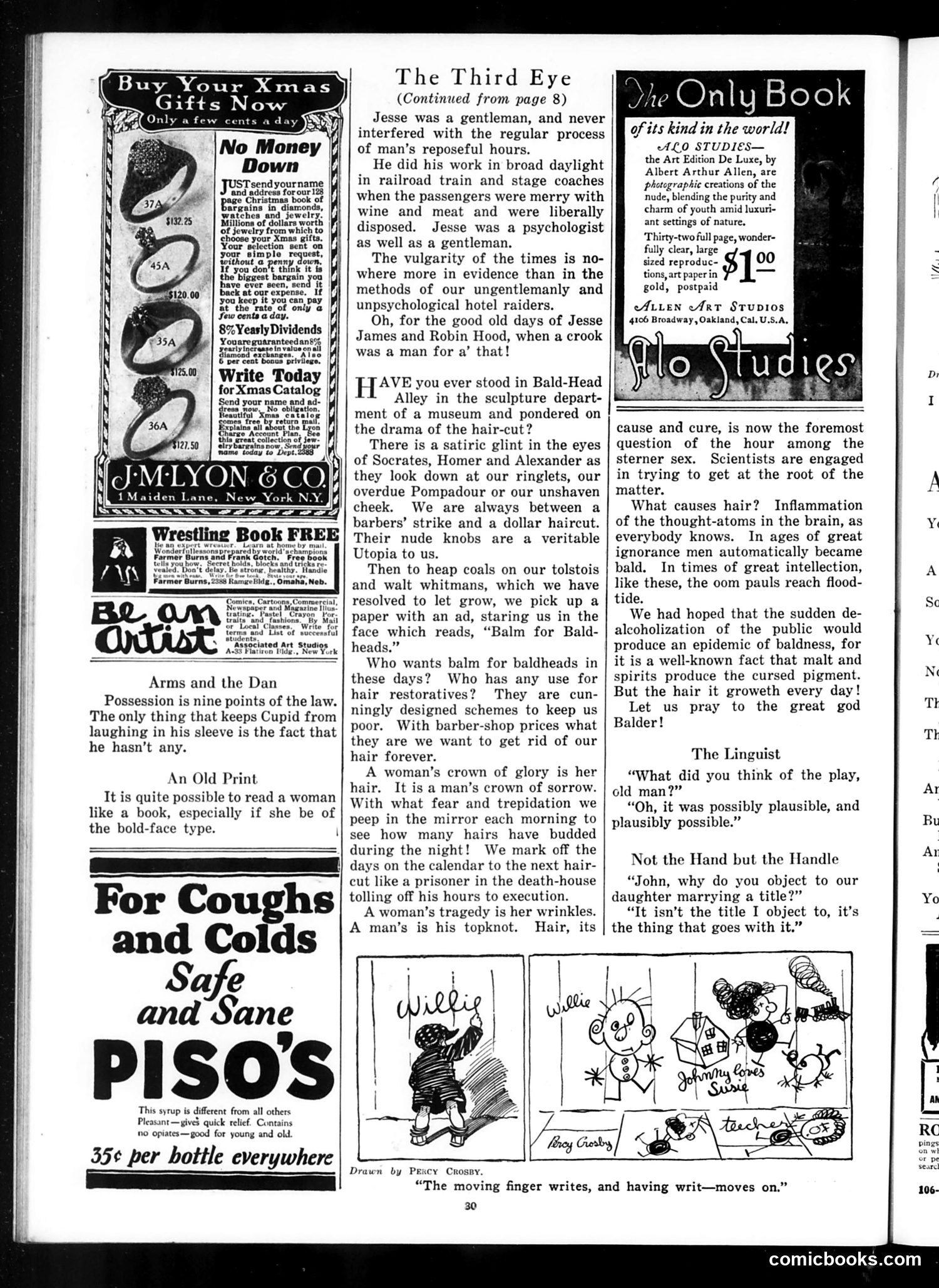
This page from *Judge* magazine is primarily **advertisements and satirical essays**—not a political cartoon. The main content is "The Third Eye," a humorous essay about baldness and hair loss. The satire mocks contemporary anxieties about male vanity and appearance. The author ironically suggests that baldness results from excessive thinking ("inflammation of the thought-atoms in the brain"), implying that intelligent men lose their hair. The piece also nostalgically references Jesse James and Robin Hood, contrasting "gentlemanly" historical outlaws with modern hotel thieves—a veiled social critique. The essay ridicules hair-restoration products and barber prices while comparing men's hair loss to women's wrinkles as respective tragedies. A brief dialogue joke about a father objecting to his daughter marrying a titled man (because "it's the thing that goes with it") plays on class anxiety regarding titles. The cartoons at bottom by Percy Crosby are minor, whimsical drawings unrelated to the essays. Most of the page features **period advertisements**: jewelry payment plans, cough syrup, and art photography books—typical commercial content of the era.
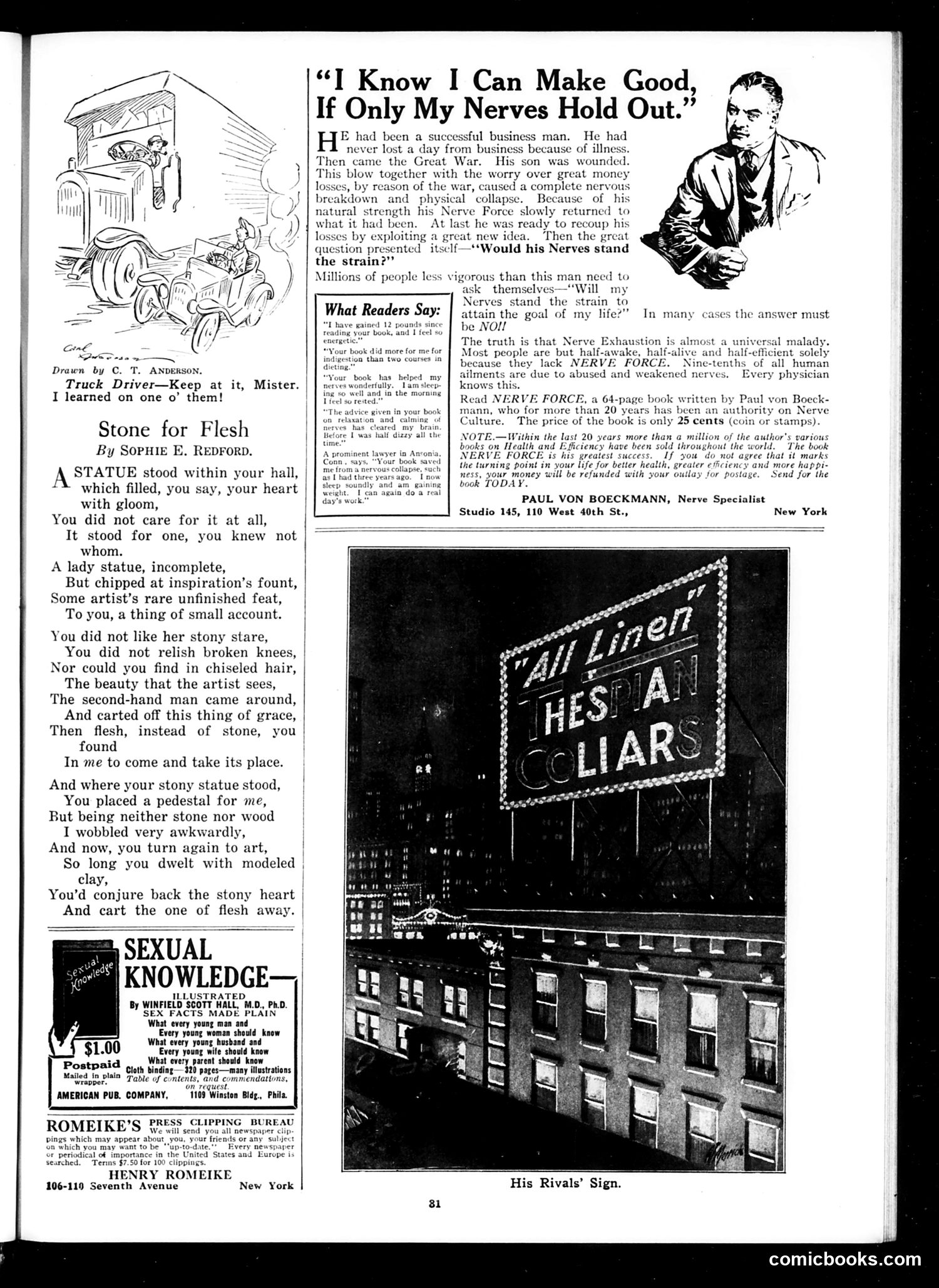
This page contains two distinct pieces: **"Stone for Flesh" (poem):** A romantic/metaphorical poem about replacing an unwanted stone statue with a living woman. The speaker argues that flesh is superior to cold stone—until the narrator realizes the woman is unreliable ("wobbled very awkwardly"), making him regret losing the stable, permanent statue. It's a misogynistic commentary dressed as poetry: women are unstable compared to art/permanence. **"I Know I Can Make Good, If Only My Nerves Hold Out" (advertisement):** A testimonial ad for Paul von Boeckmann's self-help book on "Nerve Force." It describes a successful businessman whose nervous breakdown—triggered by his son's WWI wounding and financial losses—threatens his comeback. The ad promises that Boeckmann's book will restore "nerve" (meaning vitality/resilience). This reflects early-20th-century pseudo-scientific anxieties about "nerve exhaustion" as a treatable malady. The $0.25 price and mail-order format were typical of Judge's advertising. The page also includes smaller ads for "Sexual Knowledge" and press clipping services, typical of the magazine's commercial content.
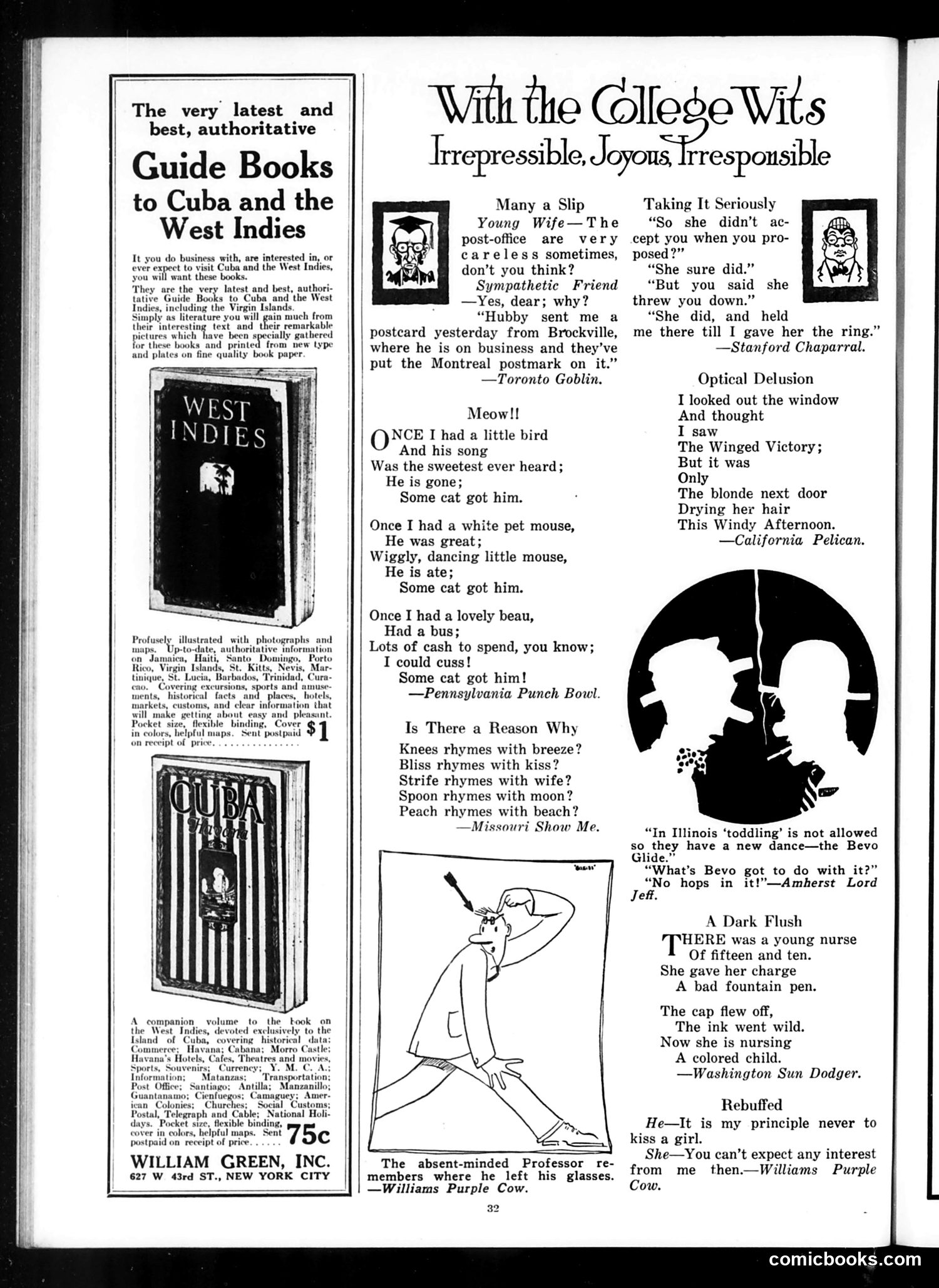
This page is primarily **advertising and humor content** rather than political satire. The left side advertises travel guidebooks to Cuba and the West Indies (likely early 20th century, when such destinations were becoming tourist draws). The right side features a collection of **college humor and light romantic/social comedy** sourced from various university publications (Stanford Chaparral, California Pelican, Pennsylvania Punch Bowl, etc.). The jokes target typical college-era concerns: romantic rejection, courtship mishaps, absent-minded professors, and observations about modern life. Notable content includes: a poem about a girl losing pets to cats; wordplay on rhyming pairs; a joke about a dance called "Bevo Glide" (Bevo being a non-alcoholic beer, making "no hops" a pun); and casual racial humor in "A Dark Flush" that reflects period attitudes. The cartoons are decorative line drawings accompanying the jokes. Overall, this is **light entertainment rather than political commentary**—typical Judge magazine filler content.
This is not a cartoon page but rather **advertising copy** for Leslie's Weekly magazine. There are no caricatures or satirical images visible. The ad promotes Leslie's coverage of President Harding's **Armament Conference** (a real 1921 disarmament conference in Washington). The text frames this as a historic moment—"History in the Making"—where world leaders will gather to hopefully achieve "permanent peace" and reduce the burden of military spending. Leslie's pitches itself as the authoritative source for understanding this conference's significance. It promises expert analysis by writers like Herbert Corey and emphasizes the magazine's 66-year tradition of interpreting world events. The final paragraph features a testimonial from "a veteran magazine publisher" praising Leslie's as "the best Weekly published"—a common advertising tactic. **For modern readers**: This reflects post-WWI optimism about international cooperation and disarmament, before such hopes were dashed by the 1930s.
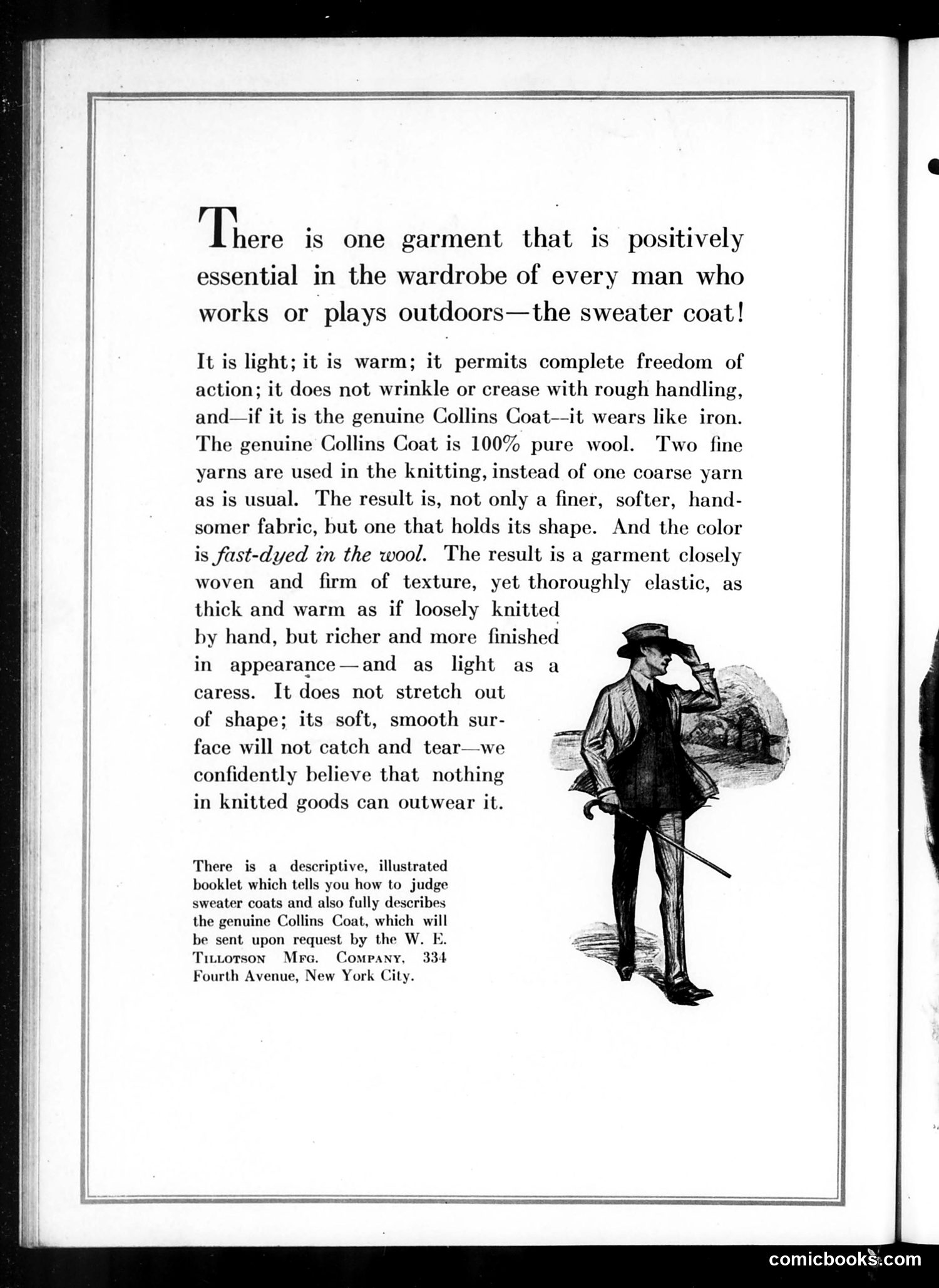
This is **not political satire or a cartoon joke**—it's a straightforward **product advertisement** for the Collins Coat sweater, published in *Judge* magazine. The page features promotional text praising the sweater's qualities (warmth, durability, pure wool construction) alongside an illustration of a well-dressed man in outdoor attire, presumably modeling or representing the product's ideal customer. The W. E. Tillotson Manufacturing Company uses the magazine's space to market their garment to working and outdoor-oriented men. The "fast-dyed in the wool" and "100% pure wool" claims were marketing differentiators of the era, suggesting competitors used inferior materials or processes. This represents how *Judge*—primarily a satirical publication—also accepted paid advertising to sustain itself, mixing editorial content with commercial endorsements aimed at the magazine's male readership.