
Judge, 1921-11-05 · page 12 of 36
Judge — November 5, 1921 — page 12: what you’re looking at
What you’re looking at
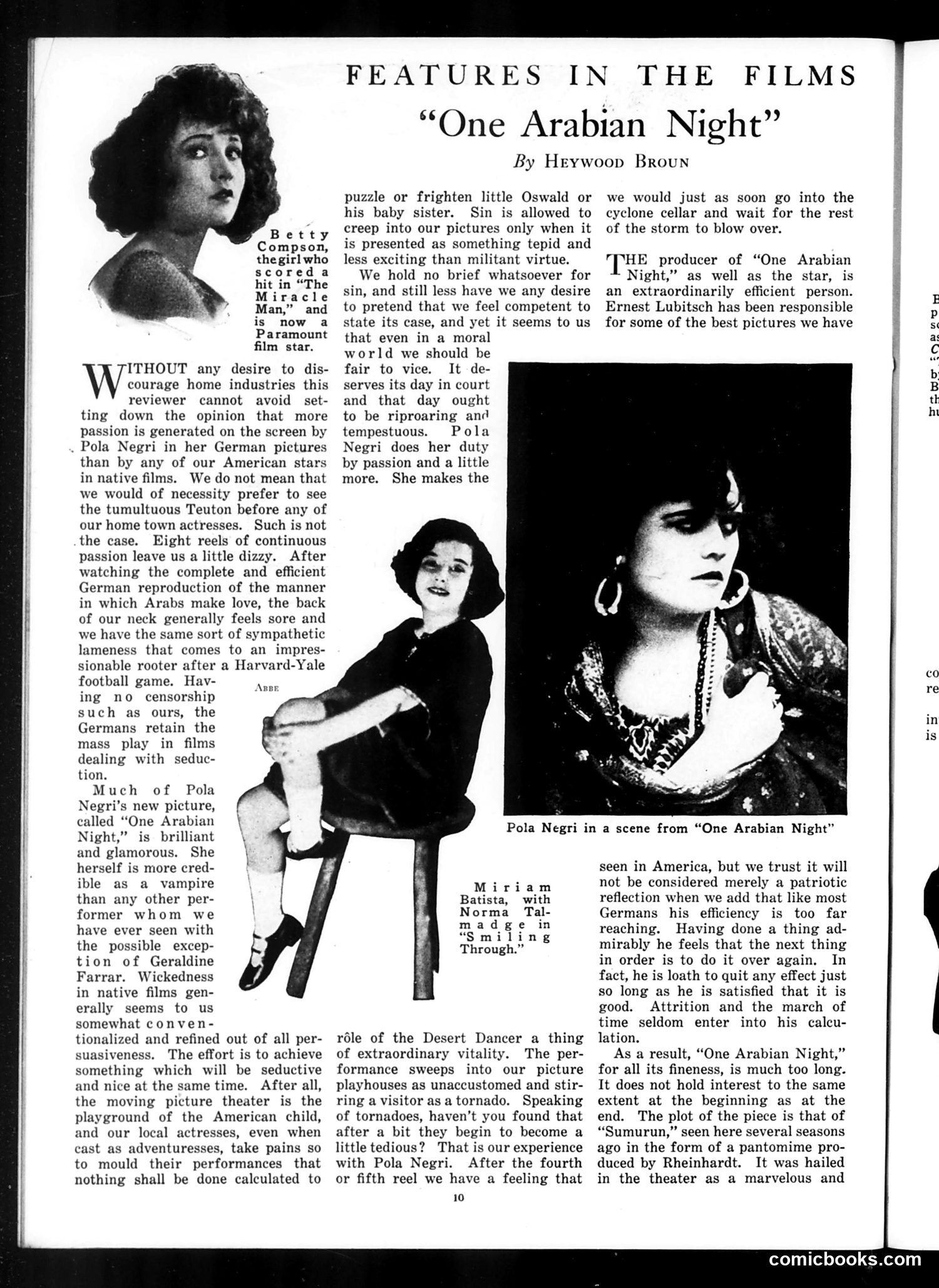
This is a film review by Heywood Broun of "One Arabian Night" starring Pola Negri, a German-Polish actress. The piece contrasts European and American filmmaking approaches to depicting vice and passion. **The Critique's Context:** The reviewer argues that German films (particularly those starring Negri) portray passion and seduction more authentically than sanitized American productions. He suggests American films tone down "sin" because moviehouses serve as children's playgrounds, while German cinema operates without equivalent censorship restrictions. **The Satire:** Broun admits admiring Negri's vampire roles while simultaneously criticizing the film's excessive length—a sly jab at German director Ernest Lubitsch's tendency to over-elaborate effects. The tornado metaphor humorously captures how Negri's intense performance becomes exhausting by the fourth or fifth reel. **Key Players:** Betty Compson and Miriam Batista appear as comparative American actresses; Lubitsch represents efficient but relentless German filmmaking. The piece reflects 1920s anxieties about censorship, European vs. American cultural values, and cinema's moral influence on audiences.
📄 Transcribed text from this page (OCR, searchable)
Machine-transcribed from the original scan — historical spelling and the odd misread are preserved.
p Betty Compson, thegirl who scoreda hit in “The Miracle Man,” and is now a Paramount film star. ITHOUT any desire to dis- V V courage home industries this reviewer cannot avoid set- ting down the opinion that more passion is generated on the screen by . Pola Negri in her German pictures than by any of our American stars in native films. We do not mean that we would of necessity prefer to see the tumultuous Teuton before any of our home town actresses. Such is not the case. Eight reels of continuous passion leave us a little dizzy. After watching the complete and efficient German reproduction of the manner in which Arabs make love, the back of our neck generally feels sore and we have the same sort of sympathetic lameness that comes to an impres- sionable rooter after a Harvard-Yale football game. Hav- ing no censorship such as ou the Germans retain the mass play in films dealing with seduc- Axe ch of Pola 's new picture, called “One Arabian Night,” is brilliant and glamorous. She herself is more cred- ible as a vampire than any other per- former whom we have ever seen with the possible excep- tion of Geraldine Farrar. Wickedness in native films gen- erally seems to us somewhat conven- tionalized and refined out of all per- suasiveness. The effort is to achieve something which will be seductive and nice at the same time. After all, the moving picture theater is the playground of the American child, and our local actresses, even when cast as adventuresses, take pains so to mould their performances that nothing shall be done calculated to FEATURES IN THE FILMS “One Arabian Night” By Heywoop Broun puzzle or frighten little Oswald or his baby sister. Sin is allowed to creep into our pictures only when it is presented as something tepid and less exciting than militant virtue. We hold no brief whatsoever for sin, and still less have we any desire to pretend that we feel competent to state its case, and yet it seems to us that even in a moral world we should be fair to vice. It de- serves its day in court and that day ought to be riproaring and tempestuous. Pola Negri does her duty by passion and a little more. She makes the we would just as soon go into the cyclone cellar and wait for the rest of the storm to blow over. THE producer of “One Arabian Night,” as well as the star, is an extraordinarily efficient person. Ernest Lubitsch has been responsible for some of the best pictures we have Pola Negri in a scene from “One Arabian Night” Miriam Batista, with Norma Tal- madge in “Smiling Through.” réle of the Desert Dancer a thing of extraordinary vitality. The per- formance sweeps into our picture playhouses as unaccustomed and stir- ring a visitor asa tornado. Speaking of tornadoes, haven’t you found that after a bit they begin to become a little tedious? That is our experience with Pola Negri. After the fourth or fifth reel we have a feeling that 10 seen in America, but we trust it will not be considered merely a patriotic reflection when we add that like most Germans his efficiency is too far reaching. Having done a thing ad- mirably he feels that the next thing in order is to do it over again. In fact, he is loath to quit any effect just so long as he is satisfied that it is good. Attrition and the march of time seldom enter into his calcu- lation. As a result, “One Arabian Night,” for all its fineness, is much too long. It does not hold interest to the same extent at the beginning as at the end. The plot of the piece is that of “Sumurun,” seen here several seasons ago in the form of a pantomime pro- duced by Rheinhardt. It was hailed in the theater as a marvelous and comicbooks.com