
Judge, 1921-11-05 · page 15 of 36
Judge — November 5, 1921 — page 15: what you’re looking at
What you’re looking at
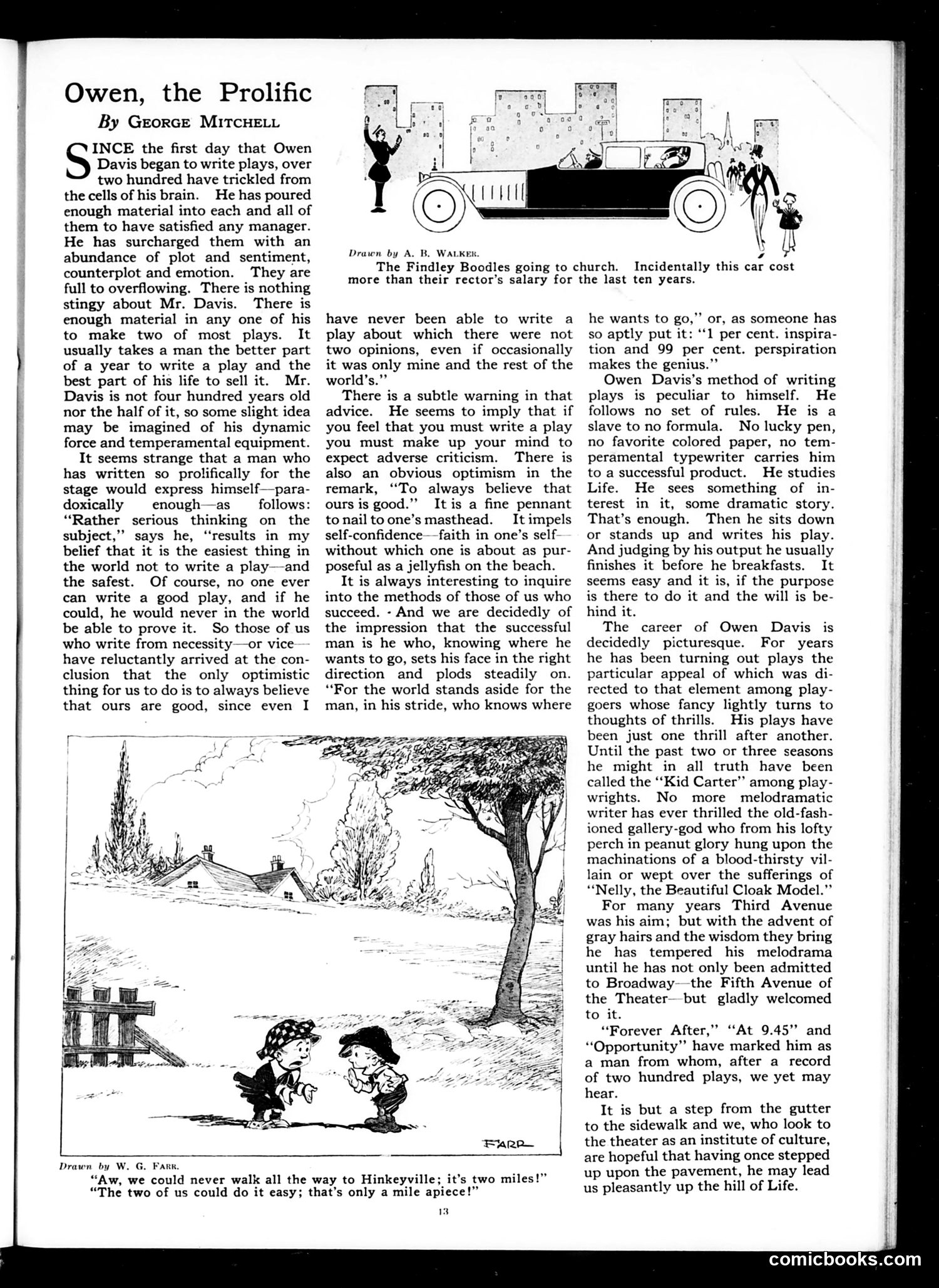
This article profiles Owen Davis, a prolific early 20th-century American playwright who had written over 200 plays by the time of publication. The piece celebrates his extraordinary productivity while quoting Davis's paradoxical admission that he believes writing plays is actually dangerous to one's career—since any play will face criticism and proving its quality is impossible. The article explains Davis's unconventional method: he observes life, finds a dramatic story, and writes rapidly (often completing plays before breakfast), following no rigid formula. Two cartoons illustrate the text: one shows a wealthy couple in an expensive car, captioned as "The Findley Boodles going to church"; another depicts two children discussing walking distance, with the joke playing on faulty arithmetic. The piece notes Davis previously wrote sensational "thrill plays" for popular audiences (earning him the nickname "Kid Carter") but has since shifted toward more respectable Broadway productions, suggesting his artistic evolution.
📄 Transcribed text from this page (OCR, searchable)
Machine-transcribed from the original scan — historical spelling and the odd misread are preserved.
Owen, the Prolific By Grorce MITCHELL INCE the first day that Owen Davis began to write plays, over two hundred have trickled from the cells of his brain. He has poured enough material into each and all of them to have satisfied any manager. He has surcharged them with an abundance of plot and sentiment, counterplot and emotion. They are full to overflowing. There is nothing stingy about Mr. Davis. There is enough material in any one of his to make two of most plays. It usually takes a man the better part of a year to write a play and the best part of his life to sell it. Mr. Davis is not four hundred years old nor the half of it, so some slight idea may be imagined of his dynamic force and temperamental equipment. It seems strange that a man who has written so prolifically for the stage would express himself—para- doxically enough—as follows: “Rather serious thinking on the subject,”” says he, ‘results in my belief that it is the easiest thing in the world not to write a play—and the safest. Of course, no one ever can write a good play, and if he could, he would never in the world be able to prove it. So those of us who write from necessity—or vice have reluctantly arrived at the con- clusion that the only optimistic thing for us to do is to always believe that ours are good, since even I Drawn by A. B. WALKER. The Findley Boodles going to church. more than their rector’s salary for the last ten years. have never been able to write a play about which there were not two opinions, even if occasionally it was only mine and the rest of the world’s.” There is a subtle warning in that advice. He seems to imply that if you feel that you must write a play you must make up your mind to expect adverse criticism. There is also an obvious optimism in the remark, “To always believe that ours is good.” Itis a fine pennant to nail to one’s masthead. It impels self-confidence—faith in one’s self- without which one is about as pur- poseful as a jellyfish on the beach. It is always interesting to inquire into the methods of those of us who succeed. - And we are decidedly of the impression that the successful man is he who, knowing where he wants to go, sets his face in the right direction and plods steadily on. “For the world stands aside for the man, in his stride, who knows where Fare Drawn by W. G. Farr. “Aw, we could never walk all the way to Hinkeyville; it’s two miles!” “The two of us could do it easy; that’s only a mile apiece!” 13 he wants to go,”’ or, as someone has so aptly put it: ‘‘l per cent. inspira- tion and 99 per cent. perspiration makes the genius.” Owen Davis’s method of writing plays is peculiar to himself. He follows no set of rules. He is a slave to no formula. No lucky pen, no favorite colored paper, no tem- peramental typewriter carries him to a successful product. He studies Life. He sees something of in- terest in it, some dramatic story. That’s enough. Then he sits down or stands up and writes his play. And judging by his output he usually finishes it before he breakfasts. It seems easy and it is, if the purpose is there to do it and the will is be- hind it. The career of Owen Davis is decidedly picturesque. For years he has been turning out plays the particular appeal of which was di- rected to that element among play- goers whose fancy lightly turns to thoughts of thrills. His plays have been just one thrill after another. Until the past two or three seasons he might in all truth have been called the ‘‘Kid Carter” among play- wrights. No more melodramatic writer has ever thrilled the old-fash- ioned gallery-god who from his lofty perch in peanut glory hung upon the machinations of a blood-thirsty vil- lain or wept over the sufferings of “Nelly, the Beautiful Cloak Model.” For many years Third Avenue was his aim; but with the advent of gray hairs and the wisdom they bring he has tempered his melodrama until he has not only been admitted to Broadway—-the Fifth Avenue of the Theater—but gladly welcomed to it. “Forever After,” “At 9.45” and “Opportunity”’ have marked him as a man from whom, after a record of two hundred plays, we yet may hear. It is but a step from the gutter to the sidewalk and we, who look to the theater as an institute of culture, are hopeful that having once stepped up upon the pavement, he may lead us pleasantly up the hill of Life. comicbooks.com