
Judge, 1921-11-05 · page 21 of 36
Judge — November 5, 1921 — page 21: what you’re looking at
What you’re looking at
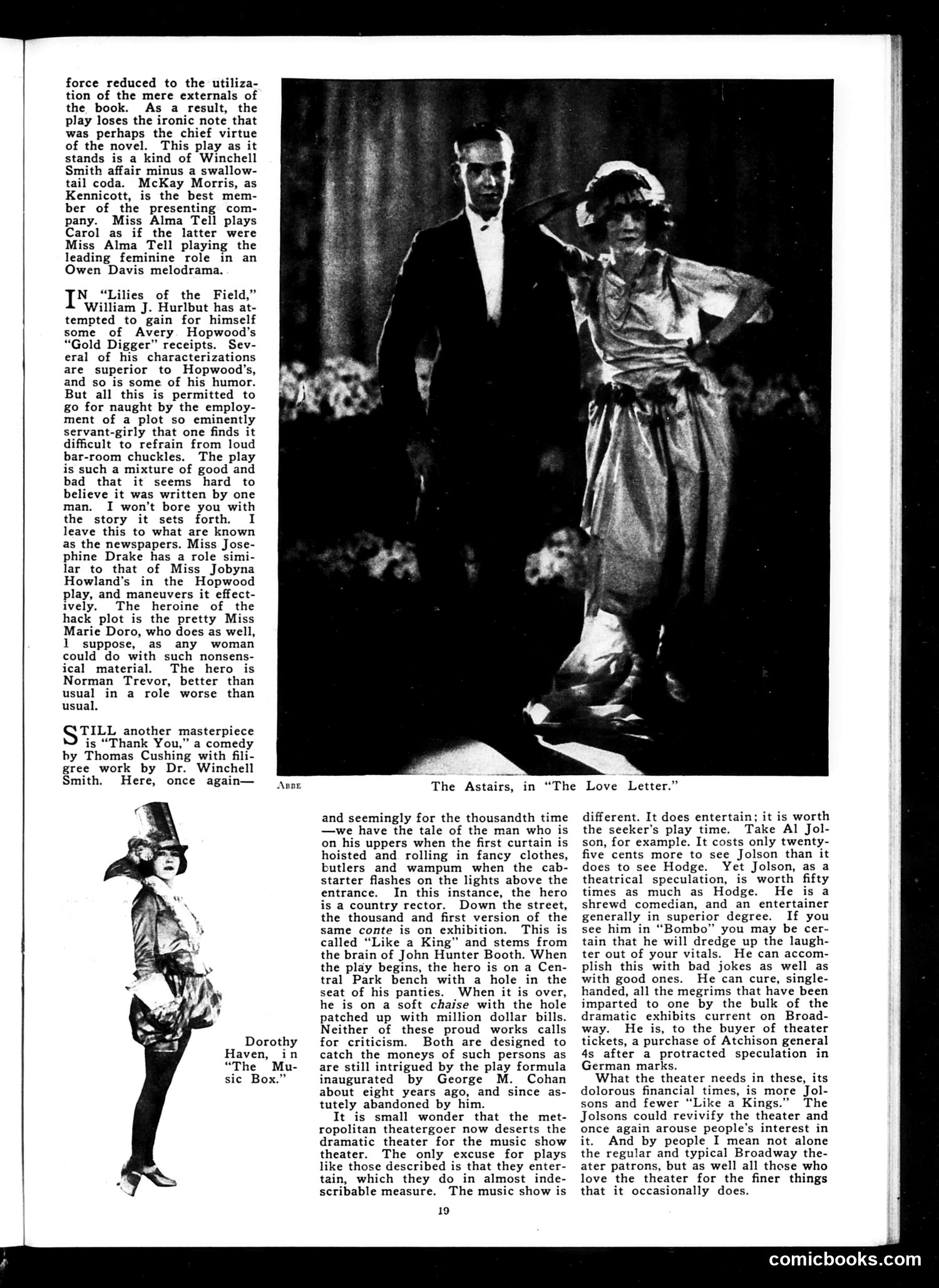
This page contains theater reviews comparing Broadway productions. The visible photograph shows actors in "The Love Letter," while the text discusses several plays including "Lilies of the Field" and "Thank You." The reviewer contrasts theatrical entertainment with music-hall performances, arguing that dramatic theater has declined because audiences prefer entertainers like Al Jolson in musical shows. The criticism suggests that contemporary plays rely on tired, formulaic plots (wealthy man/poor man schemes dating to George M. Cohan) rather than substance. The reviewer praises music-hall performers for their superior skill and value—Jolson costs only slightly more than dramatic theater but delivers far better entertainment and comedic ability. The implication is that Broadway theater is losing audiences to vaudeville and musical revues because playwrights recycle worn-out scenarios while music-hall performers offer genuine talent and originality.
📄 Transcribed text from this page (OCR, searchable)
Machine-transcribed from the original scan — historical spelling and the odd misread are preserved.
force reduced to the utiliza- tion of the mere externals of the book. As a result, the play loses the ironic note that was perhaps the chief virtue of the novel. This play as it stands is a kind of Winchell Smith affair minus a swallow- tail coda. McKay Morris, as Kennicott, is the best mem- ber of the presenting com- pany. Miss Alma Tell plays Carol as if the latter were Miss Alma Tell playing the leading feminine role in an Owen Davis melodrama. N “Lilies of the Field,” William J. Hurlbut has at- tempted to gain for himself some of Avery Hopwood’s “Gold Digger” receipts. Sev- eral of his characterizations are superior to Hopwood’s, and so is some of his humor. But all this is permitted to go for naught by the employ- ment of a plot so eminently servant-girly that one finds it difficult to refrain from loud bar-room chuckles. The play is such a mixture of good and bad that it seems hard to believe it was written by one man. I won’t bore you with the story it sets forth. I leave this to what are known as the newspapers. Miss Jose- phine Drake has a role simi- lar to that of Miss Jobyna Howland’s in the Hopwood play, and maneuvers it effect- ively. The heroine of the hack plot is the pretty Miss Marie Doro, who does as well, 1 suppose, as any woman could do with such nonsens- ical material. The hero is Norman Trevor, better than usual in a role worse than usual. STILL another masterpiece is “Thank You,” a comedy by Thomas Cushing with fili- gree work by Dr. Here, Winchell Smith. once again— Abbe Dorothy Haven, in “The Mu- sic Box.” The Astairs, in “The Love Letter.” and seemingly for the thousandth time —we have the tale of the man who is on his uppers when the first curtain is hoisted and rolling in fancy clothes, butlers and wampum when the cab- starter flashes on the lights above the entrance. In this instance, the hero is a country rector. Down the street, the thousand and first version of the same conte is on exhibition. This is called “Like a King” and stems from the brain of John Hunter Booth. When the play begins, the hero is on a Cen- tral Park bench with a hole in the seat of his panties. When it is over, he is on a soft chaise with the hole patched up with million dollar bills. Neither of these proud works calls for criticism. Both are designed to catch the moneys of such persons as are still intrigued by the play formula inaugurated by George M. Cohan about eight years ago, and since as- tutely abandoned by him. It is small wonder that the met- ropolitan theatergoer now deserts the dramatic theater for the music show theater. The only excuse for plays like those described is that they enter- tain, which they do in almost inde- scribable measure. The music show is 19 different. It does entertain; it is worth the seeker’s play time. Take Al Jol- son, for example. It costs only twenty- five cents more to see Jolson than it does to see Hodge. Yet Jolson, as a theatrical speculation, is worth fifty times as much as Hodge. He is a shrewd comedian, and an entertainer generally in superior degree. If you see him in “Bombo” you may be cer- tain that he will dredge up the laugh- ter out of your vitals. He can accom- plish this with bad jokes as well as with good ones. He can cure, single- handed, all the megrims that have been imparted to one by the bulk of the dramatic exhibits current on Broad- way. He is, to the buyer of theater tickets, a purchase of Atchison general 4s after a protracted speculation in German marks. What the theater needs in these, its dolorous financial times, is more Jol- sons and fewer “Like a Kings.” The Jolsons could revivify the theater and once again arouse people’s interest in it. And by people I mean not alone the regular and typical Broadway the- ater patrons, but as well all those who love the theater for the finer things that it occasionally does. comicbooks.com