
Judge, 1921-11-05 · page 10 of 36
Judge — November 5, 1921 — page 10: what you’re looking at
What you’re looking at
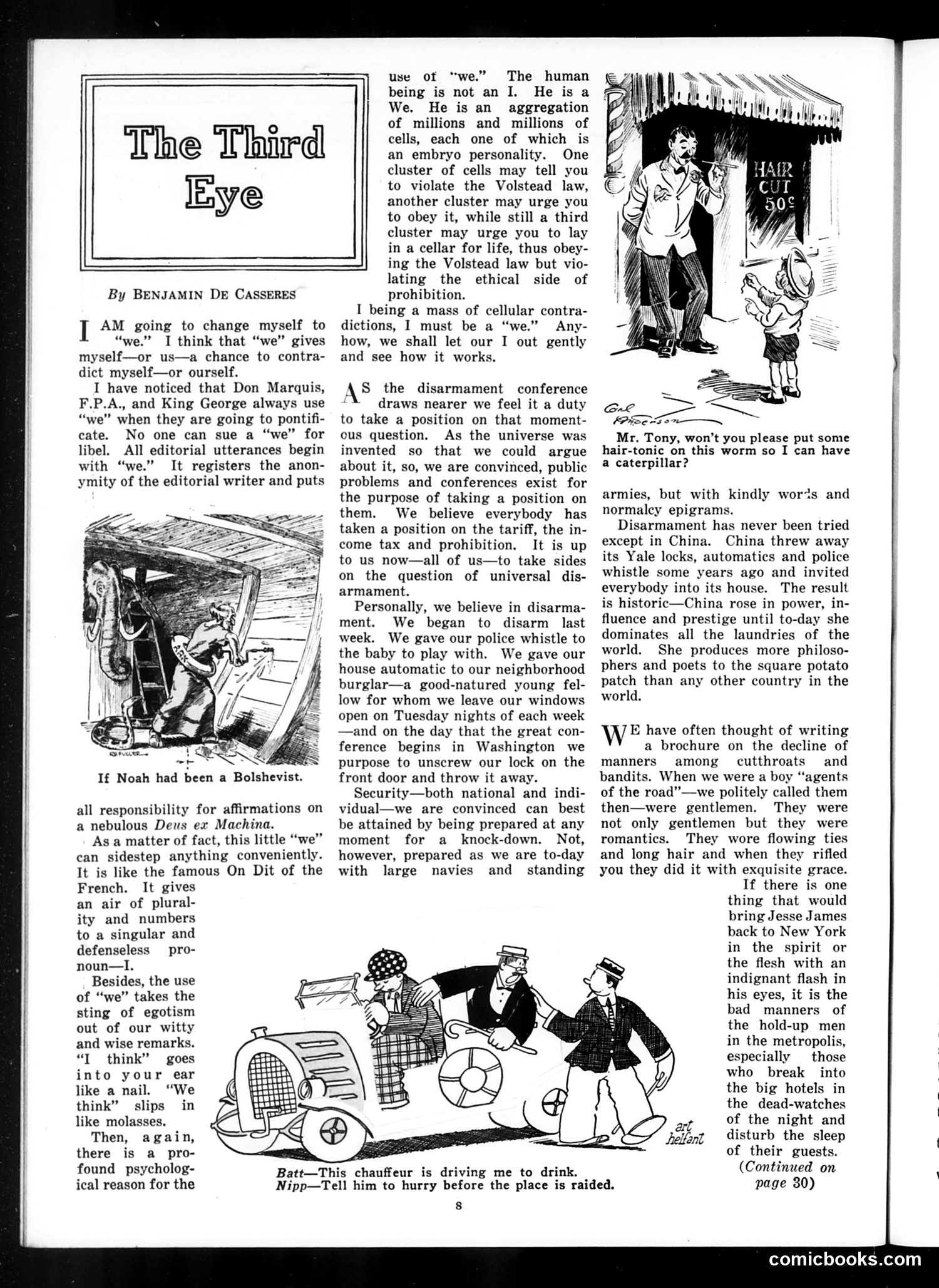
This satirical essay mocks editorial pretension and naive disarmament advocacy. De Casseres explains why writers use the collective "we" instead of "I"—it provides anonymity, diffuses responsibility, and sounds more authoritative while actually being evasive. The piece then ridicules the upcoming disarmament conference, ironically endorsing total disarmament by describing absurd personal examples: giving away his police whistle and house key, leaving his front door unlocked. He cites China as proof disarmament works, claiming it rose to dominance by surrendering defenses—clearly nonsensical, as China faced chaos and foreign exploitation after weakening. The cartoons reinforce the humor: one depicts Prohibition-era drinking ("chauffeur driving me to drink"), another shows a child requesting hair-tonic for a worm to create a caterpillar. The satire targets both editorial cowardice and what De Casseres sees as dangerous, idealistic disarmament proposals disconnected from reality.
📄 Transcribed text from this page (OCR, searchable)
Machine-transcribed from the original scan — historical spelling and the odd misread are preserved.
By BENJAMIN DE CASSERES I AM going to change myself to “we.” I think that “we” gives myself—or us—a chance to contra- dict myself—or ourself. I have noticed that Don Marquis, F.P.A., and King George always use “we” when they are going to pontifi- cate. No one can sue a “we” for libel. All editorial utterances begin with “we.” It registers the anon- ymity of the editorial writer and puts If Noah had been a Bolshevist. all responsibility for affirmations on a nebulous Deus ex Machina. As a matter of fact, this little “we’ can sidestep anything conveniently. It is like the famous On Dit of the French. It gives an air of plural- ity and numbers to a singular and defenseless pro- noun—I. Besides, the use of “we” takes the sting of egotism out of our witty and wise remarks. “I think” goes into your ear like a nail. “We think” slips in like molasses. Then, again, there is a pro- found psycholog- ical reason for the use ot “we.” The human being is not an I. He is a We. He is an aggregation of millions and millions of cells, each one of which is an embryo personality. One cluster of cells may tell you to violate the Volstead law, another cluster may urge you to obey it, while still a third cluster may urge you to lay in a cellar for life, thus obey- ing the Volstead law but vio- lating the ethical side of prohibition. I being a mass of cellular contra- dictions, I must be a “we.” Any- how, we shall let our I out gently and see how it works. AS the disarmament conference draws nearer we feel it a duty to take a position on that moment- ous question. As the universe was invented so that we could argue about it, so, we are convinced, public problems and conferences exist for the purpose of taking a position on them. We believe everybody has taken a position on the tariff, the in- come tax and prohibition. It is up to us now—all of us—to take sides on the question of universal dis- armament. Personally, we believe in disarma- ment. We began to disarm last week. We gave our police whistle to the baby to play with. We gave our house automatic to our neighborhood burglar—a good-natured young fel- low for whom we leave our windows open on Tuesday nights of each week —and on the day that the great con- ference begins in Washington we purpose to unscrew our lock on the front door and throw it away. Security—both national and indi- vidual—we are convinced can best be attained by being prepared at any moment for a_ knock-down. Not, however, prepared as we are to-day with large navies and standing Batt—This chauffeur is driving me to drink. Nipp—Tell him to hurry before the place is raided. 8 ~~ Ge Peo 2——<—_ Mr. Tony, won’t you please put some hair-tonic on this worm so I can have a caterpillar? armies, but with kindly worts and normalcy epigrams. Disarmament has never been tried except in China. China threw away its Yale locks, automatics and police whistle some years ago and invited everybody into its house. The result is historic—China rose in power, in- fluence and prestige until to-day she dominates all the laundries of the world. She produces more philoso- phers and poets to the square potato patch than any other country in the world. WE have often thought of writing a brochure on the decline of manners among cutthroats and bandits. When we were a boy “agents of the road”—we politely called them then—were gentlemen. They were not only gentlemen but they were romantics. They wore flowing ties and long hair and when they rifled you they did it with exquisite grace. If there is one thing that would bring Jesse James back to New York in the spirit or the flesh with an indignant flash in his eyes, it is the bad manners of the hold-up men in the metropolis, especially those who break into the big hotels in the dead-watches of the night and disturb the sleep of their guests. (Continued on page 80) comicbooks.com