
Judge, 1921-11-05 · page 20 of 36
Judge — November 5, 1921 — page 20: what you’re looking at
What you’re looking at
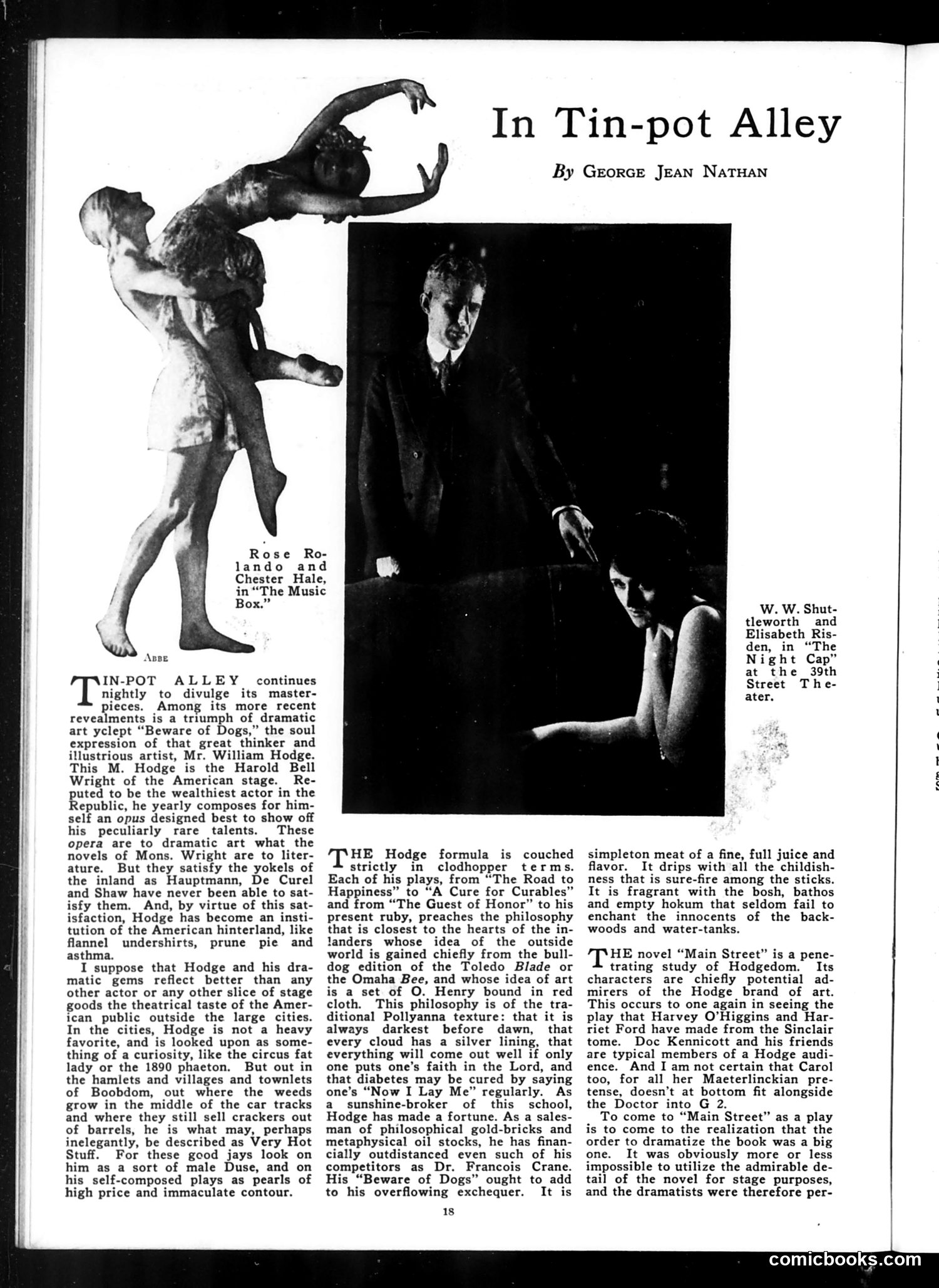
This is a theater column by George Jean Nathan satirizing William Hodge, a wealthy actor-playwright whose sentimental, moralistic plays appealed to rural American audiences but were dismissed by urban critics as lowbrow drivel. **The satire:** Nathan mocks Hodge's formula—simplistic Pollyanna philosophy, cornball humor, and false inspirational messages—comparing him unfavorably to serious playwrights like Hauptmann and Shaw. Nathan argues Hodge's work reflects the unsophisticated tastes of "Boobdom" (rural America), where audiences consume Toledo newspapers and O. Henry paperbacks. **The photos** show theatrical performers from current Broadway productions ("The Music Box," "The Night Cap") as examples of better stage work. Nathan's point: Hodge represents the gap between cosmopolitan urban theatrical standards and what he derisively calls "hinterland" America—a common 1920s intellectual prejudice against rural audiences and their cultural preferences.
📄 Transcribed text from this page (OCR, searchable)
Machine-transcribed from the original scan — historical spelling and the odd misread are preserved.
In Tin-pot Alley By Georce Jean NaTHAN Rose Ro- lando and Chester Hale, in “The Music Anse IN-POT ALLEY _ continues nightly to divulge its master- pieces. Among its more recent revealments is a triumph of dramatic art yclept “Beware of Dogs,” the soul expression of that great thinker and illustrious artist, Mr. William Hodge. This M. Hodge is the Harold Bell Wright of the American stage. Re- puted to be the wealthiest actor in the Republic, he yearly composes for him- self an opus designed best to show off his peculiarly rare talents. These opera are to dramatic art what the novels of Mons. Wright are to liter- ature. But they satisfy the yokels of the inland as Hauptmann, De Curel and Shaw have never been able to sat- isfy them. And, by virtue of this sat- isfaction, Hodge has become an insti- tution of the American hinterland, like flannel undershirts, prune pie and asthma. I suppose that Hodge and his dra- matic gems reflect better than any other actor or any other slice of stage goods the theatrical taste of the Amer- ican public outside the large cities. In the cities, Hodge is not a heavy favorite, and is looked upon as some- thing of a curiosity, like the circus fat lady or the 1890 phaeton. But out in the hamlets and villages and townlets of Boobdom, out where the weeds grow in the middle of the car tracks and where they still sell crackers out of barrels, he is what may, perhaps inelegantly, be described as Very Hot Stuff. For these good jays look on him as_a sort of male Duse, and on his self-composed plays as pearls of high price and immaculate contour. ‘THE Hodge formula is couched strictly in clodhopper terms. Each of his plays, from “The Road to Happiness” to “A Cure for Curables” and from “The Guest of Honor” to his present ruby, preaches the philosophy that is closest to the hearts of the in- landers whose idea of the outside world is gained chiefly from the bull- dog edition of the Toledo Blade or the Omaha Bee, and whose idea of art is a set of O. Henry bound in red cloth. This philosophy is of the tra- ditional Pollyanna texture: that it is always darkest before dawn, that every cloud has a silver lining, that everything will come out well if only one puts one’s faith in the Lord, and that diabetes may be cured by saying one’s “Now I Lay Me” regularly. As a_sunshine-broker_ of this school, Hodge has made a fortune. As a sales- man of philosophical gold-bricks and metaphysical oil stocks, he has finan- cially outdistanced even such of his competitors as Dr. Francois Crane. His “Beware of Dogs” ought to add to his overflowing exchequer. It is 18 W. W. Shut- tleworth and Elisabeth Ris- den, in “The Night Cap” at the 39th Street The- ater. simpleton meat of a fine, full juice and flavor. It drips with all the childish- ness that is sure-fire among the sticks. It is fragrant with the bosh, bathos and empty hokum that seldom fail to enchant the innocents of the back- woods and water-tanks. HE novel “Main Street” is a pene- trating study of Hodgedom. Its characters are chiefly potential ad- mirers of the Hodge brand of art. This occurs to one again in seeing the play that Harvey O’Higgins and Har- riet Ford have made from the Sinclair tome. Doc Kennicott and his friends are typical members of a Hodge audi- ence. And I am not certain that Carol too, for all her Maeterlinckian pre- tense, doesn’t at bottom fit alongside the Doctor into G 2. To come to “Main Street” as a play is to come to the realization that the order to dramatize the book was a big one. It was obviously more or less impossible to utilize the admirable de- tail of the novel for stage purposes, and the dramatists were therefore per- comicbooks.com