
Judge, 1921-11-05 · page 7 of 36
Judge — November 5, 1921 — page 7: what you’re looking at
What you’re looking at
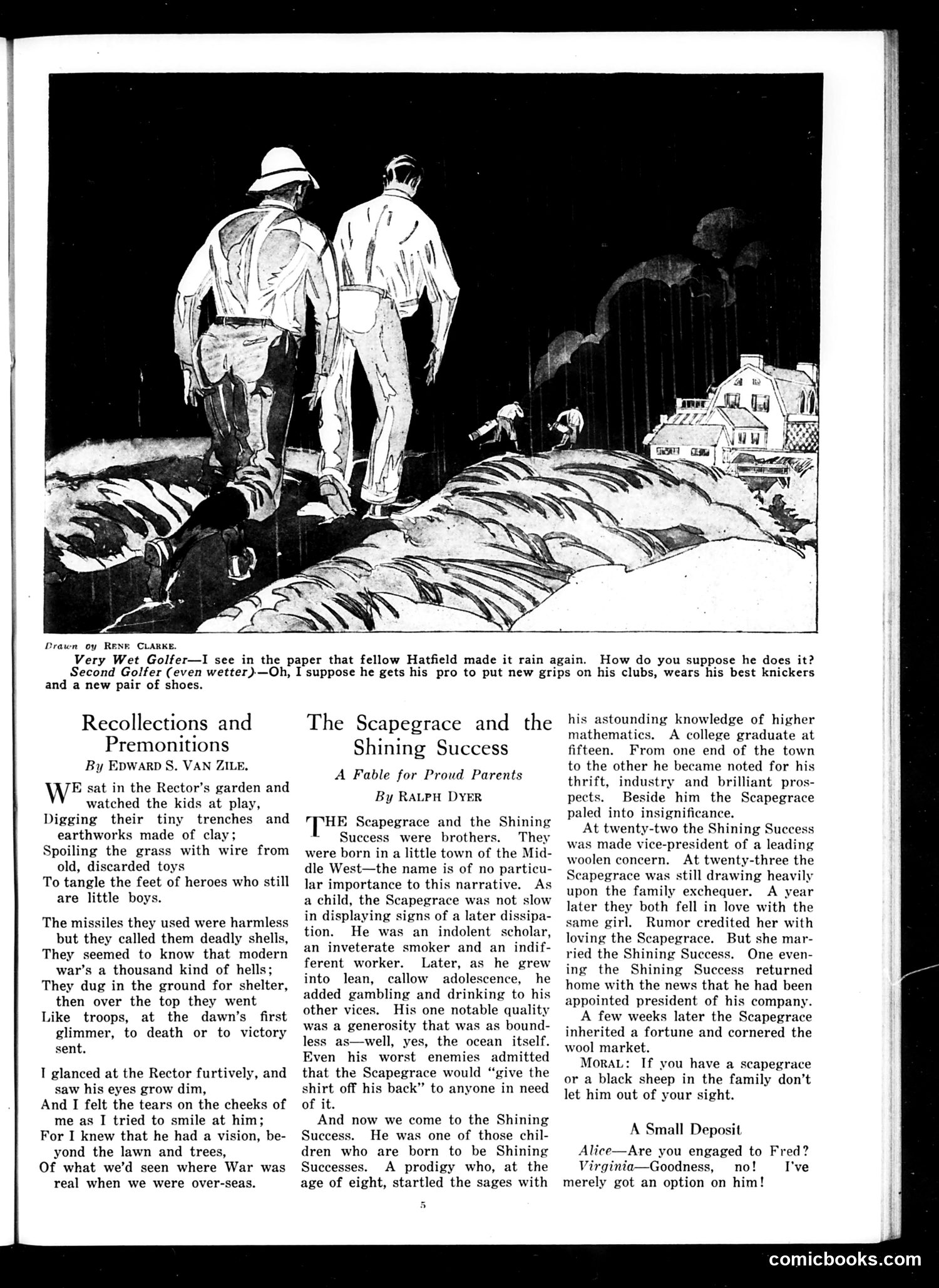
The cartoon jokes about a golfer named Hatfield who supposedly controls the weather. When one golfer notes that "Hatfield made it rain again," the second golfer humorously explains Hatfield's "method": wearing his best clothes and having his golf pro maintain his equipment. The joke is absurdist—the implication that proper attire and club maintenance might magically produce rain. This likely references **Charles Hatfield, a real "rainmaker"** who gained fame in the early 1900s claiming he could artificially induce rainfall through secret chemical methods. He famously attempted this in San Diego in 1916. Judge magazine satirizes public fascination with this dubious claim by suggesting such weather control requires nothing more than looking well-dressed on the golf course.
📄 Transcribed text from this page (OCR, searchable)
Machine-transcribed from the original scan — historical spelling and the odd misread are preserved.
Prawn oy RENE CLARKE. Very Wet Golfer—I see in the paper that fellow Hatfield made it rain again. How do you suppose he does it? Second Golfer (even wetter).—Oh, I suppose he gets his pro to put new grips on his clubs, wears his best knickers and a new pair of shoes. Recollections and Premonitions By Epwarp S. VAN ZILE. E sat in the Rector’s garden and watched the kids at play, Digging their tiny trenches and earthworks made of clay; Spoiling the grass with wire from old, discarded toys To tangle the feet of heroes who still are little boys. The missiles they used were harmless but they called them deadly shells, They seemed to know that modern war’s a thousand kind of hells; They dug in the ground for shelter, then over the top they went Like troops, at the dawn’s first glimmer, to death or to victory sent. I glanced at the Rector furtively, and saw his eyes grow dim, And I felt the tears on the cheeks of me as I tried to smile at him; For I knew that he had a vision, be- yond the lawn and trees, Of what we’d seen where War was real when we were over-seas. The Scapegrace and the Shining Success A Fable for Proud Parents By RALPH DYER 'THE Scapegrace and the Shining Success were brothers. They were born in a little town of the Mid- dle West—the name is of no particu- lar importance to this narrative. As a child, the Scapegrace was not slow in displaying signs of a later dissipa- tion. He was an indolent scholar, an inveterate smoker and an indif- ferent worker. Later, as he grew into lean, callow adolescence, he added gambling and drinking to his other vices. His one notable quality was a generosity that was as bound- less as—well, yes, the ocean itself. Even his worst enemies admitted that the Scapegrace would “give the shirt off his back” to anyone in need of it. And now we come to the Shining Success. He was one of those chil- dren who are born to be Shining Successes. A prodigy who, at the age of eight, startled the sages with his astounding knowledge of higher mathematics. A college graduate at fifteen. From one end of the town to the other he became noted for his thrift, industry and brilliant pros- pects. Beside him the Scapegrace paled into insignificance. At twenty-two the Shining Success was made vice-president of a leading woolen concern. At twenty-three the Scapegrace was still drawing heavily upon the family exchequer. A year later they both fell in love with the same girl. Rumor credited her with loving the Scapegrace. But she mar- ried the Shining Success. One even- ing the Shining Success returned home with the news that he had been appointed president of his company. A few weeks later the Scapegrace inherited a fortune and cornered the wool market. Mora: If you have a scapegrace or a black sheep in the family don’t let him out of your sight. A Small Deposit Alice—Are you engaged to Fred? Virginia—Goodness, no! I've merely got an option on him! comicbooks.com