
Judge, 1921-11-05 · page 8 of 36
Judge — November 5, 1921 — page 8: what you’re looking at
What you’re looking at
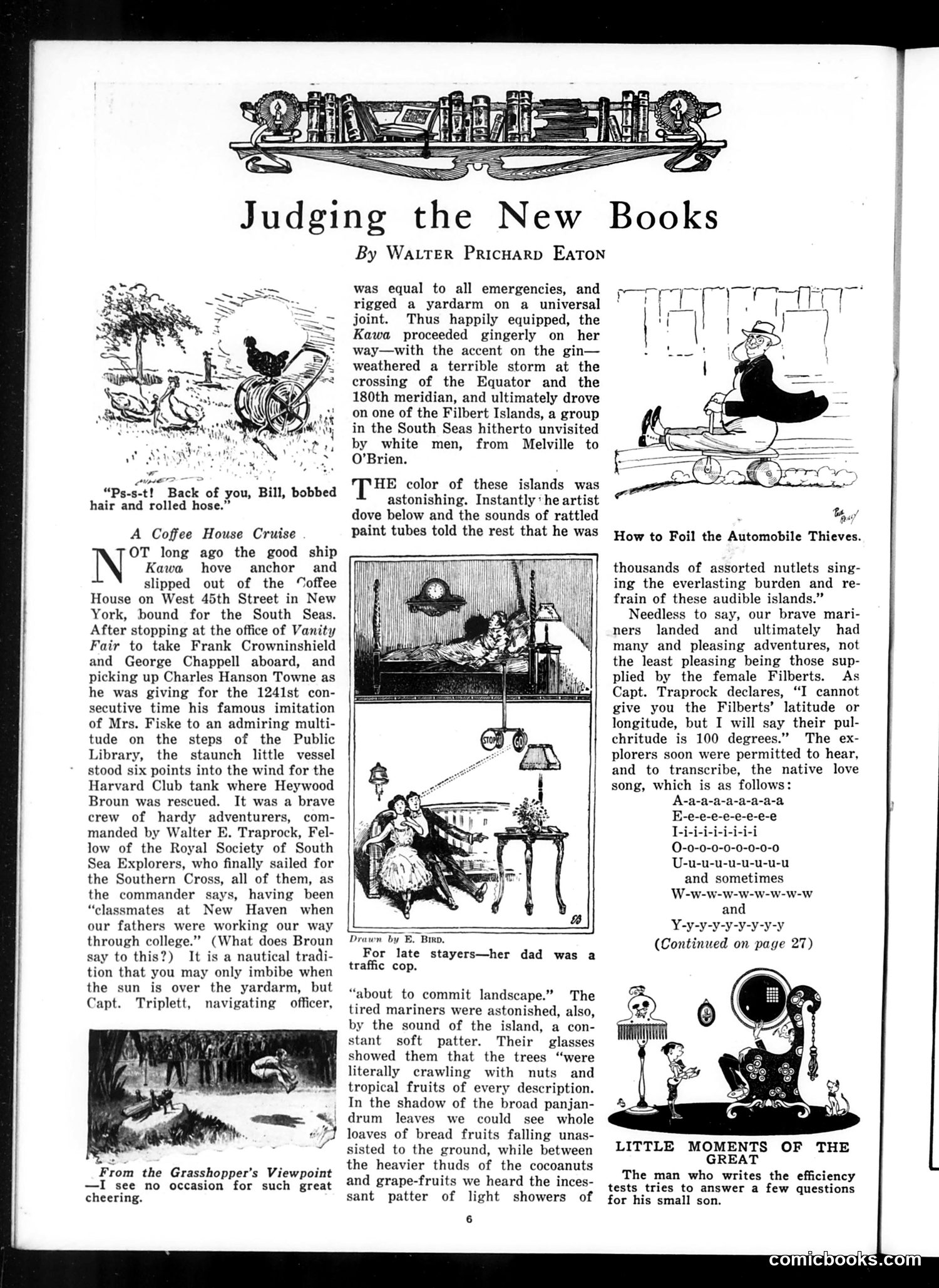
This page contains a satirical travel narrative titled "A Coffee House Cruise" by Walter E. Traprock, a fictional explorer-character. The piece mocks both adventure literature and the literary/cultural figures of 1920s New York. The narrative follows a ship called the *Kawa* departing from a coffee house on West 45th Street with a crew of recognizable Manhattan personalities: Frank Crowninshield and George Chappell (from *Vanity Fair*), Charles Hanson Towne, and Heywood Broun. The joke relies on readers recognizing these actual editors and writers. The satire targets exaggerated travel narratives—particularly South Seas adventure tales inspired by writers like Melville and O'Brien. The absurdist descriptions (trees "crawling with nuts," fruits "singing") parody overwrought exotic literature. The invented "native love song" (nonsensical vowel sequences) further mocks romanticized depictions of indigenous peoples. The cartoons and smaller pieces on the page are unrelated humor vignettes typical of *Judge* magazine's format.
📄 Transcribed text from this page (OCR, searchable)
Machine-transcribed from the original scan — historical spelling and the odd misread are preserved.
one “Ps-s-t! Back of you, Bill, bobbed hair and rolled hose.” A Coffee House Cruise OT long ago the good ship \ Kawa hove anchor and slipped out of the “offee House on West 45th Street in New York, bound for the South Seas. After stopping at the office of Vanity Fair to take Frank Crowninshield and George Chappell aboard, and picking up Charles Hanson Towne as he was giving for the 1241st con- secutive time his famous imitation of Mrs. Fiske to an admiring multi- tude on the steps of the Public Library, the staunch little vessel stood six points into the wind for the Harvard Club tank where Heywood Broun was rescued. It was a brave crew of hardy adventurers, com- manded by Walter E. Traprock, Fel- low of the Royal Society of South Sea Explorers, who finally sailed for the Southern Cross, all of them, as the commander says, having been “classmates at New Haven when our fathers were working our way through college.” (What does Broun say to this?) It is a nautical tradi- tion that you may only imbibe when the sun is over the yardarm, but Capt. Triplett, navigating officer, 7 From the Grasshopper’s Viewpoint —I see no occasion for such great cheering. Judging the New Books By Wa ter Pricuarp Eaton was equal to all emergencies, and rigged a yardarm on a _ universal joint. Thus happily equipped, the Kawa proceeded gingerly on her way—with the accent on the gin— weathered a terrible storm at the crossing of the Equator and the 180th meridian, and ultimately drove on one of the Filbert Islands, a group in the South Seas hitherto unvisited by white men, from Melville to O’Brien. HE color of these islands was astonishing. Instantly ‘he artist dove below and the sounds of rattled paint tubes told the rest that he was Drawn by E. Bixp. For late stayers—her dad was a traffic cop. “about to commit landscape.” The tired mariners were astonished, also, by the sound of the island, a con- stant soft patter. Their glasses showed them that the trees “were literally crawling with nuts and tropical fruits of every description. In the shadow of the broad panjan- e@m= “| drum leaves we could see whole “J loaves of bread fruits falling unas- sisted to the ground, while between the heavier thuds of the cocoanuts and grape-fruits we heard the inces- sant patter of light showers of 6 How to Foil the Automobile Thieves. thousands of assorted nutlets sing- ing the everlasting burden and re- frain of these audible islands.” Needless to say, our brave mari- ners landed and ultimately had many and pleasing adventures, not the least pleasing being those sup- plied by the female Filberts. As Capt. Traprock declares, “I cannot give you the Filberts’ latitude or longitude, but I will say their pul- chritude is 100 degrees.” The ex- plorers soon were permitted to hear, and to transcribe, the native love song, which is as follows: A-a-a-a-a-a-a-a-a E-e-e-e-e-e-e-e-€ Ii i O-0-0-0-0-0-0-0-0 U-u-u-u-u-u-u-u-u and sometimes W-w-w-w-w-w-w-w-w and Y-y-y-y-y-y-y-y-y (Continued on page 27) LITTLE MOMENTS OF THE GREAT The man who writes the efficiency tests tries to answer a few questions for his small son.