
Judge, 1921-11-05 · page 13 of 36
Judge — November 5, 1921 — page 13: what you’re looking at
What you’re looking at
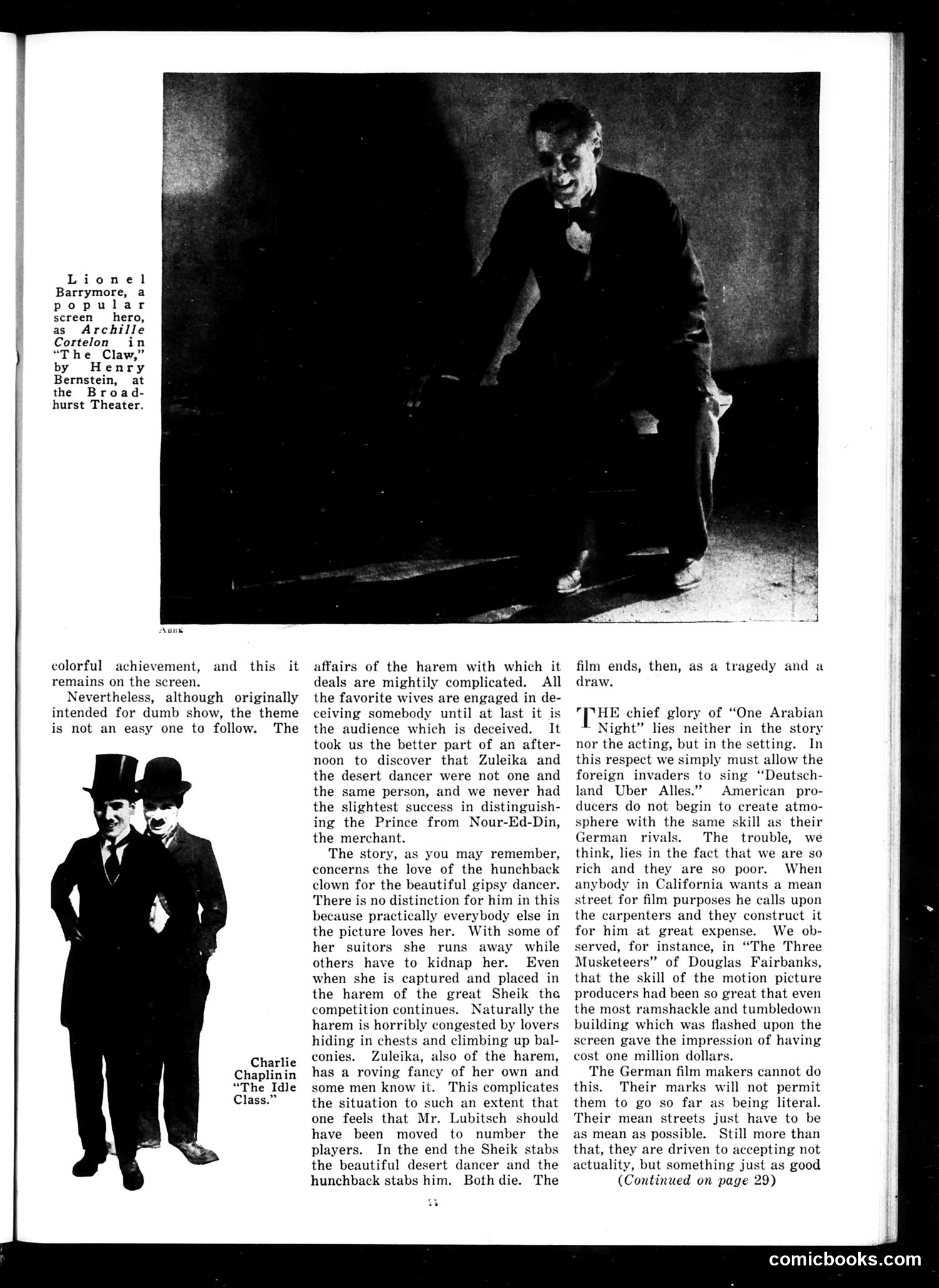
This page reviews two theatrical films. The top photograph shows **Lionel Barrymore** in "The Claw," a stage adaptation at the Broadhurst Theater. The review criticizes the plot's complexity—a harem tale where multiple suitors pursue the same dancer, making it difficult to follow which character is which. The small illustration shows **Charlie Chaplin** in "The Idle Class," mentioned without detailed commentary. The longer review discusses "One Arabian Night," likely a German production. The critic praises German filmmakers' superior ability to create authentic atmosphere on screen, attributing this to their economic constraints—German producers must create genuine-looking sets on limited budgets, while wealthy American producers can build expensive replicas that paradoxically look artificial. The review suggests American wealth actually *handicaps* cinematic realism, while German poverty forces creative authenticity. This is notably generous praise toward a foreign rival during the competitive early cinema era.
📄 Transcribed text from this page (OCR, searchable)
Machine-transcribed from the original scan — historical spelling and the odd misread are preserved.
Lionel Barrymore, a popular screen hero, as Archille Cortelon in “The Claw,” by Henry Bernstein, at the Broad- hurst Theater. colorful achievement, and this it remains on the screen. Nevertheless, although originally intended for dumb show, the theme is not an easy one to follow. The Charlie Chaplinin “The Idle Class.” affairs of the harem with which it deals are mightily complicated. All the favorite wives are engaged in de- ceiving somebody until at last it is the audience which is deceived. It took us the better part of an after- noon to discover that Zuleika and the desert dancer were not one and the same person, and we never had the slightest success in distinguish- ing the Prince from Nour-Ed-Din, the merchant. The story, as you may remember, concerns the love of the hunchback clown for the beautiful gipsy dancer. There is no distinction for him in this because practically everybody else in the picture loves her. With some of her suitors she runs away while others have to kidnap her. Even when she is captured and placed in the harem of the great Sheik tha competition continues. Naturally the harem is horribly congested by lovers hiding in chests and climbing up bal- conies. Zuleika, also of the harem, has a roving fancy of her own and some men know it. This complicates the situation to such an extent that one feels that Mr. Lubitsch should have been moved to number the players. In the end the Sheik stabs the beautiful desert dancer and the hunchback stabs him. Both die. The film ends, then, as a tragedy and a draw. [THE chief glory of “One Arabian Night” lies neither in the story nor the acting, but in the setting. In this respect we simply must allow the foreign invaders to sing ‘Deutsch- land Uber Alles.” American pro- ducers do not begin to create atmo- sphere with the same skill as their German rivals. The trouble, we think, lies in the fact that we are so rich and they are so poor. When anybody in California wants a mean street for film purposes he calls upon the carpenters and they construct it for him at great expense. We ob- served, for instance, in “The Three Musketeers” of Douglas Fairbanks, that the skill of the motion picture producers had been so great that even the most ramshackle and tumbledown building which was hed upon the screen gave the impression of having cost one million doll The German film makers cannot do this. Their marks will not permit them to go so far as being literal. Their mean streets just have to be as mean as possible. Still more than that, they are driven to accepting not actuality, but something just as good (Continued on page 29) comicbooks.com