
A complete issue · 32 pages · 1921
Judge — May 21, 1921
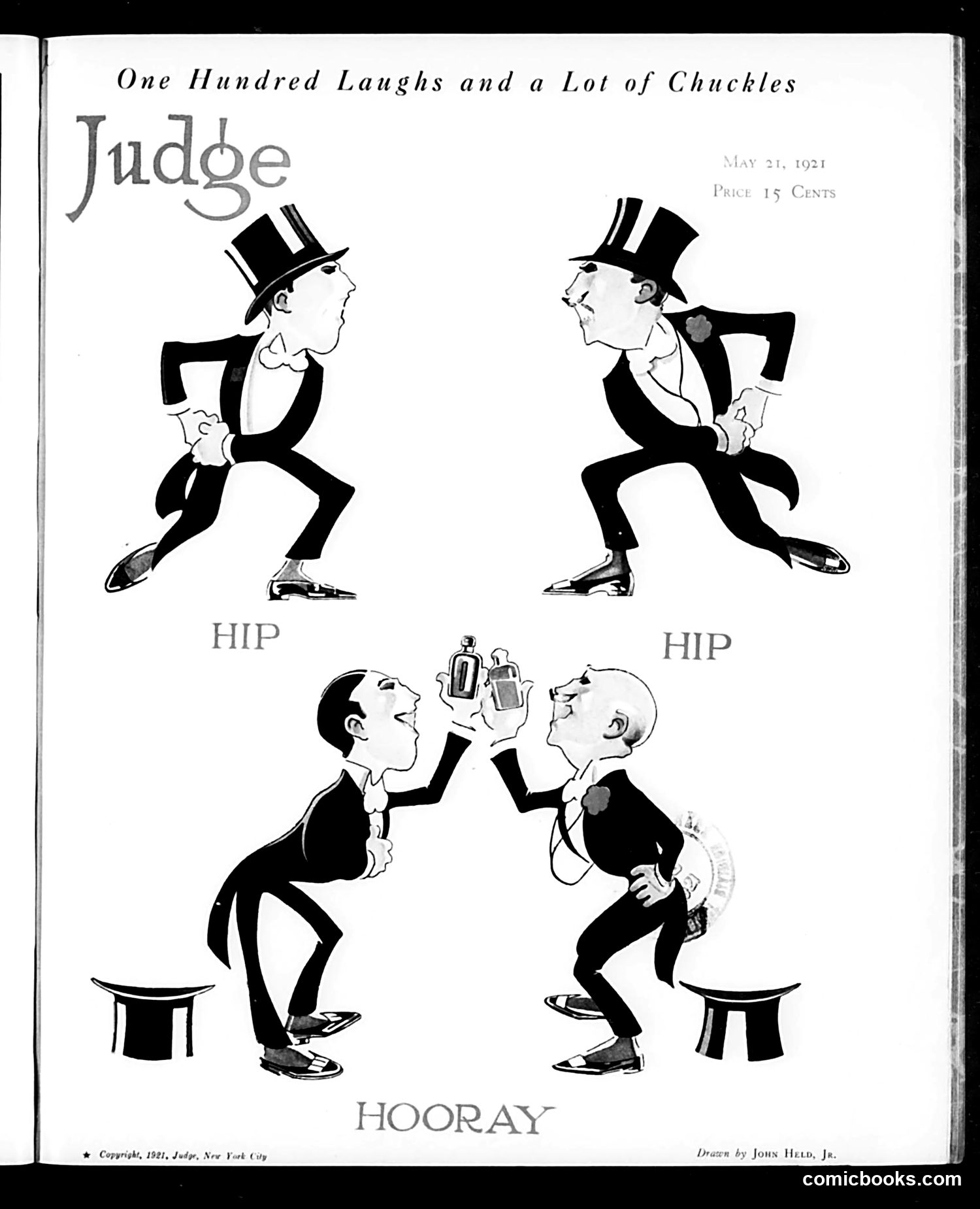
This page presents three cartoon panels illustrating fashionable social gestures of the era. The top two panels labeled "HIP" show men in formal attire (top hats and tails) performing an exaggerated dance move or gesture with bent knees and hands on hips—likely depicting the "hip" or trendy behavior of young sophisticates in the 1920s Jazz Age. The bottom panel labeled "HOORAY" shows two men toasting with bottles, appearing to celebrate enthusiastically while seated on stools. The satire appears to mock upper-class social affectations and the emerging modern mannerisms of the 1920s youth culture. The title "One Hundred Laughs and a Lot of Chuckles" suggests this is humorous commentary on contemporary social conventions and fashionable behavior.
This page is primarily **promotional content**, not a cartoon or satirical article. It's an advertisement for *Judge* magazine itself, titled "Making the Clock Tick a Smile a Minute." The text argues that *Judge* serves an important social function by providing humor and laughter to readers. It emphasizes that the magazine's writers and artists work hard to find genuine, "honest-to-goodness humor" among submissions, carefully curating content. The piece notes recent improvements in *Judge's* sketches, poems, and pictures, claiming each issue is "a rib-tickler." The advertisement concludes with a pitch for subscriptions: readers can pay one dollar for ten weeks rather than buying individual issues on Tuesdays. It reflects *Judge's* position as a major American humor publication competing for readership during the early-to-mid 20th century.
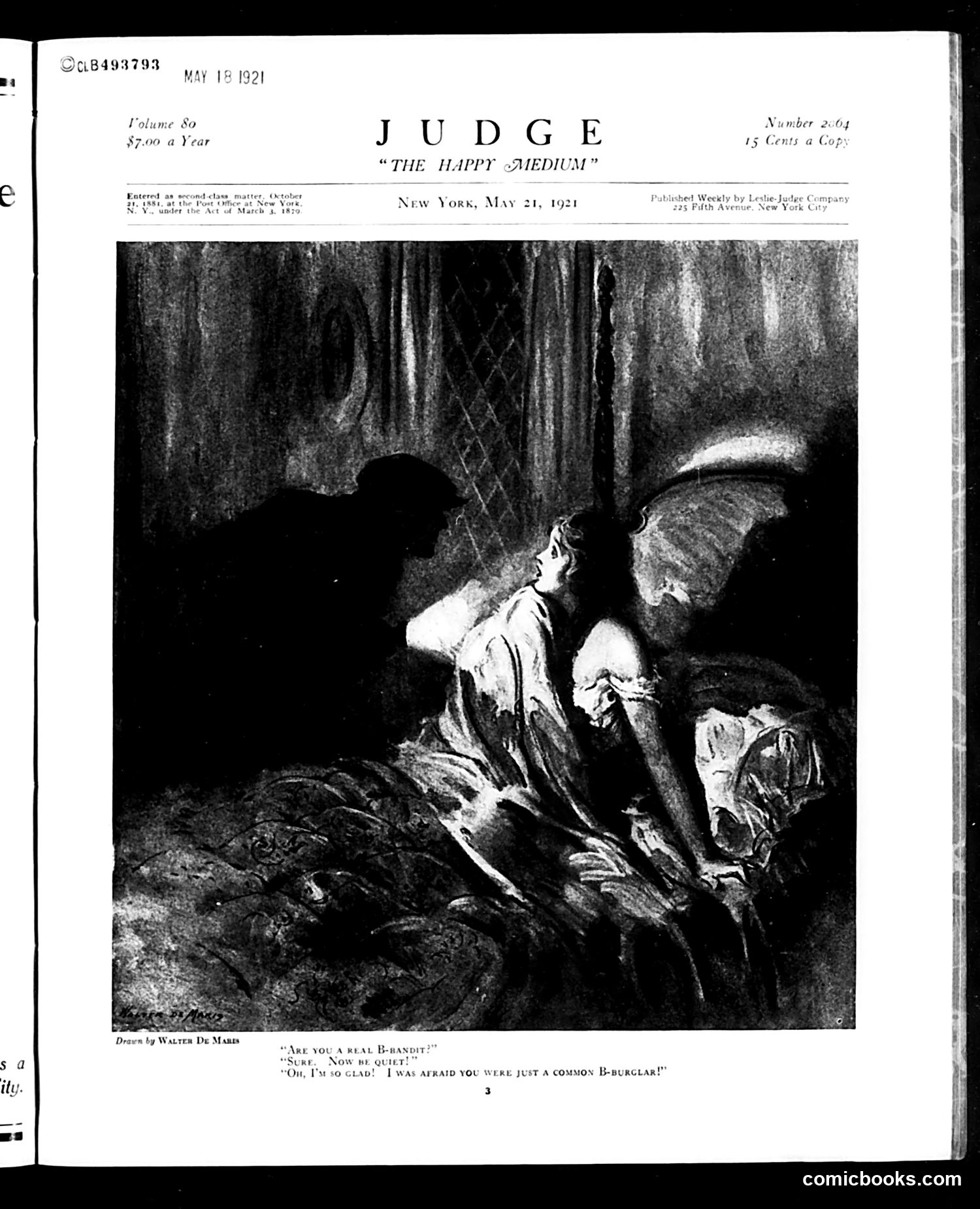
**The Cartoon:** Walter De Maris illustrates a scene showing figures in what appears to be a dark interior space. The dialogue reads: "Are you a real bandit?" / "Sure. Now be quiet!" / "Oh, I'm so glad. I was afraid you were just a common burglar!" **The Satire:** This is a class-based joke playing on 1920s social distinctions. The speaker expresses relief that their robber is a "bandit" (perhaps suggesting someone with romantic or political credentials—possibly referencing Robin Hood-style outlaws or revolutionary figures popular in post-WWI discourse) rather than a mere "common burglar" (ordinary criminal). The humor satirizes how even victims could be snobbish about the *type* of criminal victimizing them, reflecting period anxieties about class status and crime during Prohibition-era America.
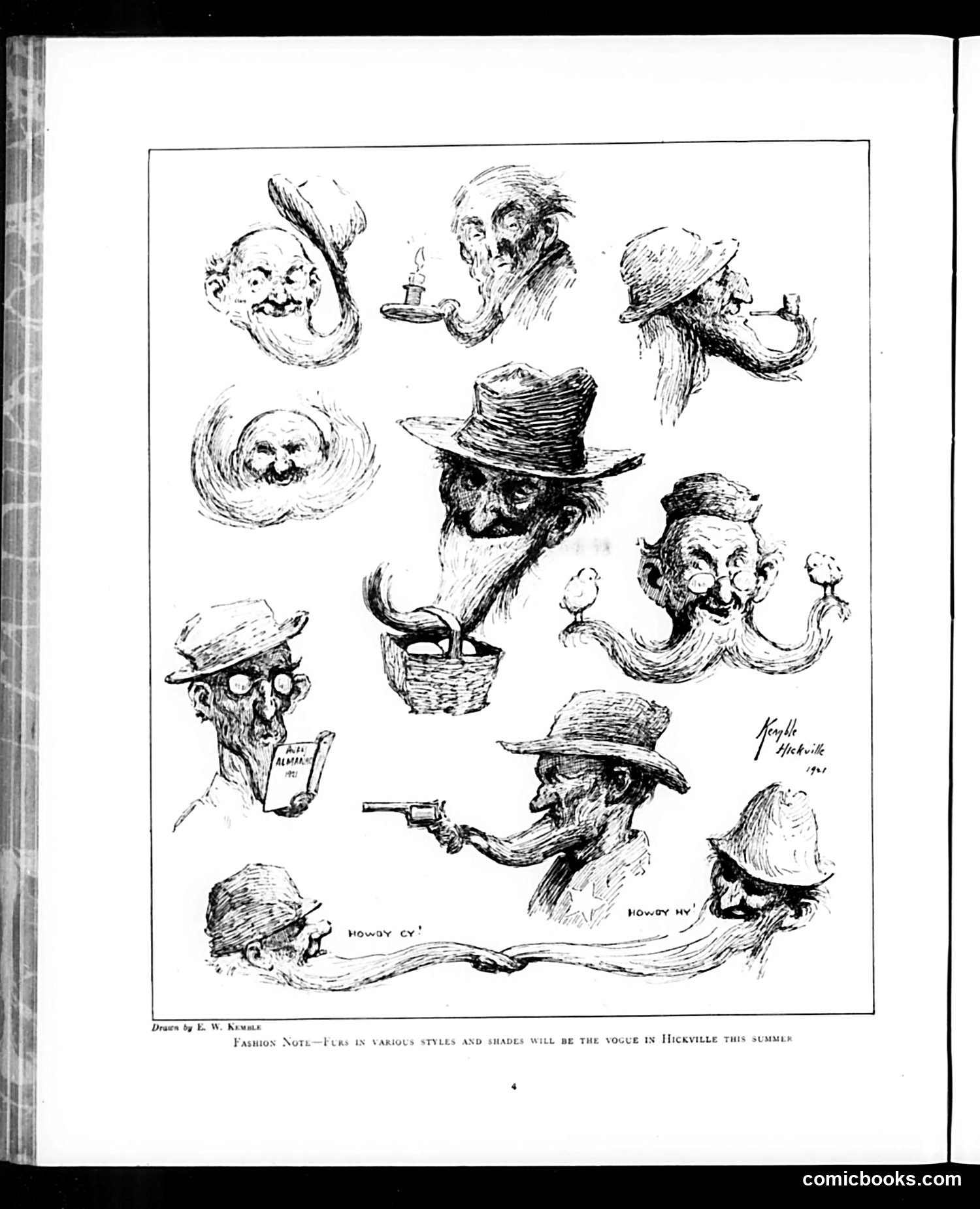
This is a fashion satire page drawn by E.W. Kemble. The caption states "Tucks in various styles and shades will be the vogue in Hicksville this summer." The drawings appear to mock rural or small-town fashion trends through exaggerated caricatures of men wearing various hats (bowlers, cowboy hats, caps) with prominent facial hair. Several figures say "Howdy Cy!" and "Howdy Hy!" — suggesting rural male nicknames. The satire targets the adoption of "tucks" (pleated fabric details) as fashionable in a provincial setting called "Hicksville." By depicting rough, whisker-faced men in crude clothing discussing these supposedly fashionable details, Kemble mocks the incongruity between high-fashion trends and their adoption in unsophisticated rural communities. The humor lies in imagining frontier types taking city fashion seriously.
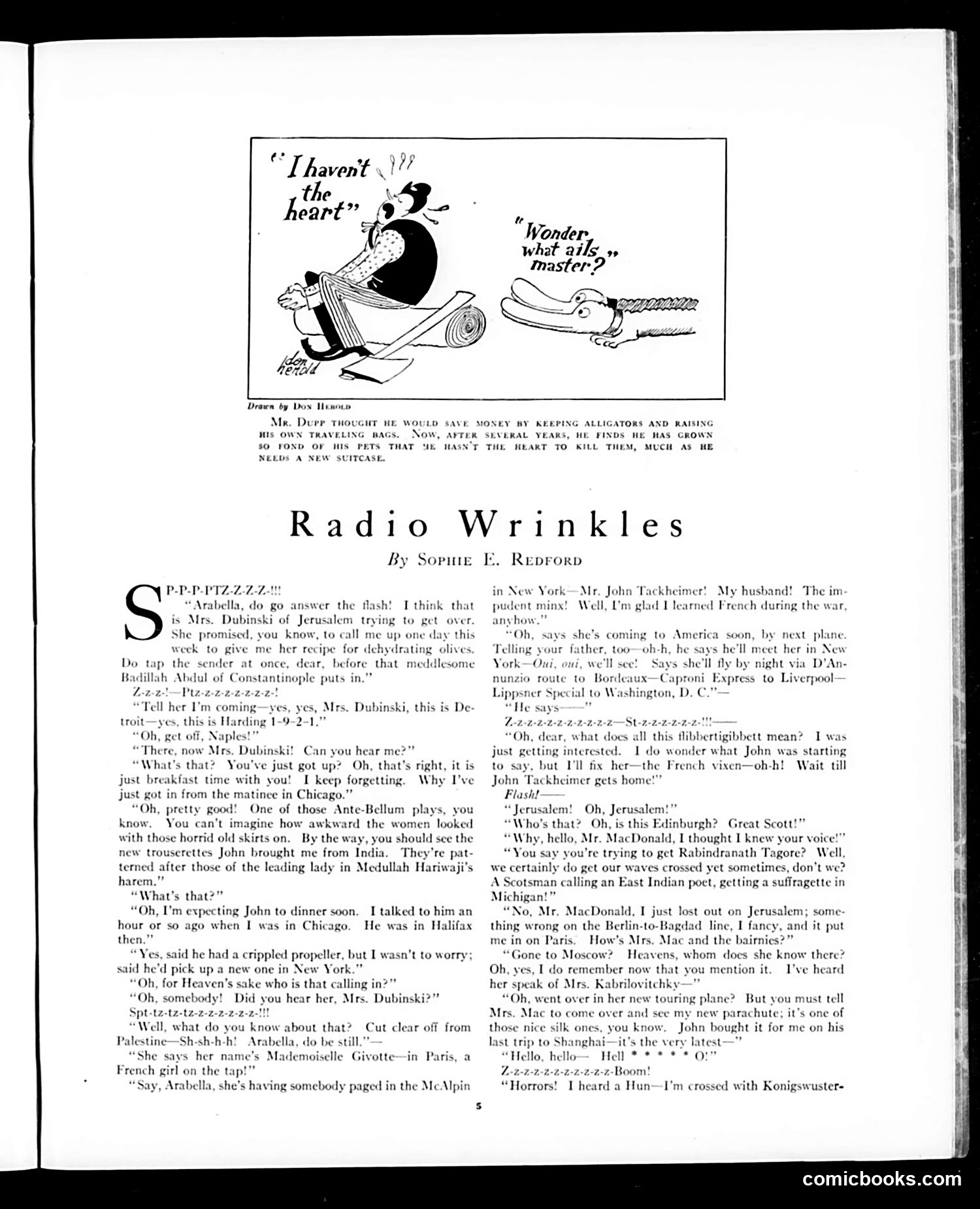
**The Cartoon:** The top cartoon depicts a man (labeled "head") operating what appears to be an early radio device, telling an alligator "I haven't the heart," while the alligator asks "Wonder what ails master?" The caption explains that a man named Dorf kept alligators as traveling pets but has grown too fond of them to kill for new suitcases—hence his dilemma. **The Story Below:** "Radio Wrinkles" is a comedic piece satirizing early radio communication. It mocks the chaos of international radio broadcasts, depicting garbled messages, crossed signals, and absurd misunderstandings between callers in different cities (Jerusalem, Detroit, Halifax, Paris, Edinburgh, Moscow). The humor relies on readers' familiarity with radio's notorious technical unreliability and the comedy of miscommunication across distances—a cutting-edge technology still novel enough to be funny.
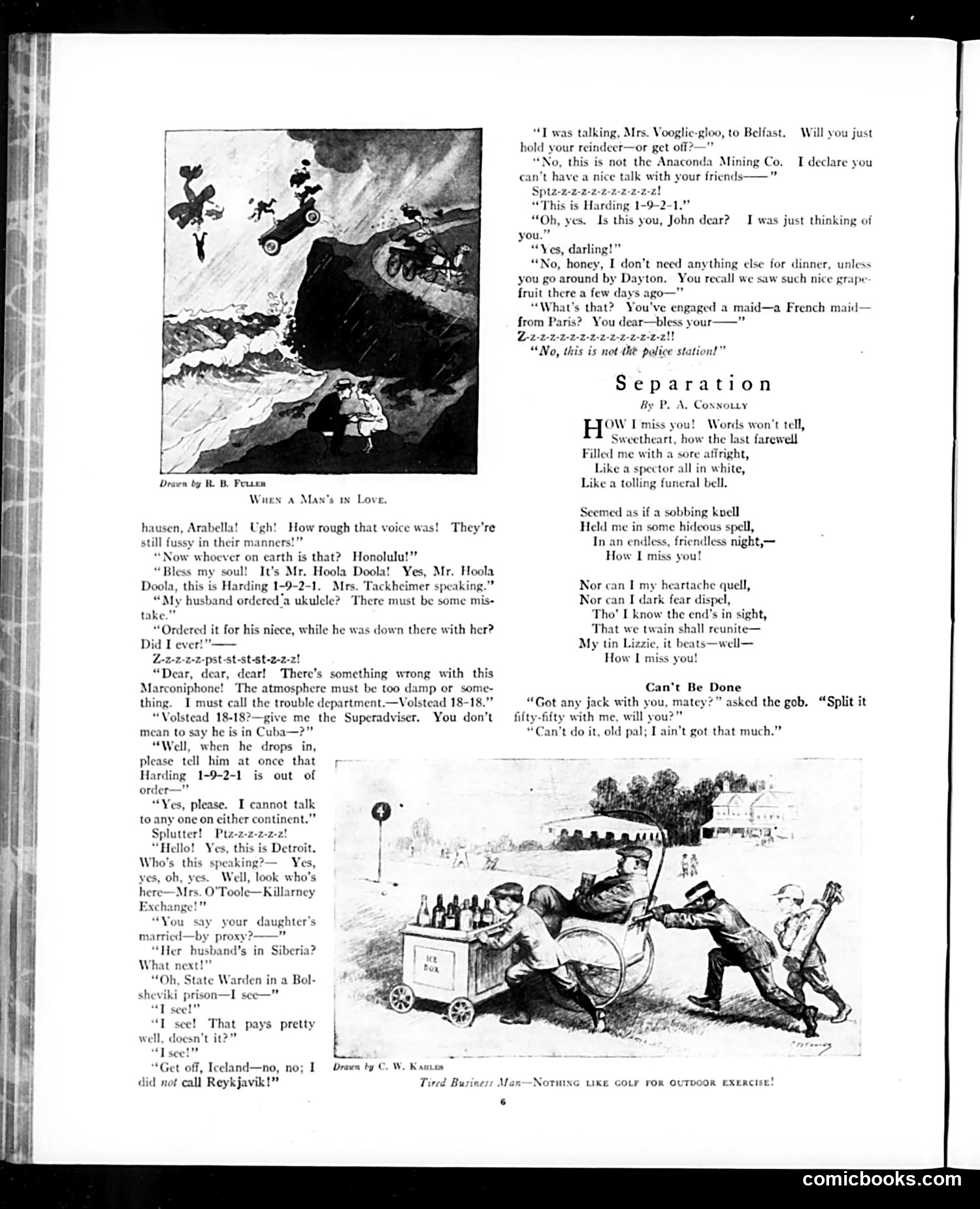
**Top Cartoon ("When a Man's in Love"):** This appears to be a humorous domestic scene showing a couple's telephone conversation being interrupted by various mishaps—vehicles crashing, chaos ensuing. The satire mocks how romantic couples monopolize phone lines with trivial conversation while causing disruption, a contemporary concern when shared party-line telephone systems were common. **Bottom Cartoon ("Tired Business Man—Nothing like Golf for Outdoor Exercise"):** This satirizes the leisure activities of businessmen during Prohibition era. The "ice" vendor (likely concealing alcohol) serves drinks to golf players, mocking the hypocrisy of supposedly "respectable" businessmen secretly obtaining illegal liquor during Prohibition. Both cartoons employ visual exaggeration to critique 1920s social behaviors and technology.
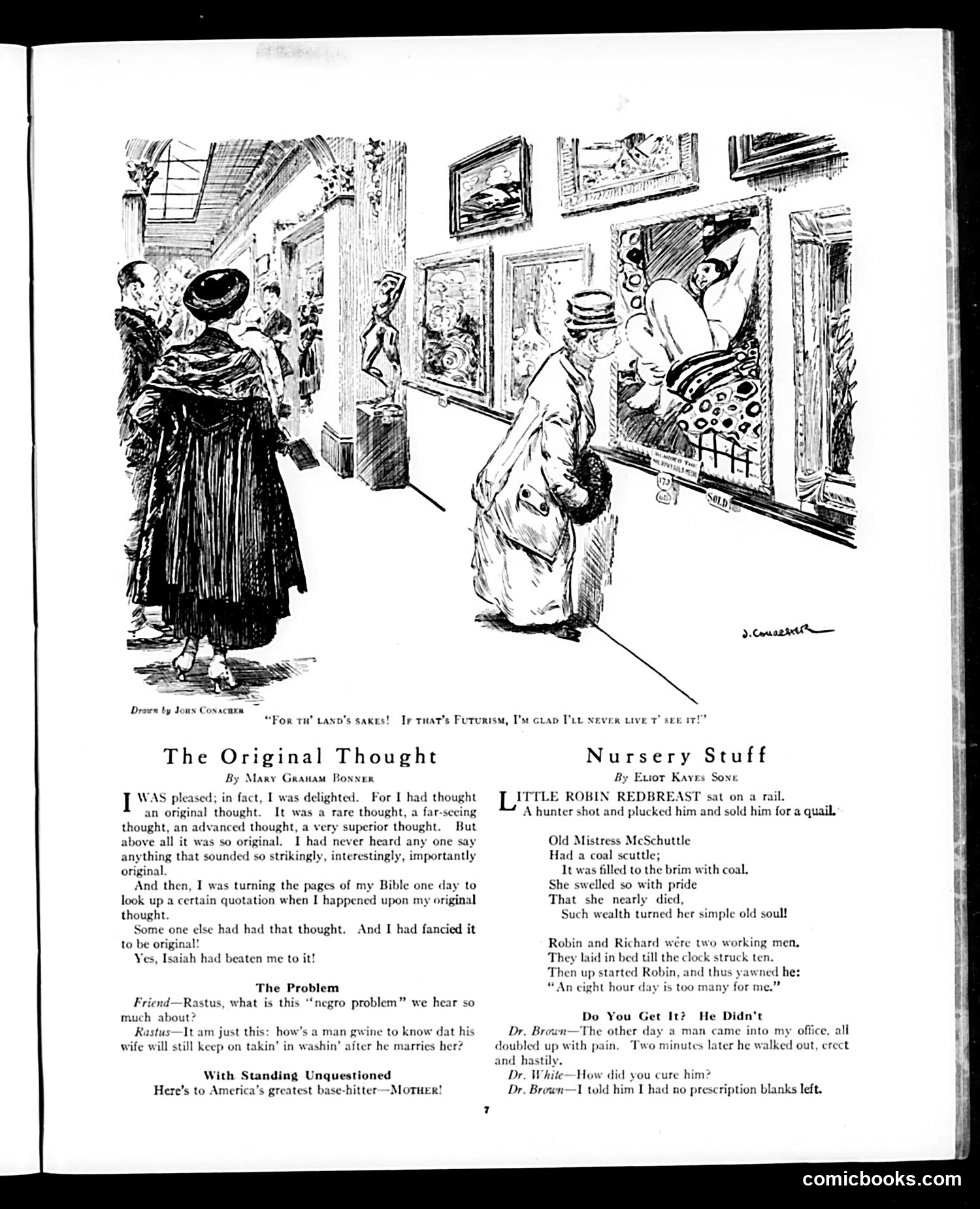
This early 20th-century satirical page contains several humor pieces: **Main Cartoon (top):** A woman viewing modern art in a gallery dismisses Futurism as unwelcome, saying she'll never live to see such things. The satire mocks both avant-garde art movements (Futurism) and presumably conservative resistance to modernism. **"The Original Thought":** A mordant commentary on originality—the author believes he's had a novel idea until discovering the same thought in the Bible, suggesting there's "nothing new under the sun." **"The Problem":** A racist dialect joke stereotyping Black Americans, using offensive language and perpetuating harmful caricatures common to early 20th-century American humor. **"Nursery Stuff":** Darkly humorous nursery rhyme variations, including one mocking labor movements (the "eight hour day" complaint). **"Do You Get It?":** A doctor joke: a patient leaves cured simply because the doctor has no prescription blanks—satirizing medical practice or hypochondria. The page reflects period attitudes, including casual racism, that modern readers should recognize as historically revealing rather than humorous.
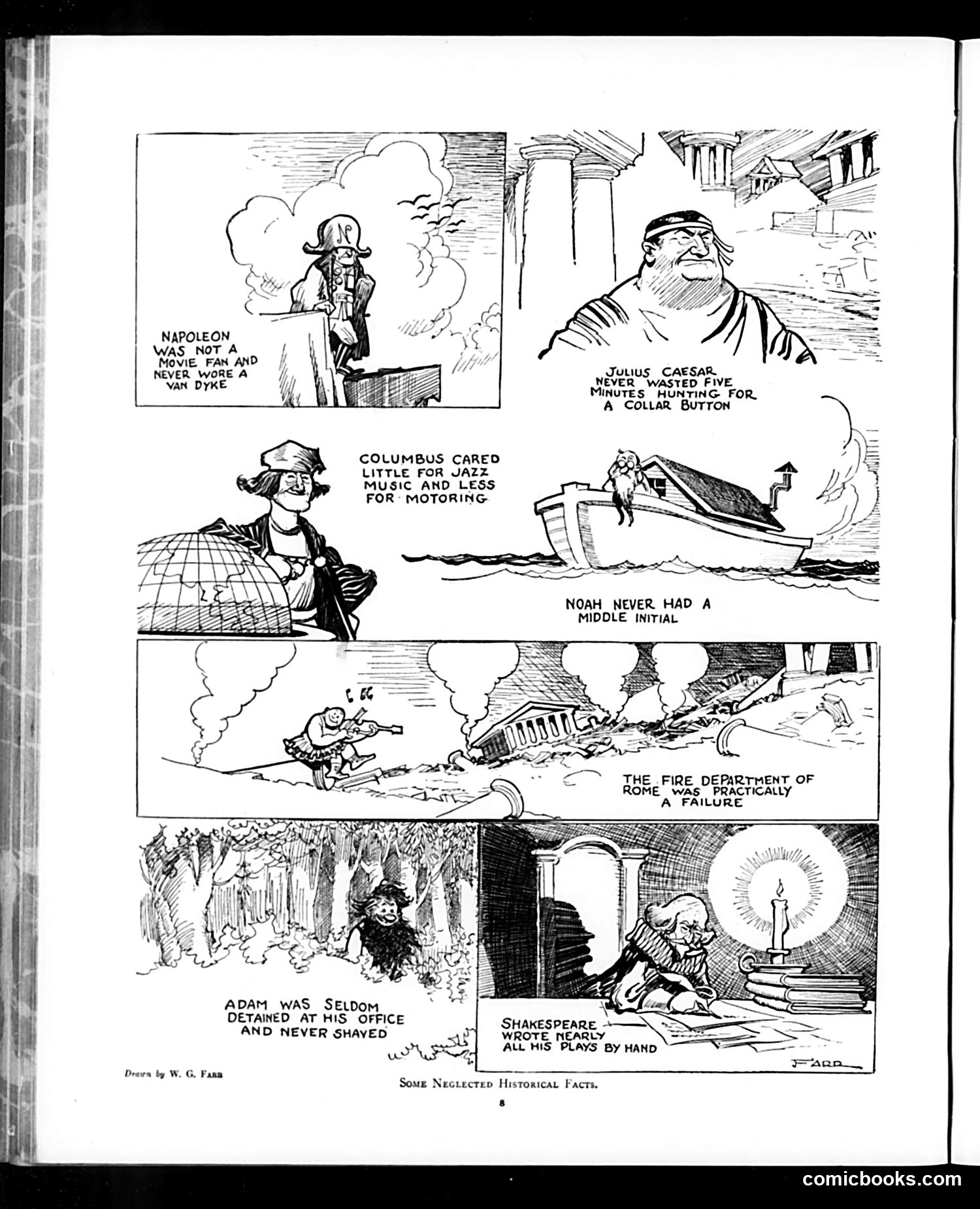
This Judge magazine page presents humorous pseudo-historical "corrections" about famous historical figures. Each panel offers absurd, made-up "facts" presented as if rectifying overlooked history: - **Napoleon** never wore a van dyke beard (contradicting common depictions) - **Julius Caesar** wasted no time hunting collar buttons (anachronistic humor—collar buttons didn't exist in Caesar's era) - **Columbus** preferred classical music to jazz and cars (anachronistic again) - **Noah** had no middle initial - **Rome's fire department** was "practically a failure" (likely referencing Nero myths) - **Adam** was detained at his office and never shaved - **Shakespeare** hand-wrote all his plays The satire mocks the tendency to invent or misremember historical "facts," presenting deliberately absurd claims with mock-serious authority. It's gentle humor about how historical narratives become distorted or embellished through repetition and popular culture.
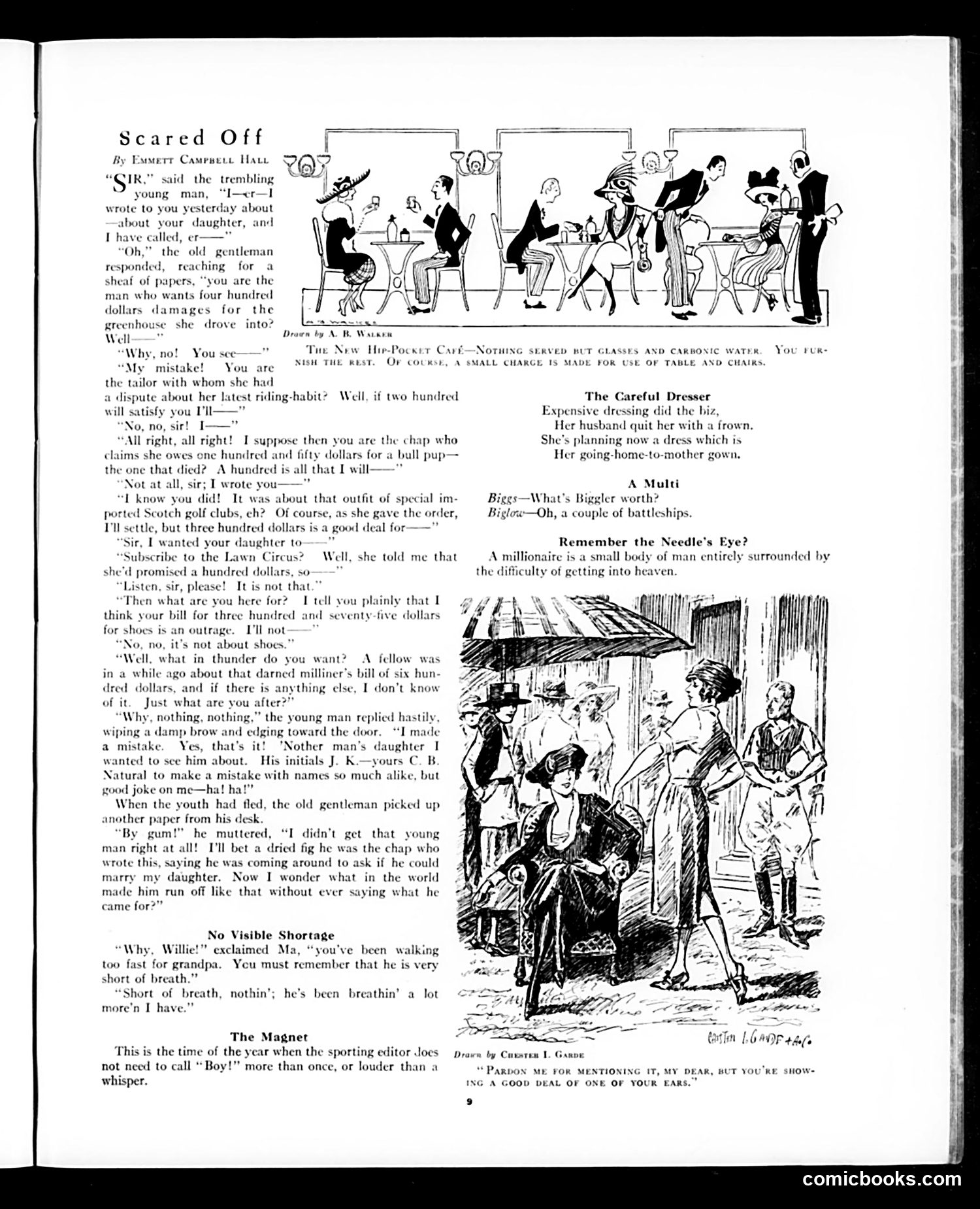
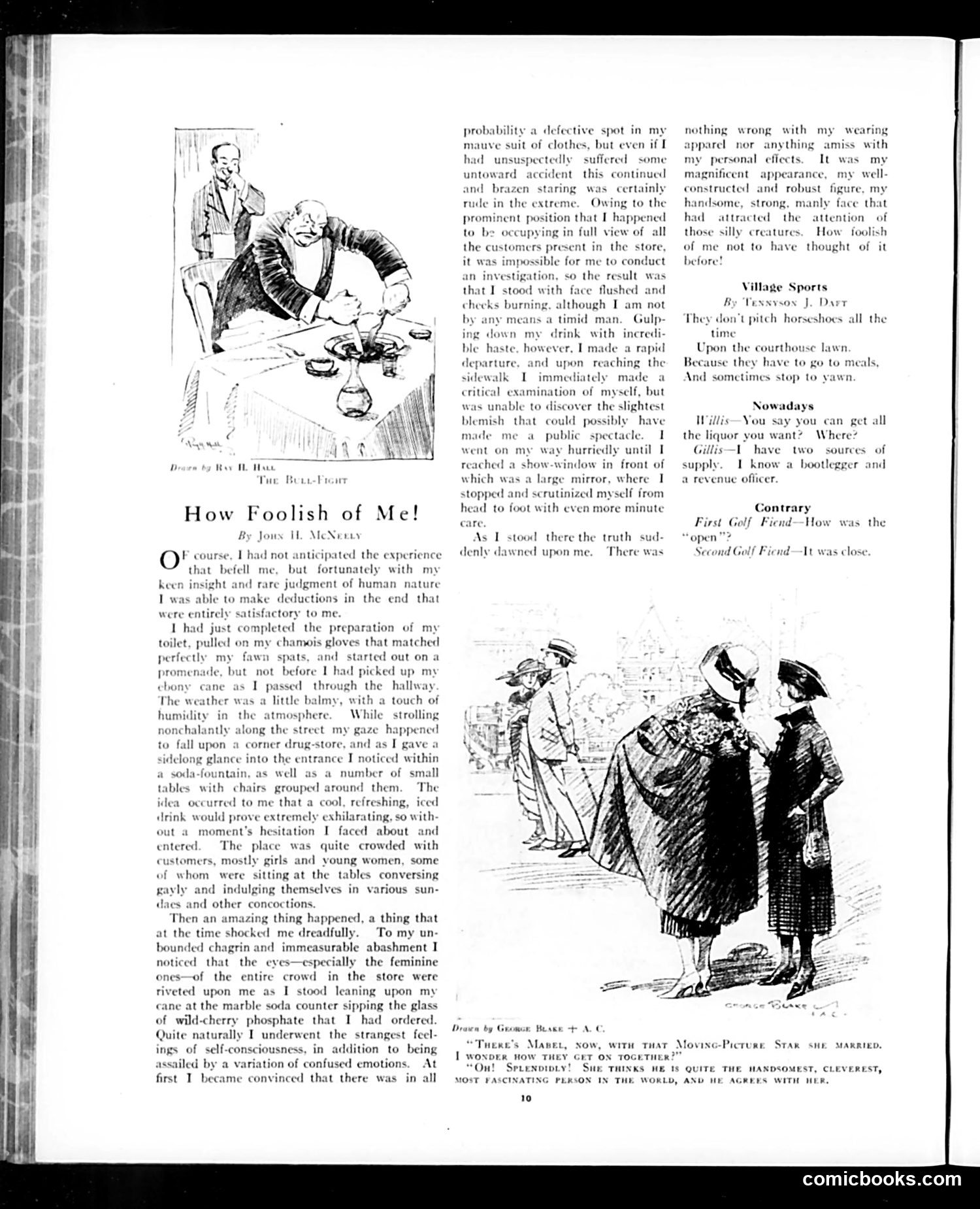
This page's main cartoon depicts a young man trying to propose to a wealthy man's daughter, but the father interrupts repeatedly, assuming the visitor represents one of many creditors. The father lists mounting debts: a tailor's bill for a riding habit, damages from a carriage accident, unpaid Scotch golf clubs, a lawn circus subscription, a milliner's bill of $600, and shoes costing $375. Each time the young man attempts to explain his actual purpose, the father mistakes him for a different creditor. The suitor eventually flees in embarrassment without ever stating his intentions to marry the daughter. **The satire targets** the extravagant spending habits of wealthy young women in the early 1900s—their expensive tastes in clothing, sports equipment, and entertainments created such substantial debts that a potential suitor cannot even gain an audience with the father. The joke suggests that courting a wealthy girl is impossible because her creditors have already monopolized her father's attention and finances.
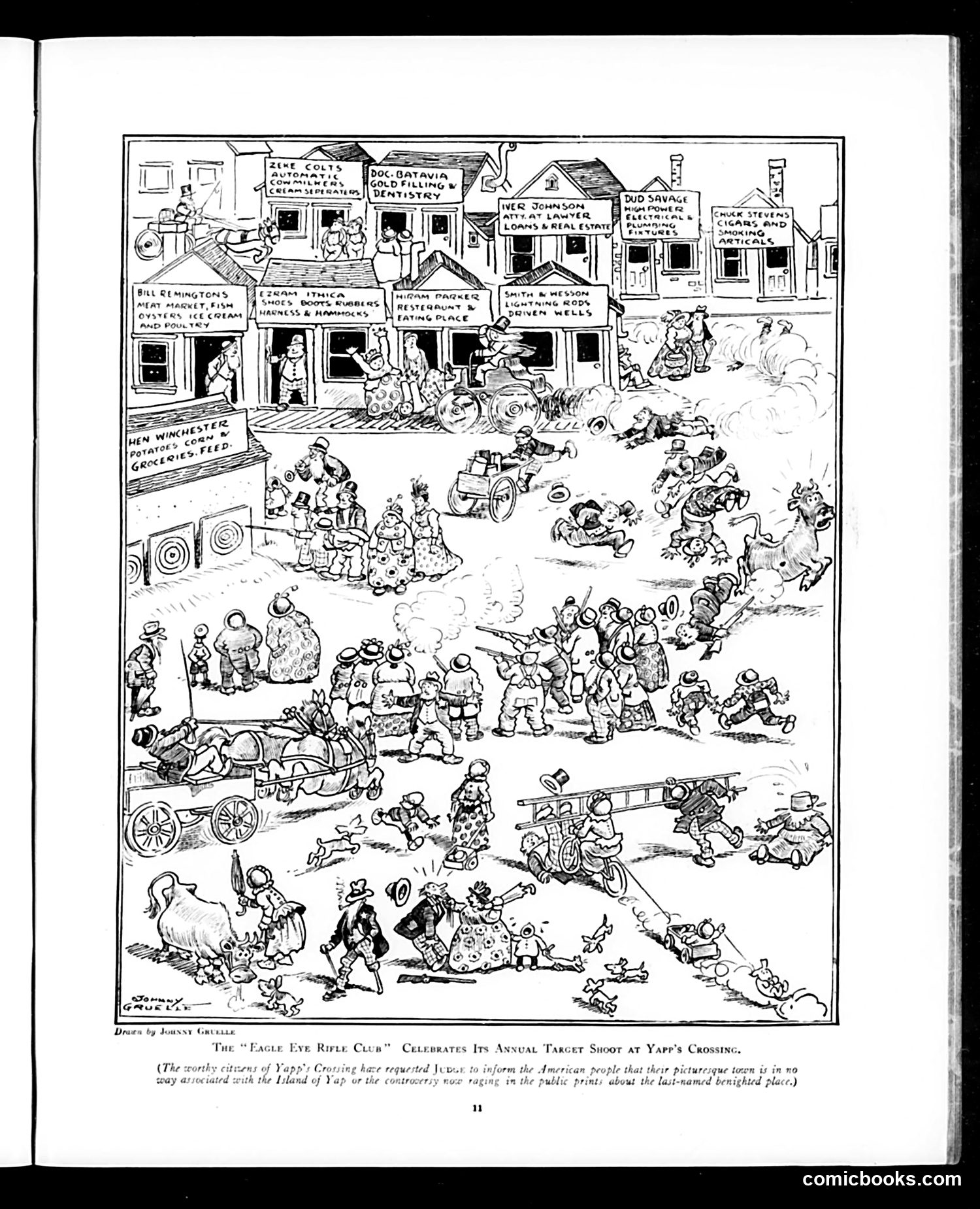
This is a crowded satirical illustration depicting a small-town gathering. The cartoon mocks a rural American community through exaggerated chaos—children, animals, and adults occupy a central square lined with business storefronts (meat markets, dentistry, real estate offices, etc.). The satire appears directed at the "Eagle Eye Rifle Club" and the town of "Yapp's Crossing." The caption's note indicates that "worthy citizens" requested Judge publish this image to mock the town's reputation, explicitly disclaiming association with "the Island of Jap or the controversy now raging in the public print about the last-named benighted place." The reference to "Jap" suggests this cartoon coincides with anti-Japanese sentiment, possibly relating to early 20th-century U.S.-Japan tensions. The cartoon ridicules rural American towns as backward, disorganized places—a common Judge magazine trope mocking provincial life compared to urban sophistication.
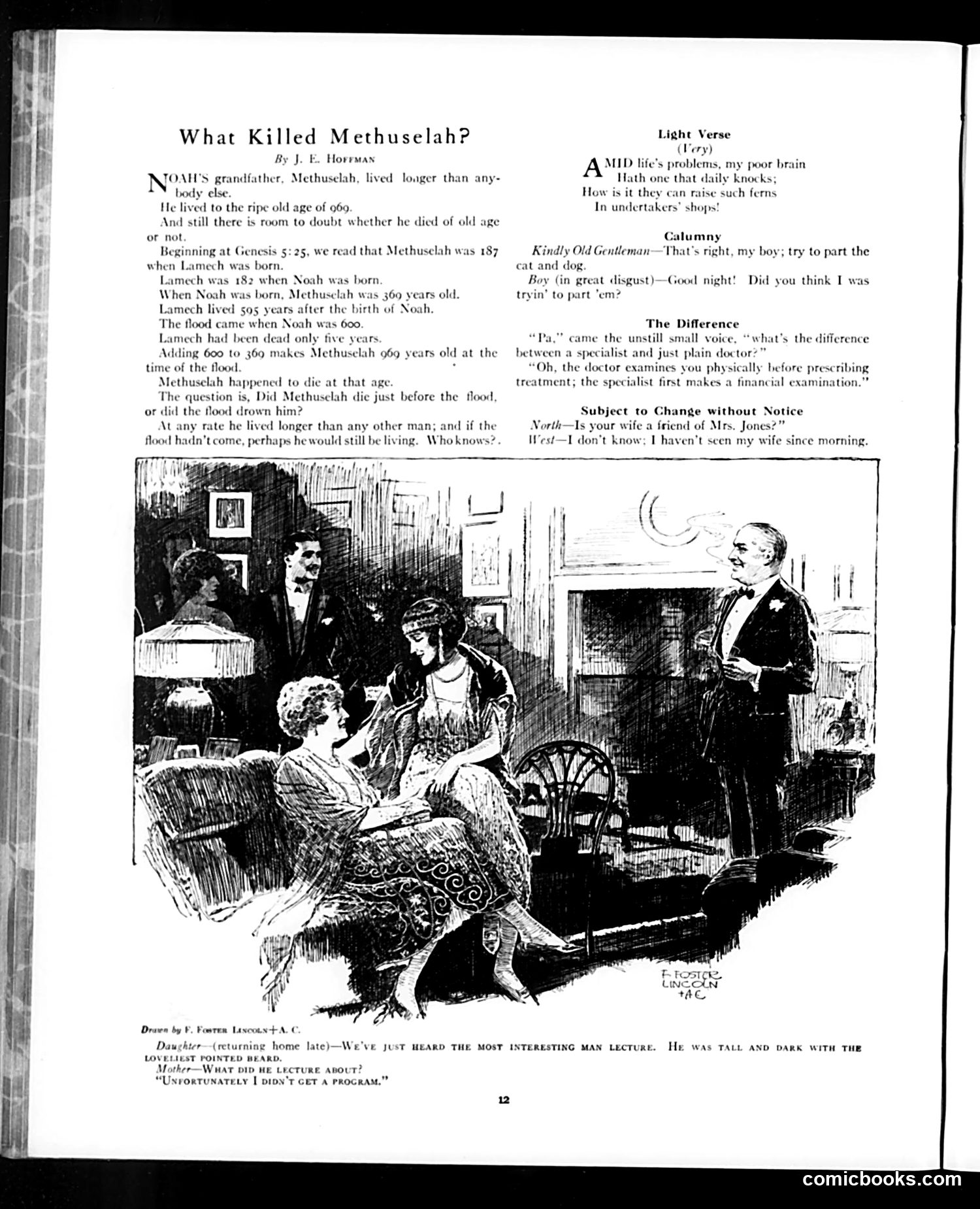
This page from *Judge* magazine presents several unrelated humorous items: **"What Killed Methuselah?"** uses biblical genealogy as the framework for a joke: the article calculates that Methuselah died at age 969, the same year as Noah's flood, leaving ambiguous whether he died of old age or drowned—a play on the absurdity of extreme longevity. **The cartoon** depicts a social gathering where a daughter describes attending a lecture by an impressively tall, dark man with a "pointed beard," but admits she didn't get a program identifying him. The humor lies in her focusing on his physical appearance rather than his actual lecture content—satirizing how audiences (particularly women, per period stereotypes) prioritize social gossip over intellectual substance. The other items are brief jokes about life's minor annoyances and social observations typical of the era's light humor.
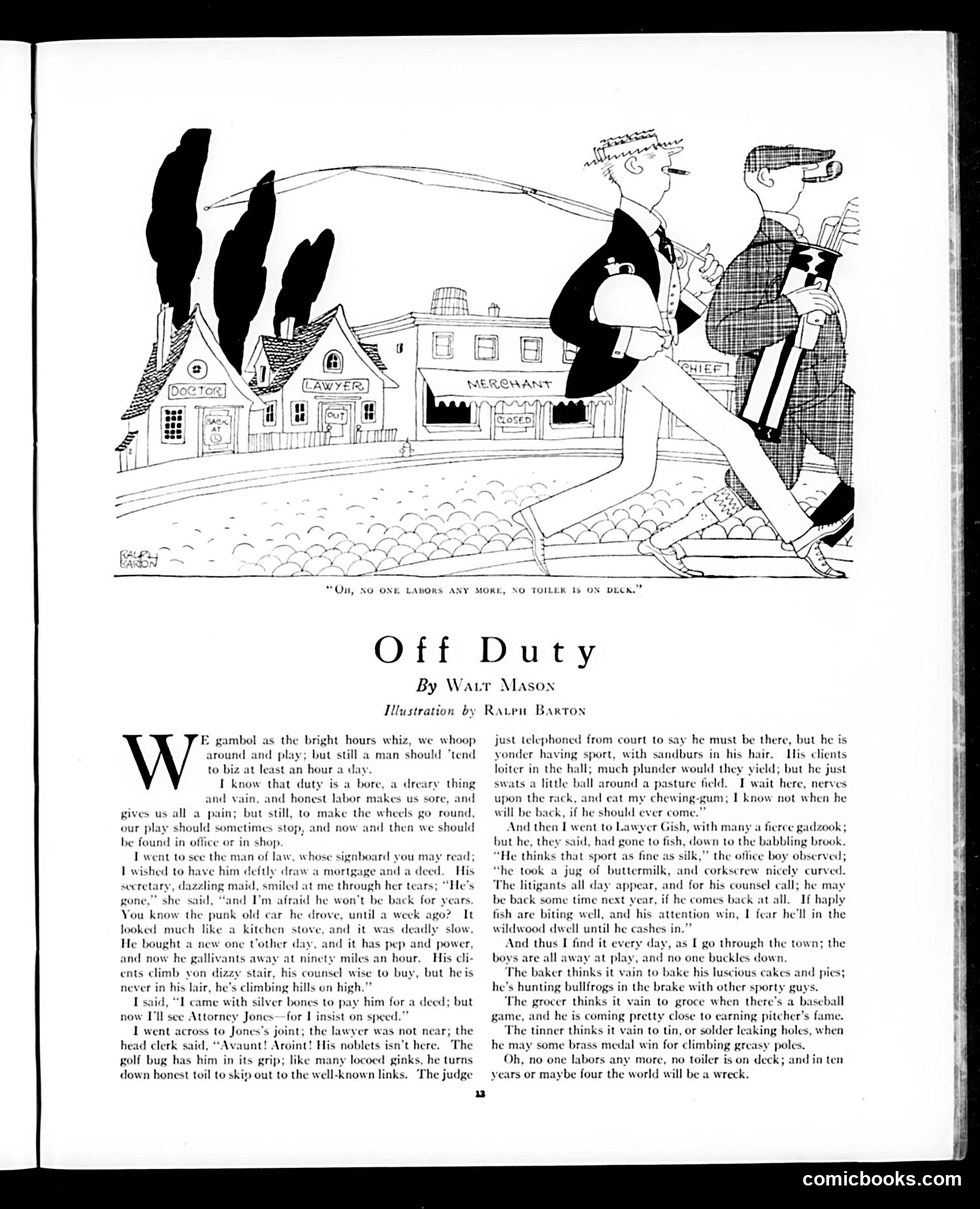
This is a humorous satirical story about widespread shirking of professional duties. The narrator attempts to hire lawyers and tradesmen but finds them all absent, pursuing leisure activities instead: one attorney is joyriding in a new car at "ninety miles an hour," another is golfing, a third is fishing with buttermilk and a corkscrew. The satire extends to ordinary workers—bakers neglecting their ovens, grocers abandoning shops for baseball games, tinners pursuing medal-winning greasy-pole climbing contests instead of their trades. The moral anxiety is explicit: this culture of play-over-work will destroy society ("in ten years or maybe four the world will be a wreck"). The piece reflects early 20th-century anxiety about leisure culture and work ethic, presenting recreational pursuits as dangerously seductive distractions from civic and economic responsibility. The illustration shows fashionably dressed leisure-seekers in stark contrast to the abandoned storefronts.
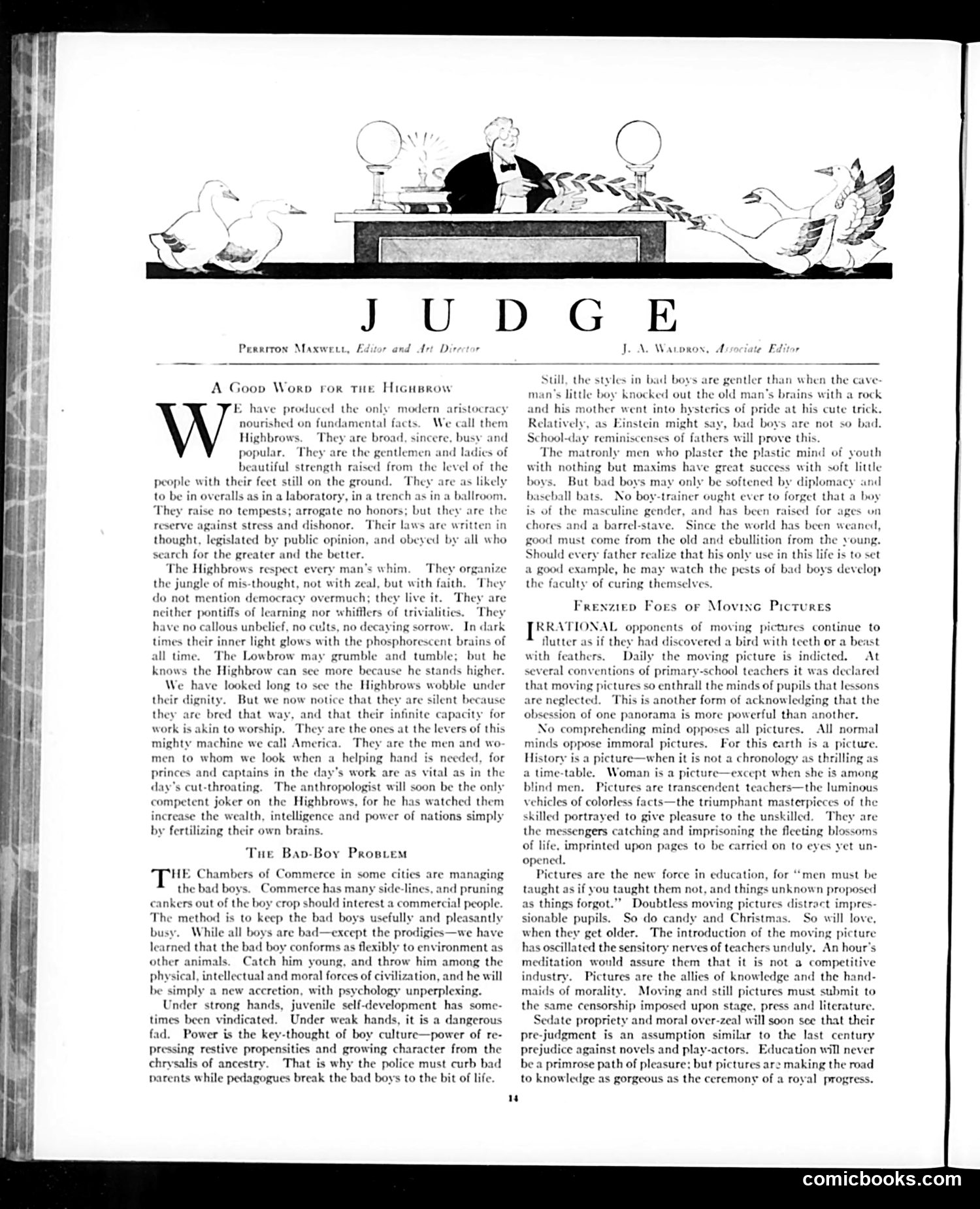
This page from *Judge* magazine presents editorial commentary rather than political cartoons. The header illustration shows a formal judge at a bench flanked by geese—a visual metaphor for judicial authority and, possibly, foolishness (geese being traditional symbols of silliness). The two main articles discuss: **"A Good Word for the Highbrow"**: Praises an intellectual aristocracy of accomplished people grounded in practical work—scientists, engineers, and business leaders who quietly drive society forward without pretension. They're contrasted with "lowbrows" who complain loudly. **"The Bad-Boy Problem"**: Addresses urban chambers of commerce attempting to reform troublemaking youth through structured activity and discipline. The author argues bad boys need firm guidance and physical labor (baseball, chores) rather than soft moral instruction alone, reflecting early 20th-century paternalistic attitudes about character development. Both articles reflect Progressive Era concerns: celebrating meritocratic competence over inherited status, while advocating strict behavioral discipline for working-class youth.
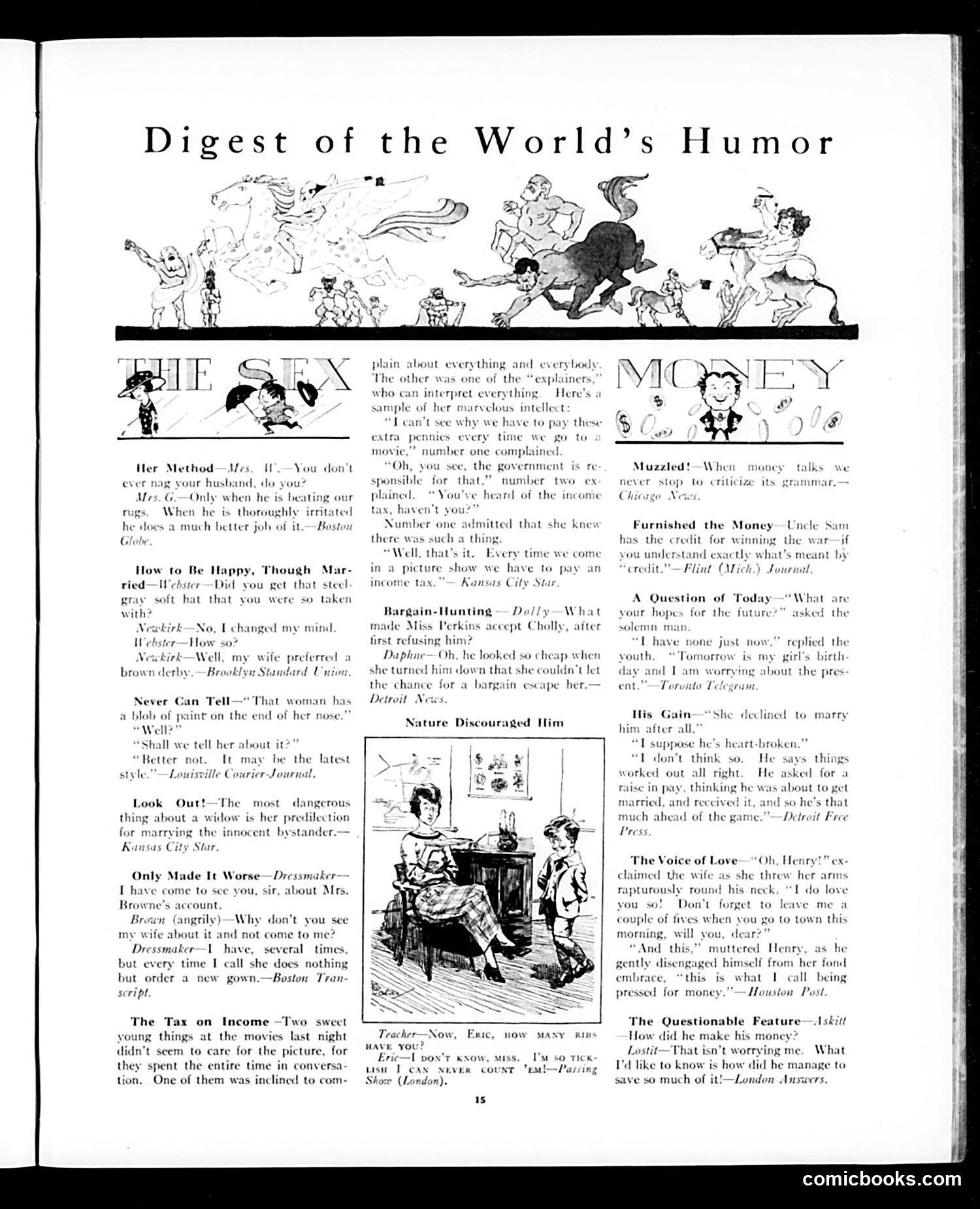
This page collects brief comedic anecdotes about marriage, money, and domestic life, typical of early-20th-century American humor magazines. **Key themes:** - **Marriage humor**: Wives nagging husbands, shopping obsessions, and financial disagreements dominate multiple jokes ("Her Method," "Only Made It Worse," "The Voice of Love") - **Income tax satire**: One lengthy piece mocks newly-implemented income tax (likely referencing the 1913 federal income tax) through two gossiping women at a movie, where one confidently but incorrectly "explains" tax policy, suggesting public confusion about the new law - **Class/materialism**: Several jokes address wealth anxiety ("His Gain," "The Questionable Feature"), questioning whether money-making ability or financial prudence matters more - **Gender stereotypes**: Women portrayed as spenders, complainers, and intellectually unreliable; men as practical but browbeaten The cartoons and text together present turn-of-the-century middle-class anxieties about marriage economics and new government financial policies through exaggerated domestic scenarios.
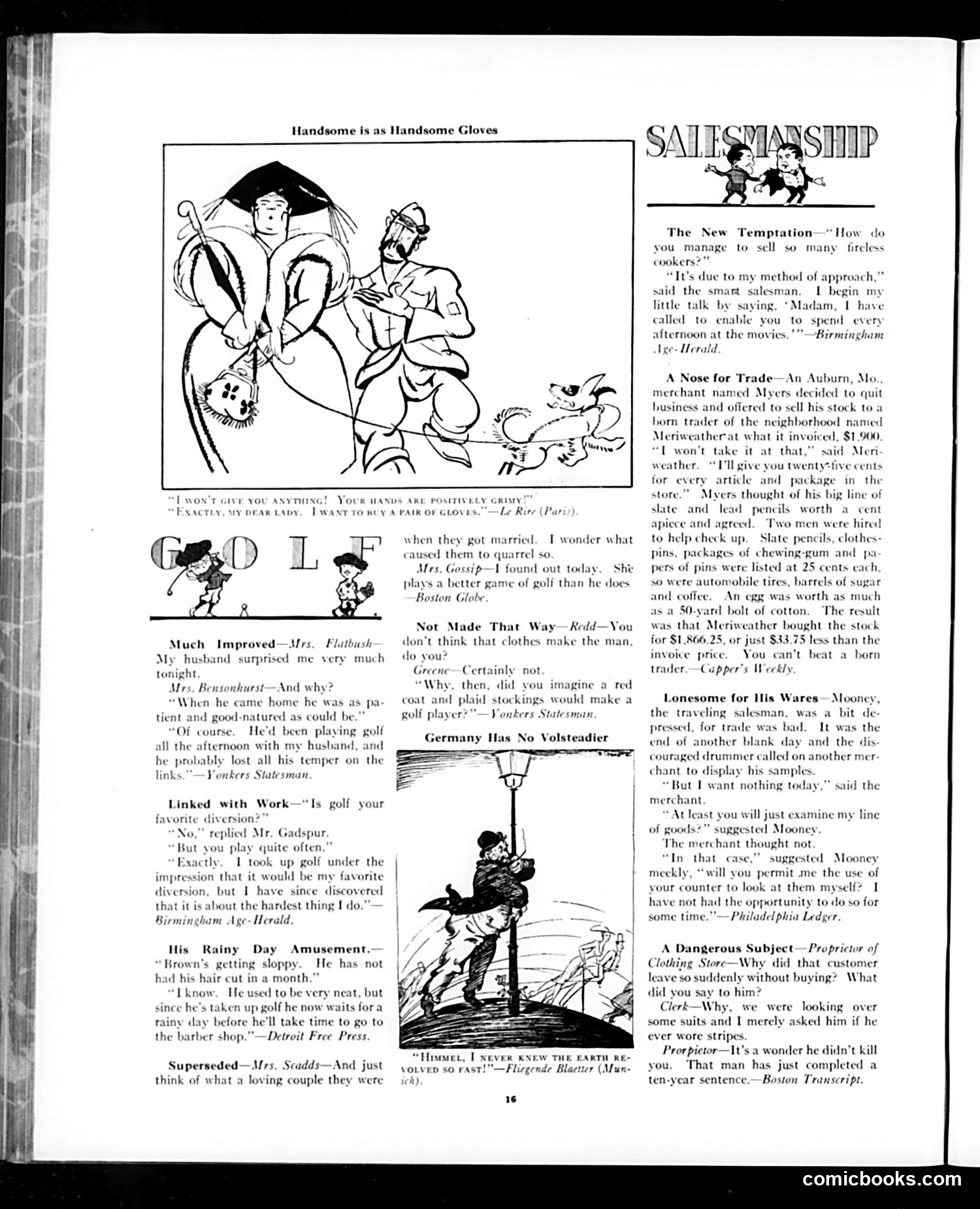
This page from Judge (a major American humor magazine) is a collection of short jokes and comic sketches centered on early 20th-century social topics, primarily **golf and sales/commerce**. **The main cartoon** (top left) depicts a salesman trying to sell gloves to a woman, with the caption about her hands being "positively grimy"—the joke being the salesman's tactless approach. **Recurring theme: Golf's cultural impact.** Multiple jokes mock how golf was consuming men's time and attention. One joke notes a husband became patient only after losing his temper playing golf with another man. Another describes a man delaying his haircut, waiting for rain to get time away from golf. **Sales/business humor** appears throughout: a "fireless cooker" salesman pitches by promising wives free afternoons at movies; a born trader negotiates a stock purchase down by meticulously pricing individual items. **The "Volsteadier" reference** (bottom) alludes to Prohibition-era enforcement (Volstead Act), with a German caption—likely comparing European versus American attitudes toward regulation. These sketches reflect 1920s anxieties: the new golf craze's social disruption, aggressive sales tactics, and consumer culture.
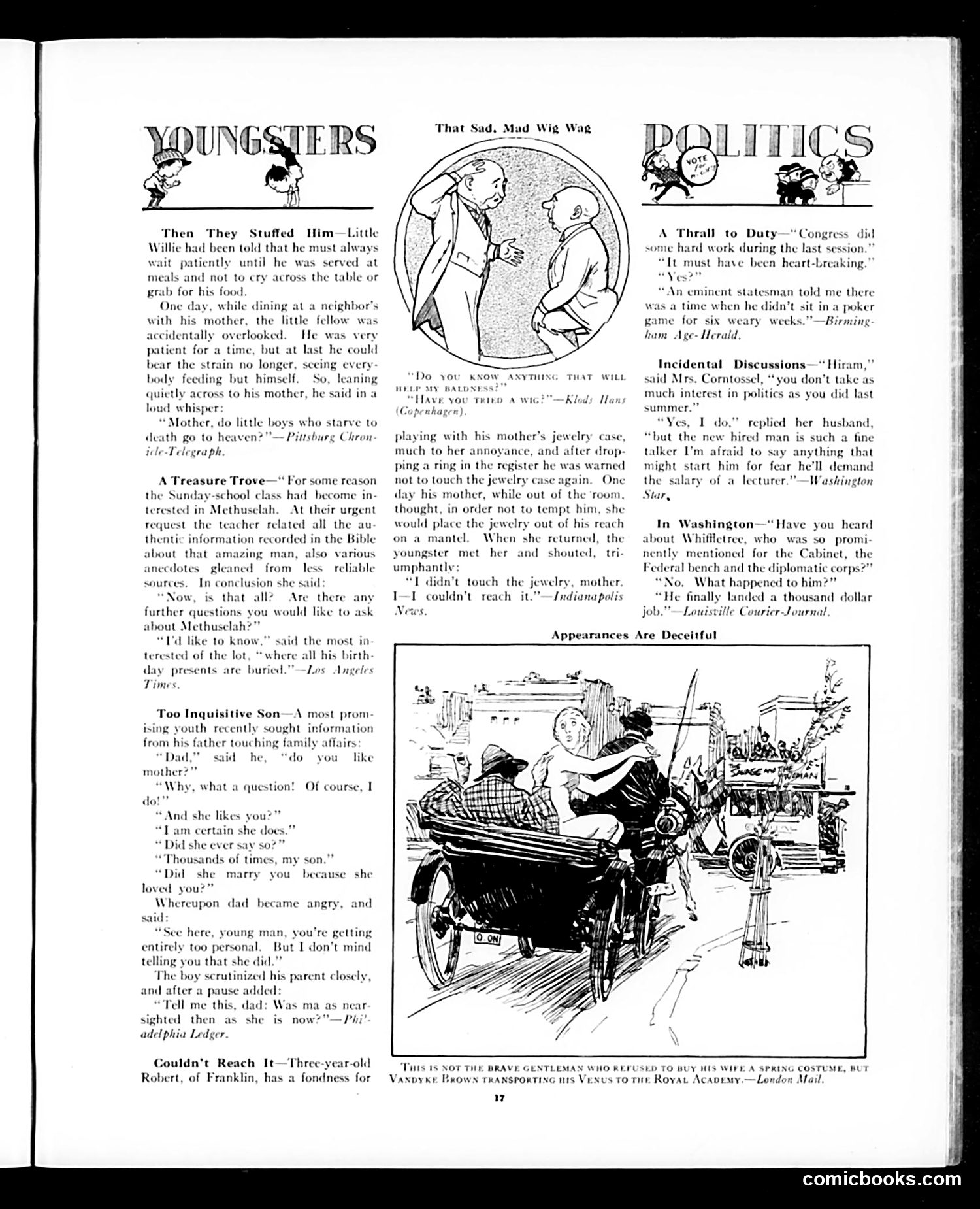
This page contains several short humorous anecdotes typical of early 20th-century American humor magazines, plus one political cartoon. **The cartoons/jokes** mock children's literal-minded logic and parental hypocrisy: - "Little Willie" asks if starving children go to heaven, satirizing parents' arbitrary dining rules - A boy questions his father's marriage motives with embarrassing directness - A three-year-old technically obeys orders (not touching jewelry) while circumventing their spirit **The political section** includes mild satire of Congress and Washington bureaucrats—mocking their work ethic and corruption (a congressman demanding higher salary after refusing Cabinet positions). **The main illustration** (captioned "Appearances Are Deceitful") shows a man in a motorcar with a woman, sarcastically contrasting him with "brave gentlemen" who refuse buying their wives spring clothing—likely satirizing male vanity and spending habits. The humor throughout relies on revealing hypocrisy and foolishness in everyday life rather than specific political figures or events.
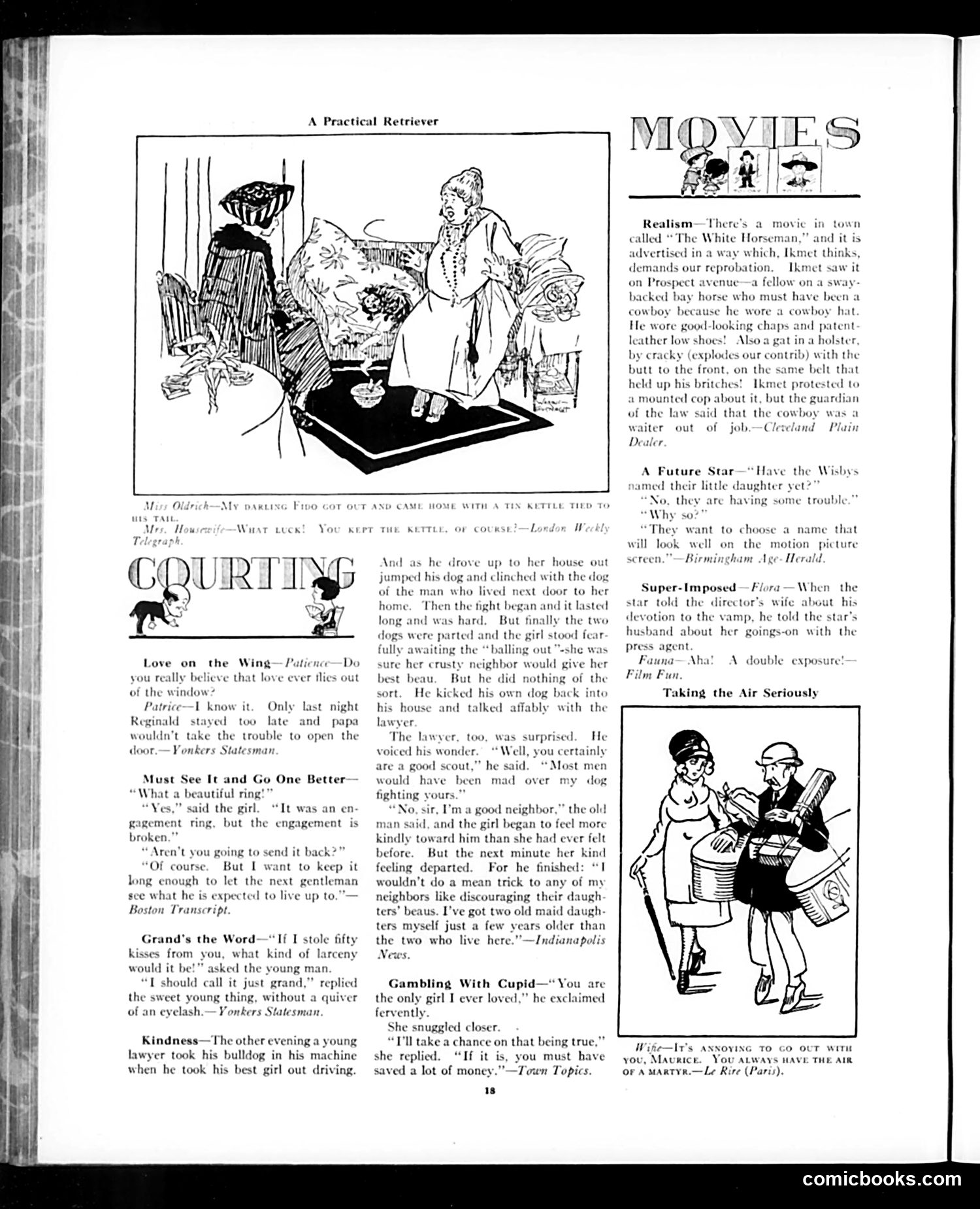
This page contains brief humorous anecdotes and cartoon commentary typical of early 20th-century satirical magazines. The content includes: **Main cartoon ("A Practical Retriever"):** Illustrates a domestic scene where a woman has retrieved a tin kettle her dog brought home, with the caption playing on the double meaning of "retriever" (the dog breed vs. retrieving objects). **Short jokes and observations** cover romantic/social themes: a woman keeping a broken engagement ring to set standards for future suitors; a young lawyer whose bulldog fights the neighbor's dog, only to have the neighbor reveal selfish motives (discouraging his daughters' beaus); a woman testing her boyfriend's claim of exclusive love by noting he must have saved money. **Film and entertainment commentary** mock contemporary movies ("The White Horseman") and Hollywood's absurdities—stars' devotion to "vamps," naming babies for screen appeal, and double-exposure effects. The "Taking the Air Seriously" cartoon (lower right) shows a couple, with a wife complaining her husband always acts martyr-like during outings. The humor relies on social observation about courtship, vanity, and emerging cinema culture.
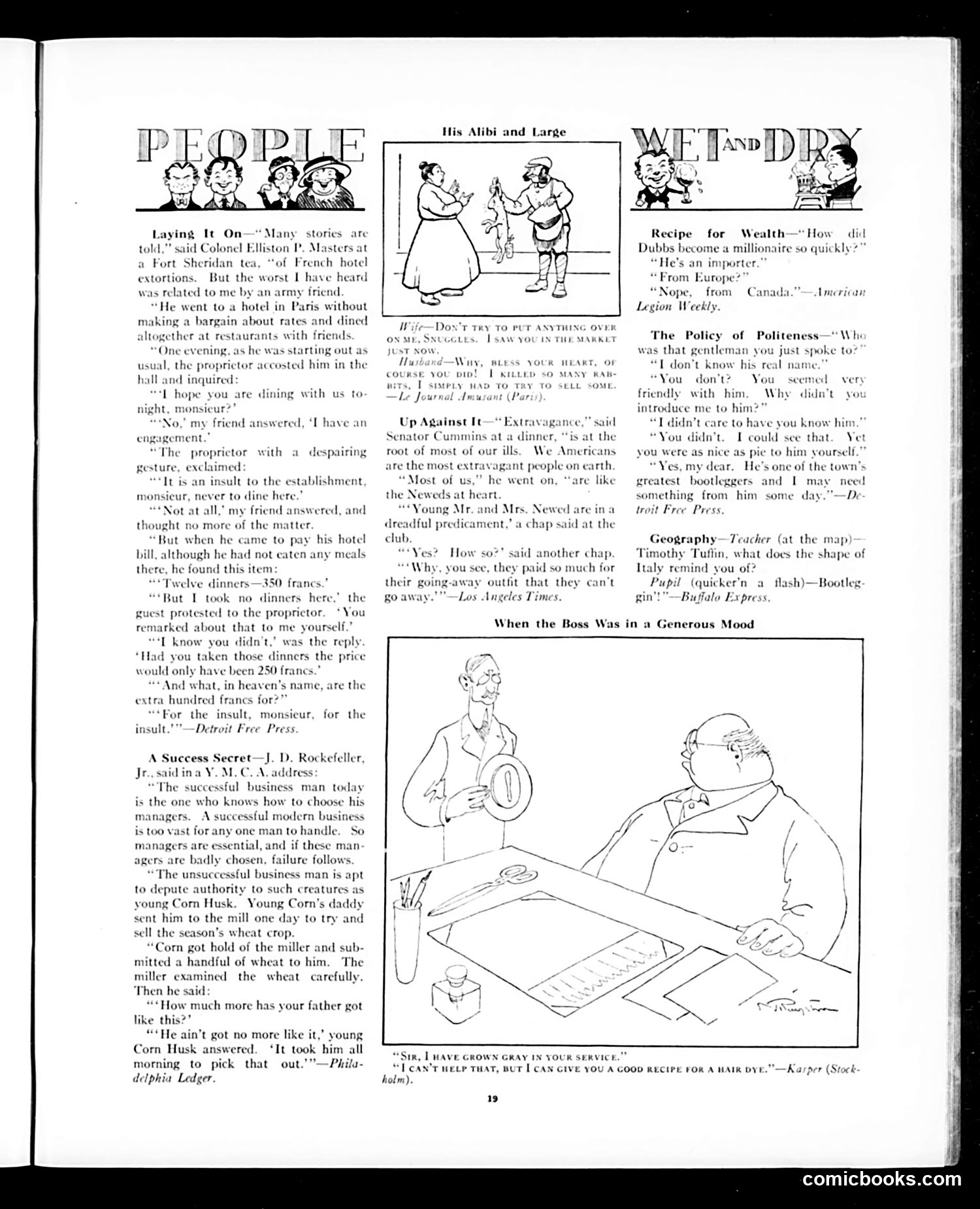
This page contains several short humorous pieces satirizing American social absurdities circa the 1920s-30s: **"Laying It On"**: Mocks French hotel proprietors' extortion tactics. An American soldier is charged for twelve dinners he never ate—the proprietor justifies the 350-franc bill as compensation for the "insult" of the guest's refusal to dine there (versus 250 francs had he actually dined). **"A Success Secret"**: J.D. Rockefeller Jr. advises choosing competent managers. The joke: a farmer sends his incompetent son to sell wheat; the miller examines one handful and learns it took the boy all morning to gather—implying hopeless inefficiency. **"When the Boss Was in a Generous Mood"**: A long-serving employee complains about gray hair from service; the boss offers a hair dye recipe instead of a raise—darkly comedic indifference to worker loyalty. Other pieces satirize American extravagance, bootlegging (Prohibition-era reference), and social hypocrisy. The humor targets both foreign swindlers and American foolishness.
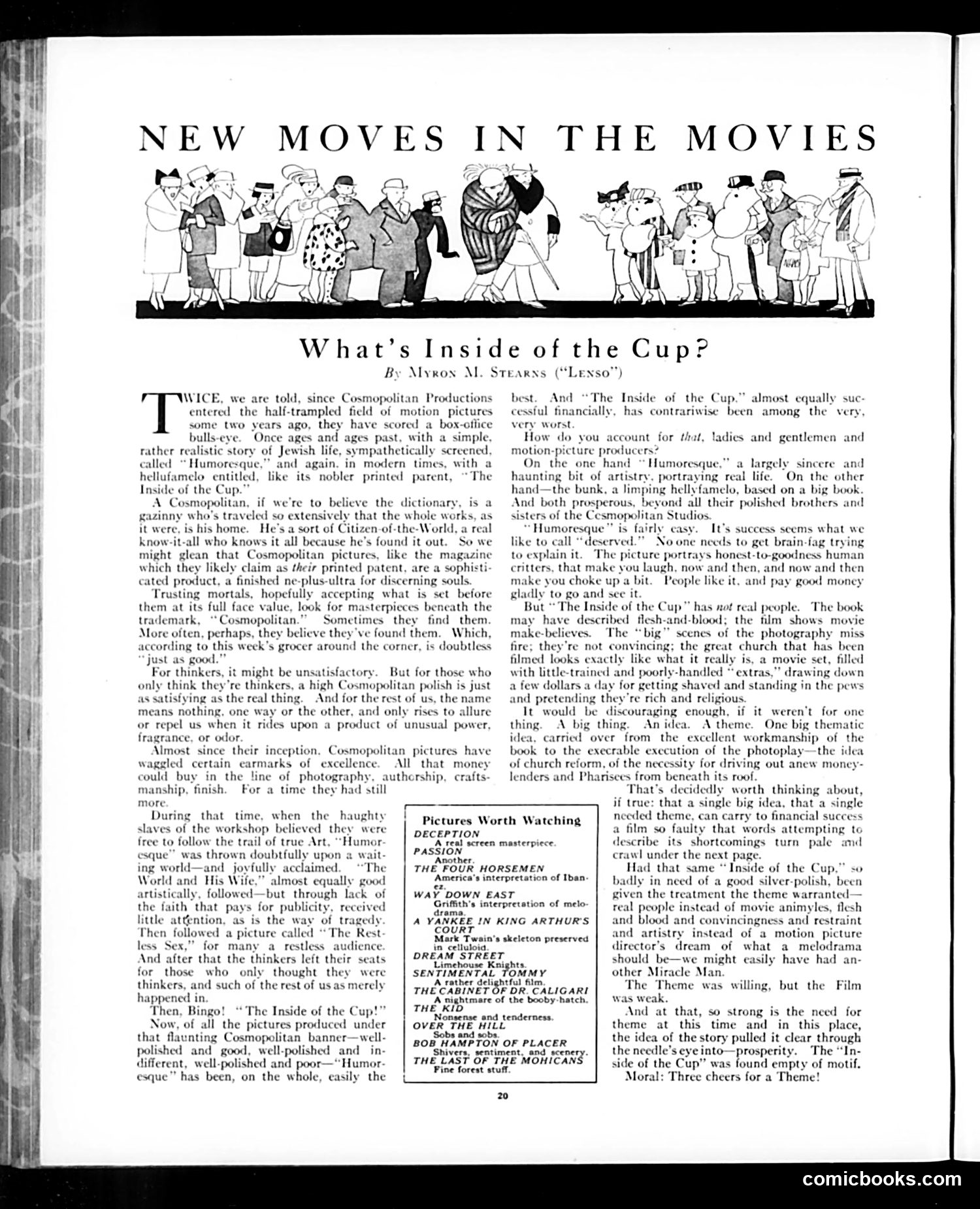
This page reviews Cosmopolitan Productions' film adaptation of "The Inside of the Cup," criticizing it as a case study in cinematic failure despite financial success. **The Satire:** The critic contrasts this film unfavorably with Cosmopolitan's earlier hit "Humoresque"—genuine, sincere, depicting real people and earning success deservedly. By contrast, "The Inside of the Cup" is dismissed as artificial: unconvincing church scenes (literally a movie set), poorly-trained extras pretending to be wealthy parishioners, and lifeless performances. **The Central Point:** Despite the film's shortcomings, one element redeems it—the thematic idea of church reform and moral cleansing (driving "money-lenders and Pharisees" from the church). The critic argues this single compelling idea, inherited from the source novel, carries the otherwise-bungled film to financial success, suggesting audiences respond to meaningful themes regardless of execution quality. This is film criticism satirizing both the studio's pretensions and audience taste.
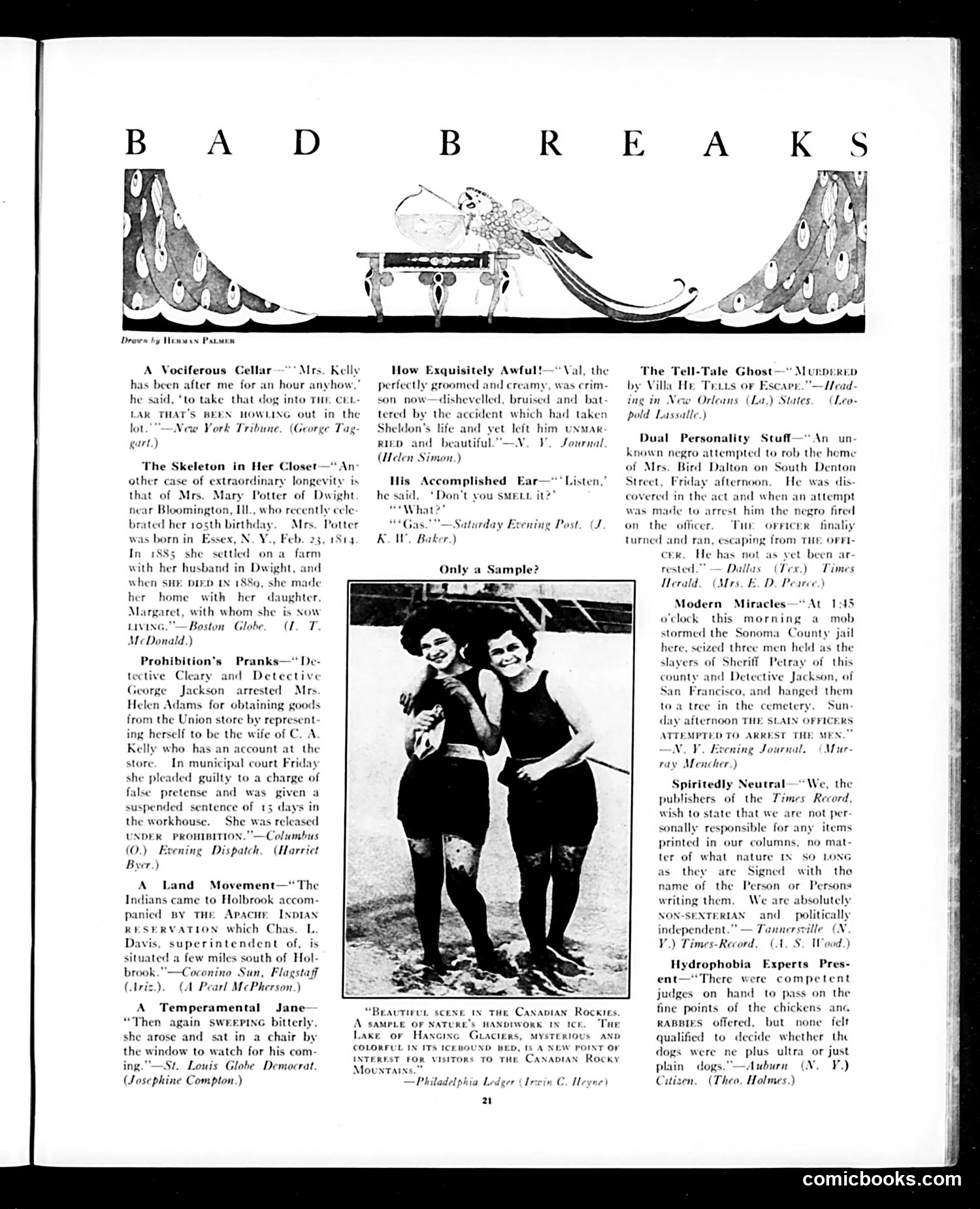
This page from *Judge* magazine collects humorous newspaper excerpts, the format's signature feature. The humor derives from **unintentional absurdities** created by poor editing or ambiguous phrasing in original publications. Key examples: **The central photograph** shows two women in the Canadian Rockies. The caption's poor wording makes it sound like nature itself is "colorful in its icebound bed"—confusing rather than descriptive. **"Modern Miracles"** is the page's best satire: a mob lynches three men, but the final sentence—likely accidentally—states "THE SLAIN OFFICERS ATTEMPTED TO ARREST THE MEN," reversing cause and effect absurdly. **"Spiritedly Neutral"** mocks a newspaper's attempted disclaimer about published letters, written so awkwardly it seems intentionally evasive about responsibility. The recurring joke: newspapers' careless prose creates unintended meanings. *Judge* presents these "bad breaks" (errors) as evidence of editorial incompetence, allowing readers to laugh at other publications' mistakes while feeling superior.
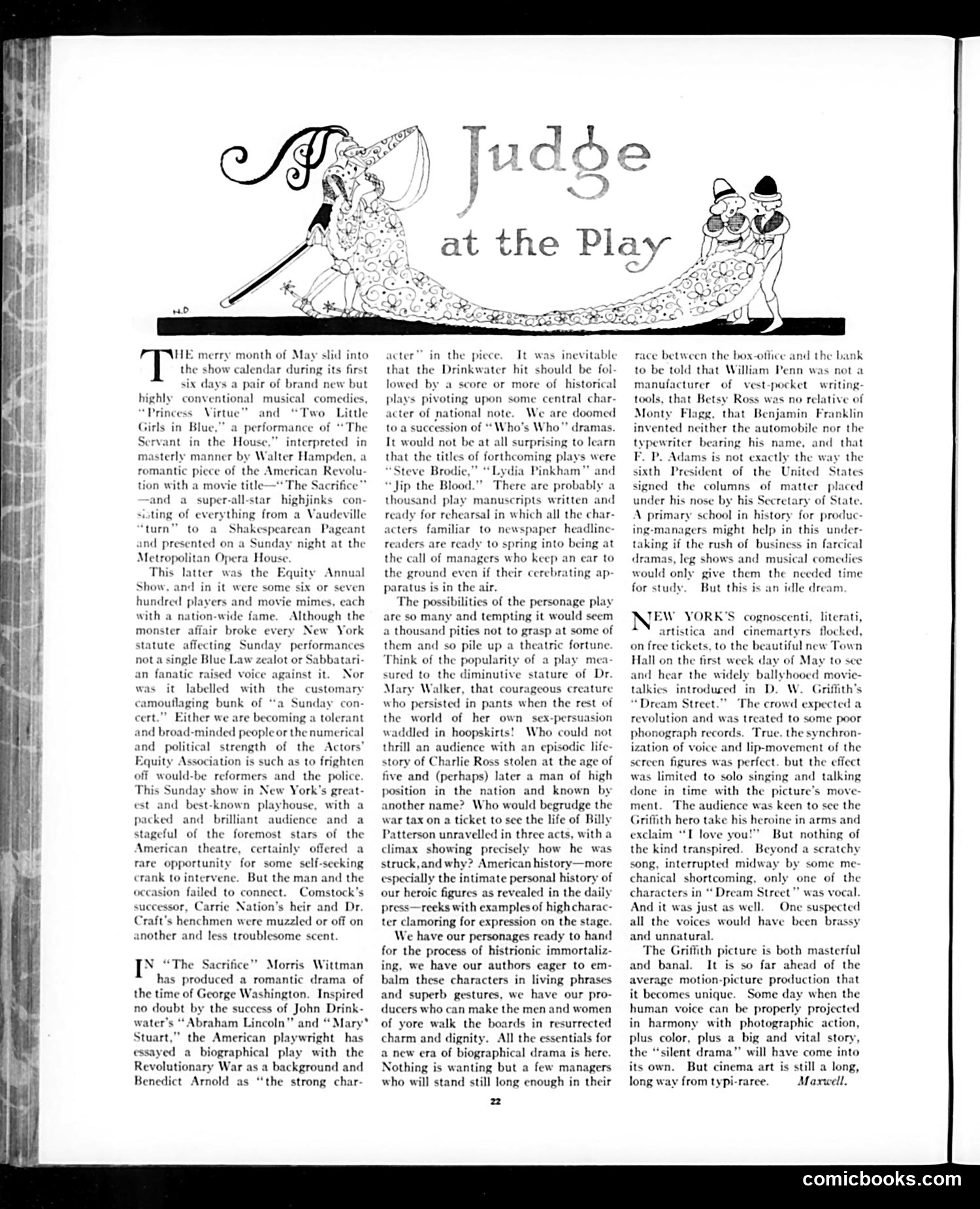
This page critiques the proliferation of biographical plays following John Drinkwater's successes with "Abraham Lincoln" and "Mary Stuart." The author satirizes how playwrights are rushing to dramatize famous historical and contemporary figures—suggesting absurd examples like "Steve Brodie" and "Lydia Pinkham." The specific target is Morris Wittman's "The Sacrifice," a Revolutionary War drama centering on Benedict Arnold. The critic mocks the trend as derivative and opportunistic, arguing that American history—particularly obscure personal details of minor celebrities—provides endless material for mediocre playwrights seeking quick theatrical fortune. The cartoon header depicts a judge figure surveying theatrical productions, reinforcing Judge magazine's role as arbiter of cultural taste. The satire reflects early 1920s concerns about commercialized theater prioritizing celebrity subjects over artistic merit.
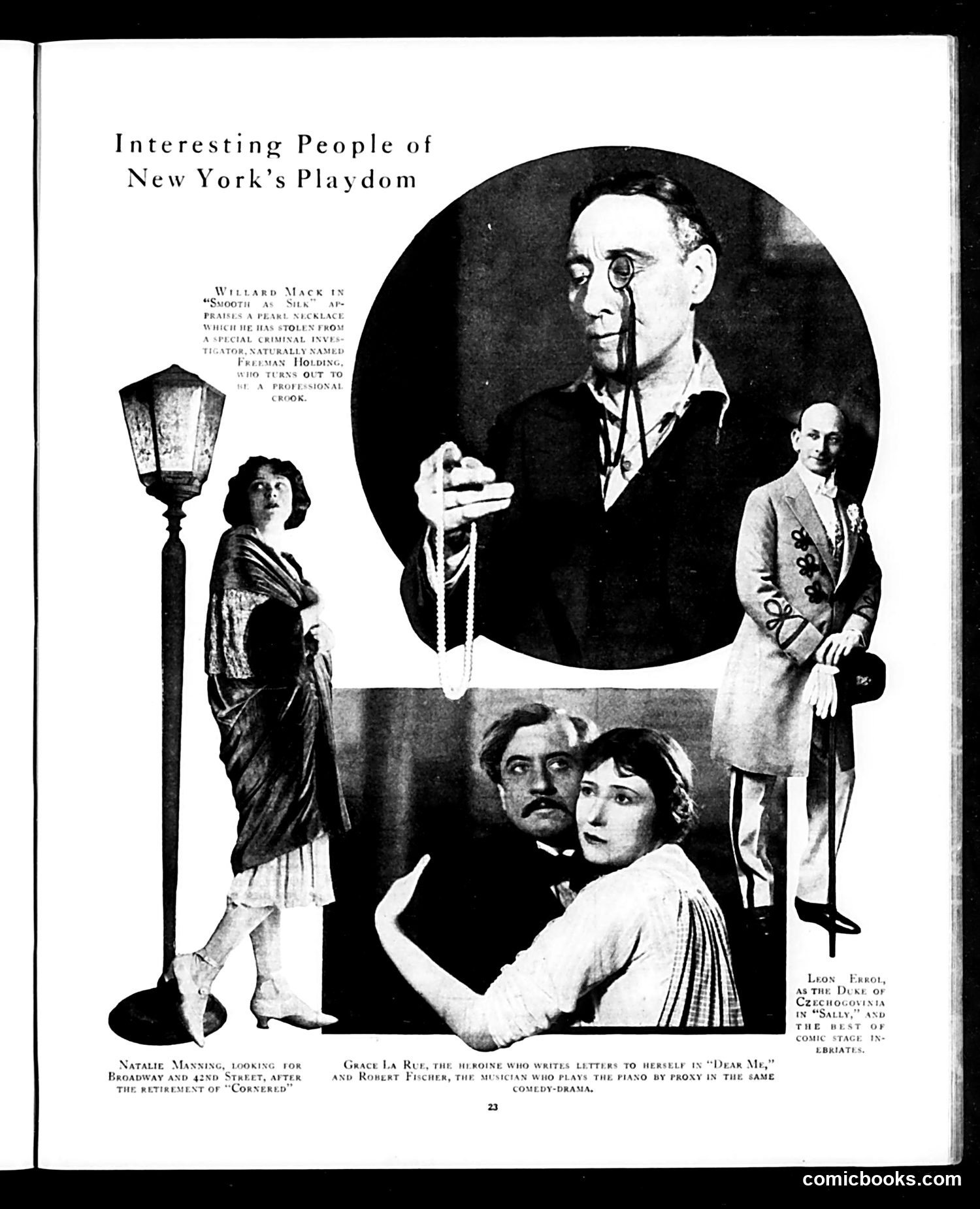
This page showcases theatrical personalities from contemporary Broadway productions, presented as a feature about "interesting people" in New York's theater scene. **The figures identified are:** - **Willard Mack** in "Smooth as Silk," praised for a stolen pearl necklace in a plot involving a criminal investigator named Freeman Horning who turns out to be a professional crook - **Natalie Manning**, searching for Broadway and 42nd Street after retirement from "Cornered" - **Grace La Rue** (heroine of "Sally"), who writes letters to herself titled "Dear Me" - **Robert Fischer** (musician), who plays piano by proxy in the same production - **Leon Errol** as the Duke of Czarnocossia in "Sally" The satire appears gentle—mocking theatrical conventions like contrived plots (the fake criminal investigator), meta-theatrical absurdities (an actress playing a character who writes to herself), and the artificiality of stage musicals. The "by proxy" piano-playing joke suggests technical shortcuts in live theater productions of the era.
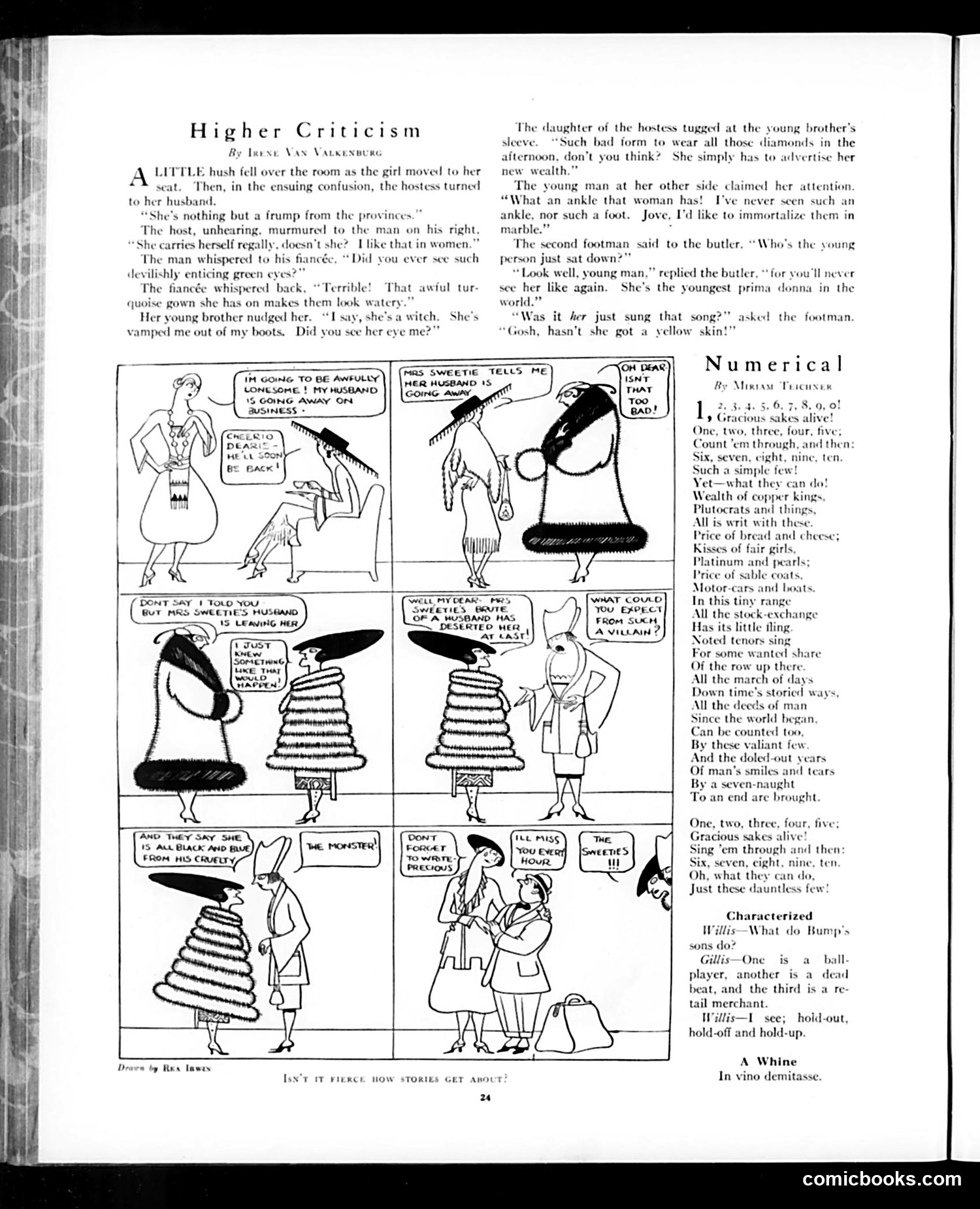
This multi-panel comic satirizes social pretension and gossip among the wealthy. A young woman enters a gathering, and each observer judges her differently based on their own values: the host sees provincial rudeness, another man admires her "regally" carried posture, a suitor fixates on her ankle, a servant notes her status as "youngest prima donna in the world." The joke targets how the same person generates wildly contradictory assessments depending on the observer's perspective and social position. The title "Higher Criticism" refers to the scholarly method of analyzing texts from multiple viewpoints—here applied mockingly to trivial social observations. The comic ultimately suggests that wealthy society engages in baseless, self-serving commentary, with each person projecting their own concerns (morality, aesthetics, status-seeking) onto an innocent newcomer. It's satire of upper-class superficiality and the unreliability of social gossip.
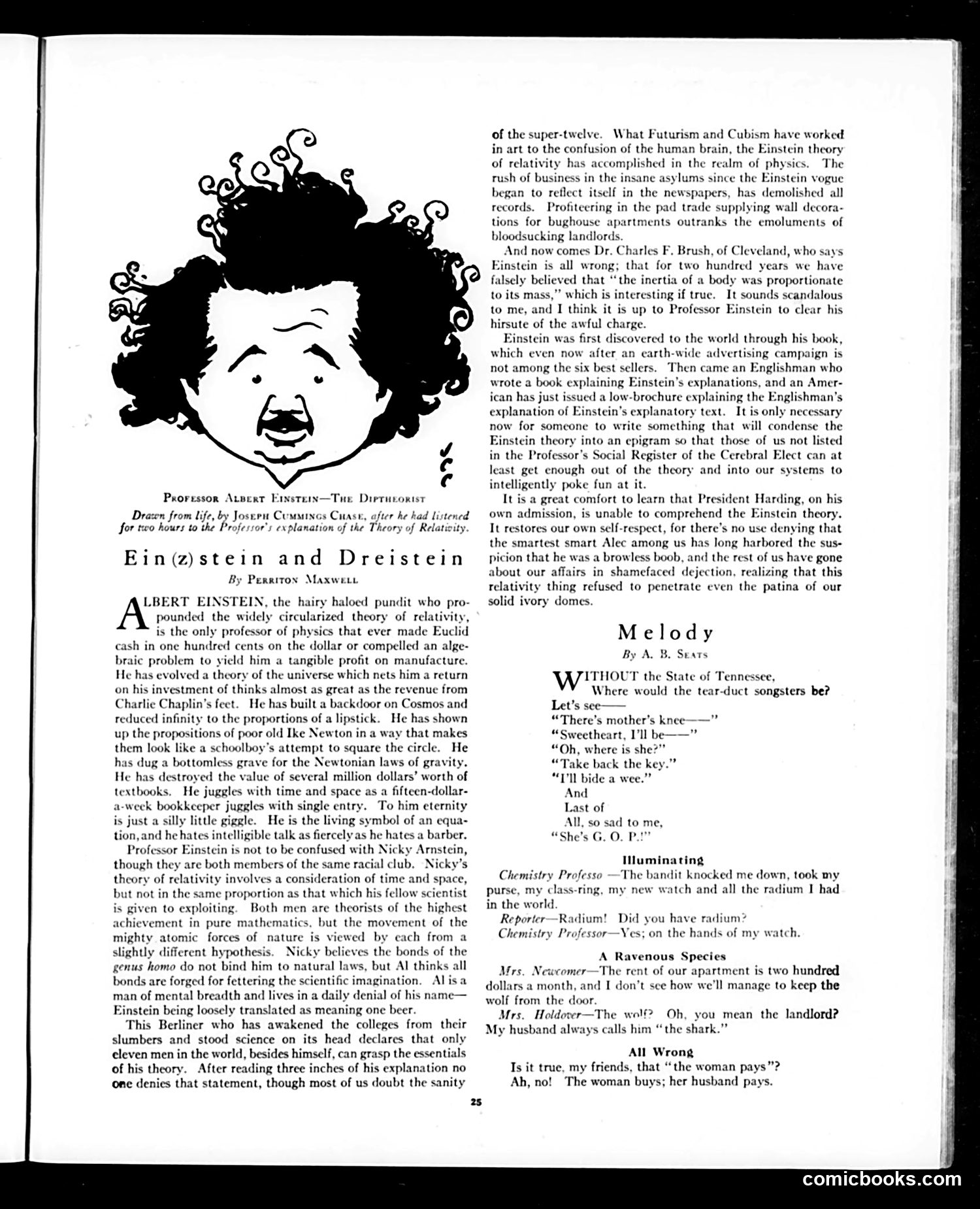
This page satirizes **Albert Einstein** and his theory of relativity, which had recently become a cultural phenomenon in America. The caricature shows Einstein with his characteristic wild hair. The satire's core joke: Einstein's theories are so incomprehensibly complex that they've driven people insane. The article mockingly suggests only 12 people worldwide understand relativity, and claims the "insane asylums" have seen record business since Einstein's ideas circulated in newspapers. The text compares Einstein to **Nicky Arnstein** (a real criminal), joking both share "relativity" theories but Arnstein's involves evading natural laws (crime) while Einstein's involves actual physics—a crude pun equating them as con artists of sorts. The humor hinges on intellectual elitism: Einstein's work is presented as so abstract and impenetrable that it's essentially useless to ordinary people, yet he's profiting enormously from it. This reflects 1920s American skepticism toward complex modernist ideas and scientists who became celebrities.
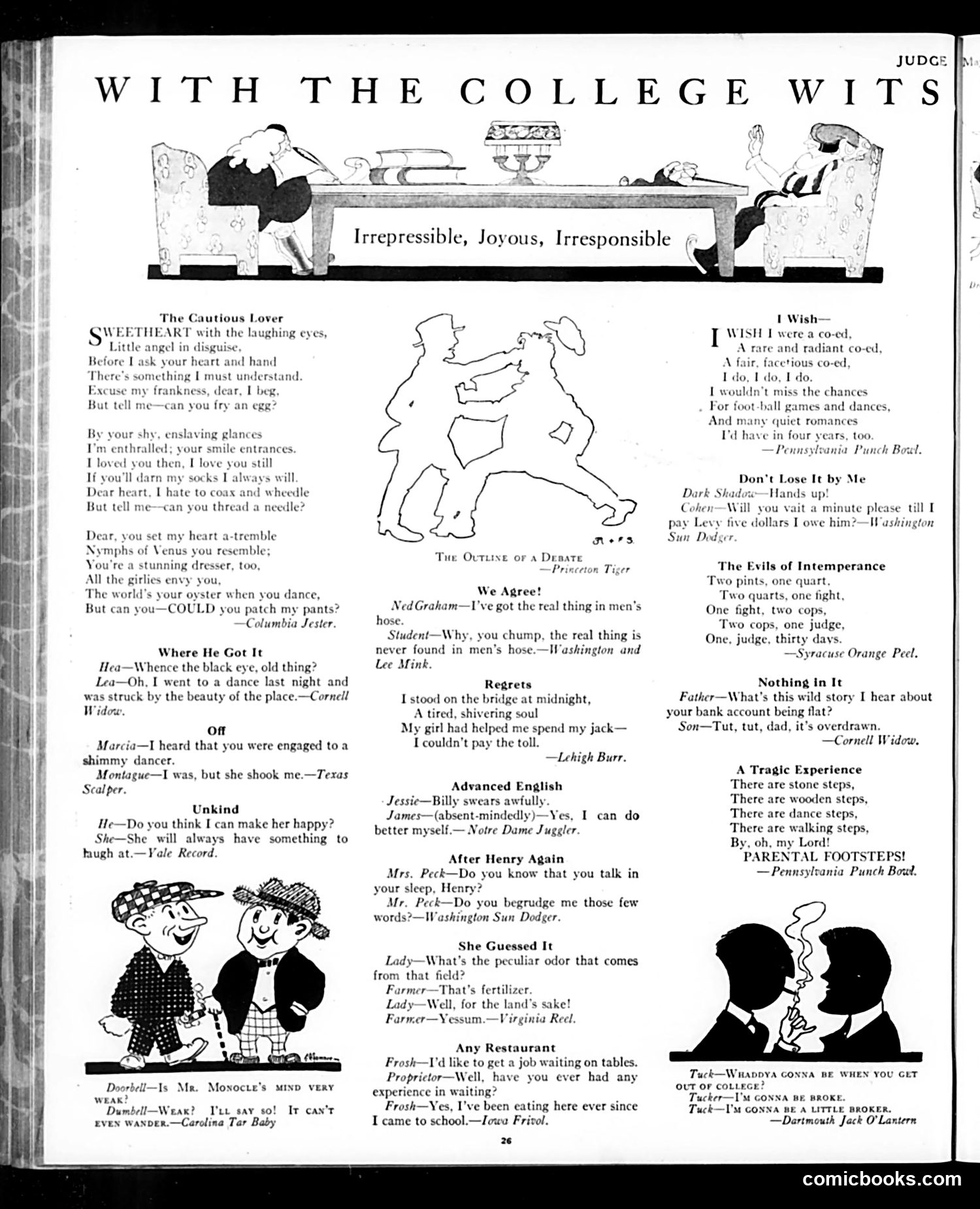
This page collects brief humorous quips from college newspapers, organized around student life themes. The content reflects early 20th-century college culture: **Key themes:** - **Domestic expectations**: "The Cautious Lover" satirizes suitors who profess romantic devotion while interrogating women about practical household skills (frying eggs, darning socks, patching pants)—mocking the contradiction between romantic rhetoric and utilitarian expectations of wives. - **Student stereotypes**: Jokes target freshmen naïveté, absent-minded scholars, and poor financial management. - **Social observations**: References to "shimmy dancers," dance hall culture, and casual profanity reflect 1920s urban social anxieties. - **Prohibition-era commentary**: "The Evils of Intemperance" sardonically traces consequences: pints→fights→police→judges→jail time. The cartoons appear generic period illustrations. The humor relies on wordplay, puns, and gentle mockery of collegiate types rather than political satire. This represents mainstream entertainment for educated readers during the Jazz Age.
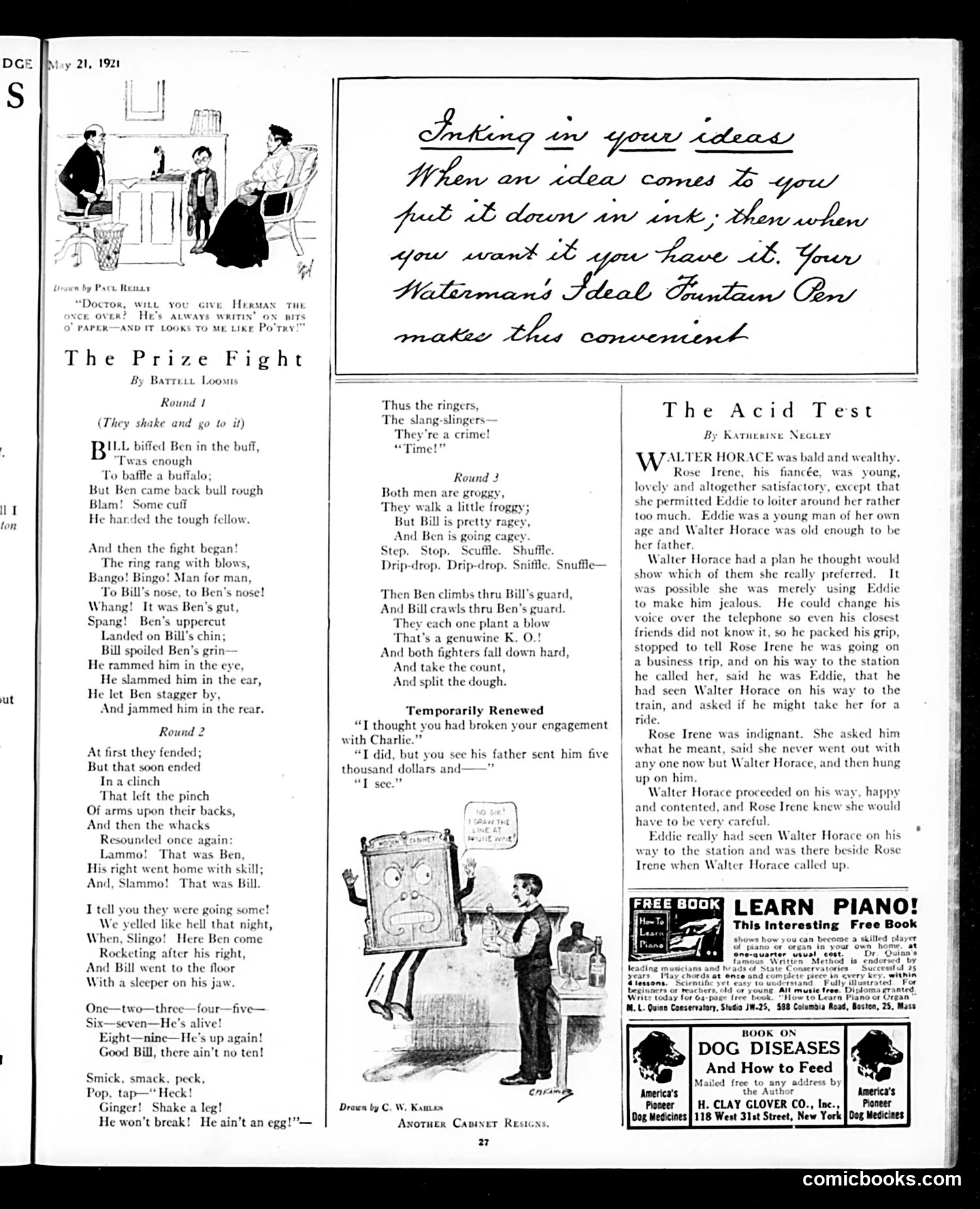
This page contains three distinct pieces: **"The Prize Fight"** (left): A humorous boxing poem by Barrett Loomis depicting a bare-knuckle fight between "Ben" and "Bill" with exaggerated sound effects ("Bango! Bingo! Spang! Smack!"). The joke appears to be the absurdity of the fight itself—both men end up knocked down simultaneously and "split the dough," suggesting the whole thing was staged or rigged for gambling purposes. This likely satirizes the era's popular boxing matches and their dubious legitimacy. **"The Acid Test"** (right): A short story by Katherine Necley about wealthy older Walter Horace testing his young fiancée Rose Irene's loyalty by impersonating her younger suitor Eddie over the phone. When she refuses Eddie's invitation, Walter feels assured of her faithfulness. The satire targets wealthy older men's insecurities about younger rivals and their need to "test" their fiancées' devotion. The page also includes period advertisements for piano lessons and dog medicine.
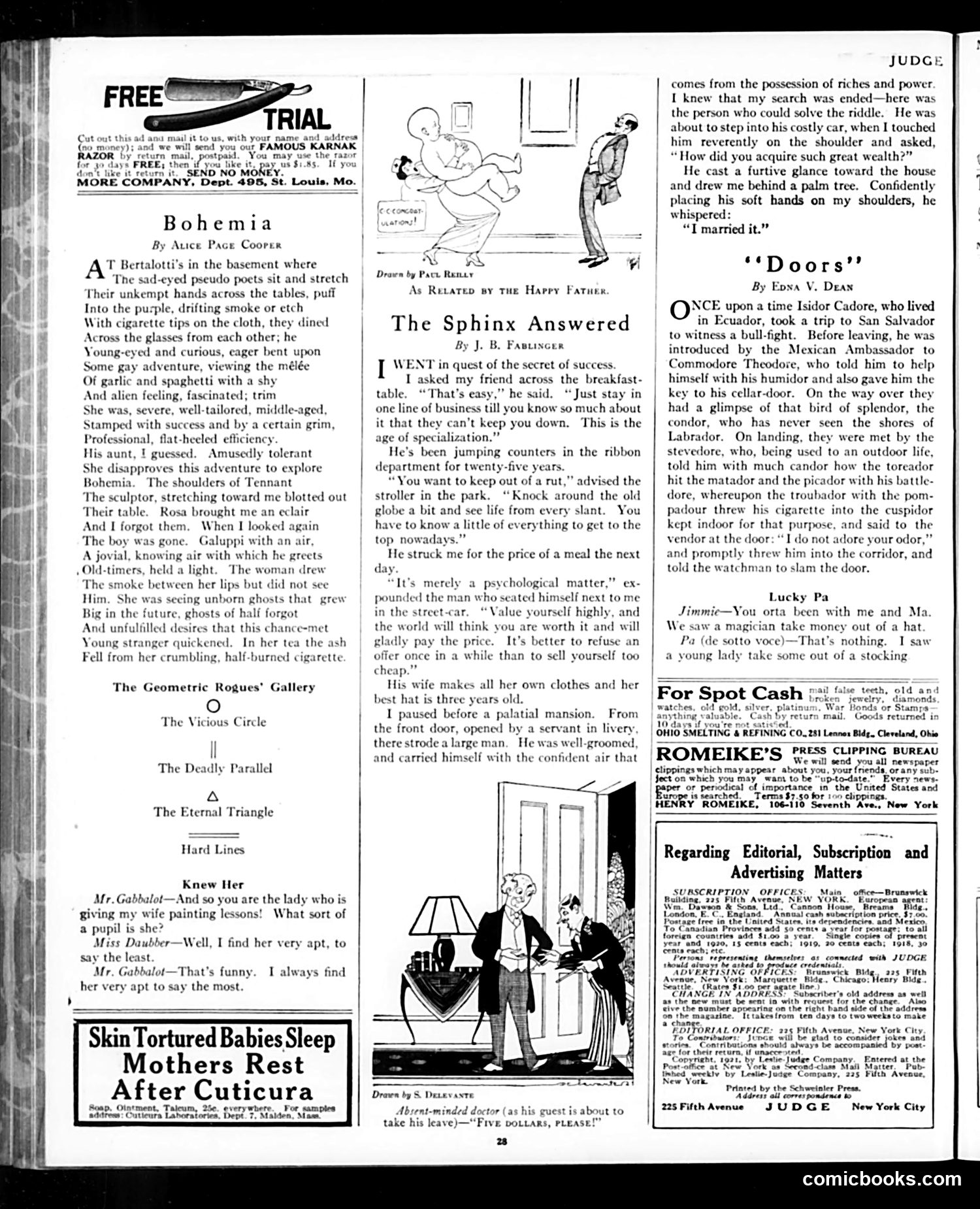
This page contains several distinct pieces satirizing early 20th-century American life: **"Bohemia"** depicts a young man visiting a bohemian café, observing an older, professionally-dressed woman (apparently his aunt) whose attention he briefly captures. The poem explores themes of unfulfilled desire and the romanticization of bohemian life. **"The Sphinx Answered"** satirizes conflicting advice about achieving success. The narrator consults various people who offer contradictory wisdom—specialization, travel, self-confidence, etc.—yet each gives examples undermining their own advice (the ribbon clerk still poor, the traveler begging for meals, the businessman's wife economizing). **"Doors"** tells of a man seeking a key to success from a wealthy doctor, only to be asked for payment—satirizing that wealth doesn't necessarily come from wisdom. The page also includes light social humor ("Knew Her") and period advertisements for razors and Cuticura skincare products. The cartoons mock pretension, false expertise, and the pursuit of easy answers to success.
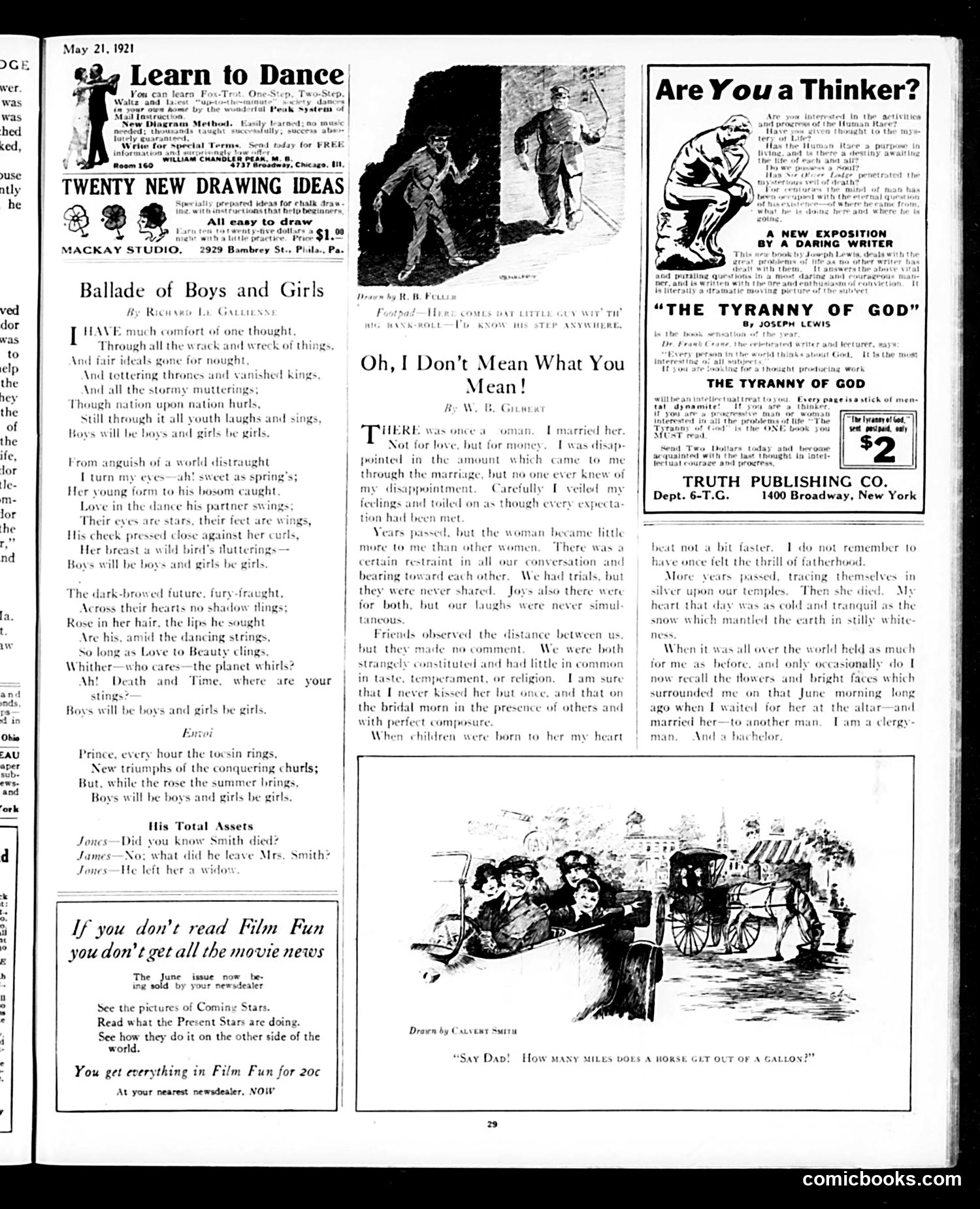
This page contains primarily **literary and advertising content** rather than political satire. The main story, "Oh, I Don't Mean What You Mean!" by W.O. Groves, is a melodramatic narrative about a loveless marriage—a man marries a woman without passion, endures years of emotional distance, and reflects with detachment on her death and their children. It's sentimental fiction typical of early-twentieth-century magazines. The page includes poetry ("Ballade of Boys and Girls"), dance instruction ads, and book advertisements. A small cartoon at the bottom shows children asking their father an innocent question about horse efficiency—a mild domestic humor joke. The "Are You a Thinker?" box advertises Joseph Lewis's book "The Tyranny of God," promoting it to readers interested in philosophy and religious critique. This appears to be a general-interest magazine page mixing entertainment, advice, and advertising—not primarily satirical or political in nature.
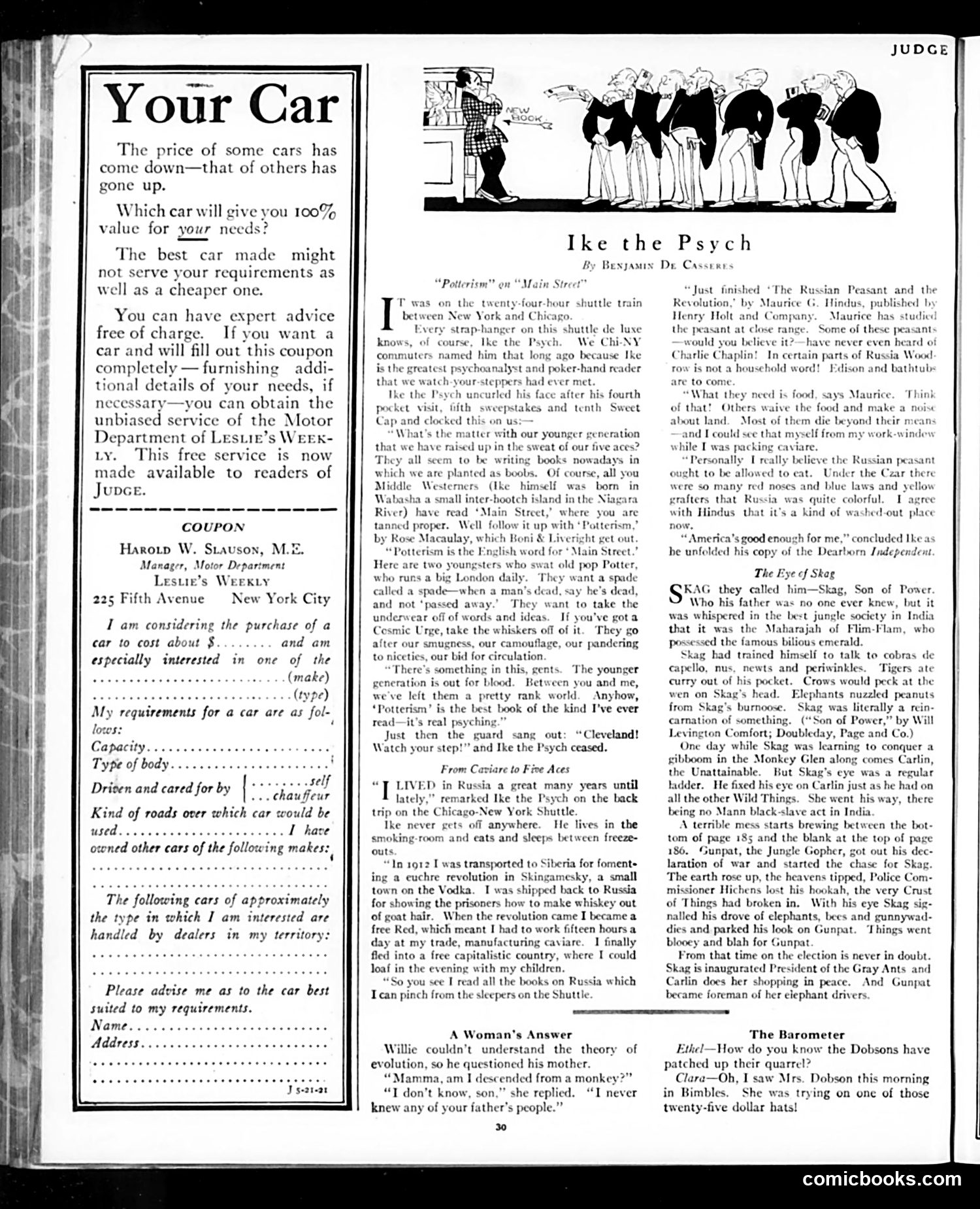
This page from Judge magazine contains several distinct elements: **Left side:** An advertisement/coupon for Leslie's Weekly's Motor Department, offering free expert advice on car purchasing to readers—reflecting early 1920s consumer culture and the growing automobile industry. **Main content:** Two satirical stories featuring "Ike the Psych," a character appearing to be a worldly, cynical commuter on the New York-Chicago shuttle train. In the first story, Ike comments on younger generation authors (likely referencing Sinclair Lewis's *Main Street* and Rose Macaulay's *Potterism*) who critique American smugness and sentimentality in literature. He sees merit in their debunking of euphemistic language and social pretense. The second story has Ike recounting his Russian experiences—fleeing Siberian exile, surviving revolution, and eventually immigrating to America for capitalist leisure—a satirical commentary on post-Revolutionary Russian upheaval and immigrant assimilation. The humor relies on Ike's sardonic worldliness contrasting with 1920s American earnestness.
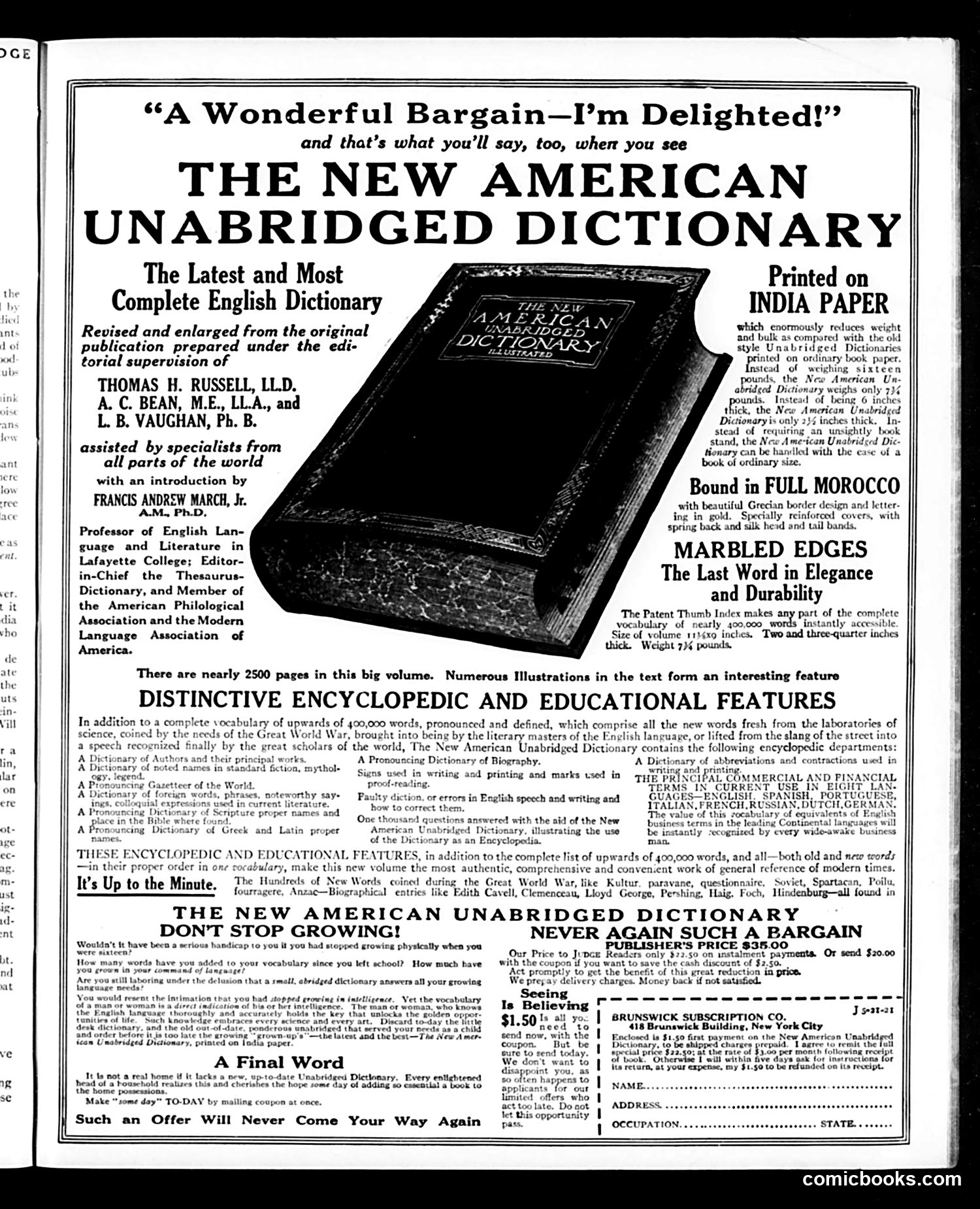
This page is primarily a **full-page dictionary advertisement** rather than satirical content. It promotes "The New American Unabridged Dictionary," emphasizing its modern features and value. The ad highlights practical innovations: the dictionary uses lightweight India paper (reducing weight from 16 to 7½ pounds) and is more compact than traditional editions, making it easier to handle. It's bound in morocco leather with marbled edges—marketed as elegant and durable. The "Don't Stop Growing!" section uses motivational language comparing vocabulary expansion to physical growth, suggesting that continuing education through dictionaries is essential for adult intelligence. Most notably, the ad includes **new words from World War I** (Spartacan, paravane, questionnaire, Poilu), reflecting how dictionaries captured contemporary language. The "Final Word" section urges immediate purchase, warning "Such an Offer Will Never Come Your Way Again"—typical high-pressure advertising rhetoric. The publisher's price is $35.00; Judge readers get it for $22.50. This reflects early 20th-century advertising conventions and Americans' faith in encyclopedic knowledge as a marker of sophistication.
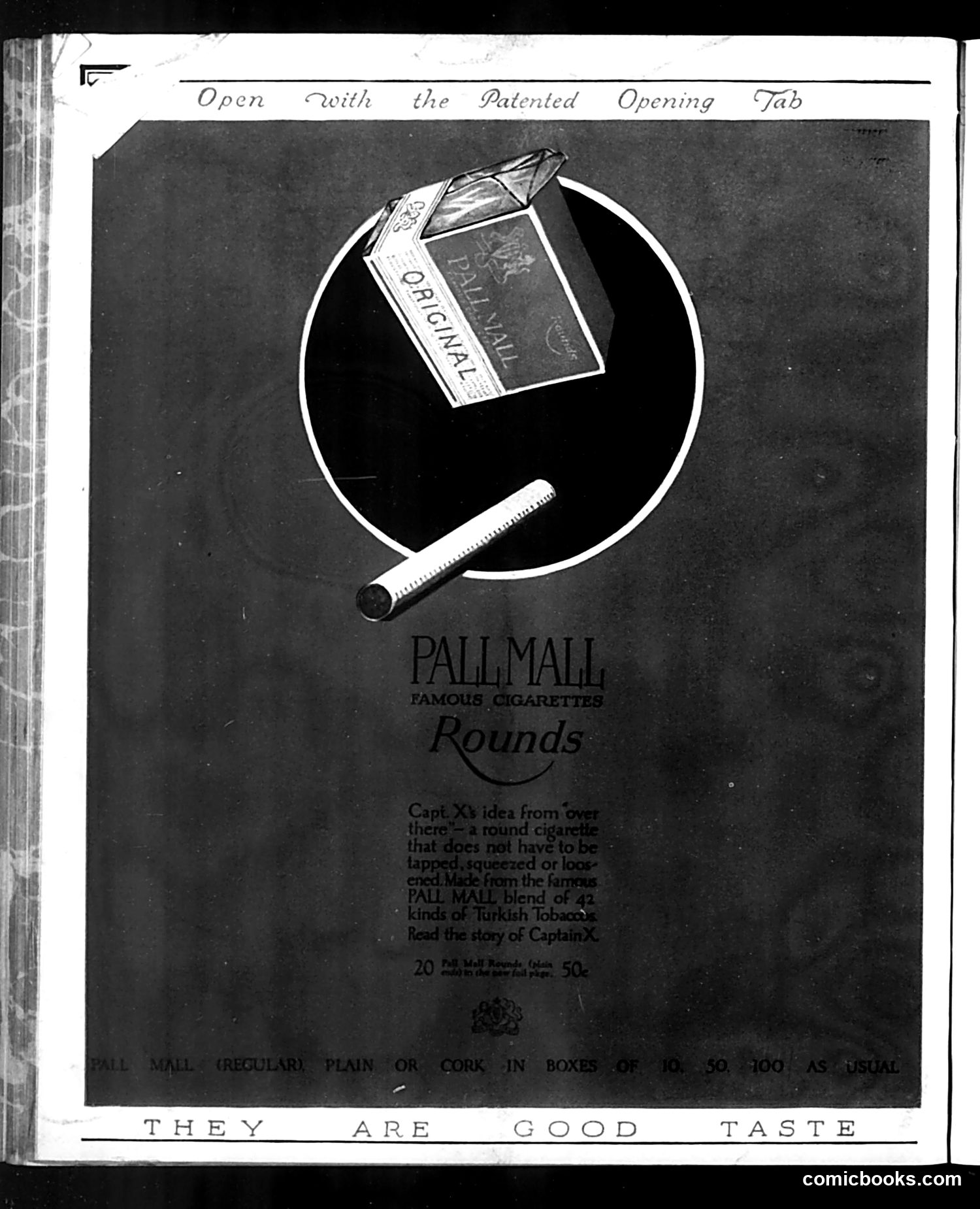
This is a **cigarette advertisement**, not a political cartoon. It advertises Pall Mall "Famous Cigarettes Rounds," emphasizing a patented opening tab for easy access to the product. The ad references "Captain X" and promises a story about this figure, likely a marketing gimmick to encourage product purchase or brand loyalty. The copy mentions the cigarettes are "made from the famous PALL MALL blend of 42 kinds of Turkish tobacco." The tagline "They Are Good Taste" is a straightforward sales claim. The circular design and round cigarette shape reinforce the "Rounds" product name. This appears to be early-to-mid 20th century advertising, when cigarette promotion in magazines was routine and unregulated.