
Judge, 1921-05-21 · page 20 of 32
Judge — May 21, 1921 — page 20: what you’re looking at
What you’re looking at
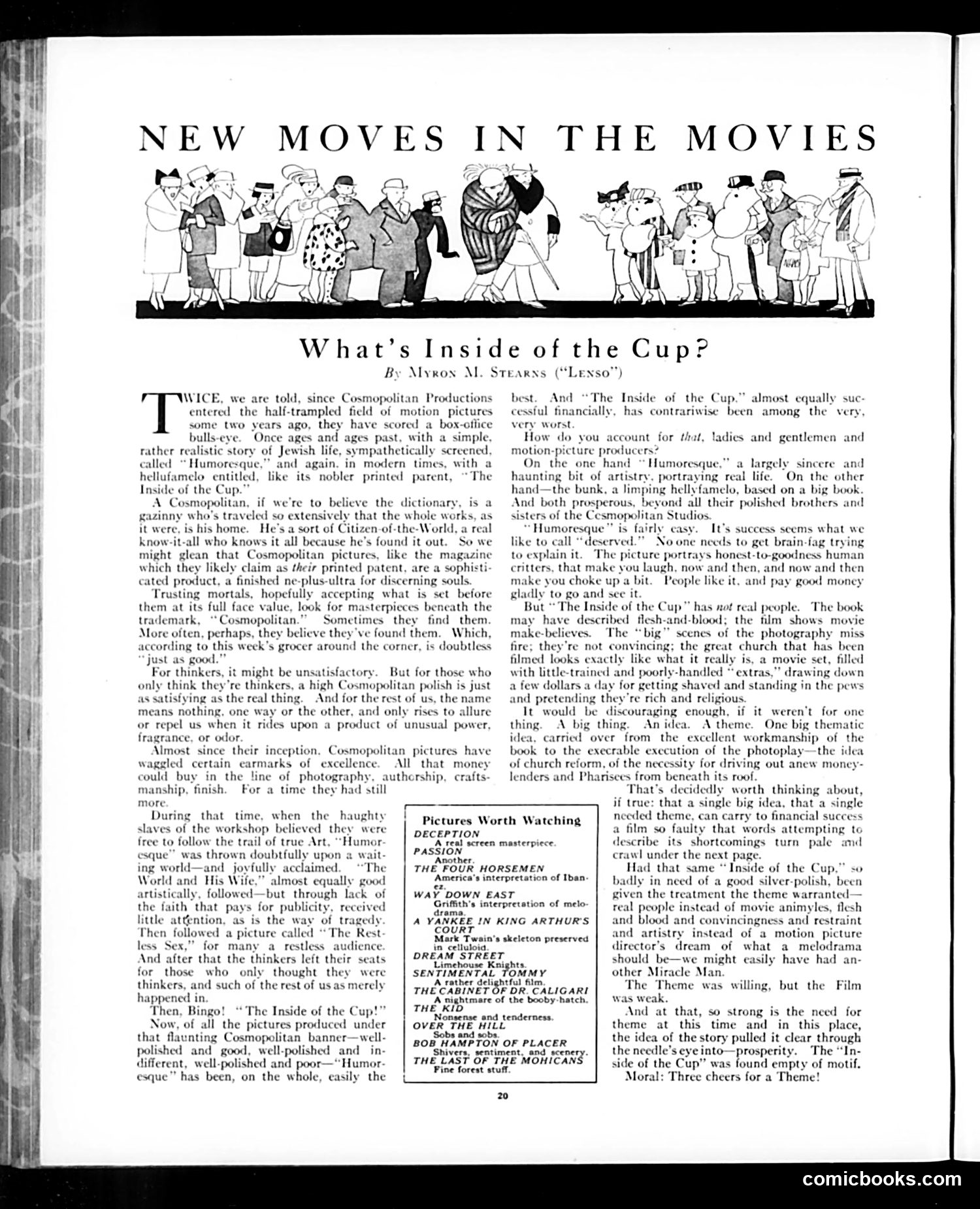
This page reviews Cosmopolitan Productions' film adaptation of "The Inside of the Cup," criticizing it as a case study in cinematic failure despite financial success. **The Satire:** The critic contrasts this film unfavorably with Cosmopolitan's earlier hit "Humoresque"—genuine, sincere, depicting real people and earning success deservedly. By contrast, "The Inside of the Cup" is dismissed as artificial: unconvincing church scenes (literally a movie set), poorly-trained extras pretending to be wealthy parishioners, and lifeless performances. **The Central Point:** Despite the film's shortcomings, one element redeems it—the thematic idea of church reform and moral cleansing (driving "money-lenders and Pharisees" from the church). The critic argues this single compelling idea, inherited from the source novel, carries the otherwise-bungled film to financial success, suggesting audiences respond to meaningful themes regardless of execution quality. This is film criticism satirizing both the studio's pretensions and audience taste.
📄 Transcribed text from this page (OCR, searchable)
Machine-transcribed from the original scan — historical spelling and the odd misread are preserved.
NEW MOVES I N THE MOVI ES ; Bats What’s Inside of the Cup? By Myron M. Stearns (“Lexso™) . we are told, since Cosmopolitan Productions entered the half-trampled field of motion pictures some two years ago, they have scored a box-oflice bulls-eve. Once ages and ages past, with a simple, rather realistic story of Jewish sympathetically screened called “ Humoresque,”” and again. in modern times, with a hellufamelo entitled, like its nobler printed parent, “The Inside of the Cup.” A Cosmopolitan, if we're to believe the dictionary, is a gazinny who's traveled so extensively that the whole works, as it were, is his home. He's a sort of Citizen-of-the-World, a real know-it-all who knows it all because he’s found it out. So we might glean that Cosmopolitan pictures, like the magazine which they likely claim as their printed patent, are a sophisti cated product, a finished ne-plus-ultra for discerning souls. Trusting mortals, hopefully accepting what is set before them at its full face value, look for masterpieces beneath the trademark, “Cosmopolitan.” Sometimes they find them. More often, perhaps, they believe they've found them. Which, according to this week's grocer around the corner, is doubtless just as good.” For thinkers, it might be unsatisfactory. But for those who only think they’re thinkers, a high Cosmopolitan polish is just as satisfying as the real thing. And for the rest of us, the name means nothing, one way or the other, and only rises to allure or repel us when it rides upon a product of unusual power, fragrance, or odor. Almost since their inception, Cosmopolitan pictures have waggled certain earmarks of excellence. All that money could buy in the line of photography. authorship, crafts- manship, finish. For a time they had still more During that slaves of the workshop believed they were DECEPTION time, when the haughty | Pictures Worth Watching best. And “The Inside of the Cup.” almost equally suc- cessful financially, has contrariwise been among the very, very worst How do you account for tat, ladies and gentlemen and motion-picture producers? On the one hand “Humoresque,” a largely sincere and haunting bit of artistry. portraying real life. On the other hand—the bunk, a limping hellyfamelo, based on a big book. And both prosperous, beyond all their polished brothers and sisters of the Cesmopolitan Studios. *Humoresque” is fairly casy. It's success seems what we like to call “deserved.” Noone needs to get brain-fag trying to explain it. The picture portrays honest-to-goodness human critters, that make you laugh, now and then, and now and then make you choke up a bit. People like it, and pay good money gladly to go and see it But “The Inside of the Cup” has not real people. The book may have described flesh-and-blood; the film shows movie make-believes. The “big” scenes of the photography miss fire; they're not convincing; the great church that has been filmed looks exactly like what it really is, a movie set, filled with little-trained and poorly-handled “ extras,” drawing down a few dollars a day for getting shaved and standing in the pews and pretending they're rich and religious. It would be discouraging enough, if it weren't for one thing. A big thing. An idea. A theme. One big thematic idea, carried over from the excellent workmanship of the book to the execrable execution of the photoplay—the idea of church reform, of the necessity for driving out anew money- lenders and Pharisees from beneath its roof. That's decidedly worth thinking about, if true: that a single big idea, that a single needed theme, can carry to financial success a film so faulty that words attempting to free to follow the trail of true Art, “Humor. esque” was thrown doubtfully upon a wait ing world—and joyfully acclaimed. “The World and His Wife,” almost equally good artistically, followed—but through lack of the faith that pays for publicity, received little ateention, as is the way of tragedy Then followed a picture called “The Rest less Sex,” for many a restless audience. And after that the thinkers left their seats for those who only thought they were thinkers, and such of the rest of us as merely happened in. Then, Bingo! ‘The Inside of the Cup!” Now, of all the pictures produced under that flaunting Cosmopolitan banner—well- polished and good, well-polished and in- different, well-polished and poor—“Humor esque” has been, on the whole, easily the es | A real screen masterpiece. PASSION ‘Another, THE FOUR HORSEMEN America’s interpretation of Iban ez WAY DOWN EAST Griffith's interpretation of melo: drama A YANKEE IN KING ARTHUR'S couRT. Mark Twain's skeleton preserved in celluloia DREAM STREET Limehouse Knights. SENTIMENTAL TOMMY A rather delightful film. THE CABINET OF DR. CALIGARI ‘A nightmare of the booby-hatch. THE KID Nonsense and tenderness. OVER THE HILL Sobs and sobs. BOB HAMPTON OF PLACER Shivers, sentiment, and scene THE LAST OF THE MOHICAN: Fine forest stuff. 20 describe its shortcomings turn pale and crawl under the next page. Had that same “Inside of the Cur badly in need of a good silver-polish, been given the treatment the theme warranted— real people instead of movie animyles, flesh and blood and convincingness and restraint and artistry instead of a motion picture director's dream of what a melodrama should be—we might easily have had an- other Miracle Man. The Theme was willing, but the was weak. And at that, so strong the need for theme at this time and in this place, the idea of the story pulled it clear through the needle’s eye into—prosperity. The “In- side of the Cup” was found empty of motif. Moral: Three cheers for a Theme! Film comicbooks.com