
Judge, 1921-05-21 · page 22 of 32
Judge — May 21, 1921 — page 22: what you’re looking at
What you’re looking at
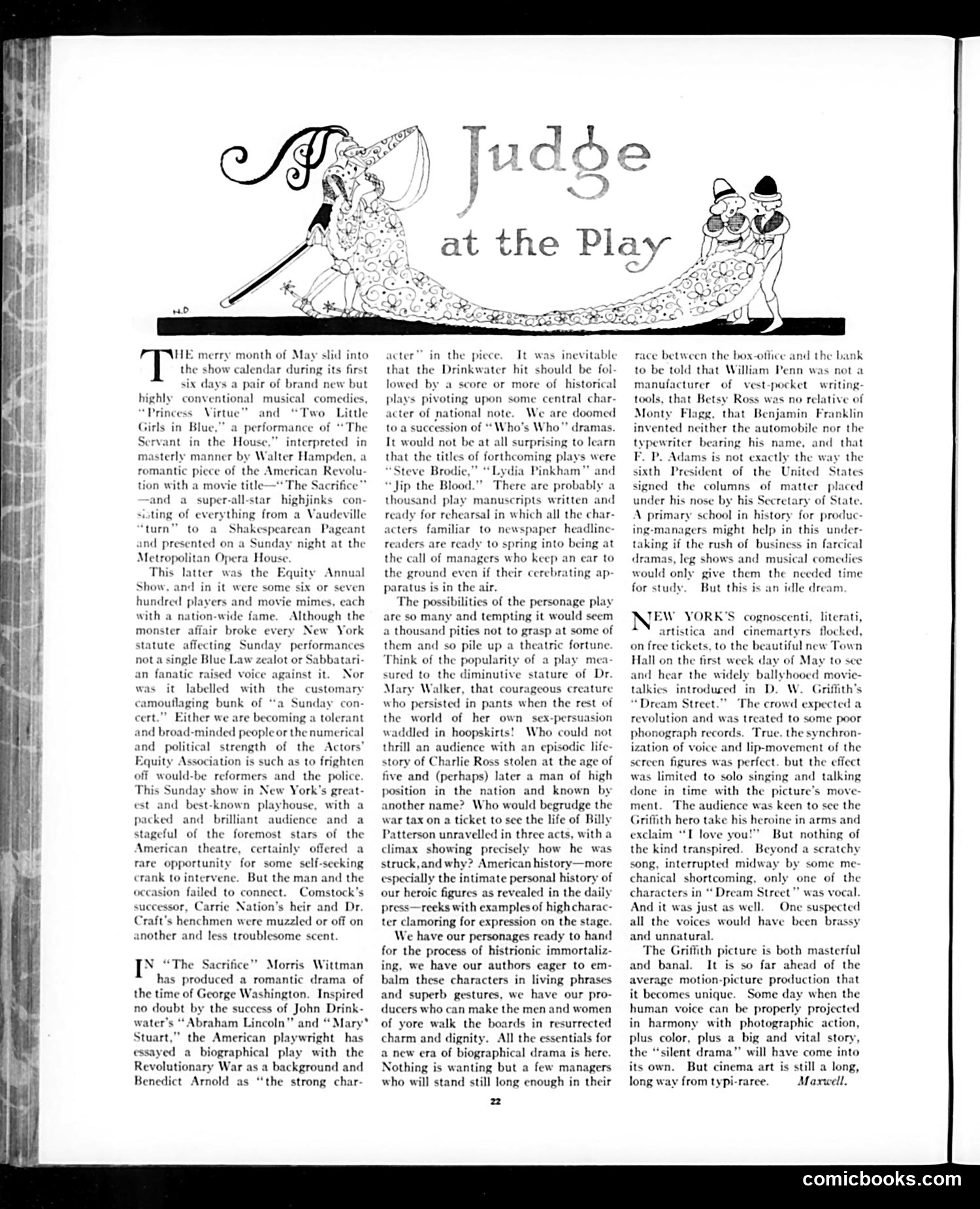
This page critiques the proliferation of biographical plays following John Drinkwater's successes with "Abraham Lincoln" and "Mary Stuart." The author satirizes how playwrights are rushing to dramatize famous historical and contemporary figures—suggesting absurd examples like "Steve Brodie" and "Lydia Pinkham." The specific target is Morris Wittman's "The Sacrifice," a Revolutionary War drama centering on Benedict Arnold. The critic mocks the trend as derivative and opportunistic, arguing that American history—particularly obscure personal details of minor celebrities—provides endless material for mediocre playwrights seeking quick theatrical fortune. The cartoon header depicts a judge figure surveying theatrical productions, reinforcing Judge magazine's role as arbiter of cultural taste. The satire reflects early 1920s concerns about commercialized theater prioritizing celebrity subjects over artistic merit.
📄 Transcribed text from this page (OCR, searchable)
Machine-transcribed from the original scan — historical spelling and the odd misread are preserved.
HE merry month of May slid into the show calendar during its first six days a pair of brand new but highly conventional musical comedies, Princess Virtue” and “Two Little Girls in Blue,” a performance of “The rvant in the House,” interpreted in masterly manner by Walter Hampden, a romantic piece of the American Revolu- tion with a movie title—* The Sacrifice and a super-all-star highjinks con- sisting of everything from a Vaudeville ‘turn” to a Shakespearean Pageant and presented a Sunday night at the Metropolitan Opera House. This latter was the Equity Annual Show, and in it were some six or seven hundred players and movie mimes, each with a nation-wide fame. Although the monster affair broke every New York statute affecting Sunday performances not a single Blue Law zealot or Sabbatari- an fanatic raised voice against it. Nor was it labelled with the customary camouflaging bunk of ‘‘a Sunday con- cert.” Either we are becoming a tolerant and broad-minded people or the numerical and political strength of the Actors’ Equity Association is such as to frighten off would-be reformers and the police. This Sunday show in New York's great- est and best-known playhouse, with a packed and brilliant audience and a stageful of the foremost stars of the American theatre, certainly offered a rare opportunity for some. self-secking crank to intervene. But the man and the occasion failed to connect. Comstock’s successor, Carrie Nation’s heir and Dr. Craft's henchmen were muzzled or off on another and less troublesome scent. | “The Sacrifice’ Morris Wittman has produced a romantic drama of the time of George Washington. Inspired no doubt by the success of John Drink- water's “Abraham Lincoln” and “Mary Stuart,” the American playwright has essayed a biographical play with the Revolutionary War as a background and Benedict Arnold as “the strong char- 4 at acter” in the piece. It was inevitable that the Drinkwater hit should be fol- lowed by a score or more of historical plays pivoting upon some central char- acter of national note. We are doomed to a succession of “ Who’s Who” dramas. It would not be at all surprising to learn that the titles of forthcoming plays were “Steve Brodie,” “Lydia Pinkham” and “Jip the Blood.” There are probably a thousand play manuscripts written and ready for rehearsal in which all the char- acters familiar to newspaper headline- readers are ready to spring into being at the call of managers who keep an ear to the ground even if their cerebrating ap. paratus is in the air, The possibilities of the personage play are so many and tempting it would seem a thousand pities not to grasp at some of them and so pile up a theatric fortune. Think of the popularity of a play mea sured to the diminutive stature of Dr Mary Walker, that courageous creature who persisted in pants when the rest of the world of her own sex-persuasion waddled in hoopskirts! Who could not thrill an audience with an episodic life- story of Charlie Ross stolen at the age of five and (perhaps) later a man of high position in the nation and known by another name? Who would begrudge the war tax on a ticket to see the life of Billy Patterson unravelled in three acts, with a climax showing precisely how he was struck,and why? American history—more especially the intimate personal history of our heroic figures as revealed in the daily press—reeks with examples of high charac- ter clamoring for expression on the stage. We have our personages ready to hand for the process of histrionic immortaliz- ing, we have our authors eager to em- balm these characters in living phrases and superb gestures, we have our pro- ducers who can make the men and women of yore walk the boards in resurrected charm and dignity. All the essentials for a new era of biographical drama is here. Nothing is wanting but a few managers who will stand still long enough in their 2 the Pla CC race between the box-office and the bank to be told that William Penn was not a manufacturer of vest-pocket writing- tools, that Betsy Ross w » relative of Monty Flagg, that Benjamin Franklin invented neither the automobile nor the typewriter bearing his name, and that F. P. Adams is not exactly the way the sixth President of the United States signed the columns of matter placed under his nose by his Secretary of State. \ primary school in history for produc- ing-managers might help in this under- taking if the rush of business in farcical dramas, leg shows and musical comedies would only give them the needed time for study. But this is an idle dream NEW YORK’S cognoscenti, literati, 4% artistica and cinemartyrs flocked, on free tickets, to the beautiful new Town Hall on the first week day of May to sce and hear the widely ballyhooed movie- talkies introduced in D. W. Griffith's “Dream Street.” The crowd expected a revolution and was treated to some poor phonograph records. True. the synchron- ization of voice and lip-movement of the screen figures was perfect. but the effect was limited to solo singing and talking done in time with the picture’s move- ment. The audience was keen to see the Griffith hero take his heroine in arms and exclaim “I love you!” But nothing of the kind transpired. Beyond a scratchy song, interrupted midway by some me chanical shortcoming, only one of the characters in * Dream Street” was vocal. And it was just as well. One suspected all the voices would have been brassy and unnatural. The Griffith picture is both masterful and banal. It is so far ahead of the average motion-picture production that it becomes unique. Some day when the human voice can be properly projected in harmony with photographic action, plus color, plus a big and vital story, the “silent drama” will have come into its own. But cinema art is still a long, long way from typi-raree. — Maxwell. comicbooks.com