
Judge, 1921-05-21 · page 14 of 32
Judge — May 21, 1921 — page 14: what you’re looking at
What you’re looking at
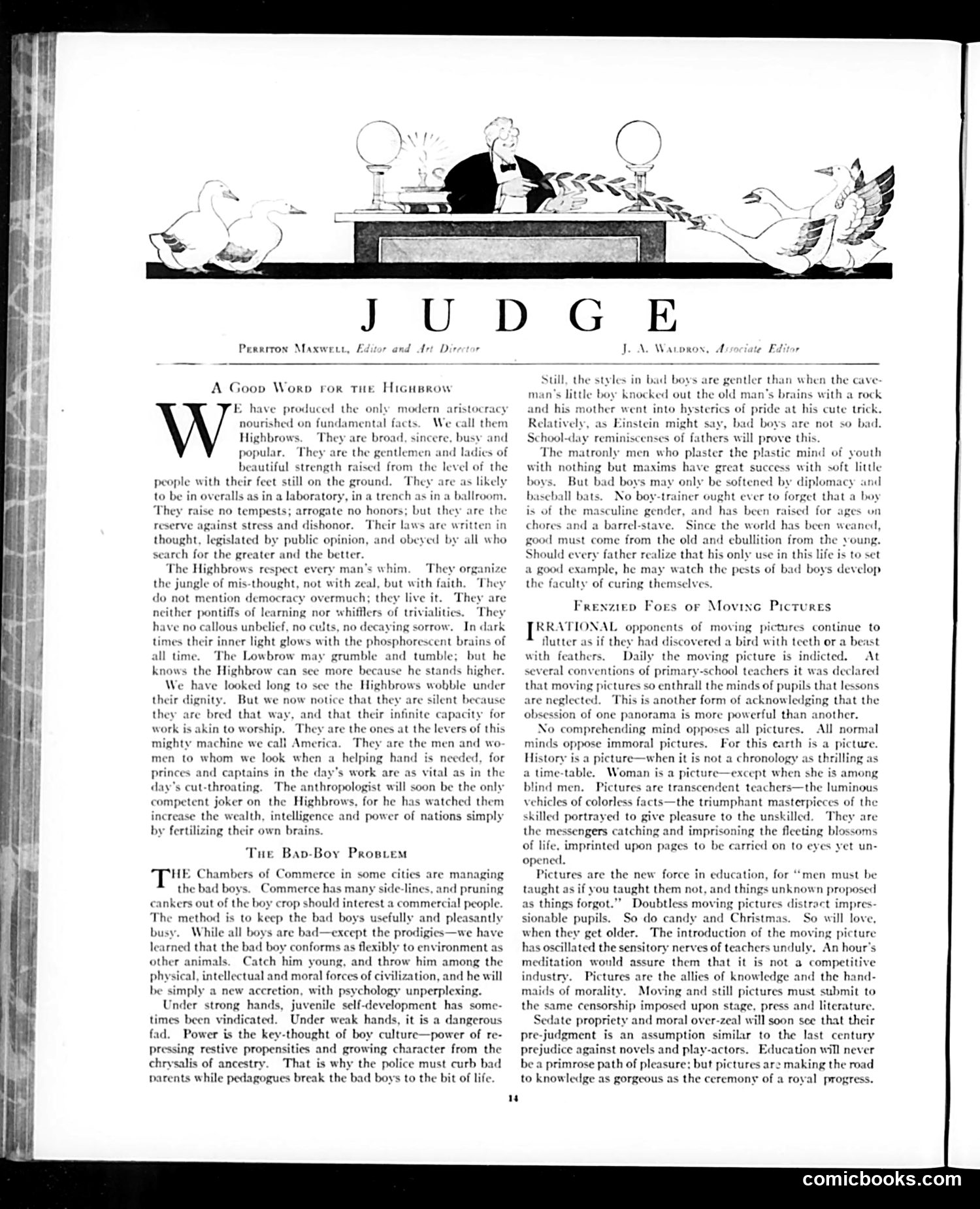
This page from *Judge* magazine presents editorial commentary rather than political cartoons. The header illustration shows a formal judge at a bench flanked by geese—a visual metaphor for judicial authority and, possibly, foolishness (geese being traditional symbols of silliness). The two main articles discuss: **"A Good Word for the Highbrow"**: Praises an intellectual aristocracy of accomplished people grounded in practical work—scientists, engineers, and business leaders who quietly drive society forward without pretension. They're contrasted with "lowbrows" who complain loudly. **"The Bad-Boy Problem"**: Addresses urban chambers of commerce attempting to reform troublemaking youth through structured activity and discipline. The author argues bad boys need firm guidance and physical labor (baseball, chores) rather than soft moral instruction alone, reflecting early 20th-century paternalistic attitudes about character development. Both articles reflect Progressive Era concerns: celebrating meritocratic competence over inherited status, while advocating strict behavioral discipline for working-class youth.
📄 Transcribed text from this page (OCR, searchable)
Machine-transcribed from the original scan — historical spelling and the odd misread are preserved.
Perrrron Maxwett, Editor and Art A. Warprox, Hicuprow A Goopv Worp ror Tue modern aristocracy on fundamental facts. We call them Highbrows. They are broad, sincere, busy’ and popular. They are the gentlemen and ladies of beautiful strength raised from the level of the people with their feet still on the ground. They are as likely to be in overalls as in a laboratory, in a trench as in a ballroom. They raise no tempests; arrogate no honors; but they are t reserve against stress and dishonor. Their laws are written in thought, legislated by public opinion, and obeyed by all who search for the greater and the better. The Highbrows respect every man’s wt the jungle of mis-thought, not with zeal, but with faith. They do not mention democracy overmuch; they live it. They are neither pontiffs of learning nor whifflers of trivialities. They have no callous unbelief, no cults, no decaying sorrow. In dark times their inner light glows with the phosphorescent brains of The Lowbrow may grumble and tumble; but he Ww can see more because he stands higher. the Highbrows wobble under E have produced the only nourished They organize all time. knows the Hight We have looked long to se their dignity. But we now notice that they are silent because they are bred that way, and that their infinite capacity for work is akin to worship. They are the ones at the levers of this mighty machine we call America. They are the men and wo. men to whom we look when a helping hand is needed, for princes and captains in the day’s work are as vital as in the day’s cut-throating. The anthropologist will soon be the only competent joker on the Highbrows, for he has watched them increase the wealth, intelligence and power of nations simply by fertilizing their own brains. Tue Bav-Boy Prostem HE Chambers of Commerce in some cities are m: ng the bad boys. Commerce has many side-lines, and pruning cankers out of the boy crop should interest a commercial people. The method is to keep the bad boys usefully and pleasantly busy. While all boys are bad—except the prodigies—we have learned that the bad boy conforms as flexibly to environment as other animals. Catch him young, and throw him among the physical, intellectual and moral forces of civilization, and he will be simply a new accretion, with psychology unperplexing. Under strong hands, juvenile self-development has some- times been vindicated. Under weak hands, it is a dangerous fad. Power is the key-thought of boy culture—power of re- pressing restive propensities and growing character from the chrysalis of ancestry. That is why the police must curb bad parents while pedagogues break the bad boys to the bit of life. Sul, the styles in bad boys are gentler than when the cave- man’s little boy knocked out the old man’s brains with a rock and his mother went into hysterics of pride at his cute trick. Relatively, as Einstein might say, bad boys are not so bad. School-day reminiscenses of fathers will prove this The matronly men who plaster the plastic mind of youth with nothing but maxims have great success with soft little boys. But bad boys may only be softened by diplomacy and baseball bats. No boy-trainer ought ever to forget that a boy is of the masculine gender, and has been raised for ages on chores and a barrel-stave. Since the world has been weaned, good must come from the old and ebullition from the voung. Should every father realize that his only use in this life is to set 1 good example, he may watch the pests of bad boys develop the faculty of curing themselves. Frenziep Fors or Movine Pictures RRATIONAL opponents of moving pictures continue to ‘utter as if they had discovered a bird with teeth or a beast with feathers. Daily the moving picture is indicted. At several conventions of primary-school teachers it was declared that moving pictures so enthrall the minds of pupils that lessons are neglected. This is another form of acknowledging that the obsession of one panorama is more powerful than another. No comprehending mind opposes all pictures, All normal minds oppose immoral pictures. For this earth is a picture. History is a picture—when it is not a chronology as thrilling as a time-table, Woman is a picture—except when she is among blind men. Pictures are transcendent teachers—the luminous vehicles of colorless facts—the triumphant masterpieces of the skilled portrayed to give pleasure to the unskilled. They are the messengers catching and imprisoning the fleeting blossoms of life, imprinted upon pages to be carricd on to eyes yet un- opened. Pictures are the new force in education, for “men must be taught as if you taught them not, and things unknown proposed as things forgot.”” Doubtless moving pictures distract impres- sionable pupils. So do candy and Christmas. So will love, when they get older. The introduction of the moving picture has oscillated the sensitory nerves of teachers unduly. An hour's meditation would assure them that it is not a competitive industry. Pictures are the allies of knowledge and the hanc maids of morality. Moving and still pictures must submit to the same censorship imposed upon stage, press and literature. Sedate propriety and moral over-zeal will soon sce that their pre-judgment is an assumption similar to the last century prejudice against novels and play-actors. Education will never be a primrose path of pleasure; but pictures are making the road to knowledge as gorgeous as the ceremony of a royal progress. comicbooks.com