
A complete issue · 33 pages · 1920
Judge — December 25, 1920
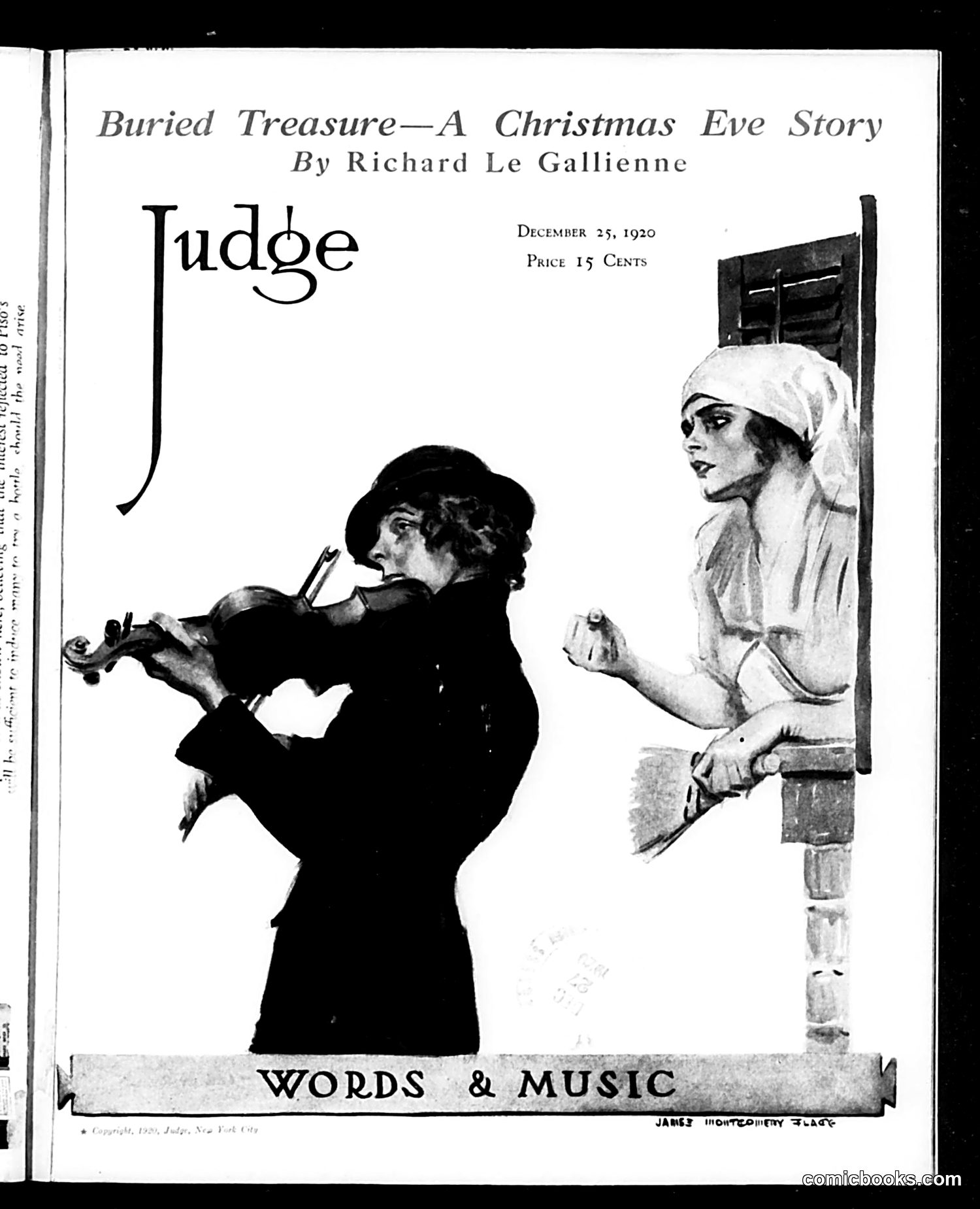
This is a cover for Judge magazine (December 25, 1920) advertising sheet music for "Buried Treasure—A Christmas Eve Story" by Richard Le Gallienne. The illustration shows two figures: a woman on the left playing violin while dressed in dark clothing, and another woman visible through a doorway or window on the right, wearing a white head covering. The "Words & Music" credit and sheet music advertisement suggest this is promoting a musical composition, likely a holiday-themed piece. Without additional context about Le Gallienne's specific work or 1920 cultural references, the exact satirical point remains unclear. The image may reference a contemporary story or musical composition, but the specific meaning of "buried treasure" as a Christmas theme and why Judge chose to feature it satirically cannot be determined from the image alone.
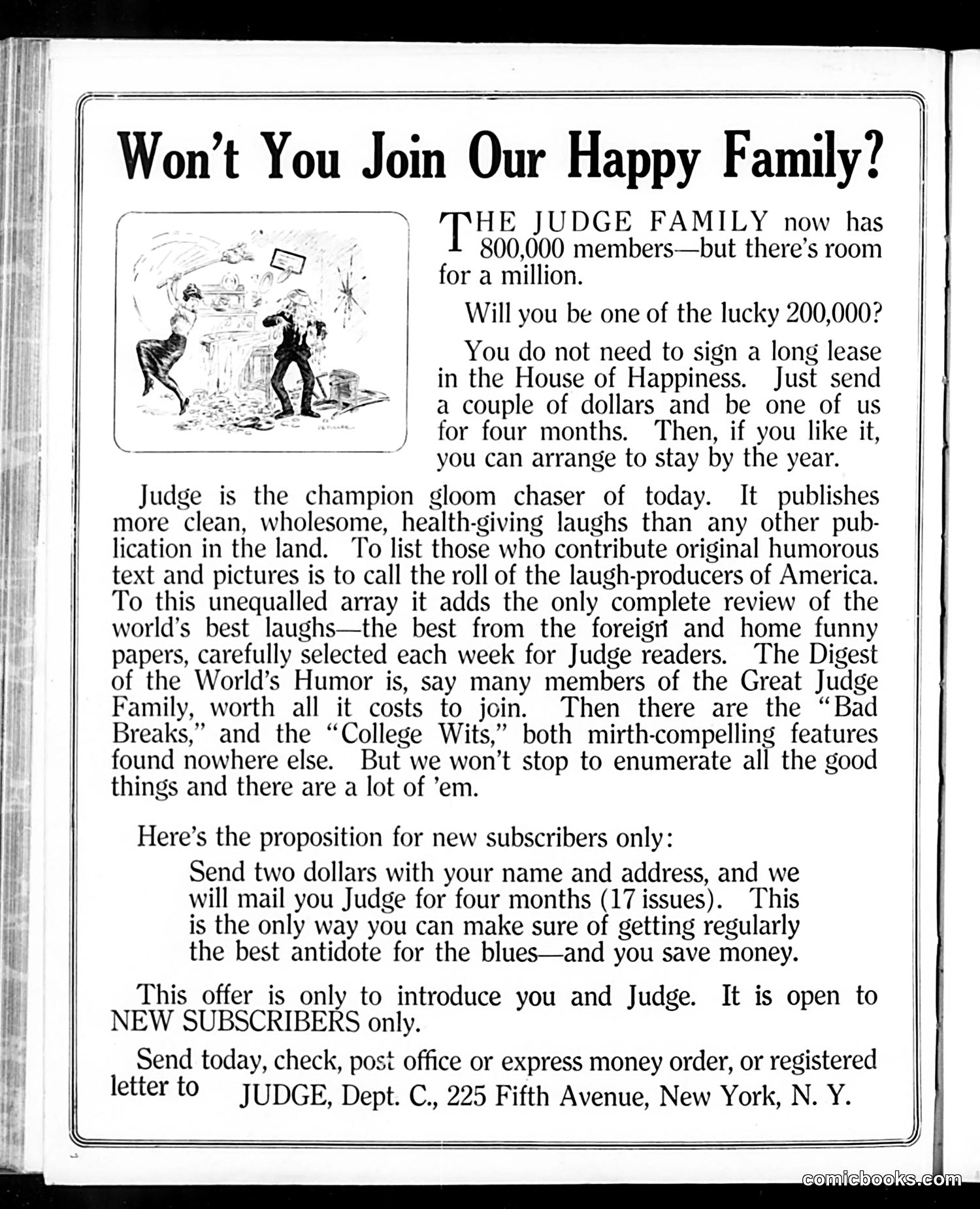
This page is primarily a **subscription advertisement** for Judge magazine itself, not political satire. The small cartoon in the upper left appears to show two figures in what looks like a chaotic domestic scene—possibly depicting marital discord or household conflict—but it's too small and unclear to identify specific references or individuals. The text promotes Judge as "the champion gloom chaser" offering "clean, wholesome, health-giving laughs." It emphasizes original humor, a "Digest of the World's Humor," and recurring features like "Bad Breaks" and "College Wits." The pitch targets new subscribers with a promotional offer: two dollars for four months (17 issues). The "Happy Family" language is ironic marketing copy designed to make subscription sound like joining a desirable social group during what appears to be the early-to-mid 20th century.
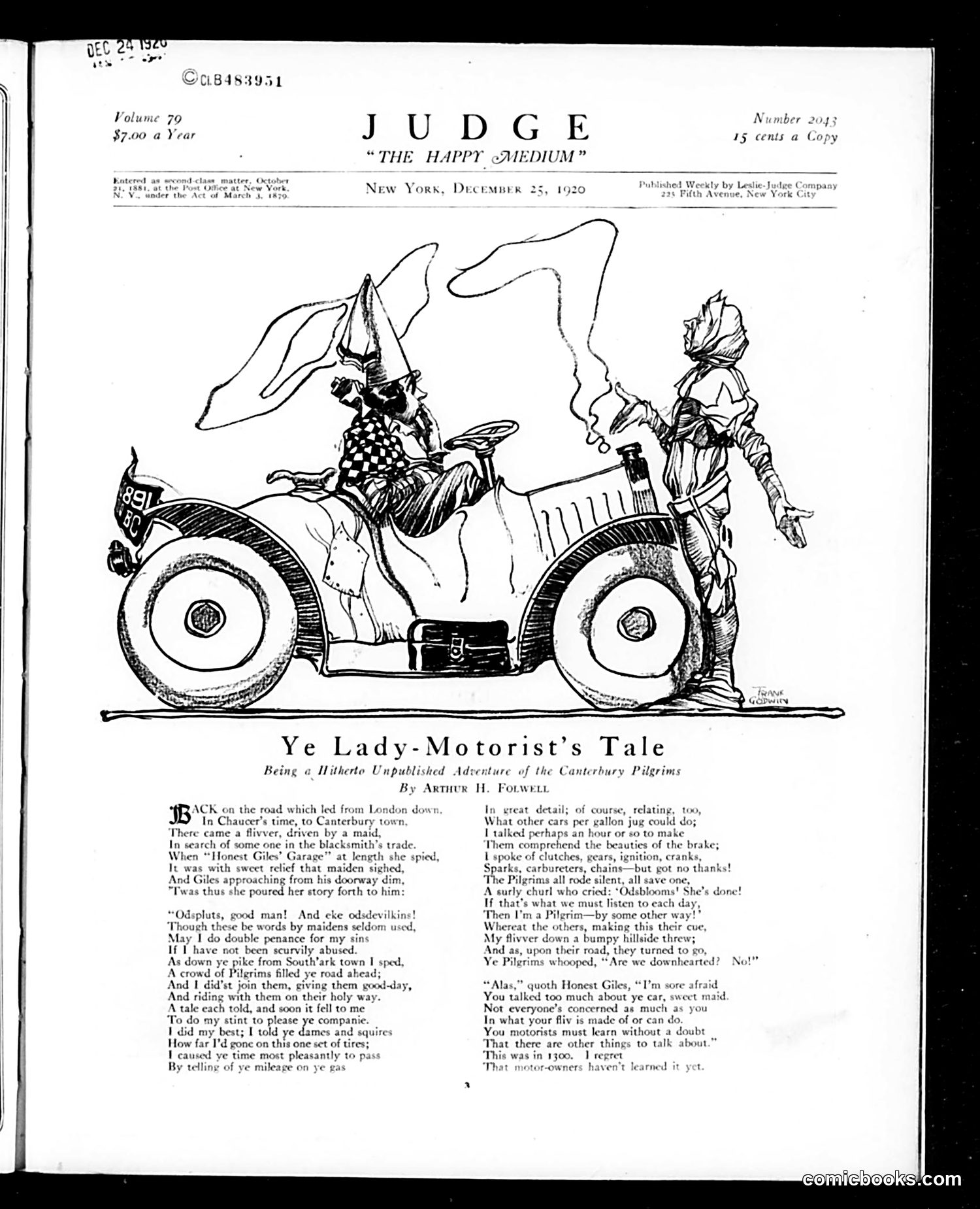
This is a humorous story-poem by Arthur H. Folwell about early women automobile drivers. The illustration depicts a woman in a motorcar with a male passenger, both dressed in period costume suggesting a mock-medieval "Canterbury Pilgrims" narrative style. The satire targets early-1920s attitudes toward female motorists—likely mocking both women drivers themselves and male anxieties about them. The poem's dialogue references automotive complaints: tire problems, brake mechanics, gear/ignition issues, and carburetors. The humor appears to derive from portraying a woman driver as ignorant about cars while chattering endlessly about technical matters she doesn't understand—a common stereotype of the era. The "Canterbury Pilgrims" framing adds mock-literary pretension to the satirical jab.
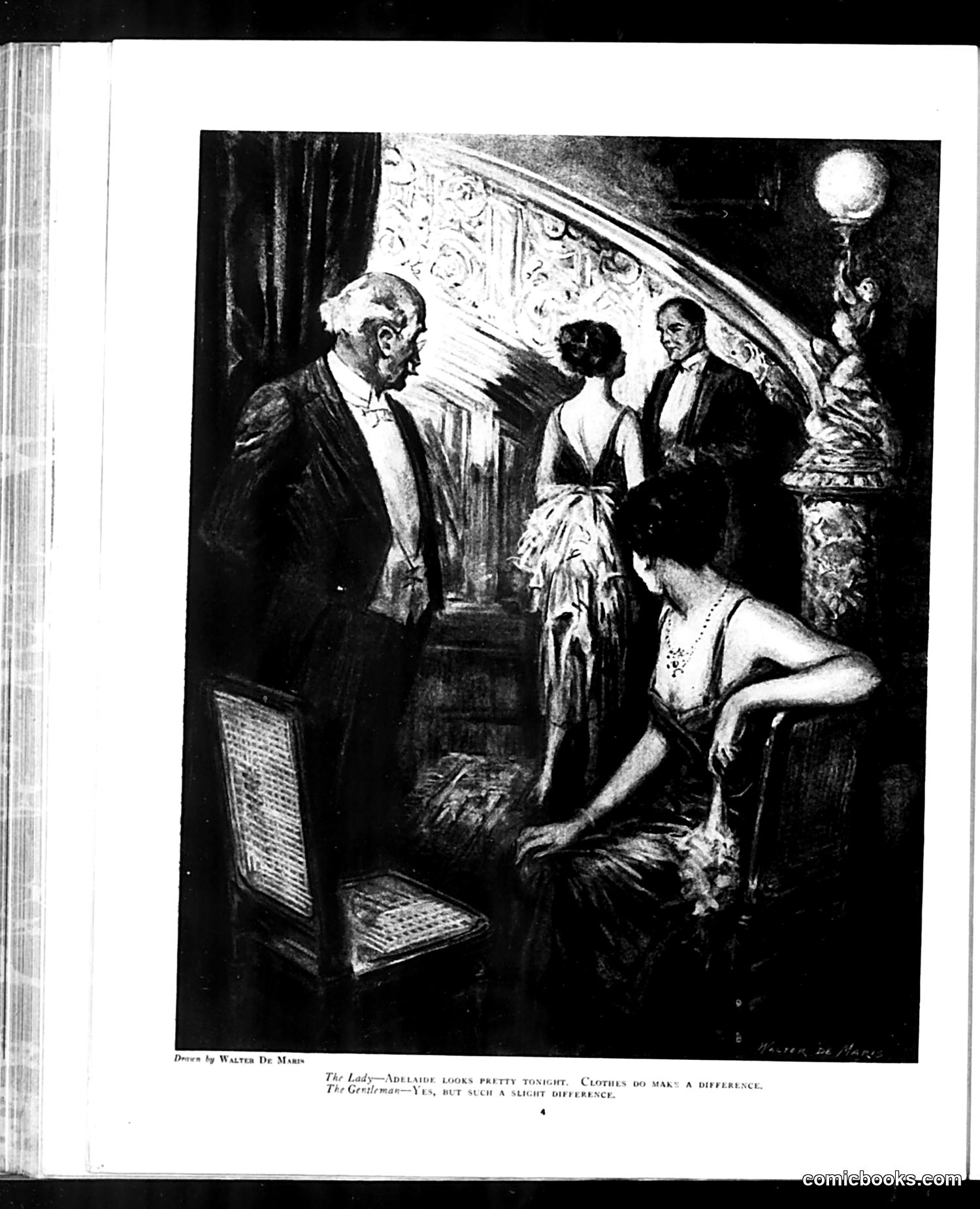
This black-and-white illustration by Walter De Maris depicts an elegant evening social gathering. The caption reads: "The Lady—Adelaide looks pretty tonight. Clothes do make a difference. / The Gentleman—Yes, but such a slight difference." The joke is a classic sexist quip: the gentleman is implying that Adelaide's appearance depends primarily on her clothing rather than her actual beauty, and that removing those clothes would reveal minimal difference. It's a backhanded compliment playing on the notion that women's worth is superficial and fashion-dependent. The setting—an ornate interior with well-dressed attendees—positions this as commentary on upper-class social interactions and the shallow nature of compliments exchanged in such circles. The satire targets both the gentleman's rudeness and perhaps broader social pretensions of the era.
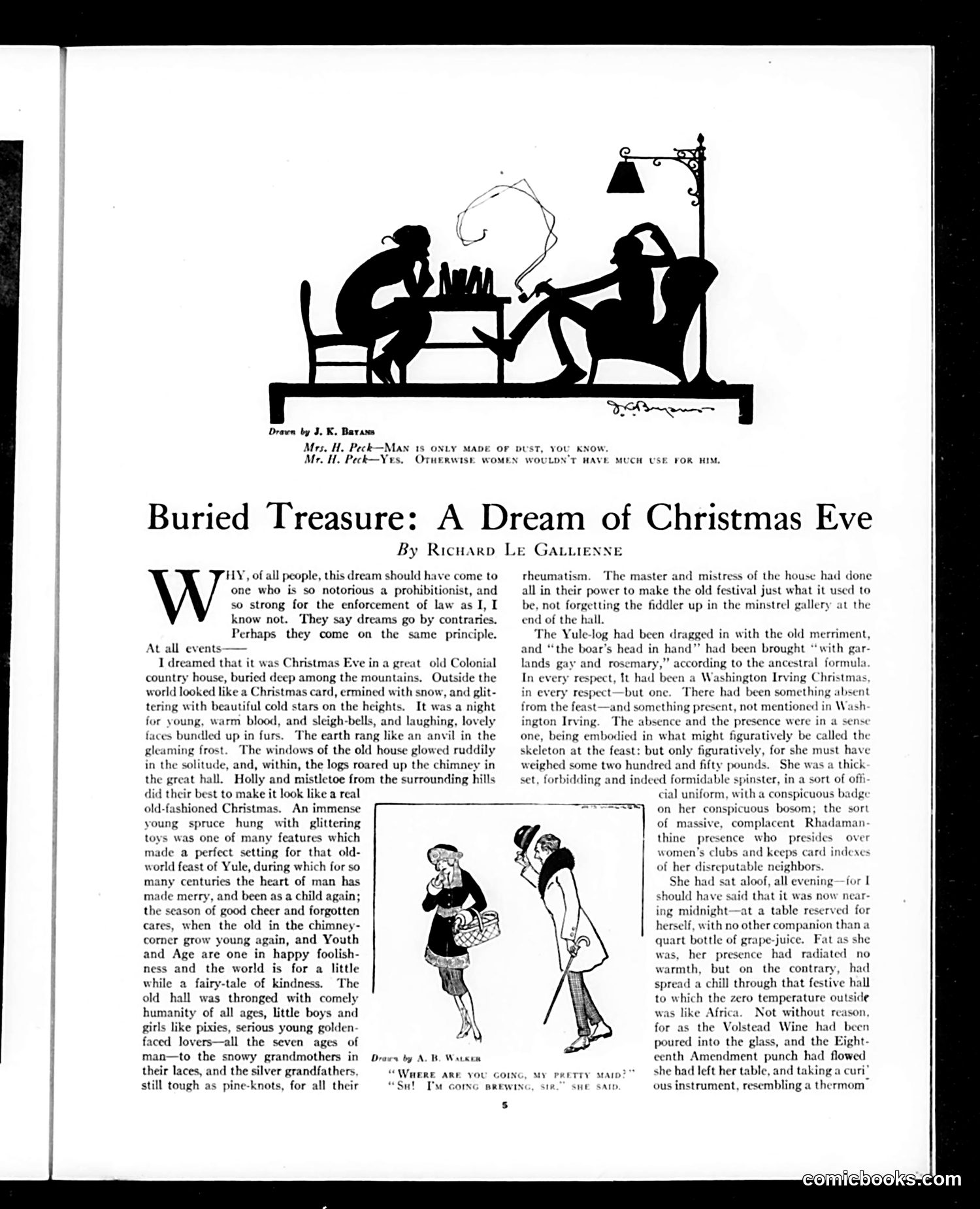
The top cartoon depicts two figures at a chess table under a lamp. The caption reads: "Mrs. H. Peck—Man is only made of dust, you know. Mr. H. Peck—Yes. Otherwise women wouldn't have much use for him." This is a domestic satire joke playing on the era's gender dynamics. The wife makes a philosophical observation about men's worthlessness (being "made of dust"), and the husband's response suggests women only tolerate men for practical purposes—implying wives view husbands as servants or useful objects rather than equals. The chess-playing setting emphasizes intellectual companionship, yet the joke undermines it, reducing the relationship to utility. The accompanying story "Buried Treasure: A Dream of Christmas Eve" by Richard Le Gallienne is a nostalgic holiday fiction piece unrelated to the cartoon's satirical content.
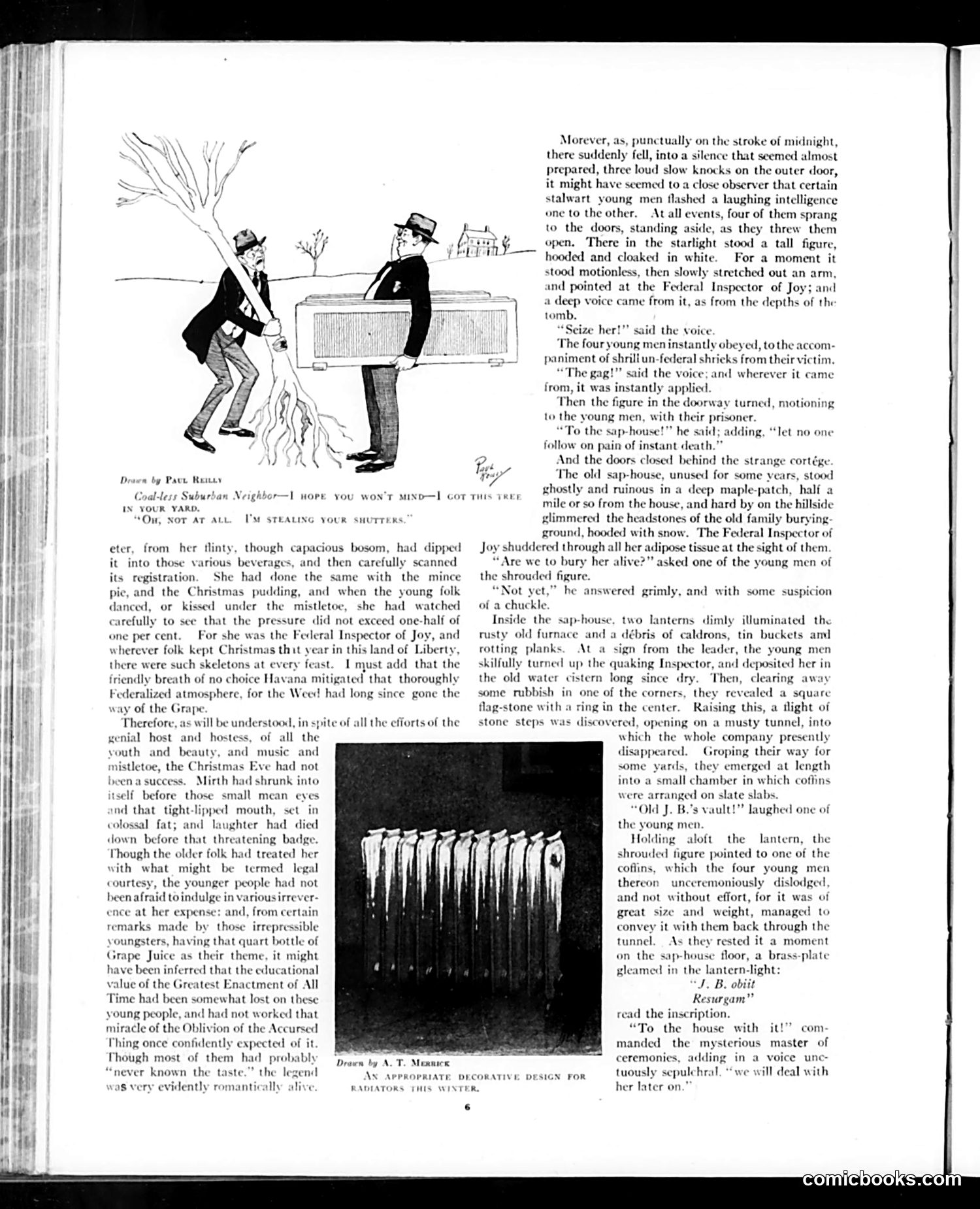
The top cartoon, credited to Paul Resis, shows two men by a fire—one stealing shutters from the other's yard. The caption reads: "Good Snakes! Neighbor—I HOPE YOU WON'T MIND—I GOT THIS TREE IN YOUR YARD. 'OH, YOU'RE ALL RIGHT. I'M STEALING YOUR SHUTTERS.'" This appears to be **wartime humor**, likely from WWI or WWII era, satirizing material shortages and home-front rationing. The joke depicts neighbors reciprocally "stealing" each other's wood/materials—implying widespread civilian theft of resources during wartime scarcity. The mutual, casual acknowledgment of theft suggests this was commonplace behavior accepted with dark humor. The remaining text and lower illustration appear to be a separate supernatural/mystery story, unrelated to the cartoon's satirical commentary on wartime deprivation.
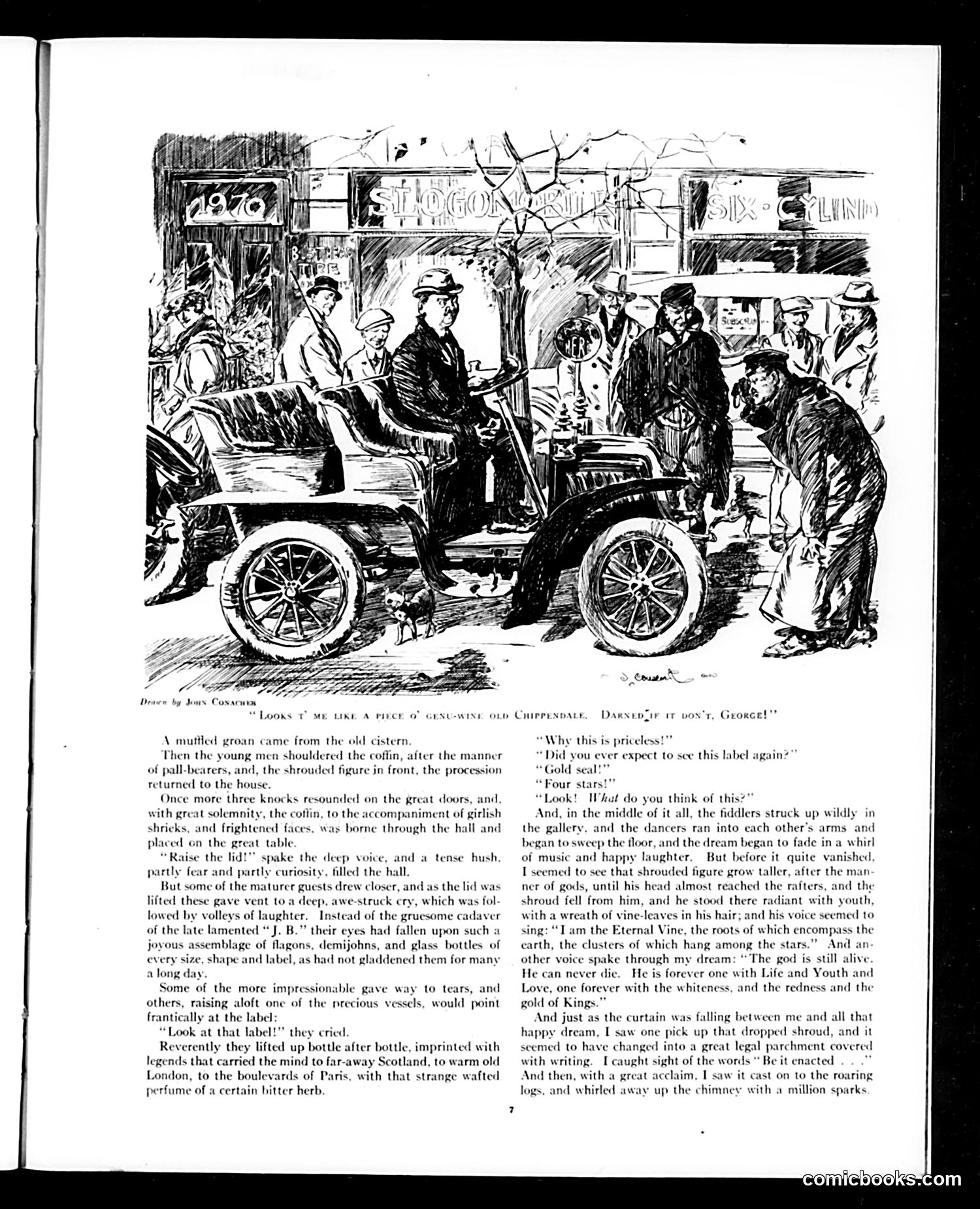
This appears to be a literary illustration accompanying a satirical story rather than a political cartoon. The image shows a funeral procession being disrupted when pallbearers discover the "coffin" actually contains valuable bottles of alcohol—scotch, wine, and other spirits with prestigious labels from Scotland, London, and Paris. The satire targets **Prohibition-era America**. The story mocks the legal ban on alcohol by depicting a mock funeral as a cover for celebrating contraband liquor. The subsequent dream sequence, where wine becomes a god figure ("I am the Eternal Vine") and a legal document burns in the fireplace, suggests commentary on Prohibition's futility and the persistence of drinking culture despite legal restrictions. The humor lies in the absurdity of using funeral rites to transport and celebrate illegal spirits—a transparent yet defiant circumvention of the law.
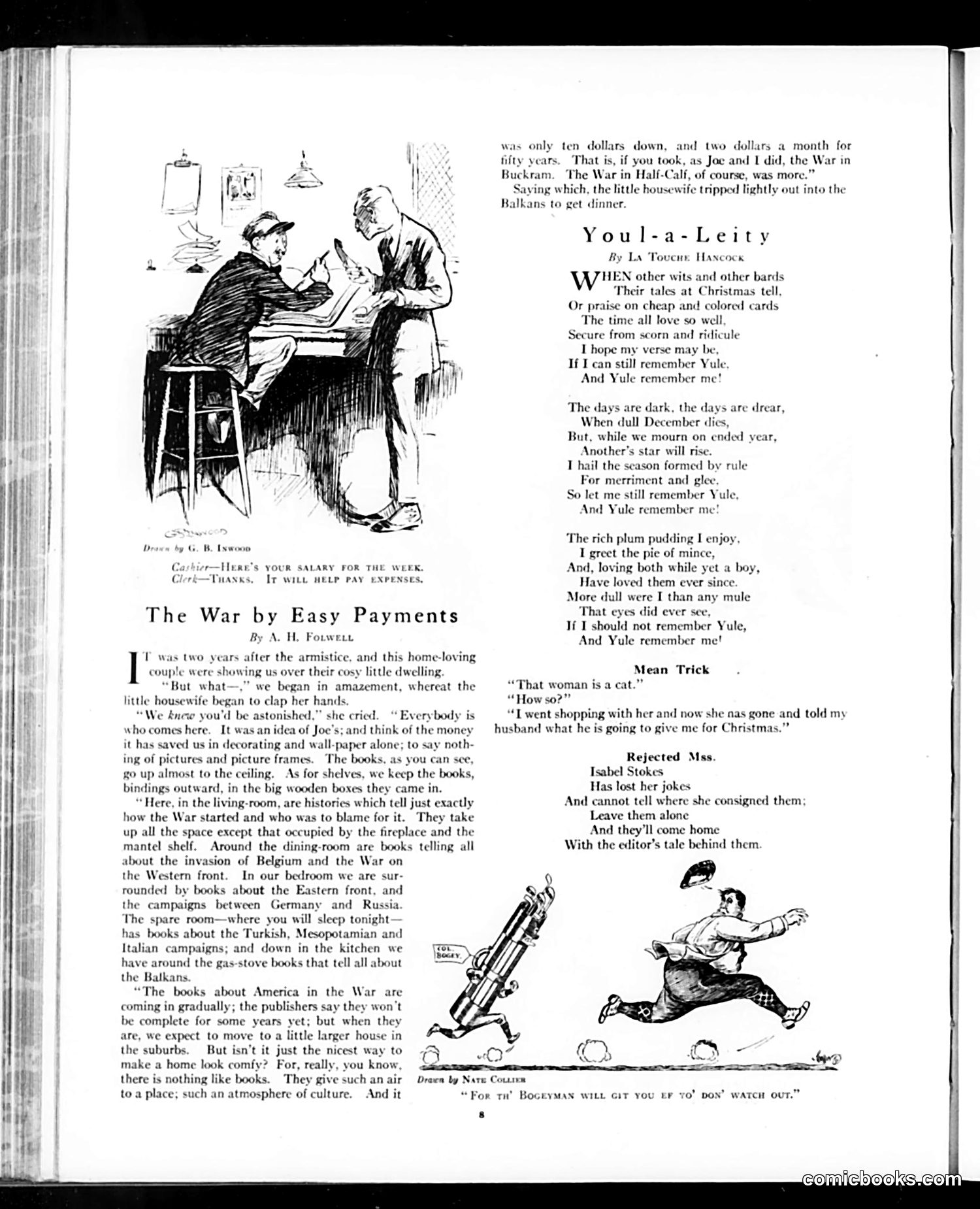
This cartoon satirizes post-WWI consumer culture and war obsession. A husband and wife proudly display their home, which they've furnished almost entirely with war history books—filling bedrooms, dining room, spare room, and kitchen—purchased on an installment plan ("ten dollars down, and two dollars a month for fifty years"). The satire targets two things: first, the absurdity of a couple so consumed by war literature they've made it their primary home decoration, and second, the easy-credit purchasing schemes that allow them to accumulate this impractical collection. The wife's delight in this arrangement—boasting that books "give such an air of culture"—mockingly exposes how people use war narratives and book-collecting as status symbols rather than genuine intellectual engagement. The joke is that this couple has essentially mortgaged their future to fill their home with books about a war that just ended (two years post-armistice), neglecting actual comfort or practical decoration.
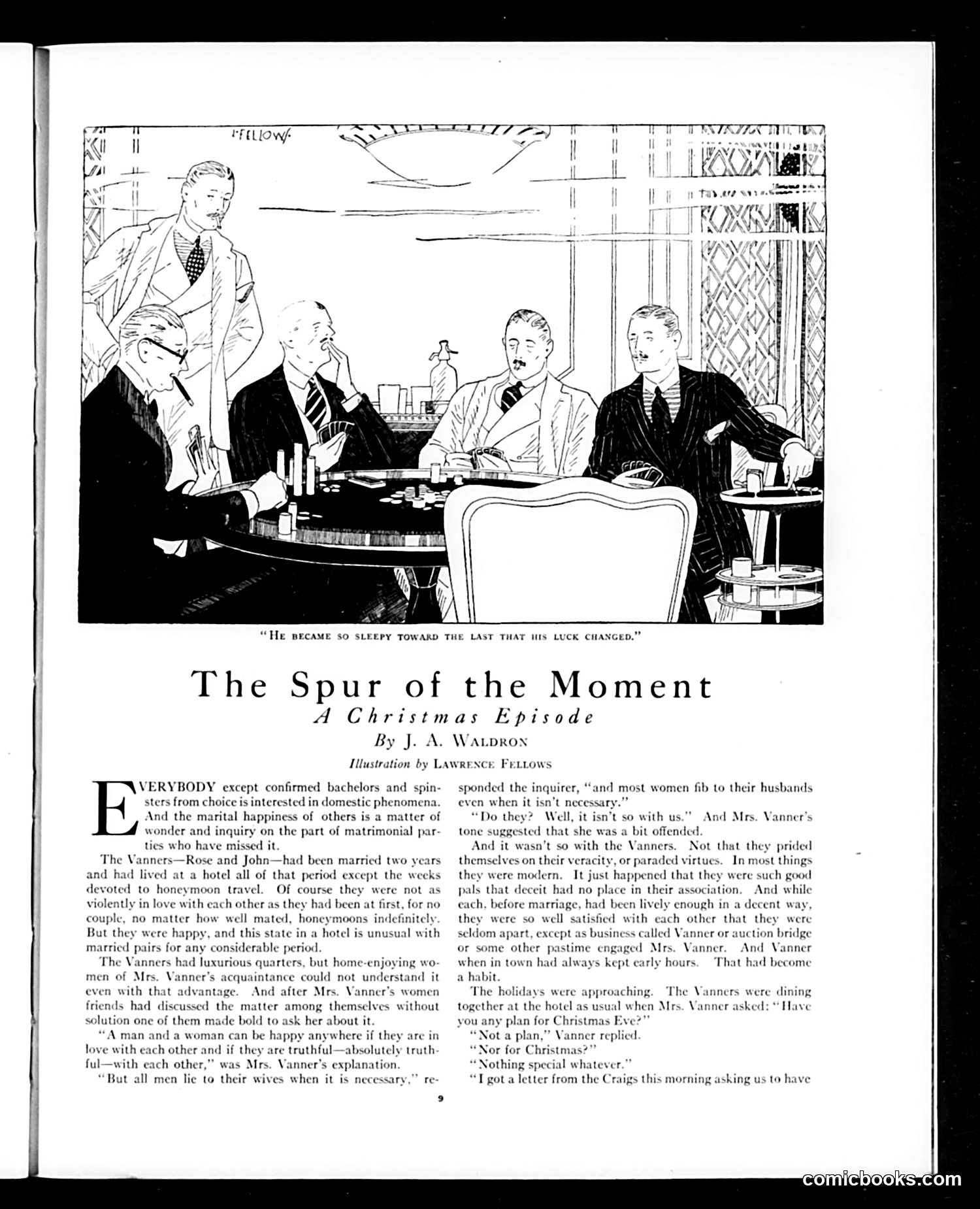
This is the opening page of a short story by J.A. Waldron, not a political cartoon. The illustration shows five men in a hotel room engaged in what appears to be poker or cards, with the caption referencing one player becoming drowsy as "his luck changed." The story itself satirizes early 20th-century marriage conventions. It concerns the Vanners, a couple who have lived contentedly in a hotel for two years—unusual for the era, when such arrangements invited gossip. The narrative mocks society's fascination with others' marriages and the assumption that marital happiness requires deception. Mrs. Vanner proudly claims she and her husband don't lie to each other, suggesting this honesty is unusual enough to be noteworthy or even suspect to contemporary observers. The "Christmas Episode" frames a story about how an ordinary moment might disrupt their domestic equilibrium.
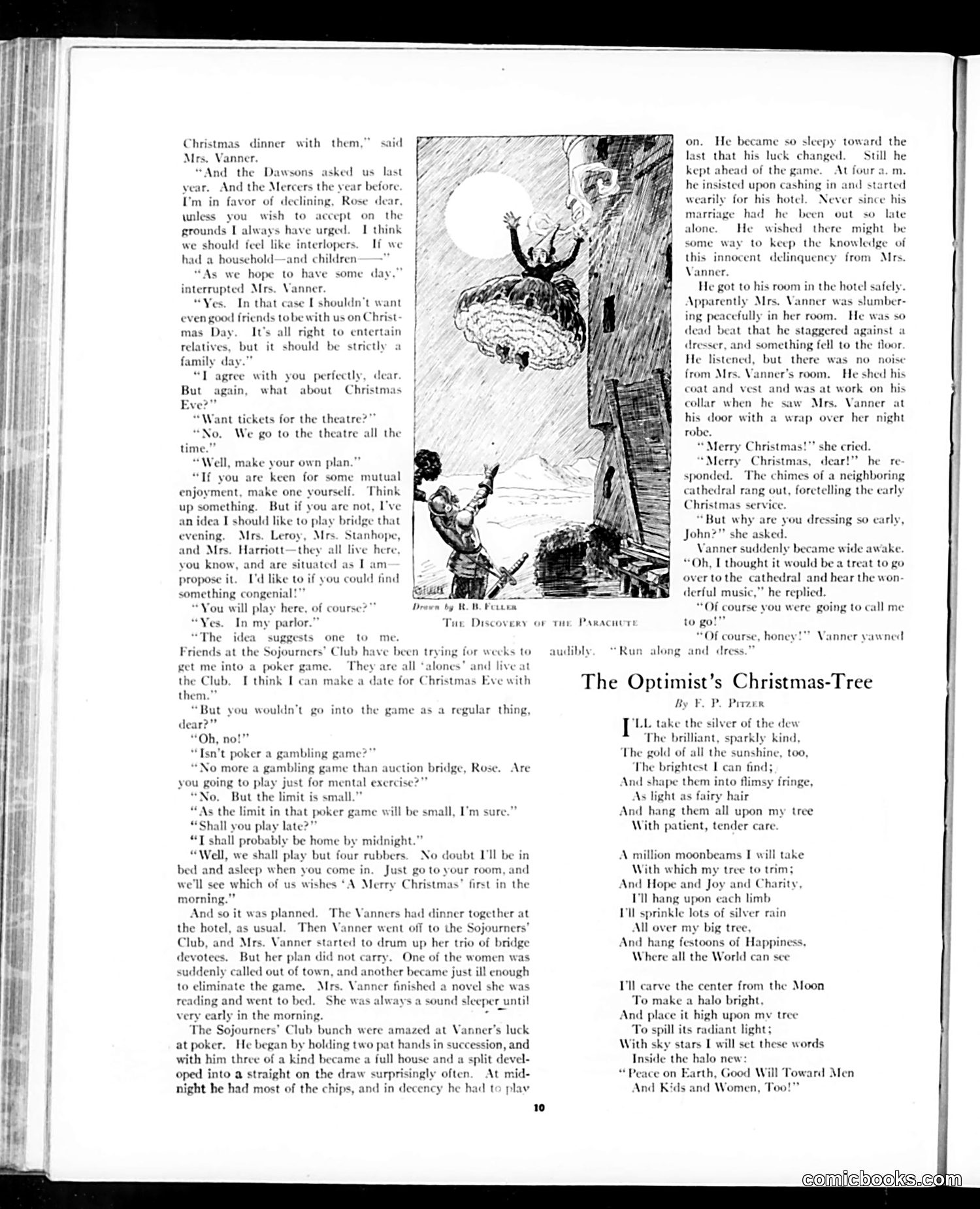
This page contains a domestic comedy story about the Vanners, a married couple spending Christmas Eve apart. Mr. Vanner attends a poker game at his club while Mrs. Vanner planned bridge (though it fell through). The satire targets early 20th-century upper-middle-class marriage dynamics and holiday customs. The cartoon illustration (labeled "The Discovery of the Parachute") shows a figure falling with an early parachute design—unrelated to the main story. **The joke**: Mr. Vanner stays out until 4 a.m. gambling, violating marital expectations, yet returns to find his wife greeting him cheerfully with "Merry Christmas!" at dawn. The humor lies in his anxiety about concealing this "innocent delinquency" from his wife, contrasted with her apparent obliviousness or forgiveness. The accompanying poem, "The Optimist's Christmas-Tree," celebrates idealistic holiday sentiments—a tonal counterpoint to the cynical married couple negotiating separate Christmas Eve plans. The satire critiques both the stiffness of period marriage conventions and the gap between romantic holiday ideals and domestic reality.
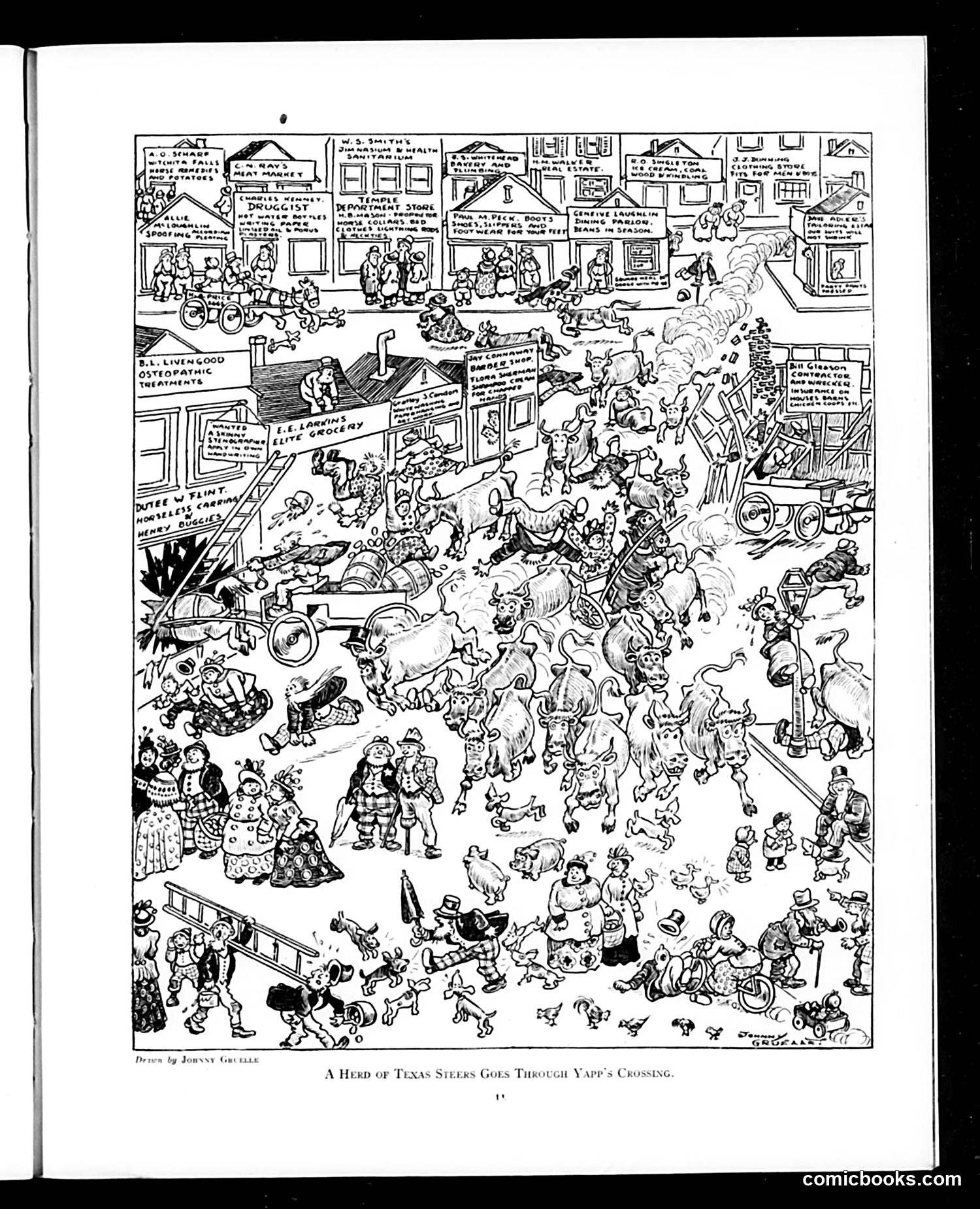
This is a chaotic street scene by Johnny Gruelle depicting cattle stampeding through an urban intersection. The cartoon satirizes the collision of rural and urban life—massive Texas longhorns (symbols of the American West) are herding wildly through a crowded city street, causing mayhem among pedestrians, vehicles, and storefronts. The storefronts visible at top suggest this is a commercial district. The "Yapp's Crossing" reference appears to be a specific location, though unclear to modern readers. The humor derives from the absurdity of frontier livestock invading civilized urban space, trampling and disrupting everything—a commentary on industrializing America's tension between its Wild West past and modern city life.
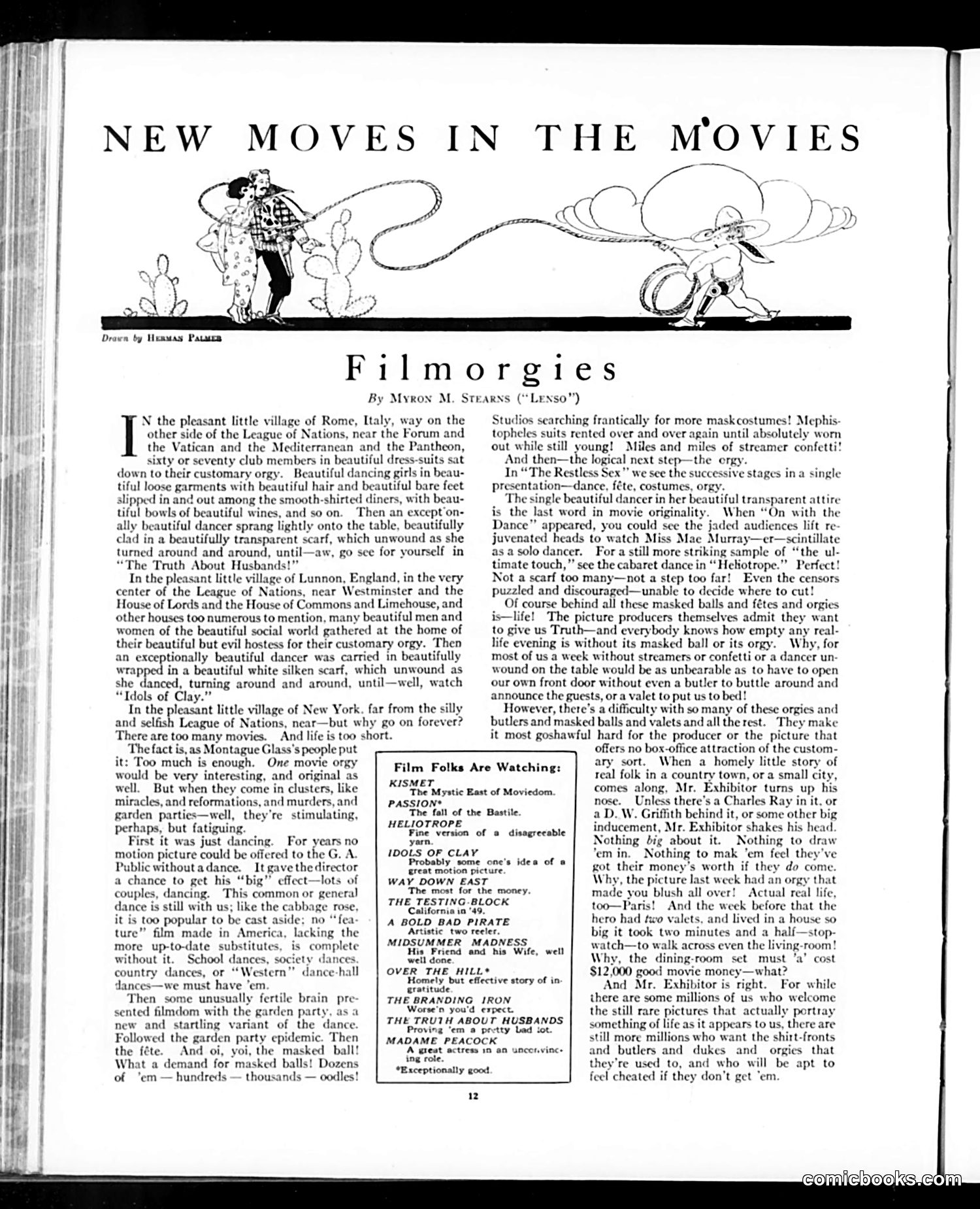
This is satirical film criticism disguised as a humorous article. Author Myron Stearns ("Lenso") mocks what he sees as lazy, repetitive filmmaking conventions of the early 1920s. The piece describes three fictional films set in Rome, London, and New York—each featuring identical "orgy" scenes with beautiful dancers in transparent scarves. This isn't actual scandal; it's satire highlighting that studios have become formulaic: they chain together dance sequences, garden parties, masked balls, and orgies in every picture, regardless of plot. Stearns's complaint: studios are exhausted the novelty. What once thrilled audiences—a single dancing girl—now appears in clusters ("miracles, reformations, and murders") until it becomes fatiguing. He argues producers lack imagination, recycling the same expensive set pieces because "too much is enough." The sidebar listing current films suggests these patterns are genuinely occurring in real releases of the era, making the satire pointed criticism of Hollywood's creative bankruptcy during this period.
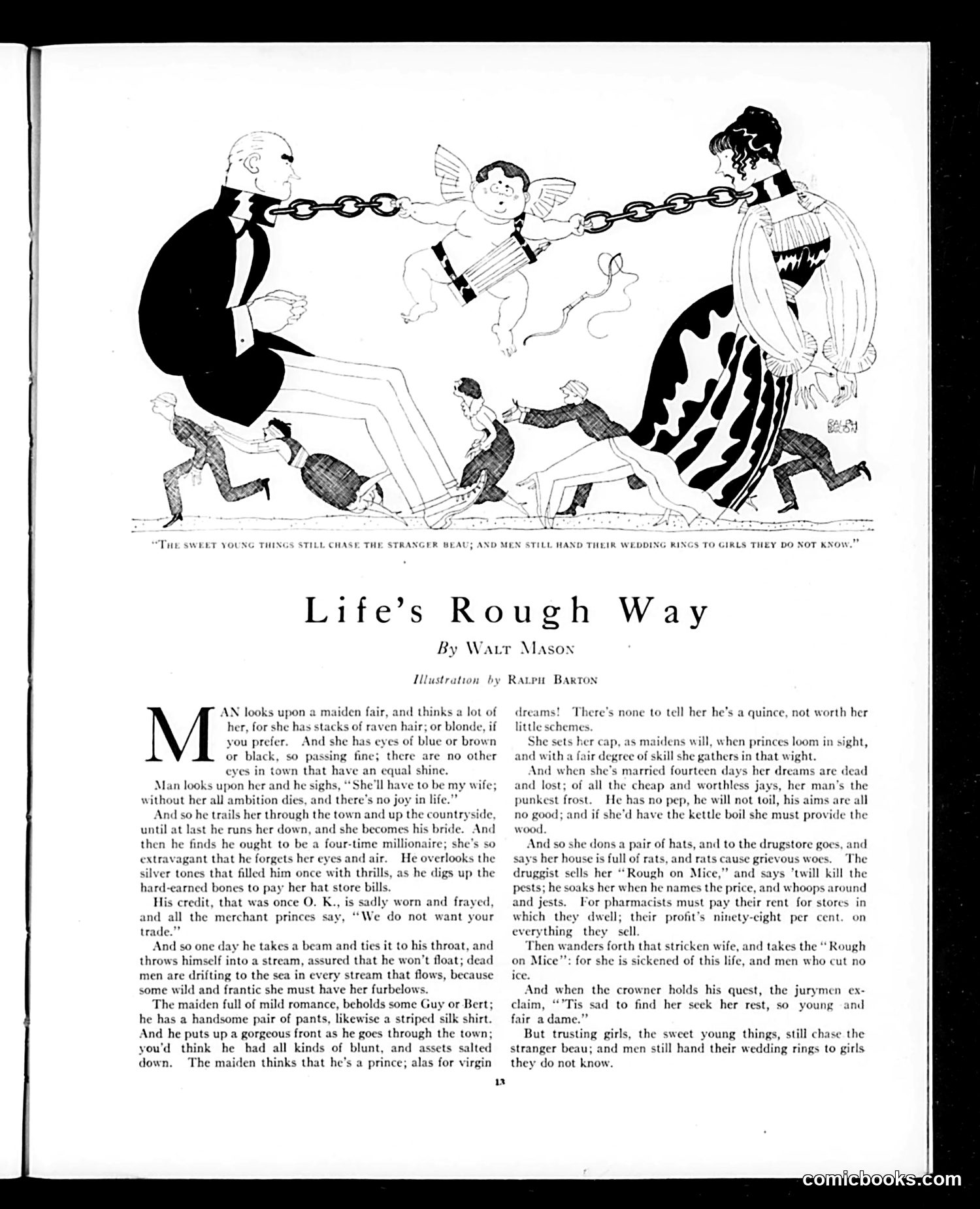
This satirical poem, illustrated by Ralph Barton, critiques romantic naivety and the harsh realities of marriage. The cartoon shows two couples connected by chains—representing marital entanglement—with cherubs and smaller figures caught in the middle. The narrative follows a familiar pattern: men pursue women based on superficial attractions, then discover their wives are financially extravagant; women chase charming but worthless suitors who prove lazy and unreliable after marriage. Mason's moral centers on disillusionment—neither gender sees reality before committing. The darkest element: the poem ends with the trapped wife purchasing rat poison ("Rough on Mice"), implying suicide as her escape from a miserable marriage. The final couplet's resigned tone—"sweet young things still chase the stranger beau"—suggests this cycle perpetually repeats despite its tragic consequences. The satire targets romantic fantasy colliding with economic and domestic reality in early 20th-century America.
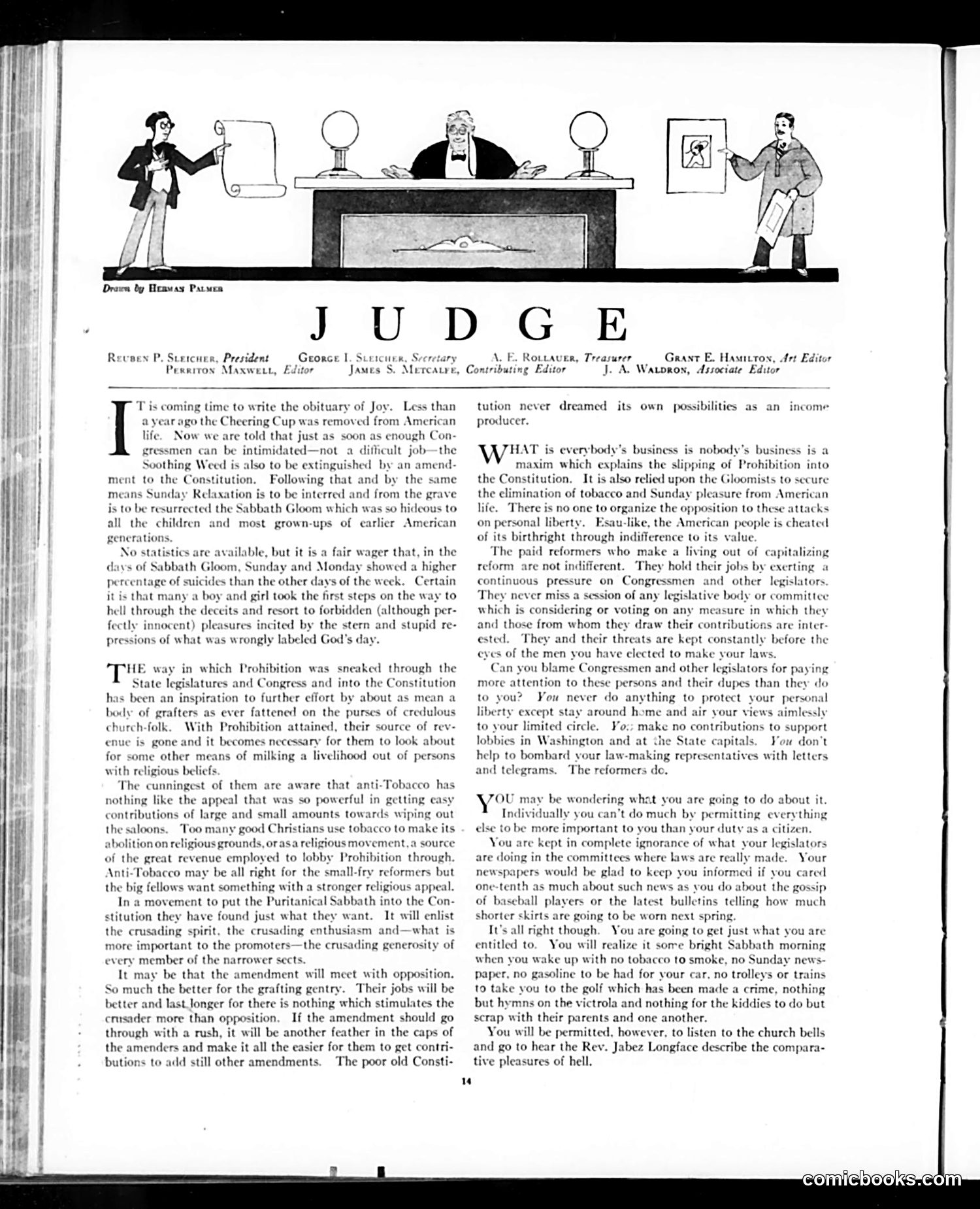
This page's masthead cartoon depicts a courtroom scene labeled "JUDGE," showing a magistrate at a bench flanked by two men holding papers—likely representing opposing legal arguments or testimony. The editorial text below satirizes the emerging reform movement, particularly targeting Prohibition (recently passed via Constitutional amendment) and the upcoming anti-tobacco and "Sabbath observance" campaigns. The author argues these reforms are driven not by genuine moral conviction but by professional reformers seeking continued income and power. The satire's key targets are: - **Prohibition advocates** who used religious appeals to "milk" donations from credulous church members - **Professional reformers** who manufacture perpetual campaigns to maintain employment and influence - The **exploitation of religious enthusiasm** to push constitutional amendments beyond voters' considered judgment The piece warns that Americans' indifference allows organized reform movements to systematically strip away personal liberties—tobacco use, Sunday leisure, alcohol consumption—by pressuring legislators while opposition remains unorganized. The Constitution itself becomes merely an "income producer" for reformers seeking the next crusade.
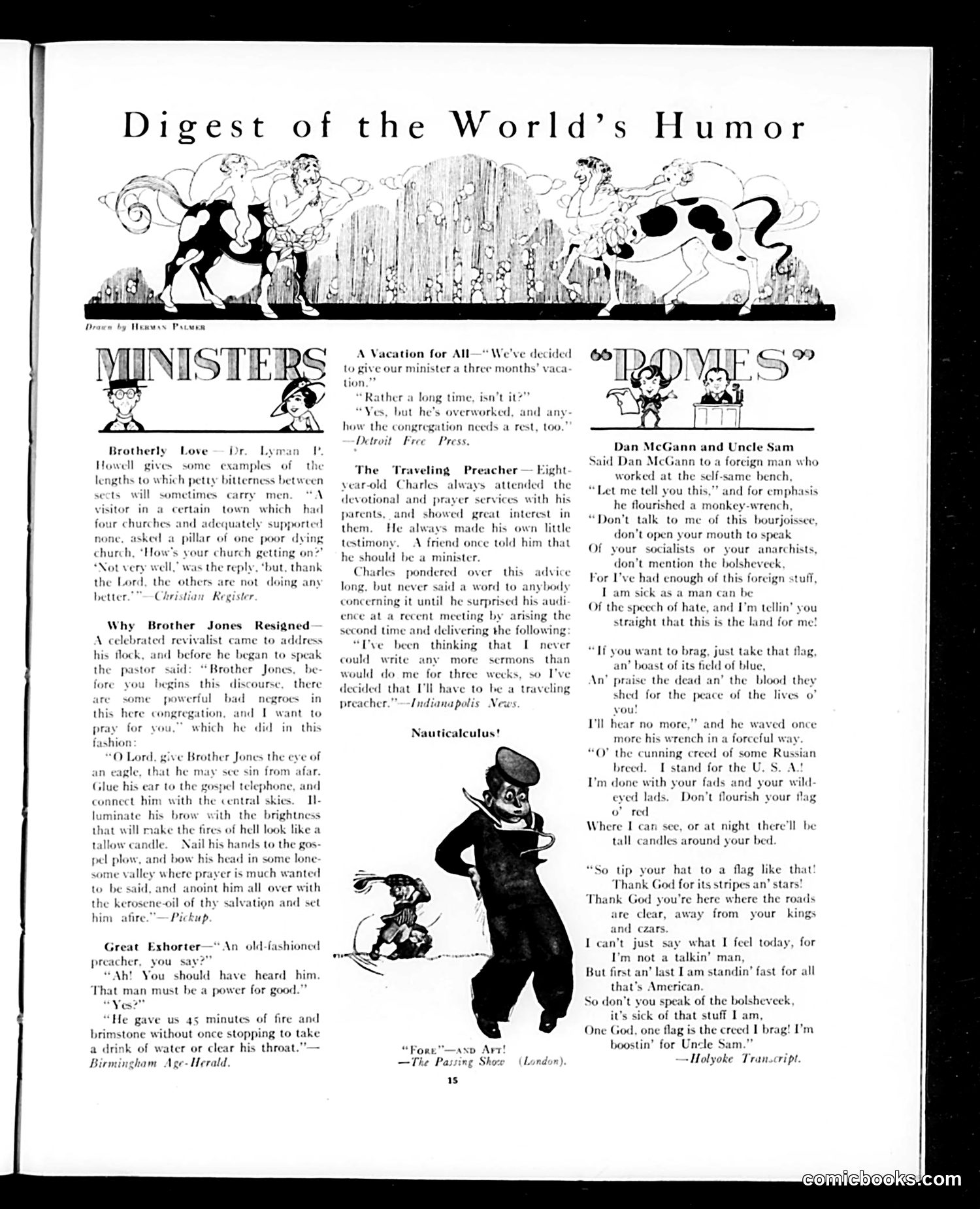
This page collects humorous anecdotes about American religious life and patriotism, likely from the 1920s. The pieces mock: **Religious hypocrisy**: Stories like "Brotherly Love" satirize petty sectarian rivalries between churches, and "Why Brother Jones Resigned" ridicules overwrought revival preaching with absurd, flowery language ("kerosene-oil of thy salvation"). **Ministerial burnout**: "A Vacation for All" jokes that congregations need rest from their overworked pastors as much as pastors need vacation. **The traveling preacher anecdote** gently mocks a child's literalist reasoning about sermon-writing. **"Dan McGann and Uncle Sam"** appears to be patriotic verse defending American identity against foreign ideologies—likely anti-communist/anti-Bolshevik sentiment post-WWI, emphasizing American exceptionalism and rejecting "fads," anarchism, and Russian creeds. It celebrates manual labor, the flag, and American values. The cartoons feature exaggerated character types typical of early-20th-century satirical illustration.
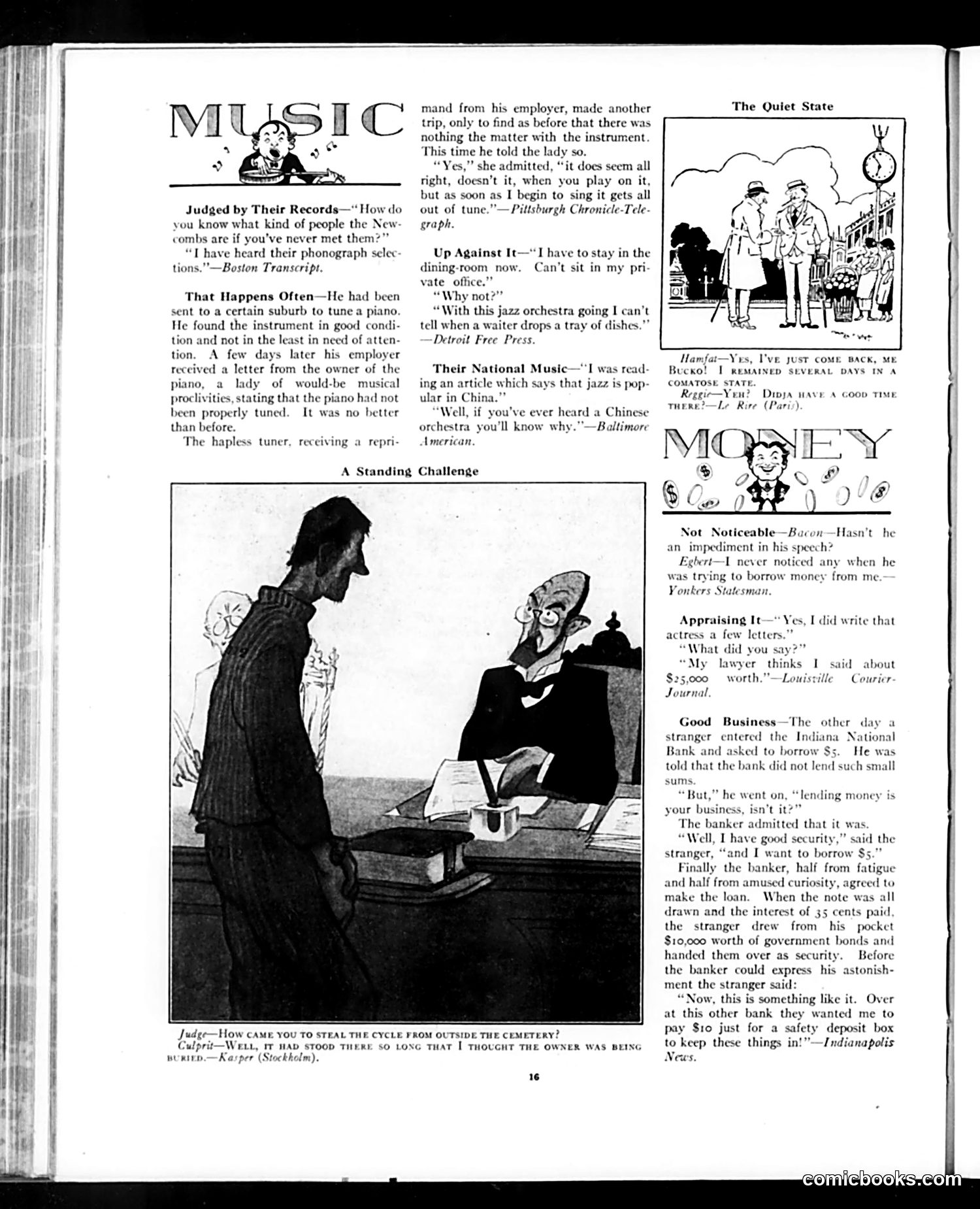
This page contains several brief satirical anecdotes mocking human behavior and social absurdities: **The main cartoon** (center) depicts a man confronting a woman at a desk, captioned about stealing a bicycle from a cemetery. The joke: he kept the cycle there so long he assumed the owner was dead—dark humor about negligence. **The text pieces** mock various social types: a phonograph-obsessed family judged by their poor taste in music; a piano tuner repeatedly called back by a vain woman who sings badly; complaints about jazz orchestras; and a banker who nearly loses business by refusing a $5 loan, only to discover the customer has $10,000 in government bonds as security—satirizing rigid banking practices. **"The Quiet State" cartoon** (upper right) shows people in a "comatose state," likely mocking boring or sleepy locations. The page reflects 1920s concerns: emerging jazz culture (seen as chaotic), consumer pretension, banking conservatism, and general human foolishness. The humor relies on exaggeration of recognizable social situations.
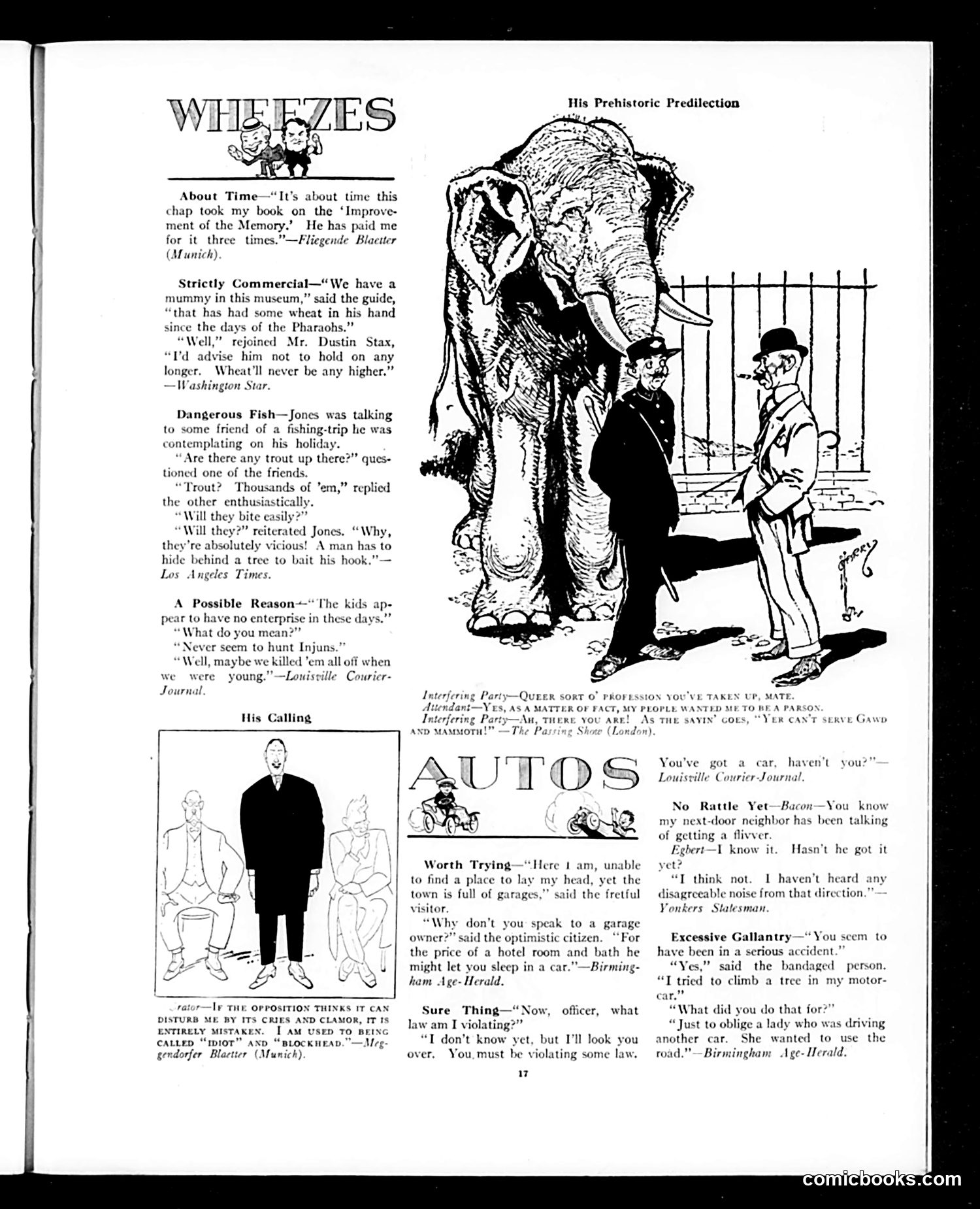
This is a humor/joke page from *Judge* magazine featuring brief comic anecdotes about early 20th-century life. The cartoons and quips satirize contemporary social attitudes and emerging technologies: **"His Prehistoric Predilection"** (main cartoon): Shows a man presenting an elephant to two onlookers. The satire targets wealthy collectors and museums acquiring exotic specimens—mocking the casual commercialization of natural history and the assumption that primitive/ancient things are inherently valuable. **Automobile jokes dominate the lower half**, reflecting the novelty and cultural impact of cars. "No Rattle Yet" jokes that a neighbor's car hasn't arrived because no one hears the characteristic noise—cars were loud, unreliable machines. "Excessive Gallantry" satirizes traffic chaos and chivalry, with a man climbing a tree in his motorcar to yield the road to a lady driver—absurd but depicting genuine early automotive confusion. **"Worth Trying"** mocks economic desperation (homelessness) and garages emerging as business alternatives to hotels. The shorter quips target human memory, museum curators, fishing lies, and Native American history with period stereotypes typical of early 20th-century American humor.
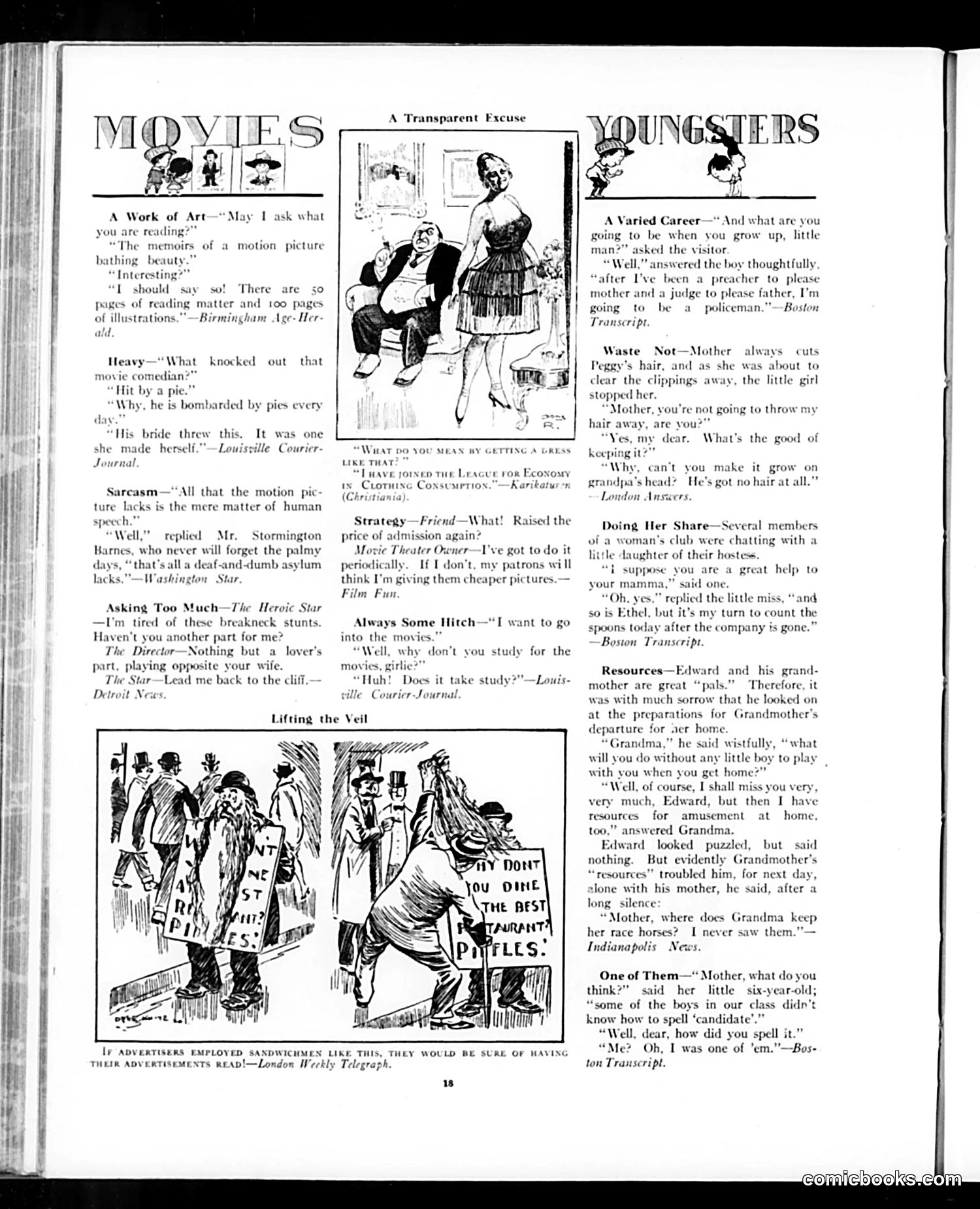
This page collects brief humorous anecdotes and jokes typical of early 20th-century American humor. Key targets include: **Movies/Film Industry**: Multiple jokes mock silent film conventions—slapstick comedy (pies in faces), melodramatic plots, and the industry's focus on visual spectacle over substance. One quip notes motion pictures lack "the mere matter of human speech," likely referencing the transition toward talkies. **Gender/Social Roles**: Jokes about women wanting movie careers, mothers managing household duties, and children's career aspirations reflect period gender norms and family dynamics. **Class Commentary**: The bottom cartoon satirizes advertising by showing sandwich-board men (working-class advertisement carriers) literally wearing text—suggesting advertisers resort to crude, intrusive methods. The caption implies advertisers would guarantee readership through such aggressive tactics. **Children's Humor**: Several anecdotes feature children misunderstanding adult concepts (horses as "resources," spelling "candidate"), providing gentle comedy about innocence. The overall tone is lighthearted social observation rather than sharp political satire, reflecting Judge's role as mainstream entertainment commentary.
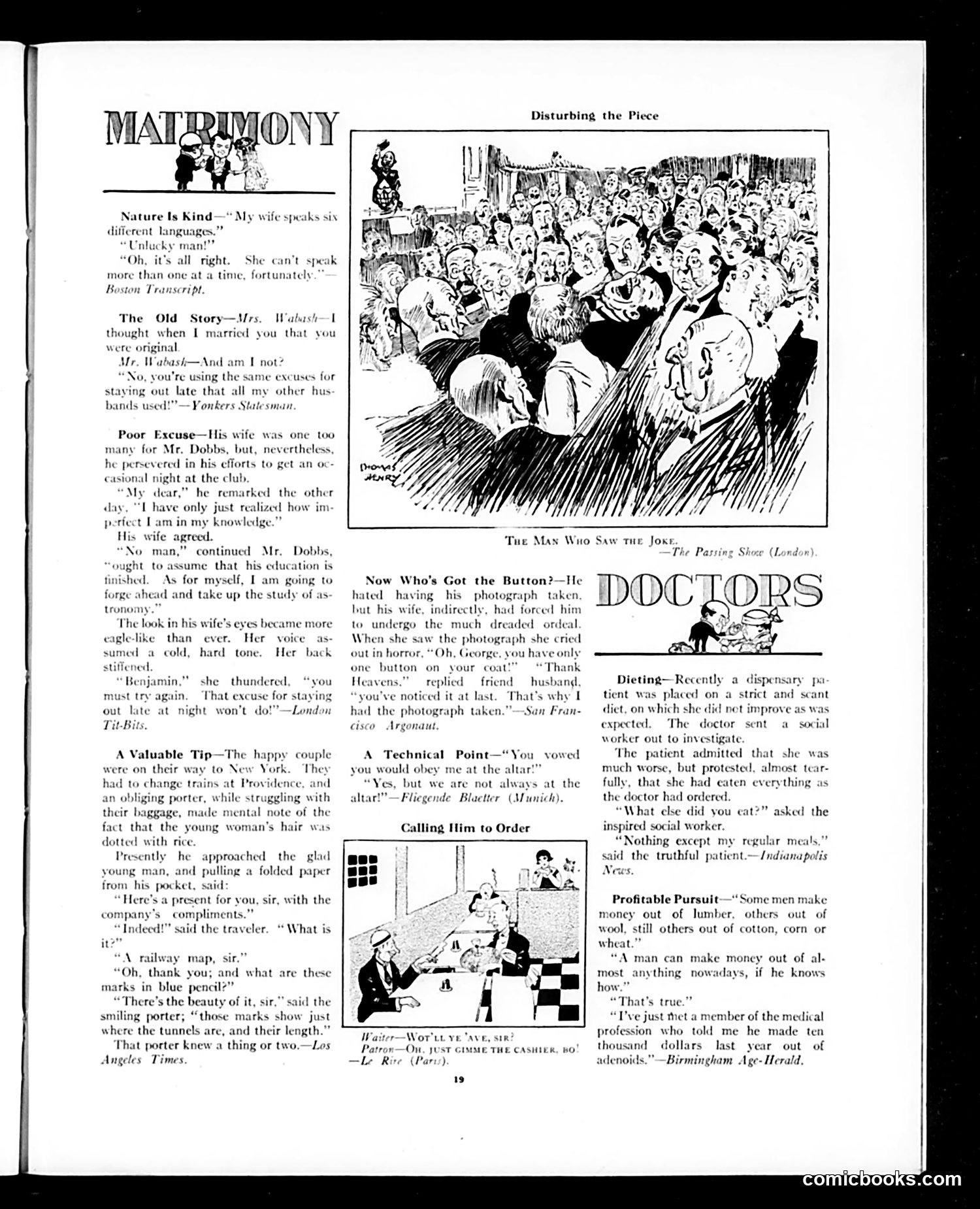
This page contains multiple short humor pieces typical of early 20th-century satirical magazines, targeting domestic life and social conventions. **"The Old Story"** and **"Poor Excuse"** satirize married men's transparent excuses for avoiding home—worn-out lines about self-improvement (astronomy study) that foolishly assume wives won't notice the repetition. The humor targets male dishonesty in marriage. **"Now Who's Got the Button?"** mocks a husband's vanity: his wife forced him to sit for an unflattering photograph, where he appears missing a coat button. He ironically thanks her for noticing—the only reason he had the photo taken was to document this embarrassment, apparently. **"Calling Him to Order"** shows a diner demanding "the cashier" instead of food—a working-class character's blunt, direct approach to getting a bill. **"Dieting"** portrays a social worker investigating a patient's failure to improve on a prescribed diet, only to discover the patient ate her "regular meals" *in addition to* the diet—missing the restriction's point entirely. These sketches reflect period anxieties about marriage, class manners, and modern institutional life (healthcare, dining).
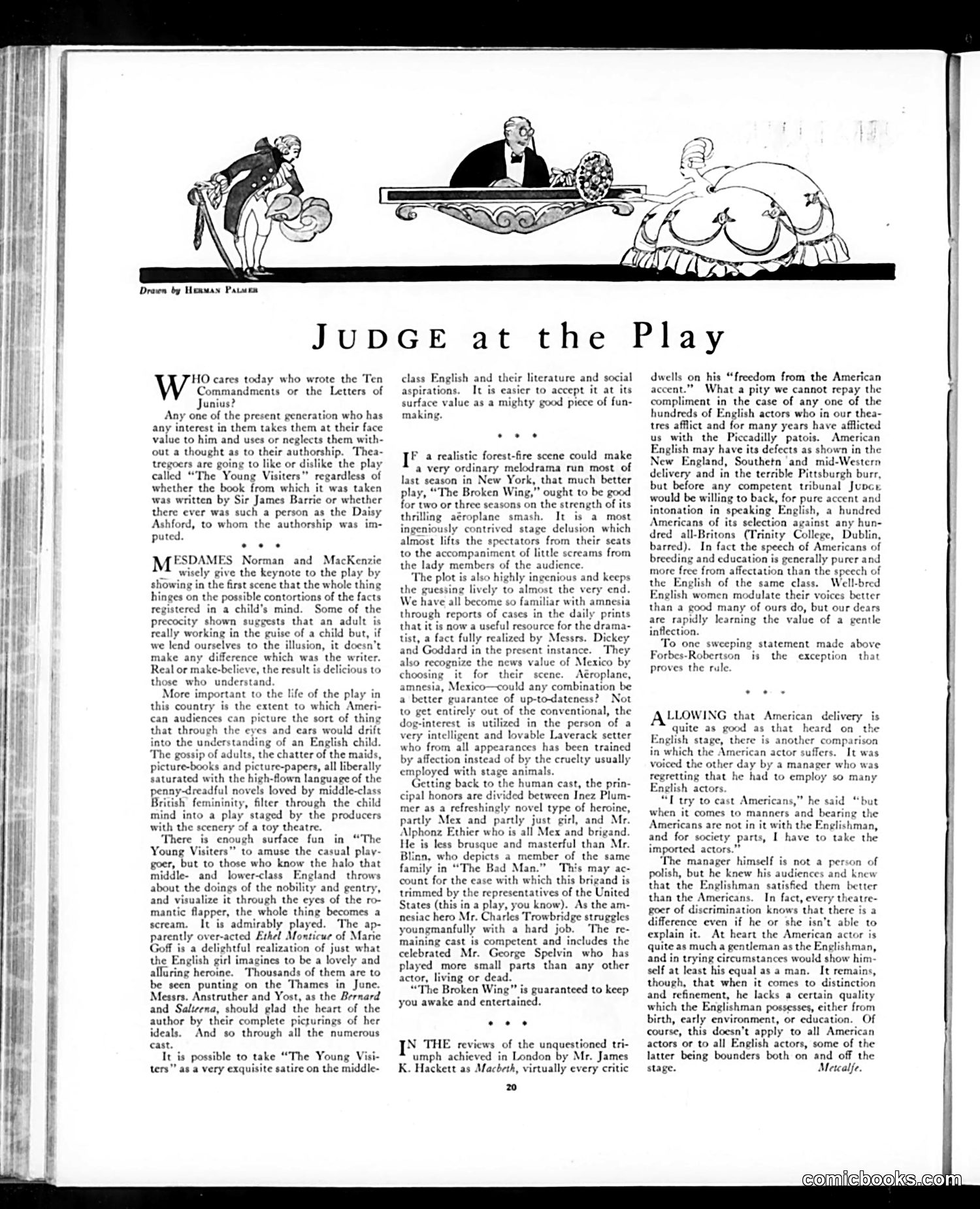
This is a theater review column titled "Judge at the Play." The cartoon header (drawn by Herman Palmer) depicts a judge presiding over theatrical performances, establishing the satirical premise of critiquing plays. The text reviews two productions: "The Young Visiters" and "The Broken Wing." The critic discusses how audiences accept stage illusions regardless of authorship details—mirroring the opening reference to the Ten Commandments and Letters of Junius. "The Young Visiters," apparently adapted from a book of disputed authorship (possibly by child author Daisy Ashford), is praised for its satirical portrayal of middle-class English society viewed through a precocious child's eyes. The reviewer notes American audiences may struggle understanding English social hierarchies and their romanticization by lower classes. "The Broken Wing" is reviewed favorably for its thrilling airplane crash scene and plot device using amnesia—topical elements (Mexico, aviation, amnesia cases) the critic notes guarantee contemporary appeal. The column exemplifies Judge magazine's theatrical commentary blending plot summary with social observation.
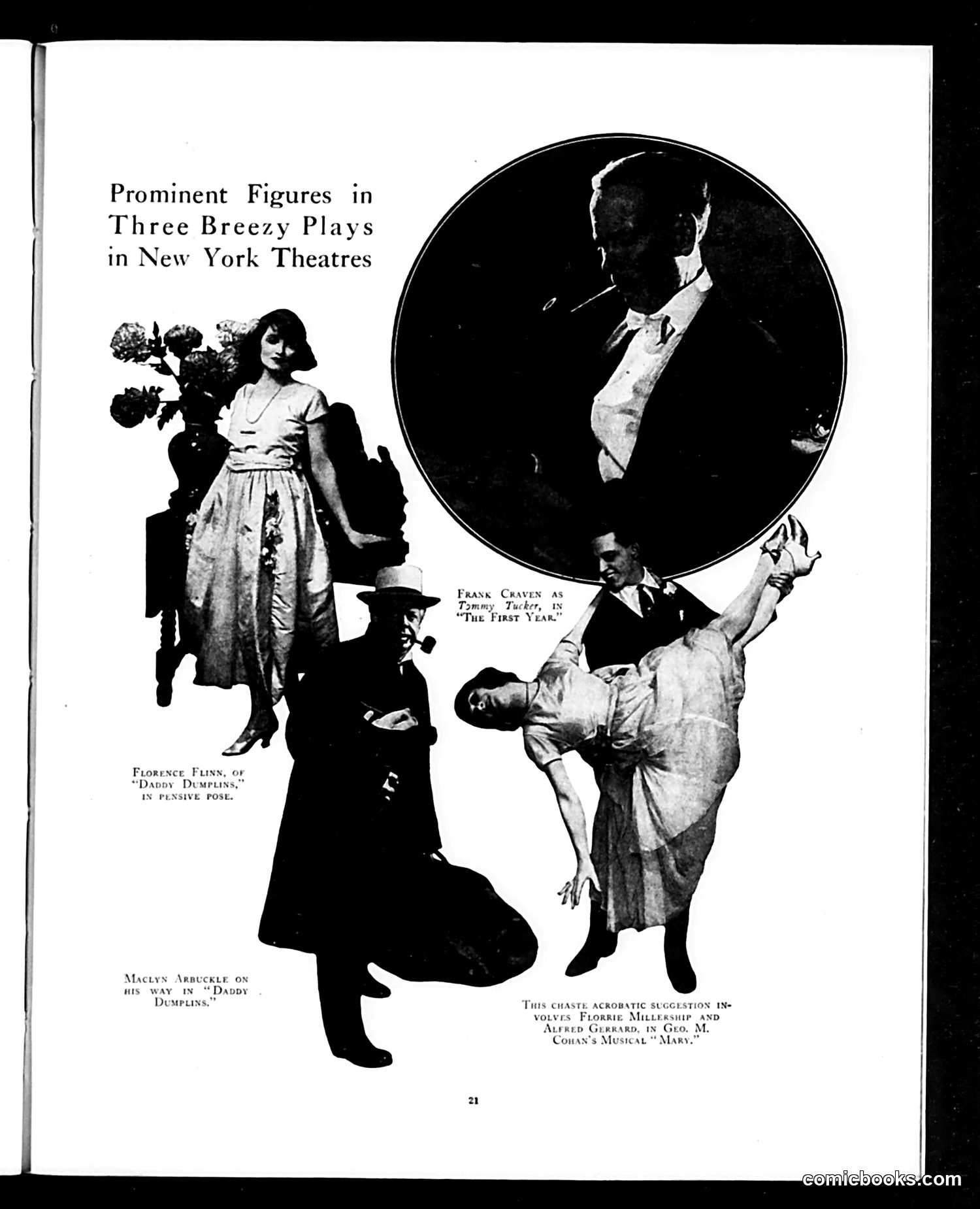
This page showcases prominent theatrical performers from three Broadway productions of the era. It features: **Frank Craven** in "The First Year" (top circle) **Florence Flinn** in "Daddy Dumplings" (left, in pensive pose) **Maclyn Arbuckle** in "Dappy Dustins" (bottom left, in an acrobatic pose) **Florrie Millership and Alfred Gerrard** in George M. Cohan's musical "Mary" (bottom right) Rather than political satire, this appears to be **entertainment coverage** — Judge magazine promoting popular theatrical productions to its readers. The "breezy" title suggests these are light comedies or musicals. The photographs showcase actors in characteristic poses or costumes from their respective plays, functioning as promotional material for New York theater audiences of the period.
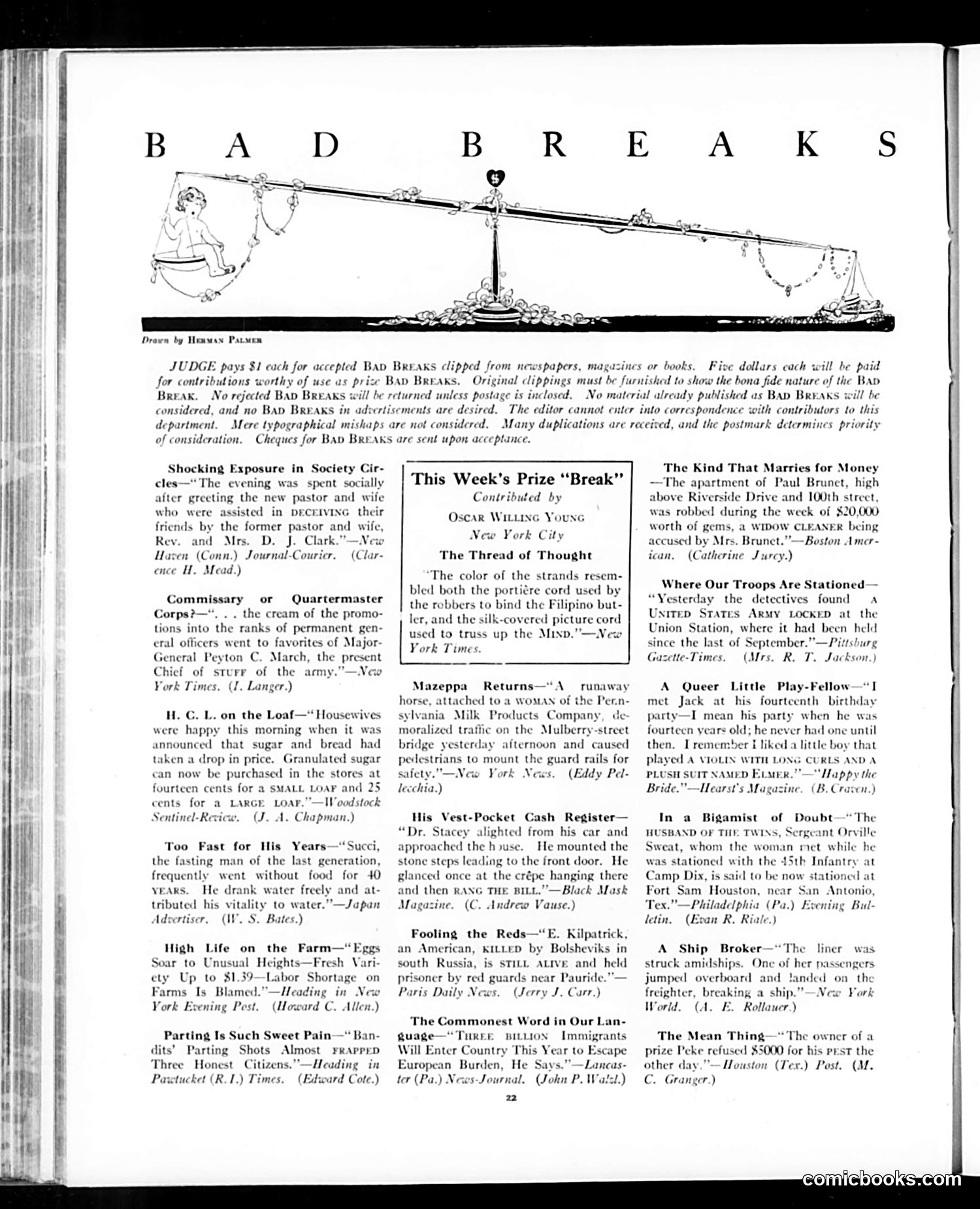
This page from *Judge* magazine showcases "Bad Breaks" — humorous typographical errors and awkward phrasing clipped from newspapers and magazines. The cartoon at the top illustrates the concept through a visual scale: errors are accepted and paid for based on quality. The examples mock real newspaper blunders: a pastor accused of "DECEIVING" guests (likely "RECEIVING"), sugar prices measured in "SMALL LOAP" instead of "LOAF," an American killed by Bolsheviks who is "STILL ALIVE," and a doctor who "RANG THE BILL" rather than rang a doorbell. These aren't politically targeted—they're general absurdist humor about journalistic carelessness. The satire works by exposing the unintended meanings created by missed letters, misplaced words, or editorial oversights. The page itself functions as both entertainment and mild critique of press quality during the post-WWI era, when this appears published.
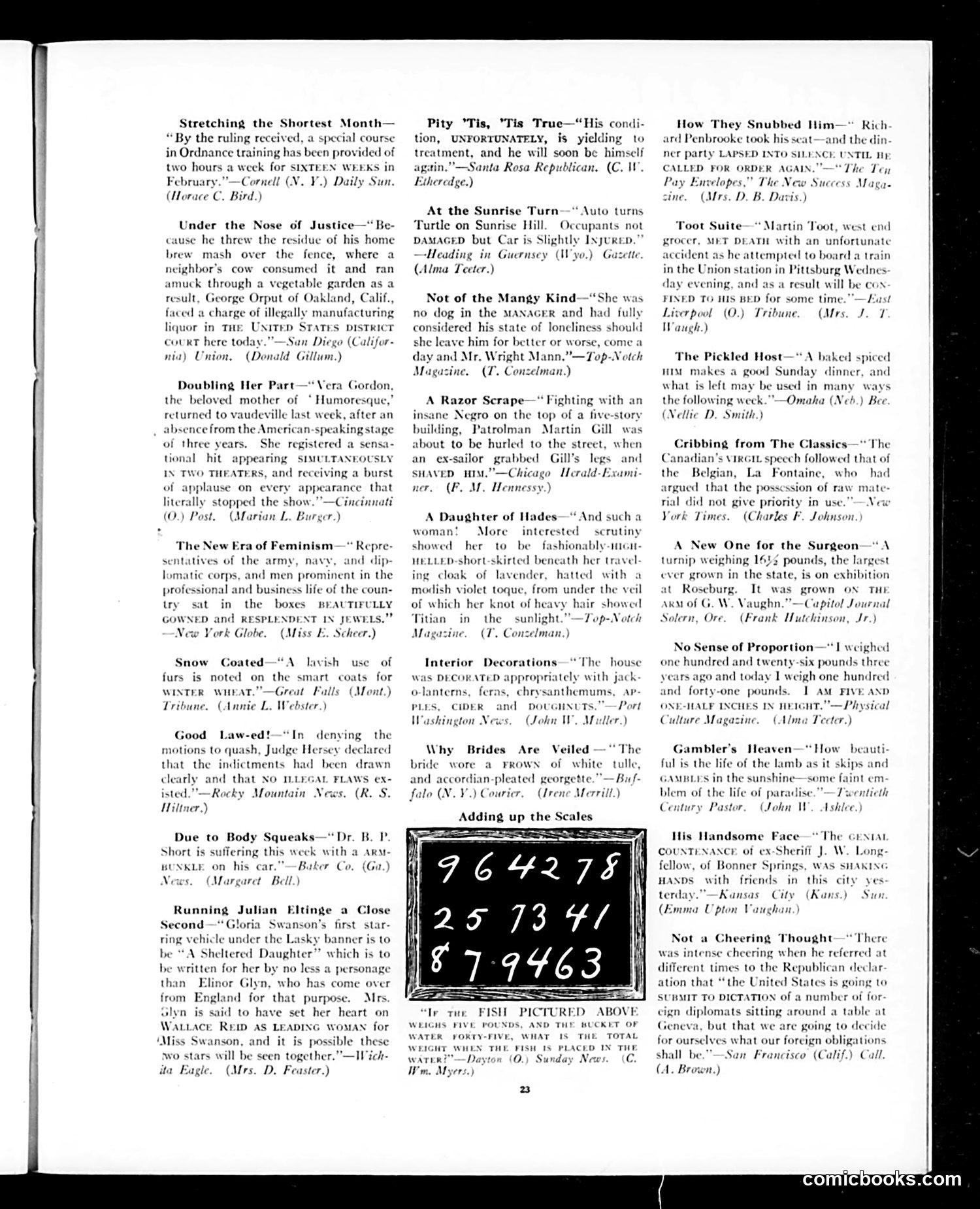
This page from *Judge* magazine consists primarily of a humor column featuring typographical errors and absurd phrasings extracted from newspapers—a regular satirical feature mocking poor editing and unintentional comedy in journalism. Key examples highlighted in all-caps ridicule: - A military training course somehow scheduled for "SIXTEEN WEEKS in February" (physically impossible) - A judge who denied motions while claiming indictments had "NO ILLEGAL FLAWS" (contradictory) - A bride wearing a "FROWN of white tulle" (obviously should be "gown") The satire targets newspapers' careless proofreading and editors' inability to catch obviously nonsensical phrases before publication. The column appears designed to entertain sophisticated readers by showcasing the incompetence of provincial and metropolitan newspapers alike. A mathematical puzzle ("Adding up the Scales") is embedded at page bottom, typical of *Judge's* mixed-format entertainment content.
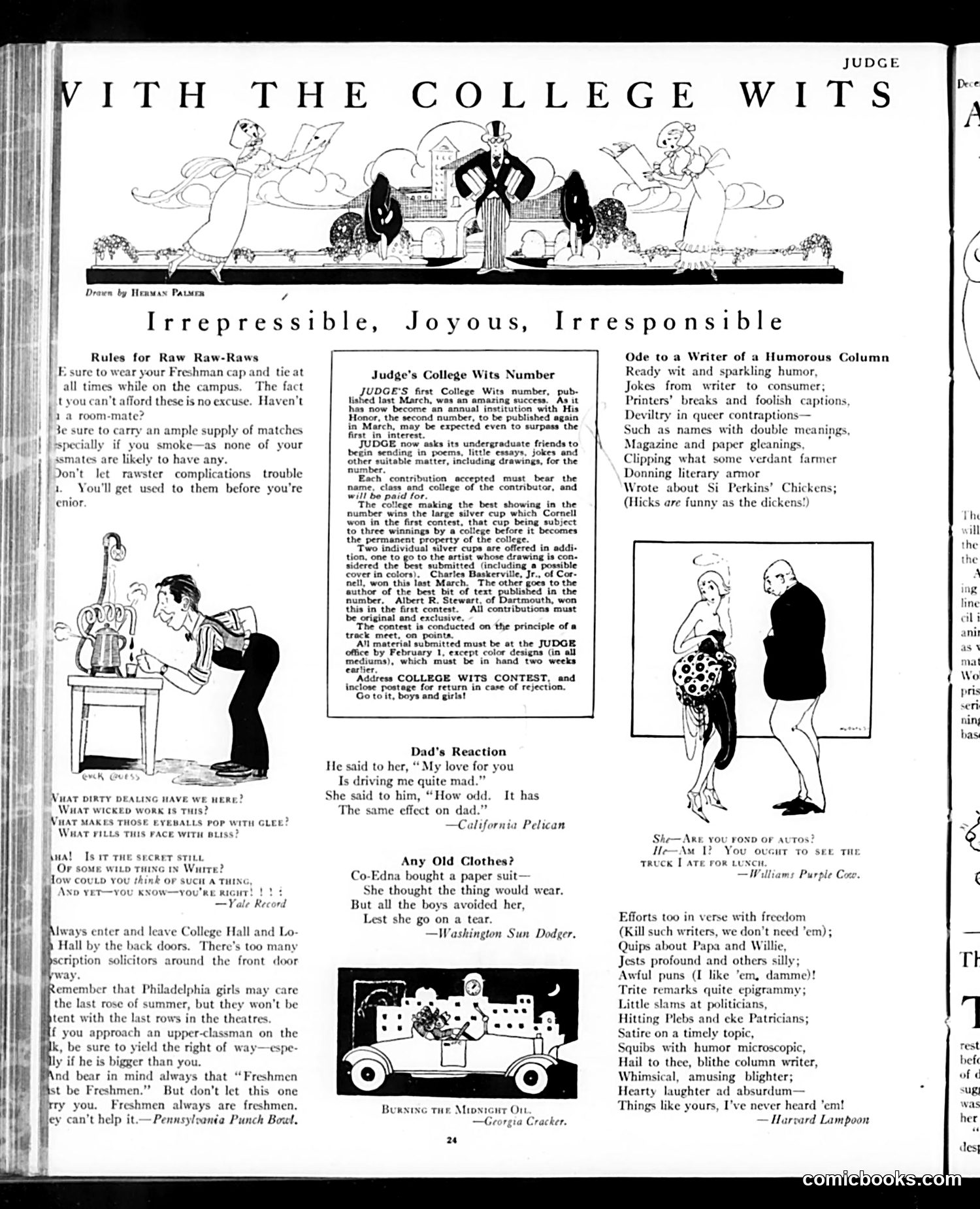
This is Judge magazine's college humor section, featuring undergraduate submissions competing for prizes. The page contains: **Main Content:** Rules for college freshmen (hazing advice), advice columns, and student-written poems/jokes about college life. The humor targets typical college experiences: freshman initiations, co-eds, dating, and campus social dynamics. **Key Items:** - A contest announcement offering silver cups to winning colleges, artists, and writers - Poems mocking relationships ("Dad's Reaction") and co-ed fashion ("Any Old Clothes?") - Cartoon illustrations of college social situations (one showing a couple discussing automobiles) - An "Ode to a Humorous Column Writer" satirizing low-quality humor writing **Context for Modern Readers:** This reflects early 20th-century college culture when such magazines regularly published undergraduate humor. The jokes are gentle by modern standards, focusing on innocent romantic mishaps, freshman hazing traditions, and satirizing mediocre writing—typical of college publications then. The gender dynamics (references to "co-Edna," Philadelphia girls) reflect period attitudes toward women in higher education.
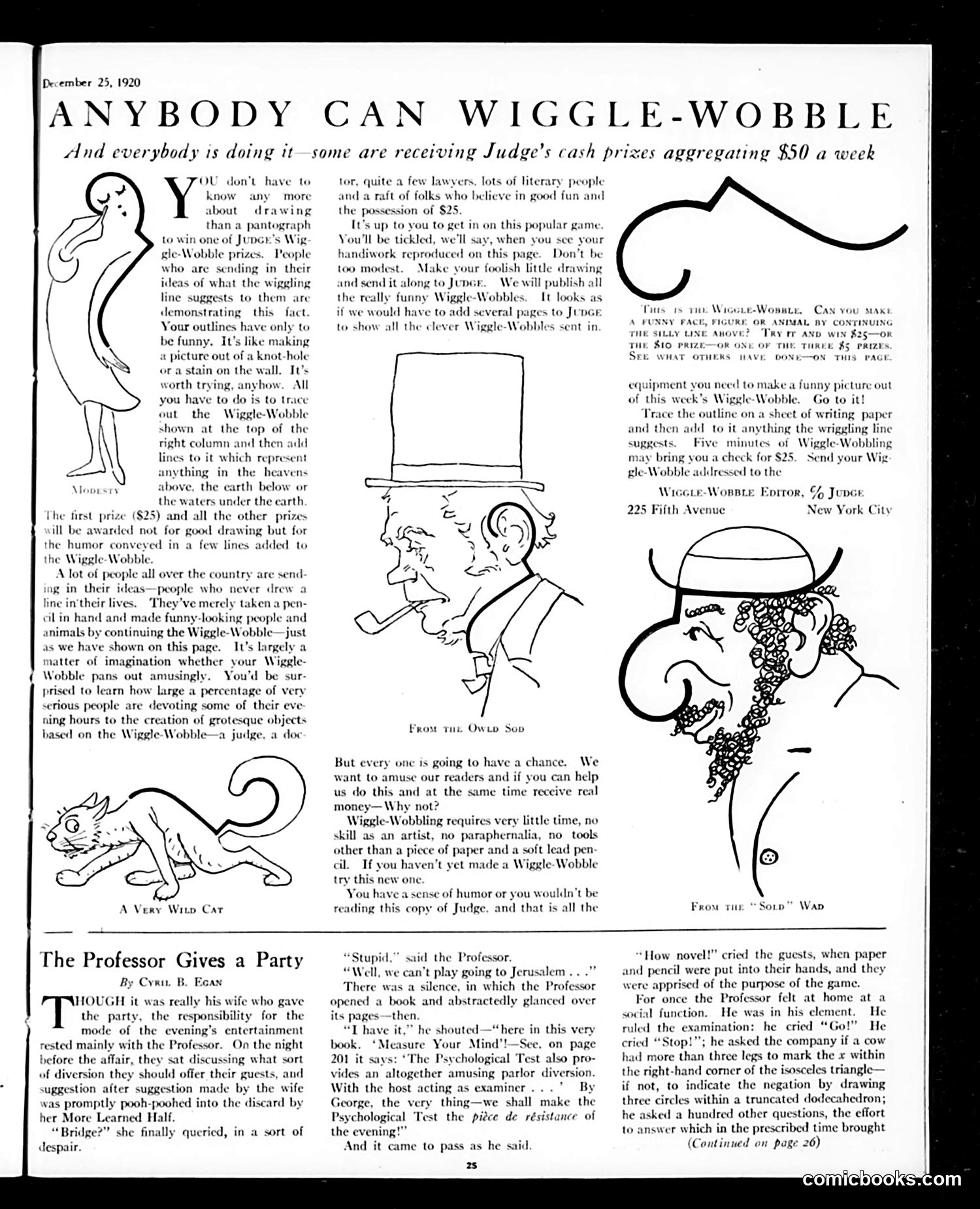
This page promotes Judge's popular "Wiggle-Wobble" drawing contest—a democratized art game requiring no skill. Readers trace a squiggly line (shown at top right) and add their own lines to create recognizable figures: animals, people, or objects. The contest offers weekly cash prizes ($25 first place, plus $5 prizes), with winners chosen for humor rather than artistic ability. The appeal is explicit: "anybody" can participate—lawyers, literary people, and non-artists nationwide are submitting entries. Three example Wobbles appear: "Modesty" (a figure), "A Very Wild Cat," and two others labeled "From the Old Sod" and "From the 'Sole' Wad." This reflects 1920s American consumer culture: Judge monetizes reader participation while democratizing creative expression as mass entertainment, positioning humor and imagination as accessible to all social classes.
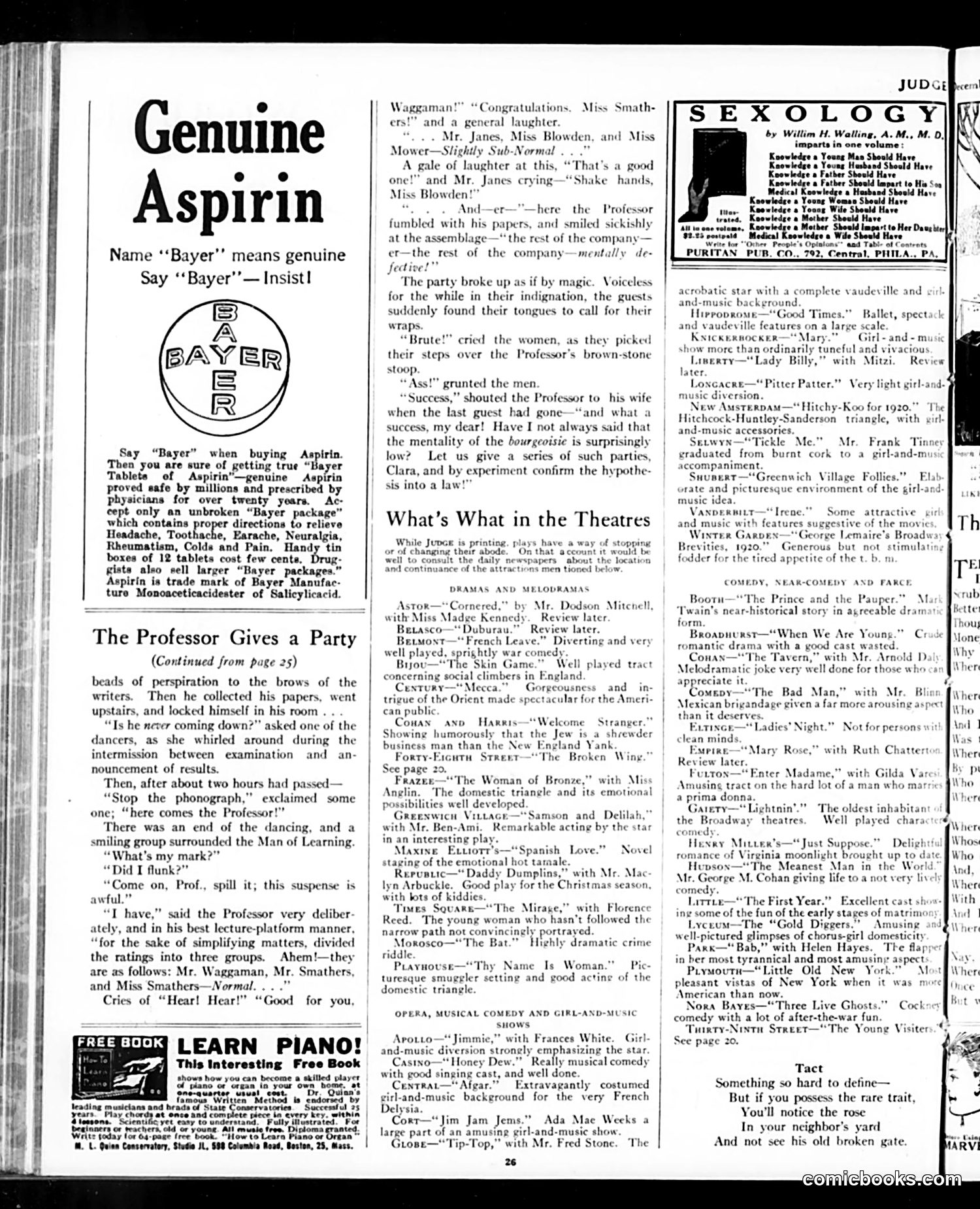
This page is primarily **advertising and entertainment listings**, not political satire. The dominant content is a **Bayer Aspirin advertisement** (top left), emphasizing brand authenticity during an era when "Bayer" was a trademark fight—the company needed to distinguish genuine aspirin from competitors. The urgent tone ("Say 'Bayer'—Insist!") reflects early 20th-century consumer marketing. The main article, "The Professor Gives a Party," is a **humorous social commentary** about class pretension. A professor divides party guests into grades—"Normal," "Slightly Sub-Normal," and "Mentally Deficient"—offending guests by ranking them like students. The satire mocks academic arrogance and social snobbery; the professor concludes he'll repeat such parties to "confirm the hypothesis into a law," lampooning pseudo-scientific justifications for class hierarchy. The right column contains **theater and entertainment reviews**—standard magazine fare listing current Broadway productions. **Historical context**: This reflects 1920s anxieties about class mobility and intellectual elitism in urban America.
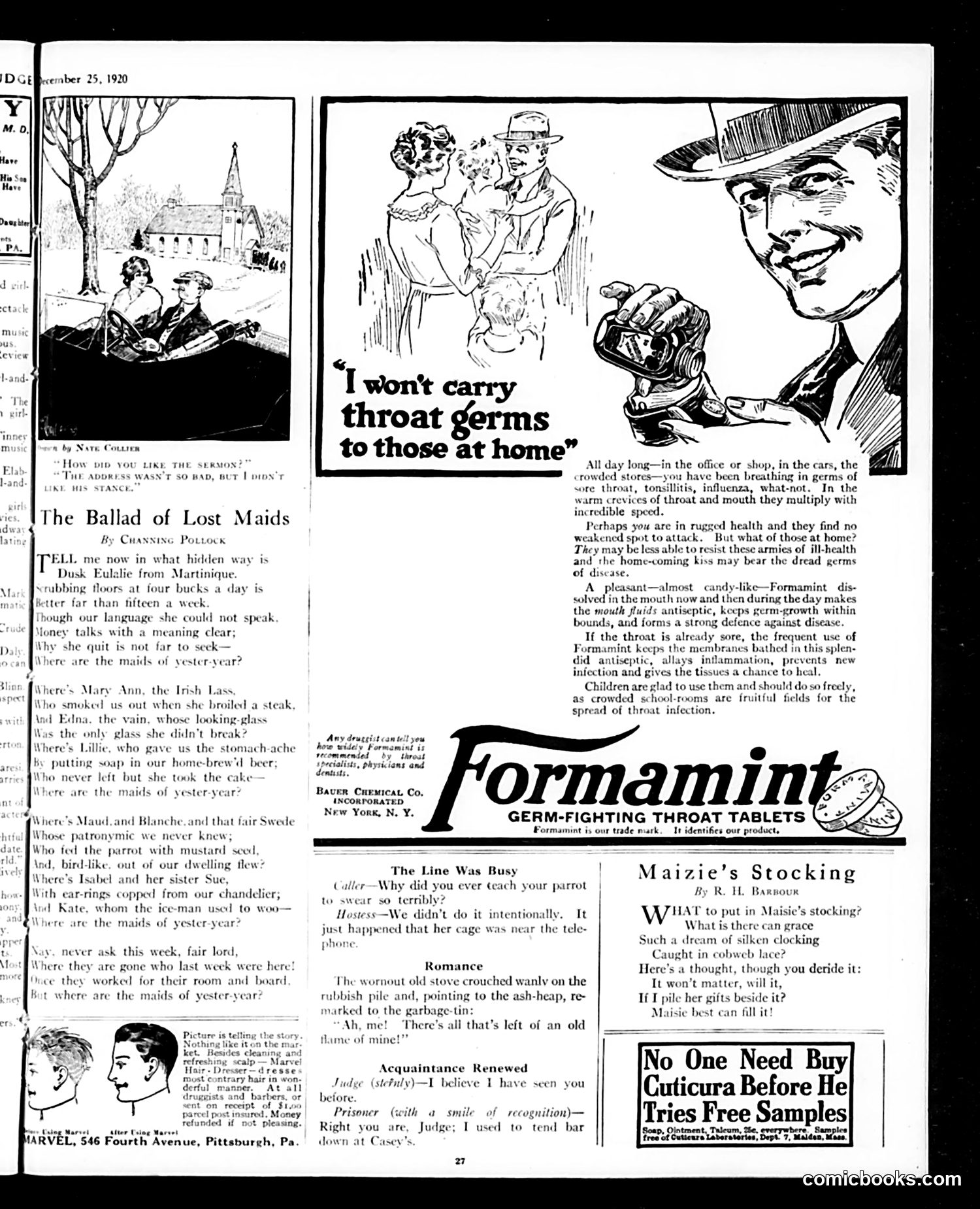
This page is primarily **advertising and light humor** rather than political satire. Key content: **"The Ballad of Lost Maids"** is a nostalgic poem lamenting the disappearance of domestic servants—a real social problem of the 1920s. Post-WWI labor shortages and women's changing opportunities made household help scarce and expensive, shifting from "$15 a week" to "$4 a day." The **Formamint advertisement** addresses public health anxiety about germs spreading from workplaces to families during the influenza era (the 1918-1920 pandemic was still recent). The ad targets affluent readers worried about bringing illness home. The remaining content includes minor humor pieces: a parrot learning to swear near a telephone, a romantic anthropomorphization of garbage, and a judge recognizing a former bartender—all conventional light jokes typical of the era's magazine humor. The page reflects contemporary concerns (servant shortage, disease transmission) but contains no identifiable political figures or satire.
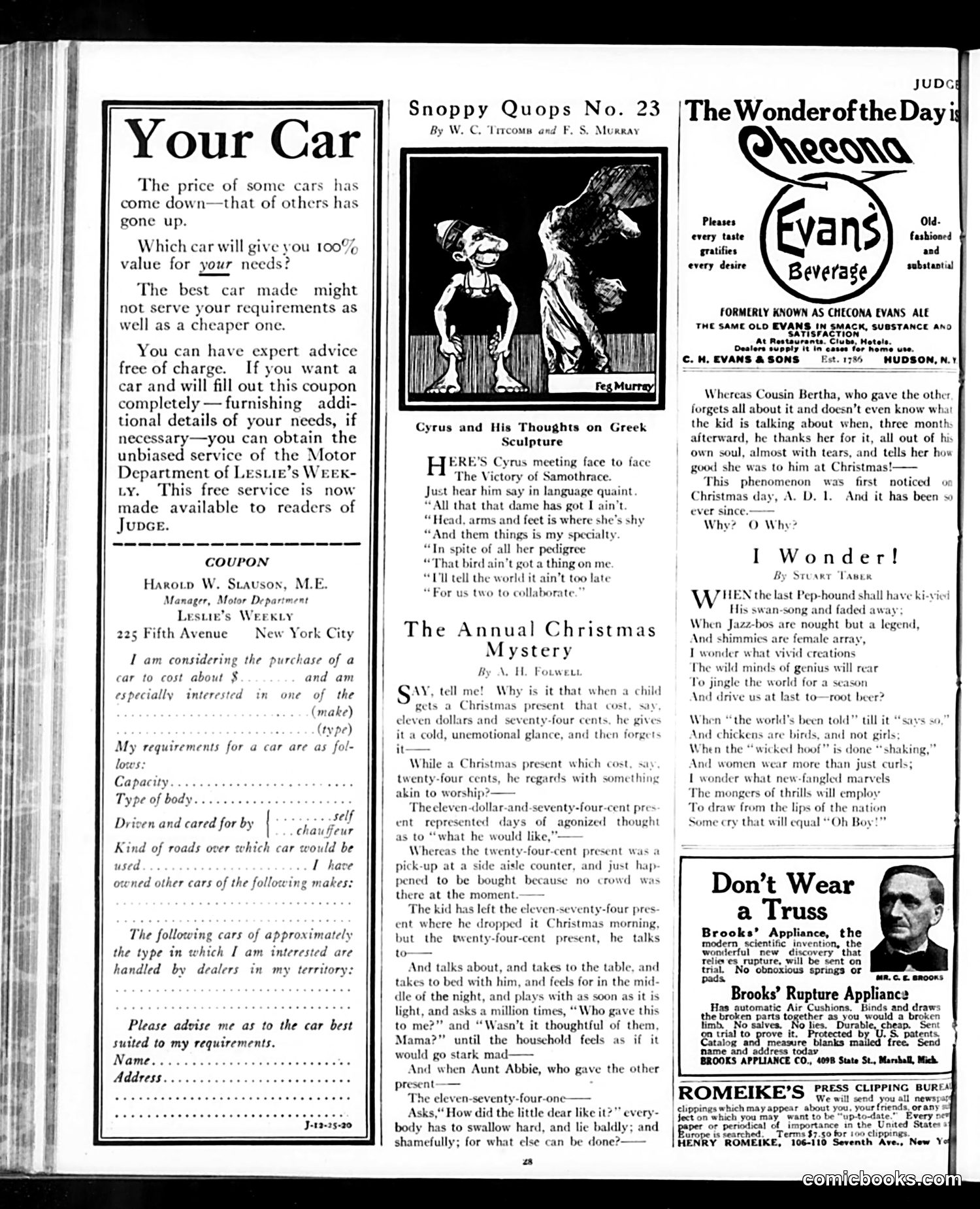
This page mixes advertisements with light satirical content typical of Judge magazine's era. **"Snoppy Quops No. 23"** is a humorous cartoon depicting a character named Cyrus admiring the classical sculpture "Victory of Samothrace." The joke is crude physical humor: Cyrus boasts that the armless, headless statue lacks body parts that are "his specialty," suggesting he's more physically impressive. The satire gently mocks both pretentious art appreciation and working-class bravado. **"The Annual Christmas Mystery"** is a brief humorous essay questioning why children treasure cheap, thoughtless gifts ($0.24) far more than expensive ones ($11.74). The irony is that expensive gifts—which required genuine consideration—are forgotten immediately, while impulse purchases become cherished possessions the child constantly discusses, causing embarrassment to the gift-giver. The remainder consists of advertisements: a car-buying service coupon from Leslie's Weekly, Chicona Evans beverage, and Brooks' Appliance truss ads. This reflects early-20th-century consumer culture and domestic humor aimed at middle-class readers.
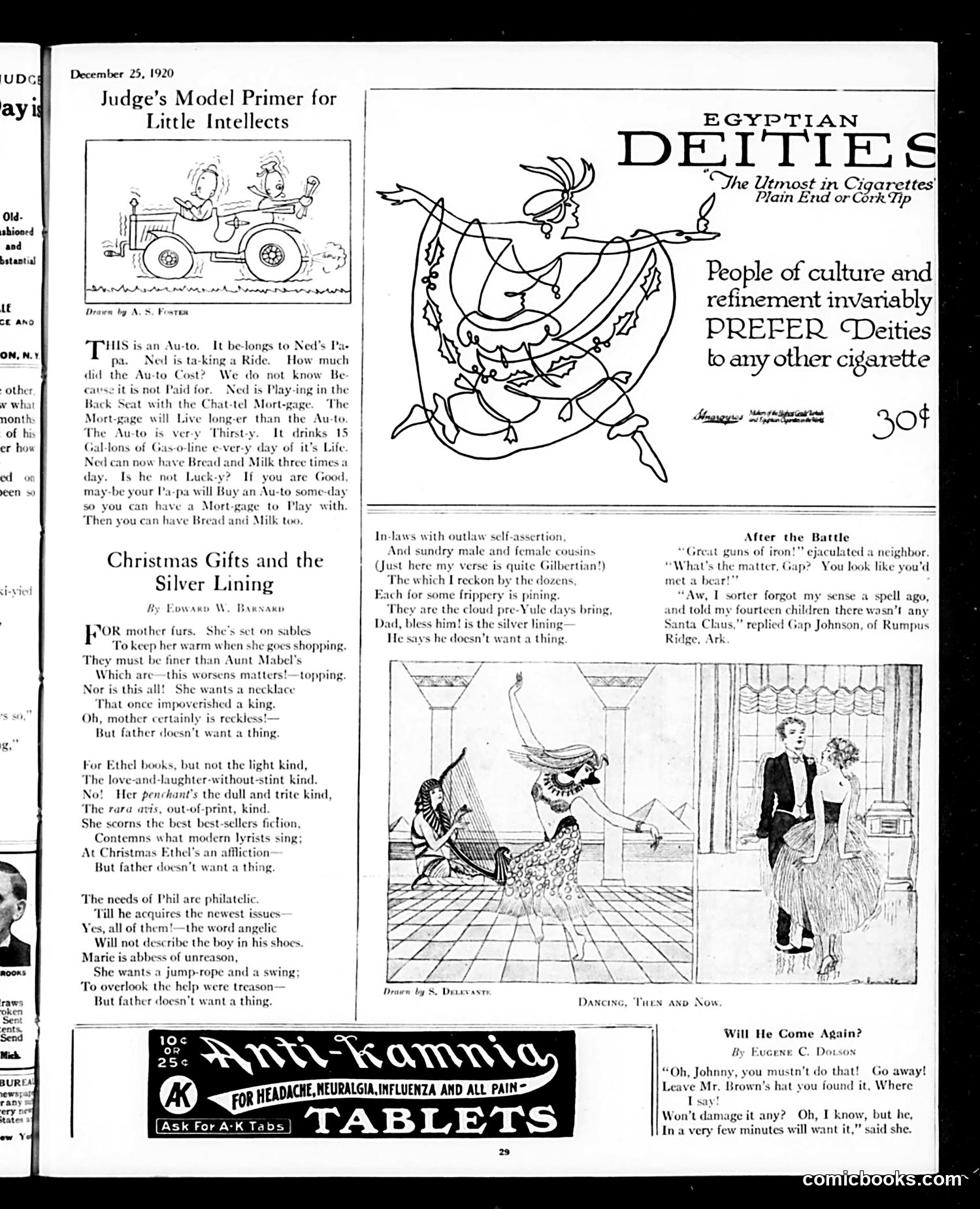
This page contains several unrelated pieces typical of Judge's satirical format: **"Judge's Model Primer for Little Intellects"** mocks consumer culture and debt. The "Au-to" (automobile) lesson teaches children that Ned's family owns a car they cannot afford—the mortgage will outlast the vehicle itself. The satire targets post-WWI installment-purchase culture and the illusion of prosperity masking financial instability. **"Egyptian Deities" cigarette ad** appears to be genuine advertising, not satire. **"Christmas Gifts and the Silver Lining"** is humorous verse about gift-giving expectations. Each family member (mother, Ethel, Phil) demands expensive or particular gifts, while "father doesn't want a thing"—a running joke about masculine indifference to materialism. **"After the Battle"** and **"Will He Come Again?"** are brief comic anecdotes with illustrations, unrelated to larger themes. The page reflects 1920s concerns: consumer debt, gender roles in gift-giving, and domestic comedy.
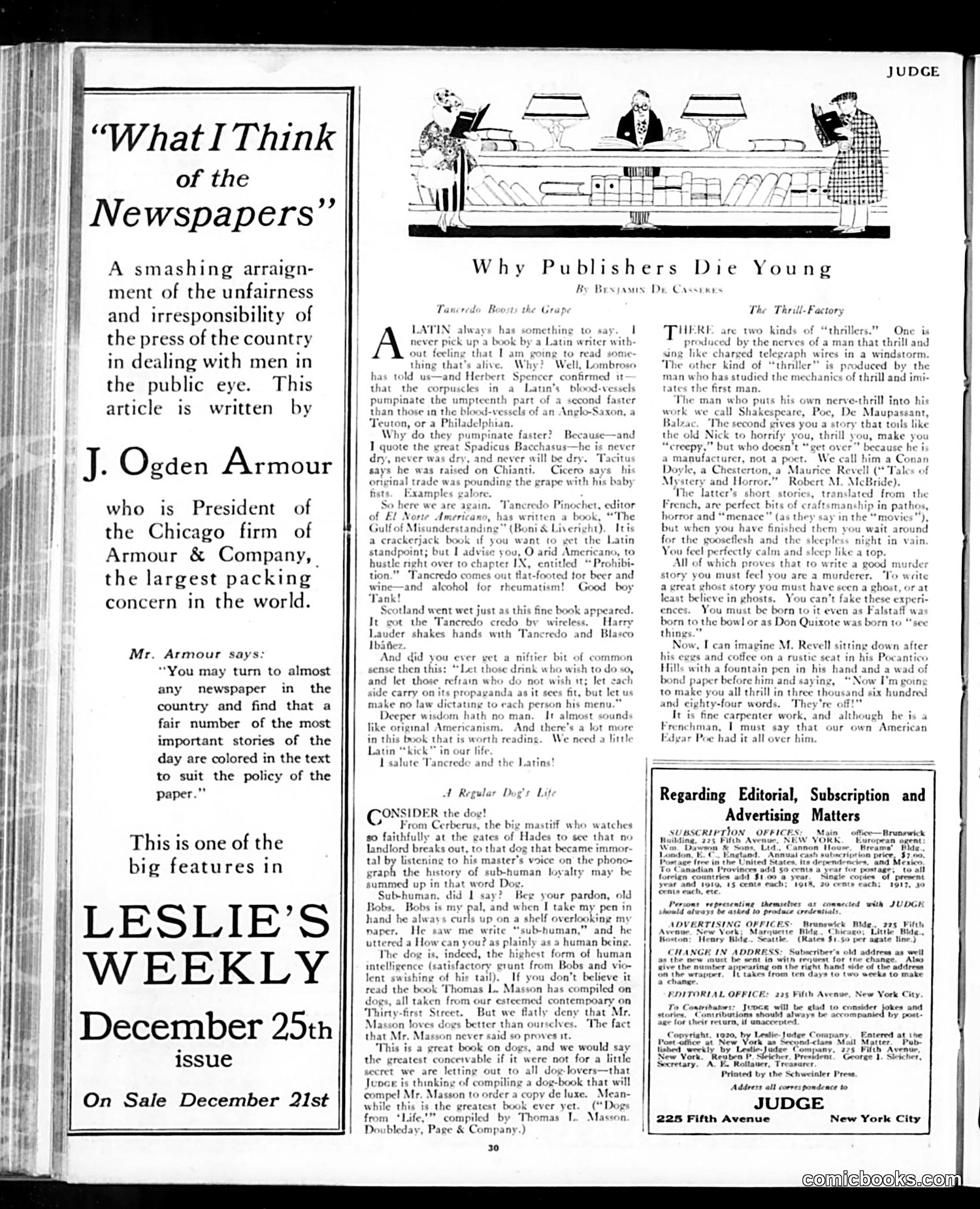
This page is primarily **advertising and promotion** for Leslie's Weekly magazine (December 25th issue). The main feature advertised is J. Ogden Armour's article critiquing American newspapers for coloring stories to match editorial policy—a relevant press-freedom complaint then and now. The page also promotes upcoming articles, including "Why Publishers Die Young" (discussing Latin versus Anglo-Saxon temperaments and alcohol), and book reviews praising Latin literature and dog-themed compilations. **The cartoon at top** depicts a judge's chambers with a well-dressed judge at his desk, likely illustrating courtroom/justice themes relevant to the newspaper criticism article. The content reflects early 20th-century concerns about **media bias and journalistic integrity**, while the peripheral articles showcase period preoccupations with racial pseudoscience (Lombroso's corpuscle theory) and sentimental dog-loyalty narratives—both now-dated cultural touchstones.
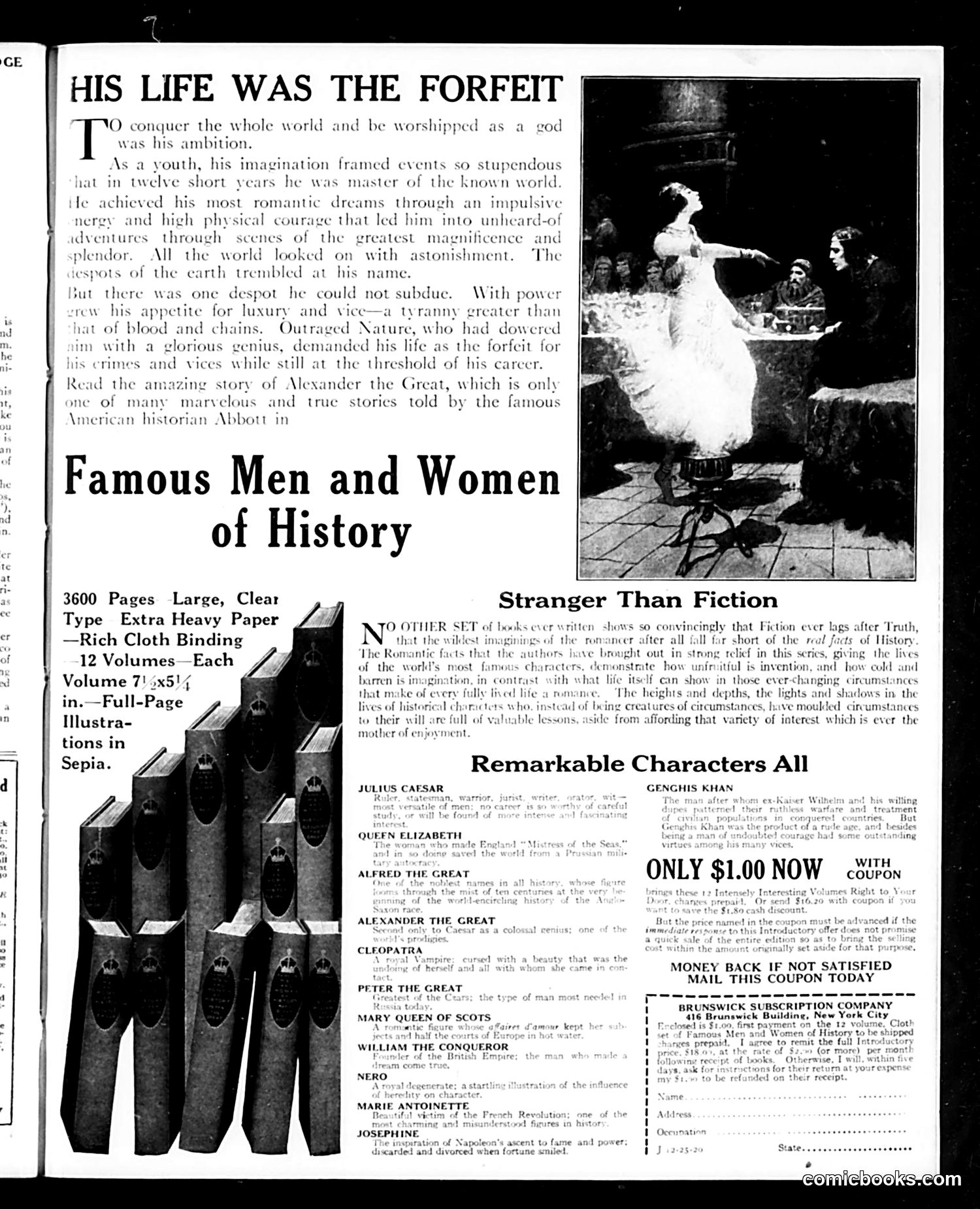
This is primarily a **book advertisement**, not political satire. The page promotes "Famous Men and Women of History," a 12-volume encyclopedic set published by the Brunswick Subscription Company. The accompanying narrative and photograph illustrate the marketing hook: historical figures like Alexander the Great achieved extraordinary ambitions but were ultimately undone by personal vices ("His life was the forfeit"). The message to readers is that this book set reveals the dramatic, "stranger than fiction" true stories behind famous historical figures. The photograph shows what appears to be a theatrical or film scene, likely depicting one of these historical characters to create visual interest for the advertisement. The copy emphasizes that real history surpasses fictional narratives in drama and moral complexity—a common sales pitch in early 20th-century educational publishing. The $1 coupon offer was an aggressive marketing tactic to drive subscriptions.
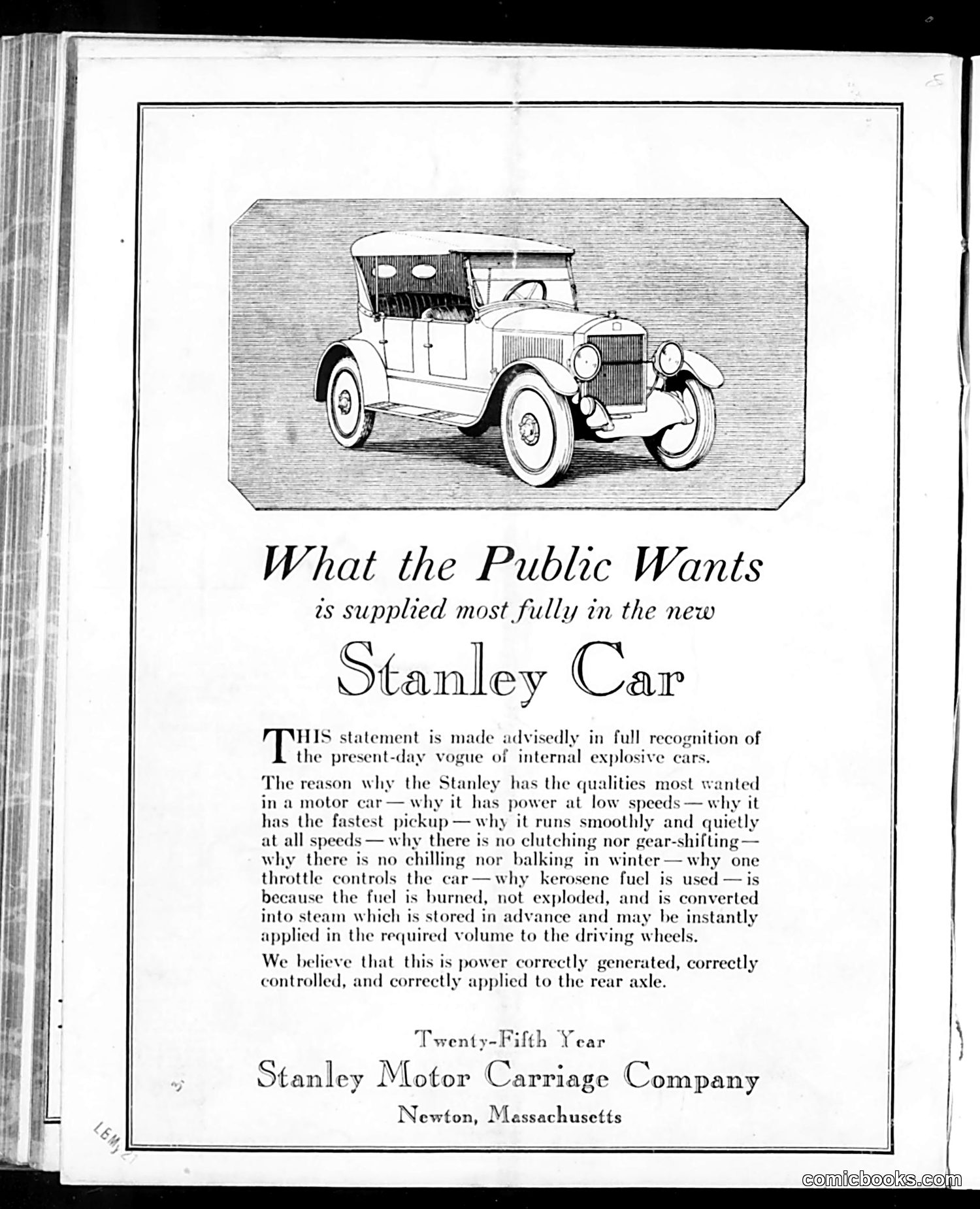
This is an **advertisement**, not a political cartoon or satire. It's a Stanley Motor Carriage Company promotional page from *Judge* magazine's Twenty-Fifth Year. The page argues for steam-powered cars over the increasingly popular gasoline ("internal explosive") automobiles of the era. Stanley emphasizes their vehicle's technical advantages: smooth operation, no gear-shifting, reliable winter performance, and single throttle control—all benefits of their steam-engine design. The implicit point: Stanley is defending an older technology against newer competition. While presented as straightforward marketing, the advertisement subtly acknowledges that gasoline cars are becoming the market standard ("present-day vogue"), positioning Stanley's steam cars as the superior alternative despite losing market dominance. This reflects early automotive history when multiple power sources competed before gasoline engines ultimately prevailed.

I can see this is a blank or nearly blank page from Judge magazine, with only "comicbooks.com" visible at the bottom right corner. The page contains no discernible cartoon, illustration, text content, or satirical material that I can analyze. This appears to be either: - A blank page from the magazine's interior - A page that failed to scan or reproduce clearly - An advertisement page without visible content Without visible imagery or text to examine, I cannot identify figures, political references, or satirical intent. To provide meaningful analysis of a Judge magazine page, a clearer image with actual cartoon or text content would be needed.