
Judge, 1920-12-25 · page 13 of 33
Judge — December 25, 1920 — page 13: what you’re looking at
What you’re looking at
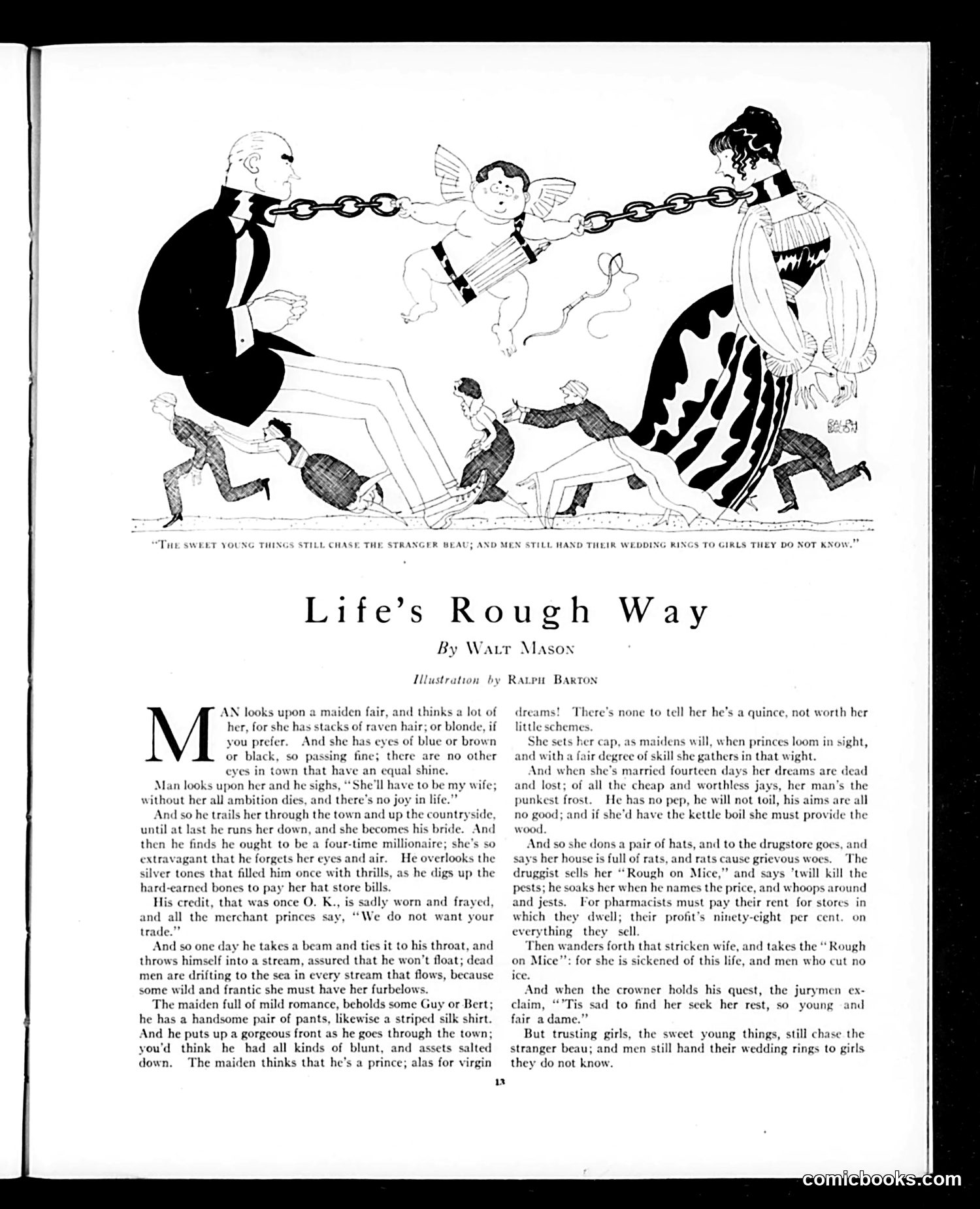
This satirical poem, illustrated by Ralph Barton, critiques romantic naivety and the harsh realities of marriage. The cartoon shows two couples connected by chains—representing marital entanglement—with cherubs and smaller figures caught in the middle. The narrative follows a familiar pattern: men pursue women based on superficial attractions, then discover their wives are financially extravagant; women chase charming but worthless suitors who prove lazy and unreliable after marriage. Mason's moral centers on disillusionment—neither gender sees reality before committing. The darkest element: the poem ends with the trapped wife purchasing rat poison ("Rough on Mice"), implying suicide as her escape from a miserable marriage. The final couplet's resigned tone—"sweet young things still chase the stranger beau"—suggests this cycle perpetually repeats despite its tragic consequences. The satire targets romantic fantasy colliding with economic and domestic reality in early 20th-century America.
📄 Transcribed text from this page (OCR, searchable)
Machine-transcribed from the original scan — historical spelling and the odd misread are preserved.
Tit SWEET YOUNG THINGS STILL CHASE THE STRANGER BEAU; AND MEN STILL HAND THEIR WEDDING KINGS TO GIRLS THEY bO NOT KNOW.” Life’s Rough Way By Watt Mason Mlustration by AN looks upon a maiden fair, and thinks a lot of her, for she has stacks of raven hair; or blonde, if you prefer. And she has eyes of blue or brown or black, so passing fine; there are no other ves in town that have an equal shine. Man looks upon her and he sighs, “She'll have to be my wife; without her all ambition dies, and there’s no joy in life.” And so he trails her through the town and up the countryside, until at last he runs her down, and she becomes his bride. And ¢ finds he ought to be a four-time millionaire; she’s so He overlooks the then h extravagant that he forgets her eyes and air. silver tones that filled him once with thrills, as he digs up the hard-earned bones to pay her hat store bills. His credit, that was once O. K., is sadly worn and frayed, and all the merchant princes say, “We do not want your trade. And so one day he takes a beam and ties it to his throat, and throws himself into a stream, assured that he won't float; dead men are drifting to the sea in every stream that flows, because some wild and frantic she must have her furbelows. The maiden full of mild romance, beholds some Guy or Bert; he has a handsome pair of pants, likewise a striped silk shirt. And he puts up a gorgeous front as he goes through the town; you'd think he had all kinds of blunt, and assets salted down. The maiden thinks that he’s a prince; alas for virgin Ratpu Barton dreams! There's none to tell her he’s a quince, not worth her little schemes. She sets her cap, as maidens will, when princes loom in si and with a fair degree of skill she gathers in that wight. And when she’s married fourteen days her dreams are dead and lost; of all the cheap and worthless jays, her man’s the punkest frost. He has no pep, he will not toil, his aims are all no good; and if she'd have the kettle boil she must provide the wood. And so she says her house is full of rats, and rats caus druggist sells her “Rough on Mic pests; he soaks her when he names the price, and jests. For pharmacists must pay the which they dwell; their profit’s ninety-cight per cent everything they sell Then wanders forth that stricken wife, and takes the “ Rough on Mice’’: for she is sickened of this life, and men who cut no ht, ns a pair of hats, and to the drugstore goes, and grievous woes. The nd says ‘twill kill the and whoops around rent for stores in on ice. And when the crowner holds his quest, the jurymen ex- claim, “ sad to find her seck her rest, so young and fair a dame.” But trusting girls, the sweet young things, still chase the stranger beau; and men still hand their wedding rings to girls they do not know.