
Judge, 1920-12-25 · page 6 of 33
Judge — December 25, 1920 — page 6: what you’re looking at
What you’re looking at
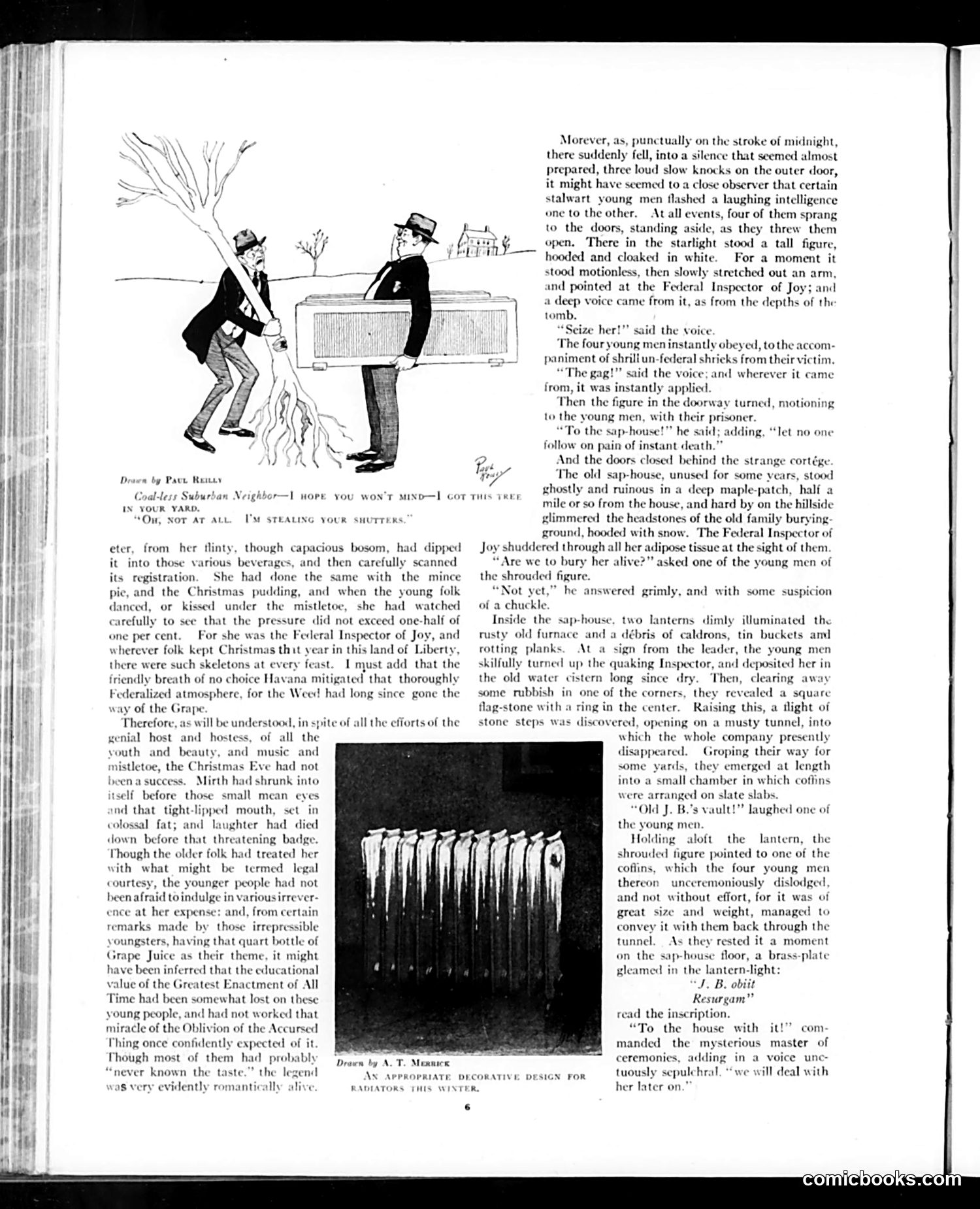
The top cartoon, credited to Paul Resis, shows two men by a fire—one stealing shutters from the other's yard. The caption reads: "Good Snakes! Neighbor—I HOPE YOU WON'T MIND—I GOT THIS TREE IN YOUR YARD. 'OH, YOU'RE ALL RIGHT. I'M STEALING YOUR SHUTTERS.'" This appears to be **wartime humor**, likely from WWI or WWII era, satirizing material shortages and home-front rationing. The joke depicts neighbors reciprocally "stealing" each other's wood/materials—implying widespread civilian theft of resources during wartime scarcity. The mutual, casual acknowledgment of theft suggests this was commonplace behavior accepted with dark humor. The remaining text and lower illustration appear to be a separate supernatural/mystery story, unrelated to the cartoon's satirical commentary on wartime deprivation.
📄 Transcribed text from this page (OCR, searchable)
Machine-transcribed from the original scan — historical spelling and the odd misread are preserved.
Deven by Pact Reiuty ral-less Suburban Neighbor—l wore you won't sxo— IN YOUR YARD. On, NOT AT ALL Vat STEALING YouR sHUTTERS though capacious bosom, had dipped it into those various beverages, and then carefully scanned its registration. She had done the same with the mince pie, and the Christmas pudding, and when the young folk danced, or kissed under the mistletoe, she had watched carefully to see that the pressure did not exceed one-half of one per cent. For she was the Federal Inspector of Joy, and wherever folk kept Christmas thit year in this land of Liberty, there were such skeletons at every feast. I must add that the jendly breath of no choice Havana mitigated that thoroughly eter, from her flinty, Federalized atmosphere, for the Weed had long since gone the way of the G Therefore, ape s will be understood, in spite genial host and hostess, of all. the youth and beauty, and music and istletoe, the Christmas Eve had not Mirth had shrunk into mean all the efforts of the been a success. If before eyes those small nd that tight-lipped mouth, set in colossal fat; and laughter had died down before that threatening badge. Though the older folk had treated her vith what might be termed legal courtesy, the younger people had not been afraid toindulge in variousirrever- ence at her expense: and, from certain remarks made by those irrepressible voungsters, having that quart bottle of Grape Juice as their theme, it might have been inferred that the educational value of the Greatest Enactment of All Time had been somewhat lost on these young people, and had not worked that miracle of the Oblivion of the Accursed hing once confidently expected of it Though most of them had probably ‘hisen by A “never known the taste.” the legend sx a8 very evidently romantically alive APPROPRIATE Mexnice RADIATORS DECORATIVE GOT THIS TREE Morever, as, punctually on the stroke of midnight, there suddenly fell, into a silence that seemed almost prepared, three loud slow knocks on the outer door, it might have seemed to a close observer that certain stalwart young men flashed a laughing intelligence ne to the other, At all events, four of them sprang to the doors, standing aside, as they threw them open. There in the starlight stood a tall figure, hooded and cloaked in white. For a moment it stood motionless, then slowly stretched out an arm, ind pointed at the Federal Inspector of Joy; and a deep voice came from it, as from the depths of the tomb. “Seize her!” said the voice ‘The four young men instantly obeyed, to the accom- paniment of shrili un-federal shrieks from their victim. “The * said the voice; and wherever it came from, it was instantly applied. Then the figure in the doorway turned, motioning to the young men, with their prisoner “To the sap-house!”” he said; addin, follow on pain of instant death And the doors closed behind the strange cortége. The old sap-house, unused for some years, ghostly and ruinous in a deep maple-patch, half a mile or so from the house, and hard by on the hillside glimmered the headstones of the old family burying ground, hooded with snow. The Federal Inspector of Joy shuddered through all her adipose tissue at the sight of them “Are we to bury her alive?” asked one of the young men of “Tet no one the shrouded figure. “Not yet,” he answered grimly, and with some suspicion of a chuckle. Inside the sap-house, two lanterns dimly illuminated the rusty old furnace and a débris of caldrons, tin buckets aml rotting planks. At a sign from the leader, the young men skilfully turned up the quaking Inspector, and deposited her in the old water cistern long since dry. Then, clearing away some rubbish in one of the corners, they revealed a squarc flag-stone with a ring in the center. Raising this, a flight of stone discovered, opening on a musty tunnel, into which the whole company presently disappeared. Groping their way for some yards, they emerged at length into a small chamber in which coffins were arranged on slate slabs. “Old J. B.'s vault!” laughed one of the young men. Holding aloft. the lantern, the shrouded figure pointed to one of the coflins, which the four young men thereon unceremoniously dislodged and not without effort, for it was of great size and weight, managed to convey it with them back through the tunnel. As they rested it a moment on the sap-house floor, a brass-plate gleamed in the lantern-light: J. B. obiit ‘surgam” steps wa R read the inscription. “To the house with it!” manded the mysterious master of ceremonies, adding in a voice unc- vill deal with com ror __ tuously sepulchral, “we DESIGN v R. her later on