
Judge, 1920-12-25 · page 20 of 33
Judge — December 25, 1920 — page 20: what you’re looking at
What you’re looking at
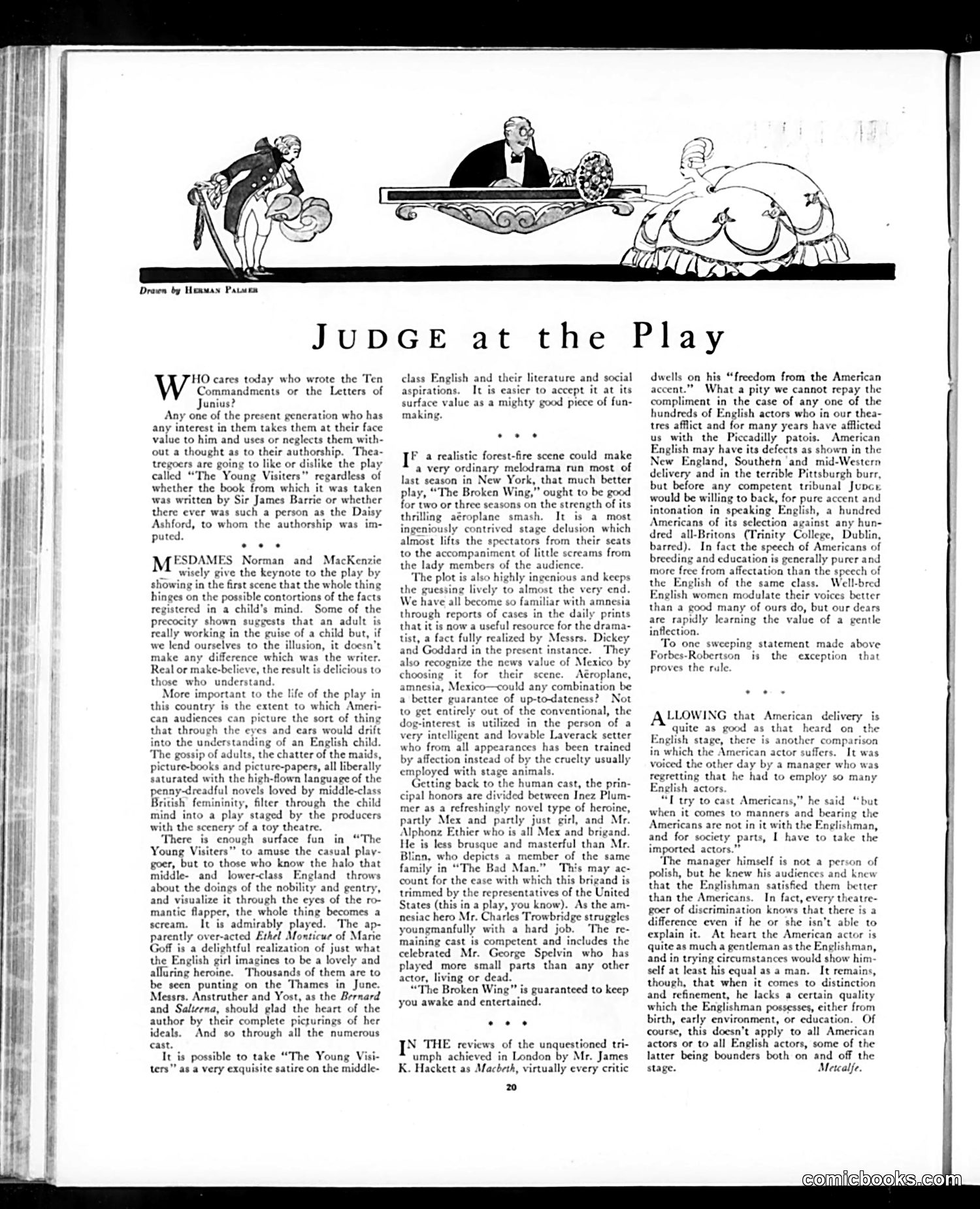
This is a theater review column titled "Judge at the Play." The cartoon header (drawn by Herman Palmer) depicts a judge presiding over theatrical performances, establishing the satirical premise of critiquing plays. The text reviews two productions: "The Young Visiters" and "The Broken Wing." The critic discusses how audiences accept stage illusions regardless of authorship details—mirroring the opening reference to the Ten Commandments and Letters of Junius. "The Young Visiters," apparently adapted from a book of disputed authorship (possibly by child author Daisy Ashford), is praised for its satirical portrayal of middle-class English society viewed through a precocious child's eyes. The reviewer notes American audiences may struggle understanding English social hierarchies and their romanticization by lower classes. "The Broken Wing" is reviewed favorably for its thrilling airplane crash scene and plot device using amnesia—topical elements (Mexico, aviation, amnesia cases) the critic notes guarantee contemporary appeal. The column exemplifies Judge magazine's theatrical commentary blending plot summary with social observation.
📄 Transcribed text from this page (OCR, searchable)
Machine-transcribed from the original scan — historical spelling and the odd misread are preserved.
SS OE EE Drown by Hexwax Pataten JUDGE at the Play HO cares today who wrote the Ten Commandments or the Letters of Junius? Any one of the present generation who has any interest in them takes them at their face value to him and uses or neglects them with- out a thought as to their authorship. Thea- tregoers are going to like or dislike the play called “The Young Visiters” regardless of whether the book from which it was taken was written by Sir James Barrie or whether there ever was such a person as the Daisy Ashford, to whom the authorship was im- puted. SSDAMES Norman and MacKenzie ¥ ly give the keynote to the play by showing in the first scene that the whole thing hinges on the possible contortions of the facts registered in a child's mind. Some of the precocity shown suggests that an adult is really working in the guise of a child but, if we lend ourselves to the illusion, it doesn’t make any difference which was the writ Real or make-believe, the result is delicious to those who understand More important to the life of the play in this country is the extent to which Ameri- can audiences can picture the sort of thin: that through the eyes and ears would drift into the understanding of an English child. The gossip of adults, the chatter of the maids, picture-books and picture-papers, all liberally saturated with the high-flown language of the penny-dreadful novels loved by middle-class British femininity, filter through the child mind into a play staged by the producers with the scenery of a toy theatre. There is enough surface fun in “The Young Visiters” to amuse the casual play- goer, but to those who know the halo that middle- and lower-class England throws about the doings of the nobility and gentry, and visualize it through the eyes of the ro- mantic flapper, the whole thing becomes a scream. It is admirably played. The ap- parently over-acted Ethel Monticue of Marie Goff is a delightful realization of just what the English girl imagines to be a lovely and alluring heroine. ‘Thousands of them are to be seen punting on the Thames in June. Messrs. Anstruther and Yost, as the Bernard and Salteena, should glad the heart of the author by their complete picturings of her ideals. And so through all the numerous cast. It is possible to take “The Young Visi- ters” as a very exquisite satire on the middle- English and their literature and social tions. It is easier to accept it at its surface value as a mighty good piece of fun- making. F a realistic forest-fire scene could make a very ordinary melodrama run most of last season in New York, that much better play, “The Broken Wing,” ought to be good for two or three seasons on the strength of its thrilling aéroplane smash. It is a most geniously contrived stage delusion which almost lifts the spectators from their seats to the accompaniment of little screams from the lady members of the audience. ‘The plot is also highly ingenious and keeps the guessing lively to almost the very end. We have all become so familiar with amnesia through reports of cases in the daily prints that it is now a useful resource for the drama- tist, a fact fully realized by Messrs. Dickey and Goddard in the present instance. They also recognize the news value of Mexico by choosing it for their scene. Aéroplane, amnesia, Mexico—could any combination be a better guarantee of up-todateness? Not to get entirely out of the conventional, the dog-interest is utilized in the person of a very intelligent and lovable Laverack setter who from all appearances has been trained by affection instead of by the cruelty usually loyed with stage animals. jetting back to the human cast, the prin- cipal honors are divided between Inez Plum- mer as a refreshingly novel type of heroine, partly Mex and partly just girl, and Mr. Alphonz Ethier who is all Mex and brigand. He is less brusque and masterful than Mr. Blinn, who depicts a member of the same family in “The Bad Man.” This may ac- count for the ease with which this brigand is trimmed by the representatives of the United States (this in a play, you know). As the am- nesiac hero Mr. Charles Trowbridge struggles youngmanfully with a hard job. ‘The re- maining cast is competent and includes the celebrated Mr. George Spelvin who has played more small parts than any other actor, living or dead. “The Broken Wing” is guaranteed to keep you awake and entertained. IN THE reviews of the unquestioned tri- umph achieved in London by Mr. James K. Hackett as Macbeth, virtually every critic 20 dwells on his “freedom from the American accent.” What a pity we cannot repay the compliment in the case of any one of the hundreds of English actors who in our thea- tres afflict and for many years have afflicted us with the Piccadilly patois. American English may have its defects as shown in the New England, Southetn ‘and mid-Western delivery and in the terrible Pittsburgh burr, but before any competent tribunal Jupce would be willing to back, for pure accent and intonation in speaking English, a hundred Americans of its selection against any hun- dred all-Britons (Trinity College, Dublin, barred). In fact the speech of Americans of breeding and education is generally purer and more free from affectation than the speech of the English of the same class. Well-bred English women modulate their voices better than a good many of ours do, but our dears are rapidly learning the value of a gentle inflection. To one swe g statement made above Forbes-Robertson is the exception that proves the rule. ALLOWING that American delivery is quite as good as that heard on th ¢ is another comps h the American actor suffers. It w voiced the other day by a manager who was regretting that he had to employ so many ish actors. T try to cast Americans,” he said “but when it comes to manners and bearing the Americans are not in it with the Englishman, and for society parts, I have to take the imported actors. The manager himself is not a person of polish, but he knew his audiences and knew that the Englishman satisfied them better than the Americans. In fact, every theatre- goer of discrimination knows that there is a difference even if he or she isn’t able to explain it. At heart the American actor is quite as much a gentleman as the Englishman, and in trying circumstances would show him- self at least his equal as a man. It remains, though, that when it comes to distinction and refinement, he lacks a certain quality which the Englishman possesses, either from birth, early environment, or education. Of course, this doesn’t apply to all American actors of to all English actors, some of the latter being bounders both on and off the stage. Metcalfe.