
Judge, 1920-12-25 · page 10 of 33
Judge — December 25, 1920 — page 10: what you’re looking at
What you’re looking at
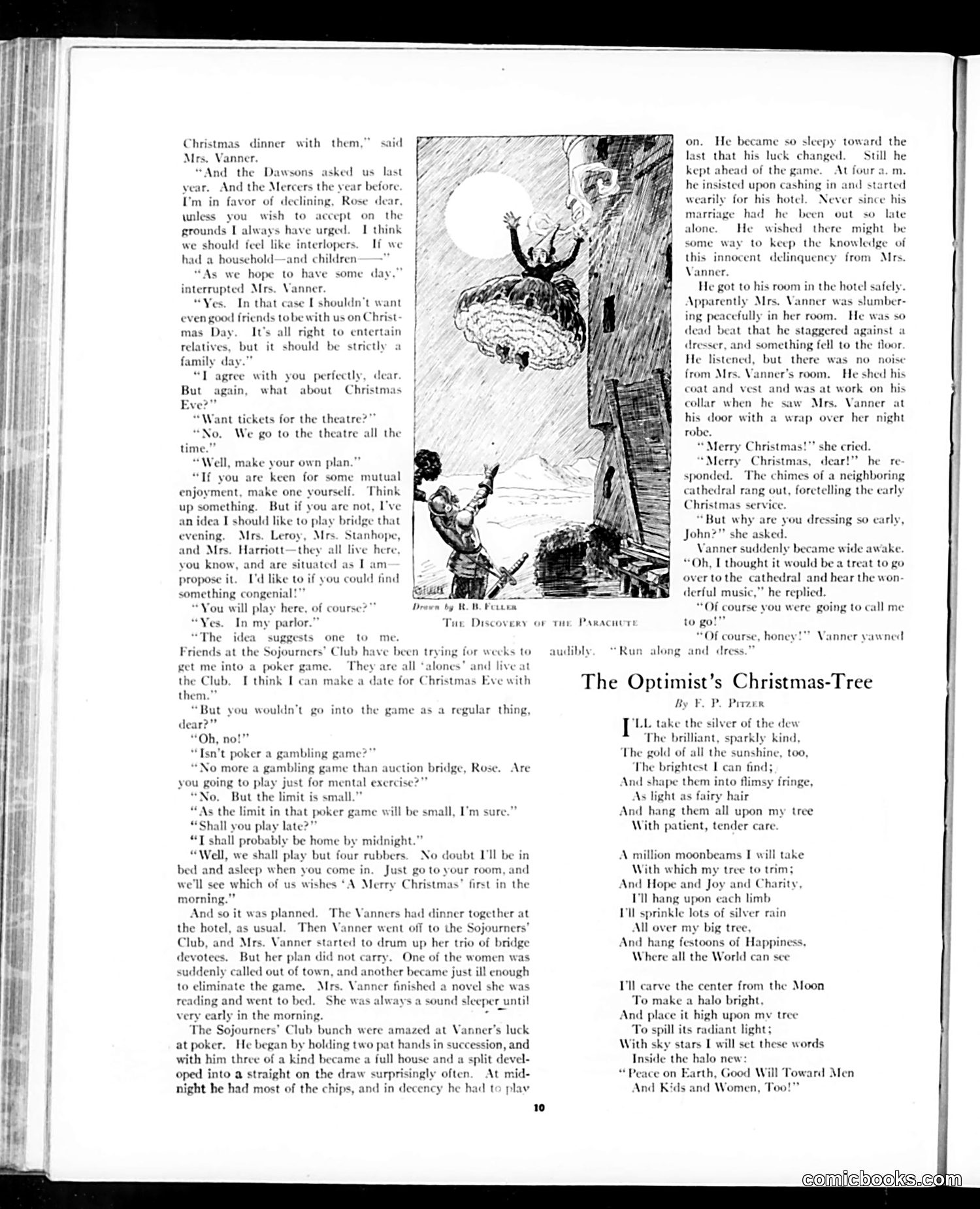
This page contains a domestic comedy story about the Vanners, a married couple spending Christmas Eve apart. Mr. Vanner attends a poker game at his club while Mrs. Vanner planned bridge (though it fell through). The satire targets early 20th-century upper-middle-class marriage dynamics and holiday customs. The cartoon illustration (labeled "The Discovery of the Parachute") shows a figure falling with an early parachute design—unrelated to the main story. **The joke**: Mr. Vanner stays out until 4 a.m. gambling, violating marital expectations, yet returns to find his wife greeting him cheerfully with "Merry Christmas!" at dawn. The humor lies in his anxiety about concealing this "innocent delinquency" from his wife, contrasted with her apparent obliviousness or forgiveness. The accompanying poem, "The Optimist's Christmas-Tree," celebrates idealistic holiday sentiments—a tonal counterpoint to the cynical married couple negotiating separate Christmas Eve plans. The satire critiques both the stiffness of period marriage conventions and the gap between romantic holiday ideals and domestic reality.
📄 Transcribed text from this page (OCR, searchable)
Machine-transcribed from the original scan — historical spelling and the odd misread are preserved.
Christmas dinner with them,” saic Mrs, Vanner. “And the Dawsons asked us last year. And the Mercers the year before I'm in favor of declining, Rose Te unless you wish to accept on the grounds I always have urged. 1 think we should feel like interlopers. If we had a household—and children “As we hope to have some day, interrupted Mrs. Vanner. “Yes. In that case I shouldn't want even good friends to be with us on Christ mas Day. It’s all right to entertain relatives, but it should be strictly a family day.” “LT agree with you perfectly, dear But again, what about Christmas Eve?” Want tickets for the theatre?” No. We go to the theatre all the time. “Well, make your own plan.” “If you are keen for some mutual enjoyment, make one yourself. Think up something. But if you are not, I've an idea I should like to play bridge that evening. Mrs. Leroy, Mrs. Stanhope, and Mrs. Harriott—they all live here you know, and are situated as I am propose it. I'd like to if you could find something congenial!” fi TV ie You will play here, of course?” n by RAM, Peis “Yes. In my parlor.” “The idea suggests one to me. Friends at the Sojourners’ Club have been trying for week Tur Discovery or get me into a poker game. They are all ‘alones’ and live the Club. T think I can make a date for Christmas Eve with them.” “But you wouldn't go into the game as a regular thing, dear?” “Oh, no!” “Isn't poker a gamblin; “No more a gambling gam you going to play just for mental exercise?” “No. But the limit is small.” “As the limit in that poker game will be small, I'm sure “Shall you play late?” “T shall probably be home by midnight.” “Well, we shall play but four rubbers. bed and asleep when you come in. Just go to your room, and we'll see which of us wishes ‘A Merry Christmas’ first in the morning.” And so it was planned. The Vanners had dinner together at the hotel, as usual. Then Vanner went off to the Sojourners’ Club, and Mrs. Vanner started to drum up her trio of bridge devote But her plan did not carry. One of the women was suddenly called out of town, and another became just ill enough to eliminate the game. Mrs. Vanner finished a novel she was reading and went to be She was always a sound sleeper until very early in the morning. aca The Sojourners’ Club bunch were amazed at Vanner’s luck at poker. He began by holding two pat hands in succession, and with him three of a kind became a full house and a split devel- oped into a straight on the draw surprisingly often. At mid- night he had most of the chips, and in decency he had to plav than auction bridge, Rose. Are o doubt I'll be in on. He became so sleepy toward the last that his luck changed. — Still he kept ahead of the game. At four a. m. he insisted upon cashing in and started wearily for his hotel. Never since his marriage had he been out so late alone, He wished there might be ome way to keep the knowledge of this innocent delinquency from Mrs. Vanner. He got to his room in the hotel safely. Apparently Mrs. Vanner was slumber- ing peacefully in her room. He was so dead beat that he staggered against a dresser, and something fell to the floor He listened, but there was no_ noise from Mrs. Vanner’s room. He shed his tand vest and was at work on his collar when he saw Mrs. Vanner at his door with a wrap over her night robe. Merry Christmas!” she cried. “Merry Christmas, dear!” he re sponded. The chimes of a neighboring cathedral rang out, foretelling the early Christmas service. ‘But why are you dressing so early, John?” she asked. Vanner suddenly became wide awake. “Oh, I thought it would be a treat to over to the hedral and hear the won. derful music,” he replied. “Of course you were going to call me rie Paracnert to go!” “Of cours ng and dress honey Vanner yawned audibly “Run The Optimist’s Christmas-Tree By F. P. Prvzer [*. take the silver of the dew The brilliant, sparkly kind, The gold of all the sunshine, too, The brightest I can find; And shape them into flimsy fringe, As light as fairy hair And hang them all upon my tree With patient, tender care. A million moonbeams I will take With which my tree to trim; And Hope and Joy and Charity Tl hang upon each limb I'l sprinkle lots of silver rain Ml over my big tree, And hang festoons of Happiness, Where all the World can see I'll carve the center from the Moon To make a halo bright, And place it high upon my tree To spill its radiant light; With sky stars I will set these words Inside the halo new: “Peace on Earth, Good Will Toward Men And Kids and Women, Too!”