
Judge, 1920-12-25 · page 5 of 33
Judge — December 25, 1920 — page 5: what you’re looking at
What you’re looking at
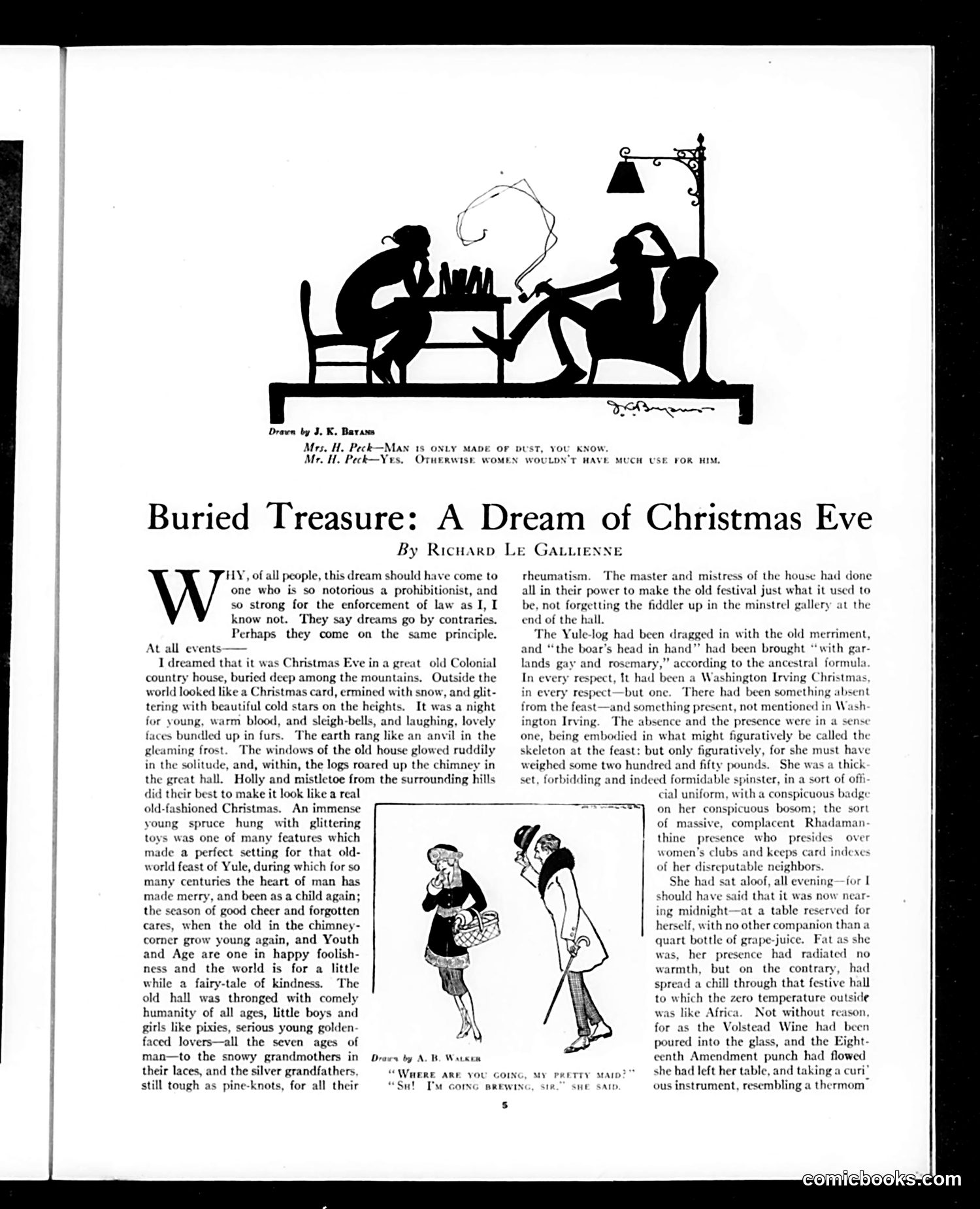
The top cartoon depicts two figures at a chess table under a lamp. The caption reads: "Mrs. H. Peck—Man is only made of dust, you know. Mr. H. Peck—Yes. Otherwise women wouldn't have much use for him." This is a domestic satire joke playing on the era's gender dynamics. The wife makes a philosophical observation about men's worthlessness (being "made of dust"), and the husband's response suggests women only tolerate men for practical purposes—implying wives view husbands as servants or useful objects rather than equals. The chess-playing setting emphasizes intellectual companionship, yet the joke undermines it, reducing the relationship to utility. The accompanying story "Buried Treasure: A Dream of Christmas Eve" by Richard Le Gallienne is a nostalgic holiday fiction piece unrelated to the cartoon's satirical content.
📄 Transcribed text from this page (OCR, searchable)
Machine-transcribed from the original scan — historical spelling and the odd misread are preserved.
Drawn by J. K. Barans as a Mrs. H. Peck—Manx 18 ONLY MADE OF DUST, YOU KNOW. Mr. H. Peck—Yes, Orwerwisk WOMEN WOULDN'T HAVE MUCH USE FOR HIM, Buried Treasure: A Dream of Christmas Eve By Ricuarp Le GALLIENNE HY, of all people, this dream should have come to one who is so notorious a prohibitionist, and so strong for the enforcement of law as I, I know not. They say dreams go by contraries. Perhaps they come on the same principle. At all events—— I dreamed that it was Christmas Eve in a great old Colonial country house, buried deep among the mountains. Outside the world looked like a Christmas card, ermined with snow, and tering with beautiful cold stars on the heights. It was a night for young, warm blood, and sleigh-bells, and laughing, lovely faces bundled up in furs. The earth rang like an anvil in the gleaming frost. The windows of the old house glowed ruddily in the solitude, and, within, the logs roared up the chimney in the great hall. Holly and mistletoe from the surrounding hills did their best to make it look like a real rheumatism. The master and mistress of the house had done all in their power to make the old festival just what it used to be, not forgetting the fiddler up in the minstrel gallery at the end of the hall. The Yule-log had been dragged in with the old merriment, and “the boar’s head in hand” had been brought “with gar- lands gay and rosemary,” according to the ancestral formula In every respect, ft had been a Washington Irving Christmas. in every respect—but one. There had been something absent from the feast—and something present, not mentioned in Wash ington Irving. The absence and the presence were in a sense one, being embodied in what might figuratively be called the skeleton at the feast: but only figuratively, for she must have weighed some two hundred and fifty pounds. She was a thick set, forbidding and indeed formidable spinster, in a sort of off cial uniform, with a conspicuous badge old-fashioned Christmas. An immense young spruce hung with glittering toys was one of many features which made a perfect setting for that old- world feast of Yule, during which for so many centuries the heart of man has made merry, and been as a child again; the season of good cheer and forgotten cares, when the old in the chimne: corner grow young again, and Youth and Age are one in happy foolish- ness and the world is for a little while a fairy-tale of kindness. The old hall was thronged with comely humanity of all ages, little boys and girls like pixies, serious young golden- faced lovers—all the seven ages of man—to the snowy grandmothers in Drows by A.B. Watxen their laces, and the silver grandfathers. “WHERE ARE you still tough as pine-knots, for all their GOING, MY PRETTY staip Ww! T's GomG BREWING, StR.” SHE SATD. on her conspicuous bosom; the sort of massive, complacent Rhadaman thine presence who presides over women’s clubs and keeps card indexes of her disreputable neighbors. She had sat aloof, all evenin should have said that it was now near- ing midnight—at a table reserved for herself, with no other companion than a quart bottle of grape-juice. Fat as she was, her presence had radiated no warmth, but on the contrary, had spread a chill through that festive hall to which the zero temperature outside was like Africa. Not without reason, for as the Volstead Wine h poured into the gl eenth Amendment punch had flowed she had left her table, and taking a curi’ ous instrument, resembling a thermom™ for 1