
A complete issue · 32 pages · 1920
Judge — October 9, 1920
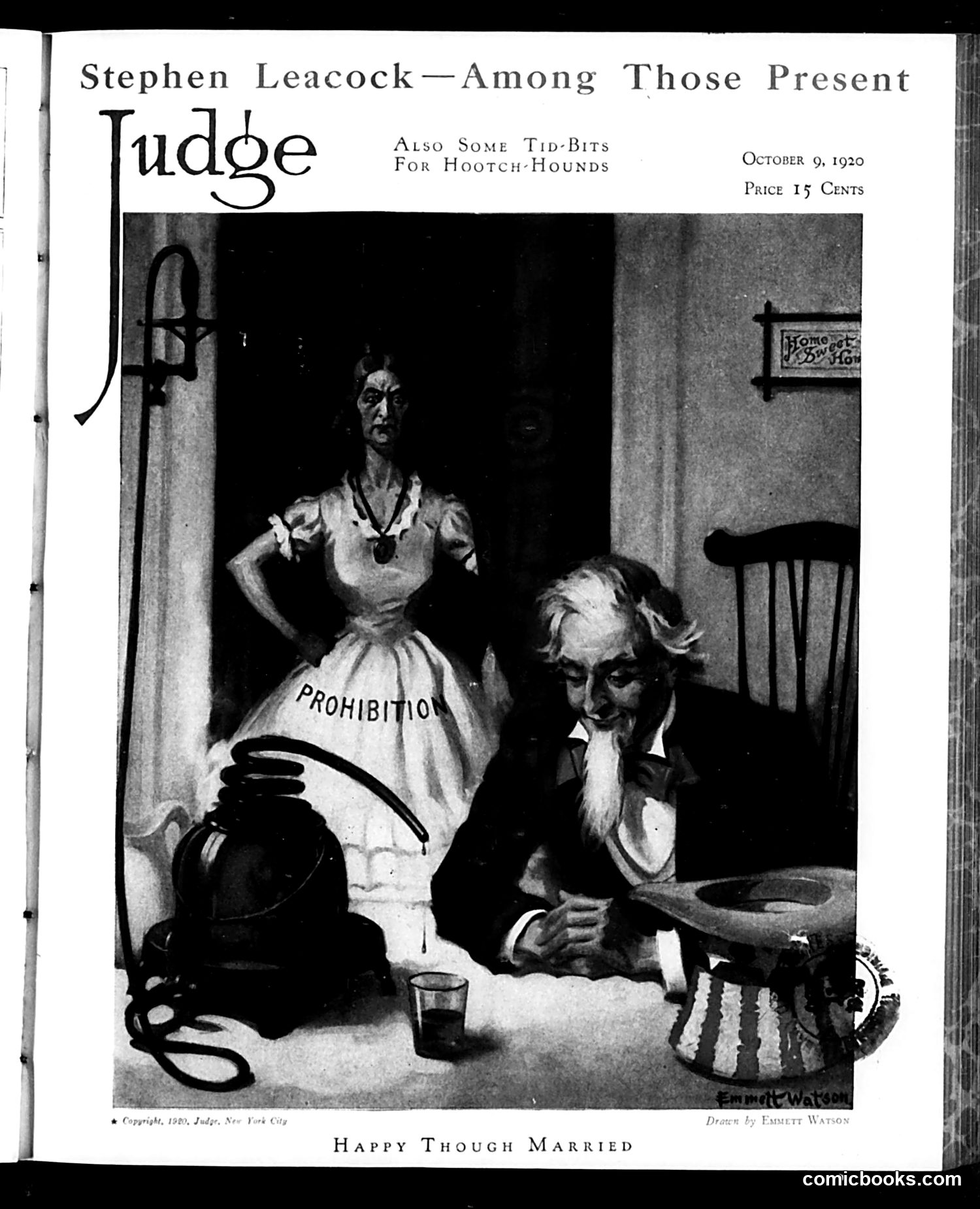
This cartoon satirizes **Prohibition**, which had just been ratified (18th Amendment, January 1920). The image shows a stern woman labeled "PROHIBITION" standing over a man at a table with alcohol bottles and a glass. The title "Happy Though Married" suggests the joke: the man is now "married" to Prohibition as an unwanted spouse he must obey. The woman's authoritarian posture and the man's resigned expression mock how Prohibition was being enforced as a restrictive, joyless regulation. The setup presents alcohol consumption as a "forbidden pleasure," with Prohibition personified as a domineering authority figure. The satire criticizes the law's invasive control over personal behavior and leisure—a common Judge magazine critique of early Prohibition enforcement.
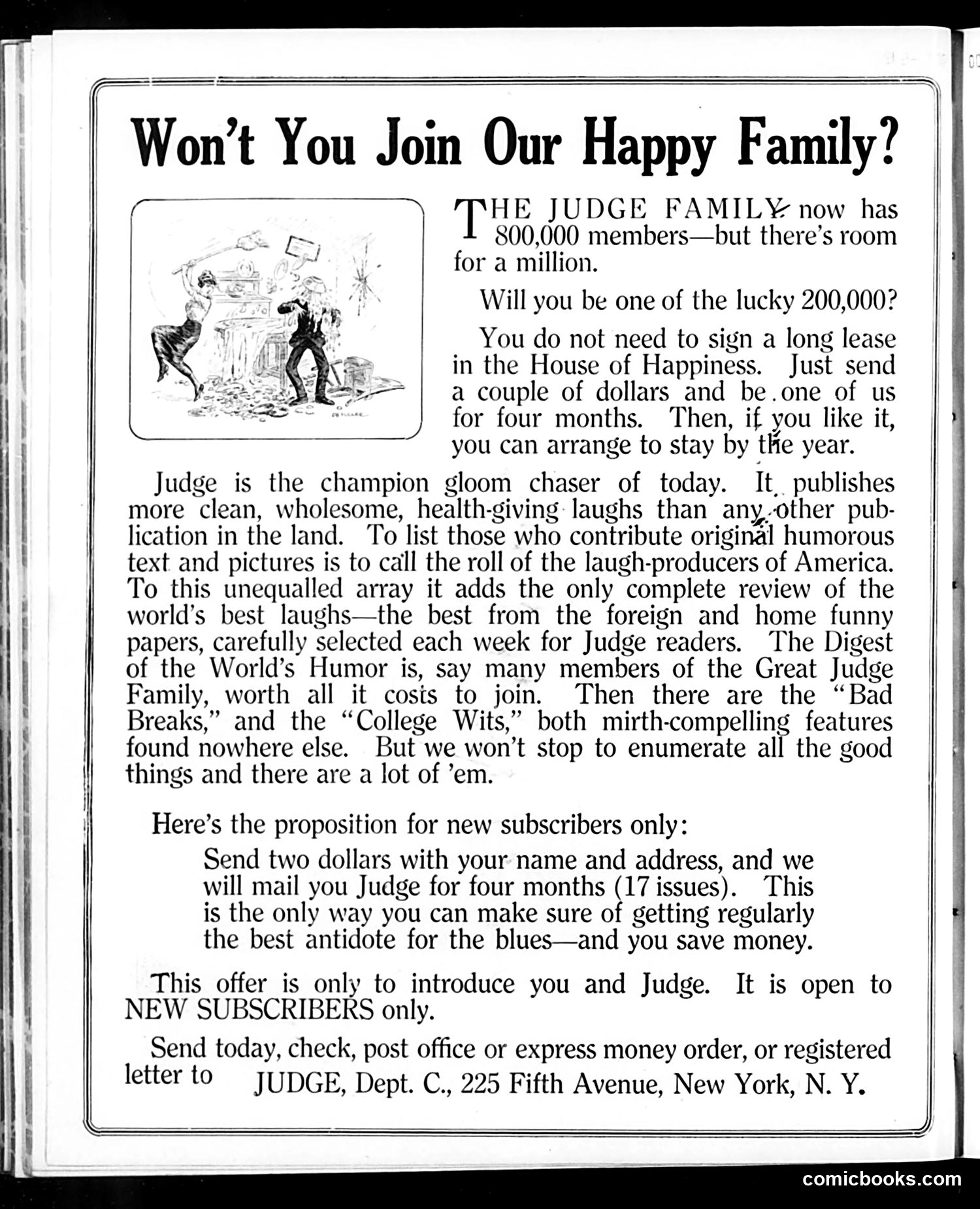
This page is primarily a subscription advertisement for *Judge* magazine itself, not political satire. The small illustration shows two figures in what appears to be a comedic domestic scene—one person appears startled or animated while another reacts, typical of early-20th-century humor illustration style. The ad promotes *Judge* as a humor publication with 800,000 members, claiming it publishes "clean, wholesome, health-giving laughs." It emphasizes features like humor digests from international sources, "Bad Breaks," and "College Wits" sections. The offer targets new subscribers only: $2 for four months (17 issues). The advertisement positions humor consumption as an "antidote for the blues," reflecting the magazine's role as entertainment during an unspecified historical period.
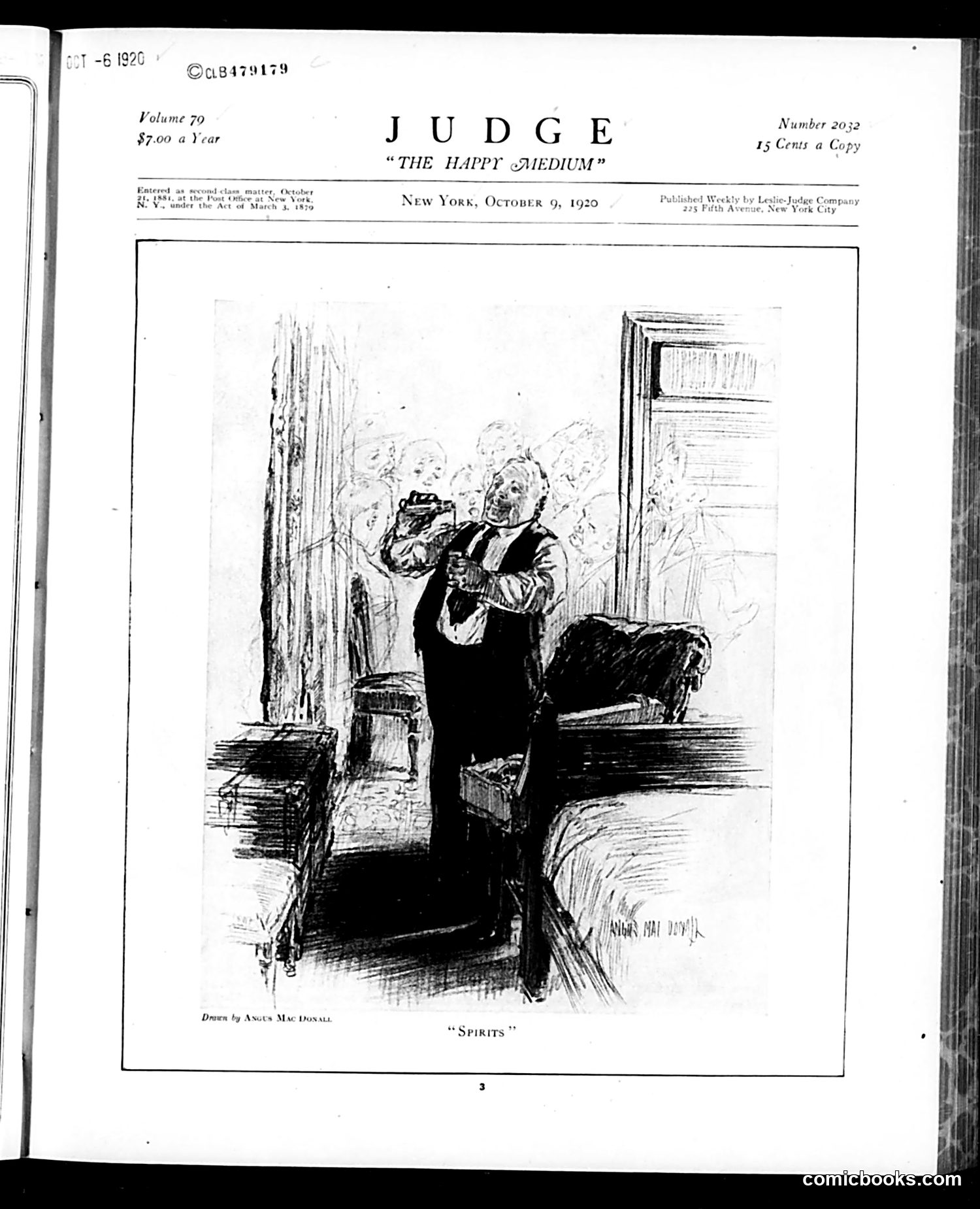
This cartoon, drawn by Agnes MacDonald, depicts a séance scene during the spiritualist craze of the early 1920s. A well-dressed man conducts what appears to be a séance, communicating with ghostly figures materializing behind him. The title "Spirits" likely carries double meaning—referencing both supernatural spirits and possibly alcohol spirits, given Prohibition had just begun (January 1920). The cartoon satirizes the spiritualist movement's popularity among the wealthy and gullible during this era, when séances were fashionable entertainments. The exaggerated ghostly forms suggest fraudulent mediumship—a common satirical target in Judge magazine. The well-dressed charlatan presumably profits from clients' desire to contact the deceased, exploiting both grief and credulity.
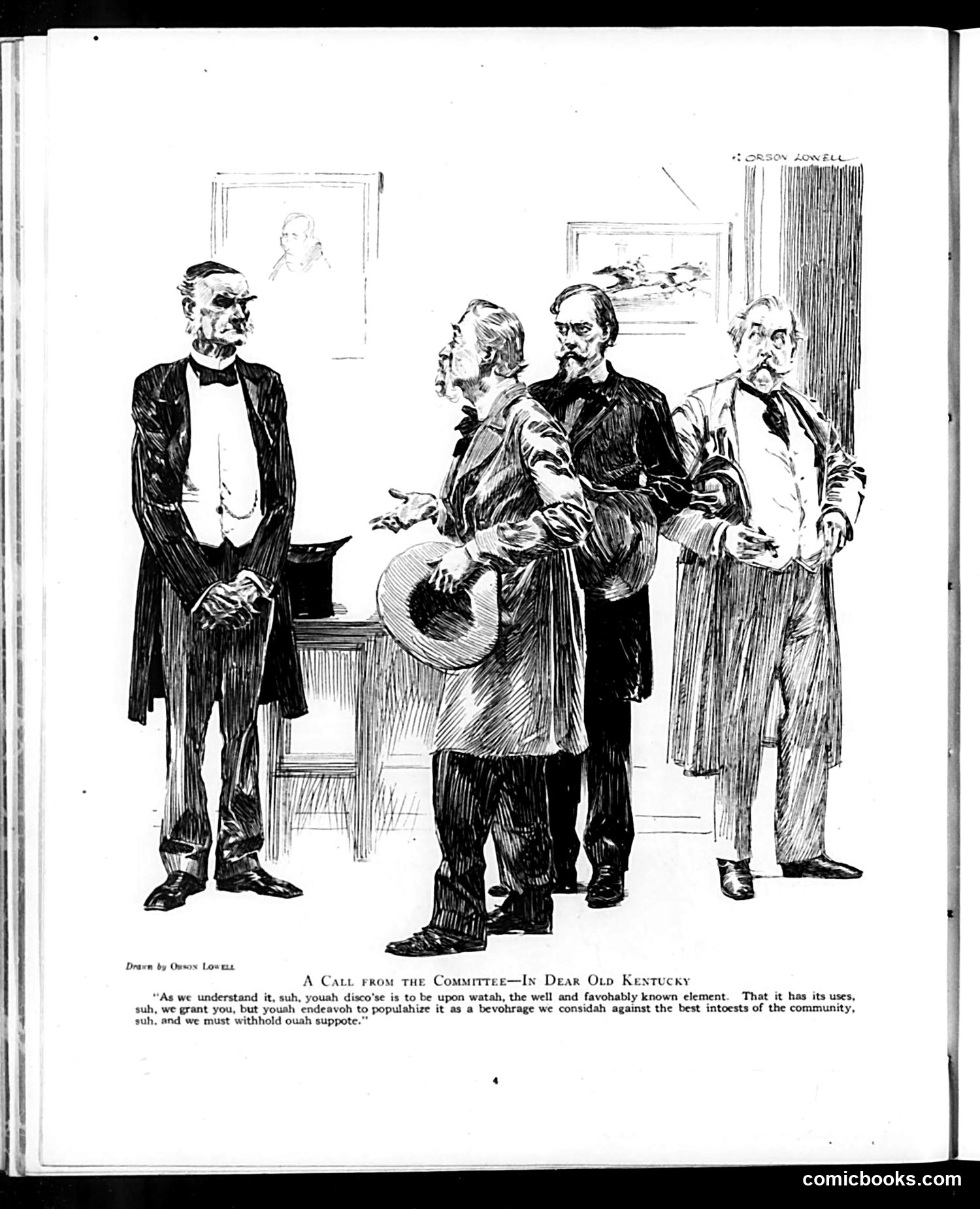
This cartoon depicts what appears to be a committee confronting a man holding a hat, likely about alcohol prohibition. The caption indicates the committee is pressuring someone to discontinue production or sale of whiskey—specifically "suh, youth disco'se is to be upon watah"—while acknowledging whiskey's "uses" and popularity. The satire targets the tension between Prohibition advocates and Kentucky's whiskey industry. The committee members represent reformers or government officials attempting to enforce anti-alcohol policy, while the central figure seems to be a distiller or seller resisting compliance. The joke hinges on the absurdity of asking Kentucky—historically central to American bourbon production—to abandon whiskey while simultaneously admitting its value and widespread support among citizens.
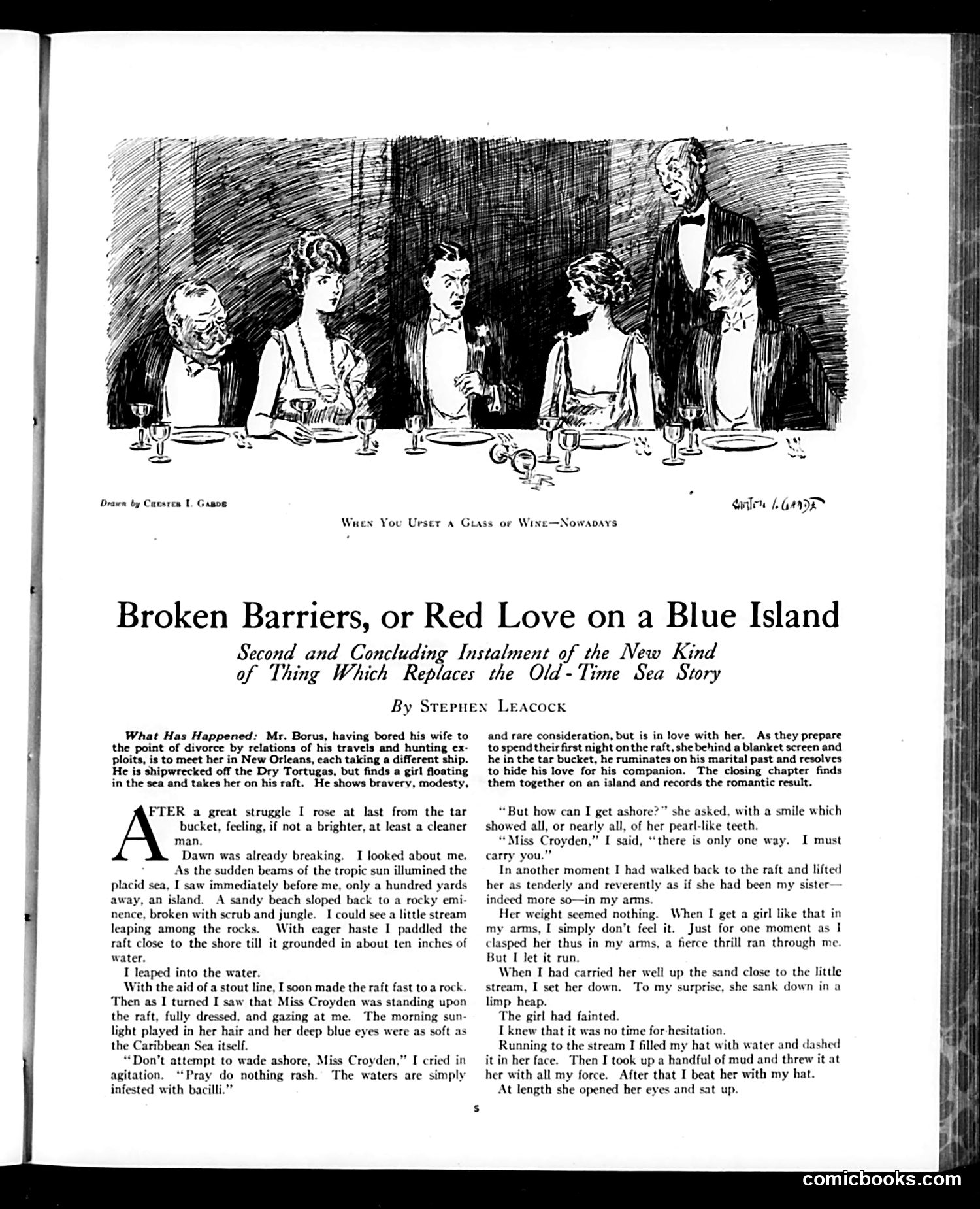
The top cartoon, titled "When You Upset a Glass of Wine—Nowadays," depicts a formal dinner scene showing six well-dressed people at a table. The satire appears to comment on **social embarrassment and etiquette during the Prohibition era** (suggested by the reference to wine and the date context of Judge magazine). The joke likely mocks how upsetting an alcoholic drink—once a minor social gaffe—had become either amusing or awkward given Prohibition's legal restrictions on alcohol. Below is the opening of a serialized story, "Broken Barriers, or Red Love on a Blue Island" by Stephen Leacock, describing a romantic encounter between characters on an island. This appears to be satirical fiction rather than political commentary. The content primarily concerns **social propriety and Prohibition-era attitudes** rather than explicit political satire.
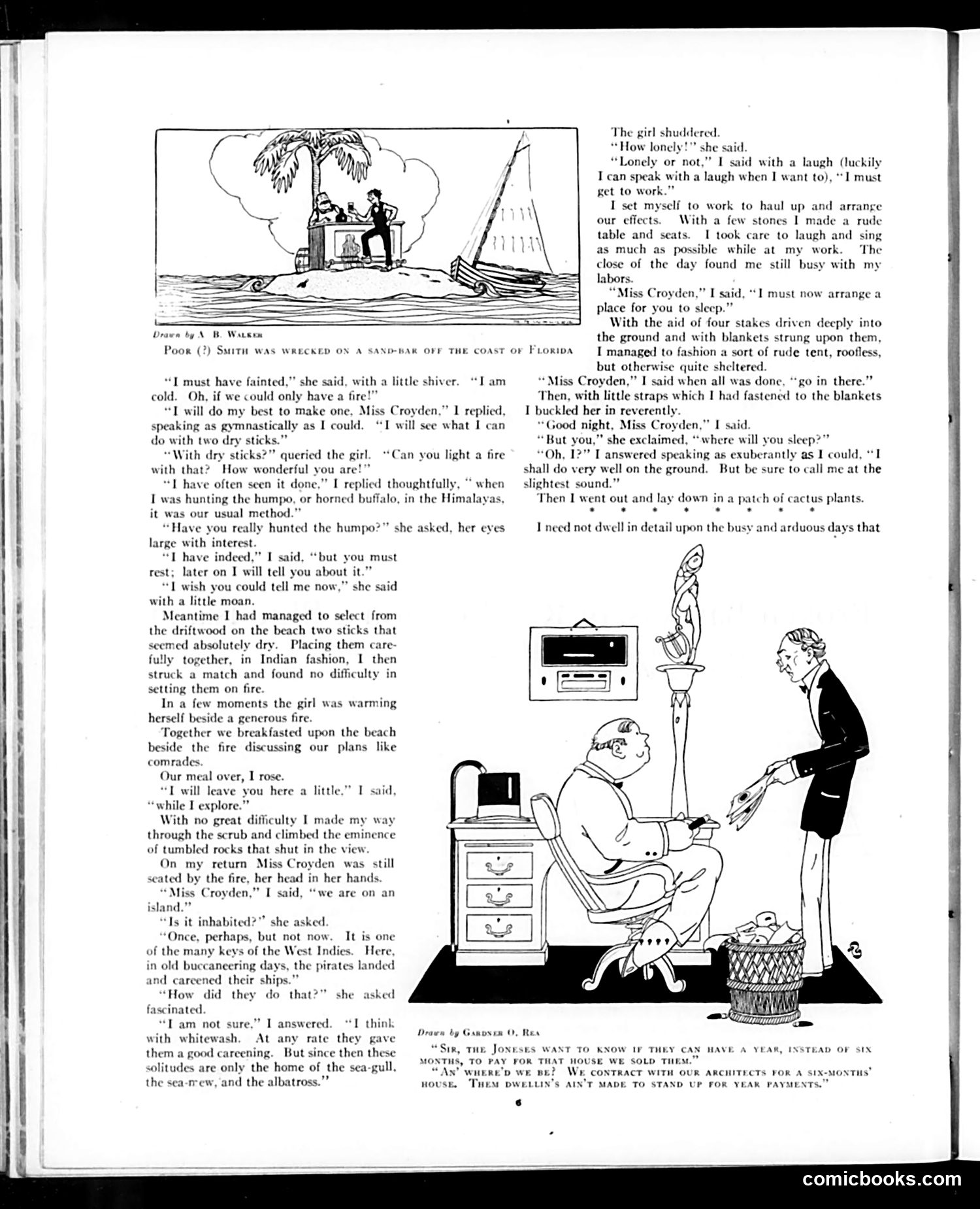
The page contains two distinct elements: **Left side:** A narrative story about shipwreck survival, illustrated with a small vignette of people on an island. This appears to be fiction rather than satire. **Right side cartoon:** Titled "Sir, the Joneses want to know if they can have a year, instead of six months, to pay for that house we sold them," the cartoon satirizes 1920s consumer credit culture and housing speculation. It depicts a real-estate agent negotiating extended payment terms with buyers—mocking the era's aggressive installment-plan selling and suggesting the inherent risk of such transactions. The joke critiques both aggressive salesmanship and buyers' inability to afford homes without lengthy financing. This reflects post-WWI economic anxieties about housing affordability and credit-fueled purchasing practices.
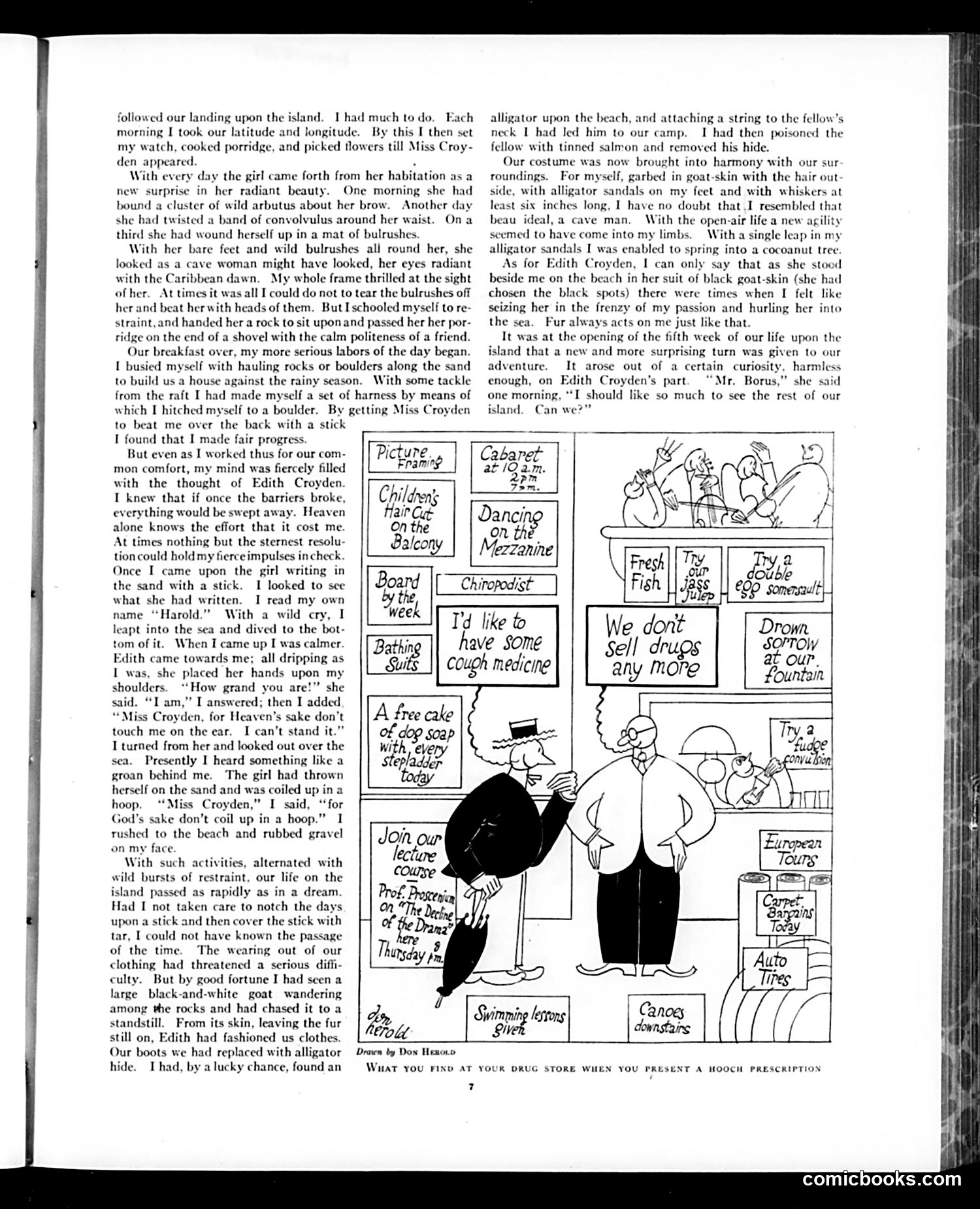
This page from *Judge* magazine contains a serialized humorous adventure story titled "What You Find at Your Drug Store When You Present a Hooch Prescription" (visible at bottom). The narrative describes a man and woman stranded on a Caribbean island, written in melodramatic adventure-story style. The story satirizes romantic adventure fiction and male restraint. The protagonist constantly battles passionate impulses toward the woman while maintaining exaggerated politeness—serving her porridge "on the end of a shovel." His bizarre logic (diving into the sea when seeing his name written in sand, fearing her touch) parodies overwrought Victorian romance conventions. The comic strip illustrations on the right offer surreal, non-sequitur vignettes about drugstore items and services, likely mocking patent medicines and the period's dubious pharmaceutical remedies. The title suggests this entire page is satirizing sensational entertainment and consumer culture of the era.
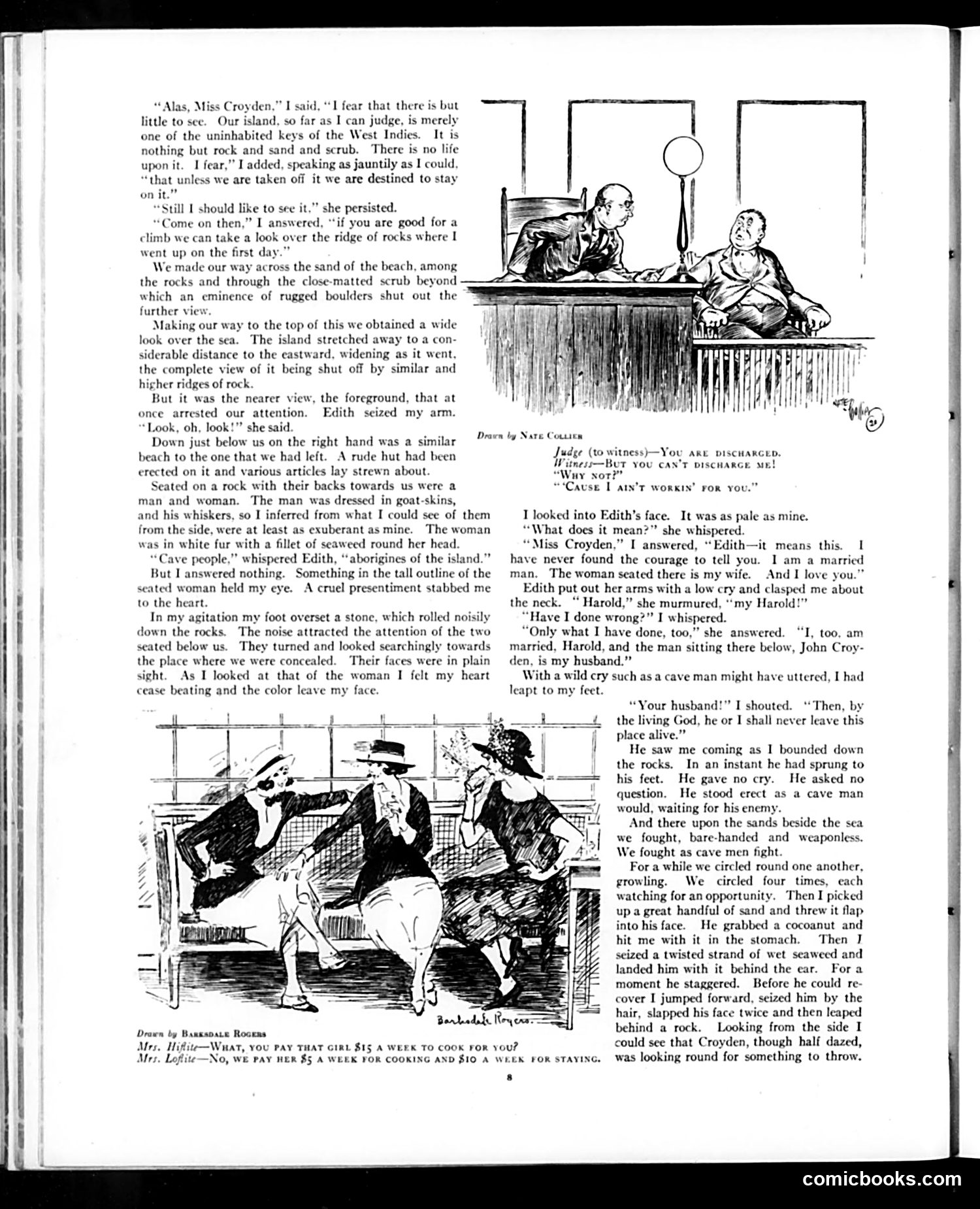
This page contains two satirical items: **Upper narrative with illustrations**: A serialized romantic adventure story about shipwrecked lovers discovering each other's spouses on a desert island. The text describes a melodramatic confrontation where two married people who love each other discover their respective spouses are also on the island, leading to a physical fight. This appears to be satirizing overwrought Victorian romance fiction and adventure narratives popular in the era. **Lower cartoon**: Depicts a domestic wage negotiation between two women about servant pay. One woman pays her cook $5/week for cooking plus $10/week "for staying"—implying the servant receives extra compensation simply for remaining employed, possibly satirizing either tight labor markets, servant retention issues, or absurd employer justifications for low wages during this period. Both items mock contemporary social conventions through exaggeration.
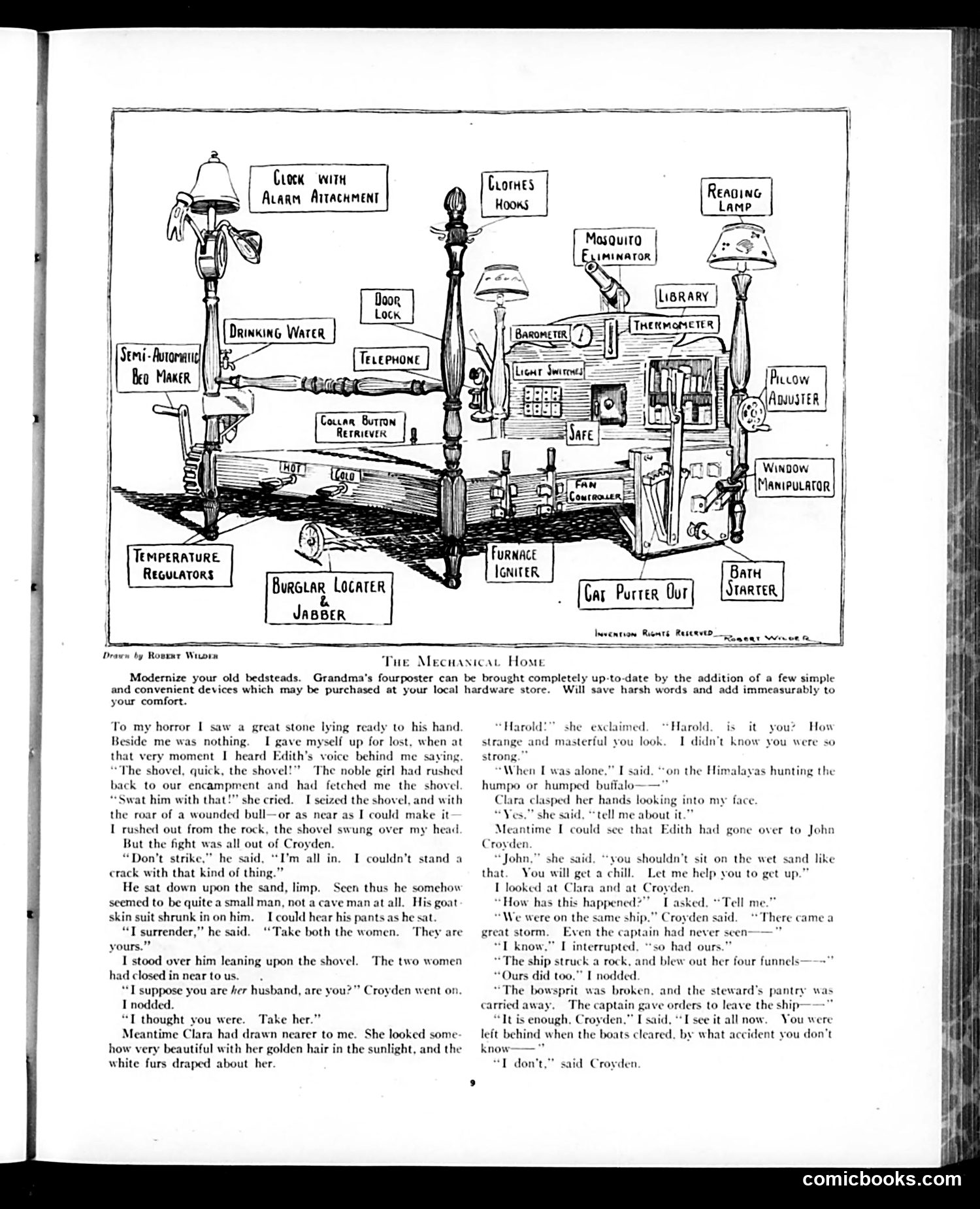
This page combines a humorous illustration with serialized fiction. The top cartoon, drawn by Robert Wilder, satirizes turn-of-the-century consumer culture and the obsession with labor-saving mechanical devices. It depicts a bedroom absurdly cluttered with gadgets—alarm clocks, mosquito eliminators, furnace igniters, bath starters, window manipulators—mocking the promise that newfangled inventions would modernize domestic life and improve comfort. The accompanying text advertises updating old bedsteads with "convenient devices" from hardware stores, a pitch clearly aimed at the newly prosperous middle class. Below runs serialized adventure fiction about a shipwreck involving characters named Harold, Clara, Edith, and John Croyden. The narrative appears to satirize popular adventure stories and romantic melodrama of the era—tales of storm-tossed ships and masculine heroics that contrasted sharply with the domestic, mechanized world depicted above.
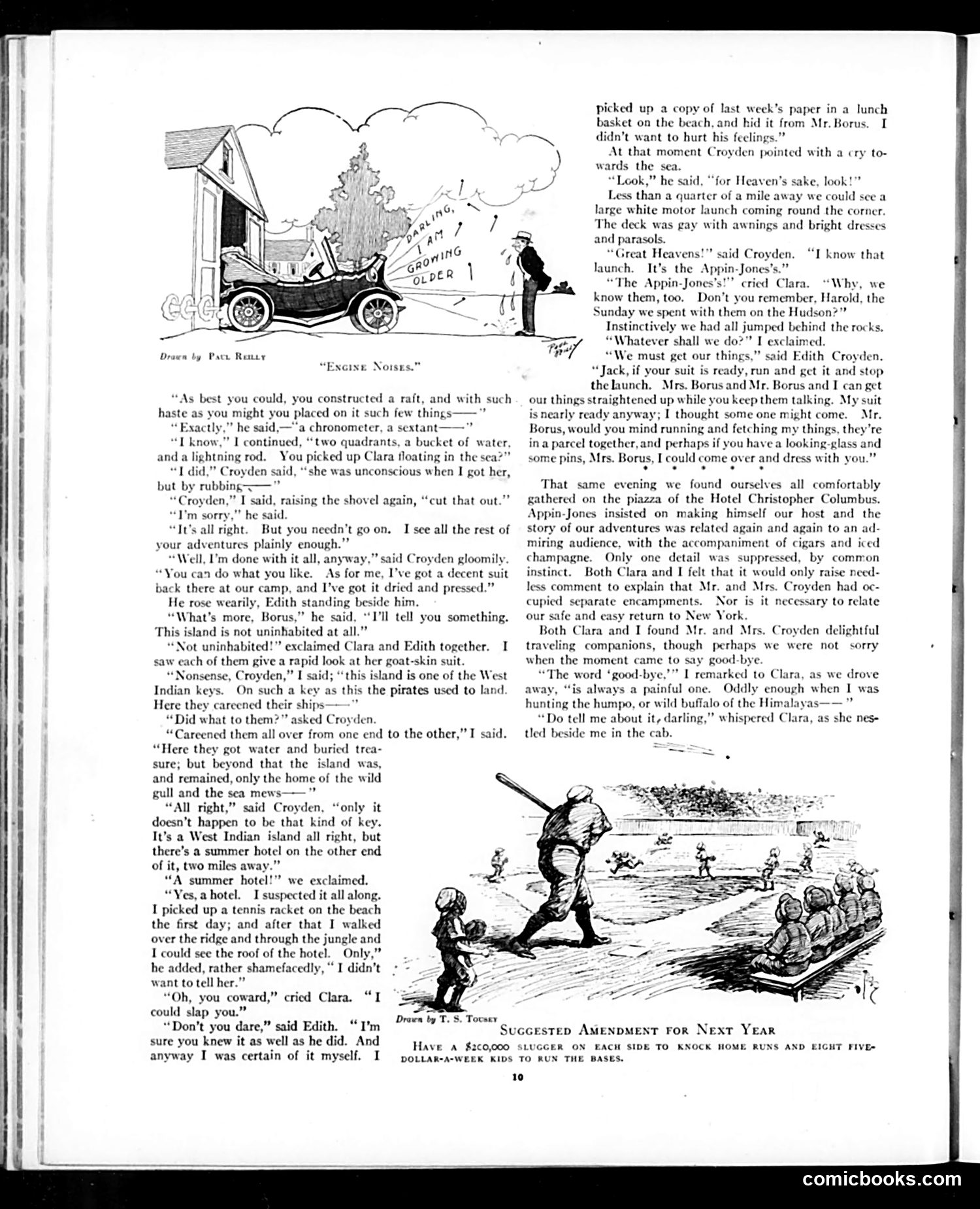
This page presents a serialized adventure story with social satire rather than political cartoons. The narrative mocks the pretensions of wealthy leisure travelers. The setup: castaways on a remote island believe themselves isolated and roughing it, but discover a summer hotel nearby. The irony deepens when they frantically hide their shabby condition—only to realize *they themselves* had secretly brought modern conveniences (a newspaper) they'd hidden from each other to appear more noble. The satire targets early 1900s upper-class hypocrisy: these people are not genuine adventurers but tourists playing at survival while clinging to luxury. The punchline involves encountering the "Appin-Jones" family—acquaintances from Hudson River social circles—revealing this wasn't wilderness at all but an established resort destination. The cartoon "Engine Noises" (top left) humorously depicts automobile culture, likely satirizing the disruptive noise of early motor cars in public spaces. The bottom illustration shows baseball, possibly commenting on leisure activities available to the wealthy.
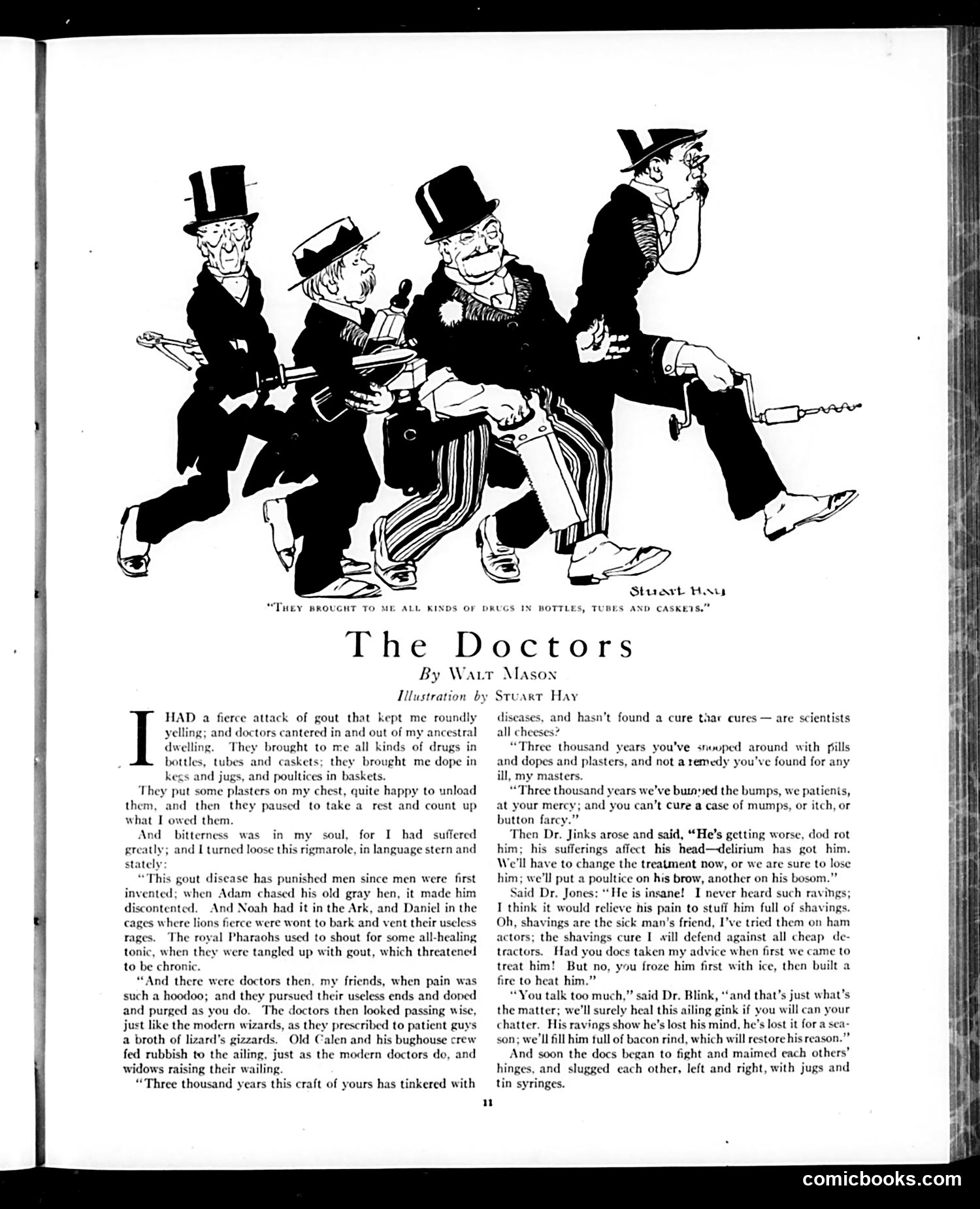
This illustrated poem by Walt Mason satirizes early 20th-century medical incompetence. The cartoon depicts four quarreling physicians—caricatured as pompous, disagreeing "experts" in top hats. The satire's core argument: doctors have provided useless treatments for thousands of years without finding actual cures. Mason traces medical futility from ancient times (Pharaohs, Calen) through the present, using gout as his example. Each doctor proposes contradictory remedies—poultices, shavings, bacon rind—revealing medicine as guesswork rather than science. The climax shows doctors literally fighting each other with medical instruments, suggesting their field lacks coherent knowledge or authority. The caption "They brought to me all kinds of drugs in bottles, tubes and caskets" emphasizes the absurd proliferation of useless remedies. This reflects genuine contemporary skepticism about medical practice before antibiotics and modern diagnostics made medicine genuinely effective.
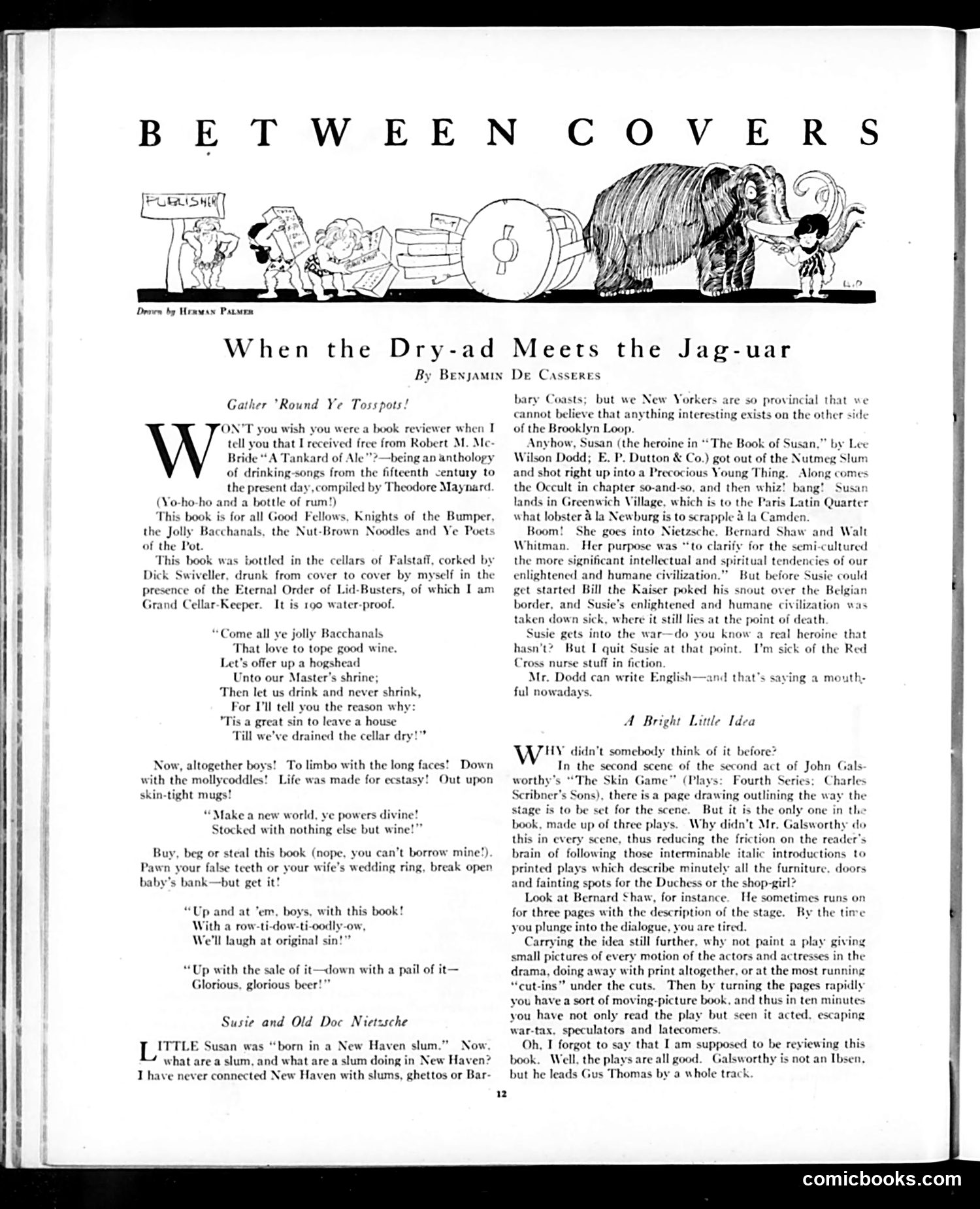
This is a literary review page from Judge magazine, not primarily political satire. It contains three humorous book reviews: 1. **"A Tankard of Ale"**: The reviewer (Benjamin De Casseres) adopts a drunk persona, using Shakespearean drinking-song references and mock-serious fraternal language ("Grand Cellar-Keeper," "Eternal Order of Lid-Busters") to humorously praise this fifteenth-century drinking-song anthology. The joke is the reviewer's exaggerated intoxication and theatrical reverence for alcohol. 2. **"The Book of Susan"**: Satirizes a novel about a slum girl who becomes a cultured intellectual, goes to Greenwich Village, discovers Nietzsche and Shaw, then becomes a WWI Red Cross nurse. The satire targets literary clichés—the predictable "enlightened heroine" plot and the overuse of war-nurse storylines in contemporary fiction. 3. **"The Skin Game"**: Praises Galsworthy's play for including stage-set diagrams, criticizing the tedious practice of lengthy written stage descriptions in published plays. The page satirizes literary trends and publishing conventions rather than politics.
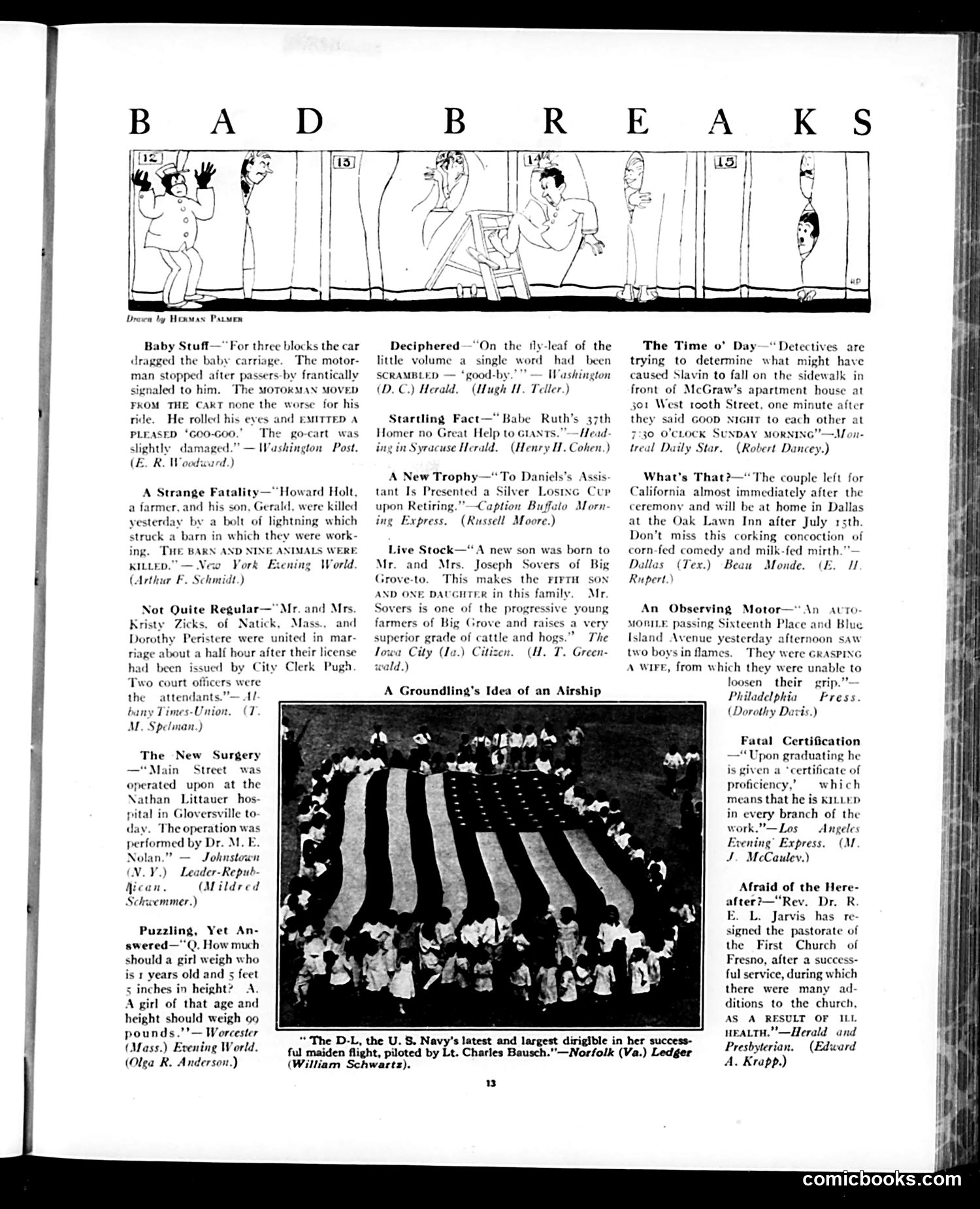
This page from *Judge* magazine collects humorous newspaper clippings—a recurring feature that satirizes absurd real-world news stories. Each item highlights logical contradictions or dark ironies in brief news reports. The cartoon at top shows a comic strip about a baby carriage dragged behind a streetcar, with the motorman unharmed and cheerfully cooing "goo-goo" despite the damaged carriage—the joke being the inverted concern for a machine over a child. Below, the "Bad Breaks" section presents edited newspaper headlines that reveal unintentional humor through poor wording or reporting: a farmer killed by lightning with "nine animals," a girl's weight recommendation, "Babe Ruth's 37th Homer no Great Help to Giants," and a clergyman resigning due to "ill health" after successfully gaining church members—implying the new converts made him sick. The large photograph shows the Navy's new dirigible (airship) with crew members visible, captioned as a "groundling's idea"—mocking how ordinary people might imagine such technology. The satire targets lazy journalism and coincidental absurdities in everyday news.
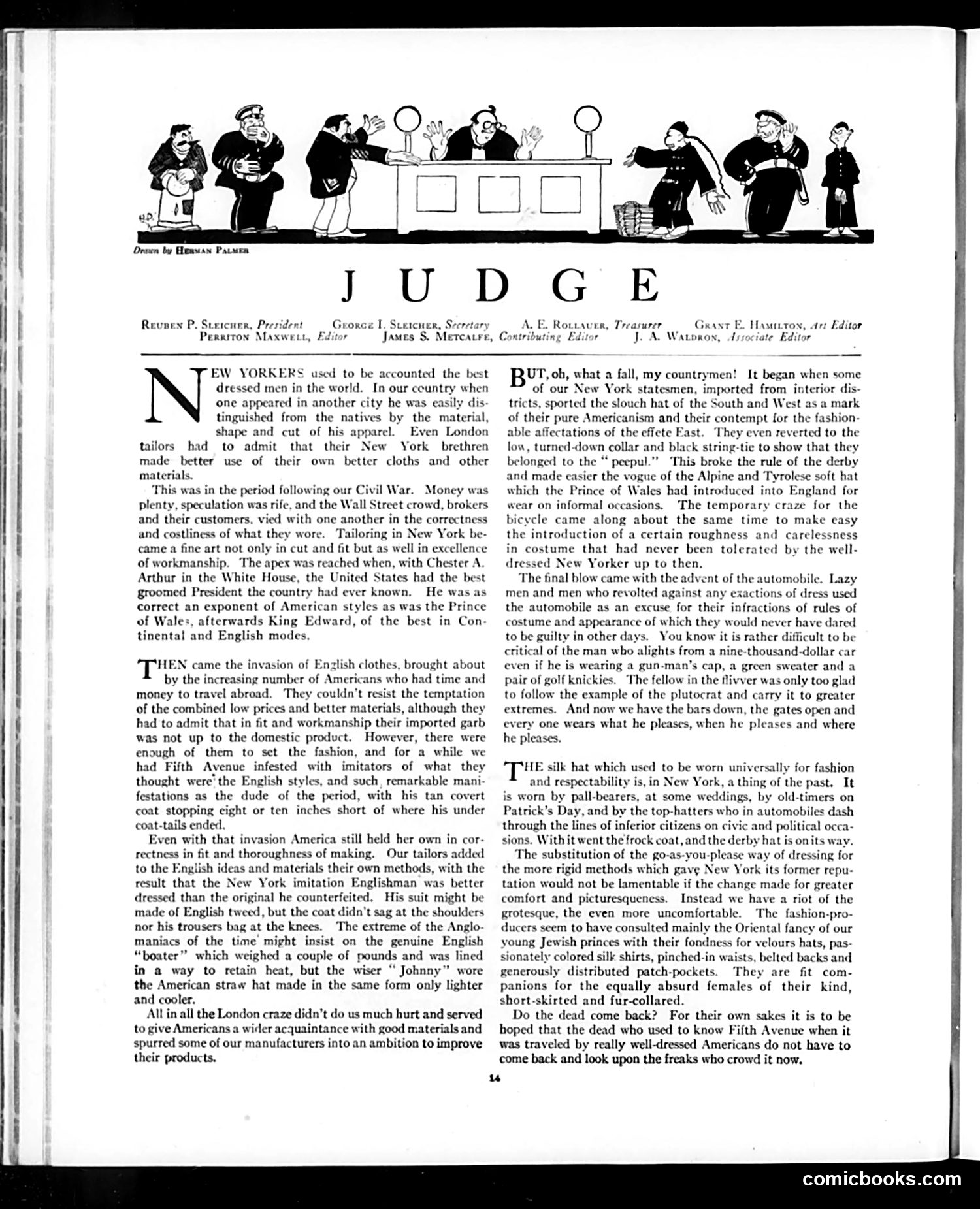
This is an editorial essay (not a comic) lamenting the decline of New York's reputation for sartorial excellence. The illustrated header shows a courtroom scene, establishing "Judge" as arbiter of taste. The article traces American fashion history: Post-Civil War New Yorkers (including President Chester Arthur) were world-renowned for impeccable tailoring. However, wealthy Americans traveling abroad adopted cheaper English styles, spawning inferior Fifth Avenue imitators. While American tailors eventually improved upon English designs, a more serious threat emerged: populist politicians from rural areas wore slouch hats and string ties as symbols of "authentic" Americanism, rejecting Eastern refinement. This anti-fashion movement, combined with the bicycle craze, introduced "roughness and carelessness" into American dress. The satire targets both rural anti-urban sentiment and the democratization of fashion—the author mourns that democratic politics has literally undressed America's gentleman class.
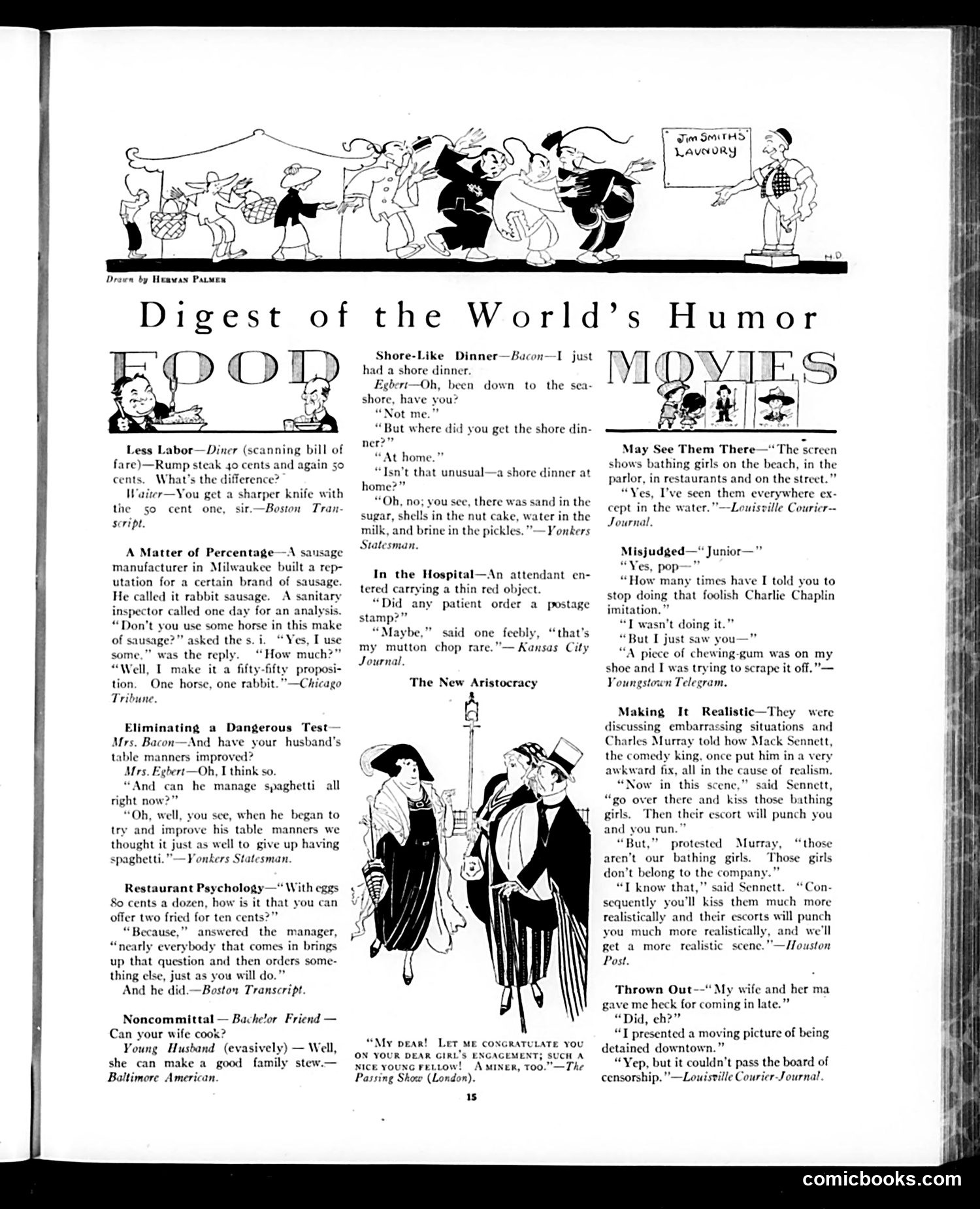
This page collects short humorous anecdotes reflecting early 20th-century American life. The jokes target working-class concerns and domestic situations: **Key themes:** - **Food/Economics**: Jokes about restaurant pricing tricks, questionable meat quality (sausage mixing horse and rabbit), and food adulteration reflect Depression-era anxieties about value and food safety. - **Gender/Marriage**: Multiple jokes depict wives' cooking abilities and husbands' table manners as marital friction points—reflecting rigid domestic expectations. - **Modern Entertainment**: References to Charlie Chaplin imitations and film censorship boards show cinema's growing cultural influence and anxieties about "realism" in movies. - **"The New Aristocracy"** cartoon (center) appears to satirize class pretension, though the specific reference is unclear without more context. The humor relies on observational comedy about ordinary frustrations—dishonest commerce, marital dynamics, and navigating new mass media—rather than political satire. These represent concerns of the magazine's middle-class audience.
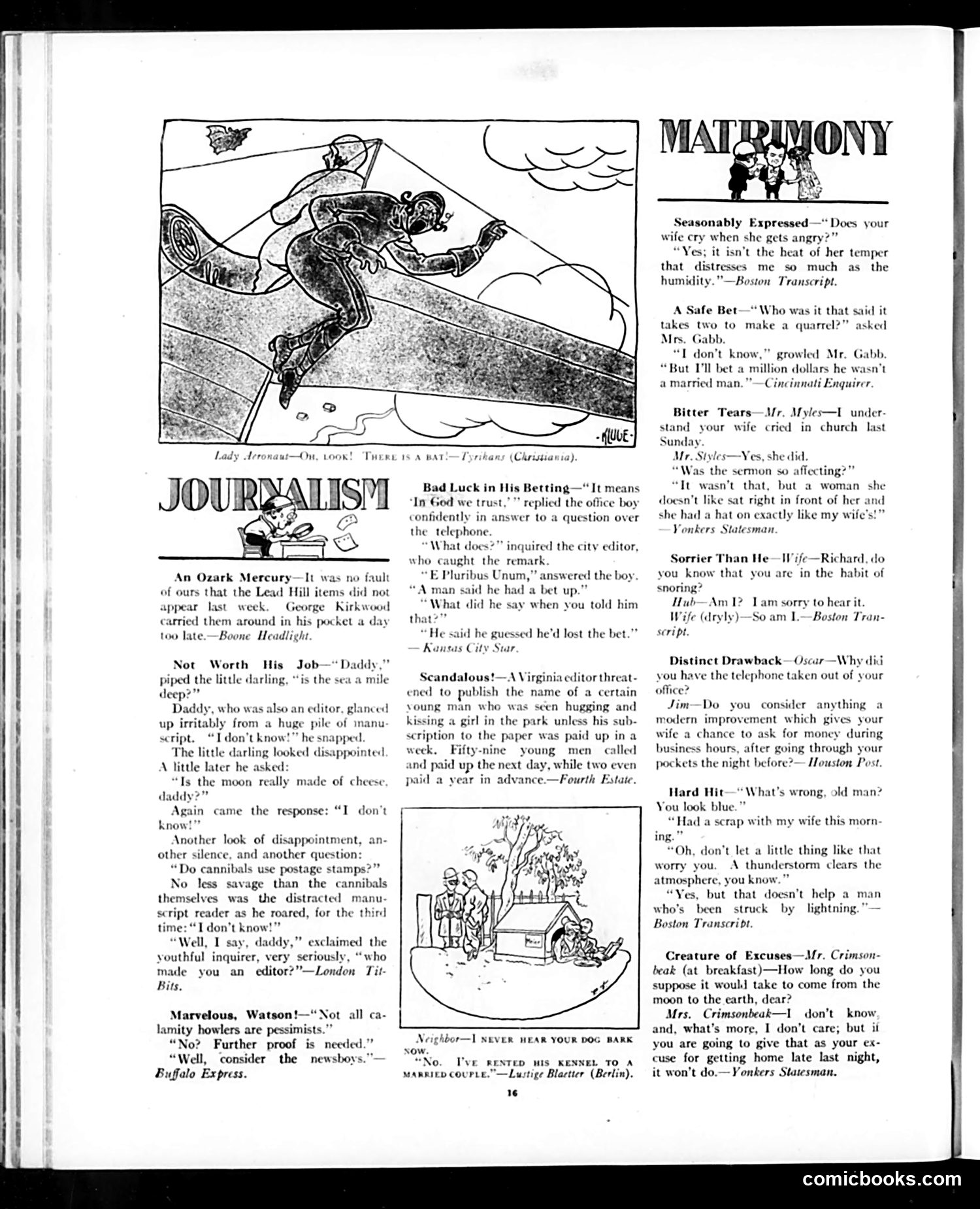
This page contains short humorous anecdotes and jokes typical of early 20th-century American humor magazines. The top cartoon depicts an aeronaut (hot air balloon pilot) spotting a bat in flight, playing on the period's fascination with aviation. The jokes satirize everyday domestic life and newspaper work. They mock: - **Distracted editors** ignoring their children's questions - **Marital discord**, particularly wives' anger and nagging (a recurring theme) - **Newspaper gossip culture**, including a Virginia editor blackmailing readers by threatening to publish a young man's name unless they paid subscriptions - **Domestic complaints** about snoring, expensive hats, and wives making excuses The humor reflects period attitudes: women are portrayed as temperamental, materialistic, and argumentative; men as exasperated but resigned to marriage. The jokes assume readers share these gendered stereotypes about marriage as inherently conflictual. The "Neighbor" cartoon at bottom uses a German source, typical of this era's international comic borrowing. Overall, this represents pre-1920s American magazine humor emphasizing workplace and marital frustrations as comedy fodder.
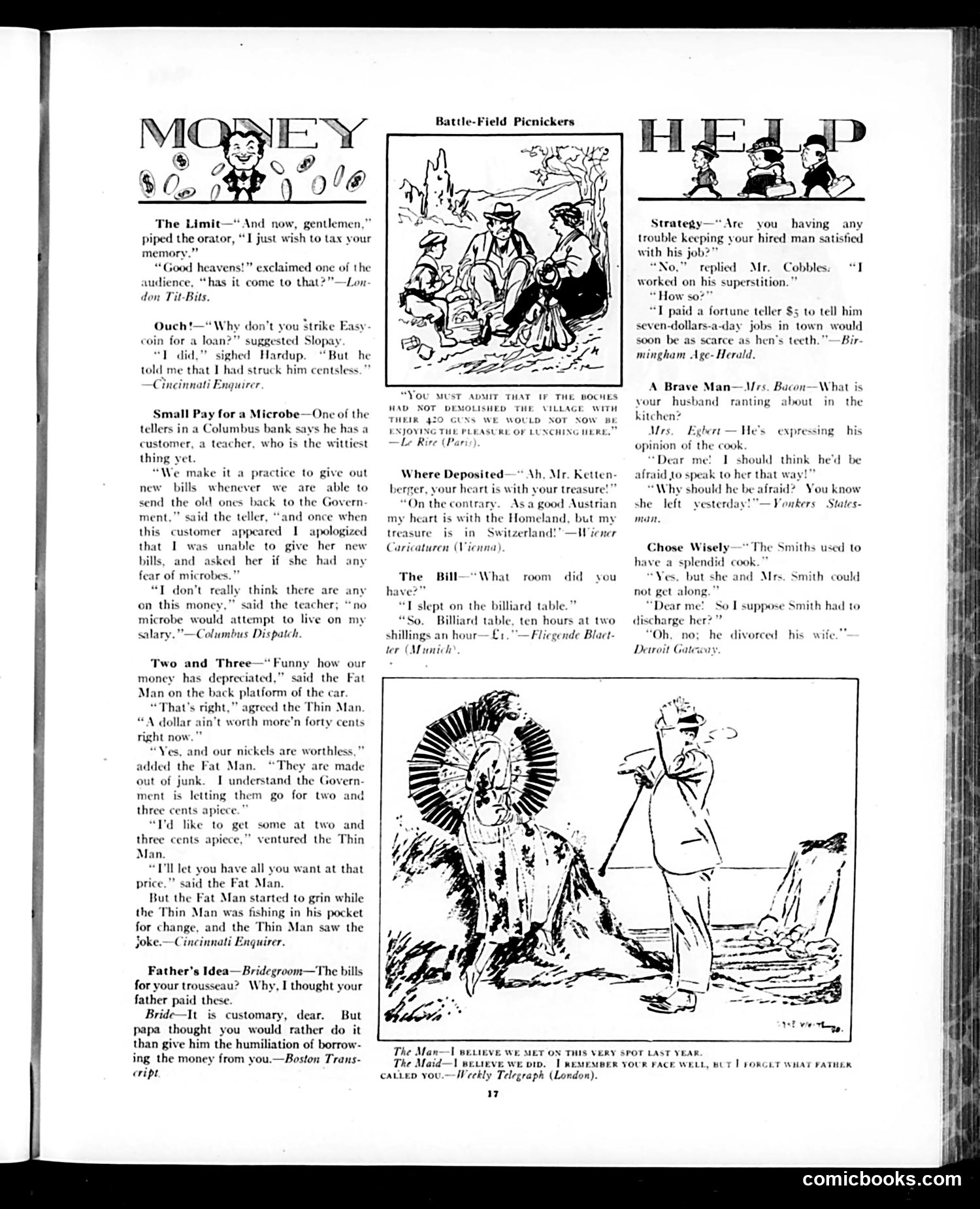
This page collects brief humorous anecdotes typical of early 20th-century American humor magazines. Most jokes concern money depreciation and economic hardship—a recurring theme suggesting post-WWI inflation. **Key satire points:** - **"The Limit"**: A speaker asks the audience to "tax your memory," prompting shock that taxation has become so severe it now targets memory itself—commentary on excessive taxation. - **"Two and Three"**: Two men discuss worthless currency; the Fat Man tricks the Thin Man into offering to sell him nickels cheaply, then reveals the joke—satirizing economic confusion and opportunism. - **"Where Deposited"**: An Austrian claims his heart belongs to the homeland while his money is safely in Switzerland—mocking wartime patriotism undermined by financial self-interest. - **"Battle-Field Picnickers"**: German soldiers enjoy lunch where a village was destroyed—dark humor about war's aftermath. The remaining anecdotes are lighter domestic humor. The overall tone reflects post-WWI economic anxiety and cynicism about human nature.
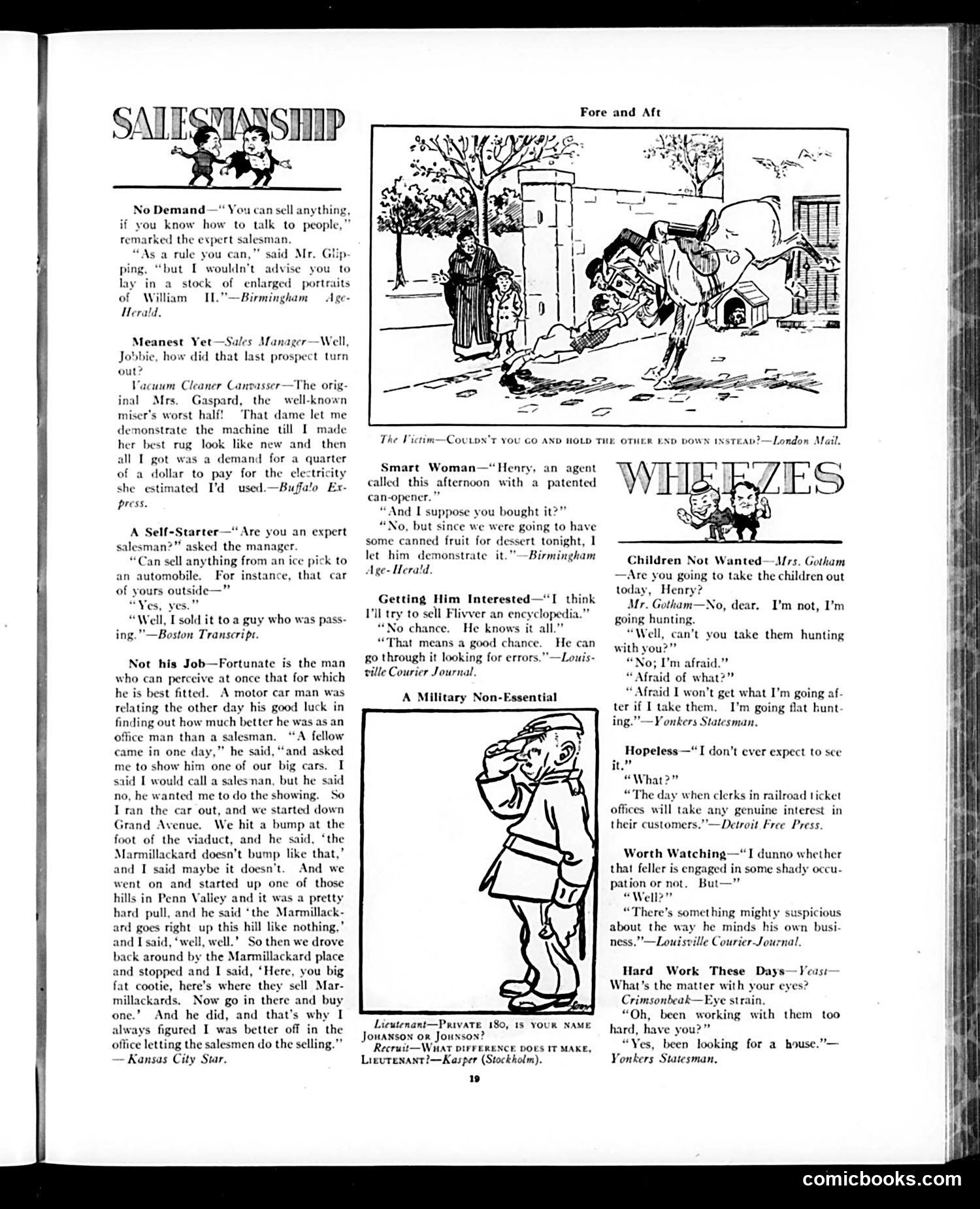
This page from the satirical magazine *Judge* collects humorous anecdotes about salesmanship and everyday life, likely from the early 20th century. The main satire targets **sales culture and consumer behavior**. Several jokes mock overeager salesmen ("Meanest Yet" depicts a vacuum cleaner demonstrator failing to sell to a miserly woman) and the gullibility of buyers ("Smart Woman" shows a housewife convinced to purchase a can-opener). Other jokes reveal social frustrations: railroad ticket clerks' indifference to customers, difficulty finding affordable housing, and the absurdity of military bureaucracy (the "Non-Essential" cartoon jokes about a recruit's name spelling variation). The cartoon at top right ("The Victim") depicts a man being pestered by a salesman at his doorstep—visualizing the invasive sales tactics satirized throughout. The humor assumes a middle-class audience familiar with these annoyances: aggressive door-to-door salesmen, bureaucratic inefficiency, and housing shortages were common grievances of the era.
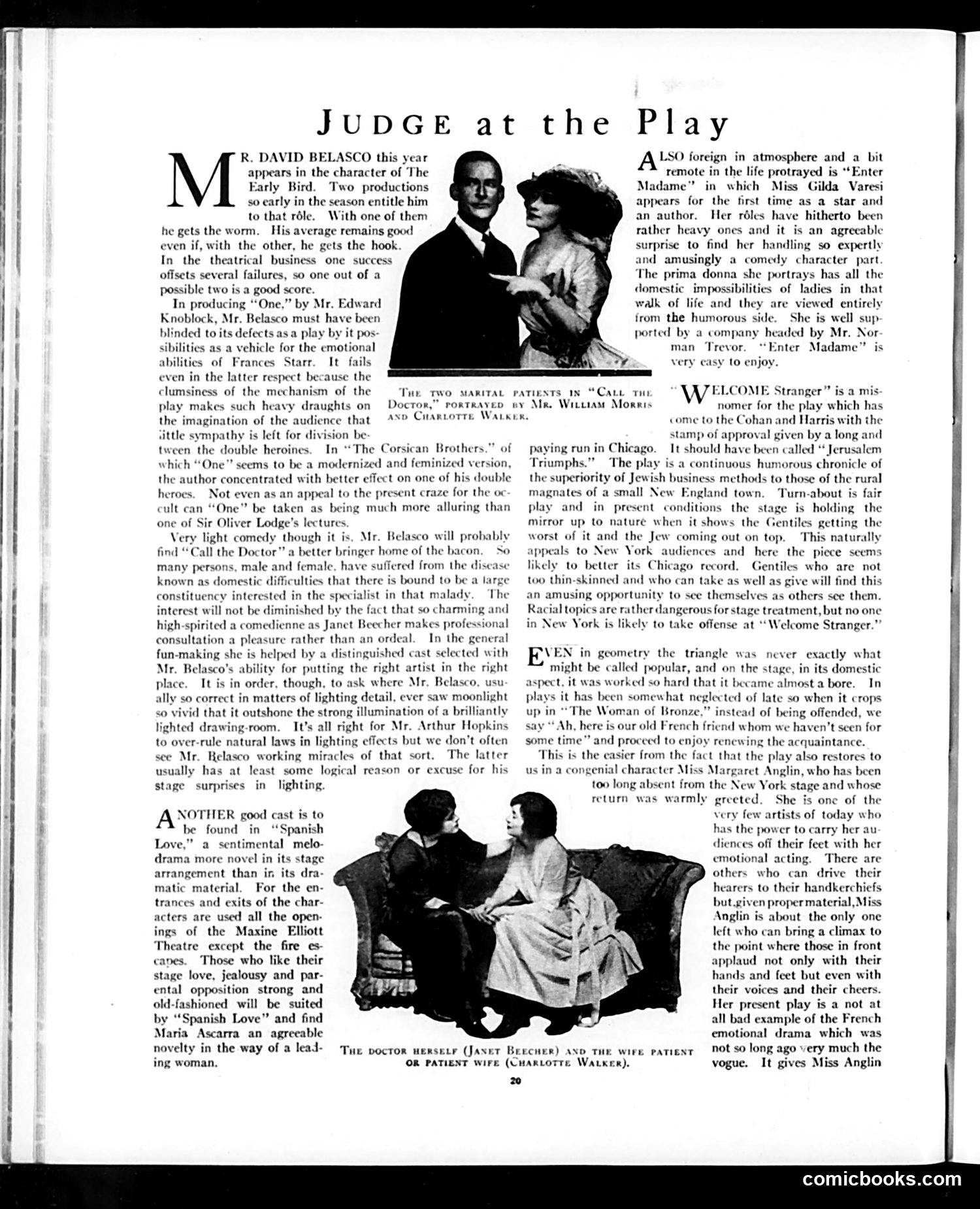
This page reviews several Broadway productions directed by or featuring David Belasco and other theatrical figures of the era. The text discusses three plays: "One" (a modernized version of "The Corsican Brothers"), "Call the Doctor" (a light comedy), and "Spanish Love" (a sentimental melodrama). The photographs show actors in costume—apparently from "Call the Doctor" (top) and "Spanish Love" (bottom). The reviews critique both the dramatic material and technical execution, particularly praising Janet Beecher's comedic talents while questioning Belasco's sometimes unrealistic lighting choices. The page reflects early 20th-century theatrical criticism, evaluating performances, plot mechanics, and stage design with an emphasis on emotional authenticity and the quality of supporting casts.
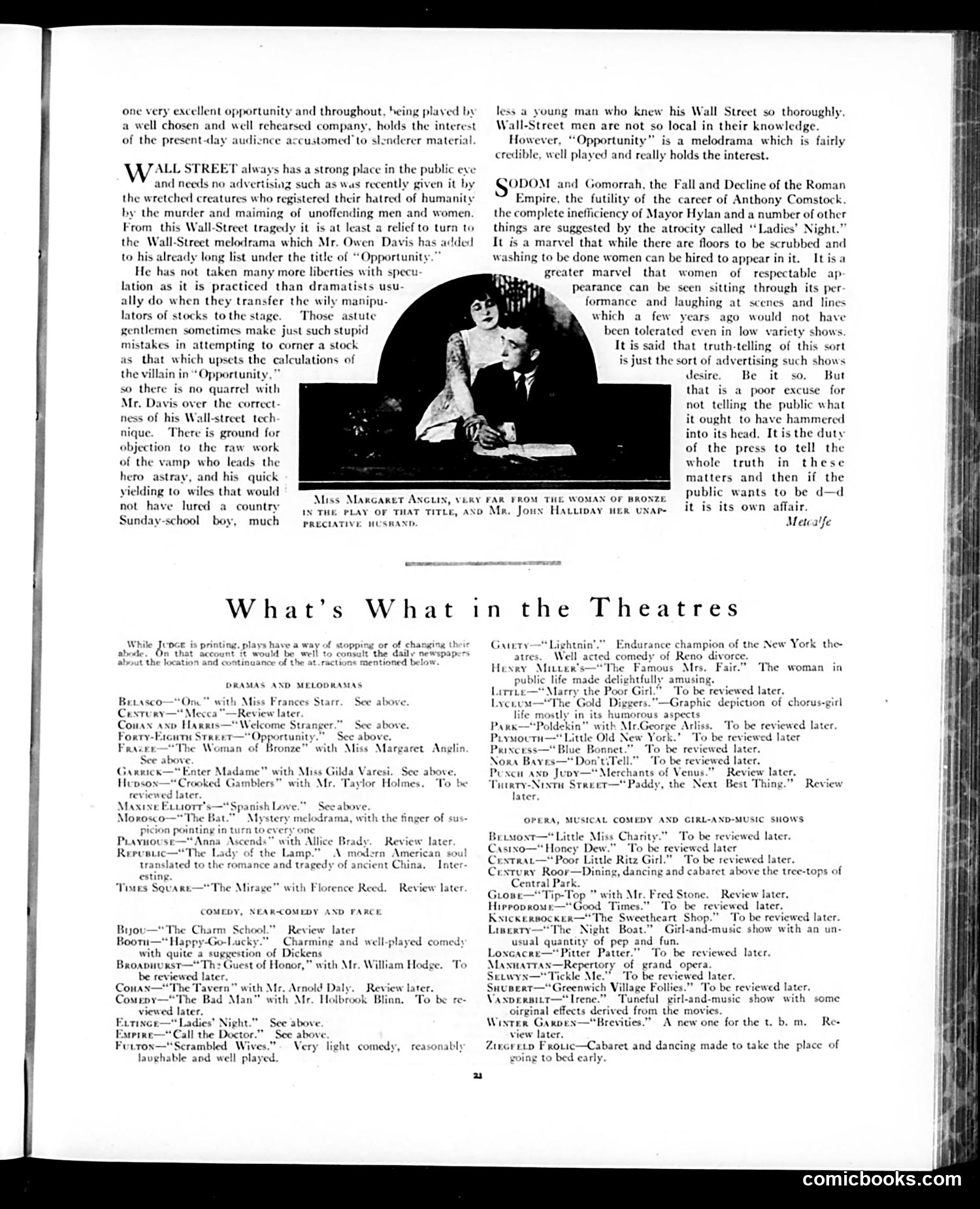
This Judge magazine page reviews theatrical productions, with particular criticism of the play "Opportunity," a Wall Street melodrama by Owen Davis. The accompanying photo shows actress Margaret Anglin in the production. The reviewer praises the play's technical accuracy regarding stock market manipulation but criticizes its portrayal of a morally weak male protagonist seduced by a "vamp" character—arguing no sensible man would fall for such obvious wiles. The larger critique targets the play "Ladies' Night," which the reviewer compares sarcastically to biblical and historical catastrophes. He's scandalized that respectable women would appear in or attend a show featuring such bawdy content, suggesting standards of propriety have dangerously declined. The page reflects early 20th-century anxieties about moral corruption, female sexuality in entertainment, and changing social standards—particularly regarding women's public behavior and what theatrical content was considered acceptable.
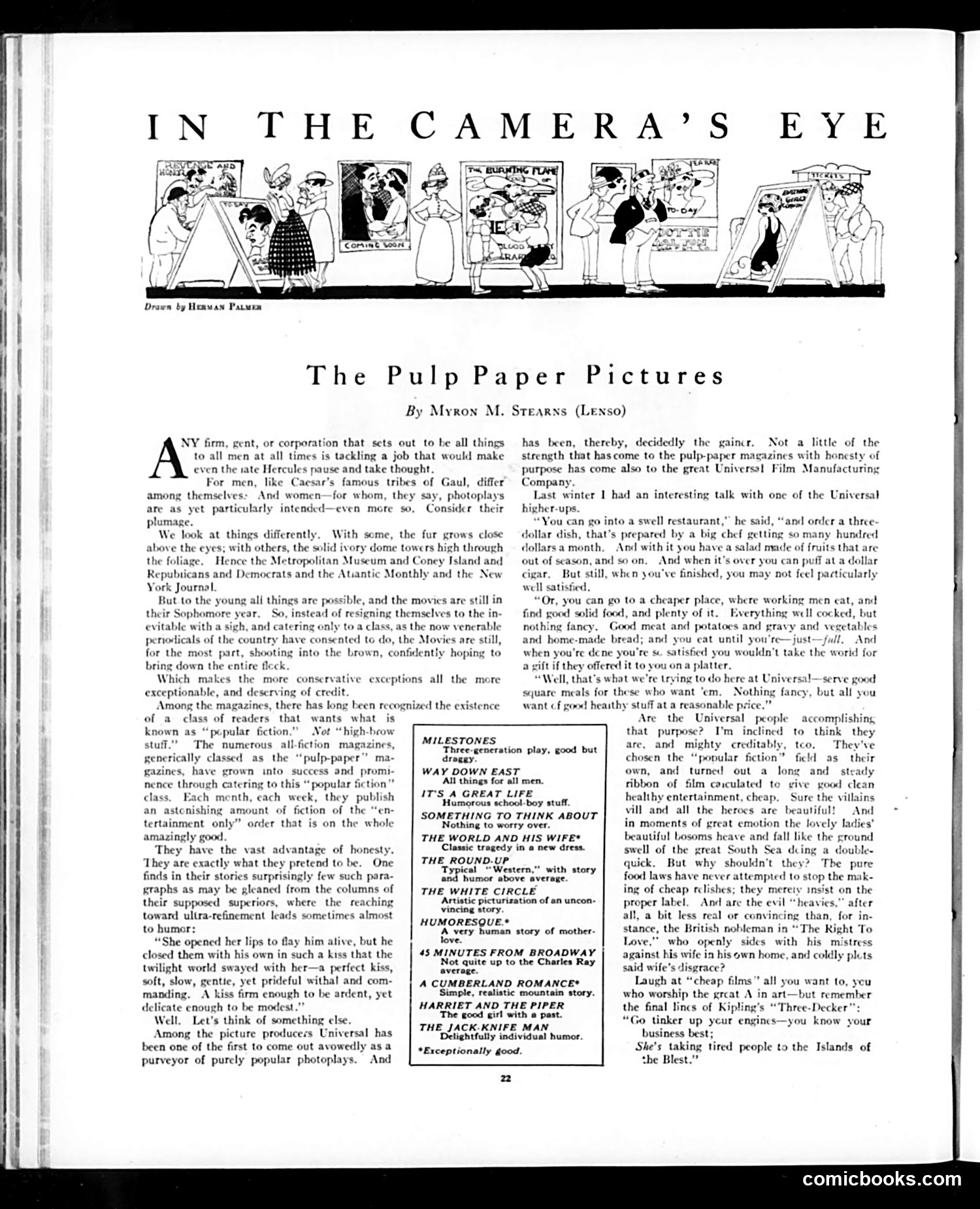
This article by Myron M. Stearns defends "pulp paper" magazines and Universal Films against elitist criticism. The cartoon header shows various entertainment venues and audiences, illustrating the article's central argument: that popular entertainment honestly serves its intended mass audience, unlike pretentious publications. Stearns argues that while highbrow publications (Metropolitan Museum, Atlantic Monthly) cater to specific tastes, pulp magazines and Universal Films openly embrace their "popular fiction" mission without pretense. He uses a restaurant metaphor—a fancy three-dollar dish versus cheap, satisfying food—to suggest both have legitimate value. The satire targets intellectual snobbery, contrasting crude kissing scenes from "refined" literature with the straightforward entertainment pulp provides. Universal's approach of serving "all men" through accessible photoplays (listed with plot synopses) represents honest commerce versus cultured hypocrisy. The piece champions democratic, unpretentious entertainment.
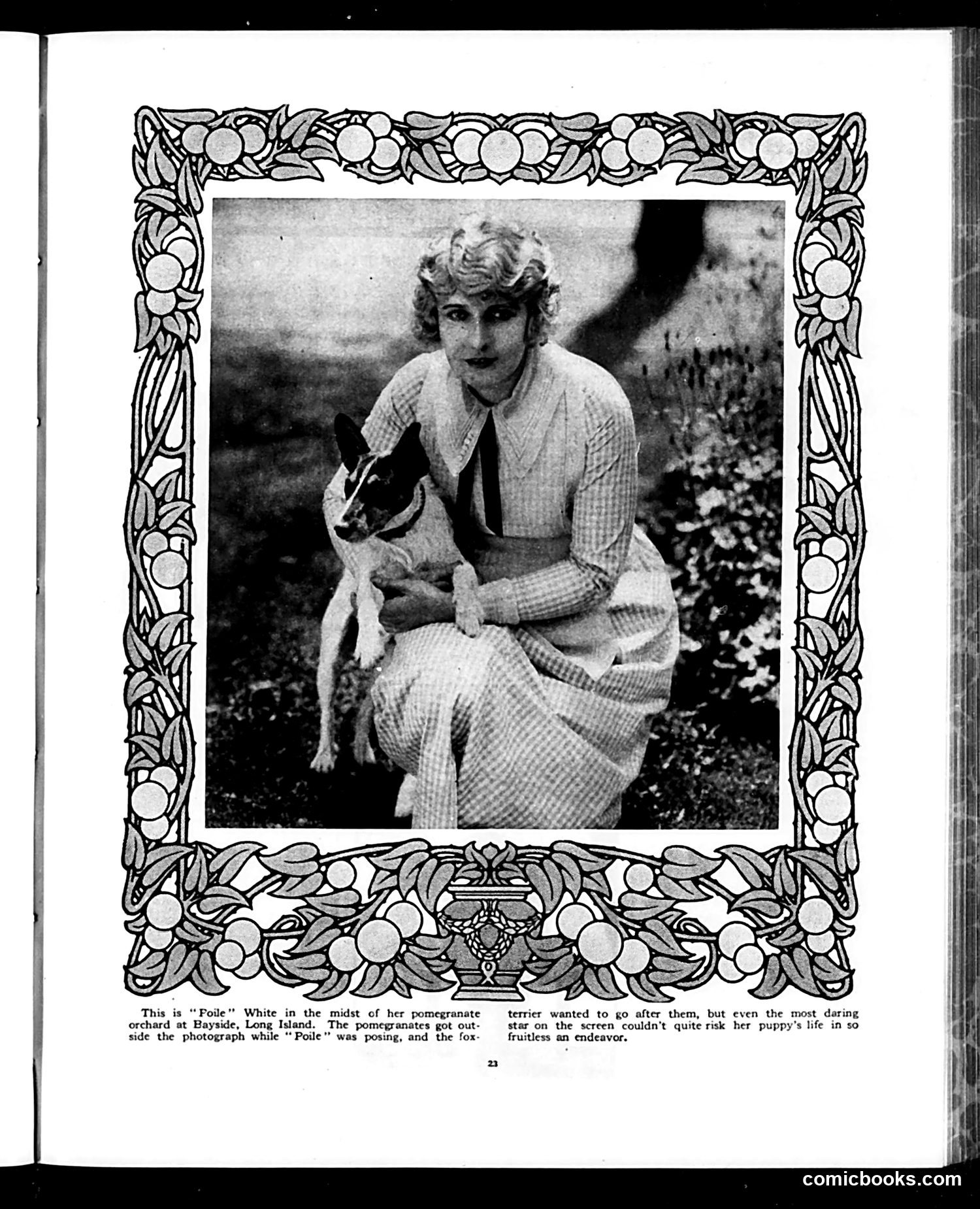
This page features a photograph of "Poile" White, identified as a film actress, posing with a small dog in a pomegranate orchard at Bayside, Long Island. The accompanying text describes an anecdote about pomegranates falling during the photo session—the fox terrier wanted to chase them, but even the "most daring star on the screen couldn't quite risk her puppy's life in so fruitless an endeavor." This appears to be a lighthearted celebrity feature rather than political satire. It's likely from Judge's entertainment coverage, presenting an amusing behind-the-scenes moment that humanizes the actress through her concern for her pet. The humor derives from the domestic situation rather than social commentary.
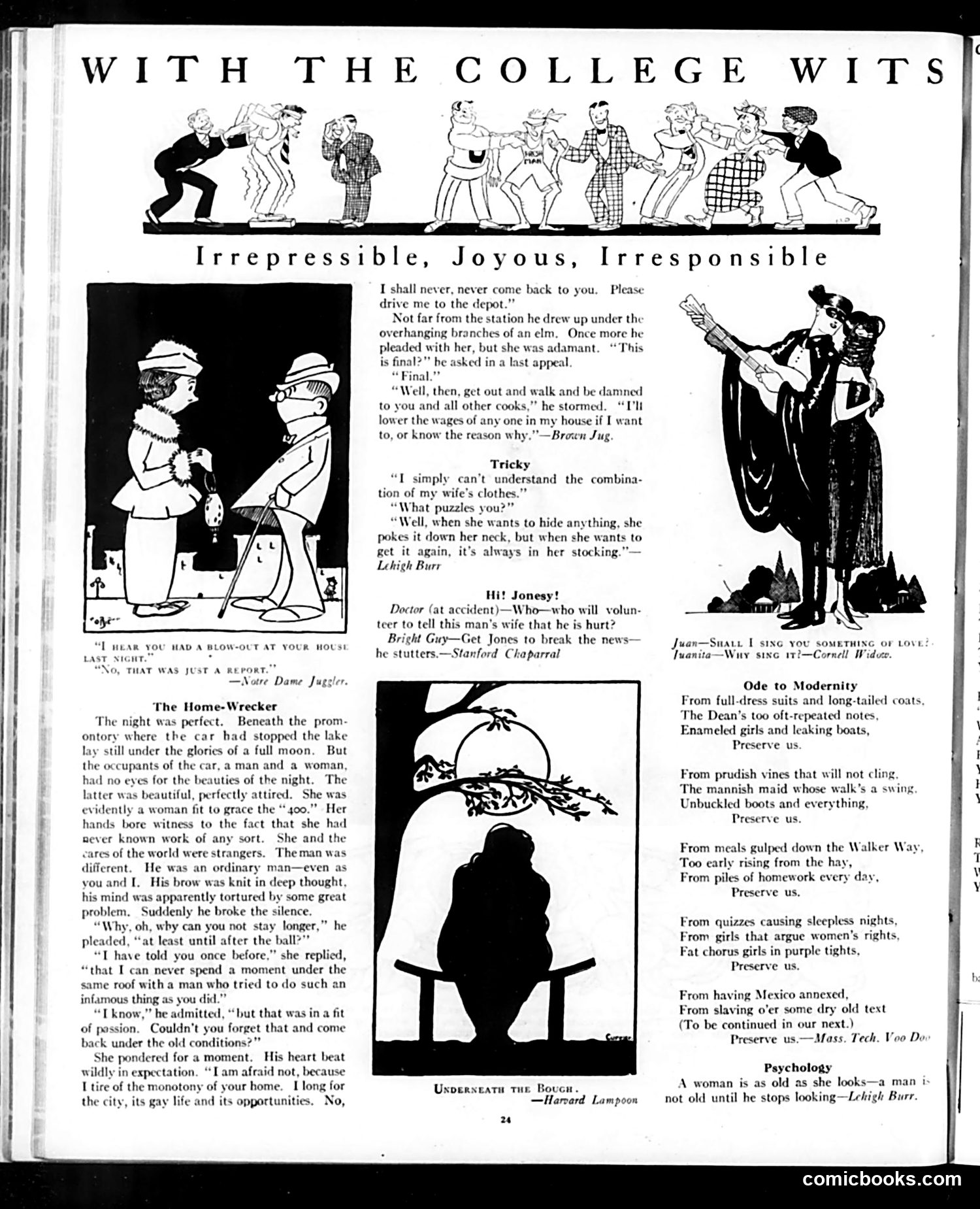
This Judge magazine page presents satirical takes on early 20th-century social issues. The main story, "The Home-Wrecker," depicts a domestic crisis: a wealthy woman (identifiable by her "400" status—old money society) abandons her ordinary husband because she finds his modest home boring and craves city excitement. His angry response reveals class anxiety—he threatens to lower servants' wages, suggesting working-class resentment of the wealthy. The surrounding pieces mock college life and gender roles: "Tricky" jokes about wives hiding things in clothing; "Hi! Jonesy!" makes light of workplace accidents; and "Ode to Modernity" satirizes changing social norms—enameled girls, mannish maids, women's rights arguments, and modern education's demands. The overall tone reflects early 1900s anxieties: women's independence, class conflict, and shifting social values threatening traditional order.
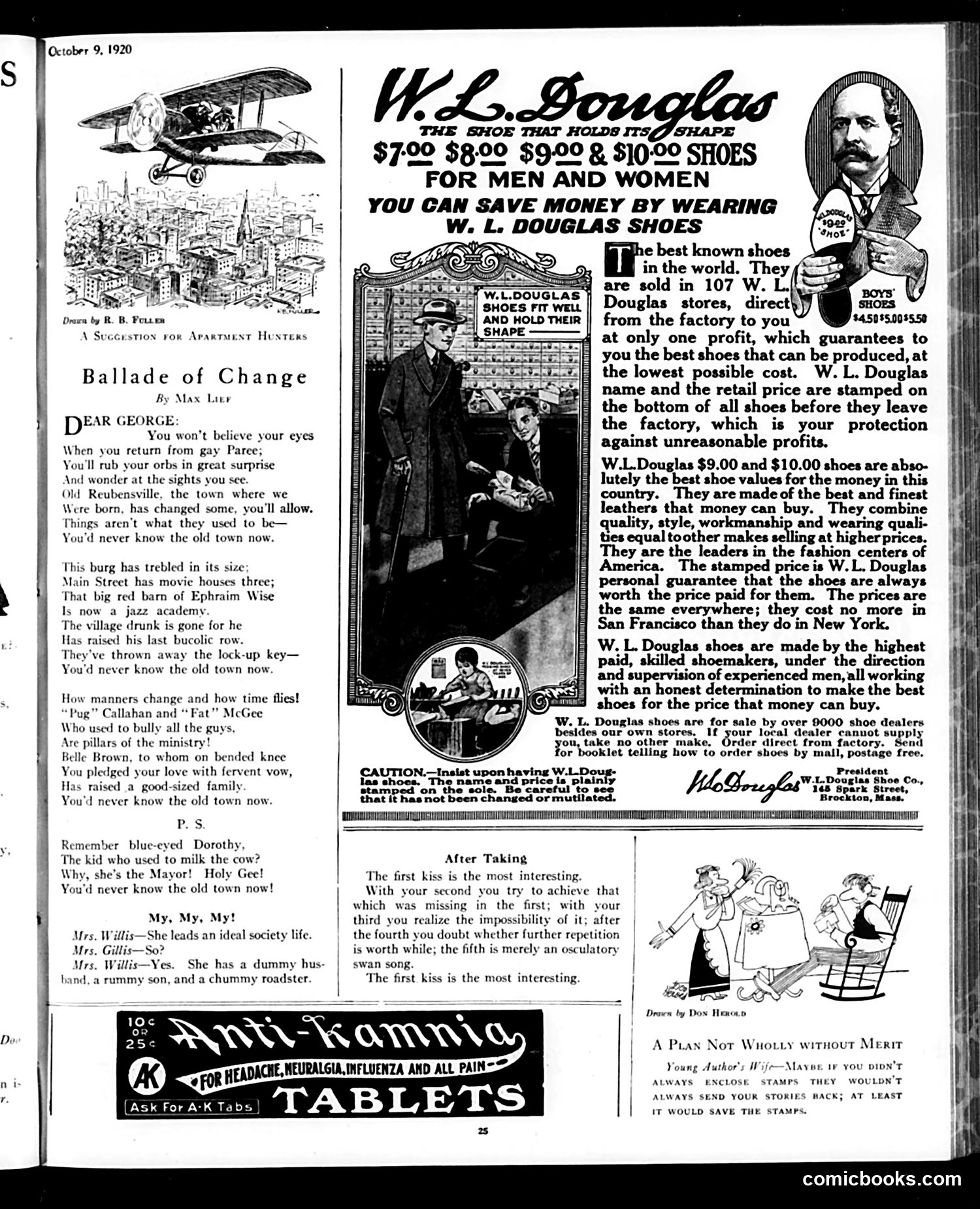
This page is primarily **advertising with light satirical content**. The dominant feature is a W.L. Douglas shoe advertisement emphasizing direct factory-to-consumer sales and value pricing. The main satirical content is **"Ballade of Change"** by Max Lief, a poem lamenting how a small American town (Reubensville) has modernized and lost its character. The speaker returns from Paris to find the rural village transformed: movie theaters replace barns, the town drunk is gone, and former bullies are now "pillars of the ministry." Even the milkmaid Dorothy is now Mayor. The repeated refrain "You'd never know the old town now" expresses nostalgia for pre-modern, small-town America—a common post-WWI theme reflecting anxiety about rapid social change, urbanization, and Jazz Age culture. Secondary humor appears in **"My, My, My!"**—a joke about society women with absent or useless husbands and hangers-on. The page reflects 1920 concerns: economic efficiency (direct shoe sales), social upheaval, and generational anxiety about American life transformation.
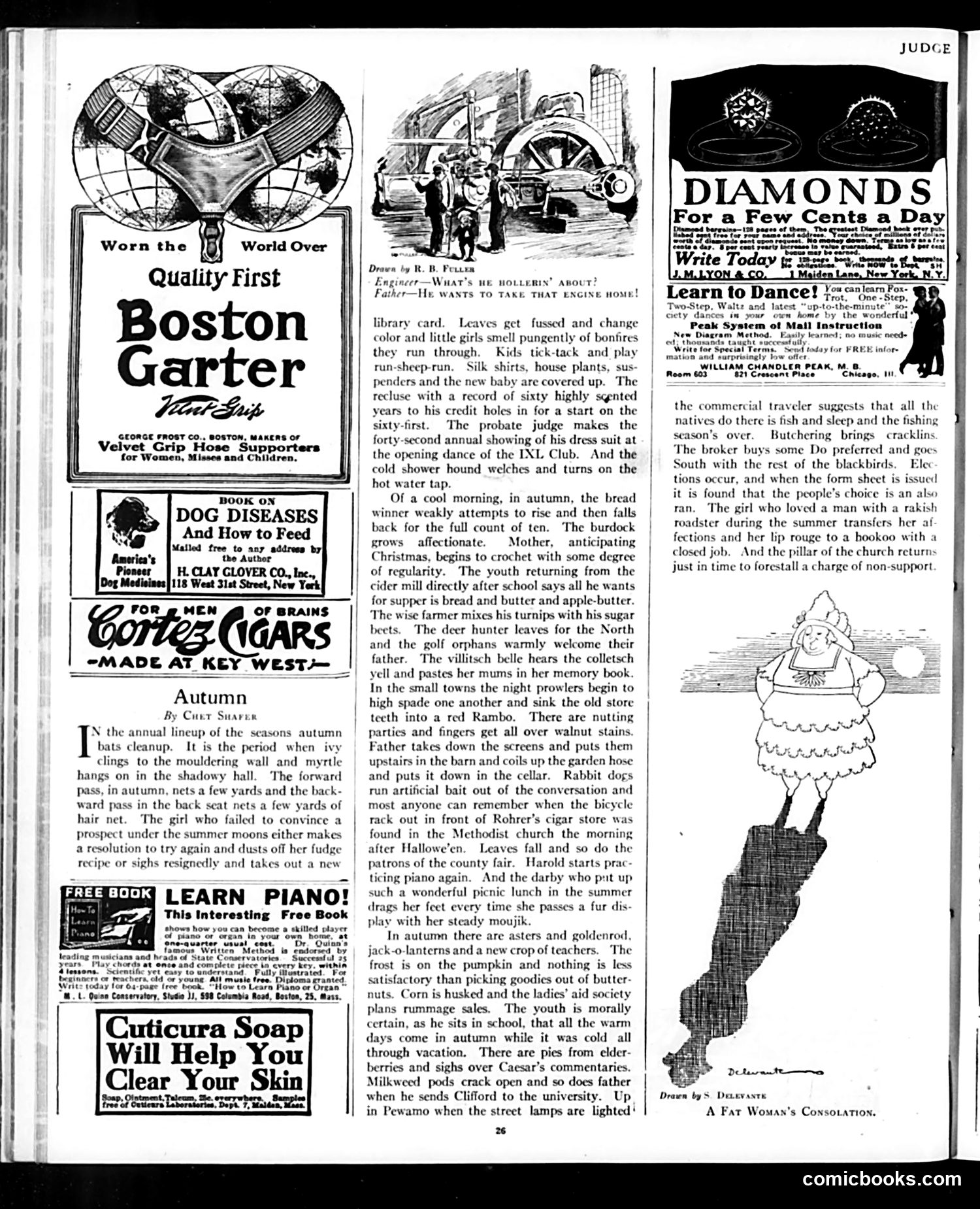
This is a humorous prose essay illustrated with a cartoon, not primarily a political satire. The piece is a nostalgic, whimsical catalog of autumn activities and seasonal changes in small-town American life. The cartoon depicts an engineer and father, where the engineer asks what the father is "hollering about," and the father responds that his son wants to take the train engine home—a simple joke about childish enthusiasm. The essay itself contains gentle, observational humor about autumn customs: ivy on walls, failed summer romance attempts, children playing, farmers mixing turnips with sugar, deer hunting season, piano practice, nutting parties, walnut stains, and harvest activities. It's nostalgic Americana with no apparent political message—just period-appropriate domestic and rural humor reflecting early 20th-century American life before industrialization fully transformed seasonal rhythms.
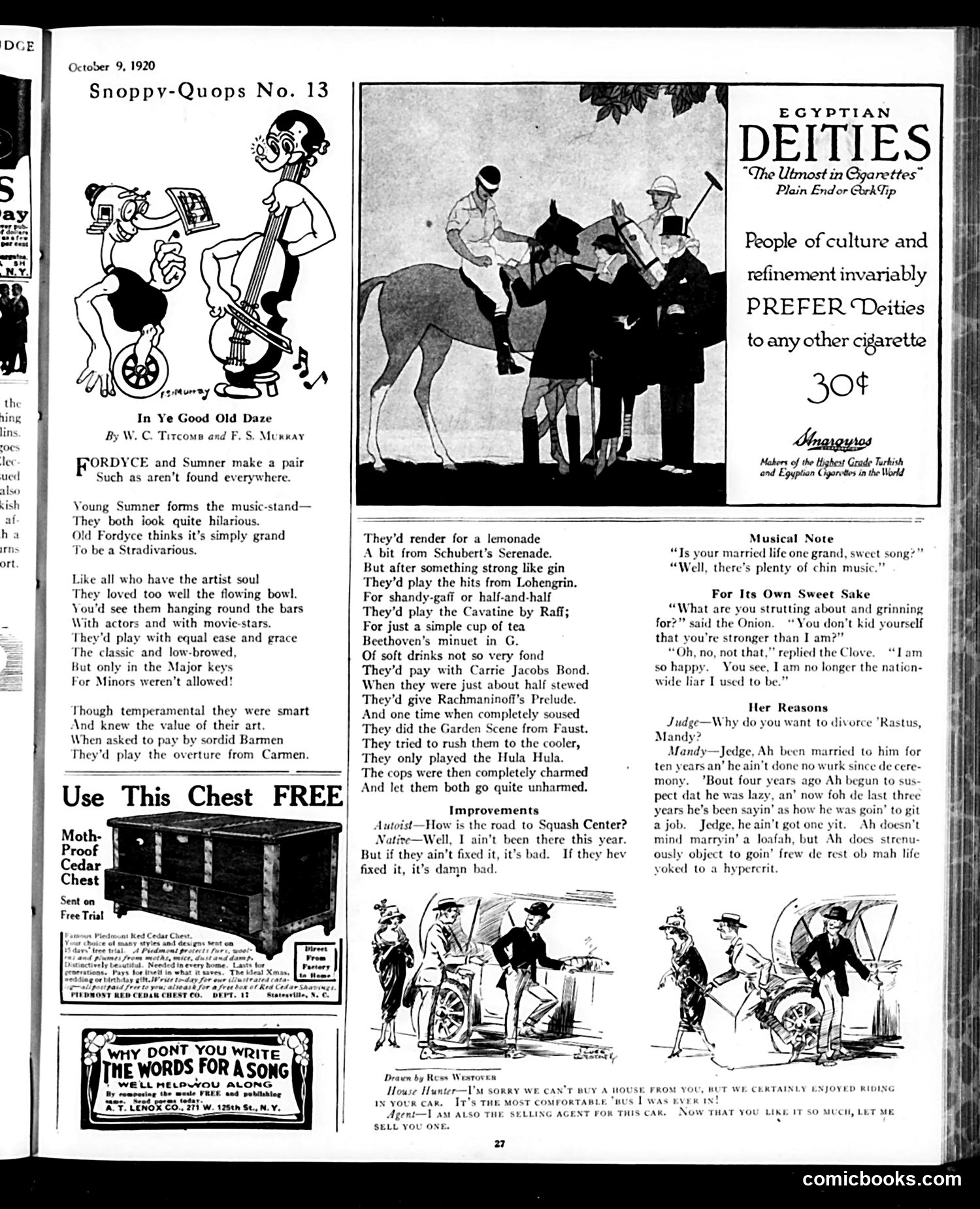
This satirical cartoon mocks bohemian musicians named Fordyce and Sumner who frequent bars and perform classical music to avoid paying tabs. The joke: they strategically play different compositions based on the drink ordered—serious classical works for expensive liquor (gin, Rachmanioff), lighter pieces for cheap drinks (tea, lemonade). When completely drunk and playing the "Hula Hula," they charm police into releasing them. The satire targets artistic pretension and alcoholism during Prohibition's early days (October 1920). These "cultured" musicians exploit their refined knowledge as currency, treating high art as a con-artist tool. The humor undercuts romanticized notions of the struggling artist, presenting them instead as clever drunks evading consequences through affected sophistication.
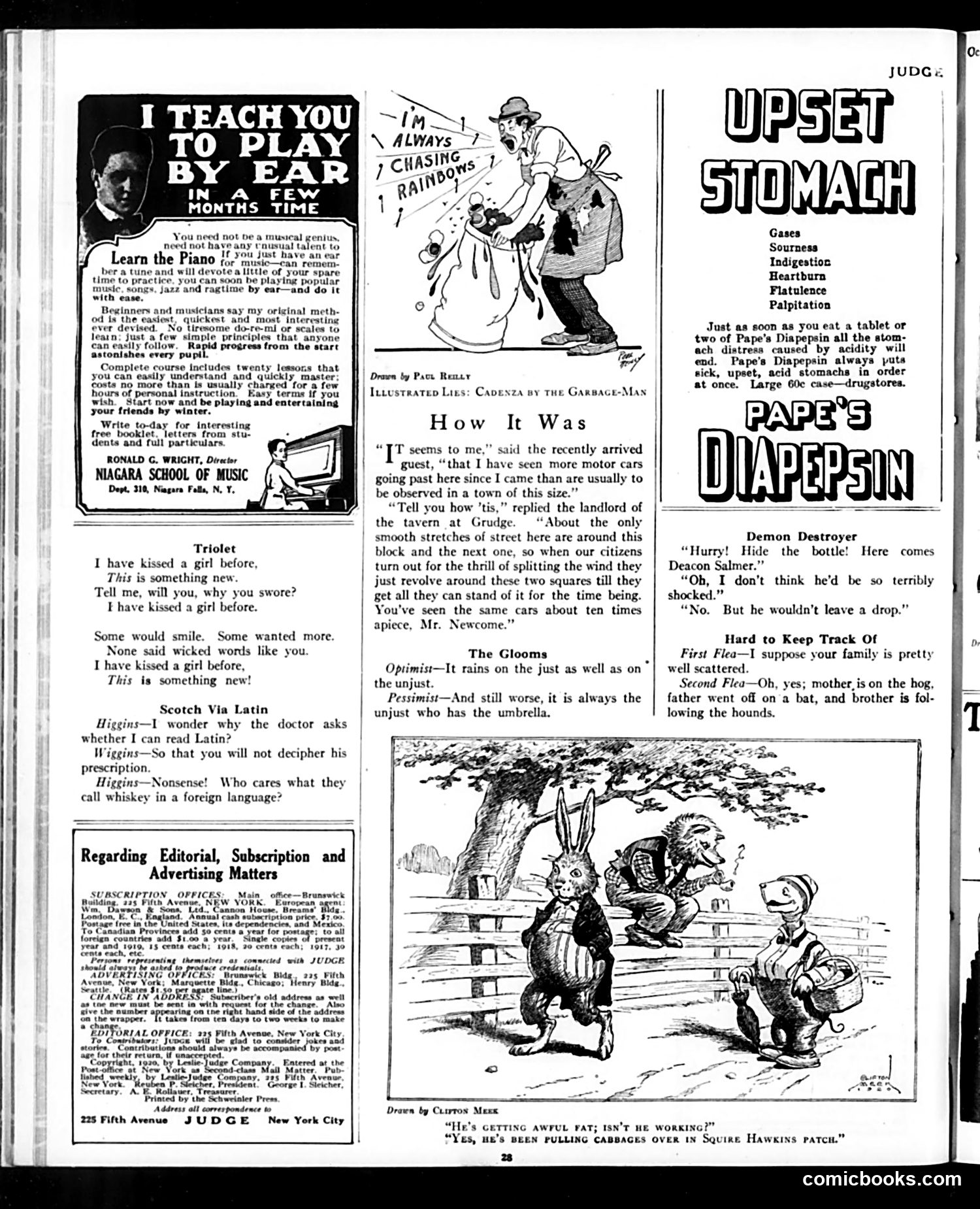
This page from *Judge* magazine contains mostly **advertisements and humorous short pieces** rather than political cartoons. The main illustrated content is "How It Was"—a joke about a small town where citizens repeatedly drive the same cars around the only smooth streets to experience speed thrills, making it appear to visitors that many more automobiles exist than actually do. It's satire on early automobile culture and small-town life. The "Illustrated Lies" cartoon below depicts **a rabbit and other animals**, with a caption about one getting fat from eating cabbages in Squire Hawkins's patch—a whimsical animal fable with no political meaning. The page also includes brief humor pieces (the "Triolet" poem, "Scotch Via Latin" joke) and substantial **advertising**—notably for piano lessons by ear and Pape's Diapepsin antacid tablets. These ads reflect 1920s consumer culture and common digestive complaints. There is **no apparent political satire** on this particular page.
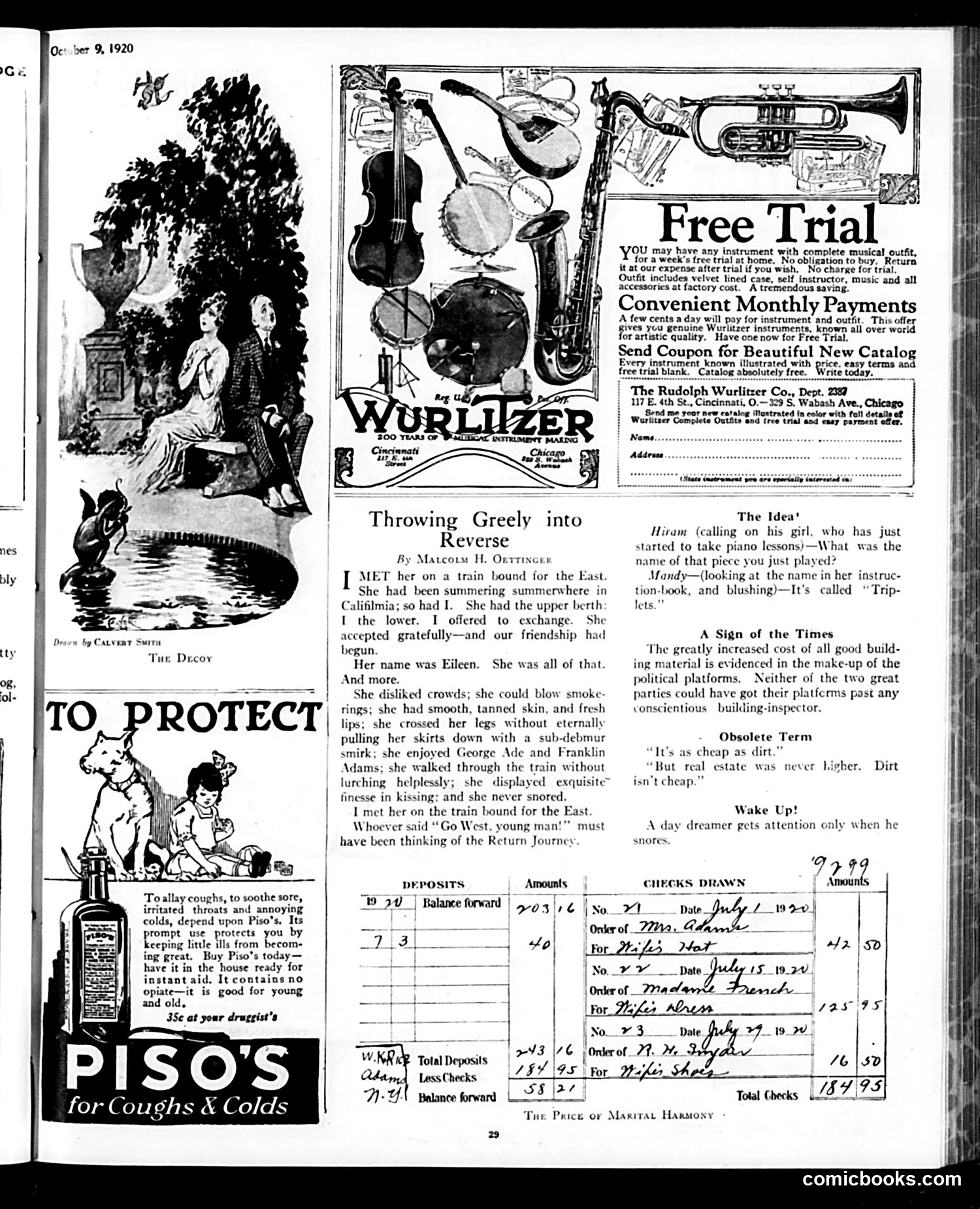
This page mixes advertisements with short humorous pieces typical of Judge's satirical content. **"Throwing Greely into Reverse"** is a romantic short story by Malcolm H. Ottinger about a man meeting an attractive woman named Eileen on an eastbound train. The title's reversal reference is unclear but likely plays on romantic expectations being upended—she's presented as unusually accomplished and independent ("disliked crowds," "could blow smoke rings," crossed legs without fussing). The joke concludes that despite advice to "Go West," the narrator met her returning East, inverting the famous Horace Greeley quote. **The sidebar jokes** ("The Idea," "A Sign of the Times," "Obsolete Term," "Wake Up!") are brief gags about modern life—piano lessons, inflation making "dirt cheap" outdated as a phrase, and attention-seekers. **The advertisements** (Wurlitzer instruments, Piso's cough medicine) and what appears to be a bank statement occupy significant space, making this primarily a commercial page with entertainment filler rather than political satire.
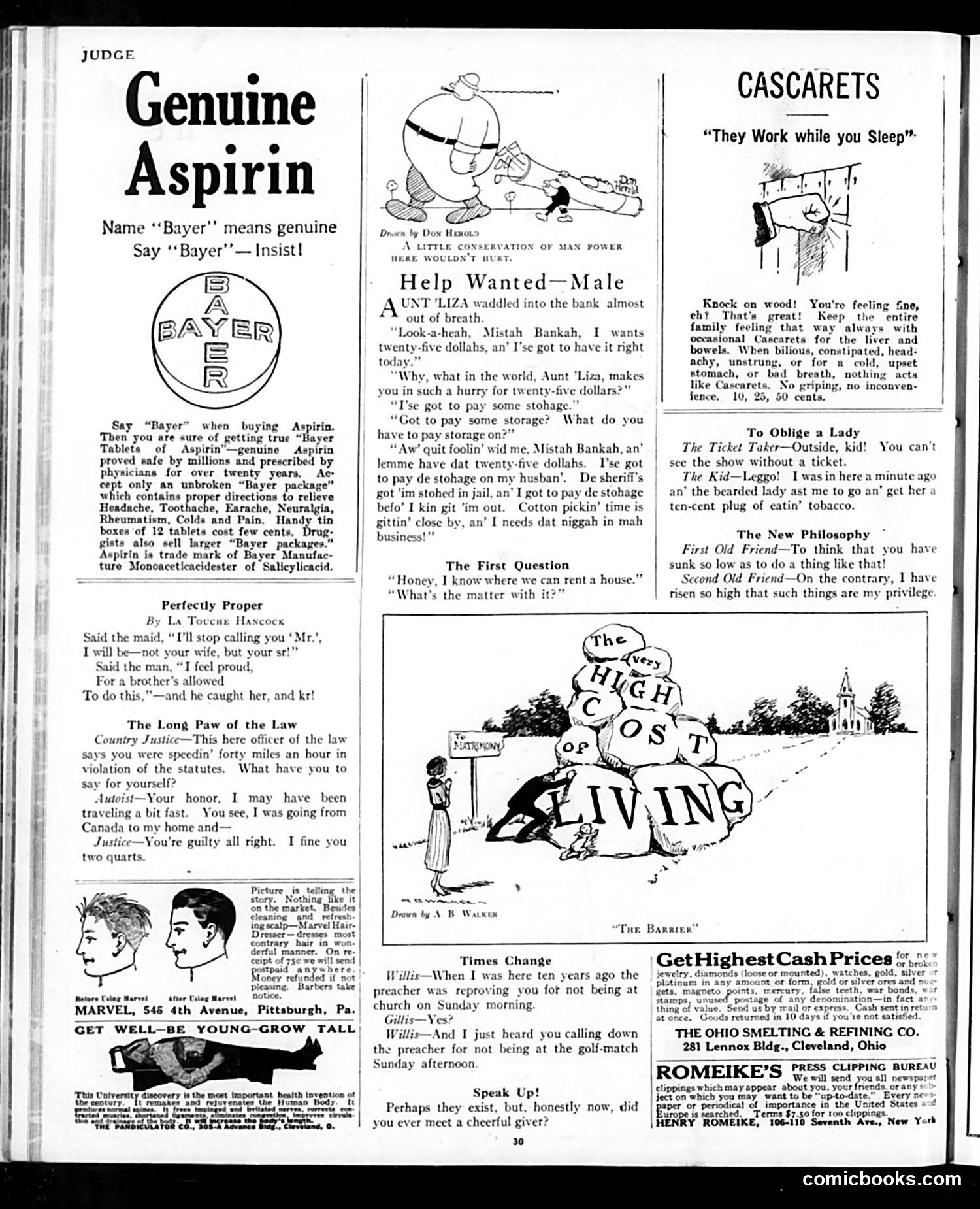
This page from *Judge* magazine contains advertisements and short humorous items rather than political cartoons. The main satirical content includes: **"Help Wanted—Male"** depicts a Black woman (rendered in period dialect) seeking a bank loan to pay "storage" on her husband—a joke about him being jailed. This reflects casual, racist humor typical of the era. **"The Barrier"** cartoon (by A.B. Walker) shows the "high cost of living" as an obstacle blocking a couple from entering a church, satirizing economic hardship's impact on religious life during the post-WWI period. **"Times Change"** contrasts a preacher reproving someone for missing church ten years prior versus now reproving them for missing golf—mocking perceived shifts in modern priorities away from religion. The remaining items are brief comic anecdotes about propriety, speeding laws, and social philosophy. The page is dominated by **advertising** for Bayer Aspirin, Cascarets laxatives, and hair products—typical of *Judge*'s revenue model.
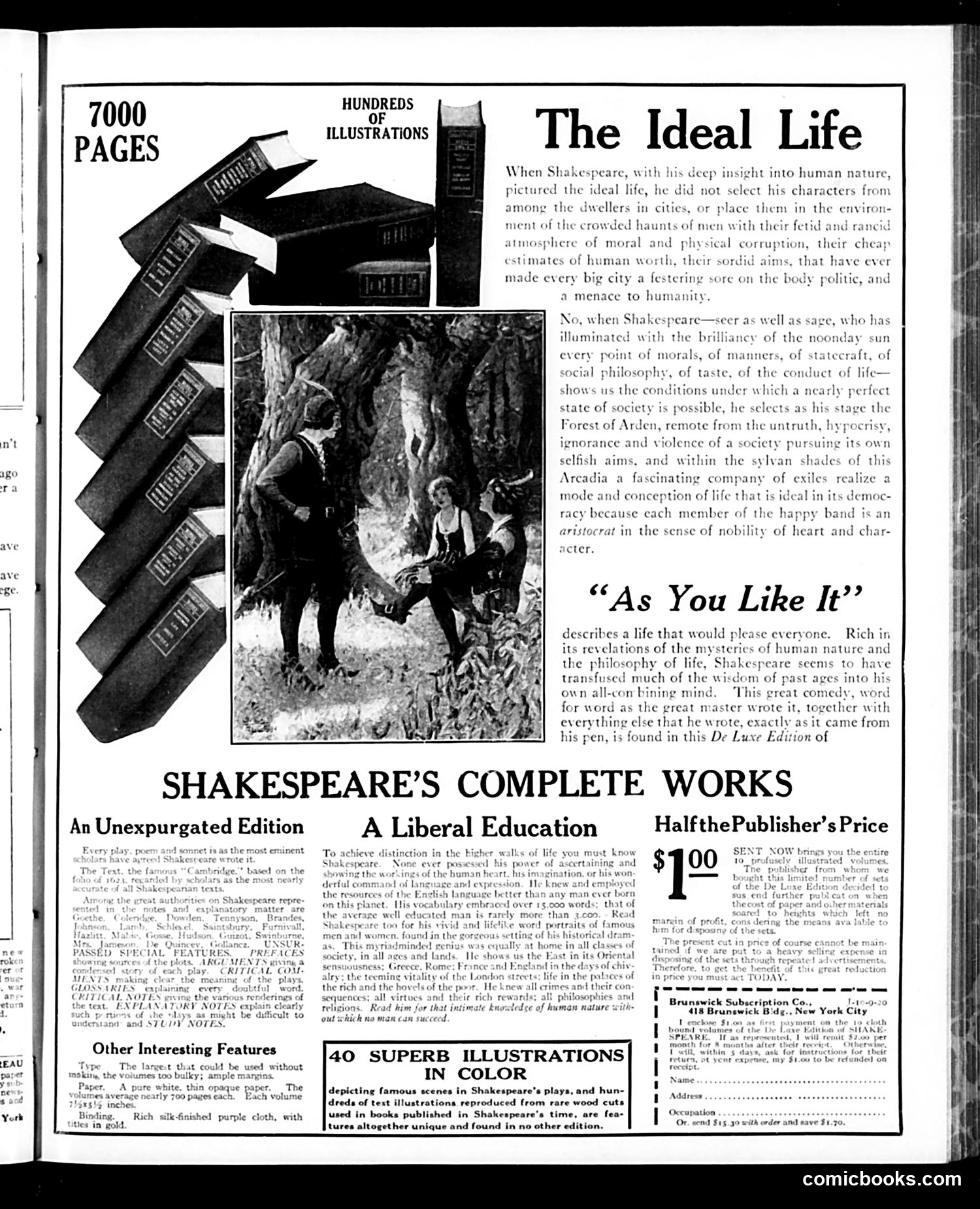
This is **not a political cartoon or satire** — it's a **full-page advertisement** for a deluxe edition of Shakespeare's Complete Works, published by the Brunswick Subscription Company. The page uses Shakespeare's *As You Like It* to market the product. The text argues that Shakespeare's ideal society exists in the Forest of Arden — a place removed from corrupt cities — where exiles form a perfect community based on merit and "nobility of heart." This pastoral philosophy is used to sell the edition itself: the implication is that owning Shakespeare's complete works elevates the reader morally and intellectually. The imagery shows a forest scene (presumably from *As You Like It*), stacked books on the left, and subscription details on the right. The price is $1.00, positioned as a bargain ("half the publisher's price"). There are mentions of 7,000 pages, hundreds of illustrations, and color plates. The "satire," if any, is gentle marketing rhetoric rather than social criticism.

This is a **Camel cigarette advertisement**, not satire or political commentary. It appears in *Judge* magazine, likely from the 1920s-30s, when tobacco advertising was ubiquitous and unregulated. The ad uses a camel silhouette—Camel's iconic mascot—standing in a desert landscape. The copywriting employs common advertising rhetoric of the era: claims that the cigarettes have superior "flavor," won't "tire your taste," leave no unpleasant aftertaste, and represent a "revelation" compared to competitors. **For modern readers**: This straightforward product advertisement would be shocking today because: - It makes health claims ("mildness") - No health warnings exist - Cigarettes are marketed as universally desirable - The ad treats smoking as purely pleasurable with zero acknowledged risks This represents pre-regulation advertising when tobacco companies faced no restrictions on claims or target audiences.