
Judge, 1920-10-09 · page 14 of 32
Judge — October 9, 1920 — page 14: what you’re looking at
What you’re looking at
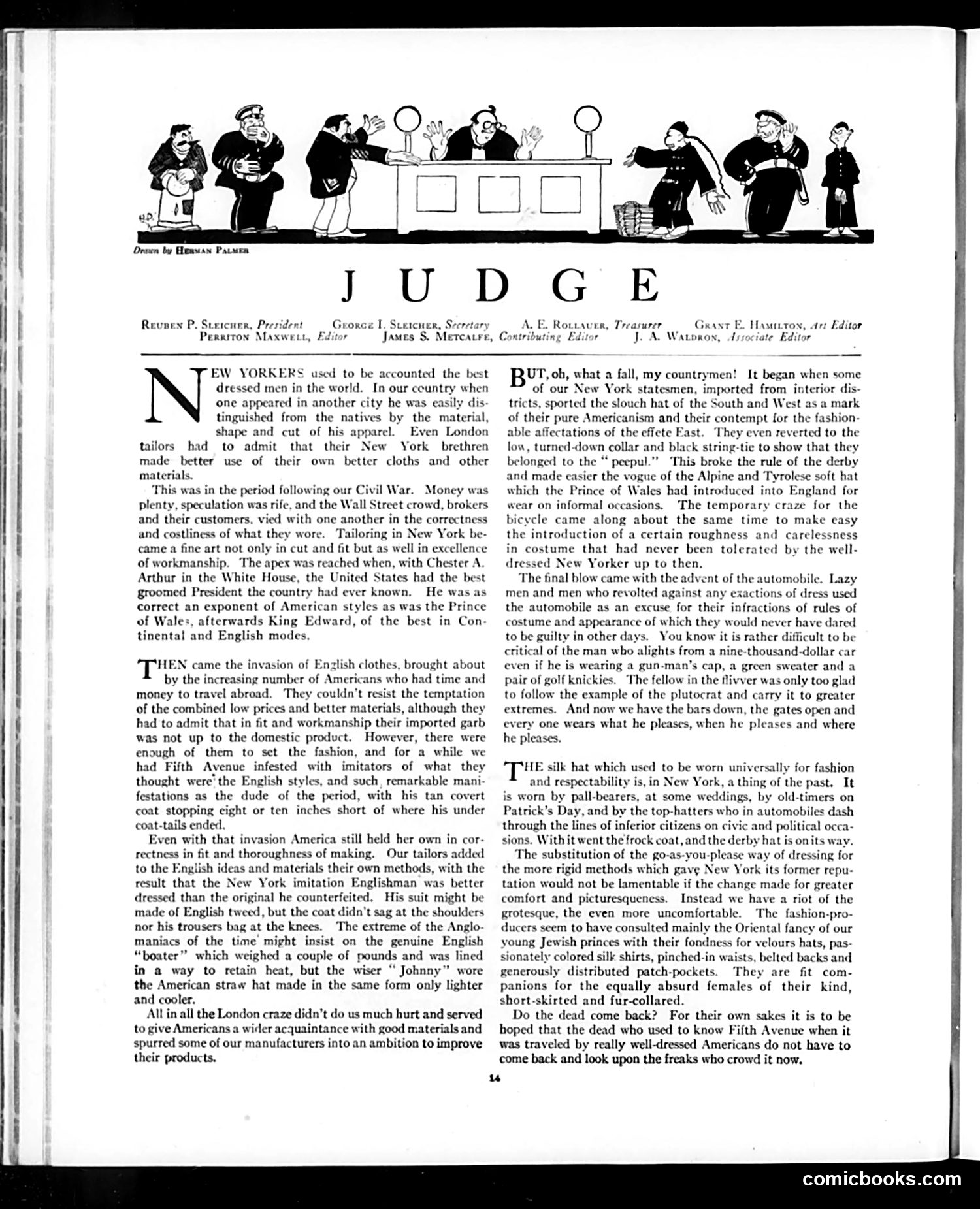
This is an editorial essay (not a comic) lamenting the decline of New York's reputation for sartorial excellence. The illustrated header shows a courtroom scene, establishing "Judge" as arbiter of taste. The article traces American fashion history: Post-Civil War New Yorkers (including President Chester Arthur) were world-renowned for impeccable tailoring. However, wealthy Americans traveling abroad adopted cheaper English styles, spawning inferior Fifth Avenue imitators. While American tailors eventually improved upon English designs, a more serious threat emerged: populist politicians from rural areas wore slouch hats and string ties as symbols of "authentic" Americanism, rejecting Eastern refinement. This anti-fashion movement, combined with the bicycle craze, introduced "roughness and carelessness" into American dress. The satire targets both rural anti-urban sentiment and the democratization of fashion—the author mourns that democratic politics has literally undressed America's gentleman class.
📄 Transcribed text from this page (OCR, searchable)
Machine-transcribed from the original scan — historical spelling and the odd misread are preserved.
Oreen by Heawax Patwen eorce I. Srercner, Secretary Lercner, President eERRITON Maxwect, & Revses P. EW YORKERS used to be accounted the best dressed men in the world. In our country when one appeared in another city he w tinguished from the natives by the material, shape and cut of his apparel. Even London tailors had to admit that their New York brethren made better use of their own better cloths and other materials. This was in the period following our Civil War. Money was peculation was rife, and the Wall Street crowd, brokers and their customers, vied with one another in the correctness and costliness of what they wore. Tailoring in New York be- came a fine art not only in cut and fit but as well in excellence of workmanship. The apex was reached when, with Chester A Arthur in the White House, the United States had the best groomed President the country had ever known. He was as correct an exponent of American styles as was the Prince of Wale:, afterwards King Edward, of the best in Con- tinental and English modes. H came the invasion of English clothes, brought about by the increasing number of Americans who had time and money to travel abroad. They couldn't resist the temptation of the combined low prices and better materials, although they had to admit that in fit and workmanship their imported garb was not up to the domestic product. However, there were enough of them to set the fashion, and for a while we had Fifth Avenue infested with imitators of what they thought were’ the English styles, and such, remarkable mani- festations as the dude of the period, with his tan covert coat stopping cight or ten inches short of where his under coat-tails ended. Even with that invasion America still held her own in cor- rectness in fit and thoroughness of making. Our tailors added to the English ideas and materials their own methods, with the result that the New York imitation Englishman was better dressed than the original he counterfeited. His suit might be made of English tweed, but the coat didn't sag at the shoulders nor his trousers bag at the knees. The extreme of the Anglo- maniacs of the time might insist on the genuine English “boater” which weighed a couple of pounds and was lined in a way to retain heat, but the wiser “ Johnny” wore the American straw hat made in the same form only lighter and cooler. Allin all the London craze didn’t do us much hurt and served to give Americans a wider acquaintance with good materials and spurred some of our manufacturers into an ambition to improve their products. James S. Metcatre, Con: Hasuntox, art Editor iate Edit Rottaver, Treasurer Grast ng Editor J. A. Watpros, or Bu. ob, what a fall, my countrymen! It began when some of our New York statesmen, imported from interior dis- tricts, sported the slouch hat of the South and West as a mark of their pure Americanism and their contempt for the fashion- able affectations of the effete East. They even reverted to the low, turned-down collar and black string-tie to show that they belonged to the “ peepul.”” This broke the rule of the derby and made easier the vogue of the Alpine and Tyrolese soft hat which the Prince of Wales had introduced into England for wear on informal occasions. The temporary craze for the bicycle came along about the same time to make easy the introduction of a certain roughness and carelessness in costume that had never been tolerated by the well- dressed New Yorker up to then, The final blow came with the advent of the automobile. Lazy men and men who revolted against a: actions of dress used the automobile as an excuse for their infractions of rules of costume and appearance of which they would never have dared to be guilty in other days. You know it is rather difficult to be critical of the man who alights from a nine-thousand-dollar car even if he is wearing a gun-man’s cap, a green sweater and a pair of golf knickies. ‘The fellow in the flivver was only too glad to follow the example of the plutocrat and carry it to greater extremes. And now we have the bars down, the gates open and every one wears what he pleases, when he pleases and where he pleases. HE silk hat which used to be worn universally for fashion and respectability is, in New York, a thing of the past. It is worn by pall-bearers, at some weddings, by old-timers on Patrick’s Day, and by the top-hatters who in automobiles dash through the lines of inferior citizens on civic and political occ: sions. With it went the frock coat, and the derby hat is onits way The substitution of the go-as-you-plea y of dressing for the more rigid methods which gave New York its former repu- tation would not be lamentable if the change made for greater comfort and picturesqueness. Instead we have a riot of the grotesque, the even more uncomfortable. The fashion-pro- ducers seem to have consulted mainly the Oriental fancy of our young Jewish princes with their fondness for velours hats, pas- sionately colored silk shirts, pinched-in waists, belted backs and generously distributed patch-pockets. They are fit com- panions for the equally absurd females of their kind, short-skirted and fur-collared. Do the dead come back? For their own sakes it is to be hoped that the dead who used to know Fifth Avenue when it was traveled by really well-dressed Americans do not have to come back and look upon the freaks who crowd it now. % se wa comicbooks.com