
Judge, 1920-10-09 · page 20 of 32
Judge — October 9, 1920 — page 20: what you’re looking at
What you’re looking at
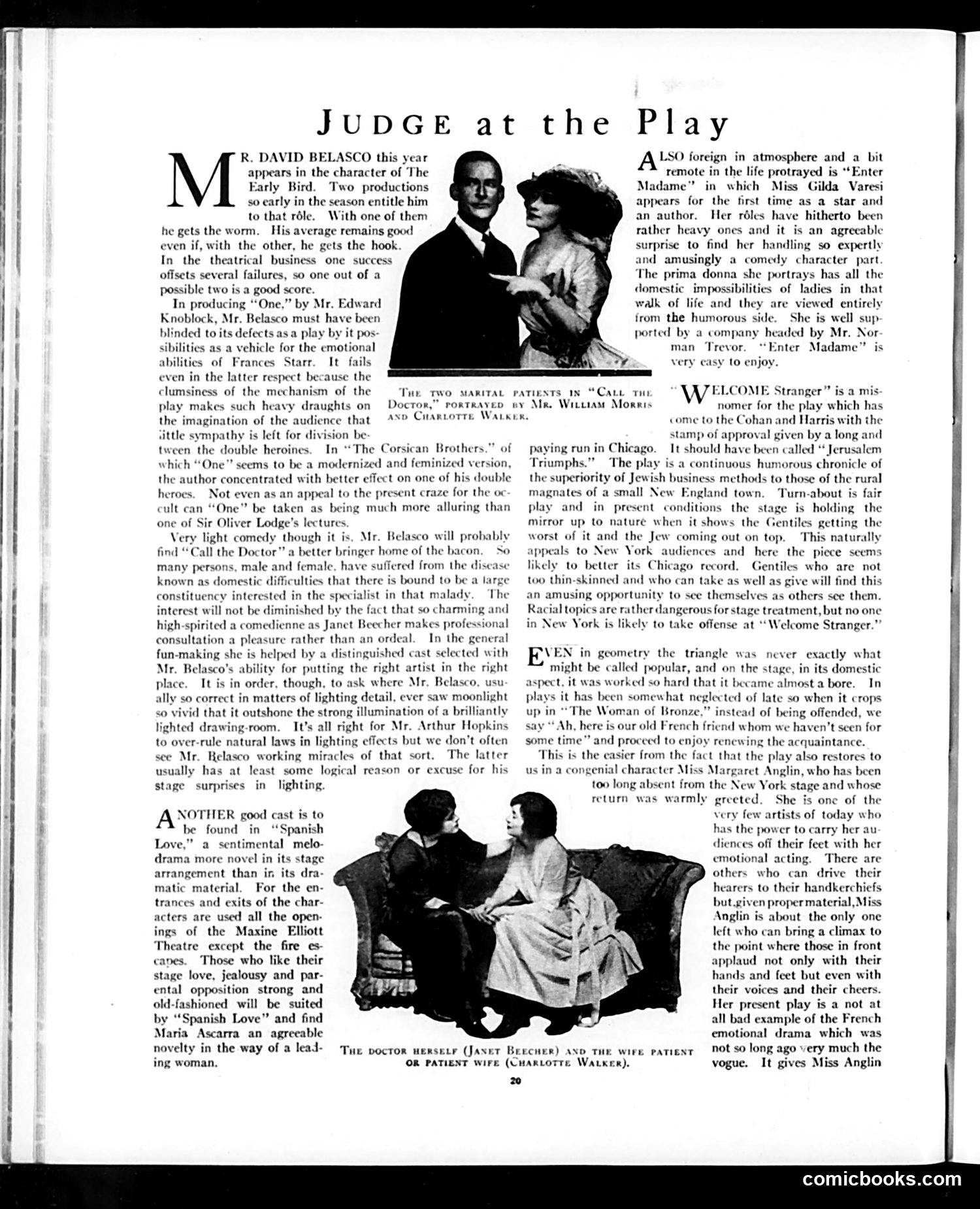
This page reviews several Broadway productions directed by or featuring David Belasco and other theatrical figures of the era. The text discusses three plays: "One" (a modernized version of "The Corsican Brothers"), "Call the Doctor" (a light comedy), and "Spanish Love" (a sentimental melodrama). The photographs show actors in costume—apparently from "Call the Doctor" (top) and "Spanish Love" (bottom). The reviews critique both the dramatic material and technical execution, particularly praising Janet Beecher's comedic talents while questioning Belasco's sometimes unrealistic lighting choices. The page reflects early 20th-century theatrical criticism, evaluating performances, plot mechanics, and stage design with an emphasis on emotional authenticity and the quality of supporting casts.
📄 Transcribed text from this page (OCR, searchable)
Machine-transcribed from the original scan — historical spelling and the odd misread are preserved.
——E R. DAVID BELASCO this year appears in the character of The Early Bird. Two productions so carly in the season entitle him to that réle. With one of them he gets the worm. His average remains good even if, with the other, he gets the hook. In the theatrical business one success offsets several failures, so one out of a possible two is a good score. In producing “One,” by Mr. Edward Knoblock, Mr. Belasco must have been blinded to its defects as a play by it pos- sibilities as a vehicle for the emotional rr. It fails ities of Frances even in the latter respect because the clumsiness of the mechanism of the Tux TWO MARITAL play makes such heavy draughts on the imagination of the audience that title sympathy is left for division be: tween the double heroines. In “The Corsican Brothers,” of which “One” seems to be a modernized and feminized version, the author concentrated with better effect on one of his double heroes. Not even as an appeal to the present craze for the oc cult can “One” be taken as being much more alluring than one of Sir Oliver Lodg Very light comedy though it find “Call the Doctor” a better bringer home of the bacon. many persons, male and female, have suffered from the disea ulties that there is bound to be a la constituency interested in the specialist in that malady. The interest will not be diminished by the fact that so charming and high-spirited a comedienne as Janet Beecher makes professional consultation a pleasure rather than an ordeal. In the general fun-making she is helped by a distinguished cast selected with Mr. Belasco’s ability for putting the right artist in the right place. It is in order, though, to ask where Mr. Belasco, usu ally so correct in matters of lighting detail, ever saw moonlight so vivid that it outshone the strong illumination of a brilliantly lighted drawing-room. It’s all right for Mr. Arthur Hopkins to over-rule natural laws in lighting effects but we don’t often see Mr. Relasco working miracles of that sort. The latter usually has at least some logical reason or excuse for his stage surprises in lighting. 's lectures. <, Mr. Belasco will probably known as domestic diff NOTHER good cast is to be found in ‘Spanish Love,” a sentimental melo- drama more novel in its stage arrangement than in its dra- matic material. For the en- trances and exits of the char- cters are used all the open- ings of the Maxine Elliott Theatre except the fire es- capes. Those who like their stage love, jealousy and par- ental opposition strong and old-fashioned will be suited by “Spanish Love” and find Maria Ascarra an agreeable novelty in the way of a lead- Tye poctor wersety (Jaxet Beecner) aNo THe wire PATIENT OR PATIENT Wire (CHARLOTTE Water). ing woman, JUDGE at the Play PATIENTS Doctor,” rortrayeo wy Mr. Witttas Morris axo Cuarrotre Watker. A!S° foreign in atmosphere and a bit remote in the life protrayed is “Enter Madame” in which Miss Gilda Varesi appears for the first time as a star and an author. Her réles have hitherto been rather heavy ones and it is an agreeable surprise to find her handling so expertly and amusingly a comedy character part. The prima donna she portrays has all the domestic impossibilities of ladies in that walk of life and they are viewed entirely from the humorous side. She is well sup: ported by a company headed by Mr. Nor man Trevor. Enter Madame” very easy to enjoy is “Cane rue \ ELCOME Stranger” is nomer for the play which has come to the Cohan and Harris with the stamp of approval given by a long and paying run in Chicago. It should have been called “ Jerusalem Triumphs. The play is a continuous humorous chronicle of the superiority of Jewish business methods to those of the rural magnates of a small New England town. Turn-about is fa play and in present conditions the stage is holding the mirror up to nature when it shows the Gentiles getting the worst of it and the Jew coming out on top. This naturally ippeals to New York audiences and here the piece seems likely to better its Chicago record. Gentiles who are not too thin-skinned and who can take as well as give will find this an amusing opportunity to sce themselves as others sce them. Racial topics are rather dangerous for stage treatment, but no one in New York is likely to take offense at “Welcome Stranger.” VEN in geometry the triangle was never exactly what might be called popular, and on the stage, in its domestic aspect. it was worked so hard that it became almost a bore. In plays it has been somewhat neglected of late so when it crops up in “The Woman of Bronze,” instead of being offended, we say “Ah, here is our old French friend whom we haven't seen for some time” and proceed to enjoy renewing the acquaintance. This is the easier from the fact that the play also restores to genial character Miss Margaret Anglin, who has been psent from the New York stage and whose us in a ce too long return was warmly greeted. She is one of the very few artists of today who has the power to carry her au diences off their feet with her emotional acting. There are others who can drive their hearers to their handkerchiefs but.given proper material, Miss Anglin is about the only one left who can bring a climax to the point where those in front applaud not only with their ands and feet but even with their voices and their cheers. Her present play is a not at all bad example of the French emotional drama which was not so long ago very much the vogue. It gives Miss Anglin comicbooks.com