
A complete issue · 36 pages · 1920
Judge — August 28, 1920
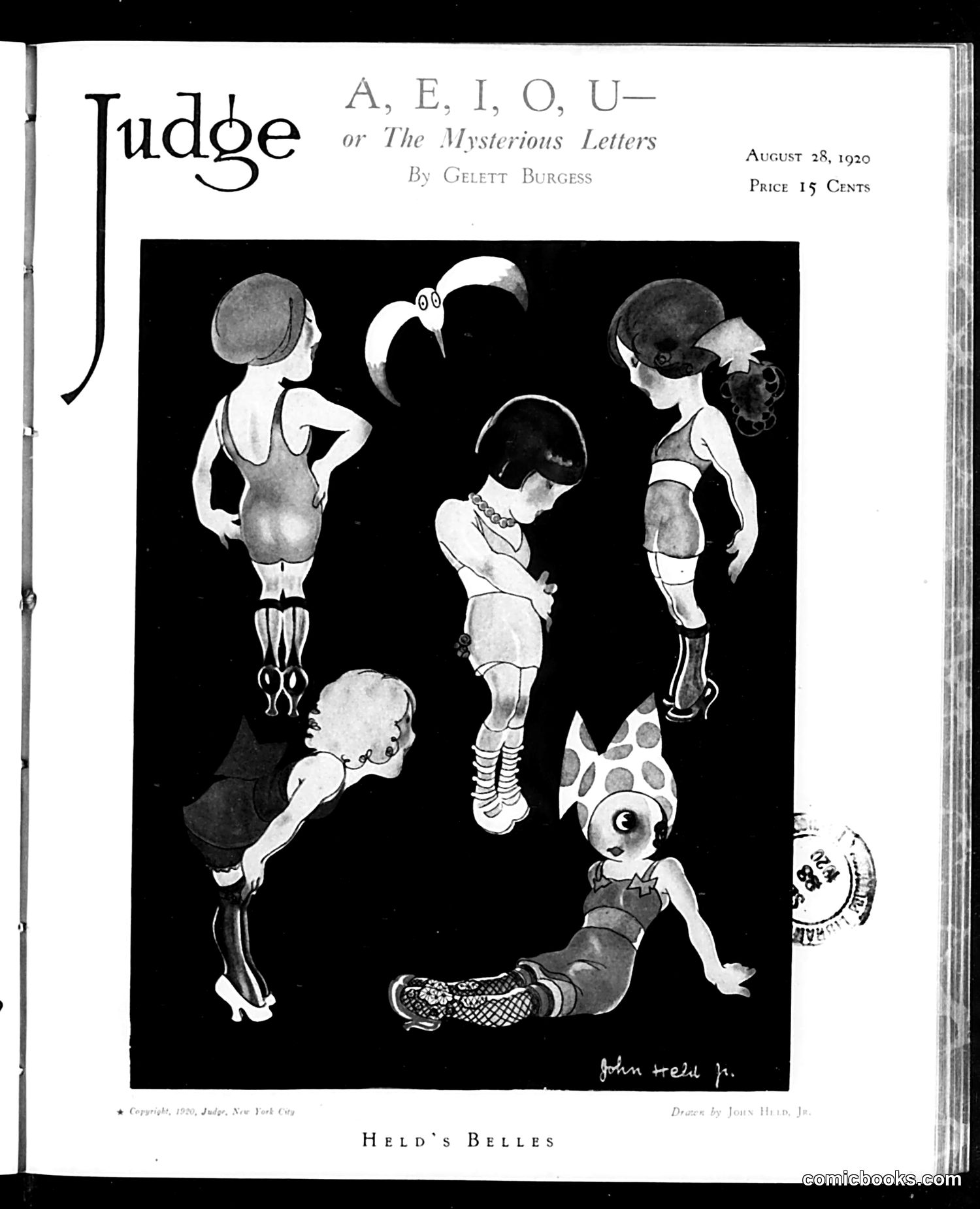
This Judge magazine page (August 28, 1920) features an illustration titled "Held's Belles" by artist John Held Jr., depicting fashionable young women in 1920s attire and poses. The subtitle "A, E, I, O, U— or The Mysterious Letters" by Gelett Burgess suggests wordplay or coded meaning, though the specific reference is unclear. The cartoon satirizes the "flapper" aesthetic—the modern, liberated woman of the Jazz Age era. The exaggerated proportions, abbreviated clothing (bathing suits and sportswear), and dynamic poses mock both the new women's fashion and the social anxieties surrounding changing gender roles during this period. Held was famous for popularizing the flapper image in American culture.
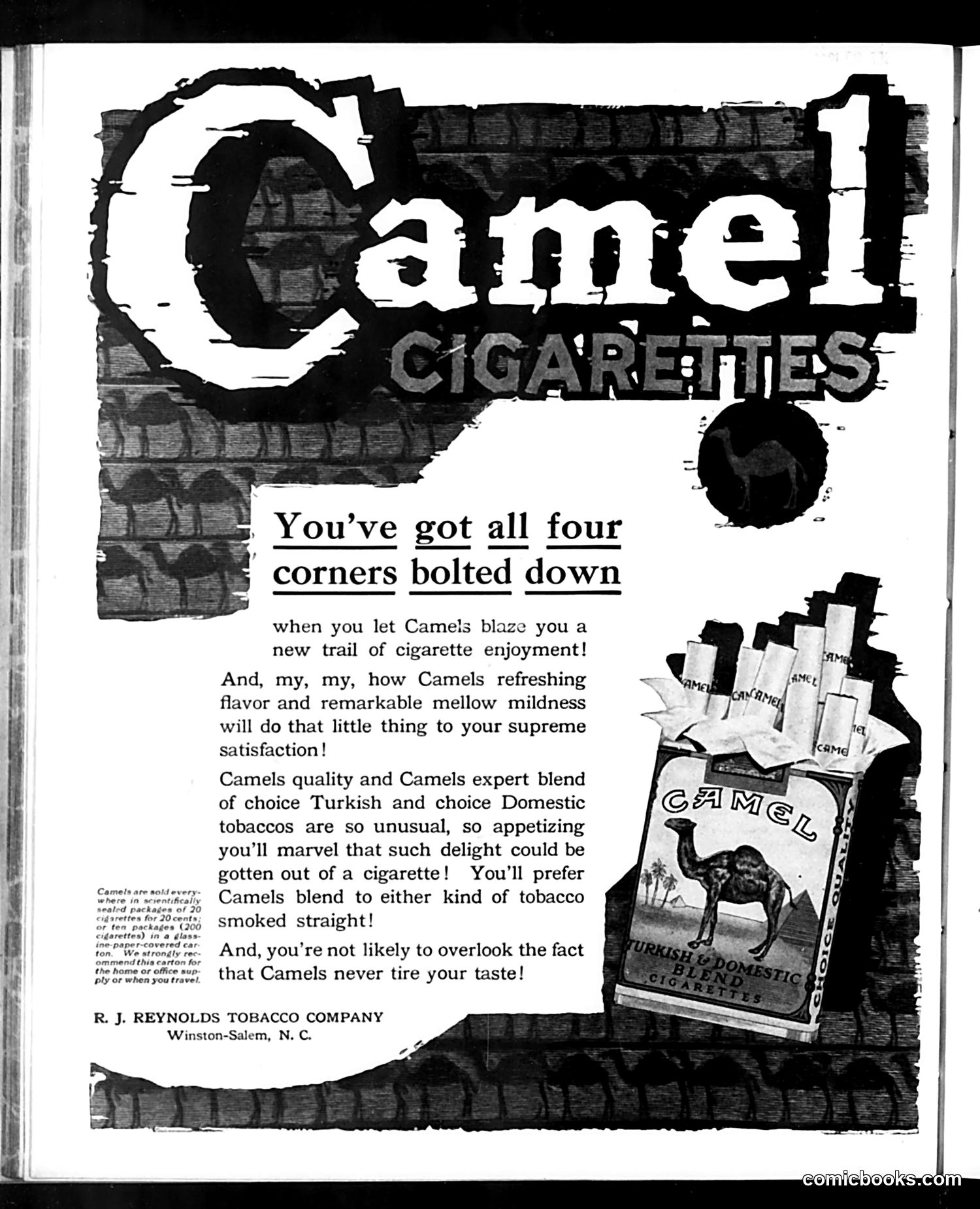
This is a **commercial advertisement**, not political satire. The page promotes Camel cigarettes by R.J. Reynolds Tobacco Company of Winston-Salem, North Carolina. The ad uses the slogan "You've got all four corners bolted down" to suggest stability and reliability. It emphasizes Camel's blend of Turkish and domestic tobaccos, claiming superior "refreshing flavor and remarkable mellow mildness." The camel mascot appears on the product packaging. A modern reader should note this represents **pre-health-warning era advertising** when tobacco companies could make unqualified claims about product quality and consumer satisfaction without disclosing health risks. The ad's confident promises about "supreme satisfaction" reflect advertising practices later heavily restricted.
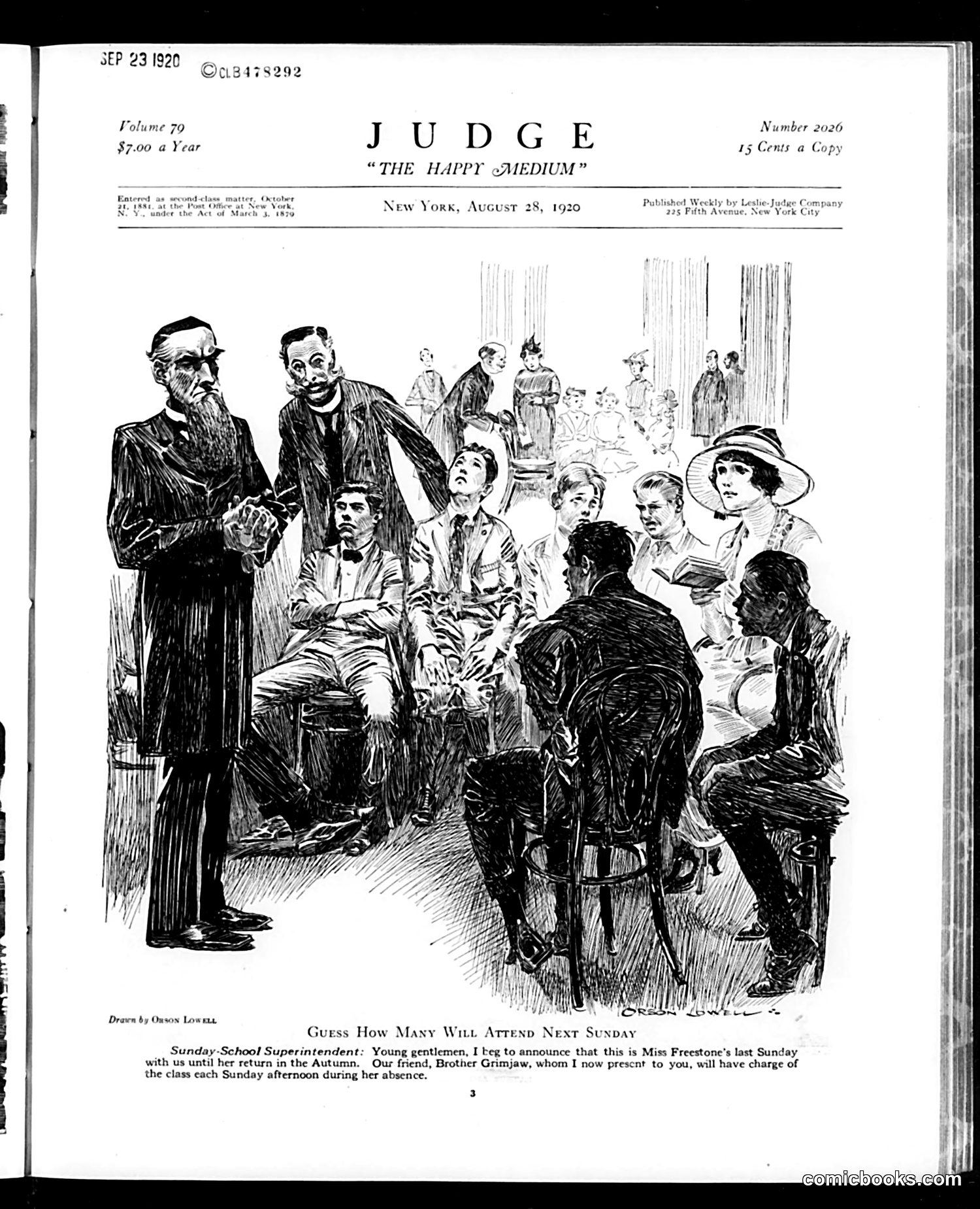
**Title & Setup**: "Guess How Many Will Attend Next Sunday" **The Satire**: A Sunday School superintendent announces that Miss Freestone's absence means Brother Grimjaw will lead the class. The cartoon mocks the likely dramatic difference in attendance this will cause—implying Brother Grimjaw is so stern or unpleasant that his presence will drive away attendance. **Visual Joke**: The contrast between the superintendent's mild demeanor and Grimjaw's stern, imposing appearance (emphasized by his dark clothing and severe features) underscores that replacing a popular teacher with an unpopular one will predictably empty the classroom. **Context**: This reflects early-20th-century American Sunday School culture and the humor derives from recognizable social types—the officious administrator and the frighteningly stern religious authority figure.
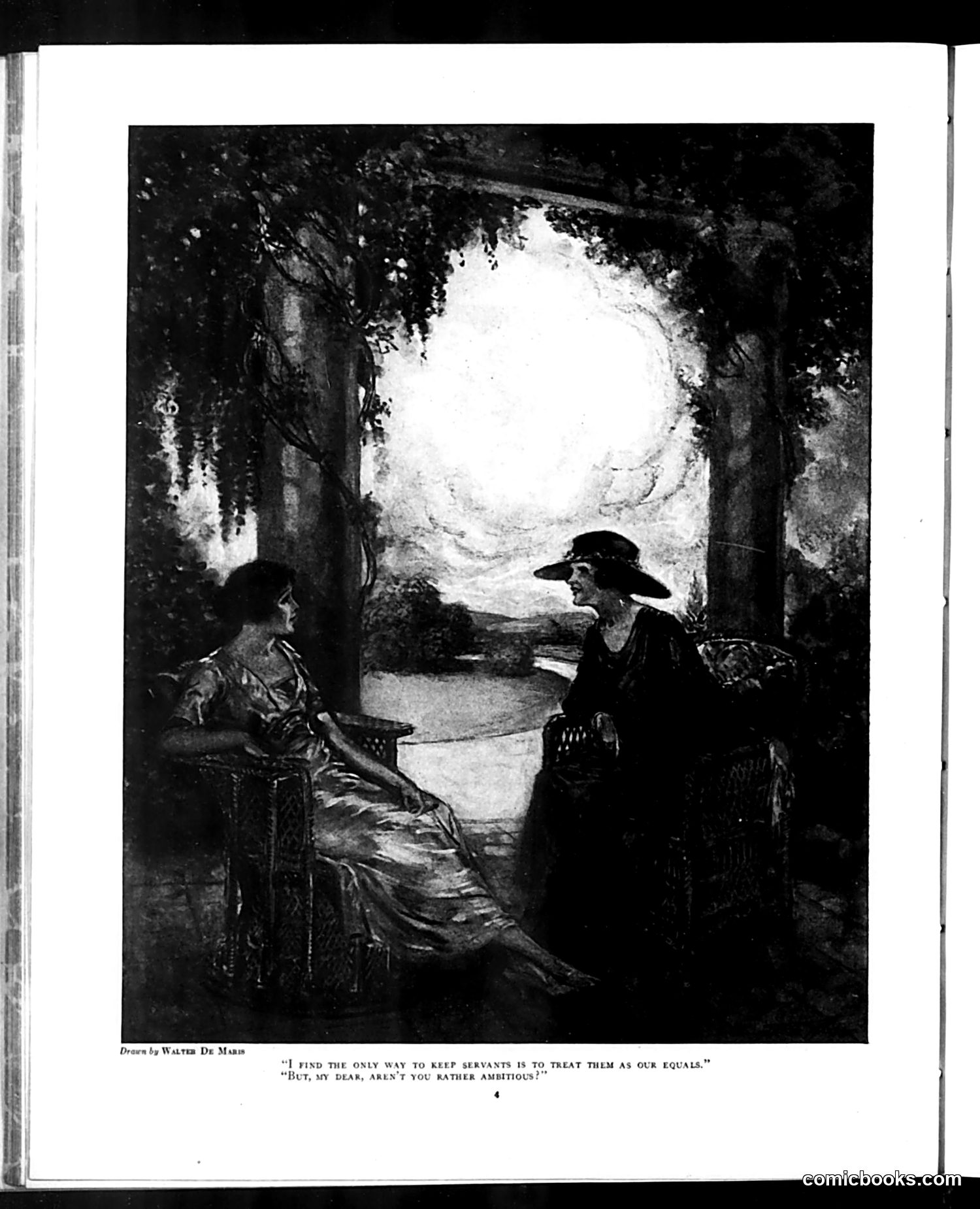
This is an illustration by Walter De Maris depicting two figures in conversation beneath an archway with moonlight visible beyond. The caption reads: "I find the only way to keep servants is to treat them as our equals." "But, my dear, aren't you rather ambitious?" The cartoon satirizes the tension between democratic ideals and class hierarchy in early 20th-century America. One figure advocates treating servants as social equals—a progressive notion for the era. The other character's response mocking this as "ambitious" expresses the conservative viewpoint that such equality is unrealistic or pretentious. The satire targets wealthy individuals who claim egalitarian principles while maintaining traditional class distinctions in household labor relationships.
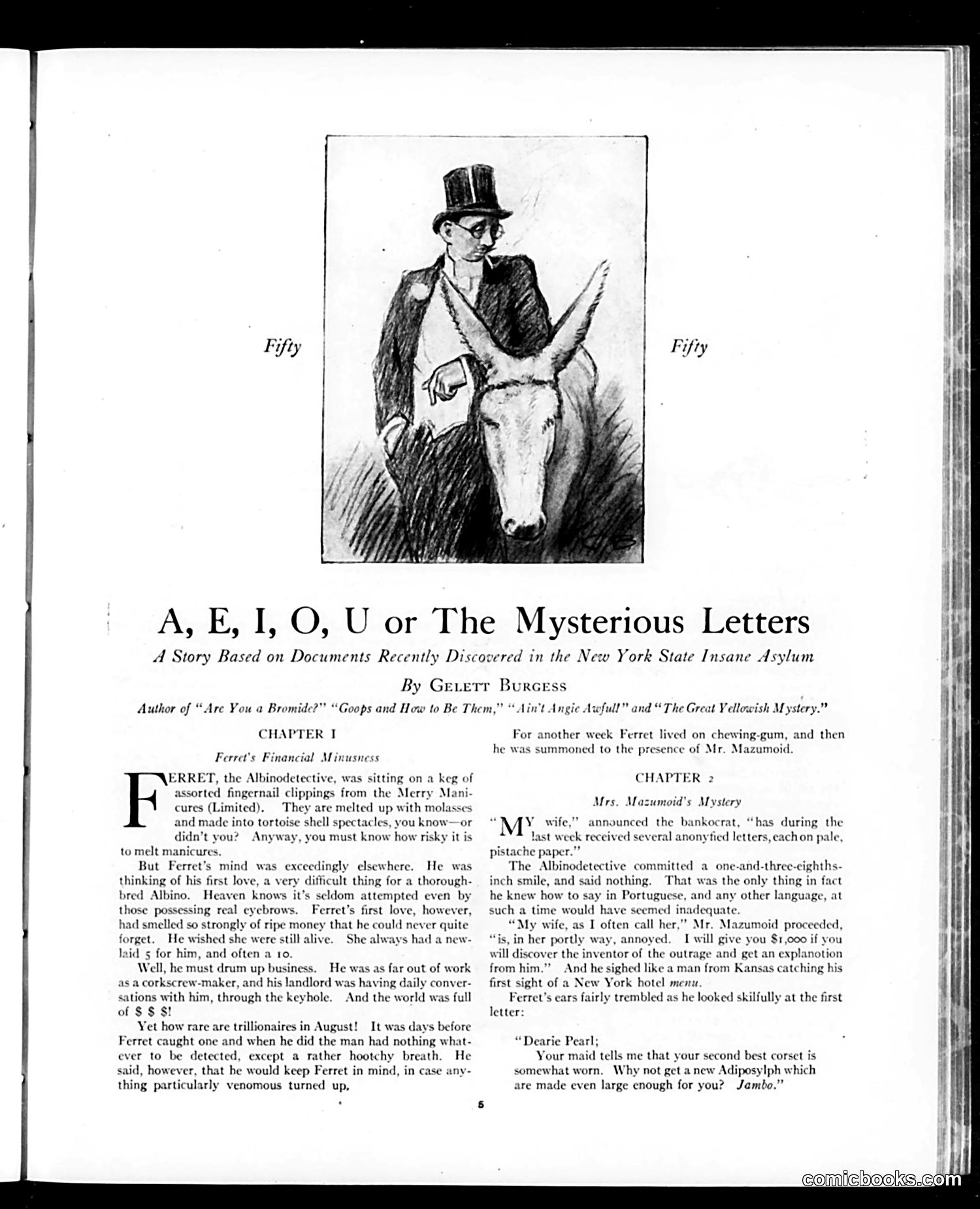
This page presents the opening of a serialized fiction story titled "A, E, I, O, U or The Mysterious Letters" by Gelett Burgess, published in Judge magazine. The illustration shows a well-dressed man in a top hat sitting on a donkey—a visual gag emphasizing absurdity or foolishness. The story itself concerns "Ferret," an albino detective involved in financial crimes and mysterious anonymous letters. The narrative appears to be a mystery-comedy hybrid, typical of Judge's satirical fiction format of the era. The humor relies on wordplay (the mysterious vowel-titled letters), physical comedy (the donkey illustration), and the melodramatic tone of period mystery stories. Without additional historical context, the specific satirical targets remain unclear, though it likely mocks contemporary detective fiction conventions.
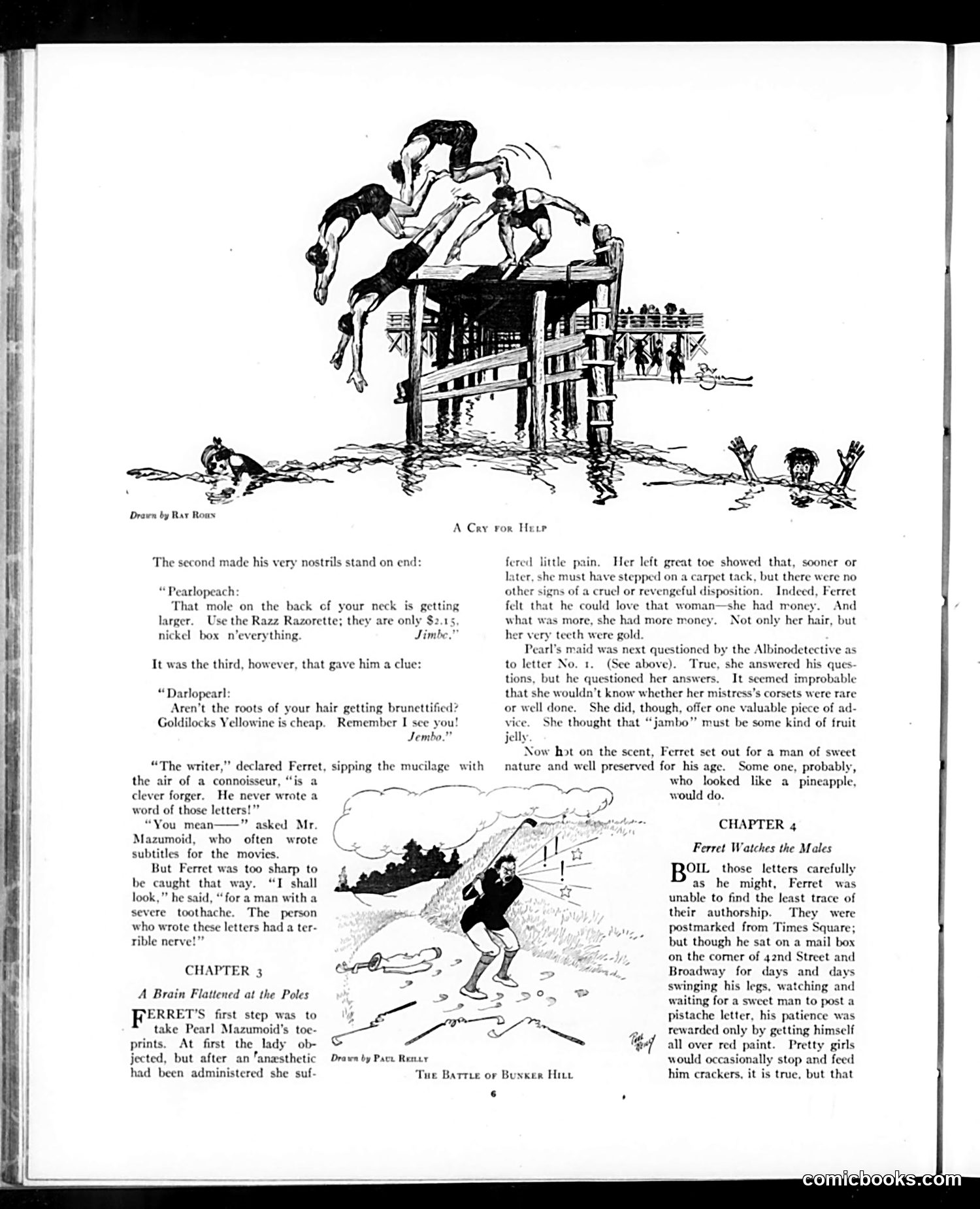
This page contains **fictional narrative content** rather than political satire. It's from a serialized story featuring characters named Ferret, Pearl Mazumond, and others engaged in what appears to be a detective or adventure plot. The top illustration "A Cry for Help" shows figures on a pier, drawn by Ray Roos. Below are chapter excerpts discussing Ferret's investigation and witty exchanges about personal grooming ("mole on the back of your neck," "hair getting brunettified"). The middle illustration "The Battle of Bunker Hill" by Paul Revere depicts what seems to be a comedic scene of figures in combat or conflict in a rural setting. **This page is primarily **literary entertainment** rather than political commentary**—typical of Judge's mix of humor, illustrations, and serialized fiction for early 20th-century readers.
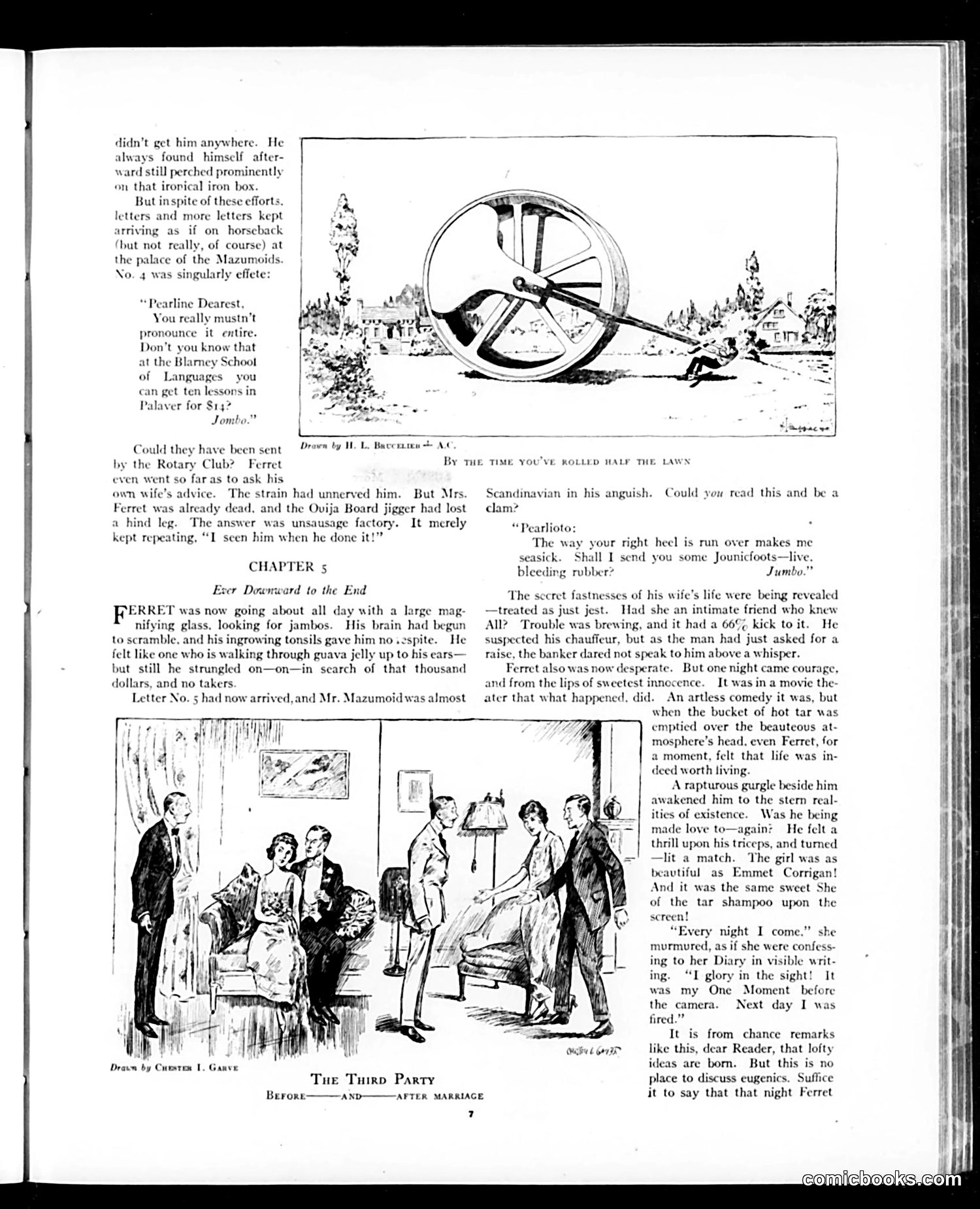
This page from Judge satirizes marital miscommunication and obsession. The main narrative follows "Ferret," a man receiving mysterious letters signed "Jombo" at his home, driving him to paranoid investigation with a magnifying glass. He suspects his wife of infidelity, even consulting a Ouija Board. **The cartoons illustrate:** 1. **Top illustration**: A man stuck on an iron box—visual metaphor for his predicament, rendered absurd by showing him literally perched on an oversized wheel. 2. **"The Third Party Before and After Marriage"**: Contrasts a social gathering (before) with a domestic scene (after), satirizing how marriage changes social dynamics. The satire mocks masculine anxiety about female independence and communication failures between spouses. The absurdist humor—mysterious letters, Ouija boards, a woman finding romance at a movie set—exaggerates domestic paranoia typical of 1920s-era Judge comedy, targeting readers' anxieties about changing gender roles post-WWI.
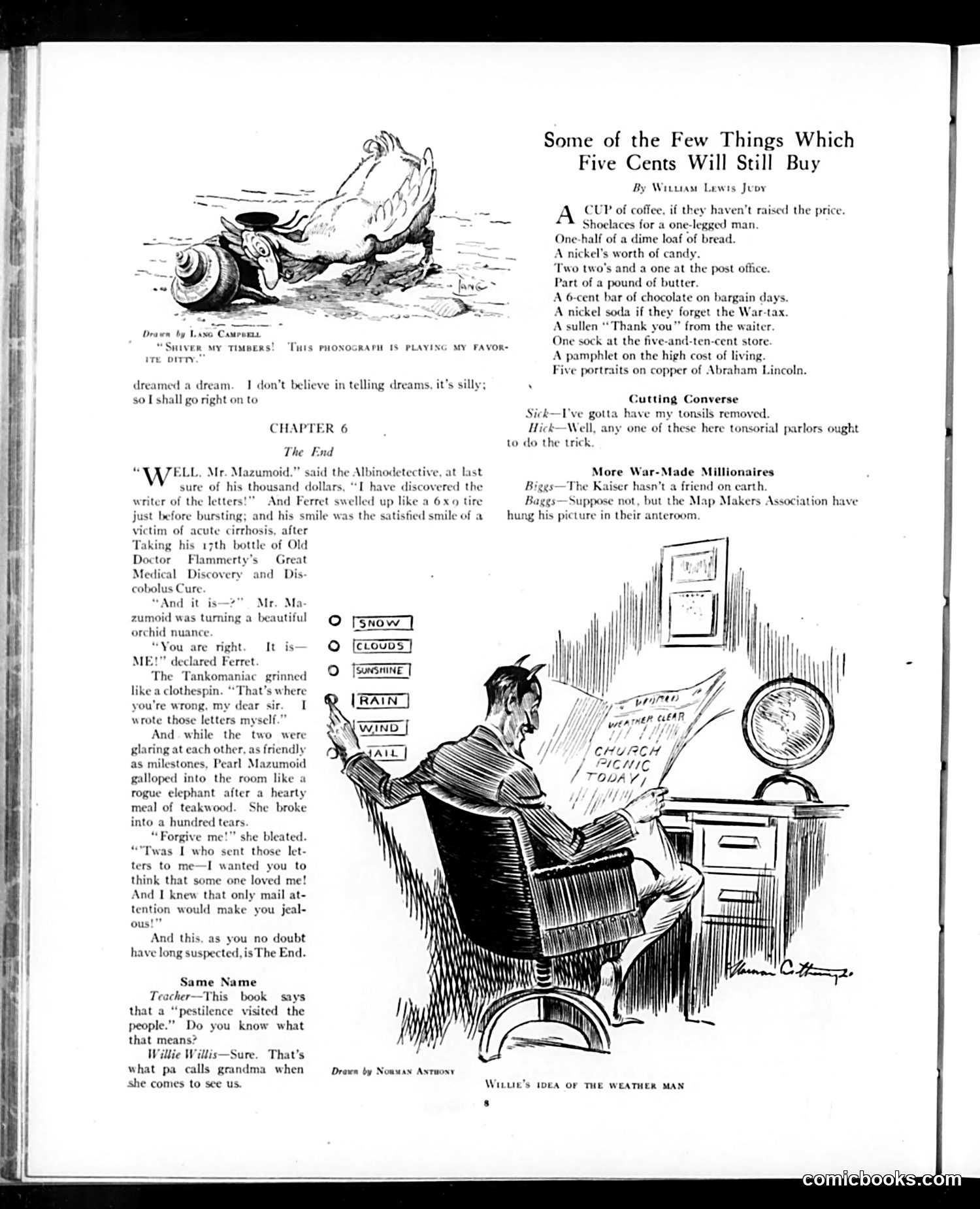
This page from *Judge* magazine contains satirical content from the World War I era, identifiable by references to "War-tax" and "the Kaiser." **Main Cartoon**: "Willie's Idea of the Weather Man" depicts a man at a desk with weather instruments, humorously representing how meteorologists were viewed—as unreliable predictors. The joke reflects public frustration with inaccurate forecasting. **"Some of the Few Things Which Five Cents Will Still Buy"**: This is economic satire about inflation during wartime. Items that once cost a nickel—coffee, candy, bread, soda—either now cost more or the portions have shrunk. References to "War-tax" and "high cost of living" highlight how WWI drove up prices, making five cents nearly worthless. Abraham Lincoln appears because his portrait was on the penny, suggesting even portraits of presidents were now cheap/abundant. **"More War-Made Millionaires"**: Dark humor about profiteering from war. The "Map Makers Association" joke suggests those who benefited financially from the war (military suppliers, industrialists) celebrated while enemies like the Kaiser suffered—a critique of war profiteering. The overall tone criticizes wartime inflation and those who grew wealthy from conflict.
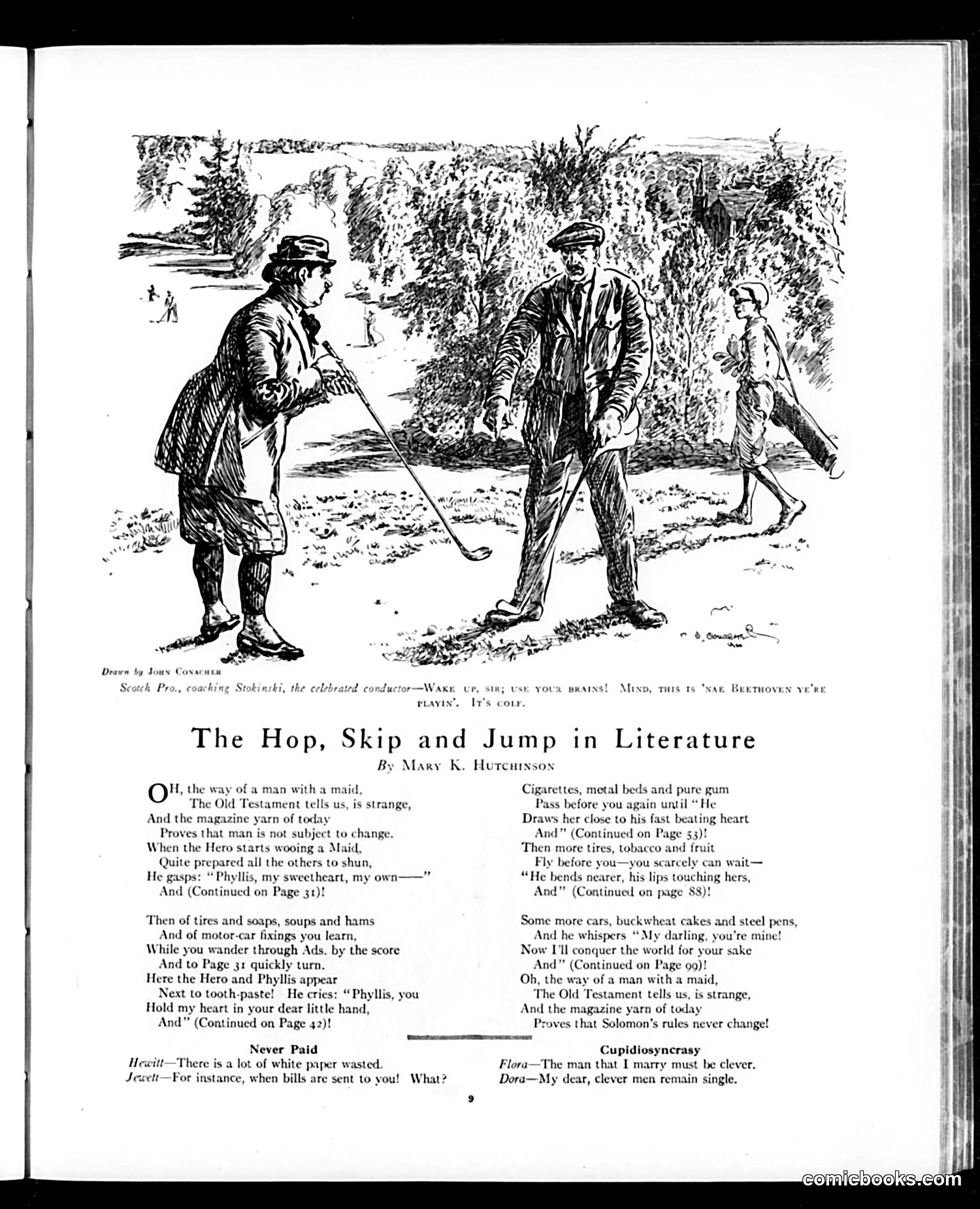
The main cartoon satirizes how magazines interrupt romantic narratives with advertisements. A poem titled "The Hop, Skip and Jump in Literature" mocks serialized love stories that constantly break the hero's passionate declarations with product ads—"Phyllis, my sweetheart..." followed by cigarettes, soap, motor-car fixes, and toothpaste before continuing pages later with "Hold my heart in your dear little hand..." (Continued on Page 42). The joke: magazines cynically fragment emotional moments to maximize ad placement, trivializing literature and romance equally. References to "Solomon's rules" (biblical wisdom about human nature) suggest nothing changes—men still pursue women predictably, and publishers still interrupt storytelling for profit. Below are two brief unrelated jokes about wasted paper in bills and expectations about clever men and marriage. The cartoon artist criticizes early 20th-century magazine publishing practices.
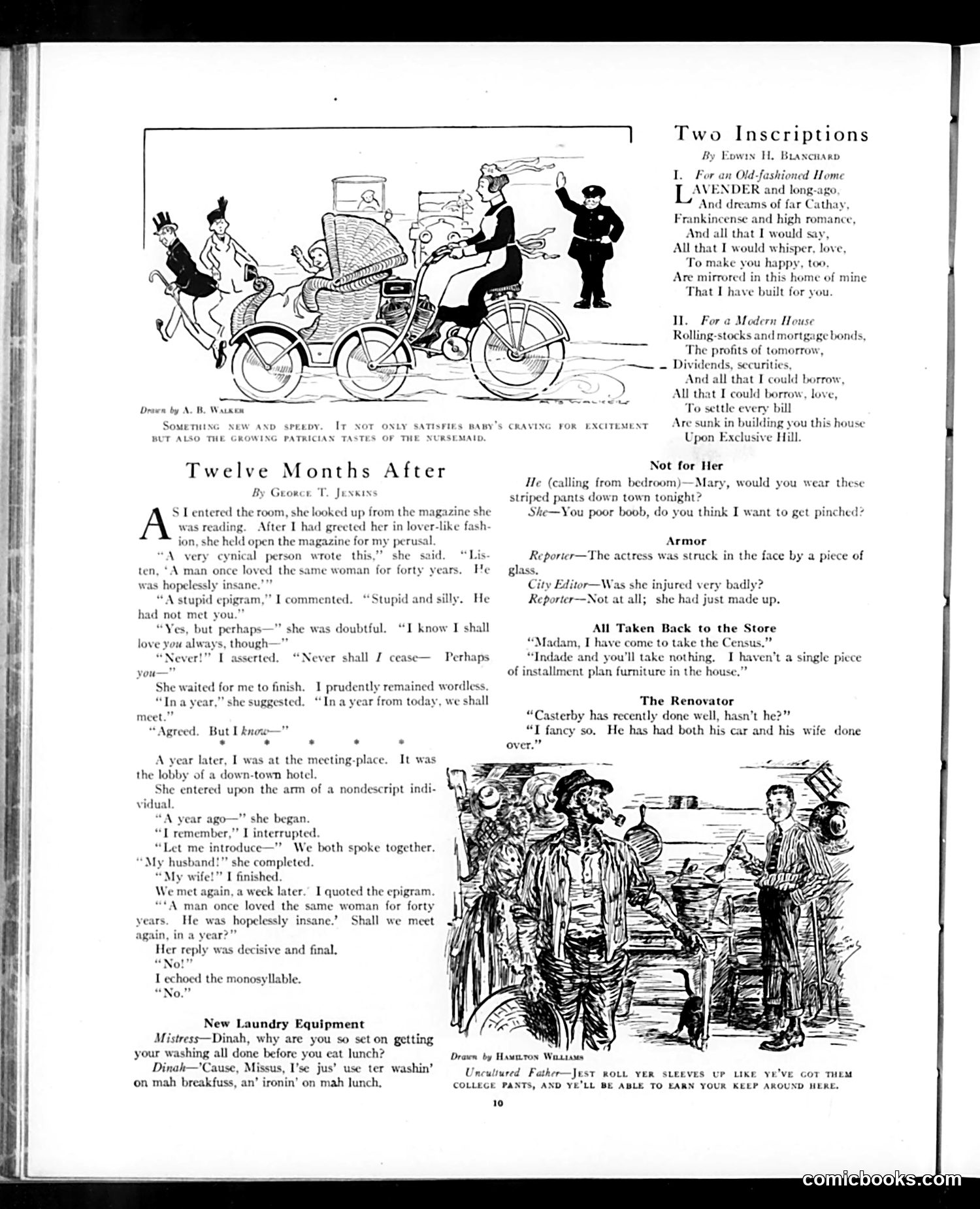
This page contains several satirical pieces reflecting early 20th-century American social anxieties: **"Twelve Months After"** mocks romantic idealism. A man quotes cynically that loving one woman for forty years means insanity, yet confidently asserts he'll love his romantic interest forever. A year later, he encounters her married to someone else at a hotel—the implication being that women's affections are transient and marriage prospects uncertain, undermining the male narrator's romantic certainty. **"Two Inscriptions"** contrasts old-fashioned romance with modern materialism: the first celebrates a home built on love and dreams; the second frankly admits a house financed through mortgages, stocks, and borrowed money for status ("Exclusive Hill"). **The shorter pieces** satirize gender dynamics and class aspirations: a woman refuses to wear her husband's pants publicly (risking being "pinched" or arrested for cross-dressing); a census-taker encounters someone with no installment furniture; a self-made man renovated his car and wife. The magazine targets pretension, marital disappointment, and the gap between romantic ideals and economic reality in the modern era.
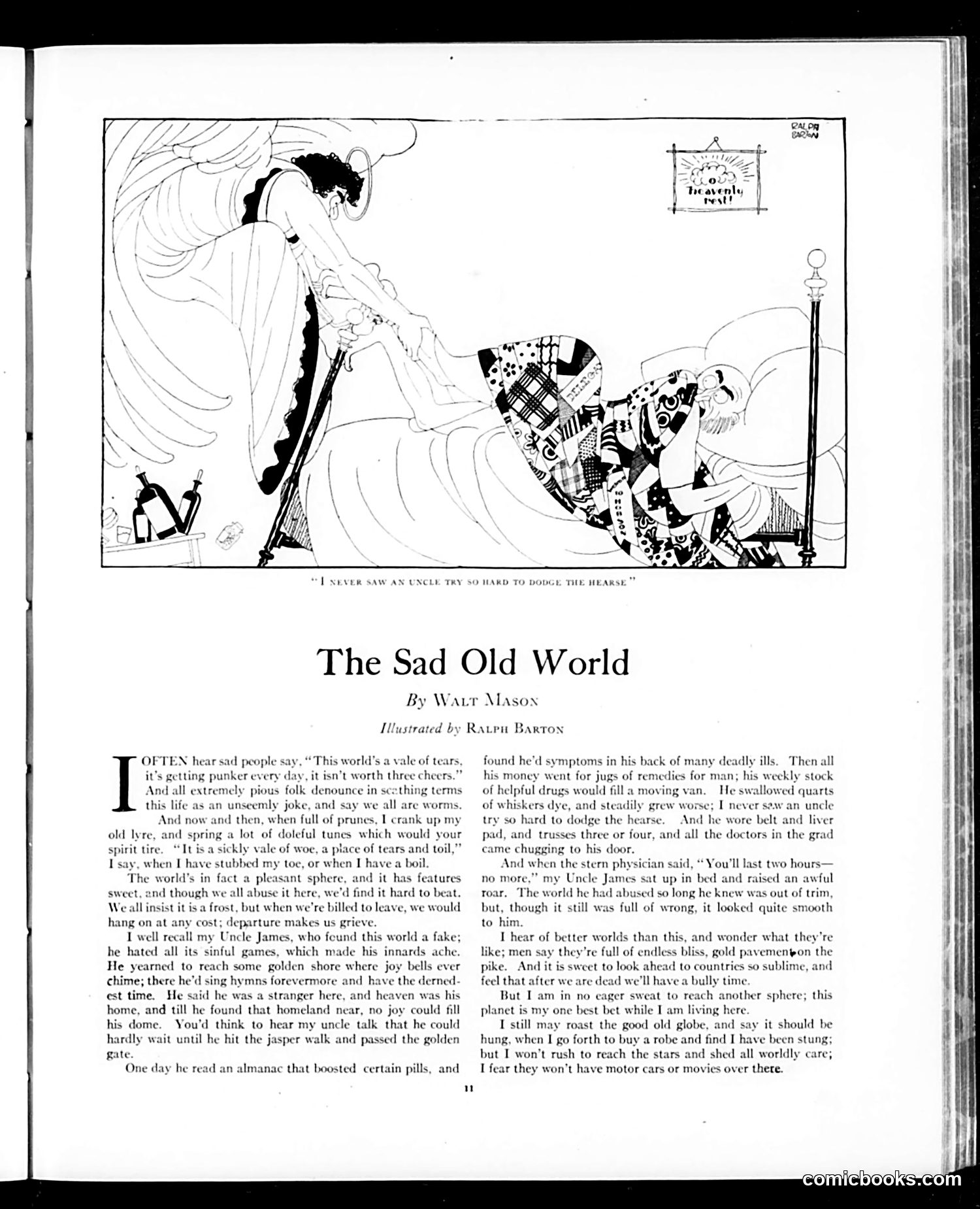
This is a humorous story illustrated by Ralph Barton satirizing pessimistic religious attitudes popular in early 20th-century America. The narrative, by Walt Mason, mocks people who constantly complain about life as a "vale of tears" while paradoxically desperately clinging to existence. The central joke appears in the illustration's caption: Uncle James, who spent his life denouncing this world as sinful and eagerly awaiting heaven, ironically "tries so hard to dodge the hearse"—he desperately seeks medical remedies and refuses to die despite his professed disdain for earthly life. The story's point: people who publicly condemn the world as wretched actually treasure life and fear death. The narrator himself admits he complains about modern inconveniences but won't "rush to reach the stars"—he prefers earthly existence, assuming heaven lacks "motor cars or movies." It's gentle satire of hypocrisy and the human contradiction between stated beliefs and actual behavior.
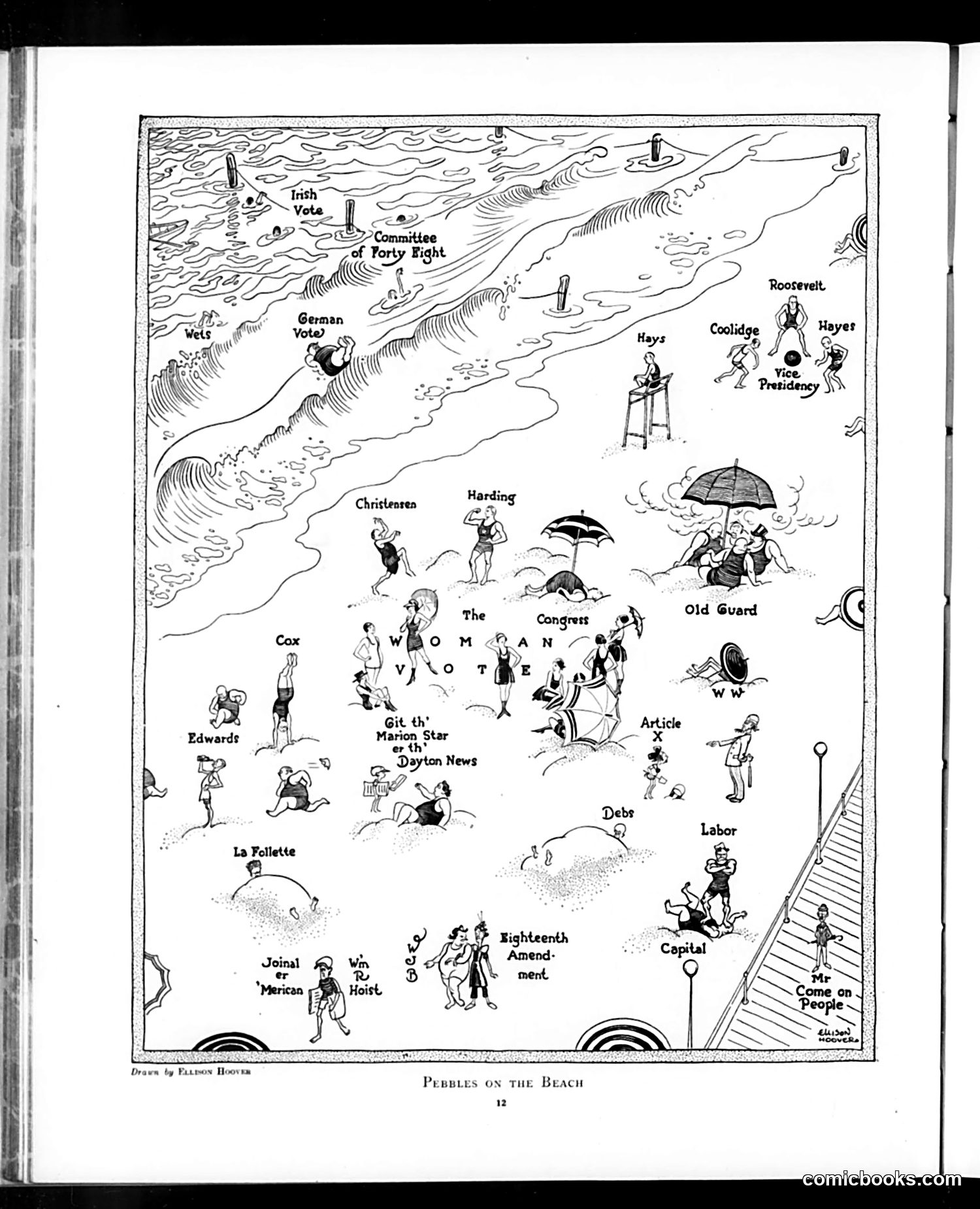
This single-panel cartoon depicts various political figures and issues as characters scattered on a beach, drawn by Elloson Hoover. The "Woman Vote" appears central, surrounded by politicians and issues competing for attention. Visible figures include Cox, Harding, Coolidge, Hayes, Roosevelt, and others—likely referencing the 1920 presidential election. Issues like "The Congress," "Capital," "Labor," "Debt," and the "Eighteenth Amendment" are personified as separate entities on the shore. The beach setting suggests these political matters are trivial distractions ("pebbles"), while waves in the background may represent larger forces. The satire appears to mock how politicians and issues competed for women voters' newly granted suffrage rights (19th Amendment, ratified 1920).
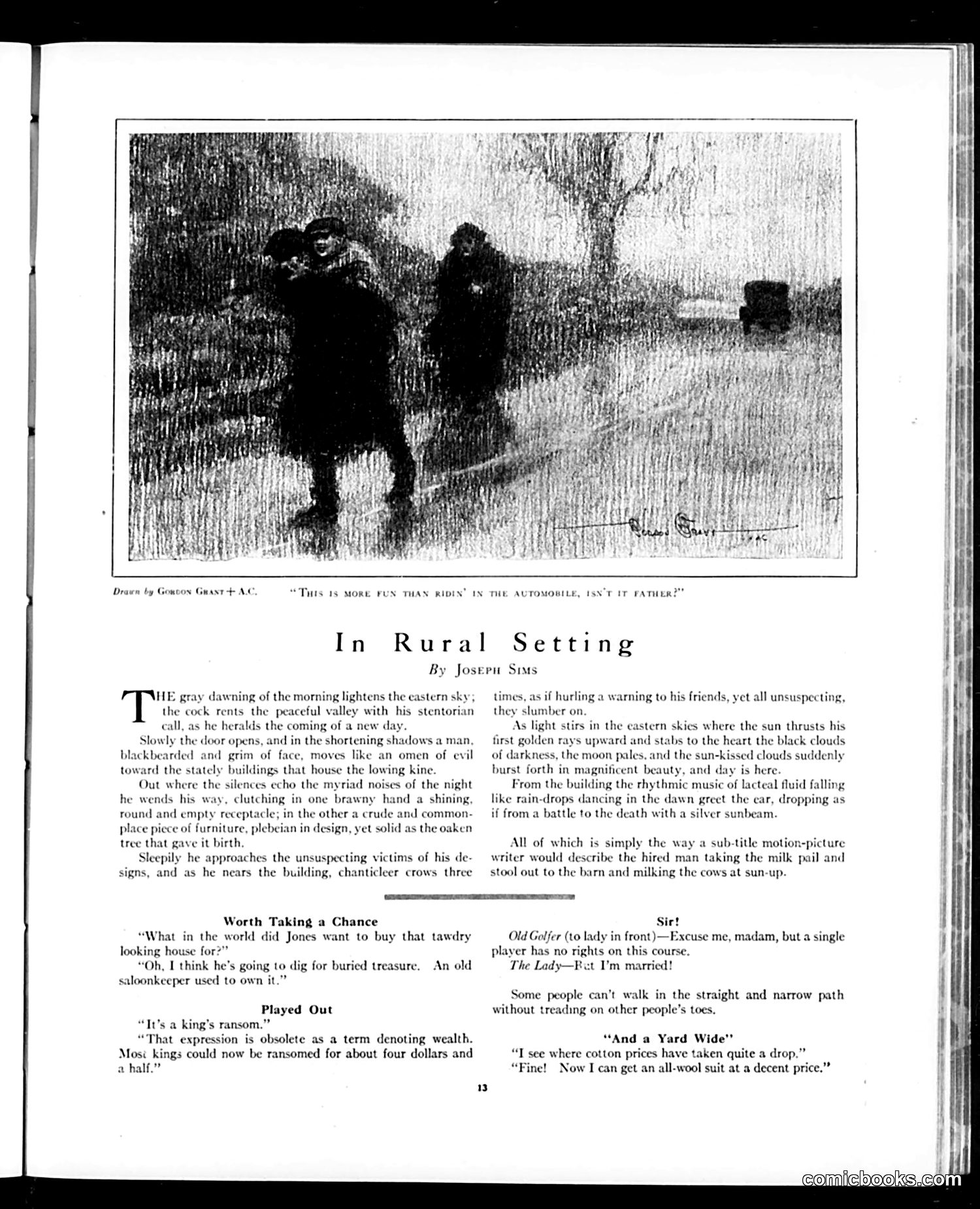
This Judge magazine page contains a humorous cartoon and several satirical short pieces reflecting early 20th-century American life. The cartoon depicts a man and woman in a horse-drawn carriage, with the caption quoting the child asking if riding in the carriage is "more fun than ridin' in the automobile." This satirizes the novelty and status anxiety around automobiles—still relatively new and expensive—versus traditional transportation. The joke mocks wealthy families' pride in automobiles. The accompanying story "In Rural Setting" uses deliberately overwrought, poetic language to describe a farmhand doing mundane chores (milking cows), mocking pretentious literary style. The short jokes below mock outdated expressions ("king's ransom"), social climbing (buying a disreputable house), and current economic concerns. "And a Yard Wide" references cotton price drops—likely referring to agricultural/economic fluctuations of the era—with the punchline that cheap cotton prices mean affordable all-wool clothing. Overall, the page satirizes social pretension, changing technology, and economic uncertainty of early-20th-century America.
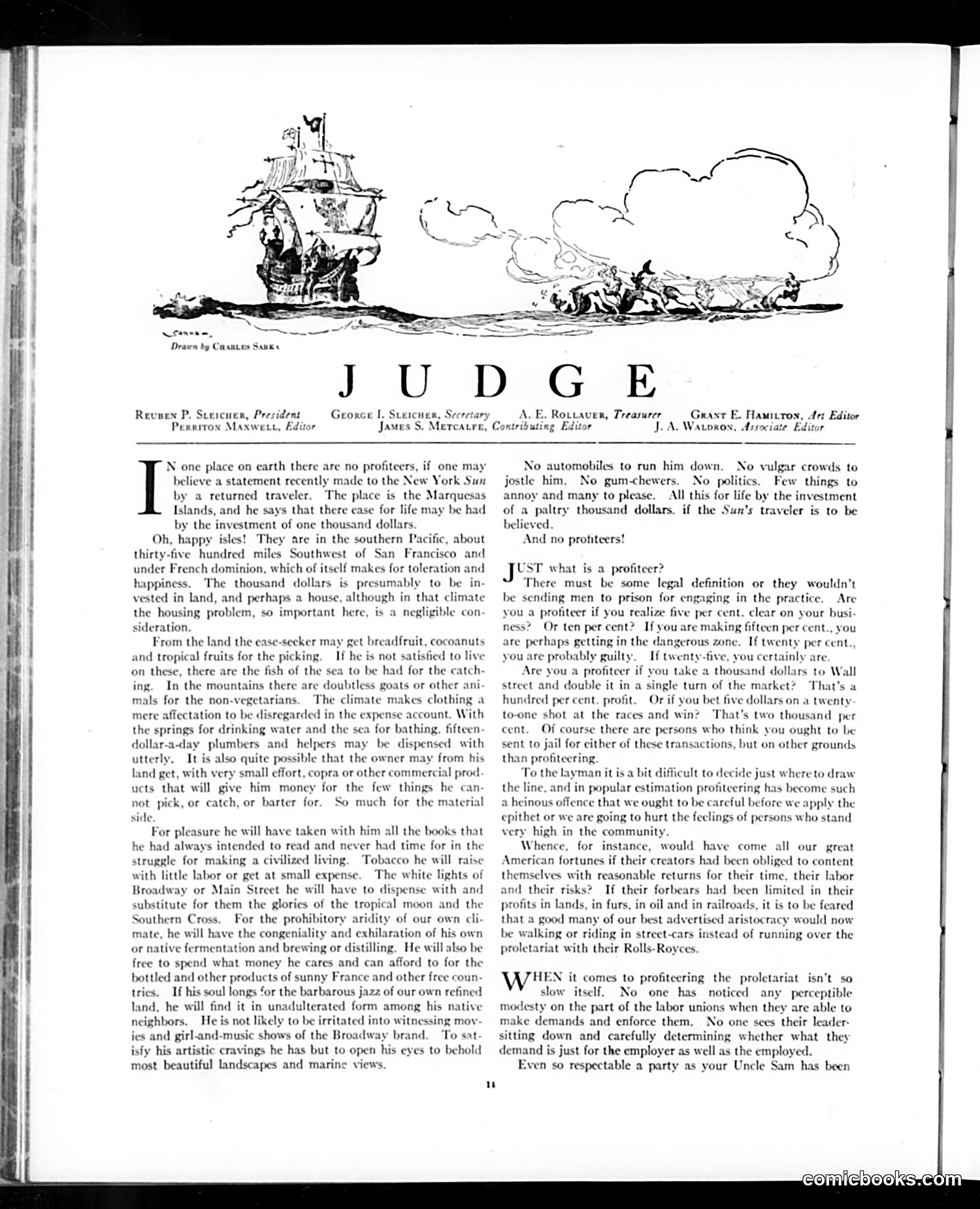
This page satirizes the concept of "profiteering"—a heated public concern during or after World War I. The illustrated header shows a colonial-era sailing ship, establishing a romantic contrast to modern commerce. The editorial argues that the Marquesas Islands offer an idyllic escape from American profiteering: no automobiles, crowds, or materialism—just natural abundance requiring only $1,000 investment. The piece then pivots to mock profiteer definitions, questioning where legitimate profit ends and greed begins. It notes labor unions demand enforcement against profiteers, yet no clear legal standard exists. The satire's point: American society obsesses over punishing "profiteers" without defining the term, making profiteering simultaneously a serious crime and an arbitrarily defined concept. The Marquesas fantasy underscores how Americans associate profit-seeking with moral corruption—suggesting escape to paradise becomes necessary to avoid being labeled a profiteer simply by earning reasonable returns.
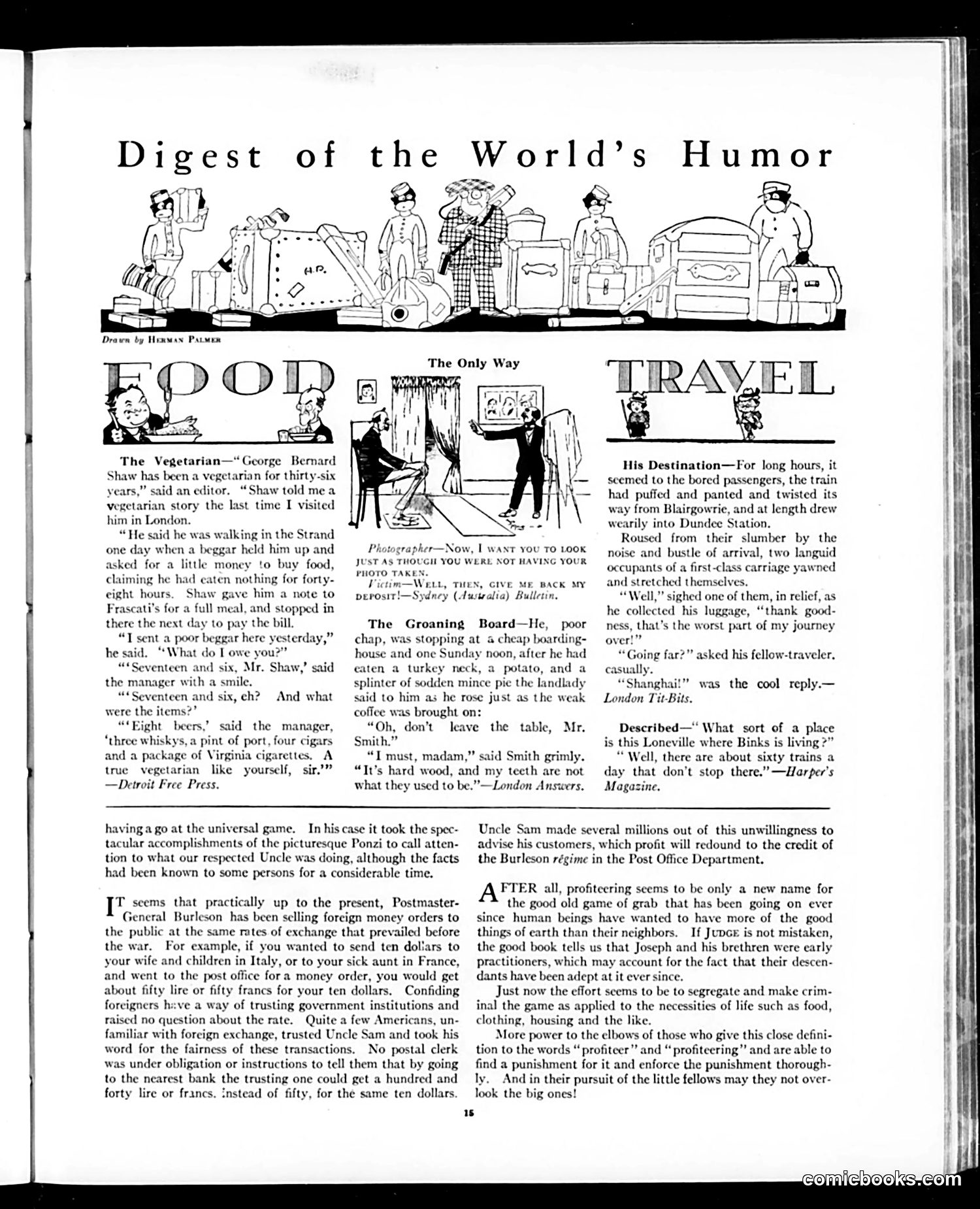
This Judge magazine page collects brief humorous anecdotes organized into three sections: **Food**, **The Only Way**, and **Travel**. The satire targets several contemporary issues: 1. **"The Vegetarian"** mocks George Bernard Shaw's famous vegetarianism through an ironic story where he generously feeds a beggar, only to be billed exorbitantly—suggesting vegetarian principles clash with financial reality. 2. **"The Groaning Board"** jokes about a cheapskate's bill at a boarding house: eight beers, whiskeys, and cigars—hardly vegetarian fare—yet he protests the modest charge of "seventeen and six." 3. **The Postmaster-General Burleson section** is sharper satire: the U.S. Post Office deliberately offered unfavorable foreign exchange rates on money orders (paying 50 lire instead of 140 for ten dollars), pocketing millions while claiming government trustworthiness. This is presented as "profiteering" under the guise of public service. The travel anecdotes are lighter, mocking bored train passengers and photographers' contrived requests.
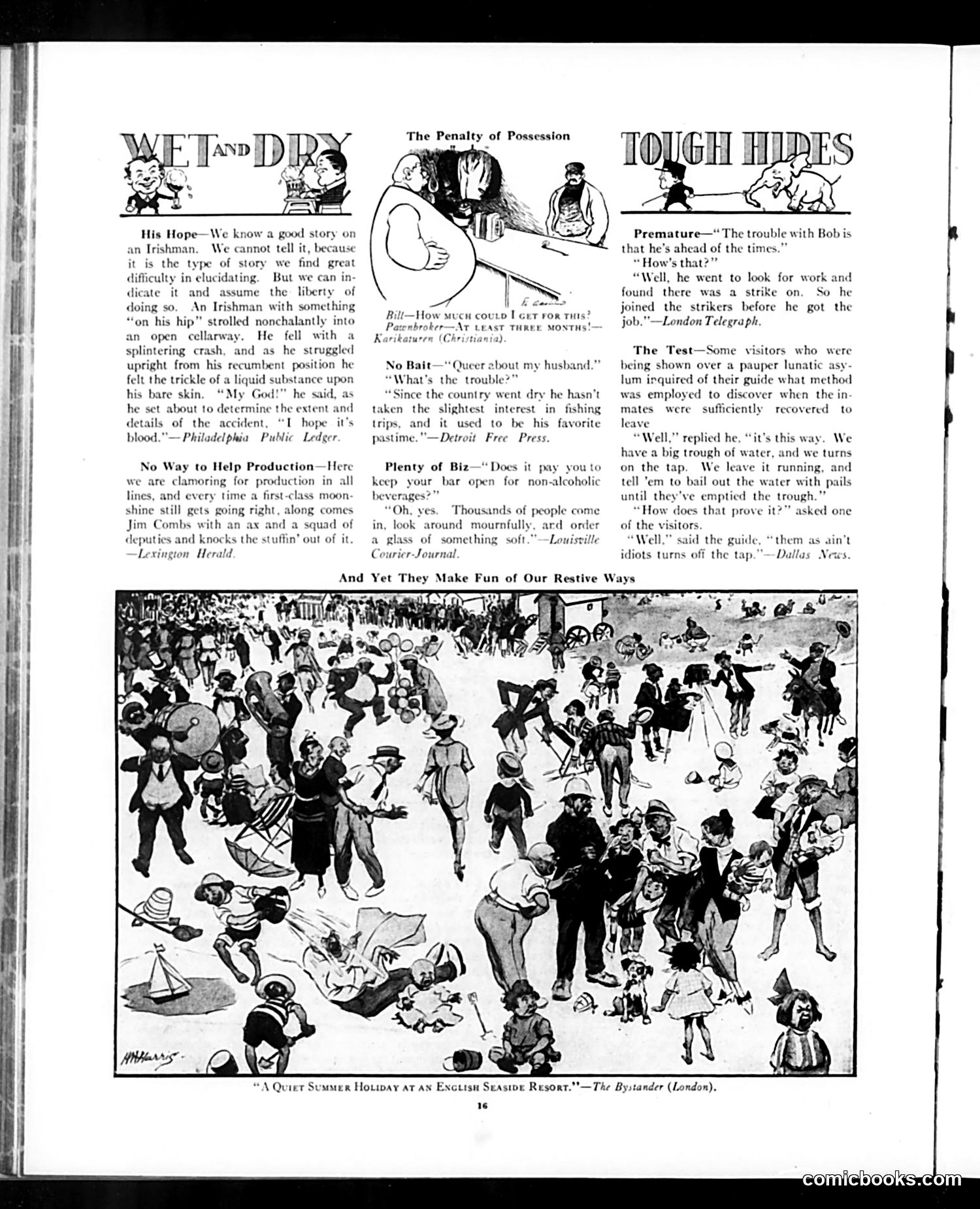
This page collects brief humorous anecdotes and social commentary typical of early 20th-century American humor magazines, alongside a large illustration of crowded English seaside resort behavior. **Key sections:** - **Irish stereotype joke**: Mocks Irish drinking culture—an Irishman falling into a cellarway hopes his injury involves blood rather than spilled alcohol. - **Prohibition-era commentary**: Multiple items satirize the 1920s alcohol ban: a moonshiner disrupts "production," a pawnbroker holds collateral from illegal possession, and a "dry" husband loses interest in fishing trips (coded reference to drinking). - **Asylum test anecdote**: Dark humor about institutionalization—identifying recovery by whether patients turn off a water tap. - **Bottom illustration**: Titled "A Quiet Summer Holiday at an English Seaside Resort," this mocking caption suggests the crowded, chaotic beach scene contradicts any notion of English restraint—the implicit joke being that Americans aren't uniquely rowdy or undisciplined. The page's overall theme: satirizing Prohibition's ineffectiveness and poking fun at English propriety.
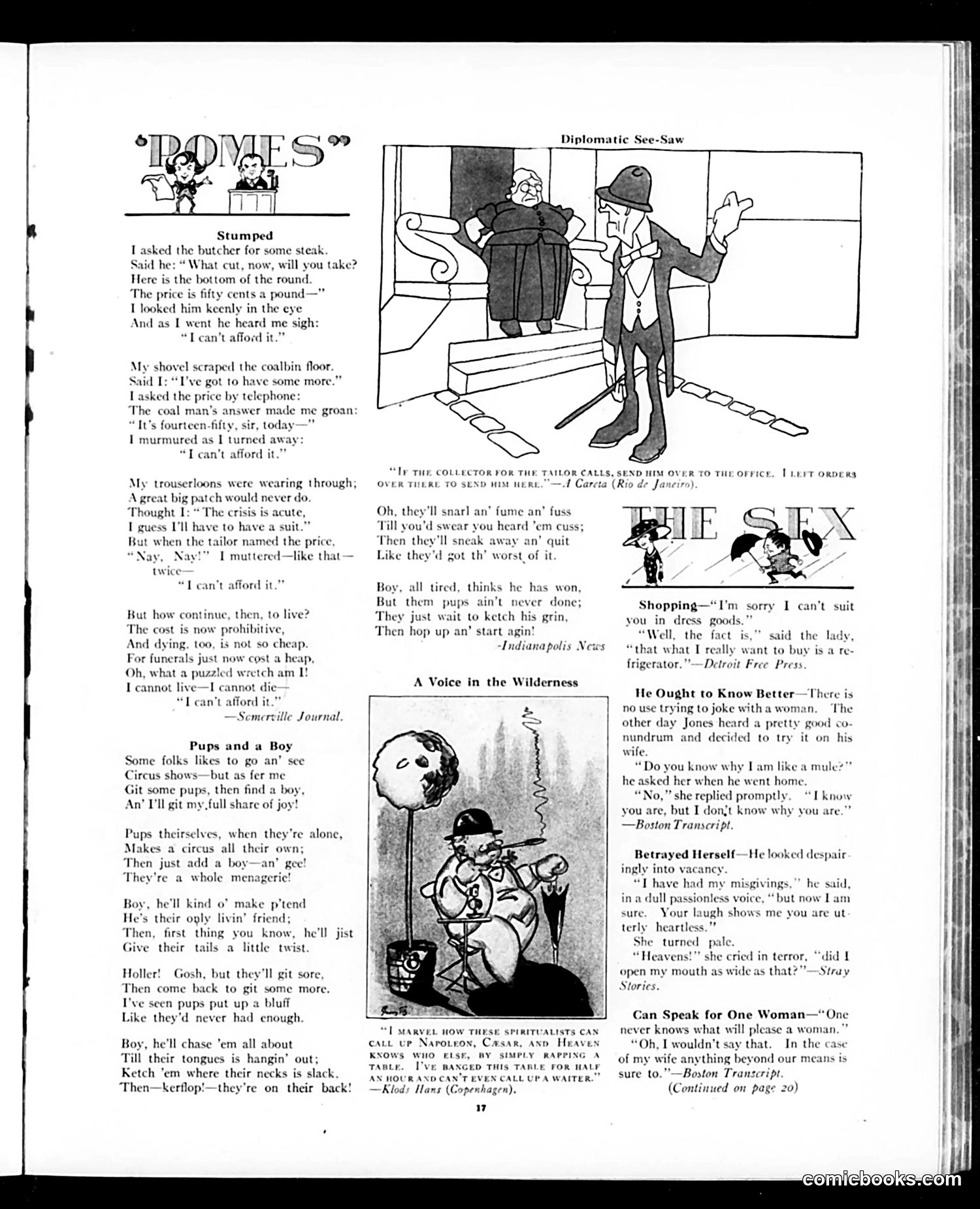
This page from Judge (appears early 20th century) contains several pieces of social satire: **"Stumped"** — A humorous poem about economic hardship. A working-class man repeatedly cannot afford basic necessities (steak, coal, clothing repairs), finally despairing that even dying is expensive. The satire targets cost-of-living crises and inflation affecting ordinary people. **"Diplomatic See-Saw"** — A cartoon showing a tailor and collector negotiating with a woman, illustrating class tensions and financial disputes. **"Pups and a Boy"** — A lighthearted rural poem about boys and dogs playing together, with no apparent political content. **"A Voice in the Wilderness"** — A cartoon mocking spiritualism (séances), showing someone frustrated trying to summon spirits by table-rapping, unable even to call a waiter—satirizing the era's spiritualist craze as useless. The remaining pieces ("He Ought to Know Better," "Betrayed Herself," "Can Speak for One Woman") are brief domestic humor anecdotes about marital misunderstandings. Overall, the page mixes economic anxiety commentary with contemporary social follies.
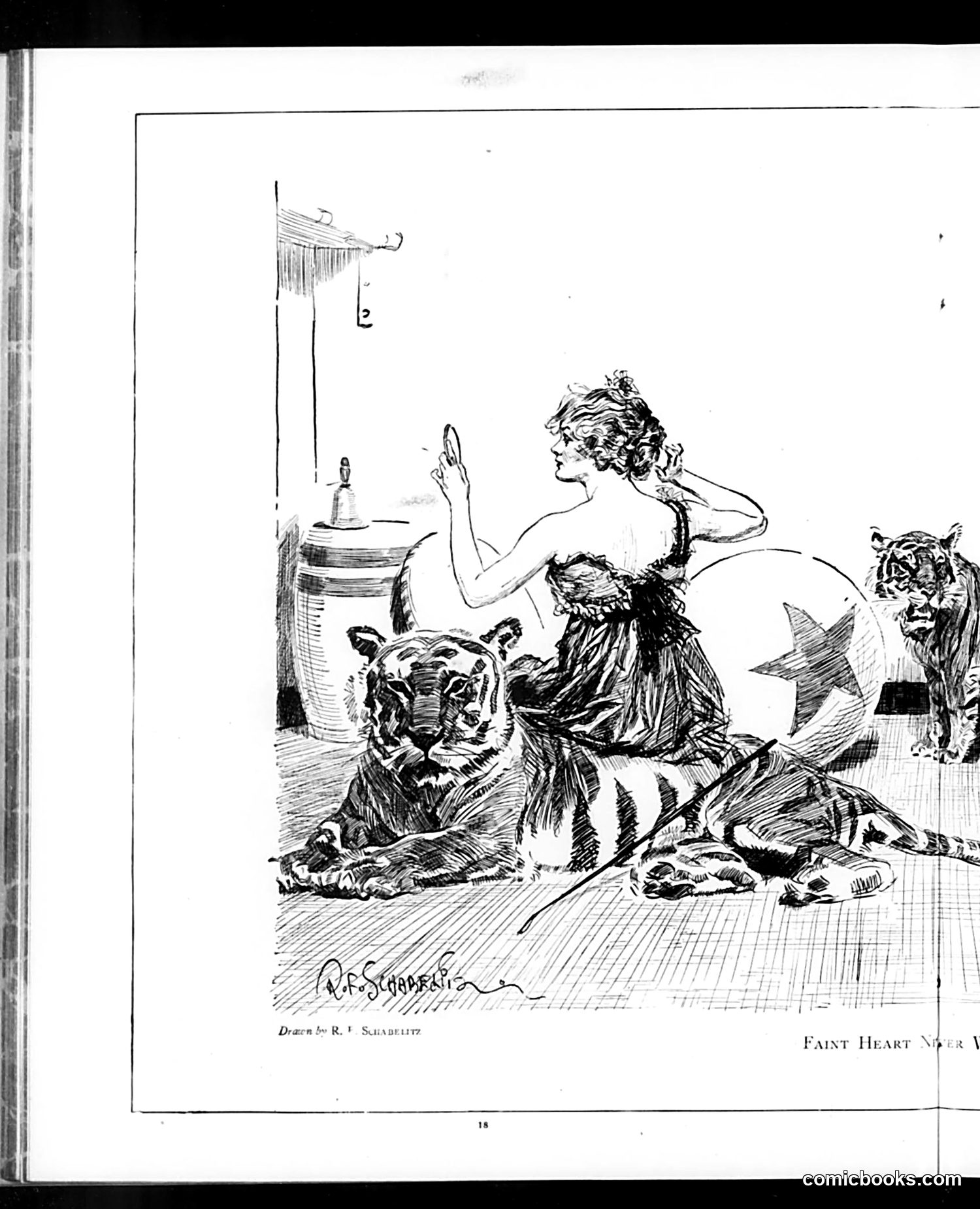
This is a sketch by R.J. Scarbeltiz titled "Faint Heart" (page 2 of what appears to be a multi-part work). The drawing depicts a woman in an elaborate dress seated among exotic animals—a tiger, leopard, and what appears to be other big cats—in what looks like a circus or theatrical setting. A barrel and curtain suggest a performance space. The title "Faint Heart" likely refers to the woman's composed demeanor despite being surrounded by dangerous animals, suggesting either courage or the theatrical artifice of appearing unafraid. The exact satirical point remains unclear without additional context—it could comment on feminine bravery, circus performance, or social pretense. The artwork style and subject matter are typical of Judge magazine's illustrated humor from the late 19th/early 20th century.
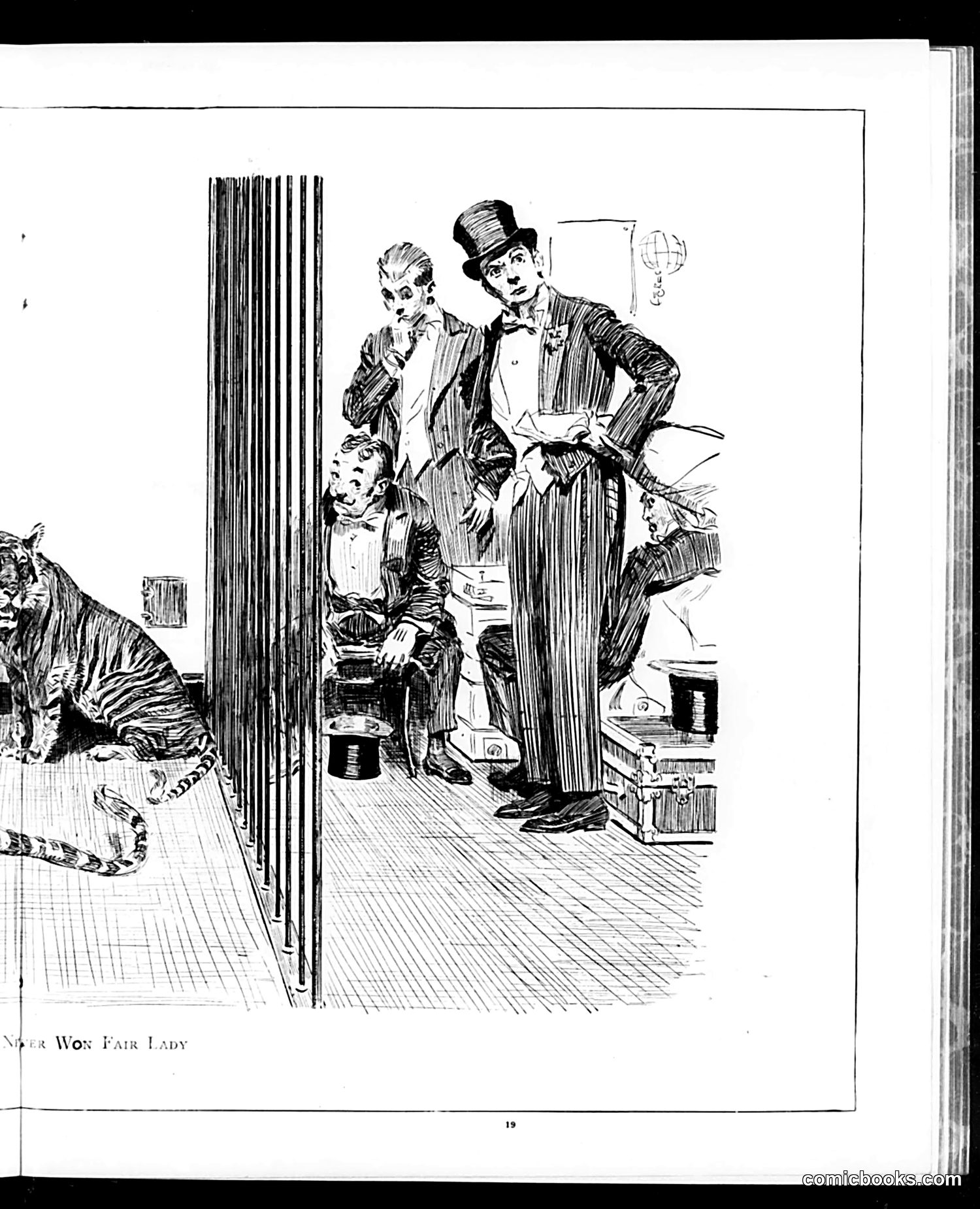
This illustration depicts a theatrical or backstage scene from what appears to be early 20th-century satirical commentary. The central figure is a well-dressed man in a top hat and formal coat, standing prominently with two other men. On the left, a tiger or large cat is visible, suggesting this may reference a theatrical production or performance piece. The caption "A Won Fair Lady" suggests romantic or courtship themes, likely mocking either theatrical pretensions or social climbing. The presence of the exotic animal and the characters' exaggerated expressions typical of Judge magazine's style indicate this is satirizing either a theatrical production, romantic entanglement, or social situation of the period. Without additional context about the specific issue or accompanying articles, the exact target of satire remains somewhat unclear.
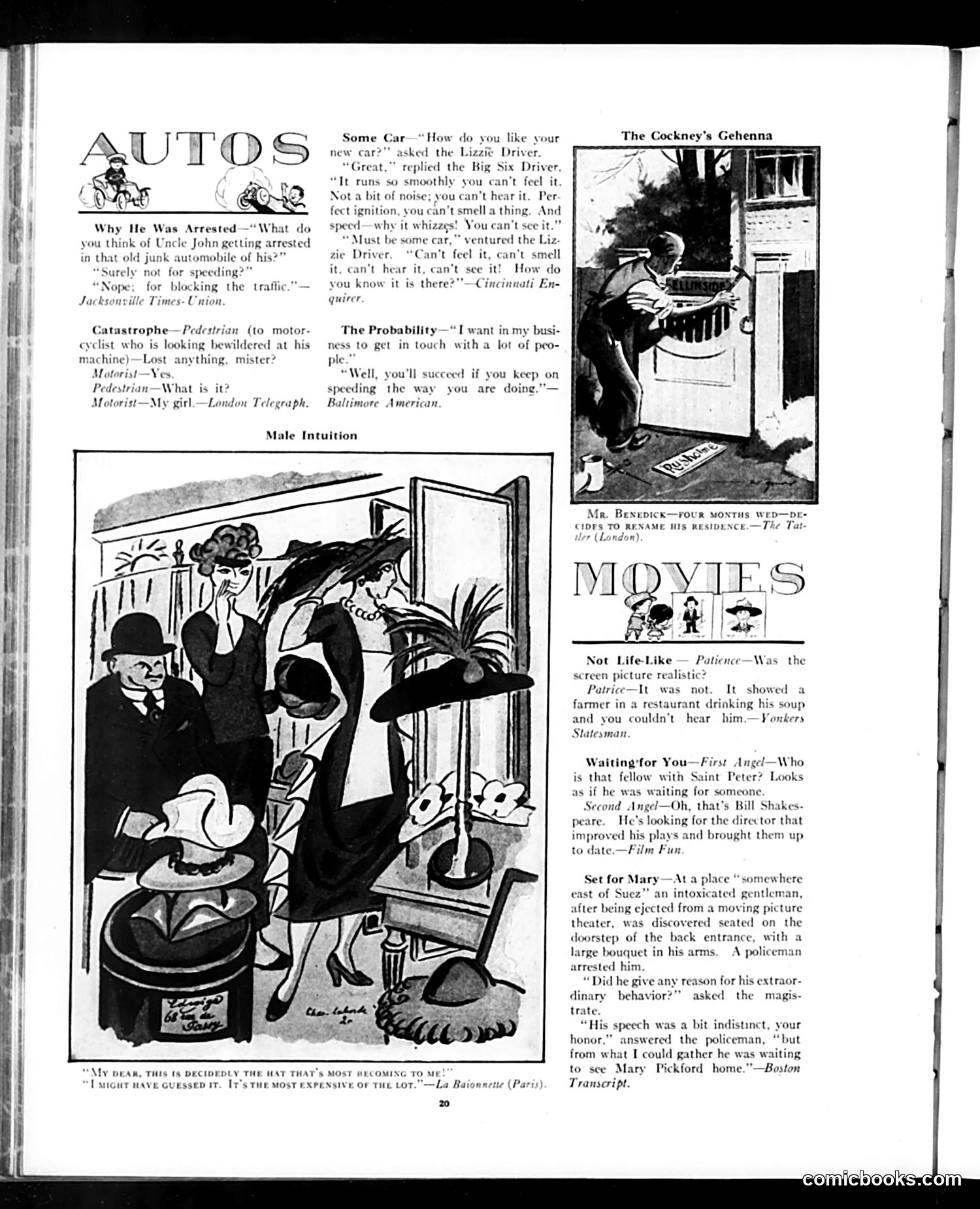
This page from *Judge* contains brief automotive and social humor pieces typical of early 20th-century satire. **"Male Intuition"** cartoon depicts a well-dressed woman shopping for hats while a man observes. The joke plays on gender stereotypes: the man correctly guesses that the hat she likes is "the most expensive of the lot"—satirizing women's supposed materialism and men's resigned cynicism about female spending habits. The automotive jokes mock the newfangled automobile: one piece jokes that a car runs so smoothly you "can't feel it, can't hear it, can't smell it"—questioning whether such a silent vehicle actually exists. Another mocks a motorist arrested for "blocking traffic" with his old jalopy. These reflect early automotive skepticism and congestion concerns. **"The Cockney's Gehenna"** photo shows a man at a window—likely a humorous caption piece about filmmaking or theater. The **movie section** contains jokes about cinema realism and references to performer Mary Pickford, a major silent film star of the era. Overall, the humor targets automotive culture, consumerism, and emerging cinema entertainment.
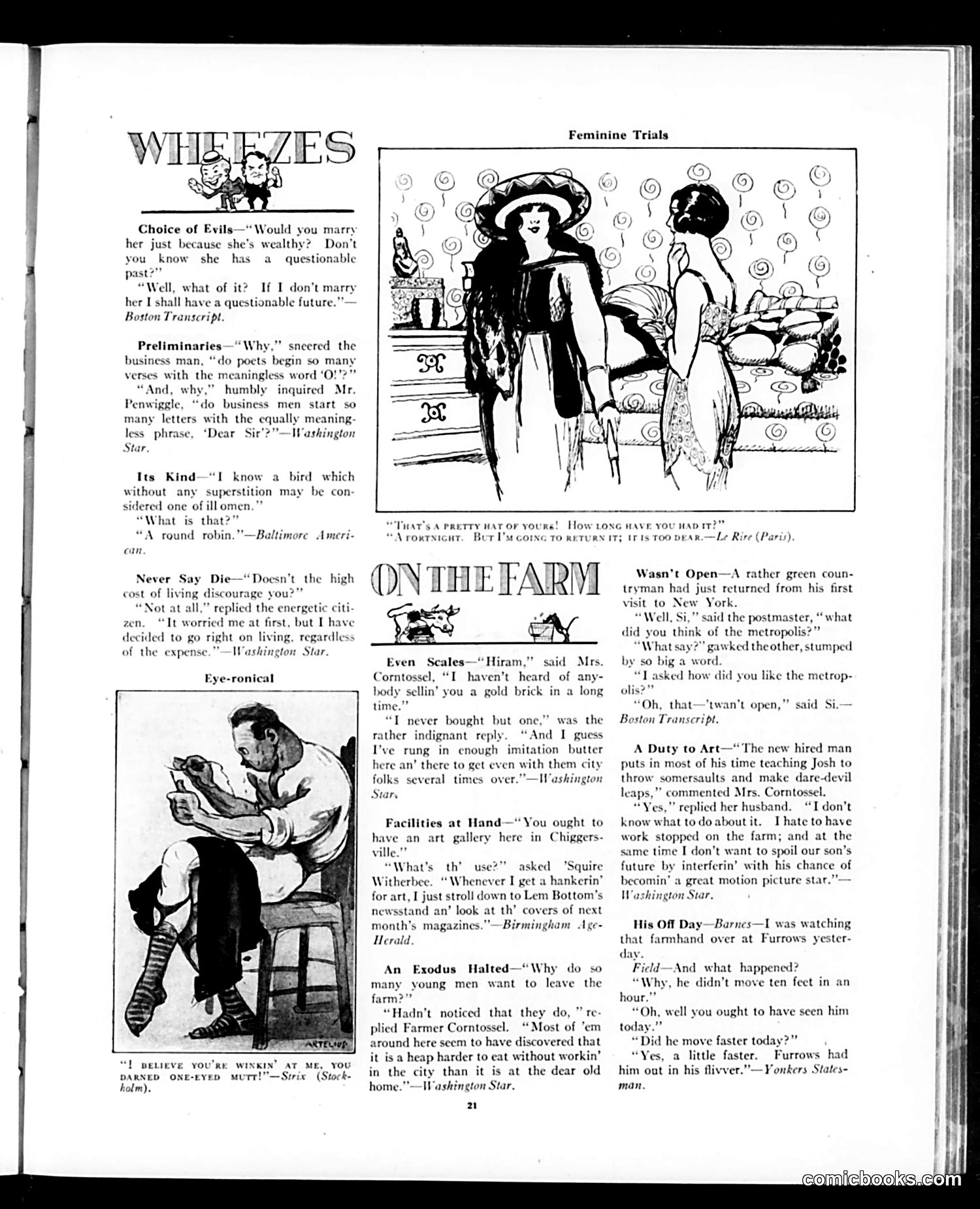
This page from Judge contains humorous short anecdotes and one cartoon, typical of early-20th-century American satirical magazines. **The Cartoon ("Feminine Trials"):** Shows a fashionable woman admiring another's hat. The joke satirizes female materialism and dishonesty: the woman compliments the hat only to admit she's borrowed it temporarily because it's too expensive to keep—a commentary on women's vanity and financial irresponsibility. **The Anecdotes** mock social pretension and rural/urban contrasts. "Choice of Evils" jokes about marriage to a wealthy woman with a "questionable past" versus remaining single with an uncertain future. "On the Farm" sketches feature rural characters outwitting city folk or struggling with modernity (confusing "metropolis," preferring newsstand magazine covers to real art). "His Off Day" pokes fun at farmhands, suggesting they work harder in a vehicle than on foot. Overall, the page reflects Judge's recurring themes: satirizing women's materialism, mocking rustic simplicity, and poking fun at urban-rural cultural gaps.
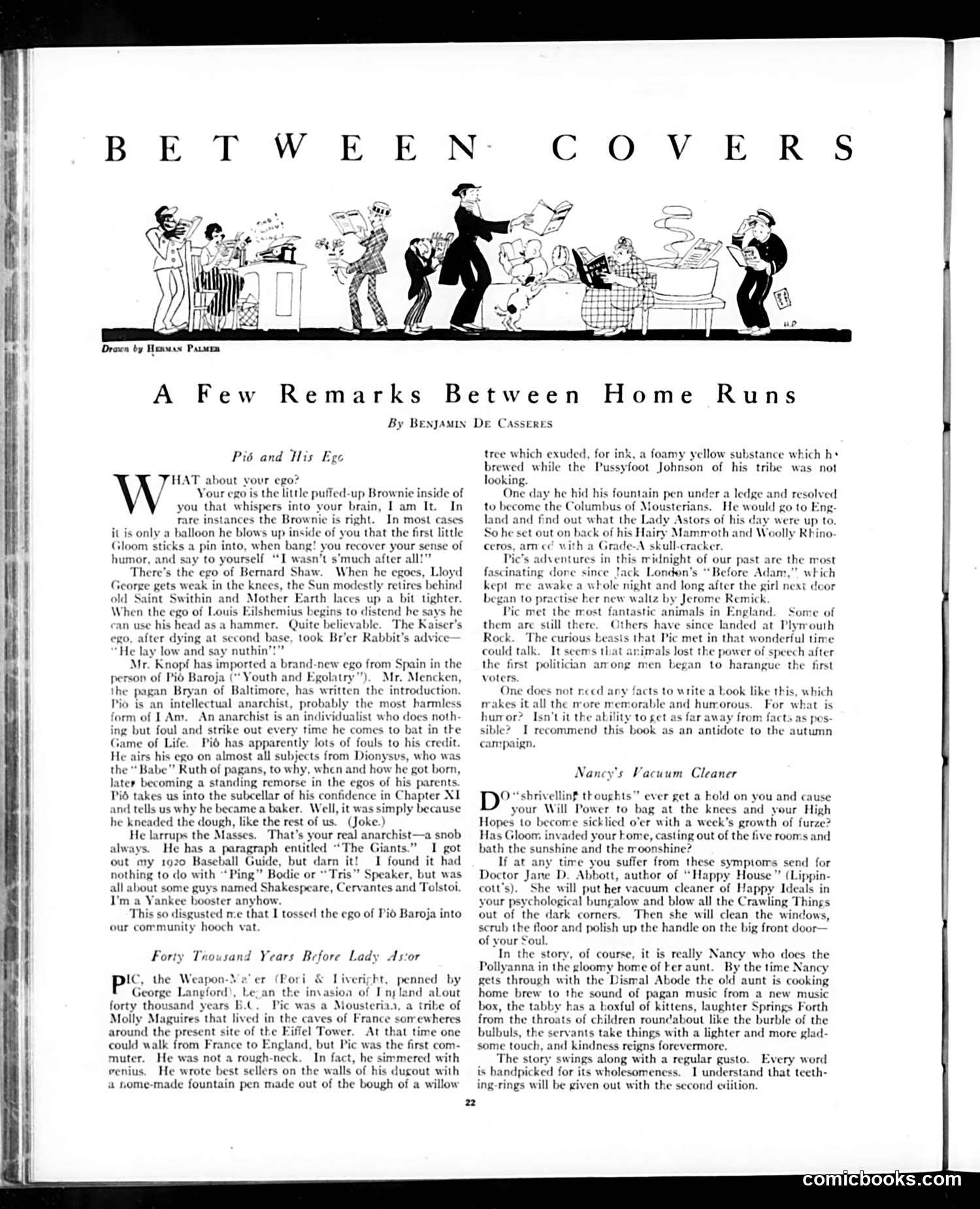
This is the contents page of Judge's "Between Covers" literary section, featuring book reviews and commentary by Benjamin De Casseres. The main article discusses **Pío Baroja**, a Spanish writer whose book "Youth and Egolatry" was recently published in English (introduced by H.L. Mencken). De Casseres sarcastically reviews Baroja as an "intellectual anarchist"—harmless but self-absorbed, full of ego. The satire mocks both Baroja's self-indulgent writing and the pretentiousness of anarchist intellectuals generally, calling them "snobs." A second piece humorously reviews George Langford's "Pic, the Weapon-Maker," a prehistoric adventure story. De Casseres jokes about mistakenly consulting a 1920 Baseball Guide instead of finding literary references. The cartoon at top depicts various domestic chaos scenes—meant to illustrate the "remarks between home runs" (leisure-time observations). The page is essentially a book review column mixing literary criticism with lighthearted mockery of contemporary authors and intellectual fashions.
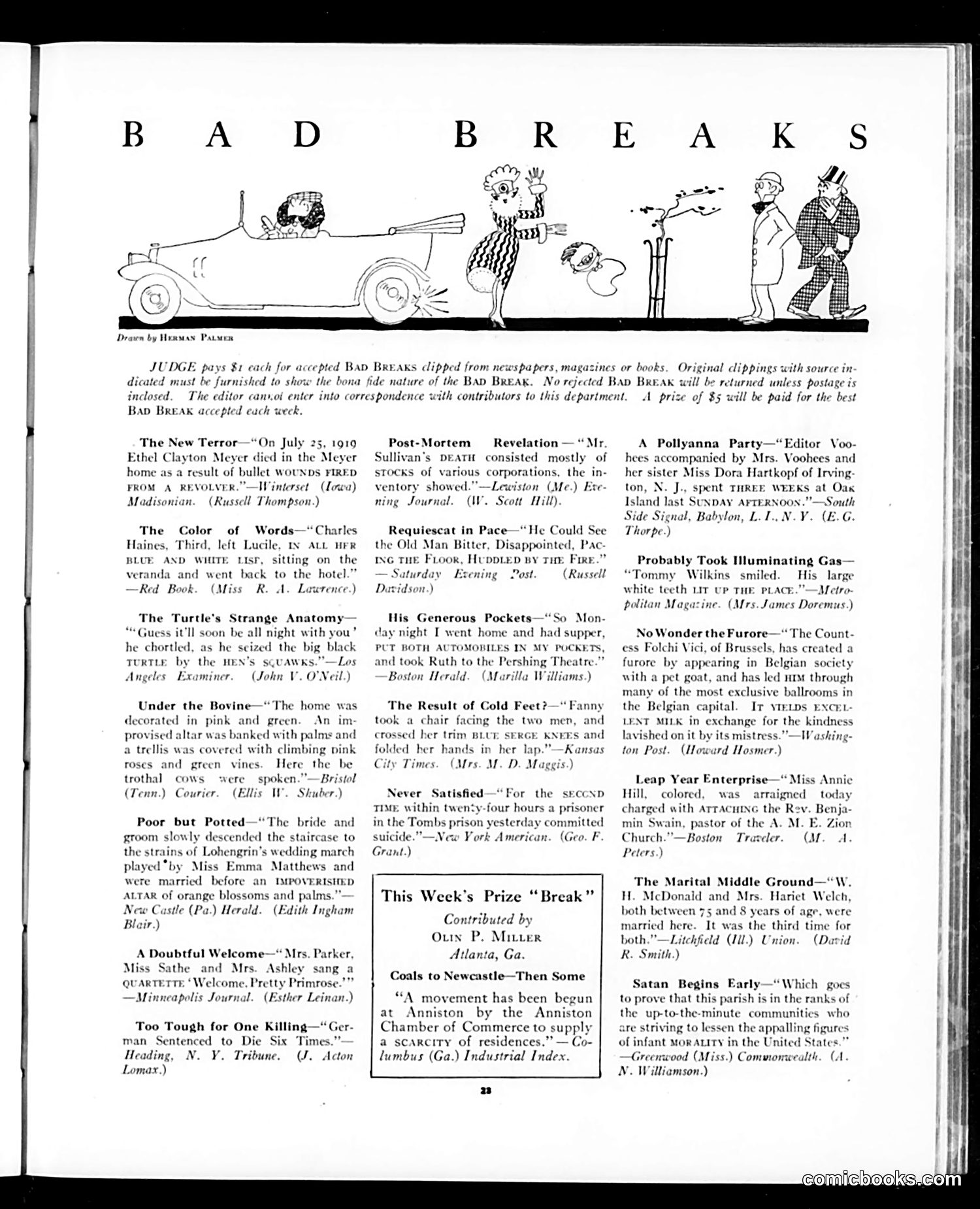
This page showcases "Bad Breaks"—comedic newspaper printing errors submitted by readers to Judge magazine. The cartoon at top illustrates the concept: a car labeled "BAD BREAKS" crashes into various people, literally breaking things apart. The column collects genuine typographical or grammatical errors from newspapers, extracting unintentional absurdity. Examples include: - A death notice mentioning "bullet wounds fired from a revolver" with unclear causation - A description of a bride and groom descending stairs to strains played by a cow ("betrothal cows were spoken") - A newspaper claiming someone put "both automobiles in my pockets" - A movement to address housing shortages by sending coal to a coal-mining town The humor relies on how literal misreadings create ridiculous meanings. Judge paid $1 for each accepted submission, rewarding readers who spotted these unintentional comedic gems in contemporary publications. This reflects early 20th-century editorial standards and the amusement value of typographical humor.
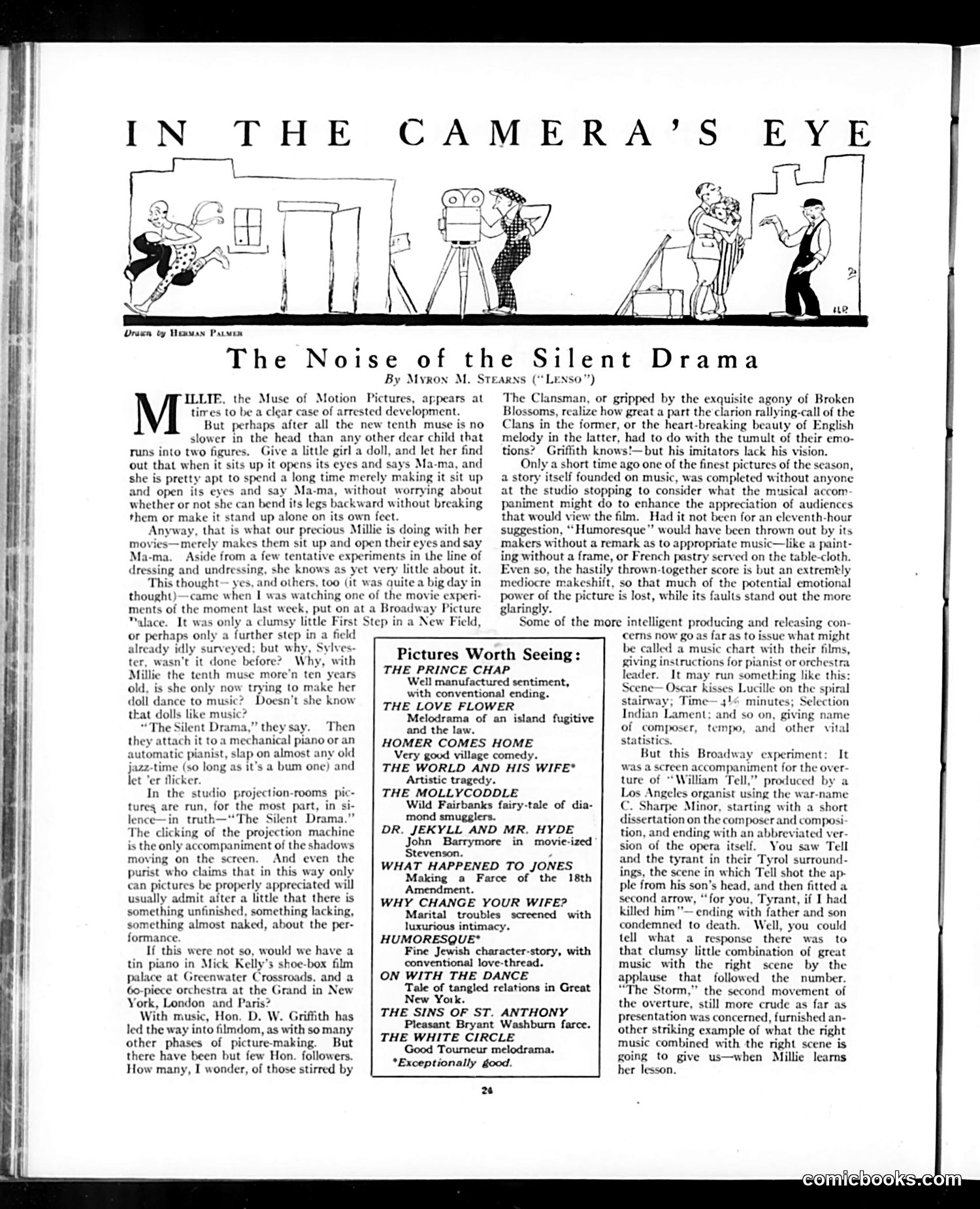
This page critiques the emerging film industry's neglect of musical accompaniment in silent movies. The cartoon header, drawn by Herman Packer, illustrates film production scenes. The article by Myron M. Stearns argues that filmmakers treat motion pictures like a child with a new doll—mechanically repeating simple tricks without developing sophistication. Stearns contends that major directors like D.W. Griffith understand music's emotional power (citing *The Clansman* and *Broken Blossoms*), but most studios carelessly slap generic jazz onto films without consideration. He notes the contradiction: filmmakers show films silently in studios yet acknowledge music's necessity by adding orchestras in theaters. Stearns criticizes "Humoresque" for nearly releasing without any musical score, and mocks studios for not issuing "music charts" to guide accompaniment. The piece champions Griffith as visionary while lamenting that few followers understand how integral music is to silent film's emotional impact.
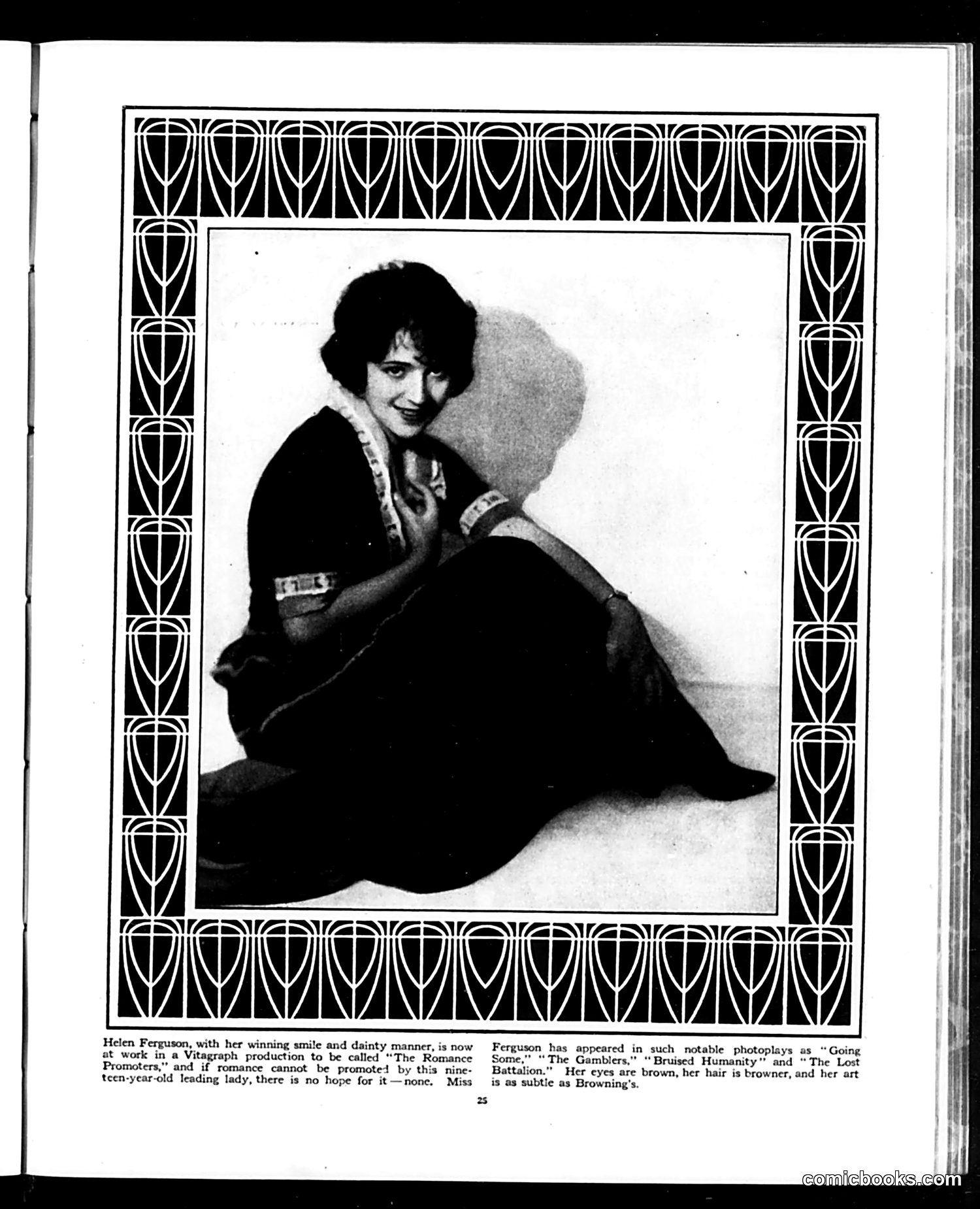
This page features a photograph of Helen Ferguson, a young actress working in Vitagraph film productions. The accompanying text discusses her current role in a film called "The Romance Promoters" and notes that at nineteen years old, she shows promise as a leading lady, though the writer expresses skepticism about romance being promotable in cinema. The text references Ferguson's previous film appearances in notable productions like "Going Some," "The Gamblers," and "Bruised Humanity," and describes her physical features—brown eyes, dark hair, and subtle artistry reminiscent of Browning's work—as assets to her performances. The ornate Art Deco border frames the photograph in a style typical of early 1910s magazine design. This appears to be a straightforward promotional feature rather than satirical content.
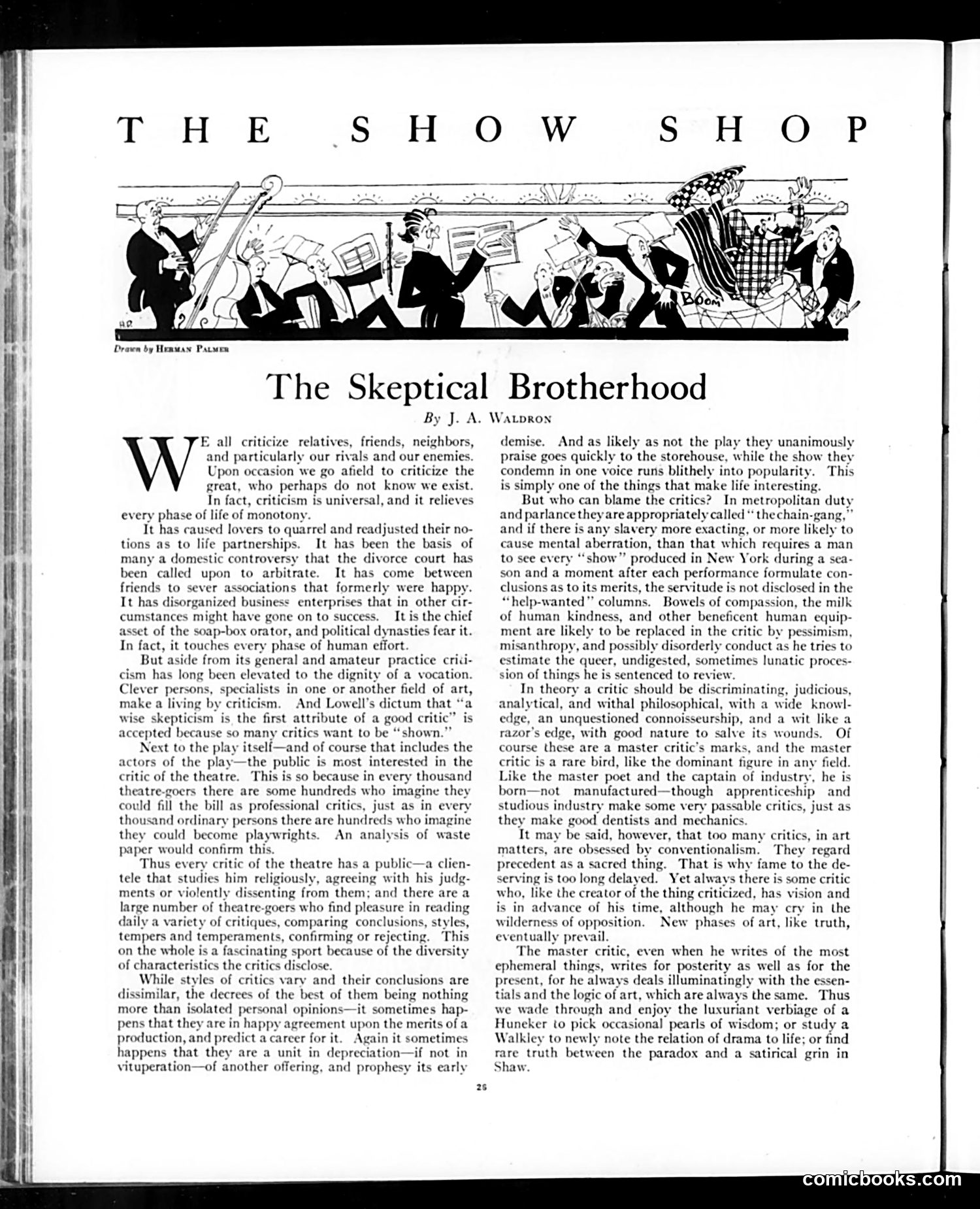
This is primarily a **text essay about theater critics**, not a political cartoon—though the header illustration by Haman Pawlen depicts silhouetted figures in chaotic activity at a theater showshop. The article, by J.A. Waldron, satirizes the profession of theater criticism itself. Waldron argues that critics occupy a peculiar position: they form a "brotherhood" united by skepticism and the burden of reviewing every theatrical production in New York during a season. **The satire's points:** - Critics wield disproportionate cultural influence despite often being self-appointed "experts" - The job is grueling ("slavery more exacting"), likely causing mental deterioration - Their judgments are merely "isolated personal opinions," yet audiences treat them as authoritative - Ironically, critically-praised shows often fail while panned productions succeed—undermining their credibility The essay gently mocks how seriously both critics and audiences take theater reviews, suggesting the entire critical apparatus may be fundamentally arbitrary.
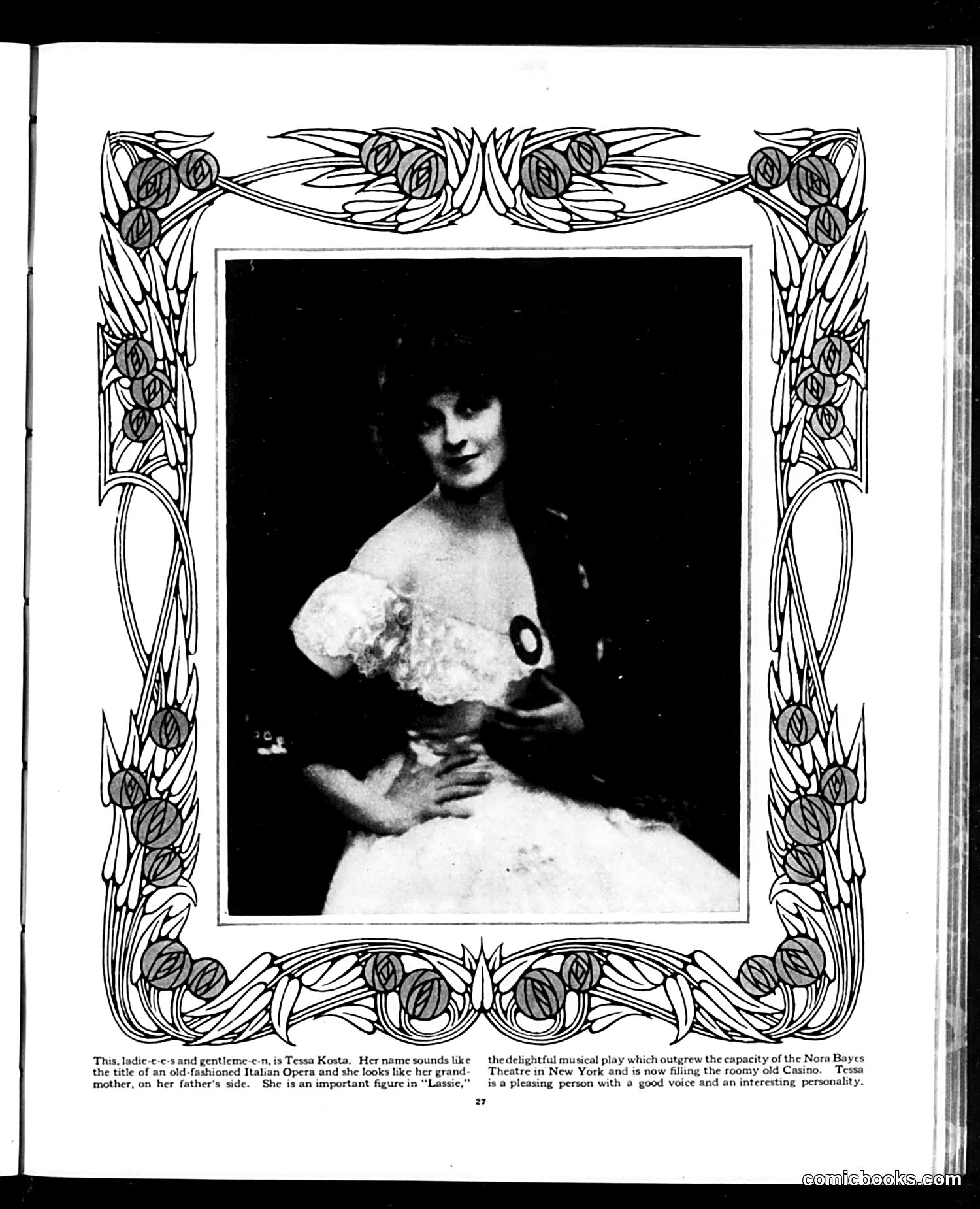
This page features a portrait photograph rather than a political cartoon. The subject is identified in the caption as **Tessa Kosta**, described as "an important figure in 'Lassie.'" The accompanying text notes her name "sounds like the title of an old-fashioned Italian Opera" and references her grandfather's side. It mentions she performed in musical theater that "outgrew the capacity of the Nora Bayes Theatre in New York" and is "now filling the roomy old Casino." The ornate Art Nouveau border suggests this is a **society or entertainment feature** rather than satire. The page celebrates Kosta as a performer with "a good voice and an interesting personality"—standard entertainment journalism of the era rather than political commentary.
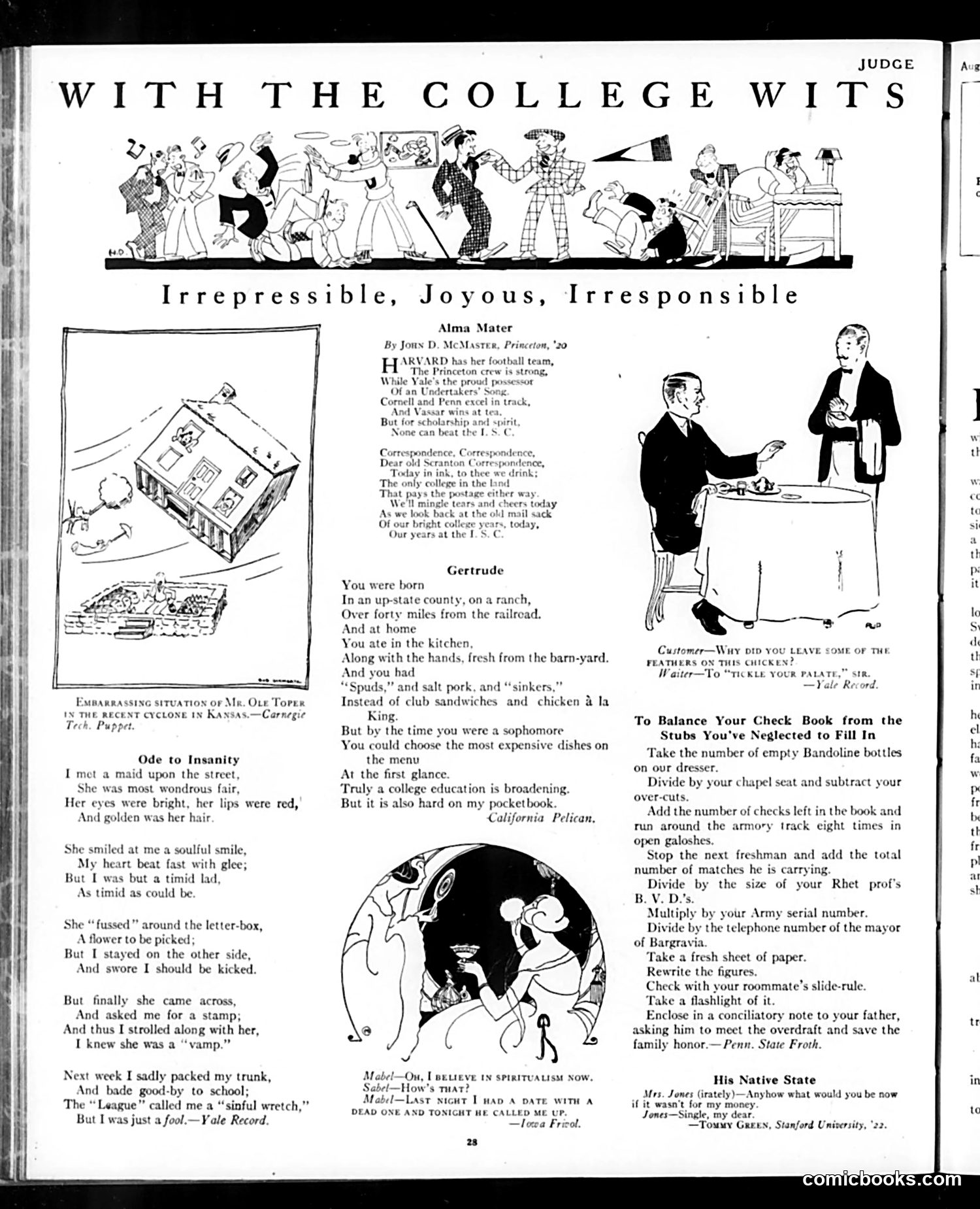
This page from *Judge* magazine collects humorous college writings and cartoons from various universities circa 1920. The content satirizes student life through several themes: **"Ode to Insanity"** mocks a timid college boy's romantic incompetence—he's too nervous to approach an attractive woman until she initiates contact, then immediately assumes she's a "vamp" (seductress) and flees college entirely. **"Gertrude"** jokes about social climbing through education: a girl from a rural ranch background who ate basic food ("spuds," salt pork) at home now pretentiously orders expensive restaurant dishes as a sophomore, inflating her family's expenses. **Other sketches** include a spiritualism joke, a waiter's feather excuse, and absurdist "check book balancing" instructions parodying student irresponsibility. **The cartoons** depict typical college tropes: a tornado destroying a dorm, a student-professor interaction about chicken. The overall tone is gently mocking—celebrating college students as "irrepressible, joyous, irresponsible"—reflecting 1920s anxieties about young people's changing manners and financial expectations.
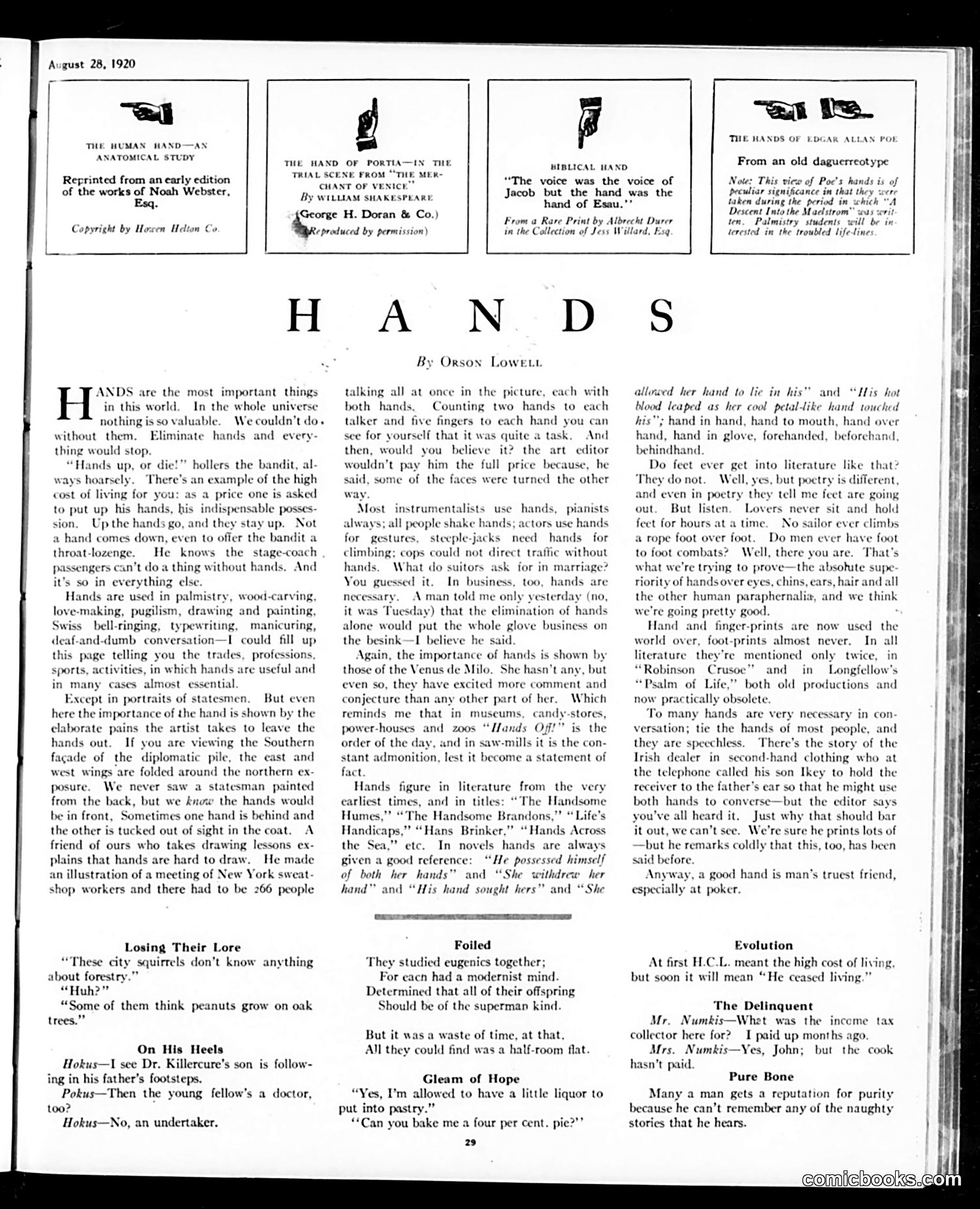
This is a humorous essay celebrating the importance of hands, with decorative historical hand images at the top. The four images shown are: an anatomical hand study from Noah Webster, Portia's hand from *The Merchant of Venice*, the biblical hand of Esau, and Edgar Allan Poe's hands from a daguerreotype. Lowell's satirical point is that hands are indispensable to civilization—used in trades, professions, romance, crime, and even diplomacy. He notes the irony that portrait painters of statesmen deliberately hide or omit hands (positioning them out of view), yet hands remain society's most essential feature. The essay includes comic asides about bandits demanding "hands up," a drawing instructor struggling to illustrate 266 people with proper hands, and various professions requiring manual dexterity. The humor lies in treating this obvious truth with mock-serious eloquence.
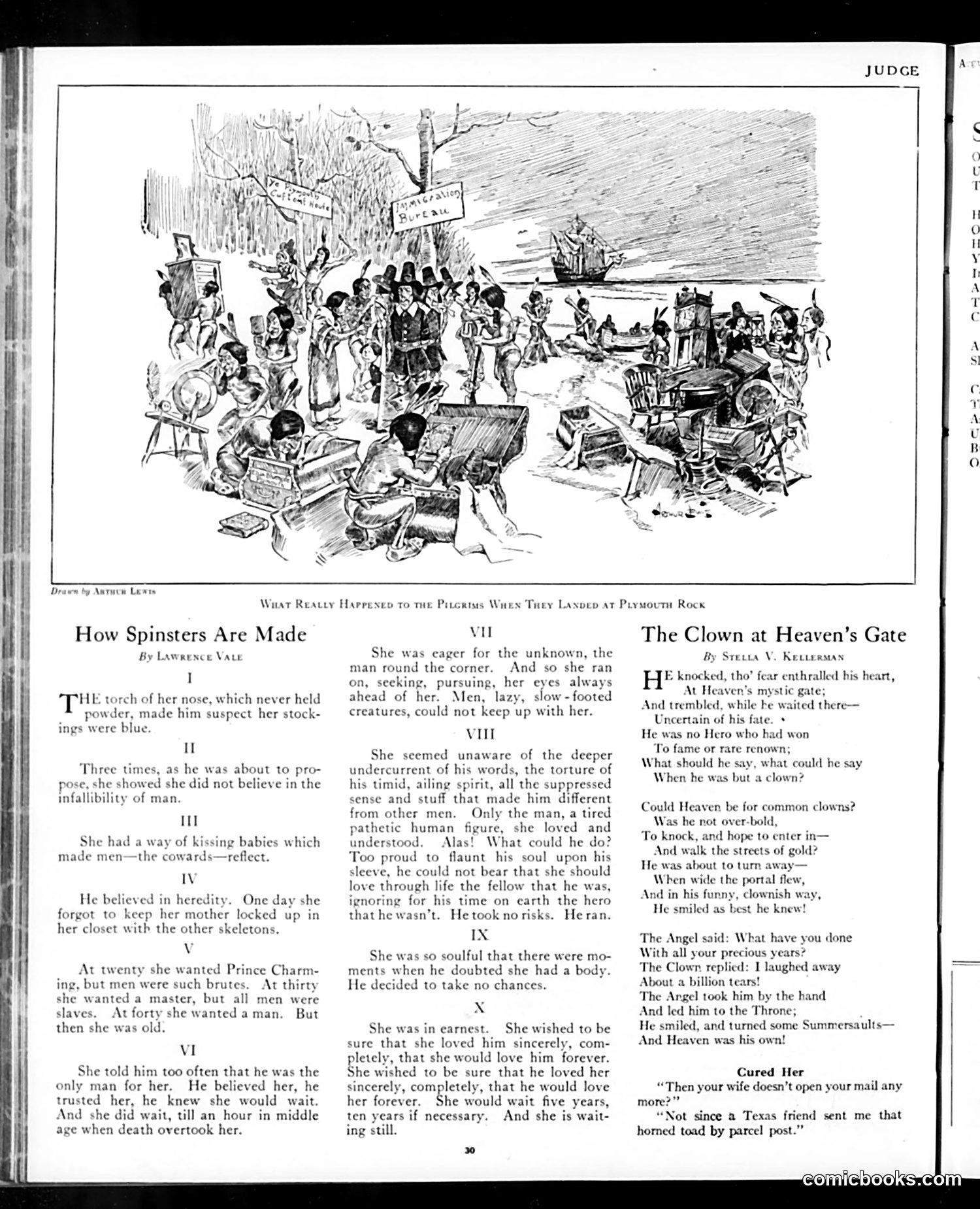
The page contains two unrelated pieces of satirical writing: **"How Spinsters Are Made"** is a cynical, ten-part commentary on why women remain unmarried. It satirizes both female pickiness and male cowardice—women reject men for various reasons (demanding perfection, emotional unavailability, chasing idealized romance), while men fail to commit out of pride, fear, or indecision. The satire suggests both sexes sabotage their own marriage prospects through unrealistic expectations and emotional timidity. **"The Clown at Heaven's Gate"** is sentimental verse about a circus performer gaining heavenly admission through his life's work bringing joy (laughing away "a billion tears"). It contrasts sharply with the cynicism above, suggesting humble goodness matters more than worldly achievement. **"Cured Her"** is a brief joke about a wife who stopped opening her husband's mail after receiving a live horned toad—implying unexpected, unpleasant surprises discourage unwanted behavior. The top illustration depicts the Pilgrims landing at Plymouth Rock, apparently being satirized as a chaotic, undisciplined rabble rather than noble colonists.
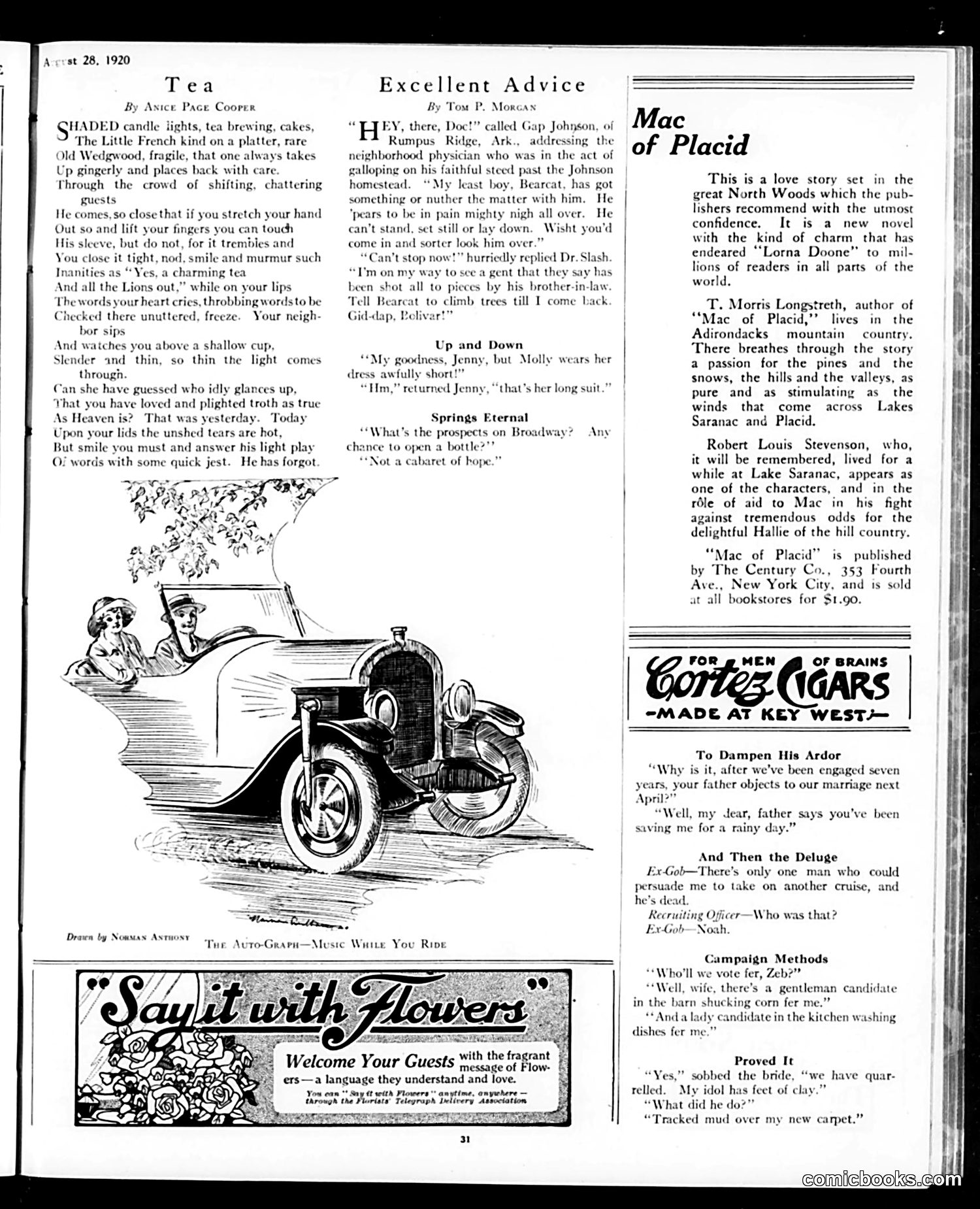
This page mixes poetry, humor, and advertising typical of Judge's format. **"Tea" (poem by Alice Page Cooper):** A sentimental narrative poem about unrequited love at a social gathering. A woman encounters a man she once loved at a tea party, maintains composure despite emotional turmoil, while he remains oblivious to her feelings. **"Excellent Advice" (by Tom P. Morgan):** Rural humor sketches. "Gap Johnson" depicts backwoods dialect comedy—an Arkansas farmer seeking a doctor who dismissively suggests the boy "climb trees." The other brief jokes play on double meanings (Molly's dress being "her long suit"; Broadway having "not a cabaret of hope"). **The automobile illustration** shows a couple in a vintage car, captioned "Music While You Ride"—advertising the novelty of in-vehicle entertainment. **Advertisements** include book promotions (*Mac of Placid*), flower delivery service, and Cortez Cigars. The humor reflects 1920 sensibilities: romantic sentimentality, rural/dialect comedy, and light social satire rather than political commentary.
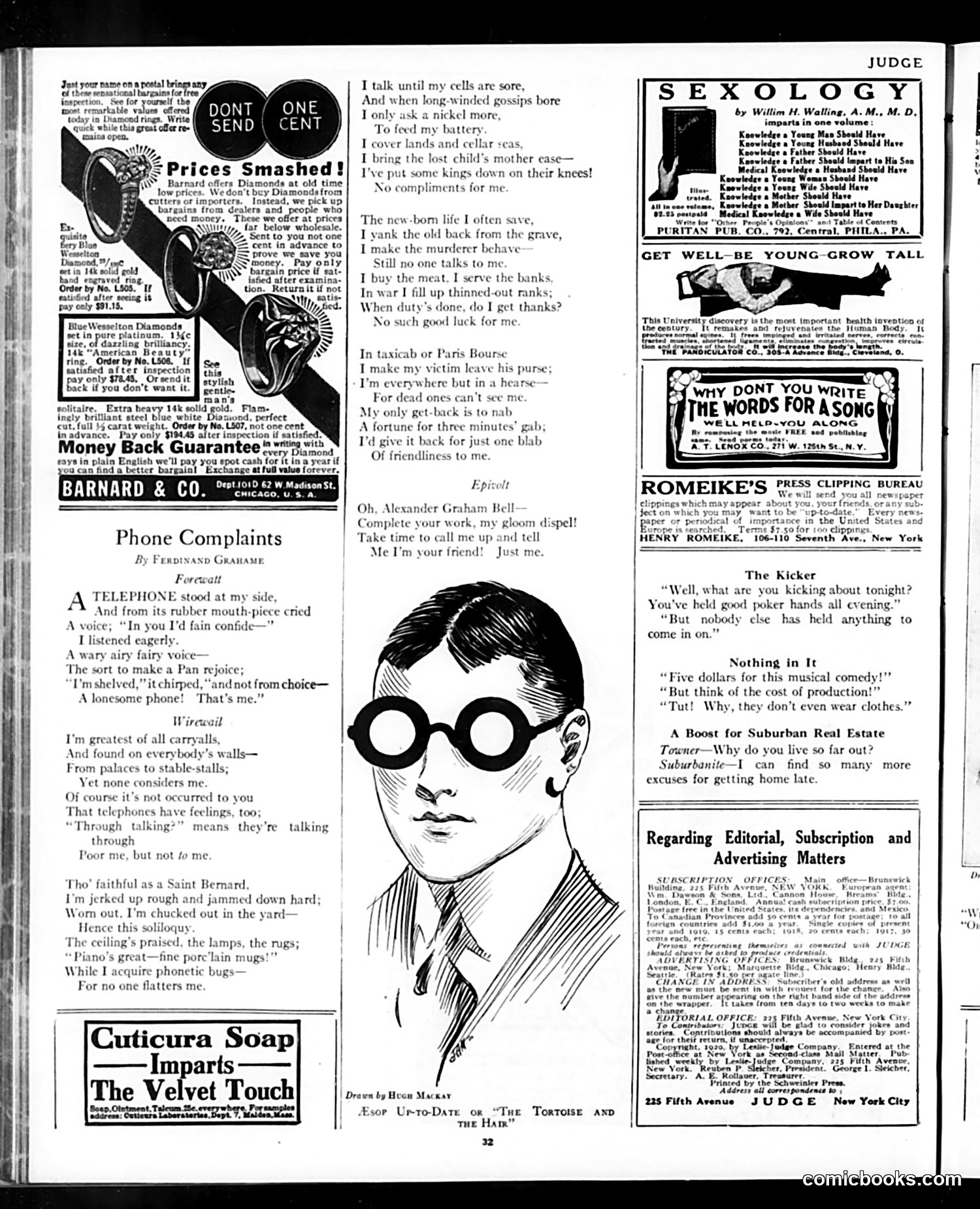
This page is primarily **advertising and filler content** rather than political satire. The main elements are: **"Phone Complaints"** — A sentimental poem by Ferdinand Grahame personifying a telephone as an underappreciated servant. The phone lists its vital contributions (connecting people, saving lives, enabling commerce, military service) yet receives no gratitude—only rough handling and replacement. It's a whimsical complaint about how humanity takes technology for granted. The drawing shows a figure with large round glasses, captioned as being from "The Tortoise and the Hair." The page also contains typical period advertisements: Barnard & Co. diamond rings (with "Money Back Guarantee"), Cuticura Soap, and Sexology books marketed to husbands, fathers, and wives. There is **no significant political content**. The satire is mild and domestic—poking fun at modern life's ingratitude toward useful objects rather than commenting on current events or politics.
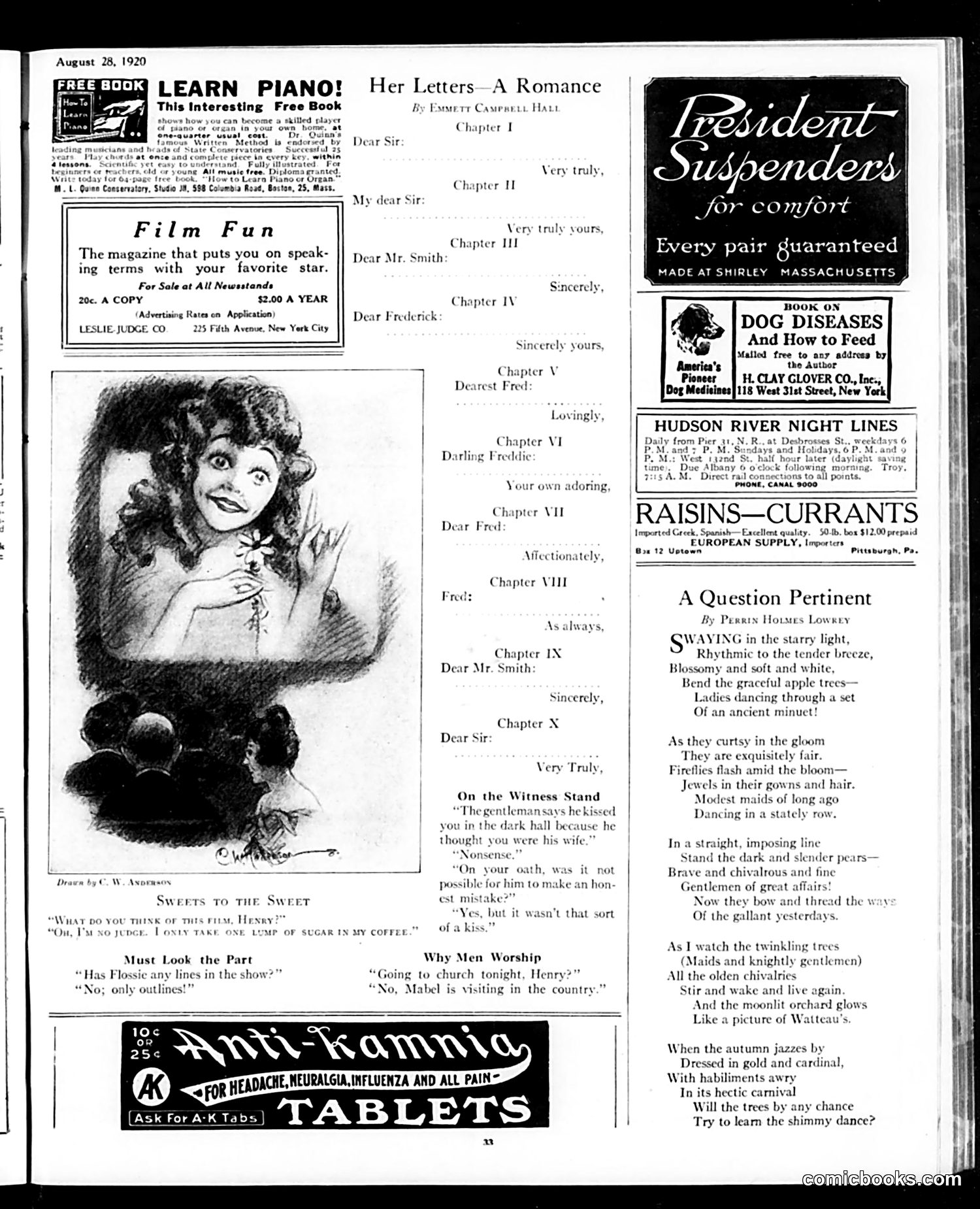
This page is primarily **advertising and light fiction**, with minimal political content. The main feature, "Her Letters—A Romance," is a serialized romantic story told entirely through letter salutations and closings (Dear Sir, Very truly, etc.). The humor derives from how the formal address changes as the relationship develops—suggesting emotional intimacy through increasingly familiar greetings, culminating in simply "Fred:" The accompanying sketch shows a woman with a romantic expression. Below are two brief joke exchanges mocking theatrical conventions and marital dynamics circa 1920. The page is dominated by **advertisements**: piano instruction, *Film Fun* magazine, President Suspenders, dog health books, Hudson River Night Lines (steamship service), and A-K Tablets (pain relief). The poetry "A Question Pertinent" uses nature imagery (apple and pear trees, fireflies) to evoke nostalgic elegance, ending with anxiety about modern dance ("the shimmy") corrupting traditional refinement—reflecting 1920s anxiety about jazz-age cultural changes.
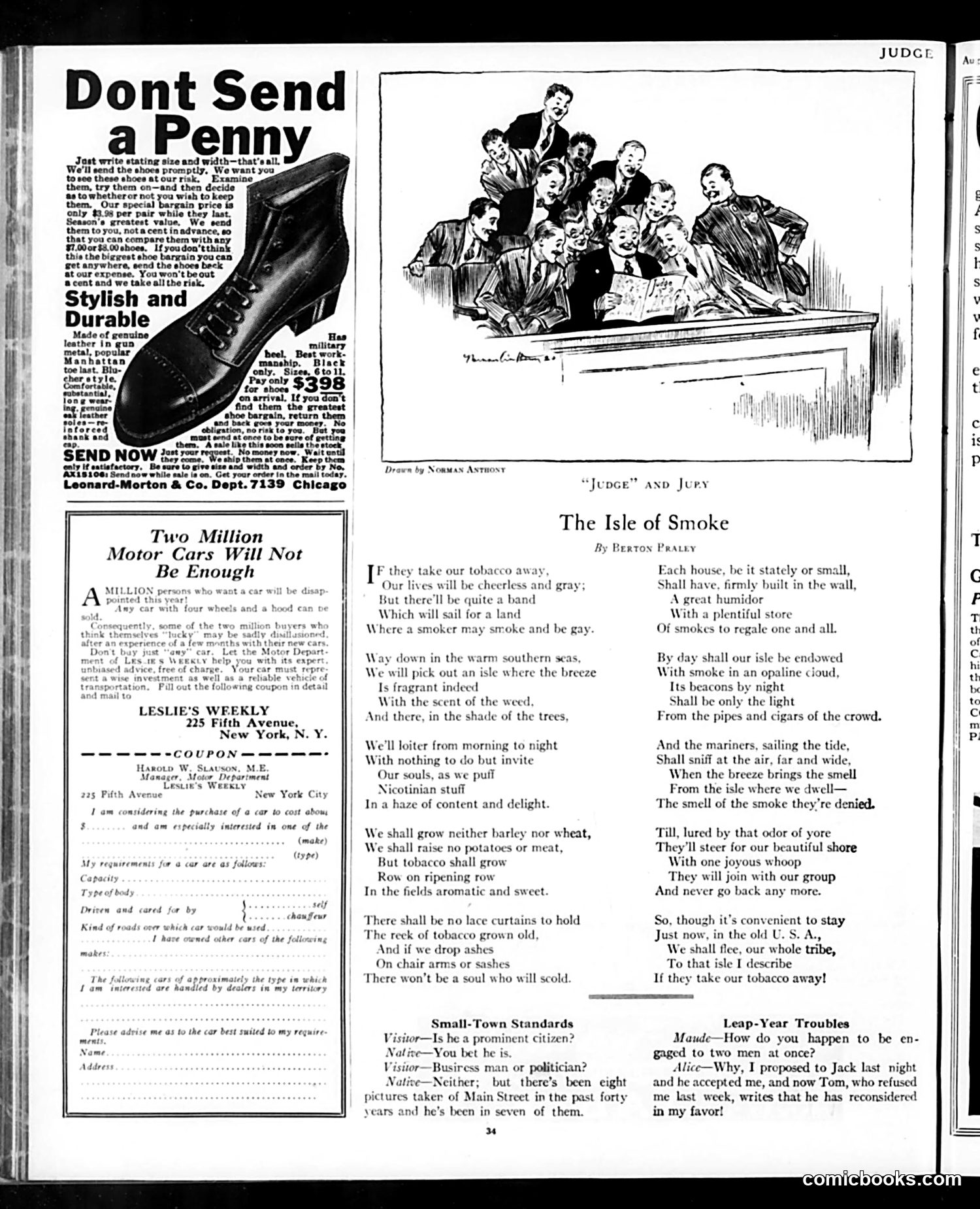
This page contains **advertisements and light humor** rather than political satire. The main cartoon, "Judge and Jury," depicts a courtroom scene with a judge overseeing what appears to be a jury or group of officials—a generic courthouse illustration without apparent political targets. The substantial poem **"The Isle of Smoke"** is a humorous fantasy about smokers fleeing to a fictional island if tobacco were prohibited. This likely references **contemporary Prohibition debates** (alcohol was banned in 1920; tobacco restrictions were occasionally discussed). The poem treats tobacco restrictions as absurdly oppressive, using exaggerated rhetoric for comic effect. Supporting content includes: - A shoe advertisement ("Don't Send a Penny") - A car market analysis piece - Small filler jokes about small-town prominence and romantic mishaps **Context for modern readers:** The page reflects 1920s attitudes where smoking was culturally dominant and any restriction seemed laughable. The "Isle of Smoke" satirizes what smokers viewed as overwrought temperance rhetoric, turning prohibition arguments back on themselves through absurdist humor.
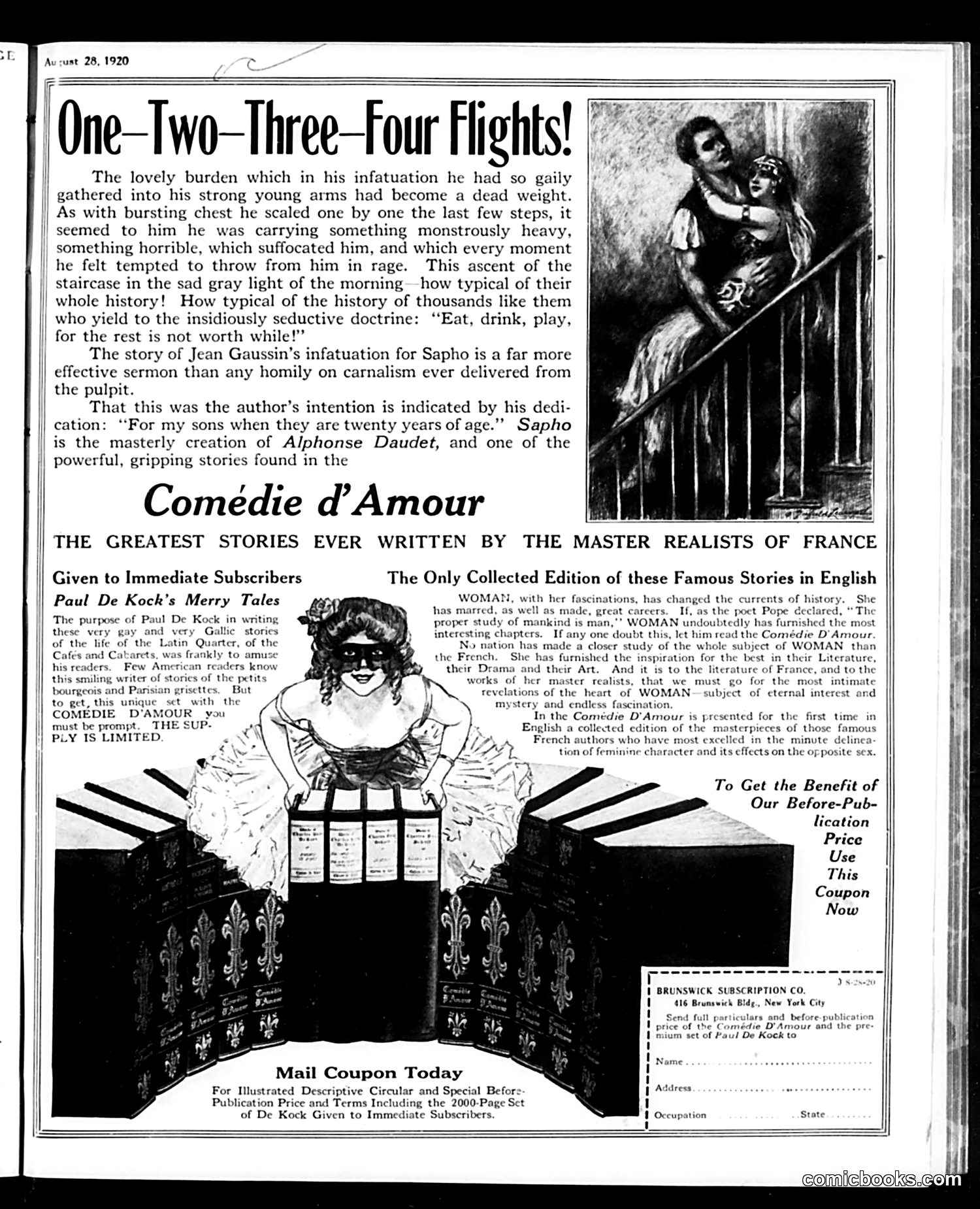
This page is primarily **advertising for book subscriptions**, not political satire. It promotes two French literary collections: *Comédie d'Amour* and Paul De Kock's *Merry Tales*. The editorial commentary ("One-Two-Three-Four Flights") critiques moral decay through discussion of Alphonse Daudet's novel *Sapho*—a cautionary tale about a young man burdened by an affair with an older woman. The passage warns against the hedonistic doctrine "Eat, drink, play, for the rest is not worth while," using the staircase climb as metaphor for life's moral deterioration. The advertising copy emphasizes that "WOMAN" is central to French literary genius, positioning these works as serious explorations of feminine character and influence on men—framing potentially risqué material as morally instructive. The illustration shows a man carrying a woman up stairs, visually representing the *Sapho* narrative's theme of romantic burden.

This is a **cigarette advertisement**, not political satire. It appears in *Judge*, a satirical magazine, but functions as a paid advertisement for Murad Turkish cigarettes priced at 20 cents. The page features: - **Visual elements**: A large stylized hand holding cigarette packs, a Turkish mosque in the background (evoking "exotic" appeal), and an open cigarette box - **Marketing claims**: The ad asserts Murads are "100% pure Turkish tobacco," the "standard of Taste," and the "largest selling high-grade cigarette in the world" - **Social positioning**: Smokers can enjoy them "in any company—on any occasion" without shame; American smokers "prefer Quality to Quantity" - **The pitch**: "Judge for Yourself!" The ad capitalizes on early-20th-century marketing tropes: appeals to sophistication, claims of purity and superiority, and ethnic/geographic exoticism. There's no identifiable satire here—it's straightforward product promotion using period advertising conventions.