
Judge, 1920-08-28 · page 14 of 36
Judge — August 28, 1920 — page 14: what you’re looking at
What you’re looking at
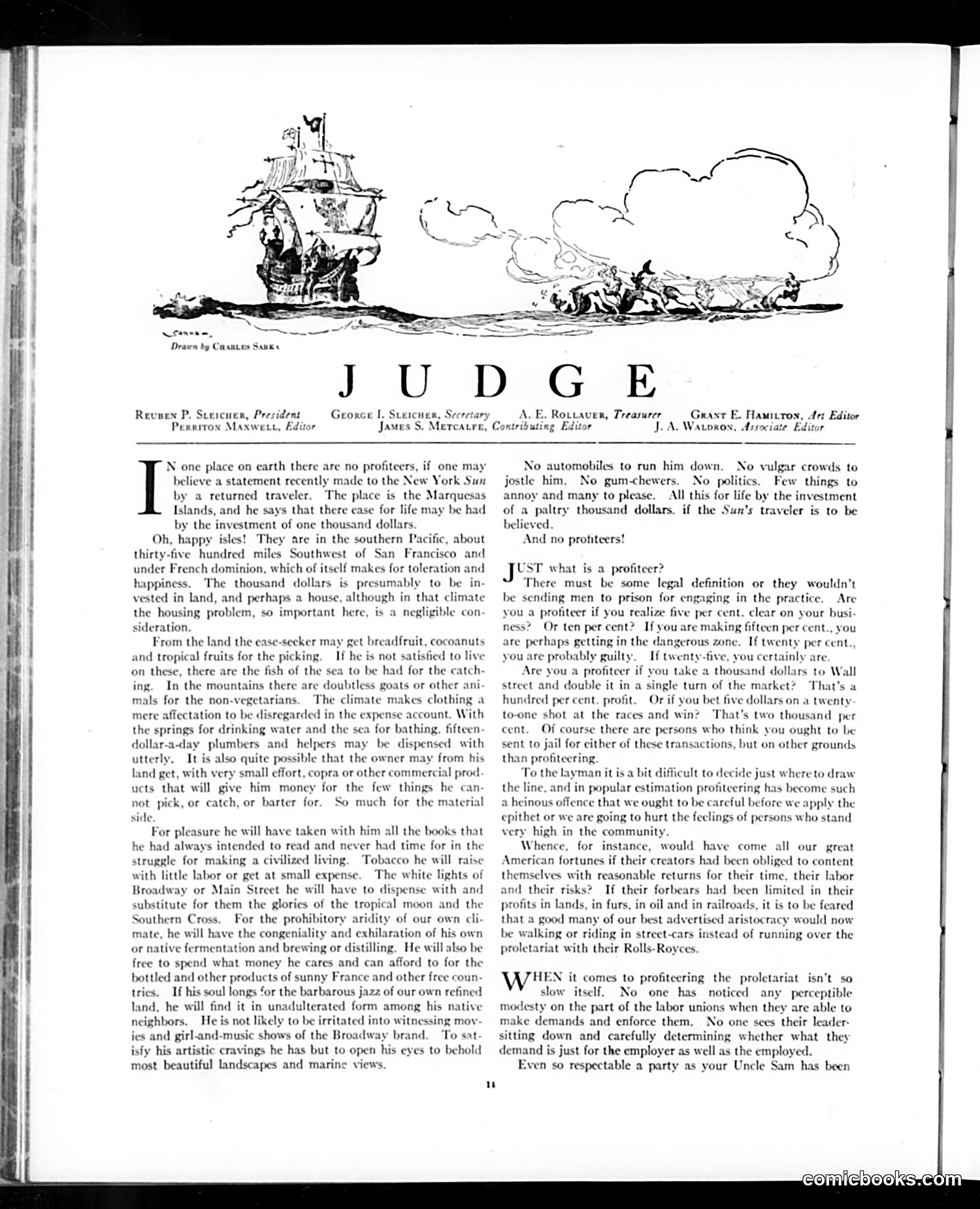
This page satirizes the concept of "profiteering"—a heated public concern during or after World War I. The illustrated header shows a colonial-era sailing ship, establishing a romantic contrast to modern commerce. The editorial argues that the Marquesas Islands offer an idyllic escape from American profiteering: no automobiles, crowds, or materialism—just natural abundance requiring only $1,000 investment. The piece then pivots to mock profiteer definitions, questioning where legitimate profit ends and greed begins. It notes labor unions demand enforcement against profiteers, yet no clear legal standard exists. The satire's point: American society obsesses over punishing "profiteers" without defining the term, making profiteering simultaneously a serious crime and an arbitrarily defined concept. The Marquesas fantasy underscores how Americans associate profit-seeking with moral corruption—suggesting escape to paradise becomes necessary to avoid being labeled a profiteer simply by earning reasonable returns.
📄 Transcribed text from this page (OCR, searchable)
Machine-transcribed from the original scan — historical spelling and the odd misread are preserved.
Geoxce I. Stercuer, S, Revnen P. Suricuer, President Jastes S. Mercatre, Perrrron Maxwext, Editor if one may N one place on earth there are no profitecrs, believe a statement recently made to the New York Sun by a returned traveler, The place is the Marquesas Islands, and he says that there ease for life may be had by the investment of one thousand dollars. Oh, py isles! They are in the southern Pacific, about thirty-five hundred miles Southwest of San Francisco and under French dominion, which of itself makes for toleration and happiness. The thousand dollars is presumably to be in- vested in land, and perhaps a house, although in that climate the housing problem, so important here, is a negligible con- sideration From the land the ease-seeker may get breadfruit, cocoanuts and tropical fruits for the picking. If he is not satisfied to live ‘on these, there are the fish of the sea to be had for the catch- ing. In the mountains there are doubtless goats or other ani mals for the non-vegetarians. The climate makes clothing a mere affectation to be disregarded in the expense account. With the springs for drinking water and the sea for bathing, fifteen dollar-a-day plumbers and helpers may be dispensed with utterly, It is also quite possible that the owner may from his land get, with very small effort, copra or other commercial prod ucts that will give him moncy for the few things he can not pick, or catch, or barter for. So much for the material side. For pleasure he will have taken with him all the books that he had always intended to read and never had time for in the struggle for making a civilized living. Tobacco he will raise with little labor or get at small expense. The white lights of Broadway or Main Street he will have to dispense with and substitute for them the glories of the tropical moon and the Southern Cross. For the prohibitory aridity of our own cli- mate, he will have the congeniality and exhilaration of his own or native fermentation and brewing or distilling. He will also be free to spend what money he cares and can afford to for the bottled and other products of sunny France and other free coun- tries. If his soul longs for the barbarous jazz of our own refined land, he will find it in unadulterated form among his native neighbors. He is not likely to be irritated into witnessing mov- ies and girl-and-music shows of the Broadway brand. sat- isfy his artistic cravings he has but to open his eyes to behold most beautiful landscapes and marine views. retary Contributing Editor A. E. Rottaver, Treasurer Grant E. Hamitton, Art Editor J. A. Wanoros, Associate Editor No automobiles to run him down. No vulgar crowds to jostle him. No gum-chewers. No politics. Few things to annoy and many to please. All this for life by the investment of a paltry thousand dollars. if the Sun's traveler is to be believed. And no protiteers! UST what is a profiteer? There must be some legal definition or they wouldn't be sending men to prison for engaging in the practice. Are you a profiteer if you realize five per cent. clear on your busi ness? Or ten per cent? If you are making fifteen per cent., you are perhaps getting in the dangerous zone. If twenty per cent you are probably guilty. If twenty-five, you certainly are. Are you a profitcer if you take a thousand dollars to Wall street and double it in a single turn of the market? That's a hundred percent. profit. Or if you bet five dollars on a twenty. to-one shot at the races and win? That's two thousand per cent. Of course there are persons who think you ought to be sent to jail for cither of these transactions, but on other grounds than profiteering. To the layman it is a bit difficult to decide just where to draw the line, and in popular estimation profiteering has become such a heinous offence that we ought to be careful before we apply the epithet or we are going to hurt the feelings of persons who stand very high in the community. Whence, for instance, would have come all our great American fortunes if their creators had been obliged to content themselves with reasonable returns for their time, their labor and their risks? If their forbears had been limited in their profits in lands, in furs, in oil and in railroads, it is to be feared that a good many of our best advertised aristocracy would now be walking or riding in street-cars instead of running over the proletariat with their Rolls-Royces. wi 2N it comes to profiteering the proletariat isn't so slow itself. No one has noticed any perceptible modesty on the part of the labor unions when they are able to make demands and enforce them. No one sees their leadet sitting down and carefully determining whether what they demand is just for the employer as well as the employed. Even so respectable a party as your Uncle Sam has been <a