
Judge, 1920-08-28 · page 26 of 36
Judge — August 28, 1920 — page 26: what you’re looking at
What you’re looking at
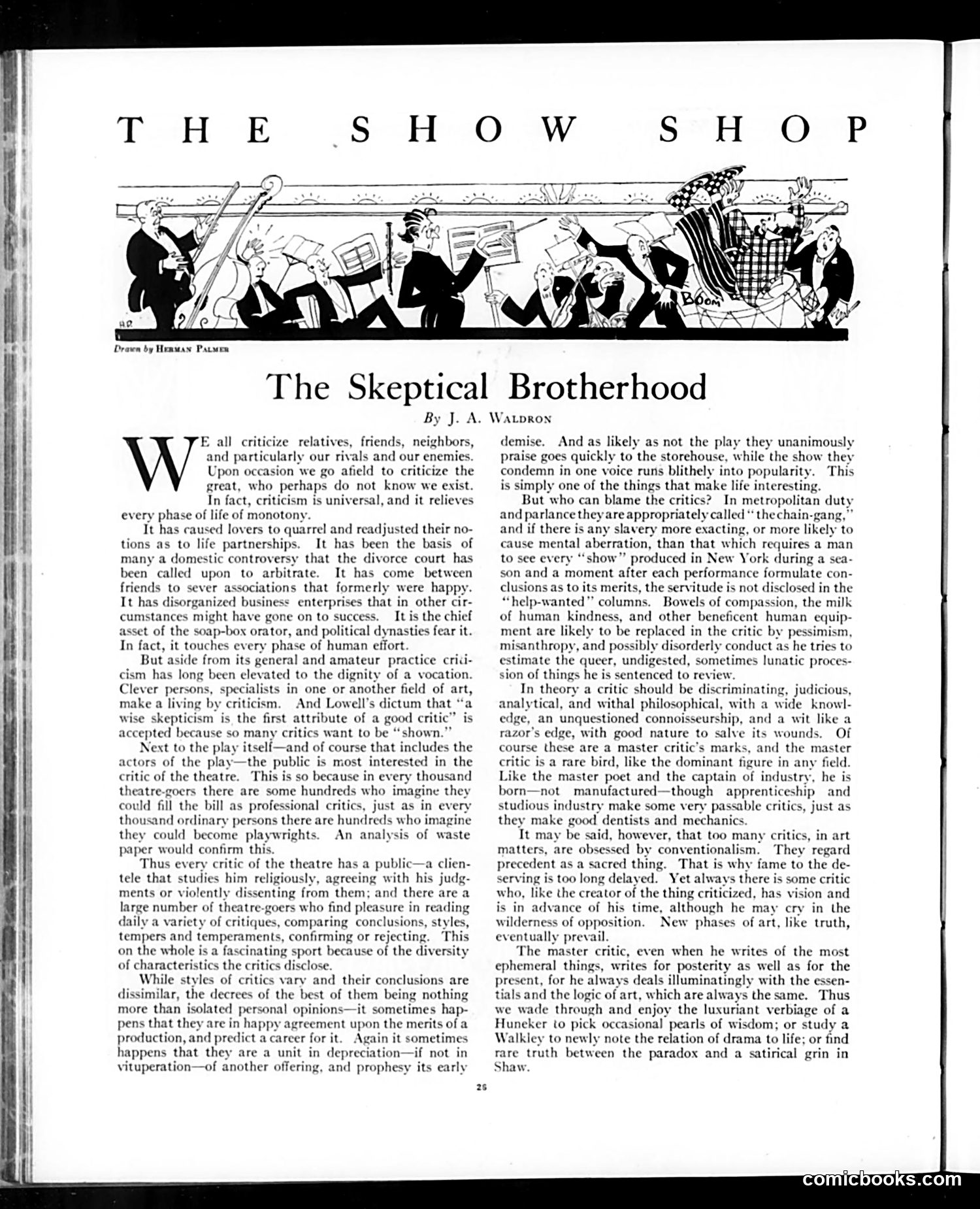
This is primarily a **text essay about theater critics**, not a political cartoon—though the header illustration by Haman Pawlen depicts silhouetted figures in chaotic activity at a theater showshop. The article, by J.A. Waldron, satirizes the profession of theater criticism itself. Waldron argues that critics occupy a peculiar position: they form a "brotherhood" united by skepticism and the burden of reviewing every theatrical production in New York during a season. **The satire's points:** - Critics wield disproportionate cultural influence despite often being self-appointed "experts" - The job is grueling ("slavery more exacting"), likely causing mental deterioration - Their judgments are merely "isolated personal opinions," yet audiences treat them as authoritative - Ironically, critically-praised shows often fail while panned productions succeed—undermining their credibility The essay gently mocks how seriously both critics and audiences take theater reviews, suggesting the entire critical apparatus may be fundamentally arbitrary.
📄 Transcribed text from this page (OCR, searchable)
Machine-transcribed from the original scan — historical spelling and the odd misread are preserved.
Drawn by Haman Patwen The Skeptical Brotherhood E all criticize relatives, friends, cha and particularly our rivals and our enemies. Upon occasion we go afield to criticize the great, who perhaps do not know we exist. In fact, criticism is universal, and it relieves of life of monotony It has caused lovers to quarrel and readjusted their no- tions as to life partnerships. It has been the basis of many a domestic controversy that the divorce court has been called upon to arbitrate. It has come between every pha friends to sever associations that formerly were happy. It has disorganized business enterprises that in other cir- cumstances might have gone on to success. It is the chief asset of the soap-box orator, and political dynasties fear it. In fact, it touches every phase of human effort. But aside from its general and amateur practice criii- ism has long been elevated to the dignity of a vocation. Clever persons, specialists in one or another field of art, make a living by criticism. And Lowell’s dictum that wise skepticism is the first attribute of a good critic” is accepted because so many critics want to be “shown.” Next to the play itseli—and of course that includes the actors of the play—the public is most interested in the critic of the theatre. This is so because in every thousand theatre-goers there are some hundreds who imagine they could fill the bill as professional critics, just as in every thousand ordinary persons there are hundreds who imagine they could become playwrights. An analysis of waste paper would confirm this. Thus every critic of the theatre has a public—a clien- tele that studies him religiously, agreeing with his judg- ments or violently dissenting from them; and there are a large number of theatre-goers who find ph in reading ly a variety of critiques, comparing conclusions, styles, tempers and temperaments, confirming or rejectin; This on the whole is a fascinating sport because of the diversity of characteristics the critics dis While styles of critics vary and their conclusions are dissimilar, the decrees of the best of them being nothing more than isolated personal opinions—it sometimes hap- pens that they are in happy agreement upon the merits of a production, and predict a career for it. Again it sometimes happens that they are a unit in depreciation—if not in vituperation—of another offering, and prophesy its early . Watpron demise. And as likely as not the play they unanimously praise goes quickly to the storehouse, while the show they condemn ii in one voice runs blithely into popularity This is simply one of the things that make life interesting. But who can blame the critics? In metropolitan duty and parlance they are appropriately called “ thechain-gan and if there is any slavery more exacting, or more likely to cause mental aberration, than that which requires a man to see every “show” produced in New York during a sea- son and a moment after each performance formulate con- clusions as to its merits, the servitude is not disclosed in the “help-wanted” columns. Bowels of compassion, the milk of human kindness, and other beneficent human equip- ment are likely to be replaced in the critic by pessimism, misanthropy, and possibly disorderly conduct as he tries estimate the queer, undigested, sometimes lunatic proce: sion of things he is sentenced to re In theory a critic should be discriminating, judicious, analytical, and withal philosophical, with a wide knowl- edge, an unquestioned connoisseurship, and a wit like razor’s edge, with good nature to salve its wounds. Of course these are a master critic’s marks, and the master critic is a rare bird, like the dominant figure in any field Like the master poet and the captain of industry, he is born—not manufactured—though apprenticeship and studious industry make some very passable critics, just as they make good dentists and mechanics. It may be said, however, that too many critics, in art matters, are obsessed by conventionalism. They regard precedent as a sacred thing. That is why fame to the de- serving is too long delayed. Yet always there is some critic who, like the creator of the thing criticized, has vision and is in advance of his time, although he may cry in the wilderness of opposition. New phases of art, like truth, eventually prevail. The master critic, even when he writes of the most ephemeral things, writes for posterity as well as for the present, for he always deals illuminatingly with the essen- tials and the logic of art, which are always the same. Thus we wade through and enjoy the luxuriant verbiage of a Huneker to pick occasional pearls of wisdom; or study a Walkley to newly note the relation of drama to life; or find rare truth between the paradox and a satirical grin in Shaw.