
Judge, 1920-08-28 · page 24 of 36
Judge — August 28, 1920 — page 24: what you’re looking at
What you’re looking at
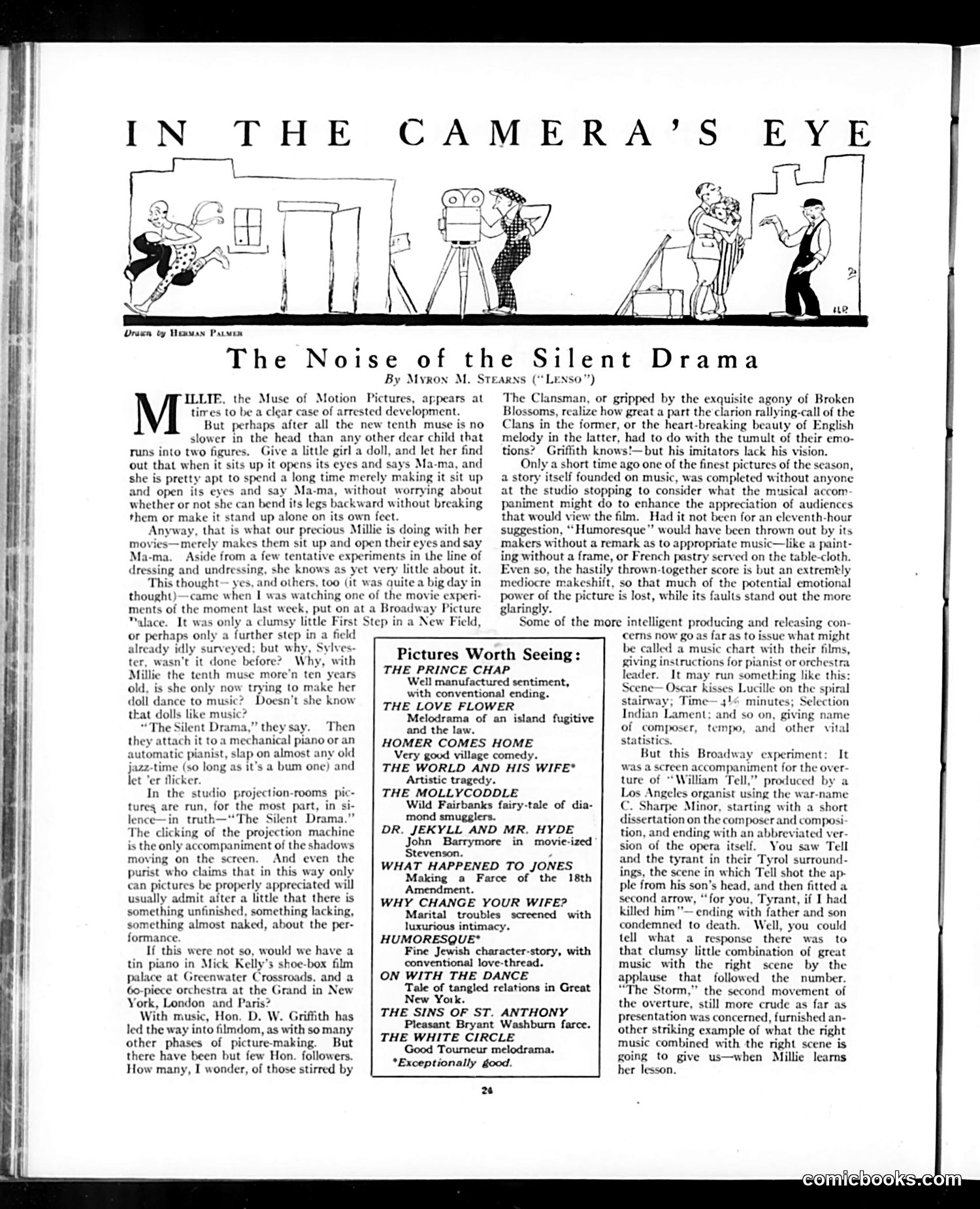
This page critiques the emerging film industry's neglect of musical accompaniment in silent movies. The cartoon header, drawn by Herman Packer, illustrates film production scenes. The article by Myron M. Stearns argues that filmmakers treat motion pictures like a child with a new doll—mechanically repeating simple tricks without developing sophistication. Stearns contends that major directors like D.W. Griffith understand music's emotional power (citing *The Clansman* and *Broken Blossoms*), but most studios carelessly slap generic jazz onto films without consideration. He notes the contradiction: filmmakers show films silently in studios yet acknowledge music's necessity by adding orchestras in theaters. Stearns criticizes "Humoresque" for nearly releasing without any musical score, and mocks studios for not issuing "music charts" to guide accompaniment. The piece champions Griffith as visionary while lamenting that few followers understand how integral music is to silent film's emotional impact.
📄 Transcribed text from this page (OCR, searchable)
Machine-transcribed from the original scan — historical spelling and the odd misread are preserved.
Drawn ty Wen Pawn The Noise of the Silent Drama By Myron M. Stearns (“*Lenso”) ILLTF, the Muse of Motion Pictures, appears at tires to be a clear case of arrested development. But perhaps after all the new tenth muse is no slower in the head than any other dear child that runs into two figures. Give a little girl a doll, and let her find out that when it sits up it opens its eyes and says Ma-ma, and she is pretty apt to spend a long time merely making it sit up and open its eyes and say Ma-ma, without worrying about whether or not she can bend its legs backward without breaking them or make it stand up alone on its own feet. Anyway, that is what our precious Millie is doing with her movies—merely makes them sit up and open their eyes and say Ma-ma. Aside from a few tentative experiments in the line of dressing and undressing, she knows as yet very little about it. This thought— yes, and others, too (it was quite a big day in thought)—came when I was watching one of the movie expe ments of the moment last week, put on at a Broadway Picture alace. It was only a clumsy little First Step in a New Field, or perhaps only a further step in a field The Clansman, or gripped by the exquisite agony of Broken Blossoms, realize how great a part the clarion rallying-call of the Clans in the former, or the heart-breaking beauty of melody in the latter, had to do with the tumult of their emo- tions? Griffith knows!—but his imitators lack his vision. Only a short time ago one of the finest pictures of the a story itself founded on music, was completed without anyone at the studio stopping to consider what the musical accom paniment might do to enhance the appreciation of audiences that would view the film. Had it not been for an eleventh-hour suggestion, “Humoresque” would have been thrown out by its makers without a remark as to appropriate music—like a paint- ing without a frame, or French pastry served on the table-cloth. Even so, the hastily thrown-together score is but an extremly mediocre makeshift, so that much of the potential emotional power of the picture is lost, while its faults stand out the more glaringly. Some of the more intelligent producing and releasing con- cerns now go as far as to issue what might be called a music chart with their films, already idly surveyed; but why, ter, wasn’t it done before? Why Millie the tenth muse more’n ten old, is she only now trying to mak doll dance to music? Doesn't she know that dolls like music? “The Silent Drama,” they say. Then they attach it toa mechanical piano or an automatic pianist, slap on almost any old jazz-time (so long as it’s a bum one) and let ‘er flicker. In the studio projection-rooms pic- tures are run, for the most part, in lence—in truth—“The Silent Drama. The clicking of the projection machine is the only accompaniment of the shadows moving on the screen. And even the purist who claims that in this way only can pictures be properly appreciated will usually admit after a little that there is something unfinished, something lacking, something almost naked, about the per- formance. If this were not so, would we have a tin piano in Mick Kelly's shoe-box film palace at Greenwater Crossroads, and a 60-piece orchestra at the Grand in New York, London and Paris? With music, Hon. D. W. Griffith has led the way into filmdom, as with somany other phases of picture-making. But there have been but few Hon. followers. How many, I wonder, of those stirred by Pictures Worth Seeing: THE PRINCE CHAP Well manufactured sentiment, with conventional ending. THE LOVE FLOWER Melodrama of an island fugitive and the law. HOMER COMES HOME Very good village comedy. THE WORLD AND HIS WIFE* Artistic tragedy. THE MOLLYCODDLE Wild Fairbanks fairy-tale of dia- mond smugglers. DR. JEKYLL AND MR. HYDE John Barrymore in movie-ized Stevenson. WHAT HAPPENED TO JONES Making a Farce of the 18th Amendment. WHY CHANGE YOUR WIFE? Marital troubles screened with luxurious intimacy. HUMORESQUE* Fine Jewish character-story, with conventional love-thread. ON WITH THE DANCE Tale of tangled relations in Great New York. THE SINS OF ST. ANTHONY Pleasant Bryant Washburn farce. THE WHITE CIRCLE Good Tourneur melodrama. *Exceptionally good. giving instructions for pianist or orchestra leader. It may run something like th Scene— Oscar kisses Lucille on the spiral stairway; Time— 416 minutes; Selection Indian Lament; and so on, giving name of composer, tempo, and other vital statistics. But this Broadway experiment: It was a screen accompaniment for the over- ture of “William Tell,” produced by a Los Angeles organist using the war-name C. Sharpe Minor, starting with a short dissertation on the composer and composi tion, and ending with an abbreviated ver- sion of the opera itself. You saw Tell and the tyrant in their Tyrol surround- ings, the scene in which Tell shot the ap- ple from his son’s head, and then fitted a second arrow, “for you, Tyrant, if I had killed him"’— ending with father and son condemned to death. Well, you could tell what a response there was to that clumsy little combination of great music with the right scene by the applause that followed the number. “The Storm,” the second movement of the overture, still more crude as far as presentation was concerned, furnished an- other striking example of what the right music combined with the right scene is going to give us—when Millie learns her lesson.