
Judge, 1920-08-28 · page 15 of 36
Judge — August 28, 1920 — page 15: what you’re looking at
What you’re looking at
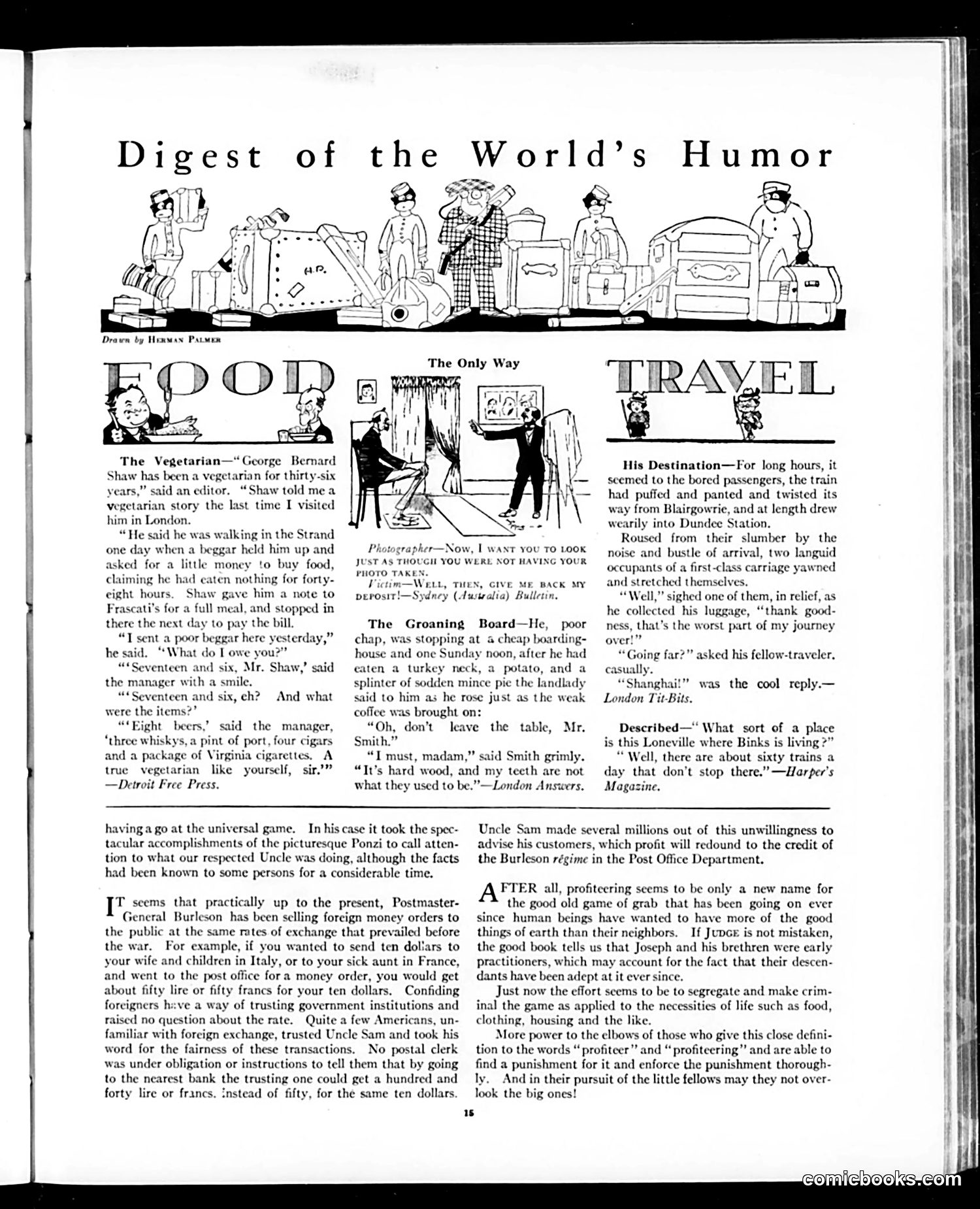
This Judge magazine page collects brief humorous anecdotes organized into three sections: **Food**, **The Only Way**, and **Travel**. The satire targets several contemporary issues: 1. **"The Vegetarian"** mocks George Bernard Shaw's famous vegetarianism through an ironic story where he generously feeds a beggar, only to be billed exorbitantly—suggesting vegetarian principles clash with financial reality. 2. **"The Groaning Board"** jokes about a cheapskate's bill at a boarding house: eight beers, whiskeys, and cigars—hardly vegetarian fare—yet he protests the modest charge of "seventeen and six." 3. **The Postmaster-General Burleson section** is sharper satire: the U.S. Post Office deliberately offered unfavorable foreign exchange rates on money orders (paying 50 lire instead of 140 for ten dollars), pocketing millions while claiming government trustworthiness. This is presented as "profiteering" under the guise of public service. The travel anecdotes are lighter, mocking bored train passengers and photographers' contrived requests.
📄 Transcribed text from this page (OCR, searchable)
Machine-transcribed from the original scan — historical spelling and the odd misread are preserved.
The Vegetarian—“ George Bernard Shaw has been a vegetarian for thirty-six years,” said an editor. “Shaw told mea vegetarian story the last time I visited him in London. “He said he was walking in the Strand one day when a beggar held him up and claiming he had eaten nothing for forty- eight hours. Shaw ga Frascati’s for a full meal, and stopped in there the next day to pay the bill, Digest of the World’ s Photograpker—Now, | want you To Loo0K asked for a little money to buy food, JUST AS THOUGH YOU WERE NOT HAVING YOUR rs Ms PHOTO TAKEN. Victim—Wett, THEN, Give Me Back sty and stretched themselves. him a note to pgposir!—Sydney (Australia) Bulletin. “Well, Humor His Destination—For long hours, it seemed to the bored passengers, the train had puffed and panted and twisted its way from Blairgowrie, and at length drew wearily into Dundee Station. Roused from their slumber by the noise and bustle of arrival, two languid occupants of a first-class carriage yawned sighed one of them, in relief, as he collected his luggage, “thank good- The Groaning Board—He, poor ness, that’s the worst part of my journey “T sent a poor beggar here yesterday,” chap, was stopping at a cheap boarding- over!” he said. “What do I owe you?” the manager with a smile. were the items?’ “«Eight beers,’ said the manager, “three whiskys, a pint of port, four cigars Smith.” and a package of Virginia cigarettes. A truce vegetarian like yourself, sir.” —Detroit having a go at the universal game. In his case it took the spec- tacular accomplishments of the picturesque Ponzi to call atten- tion to what our respected Uncle was doing, although the facts had been known to some persons for a considerable time. | seems that practically up to the present, Postmaster- General Burleson has been selling foreign money orders to the public at the same rates of exchange that prevailed before the war. For example, if you wanted to send ten dollars to your wife and children in Italy, or to your sick aunt in France, and went to the post office fora money order, you would get about fifty lire or fifty francs for your ten dollars. Confiding foreigners hve a way of trusting government institutions and raised no question about the rate. Quite a few Americans, un- familiar with foreign exchange, trusted Uncle Sam and took his word for the fairness of these transactions. No postal clerk was under obligation or instructions to tell them that by going to the nearest bank the trusting one could get a hundred and forty lire or francs. instead of fifty, for the same ten dollars. “I must, madam,” “It’s hard wood, and my tecth are not day that don’t stop there.” —Harper’s "ree Press. what they used to be.”—London Answers. | Magazine. house and one Sunday noon, after he had “Going far?” asked his fellow-traveler, “«Seventeen and six, Mr. Shaw,’ said eaten a turkey neck, a potato, and a casually. splinter of sodden mince pie the landlady “*Seventeen and six, ech? And what said to him as he rose just as the w coffee was brought on: “Oh, don’t leave the table, Mr. “Shang! was the cool reply.— London Tit-Bits. Described—‘ What sort of a place is this Loneville where Binks is living ?” said Smith grimly, “Well, there are about sixty trains a Uncle Sam made several millions out of this unwillingness to advise his customers, which profit will redound to the credit of the Burleson régime in the Post Office Department. AFIER all, profiteering seems to be only a new name for the good old game of grab that has been going on ever since human beings have wanted to have more of the good things of earth than their neighbors. If JupGE is not mistaken, the good book tells us that Joseph and his brethren were early practitioners, which may account for the fact that their descen- dants have been adept at it ever since. Just now the effort seems to be to segregate and make crim- inal the game as applied to the necessities of life such as food, clothing, housing and the like. More power to the elbows of those who give this close defini- tion to the words “ profiteer” and “ profiteering” and are able to find a punishment for it and enforce the punishment thorough- ly. And in their pursuit of the little fellows may they not over- look the big ones!