
A complete issue · 36 pages · 1920
Judge — August 21, 1920
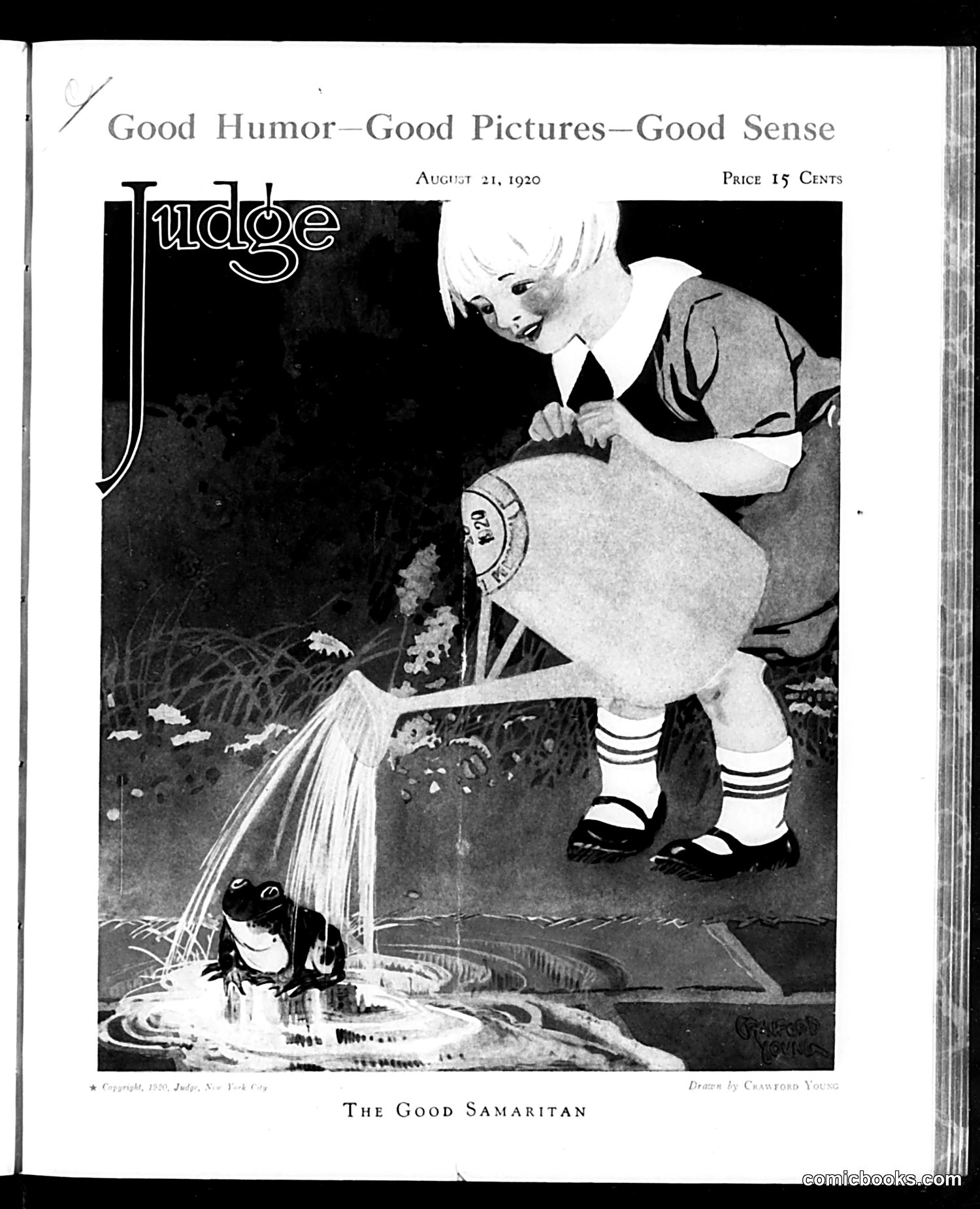
This cartoon illustrates the biblical parable of the Good Samaritan. A well-dressed woman waters a small figure in a pool—likely representing charitable aid or humanitarian assistance. The imagery suggests commentary on charity and social responsibility during the early 1920s, possibly referencing post-WWI relief efforts or domestic social welfare. The title invokes Jesus's parable about helping those in need regardless of social boundaries. The juxtaposition of the elegantly dressed woman with the small figure in water suggests either class differences or the disparity between givers and recipients of charity. Without additional context from the magazine's issues, the specific contemporary reference remains unclear, though it likely comments on American attitudes toward charitable obligation during this era.
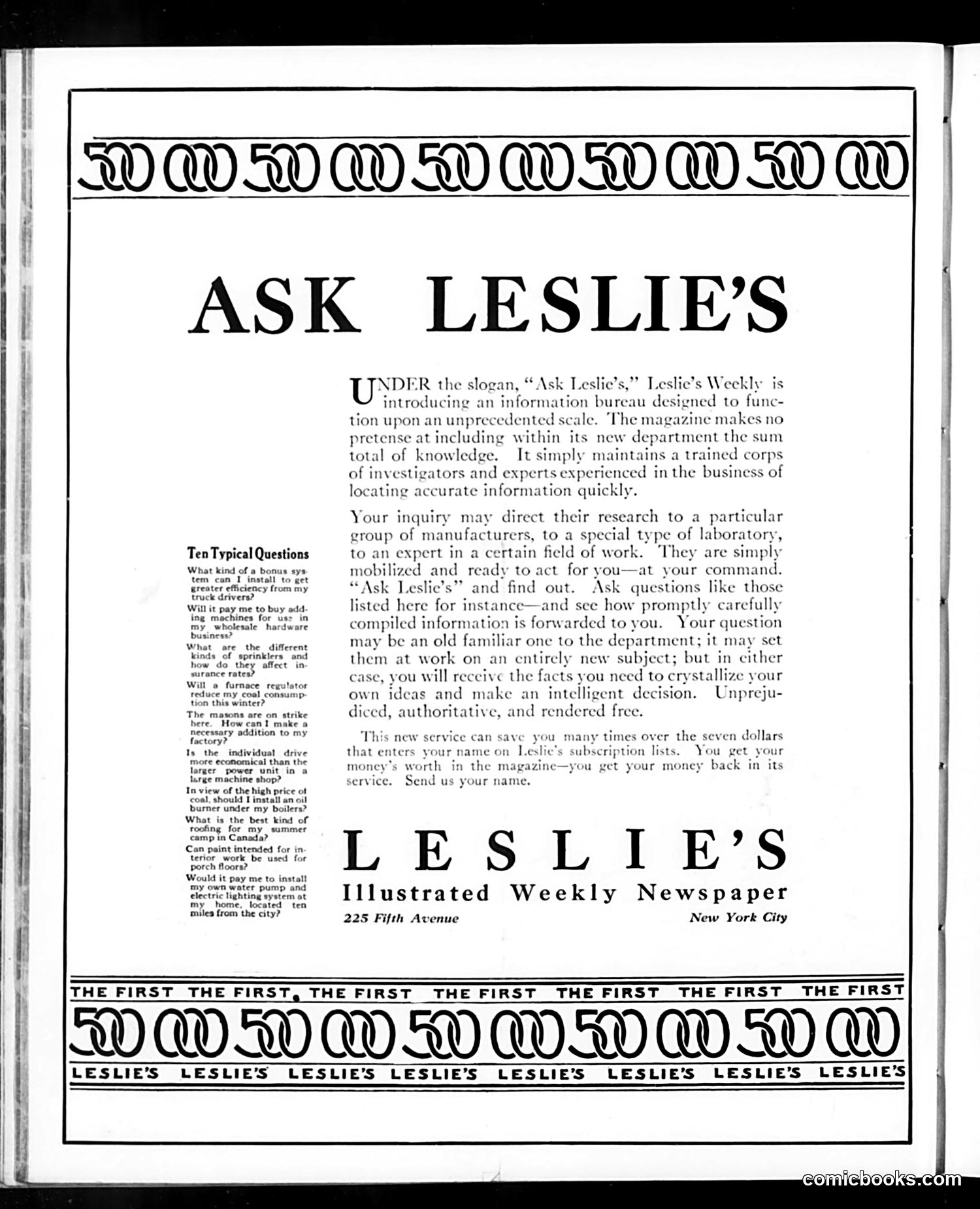
This page is primarily **advertising**, not satire or political commentary. It promotes Leslie's Illustrated Weekly Newspaper's new "Ask Leslie's" information bureau service. The ad explains that Leslie's Weekly is launching a research department to answer reader inquiries quickly and accurately. The service promises to direct questions to appropriate manufacturers, laboratories, or experts who will provide reliable information on topics ranging from technical matters to practical household questions. The "Ten Typical Questions" listed on the left side show examples of the kinds of inquiries readers might submit—about motors, heating systems, paint, water pumps, and similar practical concerns. The key selling point: this service costs nothing extra for subscribers and provides unbiased, authoritative answers. The repeated "THE FIRST" slogan emphasizes Leslie's as pioneering this comprehensive information bureau concept.
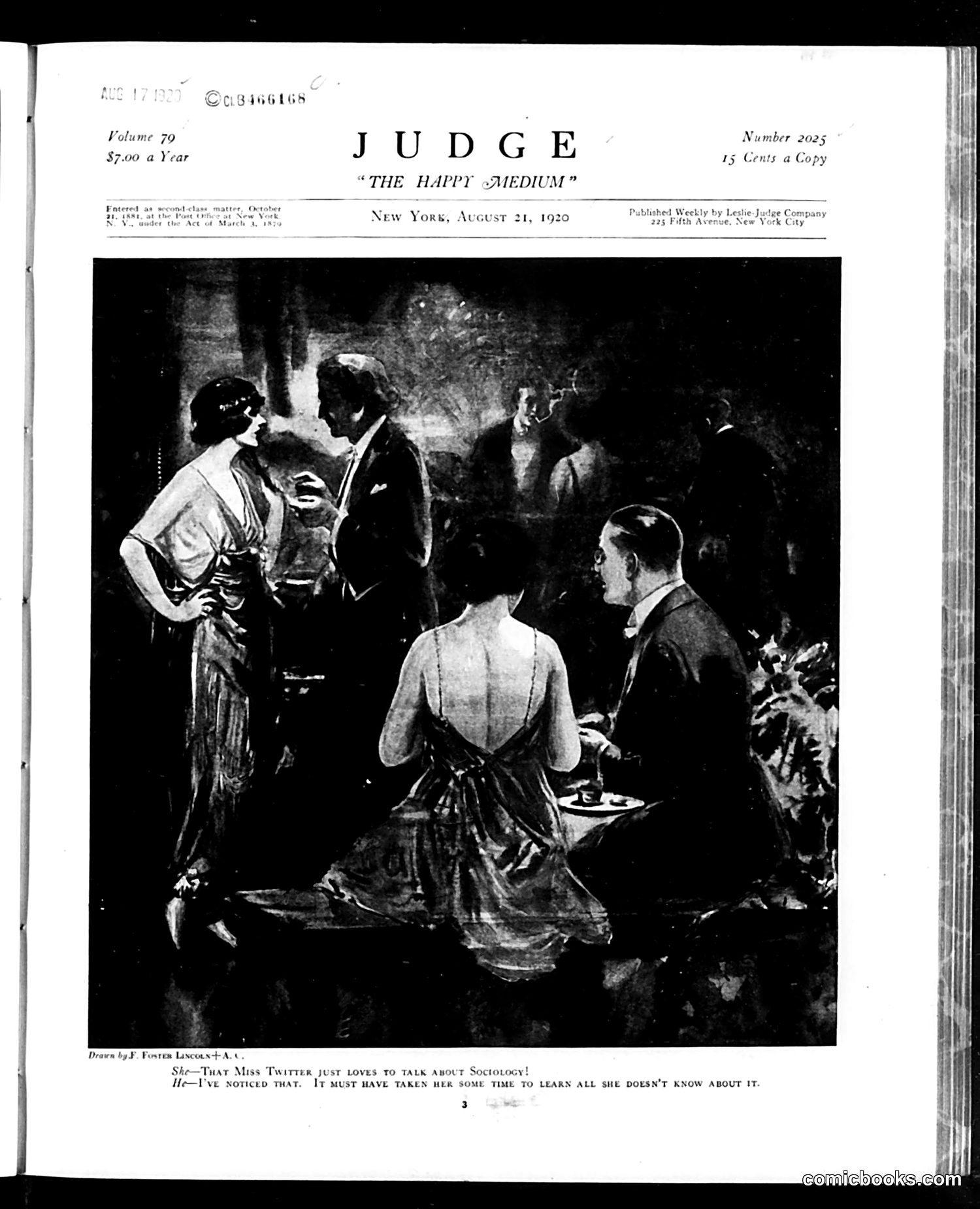
This is a social satire cartoon from Judge magazine (August 21, 1920) depicting a party scene. The caption reads: "She—That Miss Twitter just loves to talk about Sociology! He—I've noticed that. It must have taken her some time to learn all she doesn't know about it." The joke is a classic put-down of women's intellectual pretensions. "Miss Twitter" (clearly a coded name suggesting a foolish, talkative woman) is mocked for enthusiastically discussing sociology—a relatively new academic field in 1920—while the male observer's response sarcastically suggests she actually knows *nothing* about the subject despite her lengthy discussions. This reflects 1920s attitudes dismissing women's educational aspirations as superficial social posturing, particularly as women gained more public visibility and educational access during the post-WWI period.
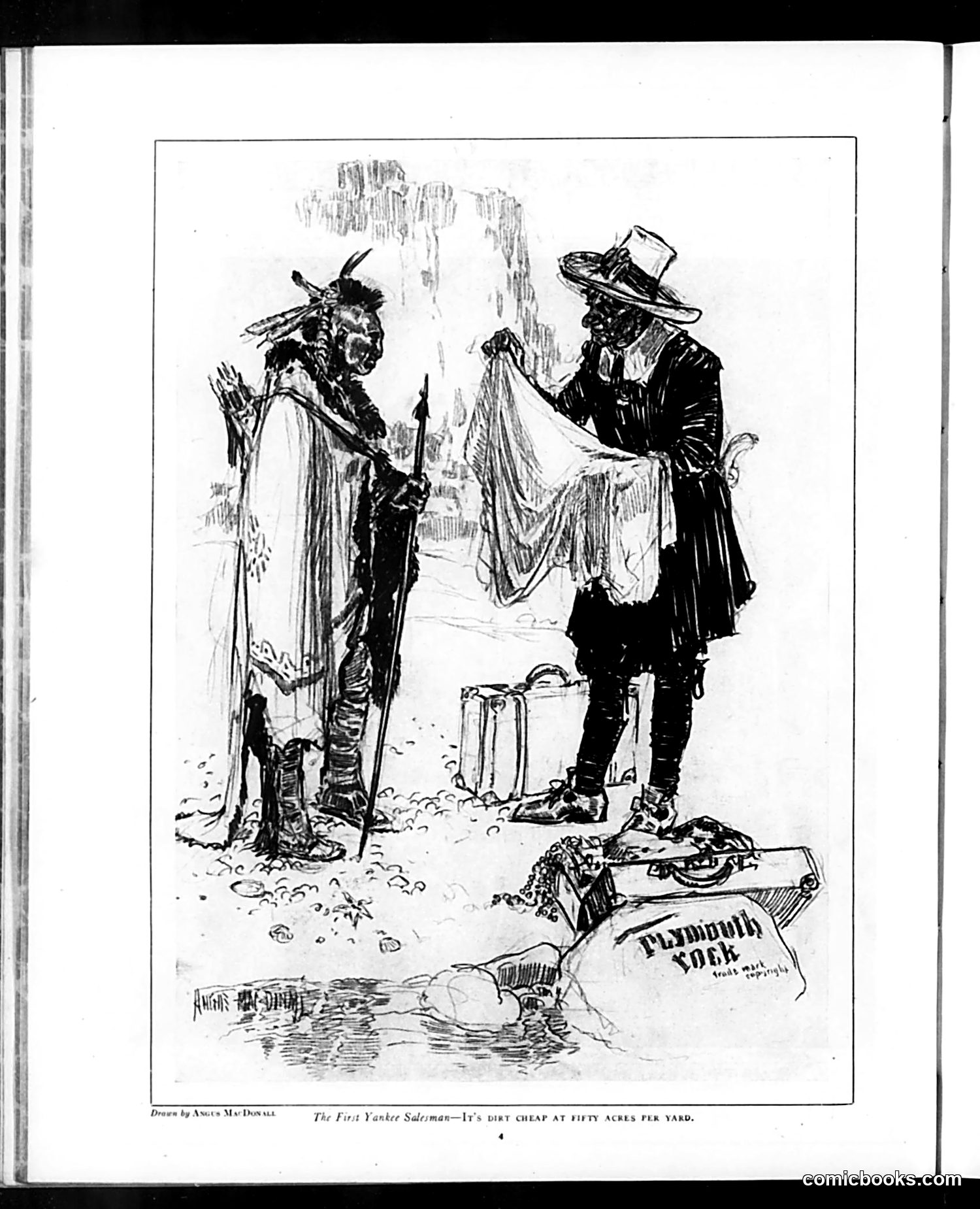
This political cartoon, drawn by Angus MacDonald, satirizes early American commercial expansion. It depicts a Native American and a well-dressed businessman conducting a land transaction. The figure on the right, representing American enterprise, appears to be showing fabric or material—possibly referencing cheap manufactured goods—while negotiating over Plymouth Rock, the historical symbol of America's founding. The caption "It's dirt cheap at fifty acres per yard" is the satirical punchline, suggesting dishonest dealings where Americans sell worthless manufactured goods in exchange for vast land holdings from Native Americans. The cartoon critiques American commercial practices and exploitative colonial-era trade dynamics as fundamentally dishonest, portraying the "Yankee salesman" as duplicitous from the nation's very beginning.
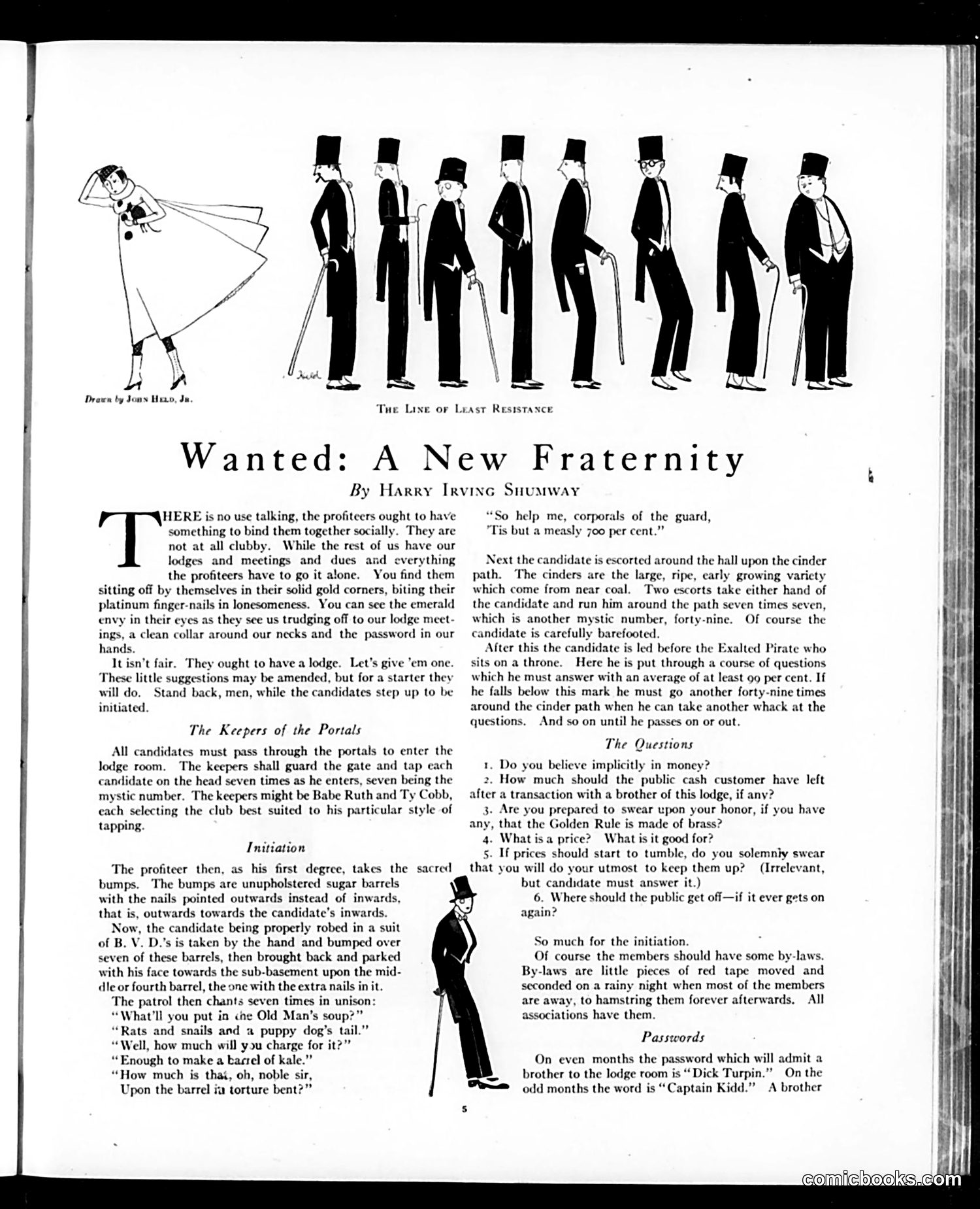
This page satirizes fraternity initiation practices of the era. The top illustration shows "The Line of Last Resistance"—eight formally-dressed men in top hats representing fraternity pledges facing hazing rituals. The accompanying article by Harry Irving Shumway mockingly proposes creating a new fraternity for "proctors" (likely union organizers or labor activists) who lack social organizations. The satire targets two groups: fraternity initiates undergoing humiliating hazing (depicted in comic fashion), and labor/political protesters seeking solidarity. The piece ridicules both the arbitrary rituals of fraternities and the "messy" nature of labor organizing, suggesting they're equally absurd and unnecessary. The questions listed (about money, honor, pricing) further mock the pretentious questioning candidates endured during initiations. The humor relies on contemporary readers understanding fraternity culture and labor tensions of the period.
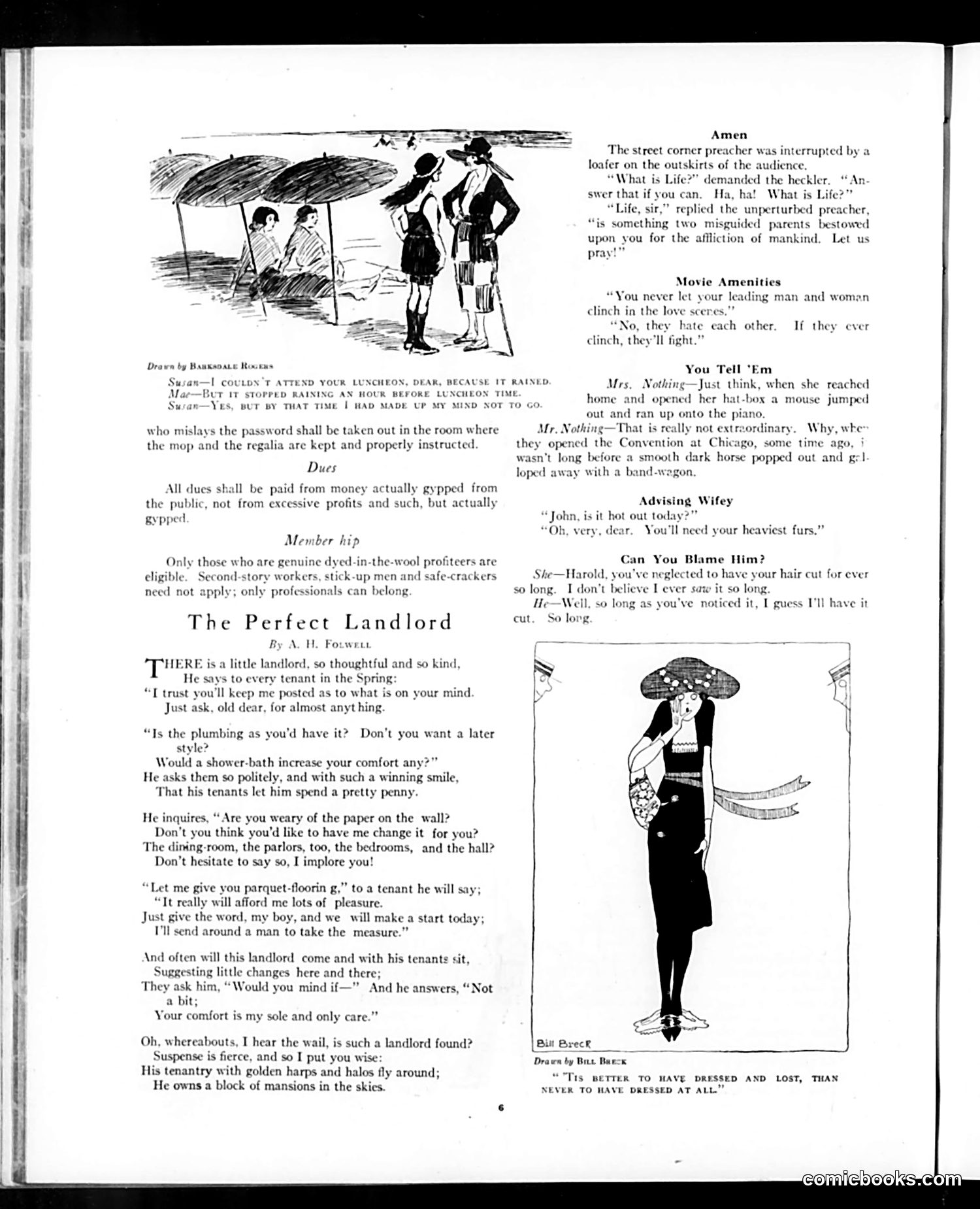
This page contains satirical short pieces and one cartoon rather than political commentary. The main cartoon shows a fashionably dressed woman with an umbrella in rain, captioned "It is better to have dressed and lost, than never to have dressed at all"—a play on Tennyson's "It is better to have loved and lost." The humor sections ("Movie Amenities," "You Tell 'Em," "Advisable Wifey," "Can You Blame Him?") are light domestic jokes about relationships and fashion. "The Perfect Landlord" is a satirical poem by A.H. Foxwell portraying an idealized landlord as impossibly generous—offering renovations, repairs, and comfort improvements while asking nothing in return. The satire mocks the fantasy of such benevolent landlords by showing how absurdly unrealistic this scenario is.
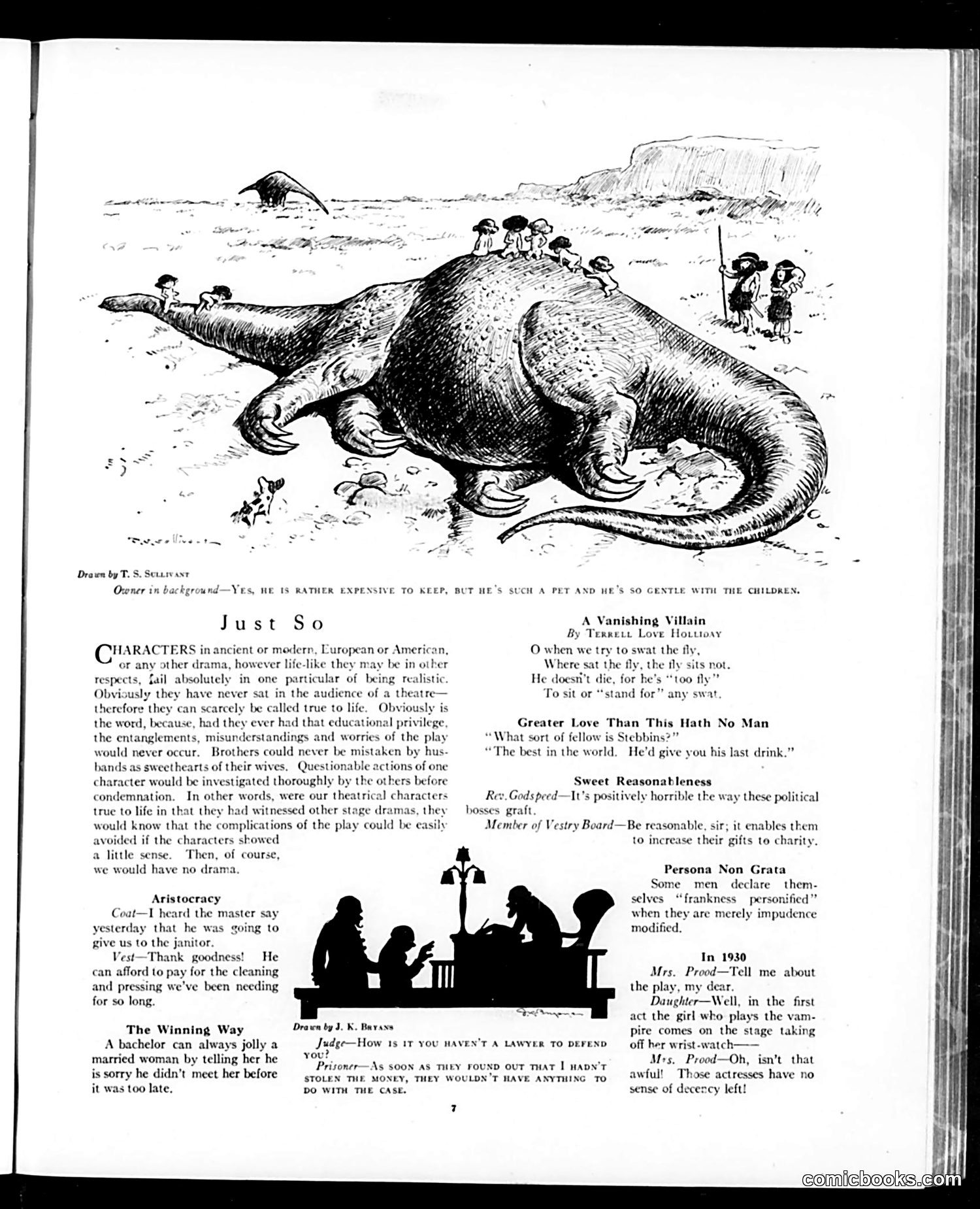
This page from Judge magazine contains multiple satirical pieces critiquing social hypocrisy and theater conventions. The main cartoon depicts a massive dinosaur (likely meant as an exotic pet) with children climbing on it. The caption establishes ironic class commentary: a wealthy owner keeps this expensive animal because he's "gentle with the children"—suggesting the absurd priorities of the wealthy and their naive assumptions about dangerous things. The text pieces mock theatrical realism (characters lacking common sense), class pretension (servants discussing master's finances), and political corruption ("Sweet Reasonableness" joke about grafting politicians using bribes to increase charitable donations—a satirical jab at how corruption gets rationalized). The 1930 piece ridicules modern theater audiences' selective morality: they object to an actress removing her watch onstage as indecent, while apparently accepting vampire roles. It's commentary on contemporary prudishness and contradictory social values. Overall, the page targets theatrical conventions, class absurdities, and hypocritical social standards of the era.
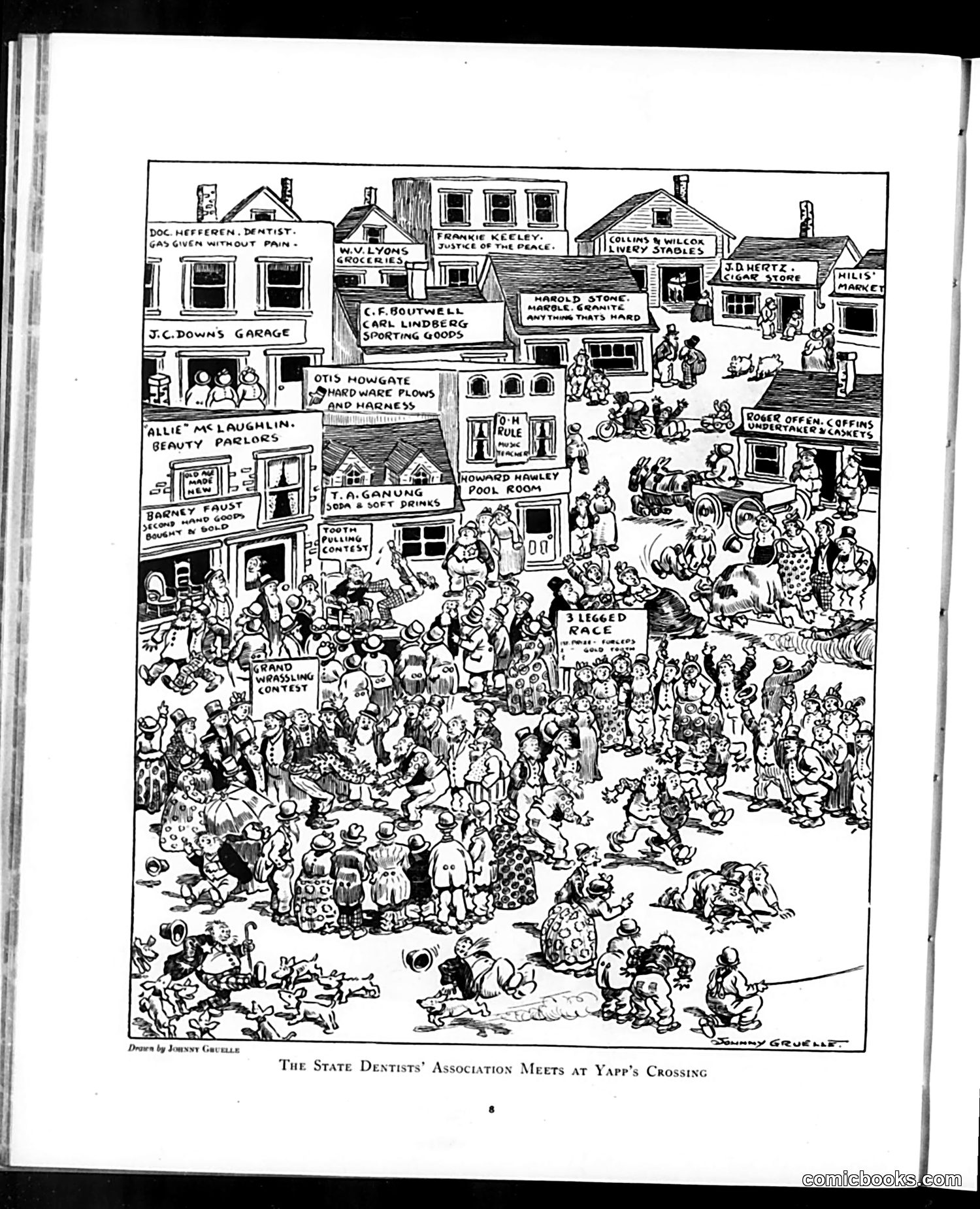
This cartoon satirizes a rural small-town gathering of dentists, shown as a chaotic, crowded country fair or street festival. The humor stems from the contrast between the profession's dignity and the undignified, rustic setting. The labeled storefronts identify local businesses—garages, beauty parlors, grocery stores, a pool room—typical of an early 20th-century rural crossroads community. Among the crowd are numerous figures engaged in undignified activities: people fighting, running, falling, and behaving rowdily, with dogs and children adding to the mayhem. The satire mocks both the pretensions of professional associations holding formal meetings and the stereotype of rural communities as lacking refinement. The "State Dentists' Association" meeting devolves into an unseemly carnival, suggesting that formal professional gatherings in remote locations descend into chaos, or that rural Americans, regardless of profession, behave crudely. The artist, Johnny Gruelle, uses exaggerated caricature and slapstick to comic effect.
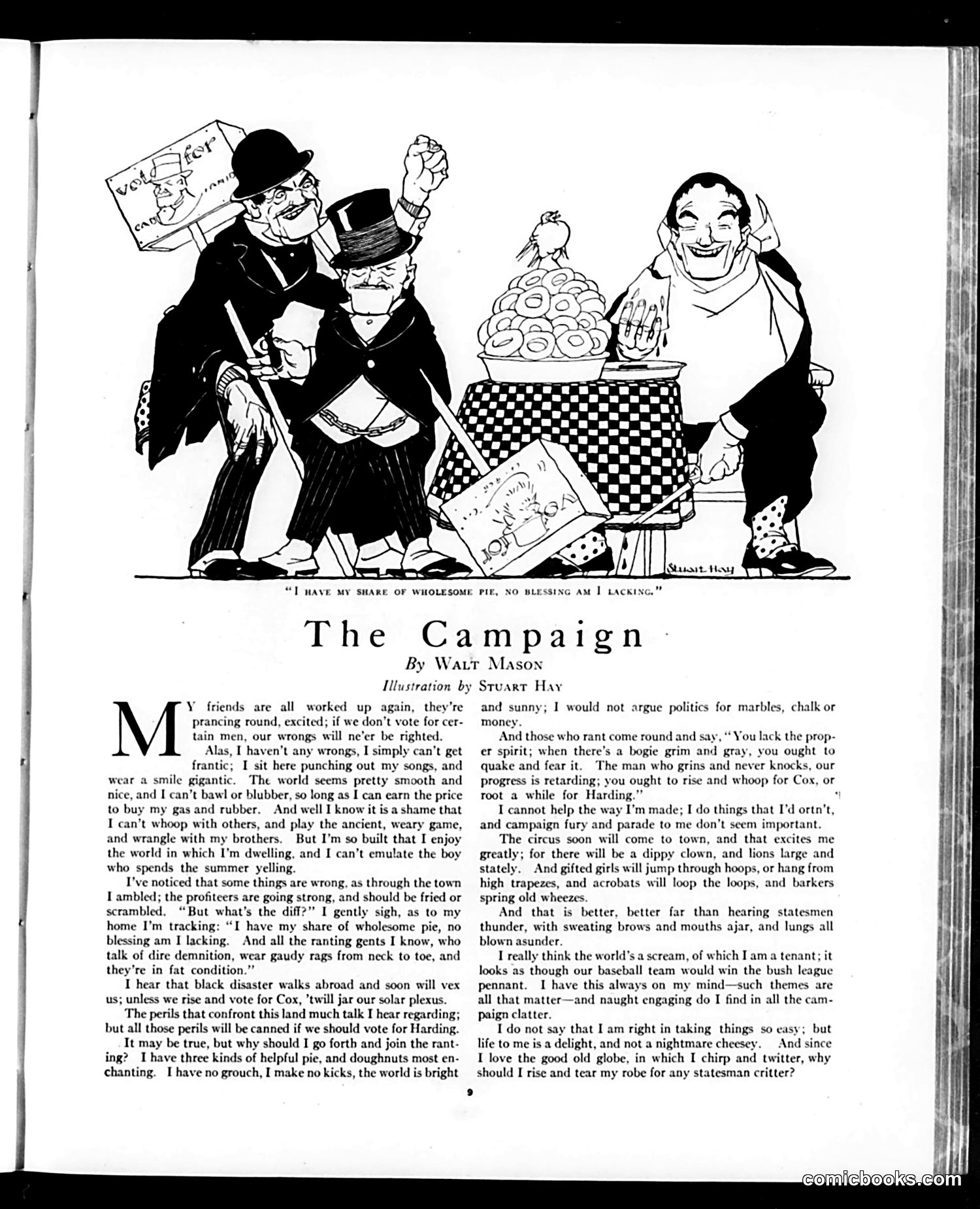
This page satirizes political apathy during what appears to be the 1920 presidential election (references to Cox and Harding). The cartoon illustrates Mason's poem about a cheerfully indifferent everyman who refuses to join campaign fervor despite pressure from politically agitated friends. The caricatured figures on the left—two thin, gaunt men in formal wear—represent typical campaign activists, depicted as skeletal and intense. The round-faced man on the right embodies the narrator: content, well-fed, and unmoved by political urgency. Mason's satire targets both sides: activists ranting about "profiteers" and national disaster, yet the poem suggests their own desperation and worn appearance undermine their righteousness. The narrator prefers circuses and baseball to political speeches. The joke is that material comfort and personal contentment trump civic engagement—a critique of American materialism masquerading as lighthearted apathy.
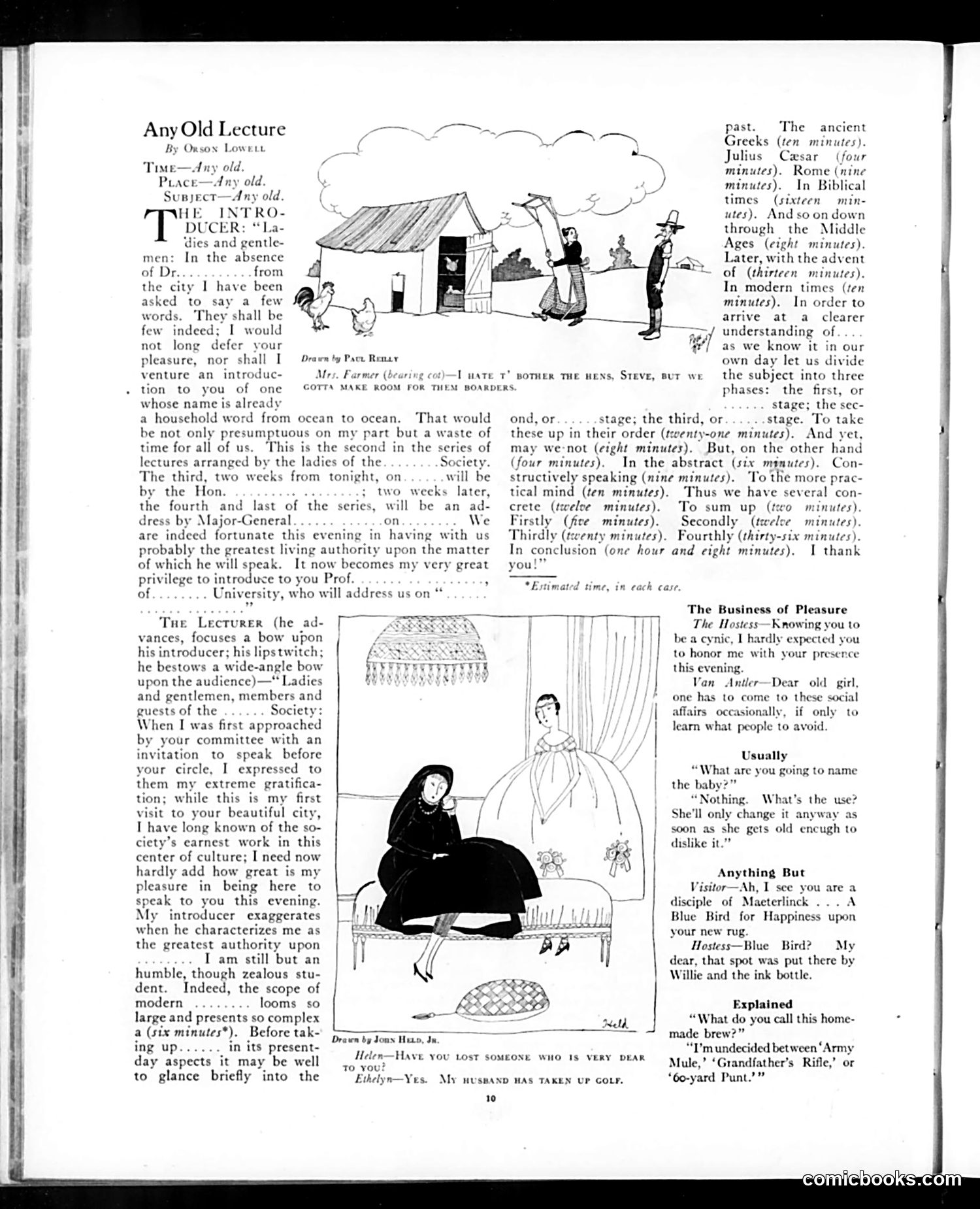
This page satirizes the tedium of academic lectures through two main pieces: **"Any Old Lecture"** (top): The cartoon mocks pretentious lecturers who deliver lengthy, rambling talks disguised as scholarly authority. The joke is the introducer's ironic promise to be "few indeed" in his remarks, followed by pages of absurdly detailed time breakdowns (ten minutes on ancient Greece, nine on Rome, etc.). The lecturer then compounds this by claiming humility while launching into his own verbose introduction—immediately contradicting the premise. The satire targets how speakers use false modesty and elaborate historical frameworks to disguise simple ideas stretched into tedious presentations. **"The Business of Pleasure"** (bottom): This sketch mocks superficial high society. A cynical man admits attending social affairs only to "learn what people to avoid"—satirizing the hollowness of such gatherings where attendance is obligatory but joyless. The page captures early 20th-century American frustration with affected intellectualism and empty social conventions, presented through Judge's characteristic humor.
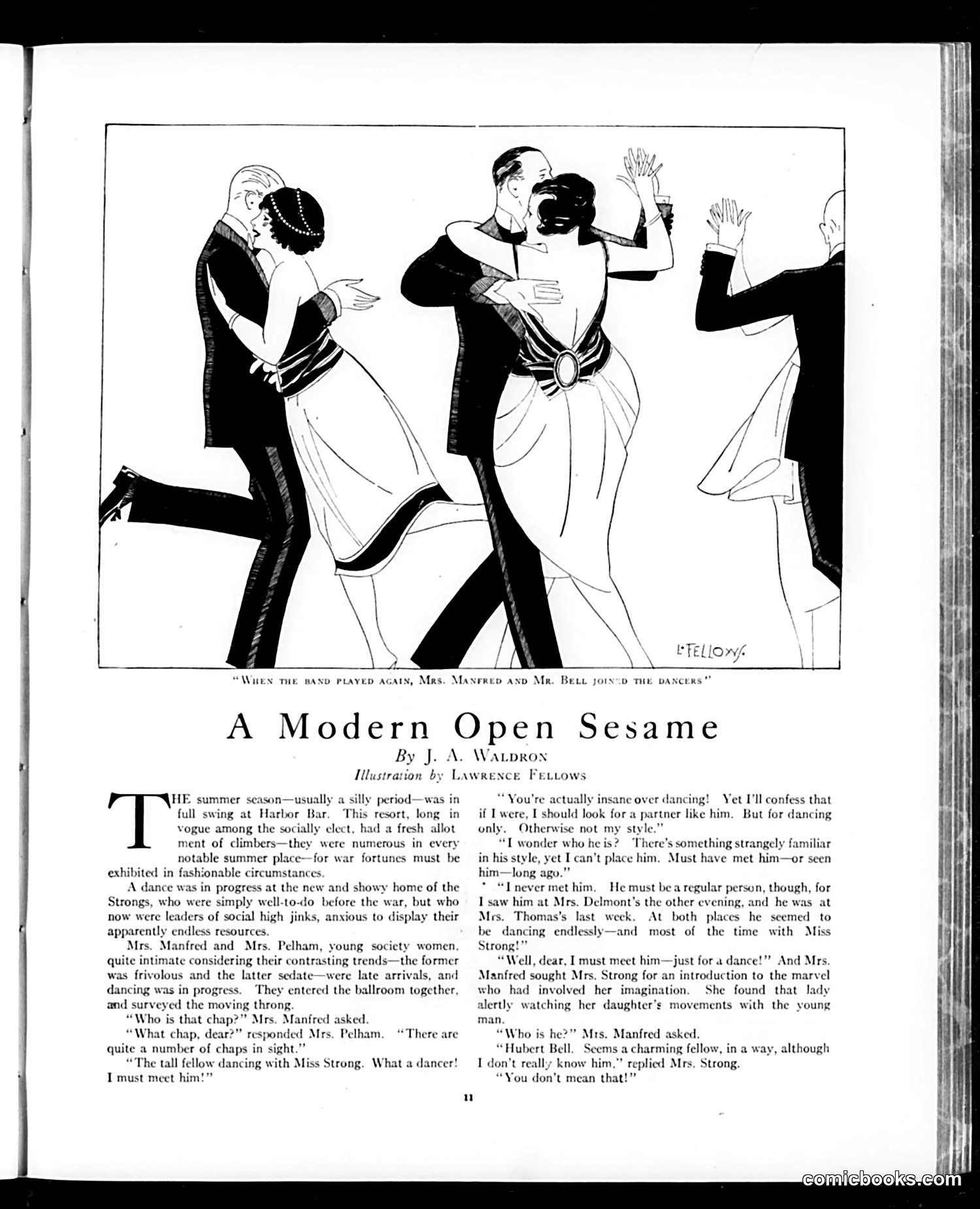
This story satirizes post-WWI social climbing and the new wealth class. The "Strongs" are newly rich war profiteers ("war fortunes must be displayed in fashionable circumstances") who have become social leaders at an exclusive resort, replacing the old established elite. The joke centers on Hubert Bell, a mysterious charming dancer who appears everywhere at society events, captivating the women despite no one knowing who he actually is. Mrs. Strong admits she doesn't really know him—suggesting he's a social parasite or fortune-hunter exploiting the nouveau riche's insecurity and eagerness to appear cosmopolitan. The title "Open Sesame" implies Bell uses dancing as his magic password to infiltrate high society. The cartoon shows couples dancing while society women gossip about the mysterious man. The satire targets how wartime profiteers, lacking genuine social standing, are easily duped by charming outsiders because they're anxious to prove their sophistication.
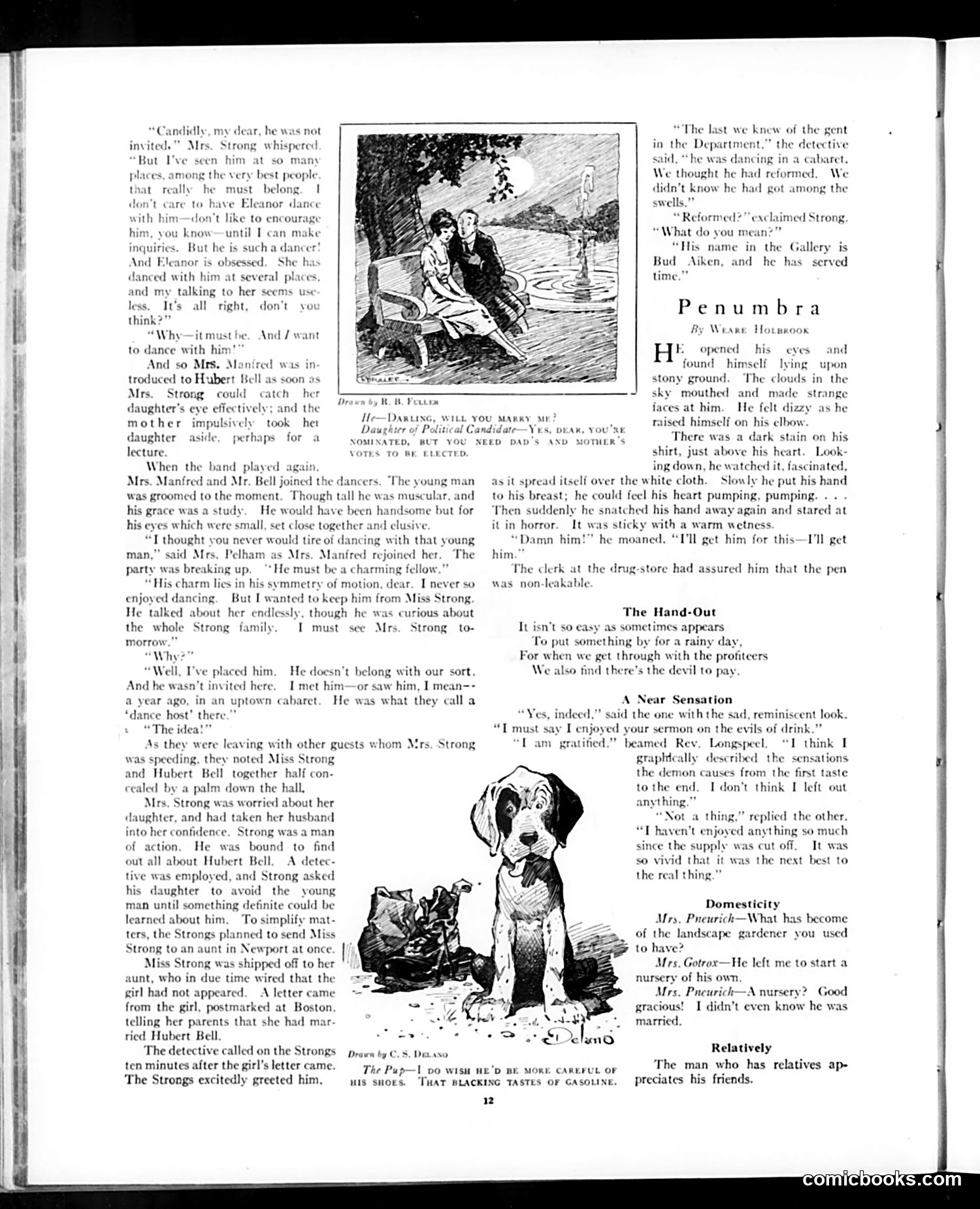
This page contains two unrelated pieces from *Judge* magazine: **Main Story ("Penumbra"):** A social satire about class deception. Mrs. Manfred introduces "Hubert Bell," an exceptionally graceful dancer, into high society. A detective reveals he's actually "Bud Aiken," an ex-convict who previously worked as a "dance host" in a cabaret. Despite warnings, the naive Miss Strong elopes with him—a cautionary tale about criminals infiltrating polite society and deceiving respectable families through charm and false appearances. **Bottom Cartoons:** Light humor pieces with minimal political content. "The Hand-Out" and "A Near Sensation" involve drinking and sermon-related jokes. "The Pup" cartoon satirizes urban pollution—a dog complains that shoe polish tastes of gasoline, mocking industrial contamination of city streets. The overall theme reflects Progressive-era anxieties about social mobility, criminal rehabilitation, and urban decay.
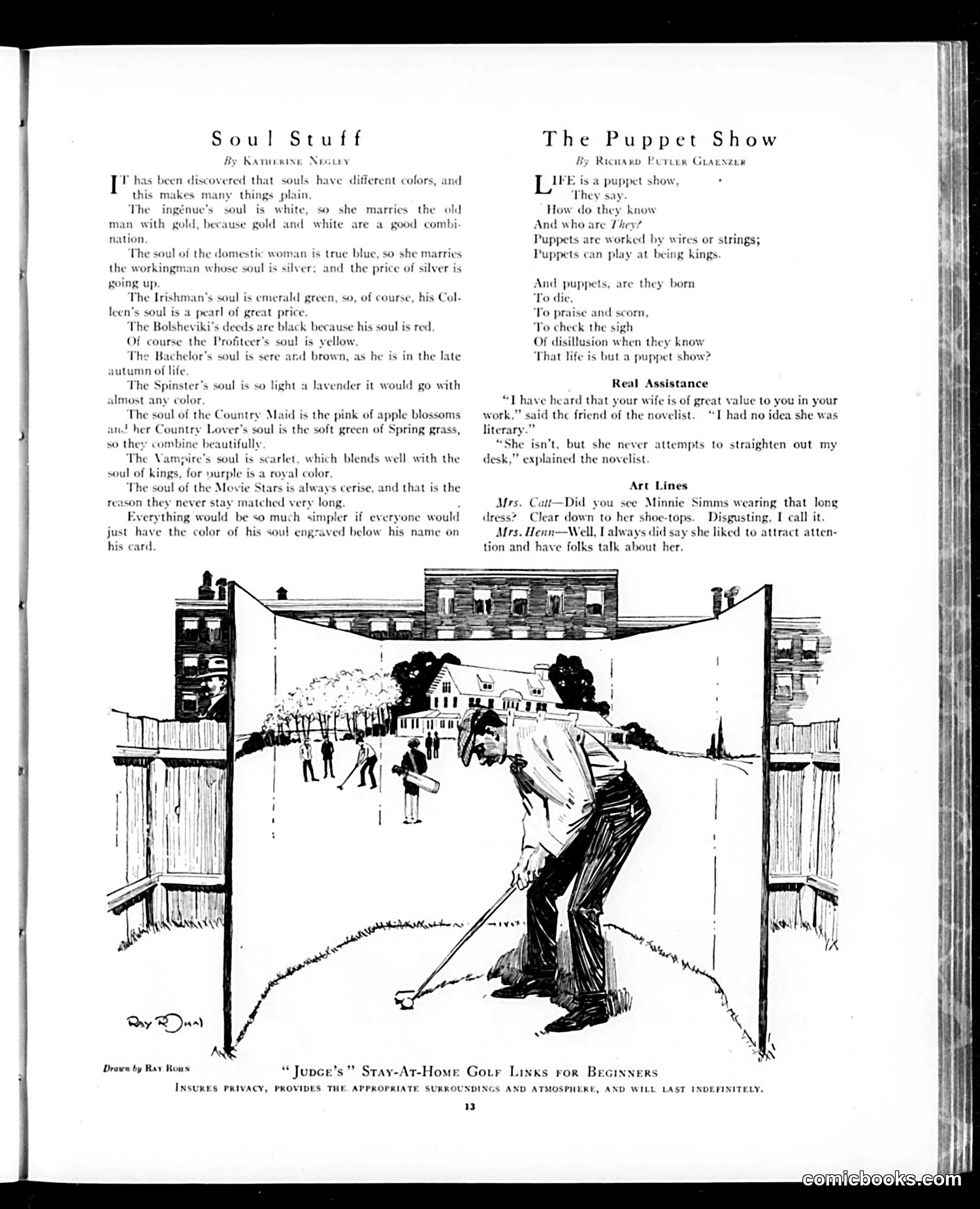
This page contains three satirical pieces from an early 20th-century American magazine: **"Soul Stuff"** is a whimsical social commentary assigning soul-colors to different character types: ingénues (white), working men (silver), Irish people (emerald green), domestic women (blue), Bolsheviks (red/black), profiteers (yellow), and vampires (scarlet). The satire mocks both ethnic stereotyping and the era's fascination with pseudo-scientific personality classification. The joke concludes that people should have their soul-color engraved on calling cards for social convenience. **"The Puppet Show"** appears to be philosophical verse questioning whether life is merely puppet theater controlled by unseen forces ("They"). **"Real Assistance"** and **"Art Lines"** are brief comic snippets about spousal dynamics and fashion criticism. The large illustration depicts a miniature golf course—"Judge's Stay-at-Home Golf Links for Beginners"—advertising indoor recreation. This references the early 1900s craze for novelty mini-golf as entertainment. The overall tone is lighthearted mockery of contemporary social pretensions and new consumer entertainments.
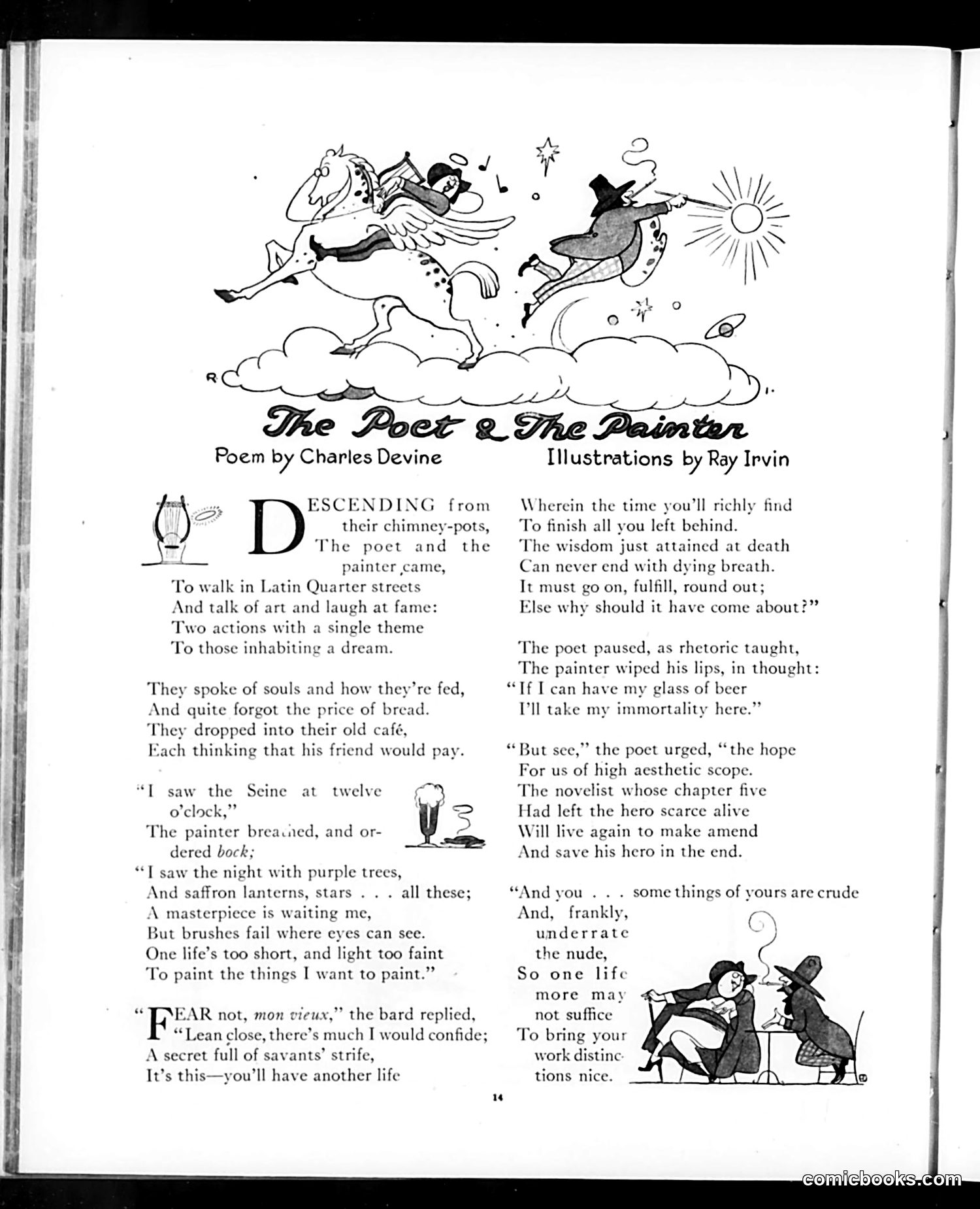
This is a satirical poem about two impoverished bohemian artists in Paris's Latin Quarter, illustrated with whimsical drawings. The joke centers on artistic pretension versus material reality: the painter and poet discuss lofty ideals—immortality, aesthetic achievement, unfinished masterworks—while living hand-to-mouth, unable to afford their café bill and hoping the other will pay. The satire's point: artists romanticize their struggles and imagine afterlives to complete their work, when they can't even manage basic sustenance in this one. The painter's response—he'd rather have a beer than immortality—punctures the poet's philosophical grandstanding with working-class practicality. The whimsical Ray Irvin illustrations (cherubs on horseback, figures in clouds) reinforce the contrast between artistic dreams and earthly concerns.
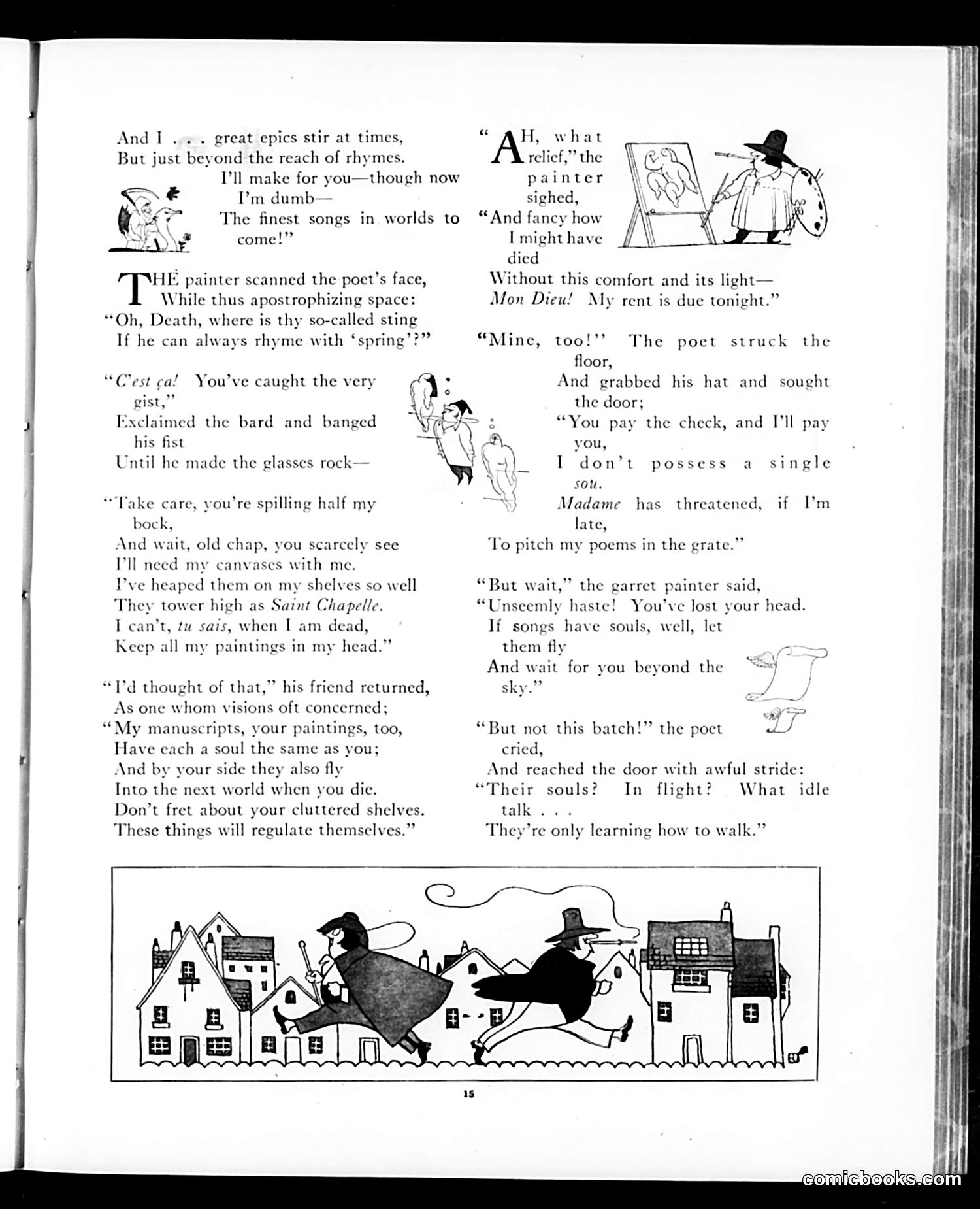
This is a satirical poem about two impoverished bohemian artists—a painter and poet—living in a Parisian garret. The humor centers on their desperate financial straits: the painter worries about his rent being "due tonight," the poet lacks even a single "sou" (coin), and a landlady threatens to burn his poems if he's late. The satire mocks the romantic notion of starving artists. When the painter suggests their artworks possess souls that will transcend death, the poet angrily rejects this consolation—insisting his unpaid poems are "only learning how to walk," meaning they're still too undeveloped to matter. The cartoon ridicules the pretentious spiritualization of art as escape from material poverty. The illustrations depict their chaotic bohemian life: arguing in their studio, fleeing through Paris streets. The satire targets both the artists' self-aggrandizing rhetoric and society's indifference to their actual suffering.
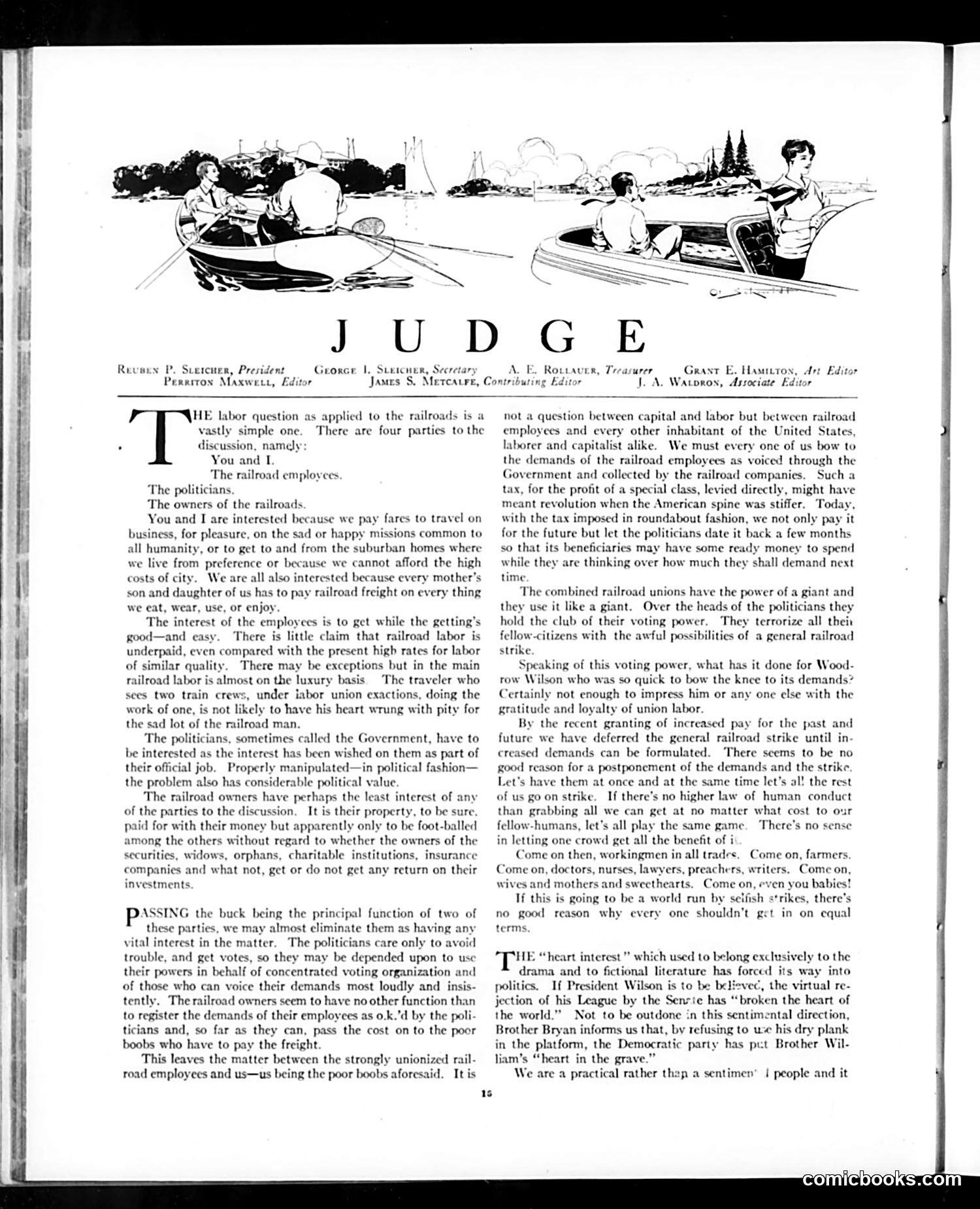
This is an editorial (not a cartoon), likely from the early 1920s, addressing the railroad labor question. The author argues that railroad strikes affect ordinary citizens—travelers and consumers—more than they affect capitalists or politicians. The piece identifies four parties: the public (who pay fares and freight costs), railroad employees (described as well-paid unionists), politicians (who avoid trouble), and railroad owners (largely powerless). The author's satire targets **railroad unions** for using voting power to coerce politicians into accepting their demands, which are then passed to the public as hidden taxes. The tone is hostile to organized labor, characterizing unions as wielding tyrannical power over average Americans while politicians and owners capitulate. The author suggests this represents an inversion of typical capital-labor conflict—here, workers dominate through political pressure rather than negotiation.
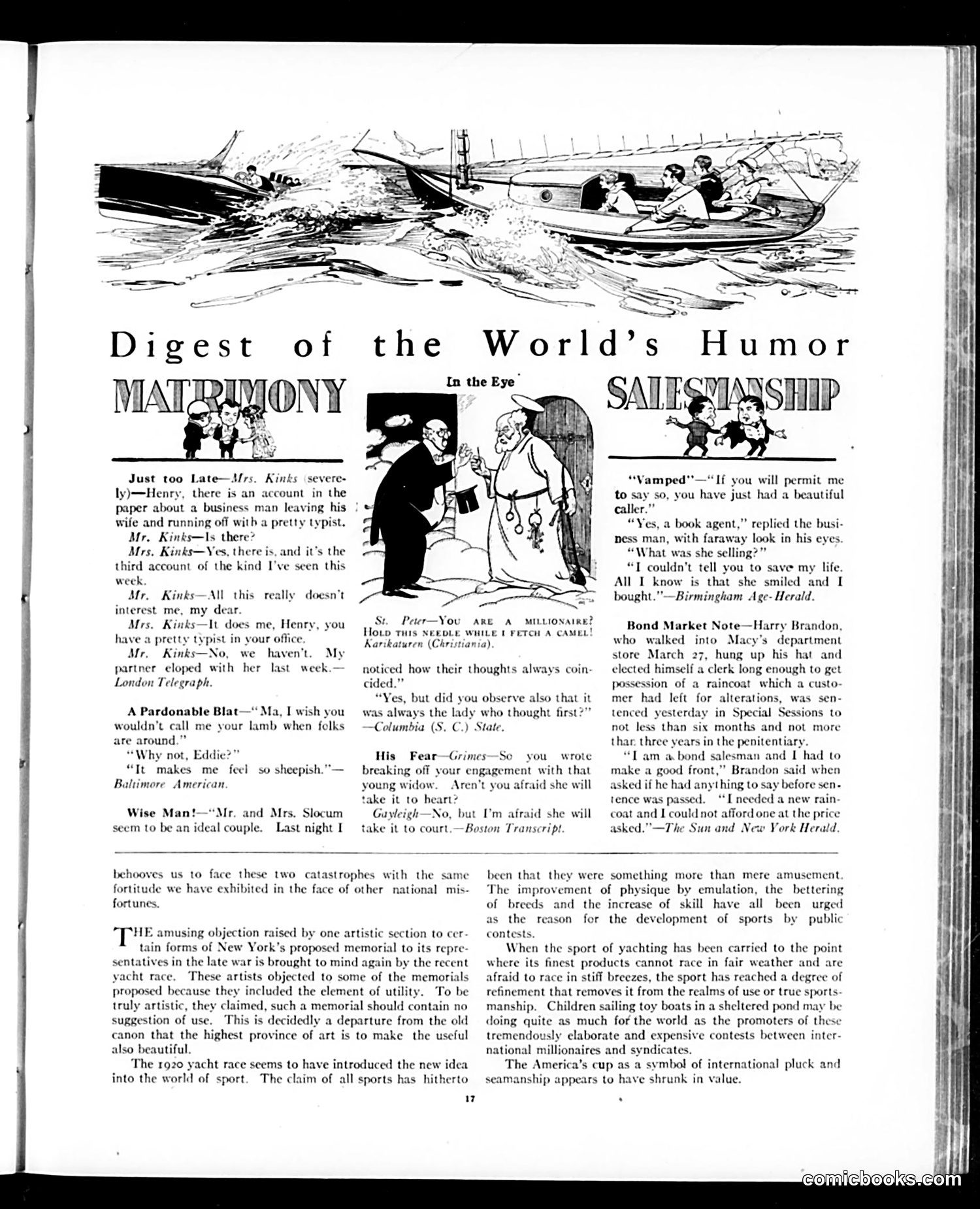
This page collects brief humorous anecdotes about marriage and social dynamics. The "Matrimony" section features the "Kinks" couple: Mrs. Kinks obsessively reads newspaper accounts of businessmen eloping with typists, while her husband dismisses her concerns—only for the joke's reveal that *his own* office typist already eloped with his partner. The satire targets wives' anxiety about workplace temptations and husbands' obliviousness. The "Salesmanship" section shows a book agent who seduces a man into buying through charm alone; he admits he has no idea what she was actually selling. This mocks both aggressive sales tactics and male susceptibility to female persuasion. The lower article critiques yacht racing's evolution into an impractical "refinement" divorced from utility or genuine sport—wealthy competitors avoid rough conditions, making the contests mere status contests rather than tests of skill. The humor reflects early-20th-century anxieties: workplace temptation, women's manipulative sales skills, and wealthy idleness.
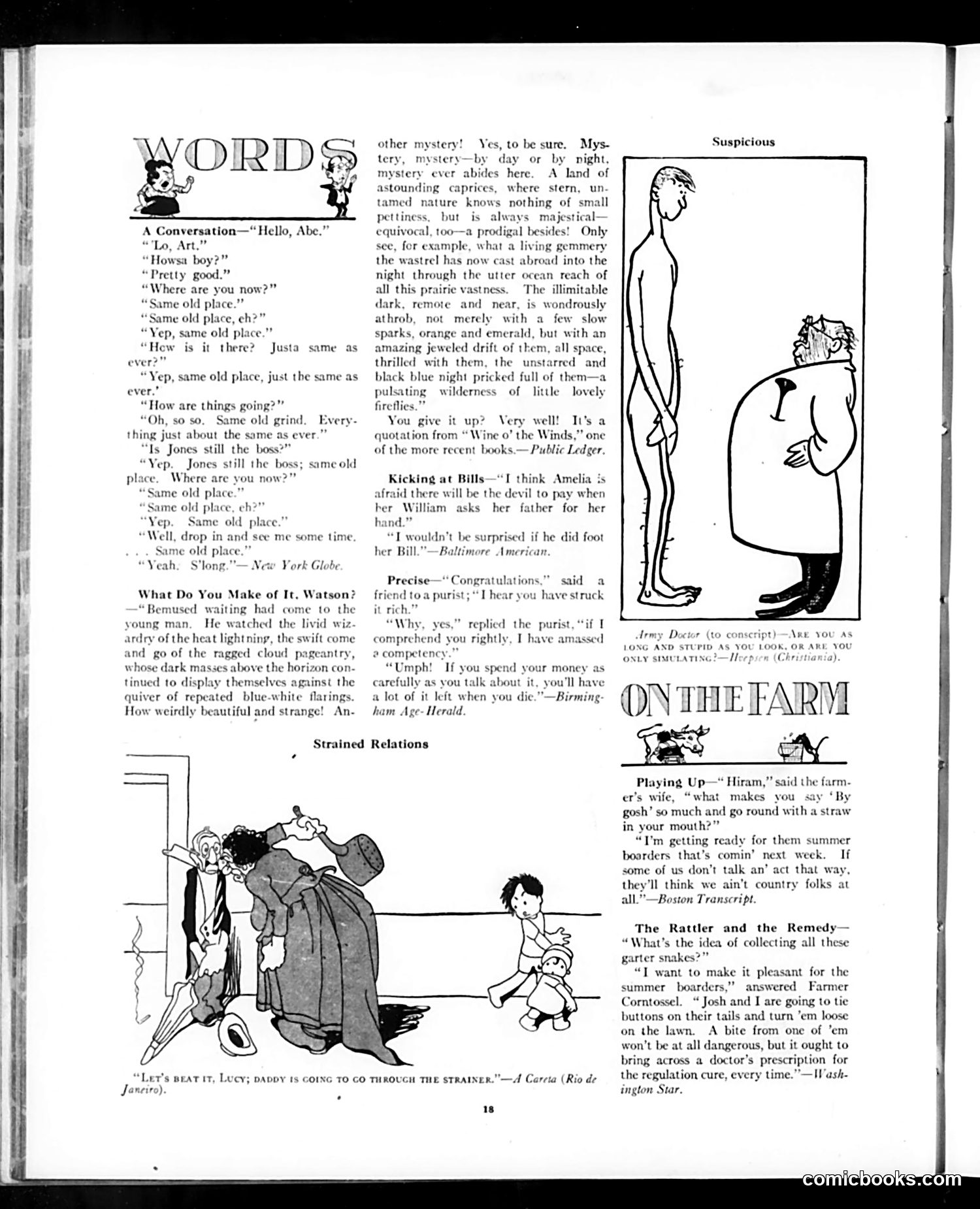
This page contains several satirical sections typical of early 20th-century American humor: **"A Conversation"** depicts two men (likely named Abe and Art) in repetitive small talk about monotonous routine—the joke being the tedious sameness of their lives and predictable dialogue. **"What Do You Make of It, Watson?"** mocks overwrought literary prose by quoting purple passage about prairie lightning and fireflies, then revealing it's from a recent popular novel, suggesting pretentious writing masquerading as profound. **"Strained Relations"** cartoon shows a domestic dispute—a man appears to be arguing with a woman while children watch, illustrating marital conflict. **"On the Farm"** section includes rural humor: farmers adopting exaggerated "country" personas (saying "by gosh," carrying straw) to meet summer visitors' stereotypical expectations, and a farmer's plan to attach buttons to garter snakes as pranks on boarders. The satire targets both rural self-caricature and city people's romanticized notions of rural life. The overall tone is gentle mockery of American middle-class life, literary pretension, and rural-urban cultural differences.
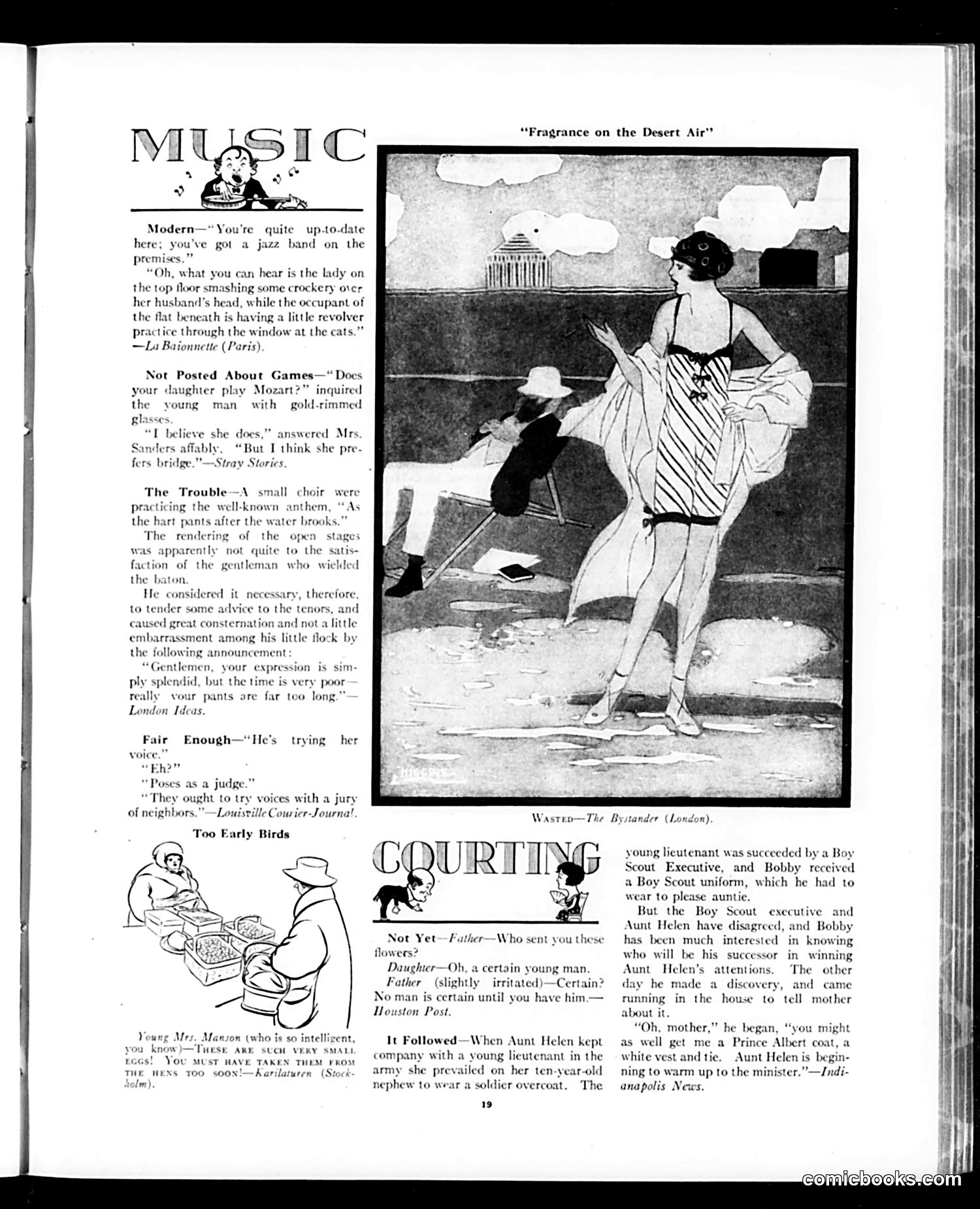
This page collects brief satirical humor pieces typical of early 20th-century Judge magazine. Key content: **"Modern"** mocks urban apartment living—the "jazz band" is actually domestic violence and a neighbor shooting at cats, satirizing claims of modernity. **"Not Posted About Games"** jokes that a young woman prefers bridge to Mozart, challenging stereotypes about feminine accomplishment. **"The Trouble"** depicts a choir director so focused on correcting tenors' posture that he publicly humiliates them about their pants being too long—absurdist humor about misplaced priorities. **"Fair Enough"** and **"Too Early Birds"** are brief one-liners about dating and egg-size. **"Courting"** section describes a woman whose romantic suitors keep changing—first a soldier, then a Boy Scout executive, now a minister. The joke is that she cycles through men based on their uniforms, and her nephew anticipates the next one will require formal dress ("Prince Albert coat"). The page demonstrates Judge's style: social commentary through exaggeration and absurdity targeting domestic life, courtship conventions, and urban manners.
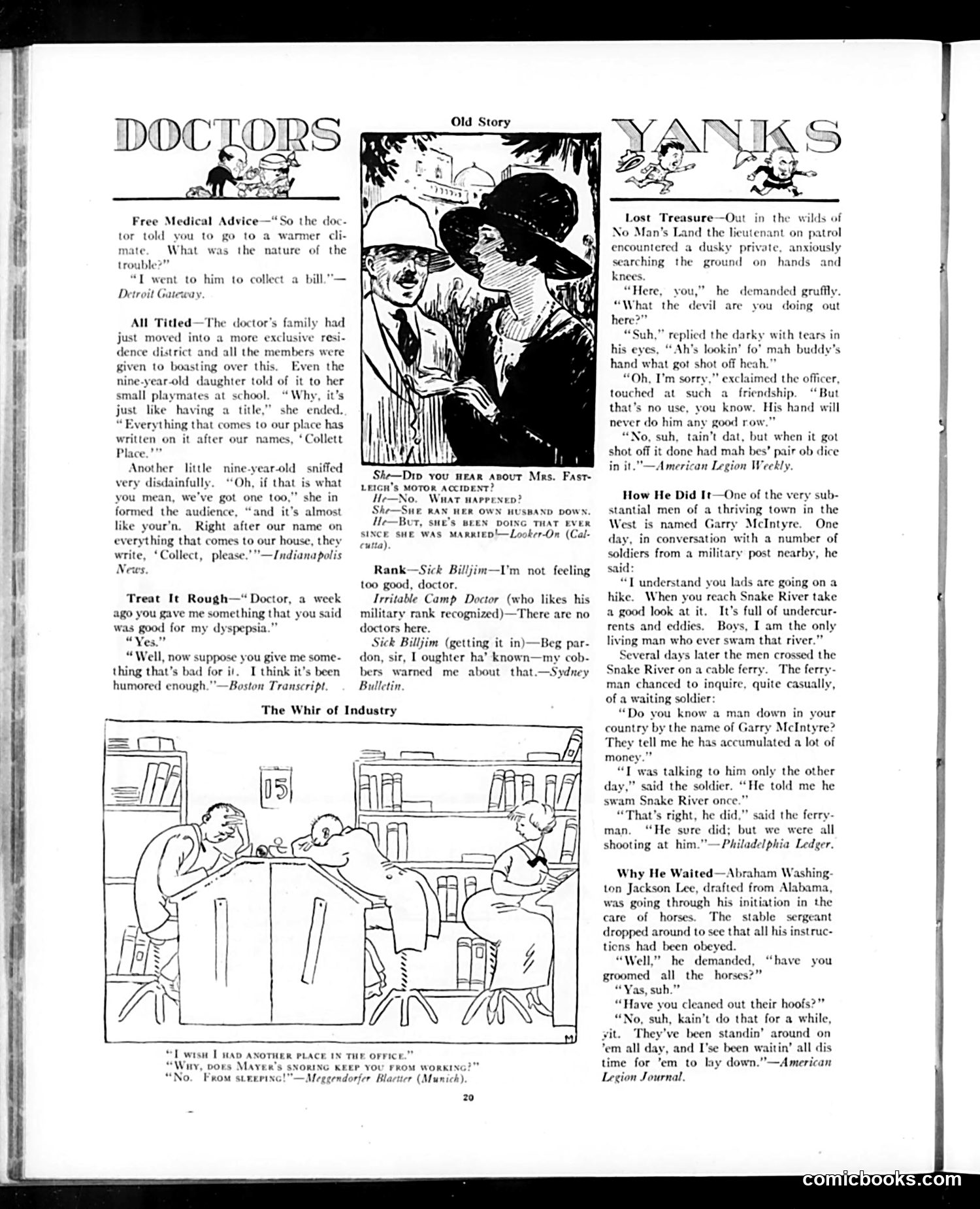
This page contains several short humorous anecdotes typical of early-20th-century American satirical magazines: **"The Whir of Industry"** cartoon depicts office workers at desks, satirizing workplace dynamics—specifically how a superior's snoring disrupts productivity while the employee must stay alert. **The text pieces mock various social situations:** - Doctors collecting bills rather than treating patients - Social pretension (a doctor's family boasting about their new address) - Gender role stereotypes (a woman driver hitting her own husband, presented as ongoing marital behavior) - Military hierarchy and class distinctions (a private deferentially addressing a camp doctor) - Racial stereotypes (a Black soldier searching for dice lost in his injured friend's severed hand) - Frontier tall tales (a man claiming to have swum a dangerous river while being shot at) - Draft-era humor (an Alabama recruit unfamiliar with horse care) The humor relies on wordplay, unexpected punchlines, and period-specific anxieties about social mobility, military service, and workplace dynamics. The racial and gender stereotypes reflect attitudes common to the era but offensive by modern standards.
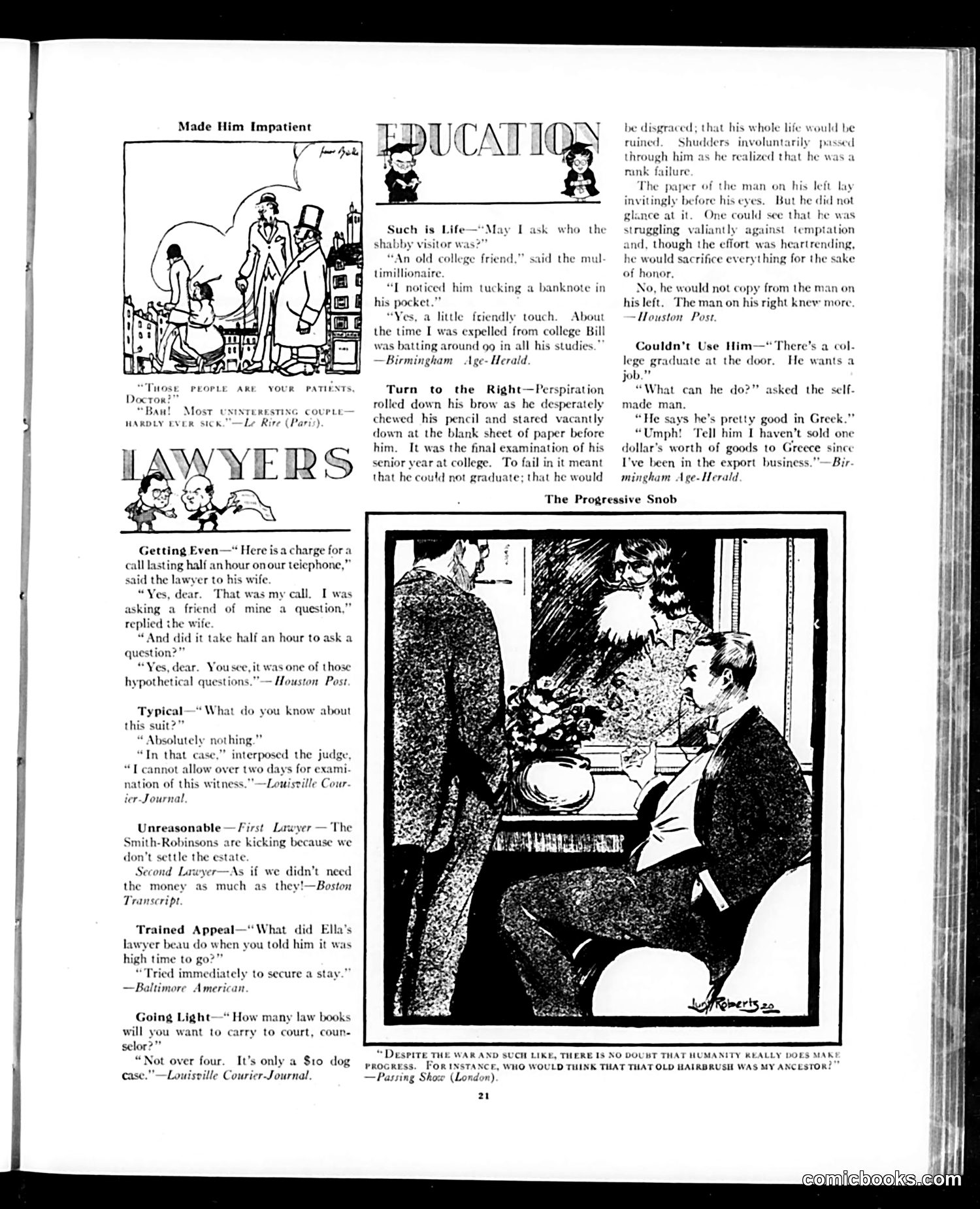
This page contains multiple short humor pieces mocking early 20th-century American professionals and social pretensions. **"Made Him Impatient"** jokes about a wealthy doctor whose patients are so healthy he's bored—satirizing how affluent practitioners served mostly well-off clients who rarely needed medical care. **The "Lawyers" section** contains several jabs at legal professionals: charging by the hour encourages frivolous questions; lawyers know nothing about cases they take; and legal fees enrich attorneys while dragging out settlements. These reflect common complaints about lawyer greed. **"Turn to the Right"** tells of a college student resisting cheating during finals—praising moral integrity over academic expediency, a values-based satire. **"Couldn't Use Him"** mocks the self-made businessman dismissing a Greek-educated college graduate as useless, suggesting practical businessmen viewed classical education as worthless. **"The Progressive Snob"** concludes the page mocking evolutionary pretension: someone claims progress because their ancestor was a mere hairbrush, inverting the logic of "superior ancestry."
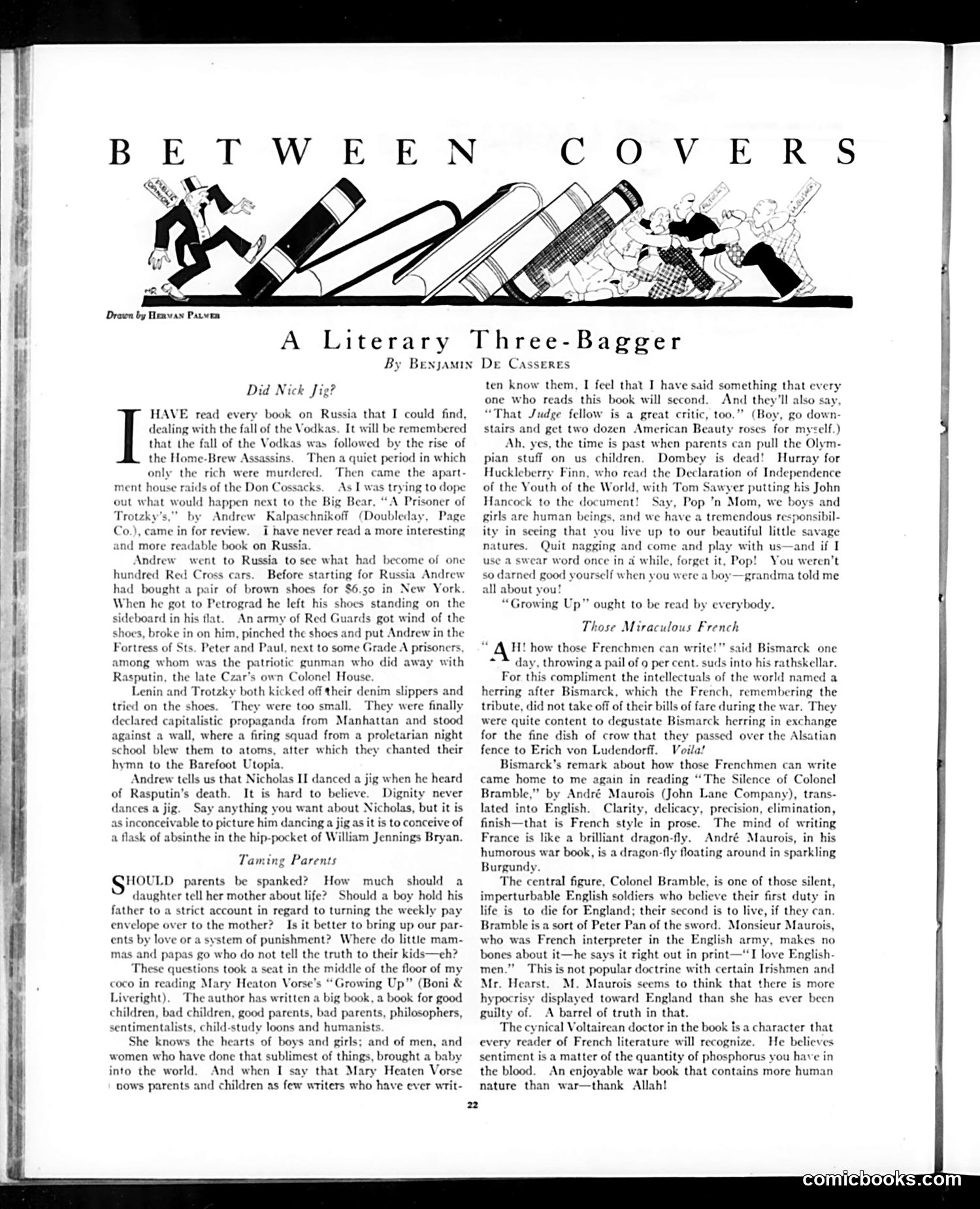
This is a **book review section** from Judge magazine, not primarily a political cartoon page. The header illustration by Hervas Palmer shows figures fleeing collapsing books—a visual metaphor for books' impact. The reviews discuss Russian literature and parenting books: 1. **"A Prisoner of Trotzky"** (Andrew Kalpaschnikoff): A satirical account mocking Soviet revolutionary figures (Lenin, Trotzky) through absurdist humor—Lenin and Trotzky fighting over seized capitalist shoes, for instance. The reviewer notes the book humorously depicts post-Revolution chaos. 2. **"Growing Up"** (Mary Heaton Vorse): Praised for understanding parent-child dynamics in modern times, contrasting outdated parental authority (referencing Dickens's *Dombey and Son*) with progressive attitudes championed by Huckleberry Finn. The satire targets both Soviet communism (as chaotic and absurd) and outdated American parenting styles, reflecting 1920s anxieties about social change.
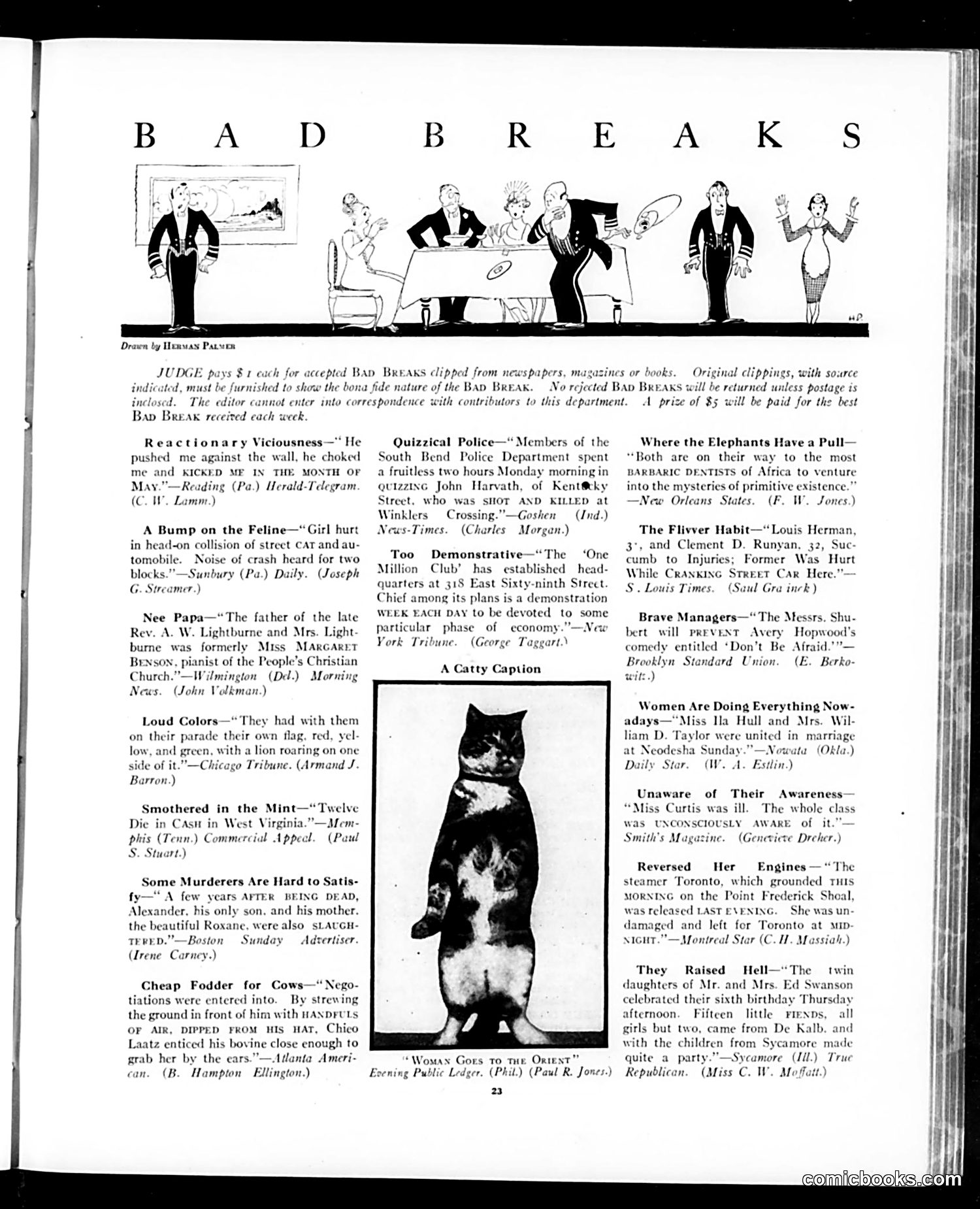
This page from *Judge* magazine showcases the "Bad Breaks" column—a humor feature rewarding readers $1 each for finding absurd or contradictory newspaper headlines and passages. The satirical premise mocks poor newspaper editing and unintentional funny phrasing. Examples include: a headline about someone "kicked in the month of May" (likely "mouth"); a cat-automobile collision described as making noise "for two blocks"; and a class being "unconsciously aware" of something. The column exploits malapropisms, illogical grammar, and accidentally suggestive phrasings clipped from real newspapers. The cartoon at top shows editors reviewing submissions at a desk, while the center features a photograph of a cat captioned "Woman Goes to the Orient"—likely a submitted example of a mismatched caption. This format allowed readers to participate in mocking American journalism's sloppiness, a popular early-20th-century pastime reflecting growing media criticism.
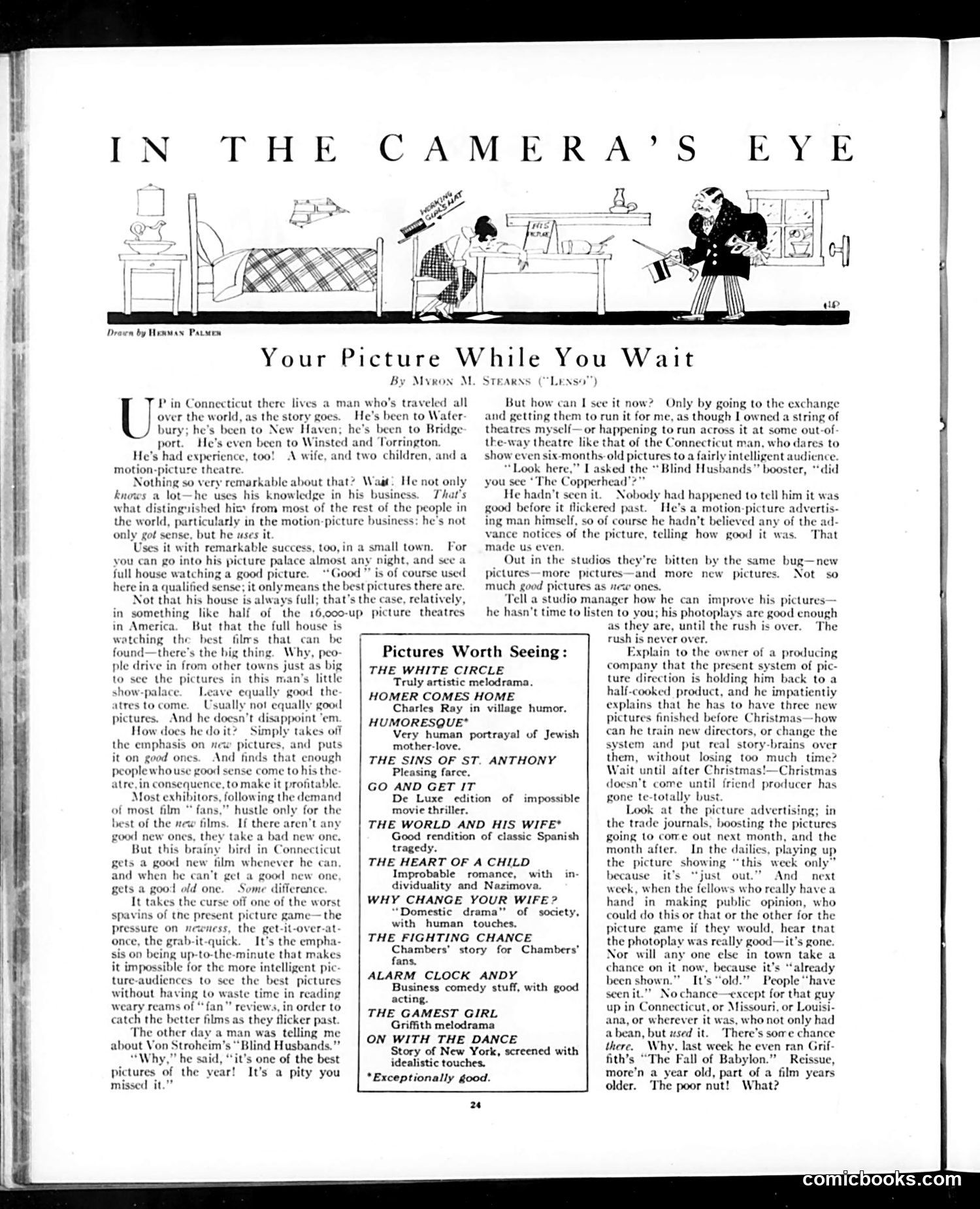
This article by Myron M. Stearns critiques the film industry's obsession with novelty over quality. The satire centers on a Connecticut theater owner who succeeds by showing *good* older films alongside new releases—a radical approach in an era fixated on current pictures. The piece mocks the industry's "rush" mentality: studios claim they're "too busy" to improve pictures, and exhibitors slavishly chase whatever's newest, regardless of quality. Trade publications boost mediocre films through hype, forcing audiences to read exhaustive reviews just to find worthwhile entertainment. The Connecticut man's strategy—deliberately programming six-month-old quality films—exposes this absurdity. He proves intelligent audiences exist and will patronize theaters offering genuine value rather than novelty-chasing. The accompanying film recommendations (melodramas, comedies) represent the "good pictures" worth reviving rather than abandoned. The cartoon (by Hewman Parscen) likely visualizes this contrast between discriminating and herd-mentality film consumption.
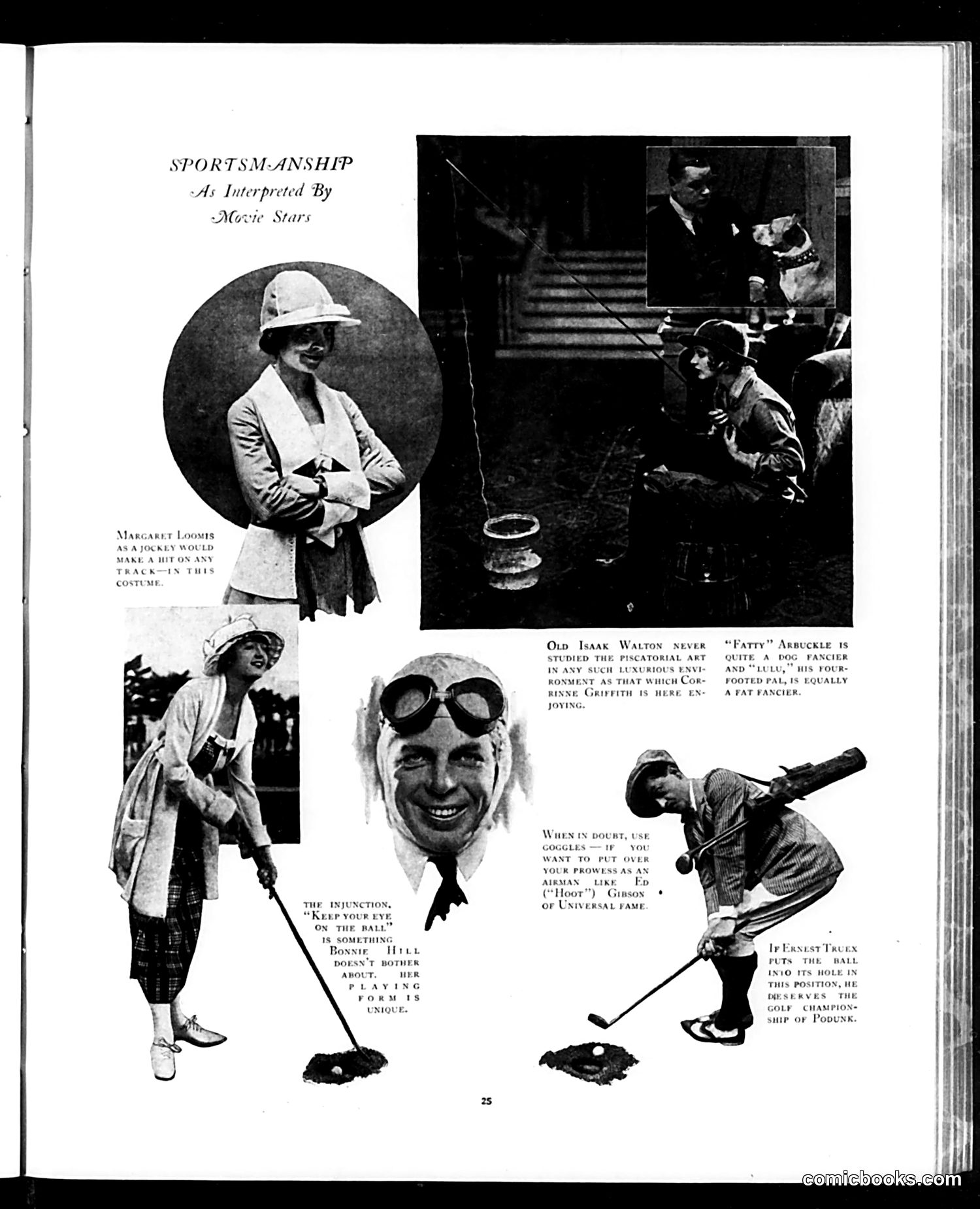
This Judge magazine page satirizes silent-film celebrities by mocking their athletic pretensions. Each photograph shows a famous actor or actress attempting a sport (golf, fishing, aviation, dog-fancying, jockey riding) while the captions humorously undercut their competence or highlight their vanity. The satire's point: Hollywood stars, despite their fame and resources, are often ridiculous or incompetent athletes. Margaret Loomis as a jockey, "Bonnie" Boyd golfing with improper form, and Ed Gibson using goggles to appear skilled—these are portrayed as laughable affectations. The references to Corinne Griffith's "luxurious environment" and "Fatty" Arbuckle's dog-fancying suggest wealth and pretension disconnected from actual sporting ability. The satire reflects contemporary skepticism toward celebrity culture overreaching beyond entertainment into serious pursuits.
This page reviews a French play by Eugène Brieux about post-WWI cultural clash. The cartoon header "The Show Shop" frames theatrical criticism. The plot concerns M. Charvet, a traditionalist French landowner, whose life is disrupted when American officer Sammy Smith arrives to develop his estate. More provocatively, Charvet's son Henri falls for Nelly, an American woman, intending to marry her and move to Chicago. The satire contrasts French conservatism (tradition, leisure, modest contentment) with American dynamism (practical efficiency, aggressive development, domination). The French characters are portrayed as passive, bewildered by American energy. Nelly embodies the "aggressive American woman" stereotype—domineering and determined to reshape Henri. The title's reference to "Lafayette" (French Revolutionary War hero) is ironic: where Lafayette once aided American independence, now Americans threaten French stability by literally uprooting estates and emotionally conquering French youth through marriage. The piece reflects post-WWI anxieties about American cultural and economic dominance replacing European tradition.
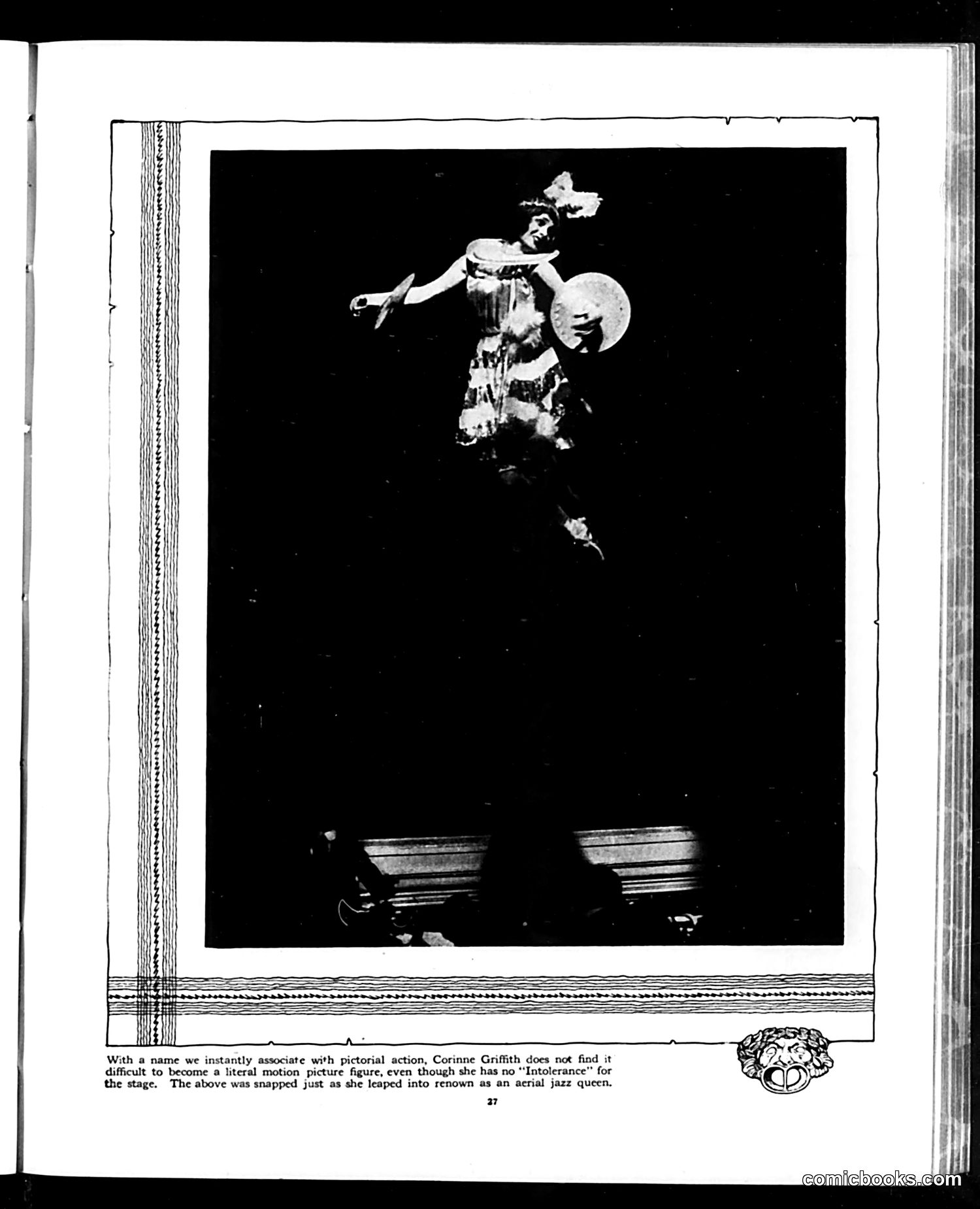
This page features a photograph (rather than a cartoon) of **Corinne Griffith**, a silent film actress, captured mid-leap in an elaborate costume with a fan-like prop, against a dark theatrical backdrop. The accompanying text explains that despite Griffith's name being associated with "pictorial action," she doesn't find it difficult to become a "literal motion picture figure"—suggesting wordplay on her surname and her physical expressiveness on stage. The reference to her as an "aerial jazz queen" indicates this depicts a dance performance, likely from a theatrical revue. The humor appears to derive from the pun on her name combined with her athletic performance style, which was apparently notable enough for *Judge* magazine's satirical commentary on entertainment personalities of the era.
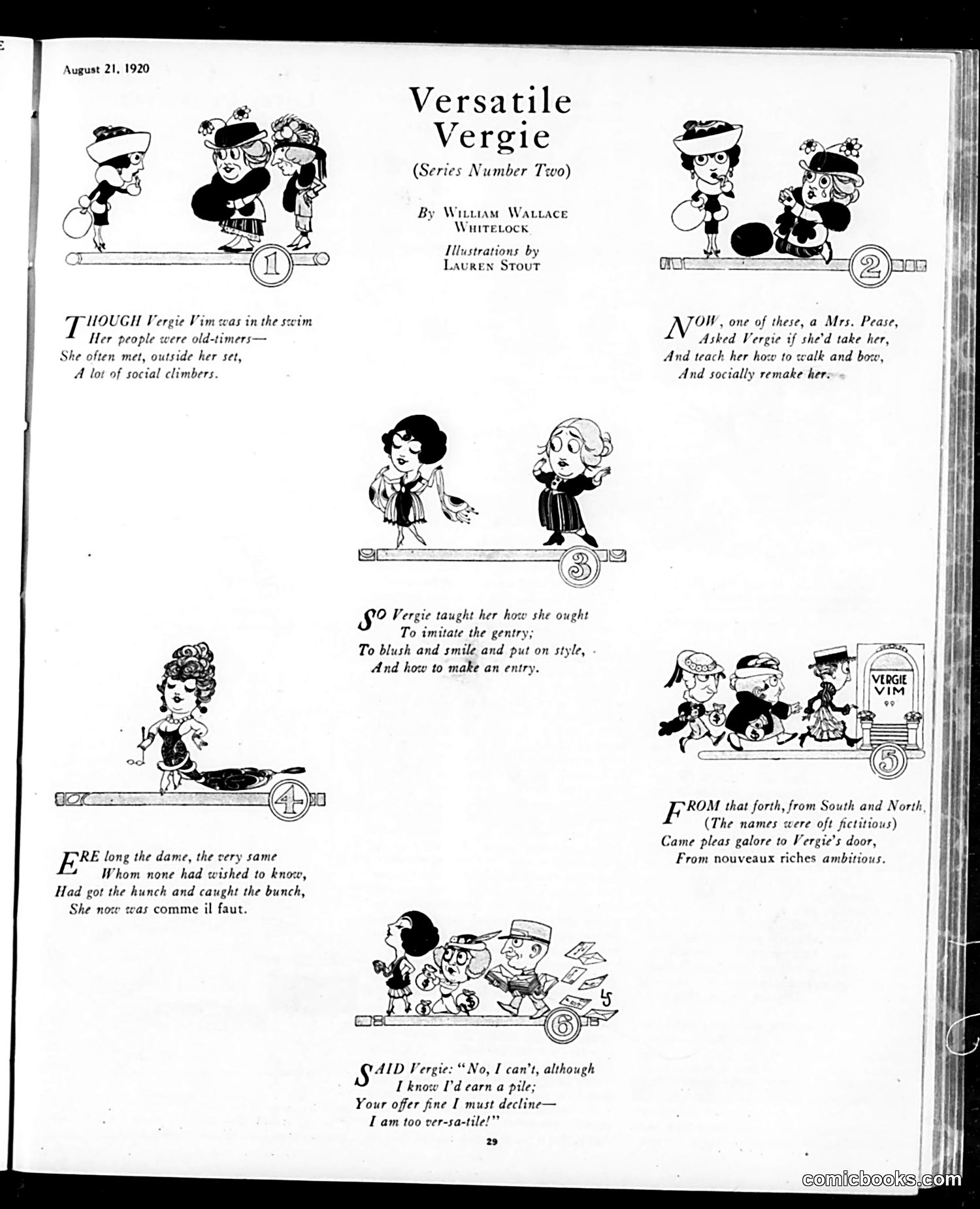
This illustrated story satirizes the social climbing and etiquette coaching that characterized the 1920s. Vergie Vim, a woman from an old-money family initially dismissed by society ("none had wished to know"), becomes a sought-after social consultant teaching nouveau riche aspirants how to behave like the gentry—how to walk, bow, smile, and "make an entry." The satire targets the newly wealthy ("nouveaux riches ambitious") desperately seeking social legitimacy by hiring coaching, while mocking Vergie's sudden value despite her previous obscurity. The final punchline—Vergie declining payment because she's "too ver-sa-tile"—plays on her name and her newfound versatility as a multi-talented social fixer. The piece reflects post-WWI anxieties about class fluidity and the rise of newly rich industrialists who lacked traditional social credentials.
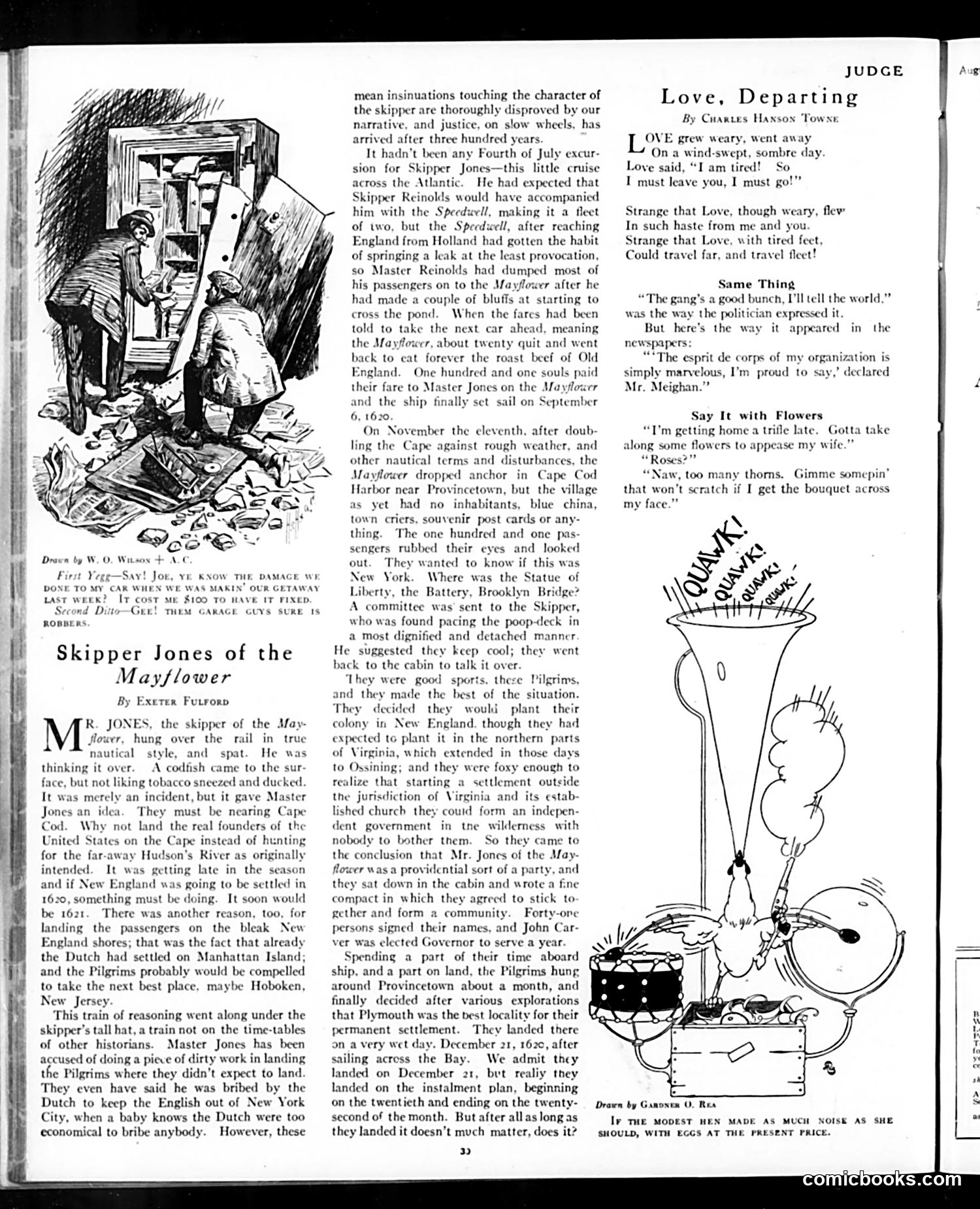
This page contains two satirical pieces. The left features "Skipper Jones of the Mayflower," a humorous alternate history suggesting Captain Jones intentionally landed the Pilgrims at Cape Cod rather than the Hudson River—supposedly to prevent Dutch settlement of Manhattan. The piece mocks both the Pilgrims' disappointment (expecting "the Statue of Liberty, the Battery, Brooklyn Bridge") and historiographical debates about Jones's motives, treating serious colonial history as comedic material. The top right contains "Love, Departing" and other brief humorous verse. Below is a joke cartoon about a man buying flowers to appease his wife after returning late, with the punchline that he'll damage them trying to conceal thorns—a domestic comedy about marital relations. The humor relies on anachronism, alternative history, and everyday domestic situations rather than specific political commentary.
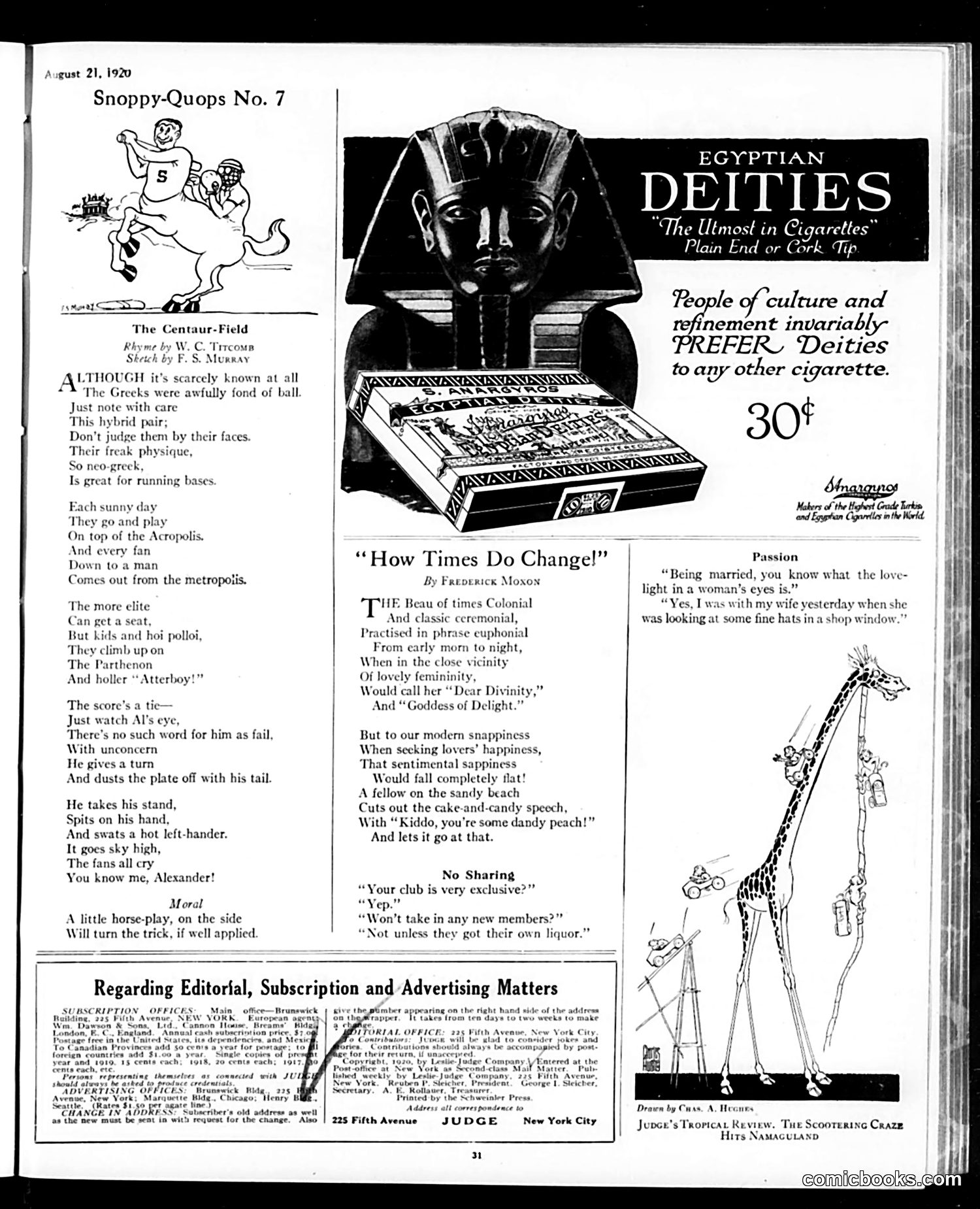
**"Snoppy-Quops No. 7"** is a humorous poem-cartoon about centaurs playing baseball. The joke juxtaposes classical Greek mythology with modern American sports: centaurs (half-man, half-horse creatures) are depicted as baseball players at the Parthenon, with fans shouting encouragement. The "moral" punchline about "horse-play" is a pun on the centaurs' literal horse nature. This is lighthearted wordplay rather than satire. **"How Times Do Change!"** contrasts romantic courtship styles: Colonial-era gentlemen used elaborate, flowery language ("Dear Divinity," "Goddess of Delight"), while 1920s modernity favors casual, direct speech ("Kiddo, you're some dandy peach!"). This reflects post-WWI cultural shift toward informality. **"No Sharing"** jokes about Prohibition-era exclusivity: a club won't admit new members unless they supply their own liquor—commenting on the illegal speakeasy culture of the 1920s. The page is primarily **advertising** (Egyptian Deities cigarettes at 30¢) and **editorial information**, with minor humor content.
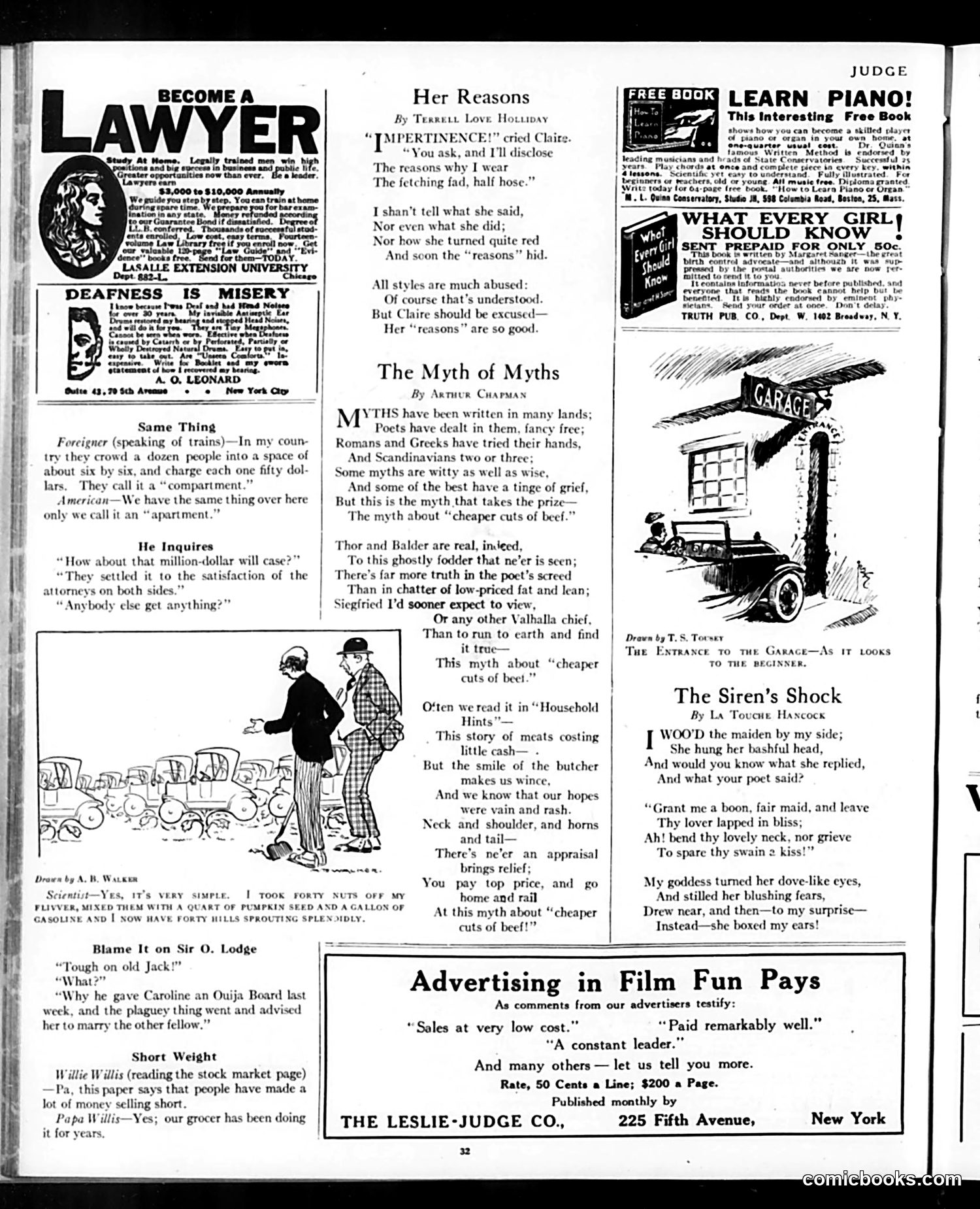
This page from *Judge* magazine contains several satirical pieces targeting early 20th-century American life: **"The Myth of Myths"** mocks the advertising claim of "cheaper cuts of beef"—a persistent myth that butchers' low prices are achievable. The satire suggests consumers perpetually hope for bargains while butchers smile knowingly, implying the cuts are never actually cheaper. **"Same Thing" cartoon** compares European and American transportation: foreigners pack trains into tiny "compartments" for high fees; Americans do the same but call it an "apartment"—suggesting American housing is equally cramped and expensive, just with a different name. **"Blame It on Sir O. Lodge"** references the Ouija Board fad, joking that a supernatural device gave relationship advice—implying the supernatural is more reliable than human judgment. **Short Weight** puns on "selling short" (financial term) versus grocer shortchanging customers—suggesting ordinary fraud predates stock market manipulation. The page also advertises piano lessons and a Margaret Sanger birth-control book, reflecting contemporary concerns.
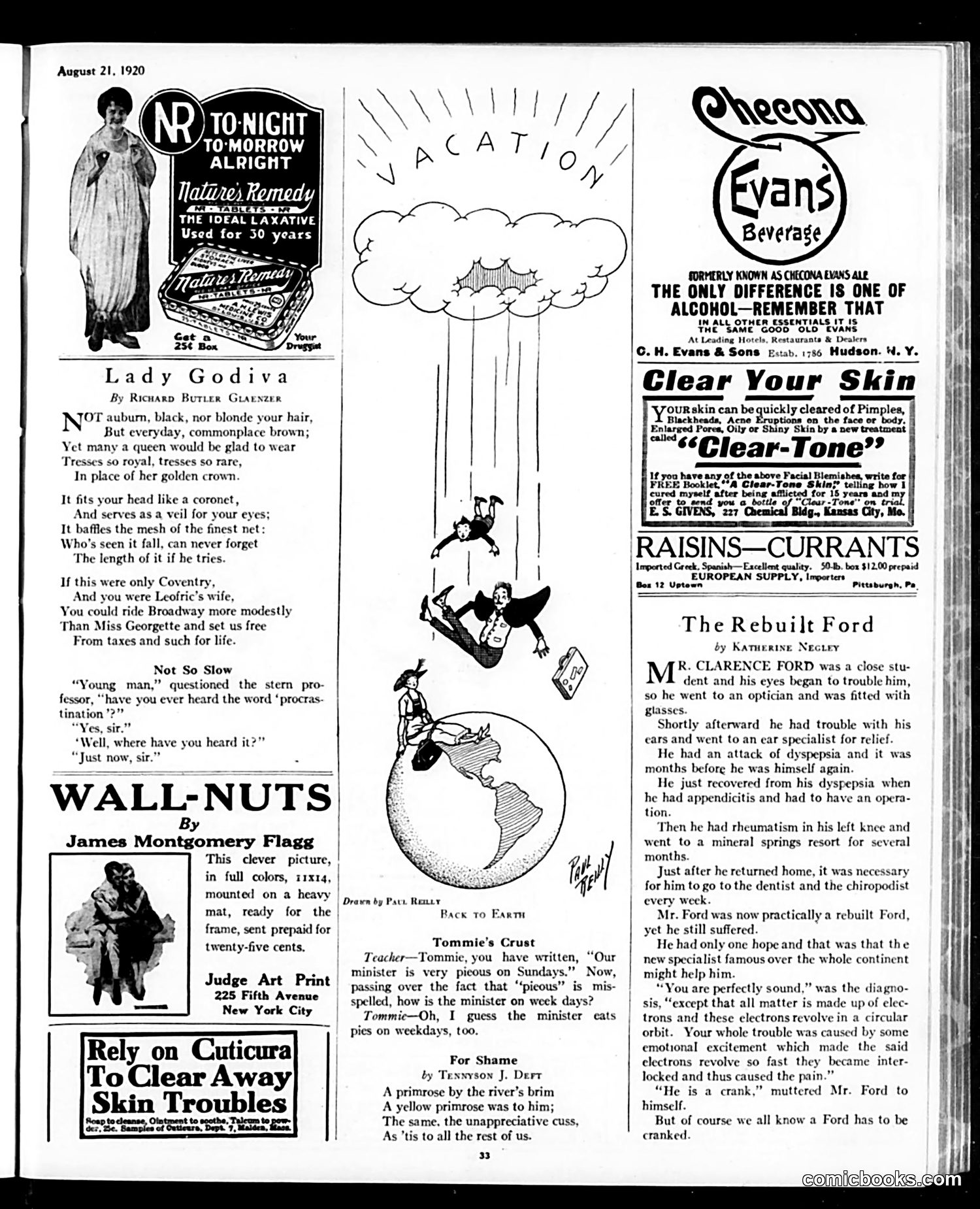
This page contains satirical humor typical of Judge's era. The central cartoon "Back to Earth" depicts people falling from clouds labeled "Vacation"—satirizing the end of summer holidays and return to mundane reality. The text jokes include: **"Not So Slow"**: A professor-student dialogue joking that the student learned the word "procrastination" only just now—a pun on the word's meaning. **"Tommie's Crust"**: A child mishears "pious" as "pies," creating a joke about the minister eating pies on weekdays versus being religious on Sundays—mocking both clerical hypocrisy and childhood literalism. **"The Rebuilt Ford"**: A longer satire on Henry Ford's famous automobile. Mr. Ford undergoes numerous medical procedures for various ailments, becoming "rebuilt" like his cars. The final joke—that "a Ford has to be cranked"—puns on both hand-cranking the vehicle and the notion that Ford (the man) is "cranky" or defective. The ads reflect 1920s consumer culture (skin remedies, raisins, beverages).
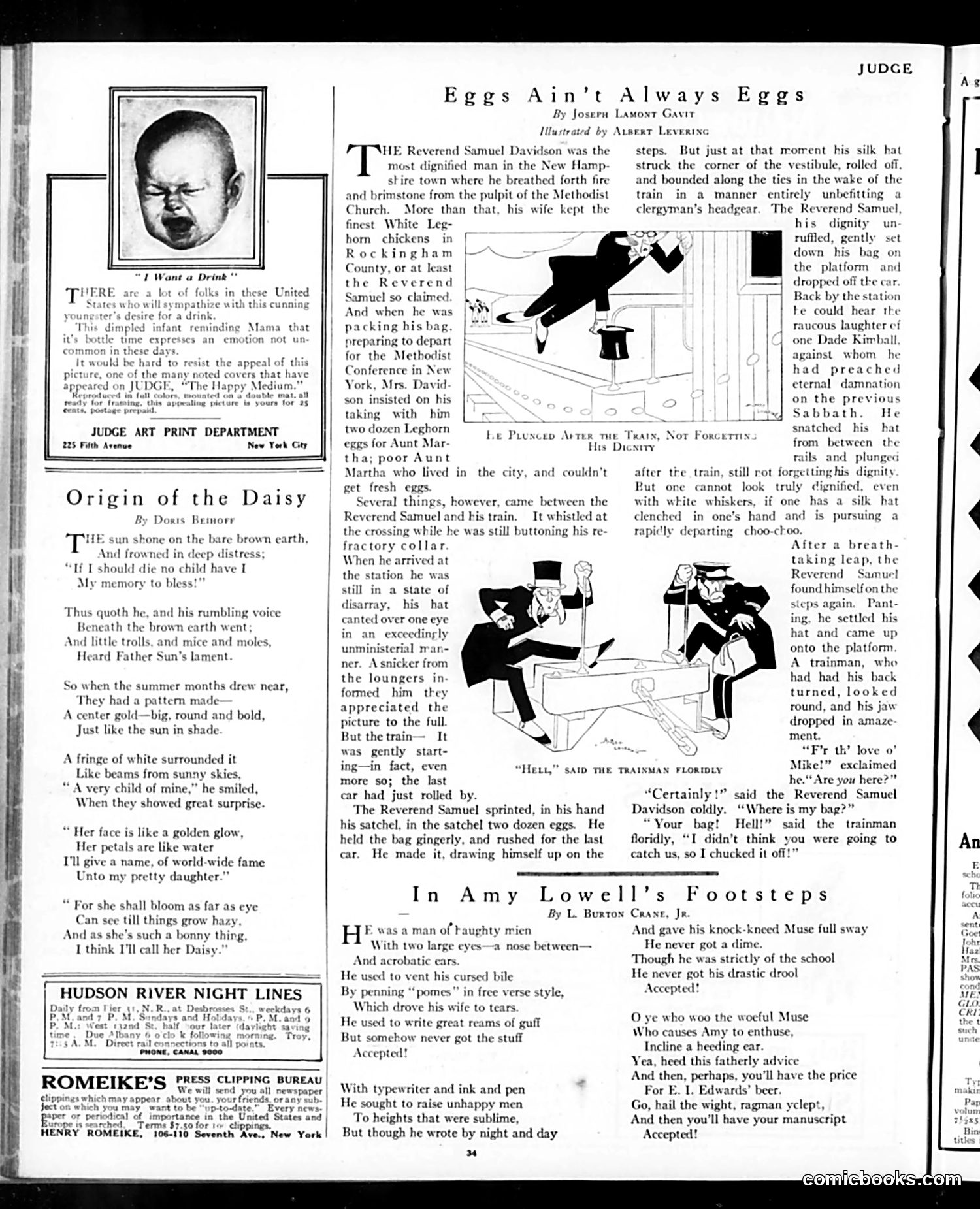
This page contains two main stories with illustrations: **"Origin of the Daisy"** is a whimsical fable where the sun, lonely without children, collaborates with earth creatures to create the first daisy flower—a poetic origin myth presented in verse. **"Eggs Ain't Always Eggs"** is a humorous narrative about Reverend Samuel Davidson, a dignified Methodist clergyman who rushes to catch a train while carrying two dozen eggs for his aunt. His silk hat gets knocked off by the train vestibule and bounces along the tracks. In his undignified scramble to retrieve it while clutching the egg bag, he's mocked by onlookers—particularly Dade Kimball, whom he'd recently condemned from the pulpit. The satire mocks religious hypocrisy: the stern preacher is reduced to an absurd, undignified figure, contradicting his moral authority. The page also includes period advertisements (Hudson River Night Lines steamship service, Romeike's press clipping bureau).
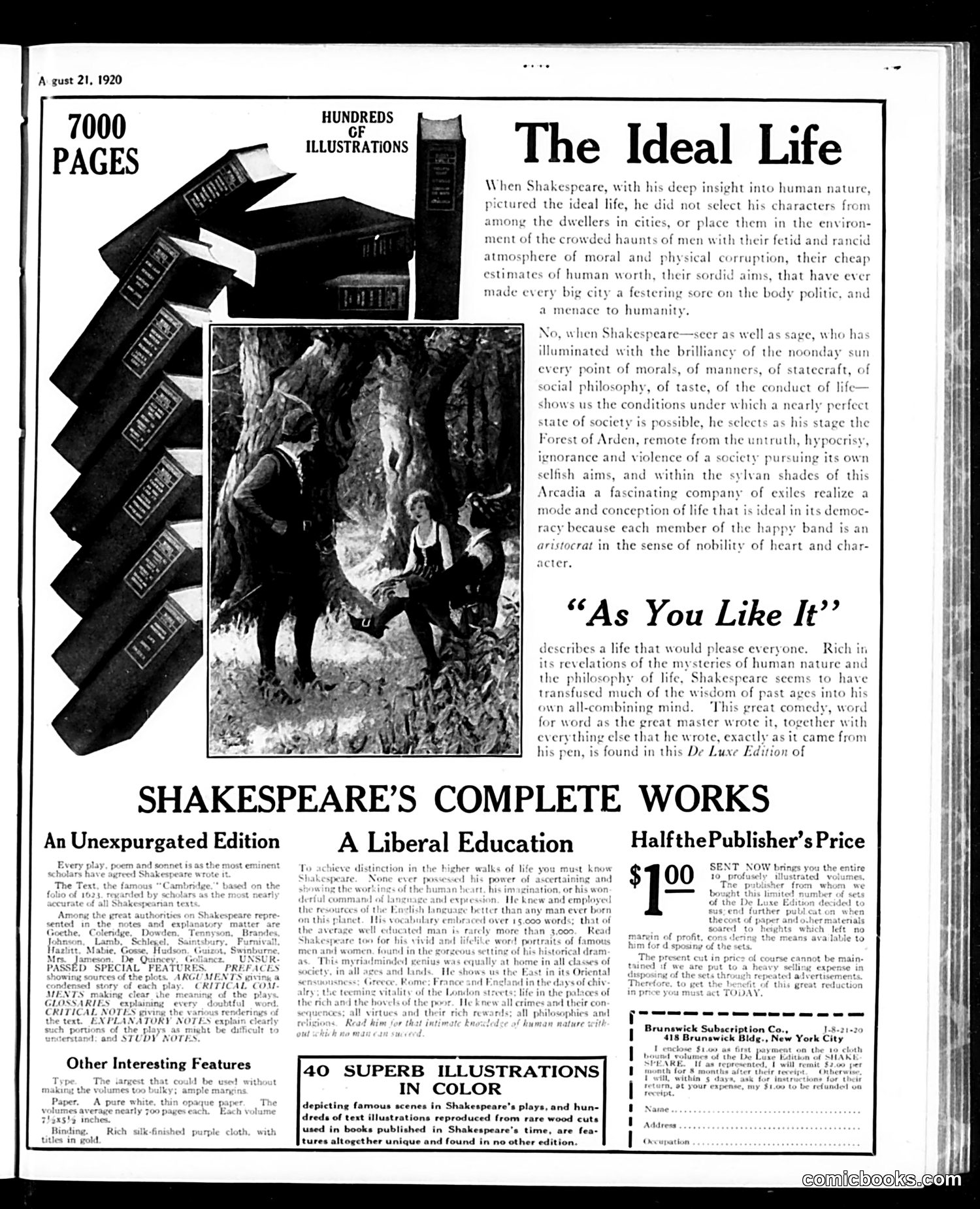
This is primarily a **book advertisement**, not a political cartoon. The page promotes the "De Luxe Edition" of Shakespeare's Complete Works, published August 21, 1920. The ad uses Shakespeare's *As You Like It* as its selling point, arguing that Shakespeare depicted "the ideal life" by setting his play in the Forest of Arden—a remote, rural space free from urban corruption and moral decay. The text contrasts Shakespeare's idealized pastoral settings with the "crowded haunts of men" in cities, which it describes as sources of "moral and physical corruption." This reflects **early 20th-century anxiety about urbanization**—a common concern during the industrial boom. The ad suggests that reading Shakespeare offers escape to an "ideal" society of noble characters and virtuous living. The page features illustrations, colored plates, and boasts "7000 pages" and "hundreds of illustrations." At $1.00, it positioned itself as an affordable "liberal education" for the average reader—a democratizing gesture toward high culture typical of this era.
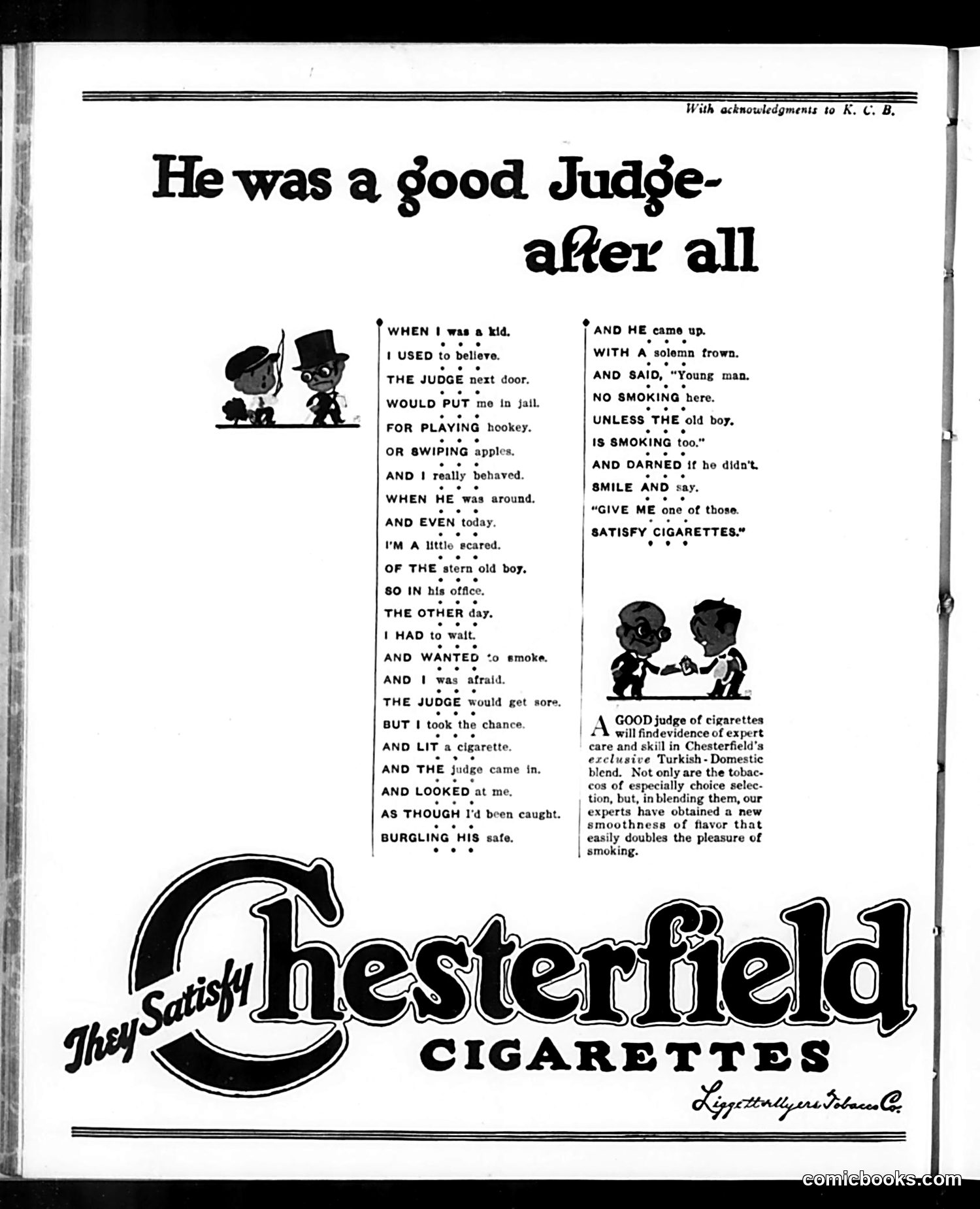
This is a **cigarette advertisement disguised as humorous storytelling** from the Chesterfield brand. The narrative describes a narrator who, as a child, feared the stern judge next door. Years later, the adult narrator smokes a cigarette in the judge's office. Rather than scold him, the judge—who appears equally stern initially—not only tolerates the smoking but *asks for a cigarette himself*, smiling in the process. The "joke" relies on the hypocrisy trope: authority figures who enforce rules they themselves break. By showing the judge as human and relatable (willing to share cigarettes), the ad normalizes smoking and positions Chesterfield cigarettes as a social lubricant that bridges generational and hierarchical gaps. The two small illustrations show figures in formal dress, emphasizing respectability. The advertisement credits "K.C.B.," likely the cartoonist. This reflects early-20th-century advertising before smoking's health dangers were widely acknowledged or regulated.