
Judge, 1920-08-21 · page 22 of 36
Judge — August 21, 1920 — page 22: what you’re looking at
What you’re looking at
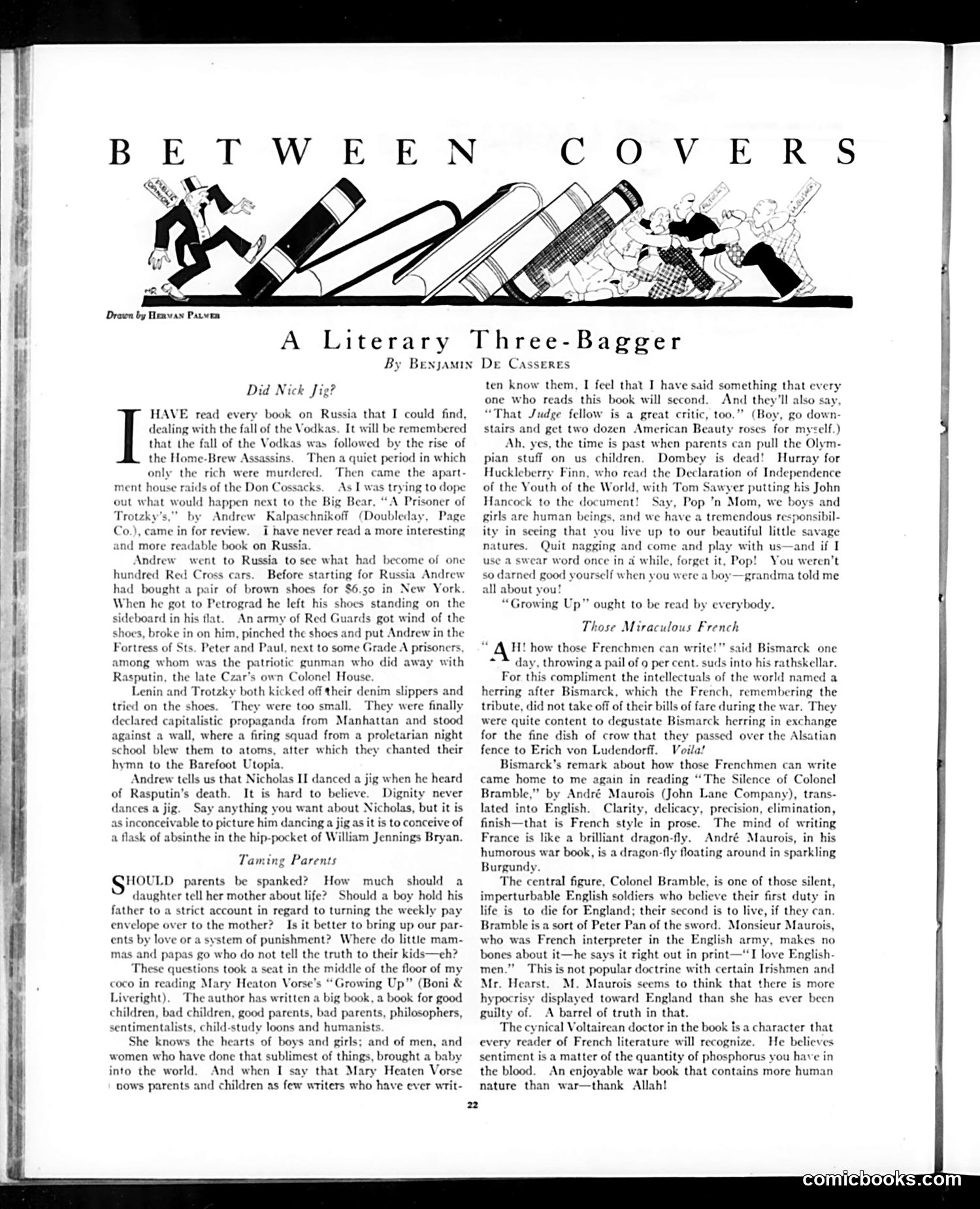
This is a **book review section** from Judge magazine, not primarily a political cartoon page. The header illustration by Hervas Palmer shows figures fleeing collapsing books—a visual metaphor for books' impact. The reviews discuss Russian literature and parenting books: 1. **"A Prisoner of Trotzky"** (Andrew Kalpaschnikoff): A satirical account mocking Soviet revolutionary figures (Lenin, Trotzky) through absurdist humor—Lenin and Trotzky fighting over seized capitalist shoes, for instance. The reviewer notes the book humorously depicts post-Revolution chaos. 2. **"Growing Up"** (Mary Heaton Vorse): Praised for understanding parent-child dynamics in modern times, contrasting outdated parental authority (referencing Dickens's *Dombey and Son*) with progressive attitudes championed by Huckleberry Finn. The satire targets both Soviet communism (as chaotic and absurd) and outdated American parenting styles, reflecting 1920s anxieties about social change.
📄 Transcribed text from this page (OCR, searchable)
Machine-transcribed from the original scan — historical spelling and the odd misread are preserved.
Drawn by Heavas Pawan By B Did Nick Jig? HAVE read every book on Russia that I could find, dealing with the fall of the Vodkas. It will be remembered that the fall of the Vodkas was followed by the rise of the Home-Brew Assassins. Then a quiet period in which only the rich were murdered. Then came the apart- ment house raids of the Don Cossacks. As I was trying to dope out what would happen next to the Big Bear, “A Prisoner of Trotzky by Andrew Kalpaschnikoff (Doubleday, Page Co.), came in for review. i have never read a more interesting d more readable book on Russia. Andrew went to Russia to sce what had become of one hundred Red Cross cars. Before starting for Russia Andrew had bought a pair of brown shoes for $6.50 in New York. When he got to Petrograd he left his shocs standing on the sideboard in his flat. An army of Red Guards got wind of the shoes, broke in on him, pinched the shoes and put Andrew in the Fortress of Sts. Peter and Paul, next to some Grade A prisoners among whom was the patriotic gunman who did away with Rasputin, the late Czar’s own Colonel House Lenin and Trotzky both kicked off their denim slippers and tried on the shoes. They were too small. They were finally declared capitalistic propaganda from Manhattan and stood against a wall, where a firing squad from a proletarian night school blew them to atoms, atter which they chanted their hymn to the Barefoot Utopia. Andrew tells us that Nicholas II danced a jig when he heard of Rasputin’s death. It is hard to believe. Dignity never dances a jig. Say anything you want about Nicholas, but it is as inconceivable to picture him dancing a is to conceive of a flask of absinthe in the hip-pocket of William Jennings Bryan. Taming Parents HOULD parents be spanked? How much should a daughter tell her mother about life? Should a boy hold his father to a strict account in regard to turning the weekly pay envelope over to the mother? Is it better to bring up our par- ents by love or a system of punishment? Where do little mam- mas and papas go who do not tell the truth to their kids—eh? These questions took a seat in the middle of the floor of my coco in reading Mary Heaton Vorse’s “Growing Up” (Boni & Liveright). The author has written a big book, a book for good children, bad children, good parents, bad parents, philosophers, sentimentalists, child-study loons and humanists. She knows the hearts of boys and girls; and of men, and women who have done that sublimest of things, brought a baby into the world. And when I say that Mary Heaten Vorse cows parents and children as few writers who have ever writ- A Literary Three-Bagger jamin De Casseres ten know them, I feel that I have said something that every one who reads this book will second. And they'll also say ‘That Judge fellow is a great critic, too.” (Boy, go dowr stairs and get two dozen American Beauty roses for myself.) Ah, yes, the time is past when parents can pull the Olym- pian stuff on us children. Dombey is dead! Hurray for Huckleberry Finn, who read the Declaration of Independence of the Youth of the World, with Tom Sawyer putting his John Hancock to the document! Say, Pop ’n Mom, we boys and girls are human beings, and we have a tremendous responsibil- ity in seeing that you live up to our beautiful little y natures. Quit nagging and come and play with us—a use a swear word once in a while, forget it, Pop! You weren’t so darned good yourself when you were a boy—grandma told me all about you! “Growing Up” ought to be read by everybody. Those Miraculous French “ H! how those Frenchmen can write!” said Bismarck one +> day, throwing a pail of 9 per cent. suds into his rathskellar. For this compliment the intellectuals of the world named a herring after Bismarck, which the French, remembering the tribute, did not take off of their bills of fare during the war. They were quite content to degustate Bismarck herring in exchange for the fine dish of crow that they passed over the Alsatian fence to Erich von Ludendorff. Voila! Bismarck’s remark about how those Frenchmen can write came home to me again in reading “The Silence of Colonel Bramble,” by André Maurois (John Lane Company lated into English. Clarity, delica precision, elimination, finish—that is French style in prose. The mind of writi France is like a brilliant dragon-fly. André Maurois, it humorous war book, is a dragon-fly floating around in sparkling Burgundy The central figure, Colonel Bramble, is one of those silent, imperturbable English soldiers who believe their first duty in life is to die for England; their second is to live, if they can Bramble is a sort of Peter Pan of the sword. Monsieur Maurois, who was French interpreter in the English army, makes no bones about it—he s: it right out in print—‘‘I love English- men.” This is not popular doctrine with certain Irishmen and Mr. Hearst. M. Maurois seems to think that there is more hypocrisy displayed toward England than she has ever been guilty of. A barrel of truth in that. The cynical Voltairean doctor in the book ts a character that every reader of French literature will recognize. He believes sentiment is a matter of the quantity of phosphorus you have in the blood. An enjoyable war book that contains more human nature than war—thank Allah!