
Judge, 1920-08-21 · page 30 of 36
Judge — August 21, 1920 — page 30: what you’re looking at
What you’re looking at
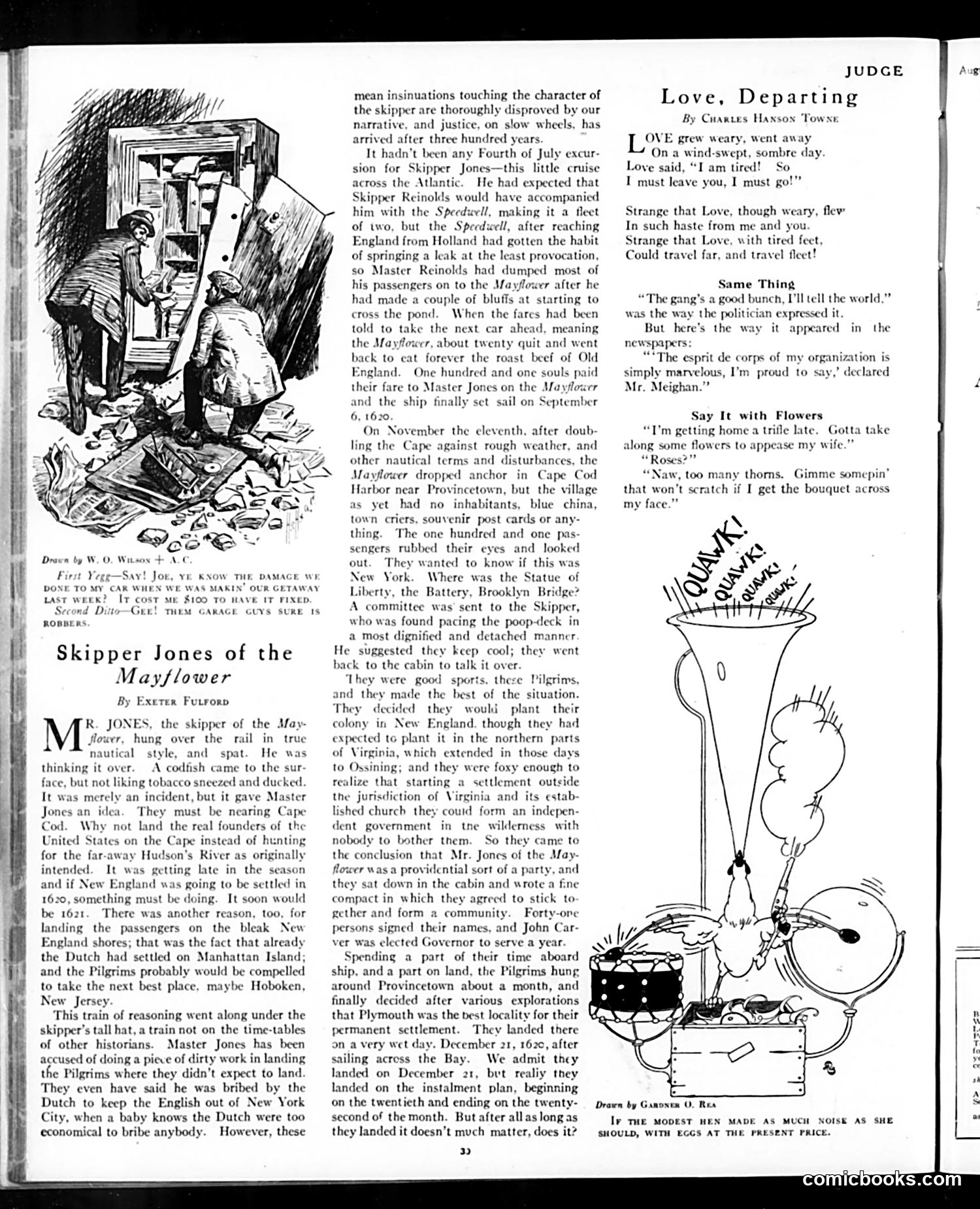
This page contains two satirical pieces. The left features "Skipper Jones of the Mayflower," a humorous alternate history suggesting Captain Jones intentionally landed the Pilgrims at Cape Cod rather than the Hudson River—supposedly to prevent Dutch settlement of Manhattan. The piece mocks both the Pilgrims' disappointment (expecting "the Statue of Liberty, the Battery, Brooklyn Bridge") and historiographical debates about Jones's motives, treating serious colonial history as comedic material. The top right contains "Love, Departing" and other brief humorous verse. Below is a joke cartoon about a man buying flowers to appease his wife after returning late, with the punchline that he'll damage them trying to conceal thorns—a domestic comedy about marital relations. The humor relies on anachronism, alternative history, and everyday domestic situations rather than specific political commentary.
📄 Transcribed text from this page (OCR, searchable)
Machine-transcribed from the original scan — historical spelling and the odd misread are preserved.
First Yege—Sav! Joe, ye KNOW THE DAMAGE WE DONE TO MY CAR WHEN WE WAS MAKIN’ OUR GETAWAY Last week? It cost Me $100 TO HAVE IT FIXED. Second Ditto—Gee! THe GARAGE GUYS SURE 18 ROBBERS Skipper Jones of the Mayflower By Exeter Futrorp R. JONES, the skipper of the May- flower, hung over the rail in true nautical style, and spat. He was thinking it over. A codfish came to the sur- face, but not liking tobacco sneezed and ducked. It was merely an incident, but it gave Master Jones an idea. They must be nearing Cape Cod. Why not land the real founders of the United States on the Cape instead of hunting for the far-away Hudson's River as originally intended. It was getting late in the season and if New England was going to be settled in 1620, something must be doing. It soon would be 1621. There was another reason, too, for landing the passengers on the bleak New England shores; that was the fact that already the Dutch had settled on Manhattan Island; and the Pilgrims probably would be compelled to take the next best place, maybe Hoboken, New Jersey. This train of reasoning went along under the skipper’s tall hat, a train not on the time-tables of other historians. Master Jones has been accused of doing a piece of dirty work in landing the Pilgrims where they didn’t expect to land They even have said he was bribed by the Dutch to keep the English out of New York (e when a baby knows the Dutch were too economical to bribe anybody. However, these mean insinuations touching the character of the skipper are thoroughly disproved by our narrative, and justice, on slow wheels, has arrived after three hundred years It hadn't been any Fourth of July excur- sion for Skipper Jones—this little cruise across the Atlantic. He had expected that Skipper Reinolds would have accompanied him with the Speedwell, making it a fleet of two, but the Speedwell, after reaching England from Holland had gotten the habit of springing a leak at the least provocation, so Master Reinolds had dumped most of his passengers on to the Mayflower after he had made a couple of bluffs at starting to cross the pond. When the fares had been told to take the next car ahead, meaning the Mayflower, about twenty quit and went back to cat forever the roast beef of Old England. One hundred and one souls paid their fare to Master Jones on the Mayflower and the ship finally set: sail on September 6, 1620 On November the eleventh, after doub- ling the Ca against rough weather, and other nautical terms and disturbances, the Mayflower dropped anchor in Cape Cod Harbor near Provincetown, but the village as yet had no inhabitants, blue china, town criers, souvenir post cards or any- thing. The one hundred and one pas- sengers rubbed their eyes and looked out. They wanted to know if this was New York. Where was the Statue of Liberty, the Battery, Brooklyn Bridge? A committee was sent to the Skipper, who was found pacing the poop-deck in a most dignified and detached manner He suggested they keep cool; they went back to the cabin to talk it over. ‘They were good sports. these Pilgrim and they made the best of the situation. They decided they would plant the colony in New England. though they expected to plant it in the northern parts of Virginia, which extended in those day to Ossining; and they were foxy enough to realize that starting a settlement outside the jurisdiction of Virginia and its estab- lished church they could form an indepen- dent government in tne wilderness with nobody to bother them. So they came to the conclusion that Mr. Jones of the May- flower was a providential sort of a party, and they sat down in the cabin and wrote a fine compact in which they agreed to stick to gether and form a community. Forty-one persons signed their names, and John Car- ver was elected Governor to serve a year. Spending a part of their time aboard ship. anda part on land, the Pilgrims hung around Provincetown about a month, and finally decided after various explorations that Plymouth was the best locality for their permanent settlement. They landed there ona y wet day. December 21, 162¢, after sailing acress the Bay. We admit tiry landed on December 21, but realiy they landed on the instalment plan, beginning on the twentieth and ending on the twenty- second of the month. But after all as long as they landed it doesn’t much matter, does it? » JUDGE Love, Departing By Cuantes Haxsox Towne OVE grew wear away On a wind-swept, sombre day. Love said, “I am tired! So I must leave you, I must go!" Strange that Love, though weary, flew’ In such haste from me and you Strange that Love, with tired feet, Could travel far, and travel feet! Same Thing “The gang's a good bunch, I'll tell the world,” was the way the politician expressed it. But here’s the way it appeared in newspaper ““The esprit de corps of my organiza simply marvelous, I’m proud to say Mr. Meighan.” the Say It with Flowers “I'm getting home a trifle late. Gotta take along some flowers to appease my wife.” “Ros “Naw, too many thorns. Gimme somepin’ that won't scratch if I get the bouquet across Drawn by Ganonex O. Res Iv THE MODEST HEN MADE AS MUCH NOISE AS SHE SHOULD, WITH EGGS AT THE PRESENT PRICE.