
Judge, 1920-08-21 · page 26 of 36
Judge — August 21, 1920 — page 26: what you’re looking at
What you’re looking at
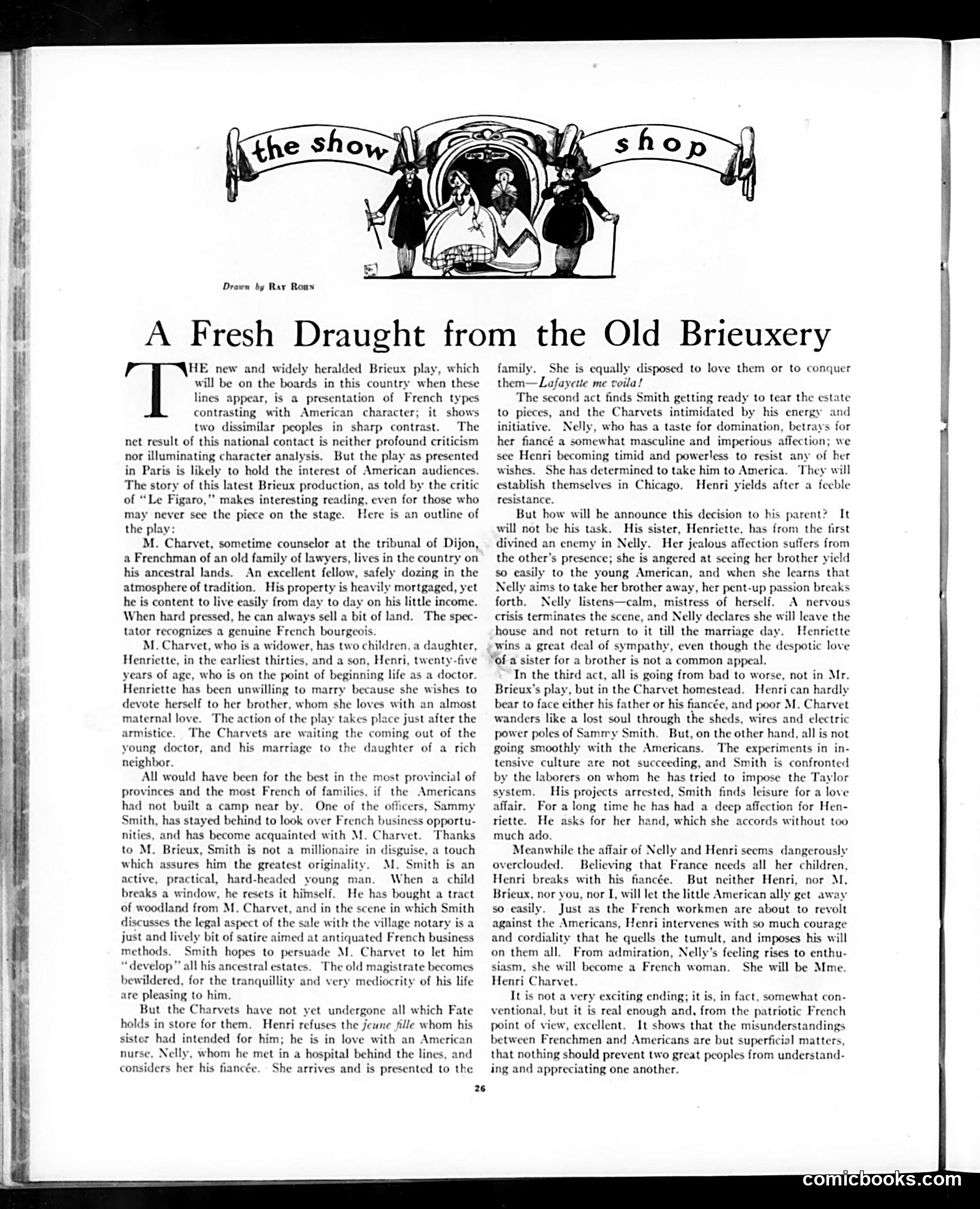
This page reviews a French play by Eugène Brieux about post-WWI cultural clash. The cartoon header "The Show Shop" frames theatrical criticism. The plot concerns M. Charvet, a traditionalist French landowner, whose life is disrupted when American officer Sammy Smith arrives to develop his estate. More provocatively, Charvet's son Henri falls for Nelly, an American woman, intending to marry her and move to Chicago. The satire contrasts French conservatism (tradition, leisure, modest contentment) with American dynamism (practical efficiency, aggressive development, domination). The French characters are portrayed as passive, bewildered by American energy. Nelly embodies the "aggressive American woman" stereotype—domineering and determined to reshape Henri. The title's reference to "Lafayette" (French Revolutionary War hero) is ironic: where Lafayette once aided American independence, now Americans threaten French stability by literally uprooting estates and emotionally conquering French youth through marriage. The piece reflects post-WWI anxieties about American cultural and economic dominance replacing European tradition.
📄 Transcribed text from this page (OCR, searchable)
Machine-transcribed from the original scan — historical spelling and the odd misread are preserved.
TF ee me Drawn by Rav Rony A Fresh Draught from the Old Brieuxery HE new and widely heralded Brieux play, which will be on the boards in this country when these lines appear, is a presentation of French types contrasting with American character; it shows two dissimilar peoples in sharp contrast. he net result of this national contact is neither profound criticism nor illuminating character analys But the play as presented in Paris is likely to hold the interest of American audiences. The story of this latest Brieux production, as told by the critic of “Le Figaro,” makes interesting reading, even for those who may never see the piece on the stage. Here is an outline of the play: M. Charvet, sometime counselor at the tribunal of Dijon, a Frenchman of an old family of lawyers, lives in the country on his ancestral lands. An excellent fellow, safely dozing in the atmosphere of tradition. His property is heavily mortgaged, yet he is content to live easily from day to day on his little income. When hard pressed, he can always sell a bit of land. The spec- tator recognizes a genuine French bourgeois. M. Charvet, who is a widower, has two children, a daughter, Henriette, in the earliest thirties, and a son, Henri, twenty-five years of age, who is on the point of beginning life as a doctor. Henriette has been unwilling to marry because she wishes to devote herself to her brother, whom she loves with an almost maternal love. The action of the play takes place just after the armistice. The Charvets are waiting the coming out of the young doctor, and his marriage to the daughter of a rich neighbor. All would have been for the best in the most provincial of provinces and the most French of families, if the Americans h 1 not built a camp near by. One of the officers, Sammy mith, has stayed behind to look over French business opportu- nities, and has become acquainted with M. Charvet. Thanks to M. Brieux, Smith is not a millionaire in disguise, a touch which assures him the greatest originality. M. Smith is an active, practical, hard-headed young man. When a child breaks a window, he resets it himself. He has bought a tract of woodland from M. Charvet, and in the scene in which Smith discusses the legal aspect of the sale with the village notary is a just and lively bit of satire aimed at antiquated French business methods. Smith hopes to persuade M. Charvet to let him “develop” all his ancestral estates. The old magistrate becomes bewildered, for the tranquillity and very mediocrity of his life are pleasing to him. But the Charvets have not yet undergone all which Fate holds in store for them. Henri refuses the jeune fille whom his had intended for him; he is in love with an American Nelly, whom he met in a hospital behind the lines, and ders her his fiancée. She arrives and is presented to the nur con: 26 family. She is equally disposed to love them or to conquer them—Lafayette me voila! The second act finds Smith getting ready to tear the estate to pieces, and the Charvets intimidated by his energy and initiative. Nelly, who has a taste for domination, betrays for her fiancé a somewhat masculine and imperious affection; we see Henri becoming timid and powerless to resist any of her wishes. She has determined to take him to America. They will establish themselves in Chicago. Henri yields after a feeble resistance. But how will he announce this decision to his parent? It will not be his task. His sister, Henriette, has from the first divined an enemy in Nelly. Her jealous affection suffers from the other’s presence; she is angered at seeing her brother yield so easily to the young American, and when she learns that Nelly aims to take her brother away, her pent-up passion breaks forth. Nelly listens—calm, mistress of herself. A nervous crisis terminates the scene, and Nelly declares she will leave the house and not return to it till the marriage day. Henriette wins a great deal of sympathy, even though the despotic love “of a sister for a brother is not a common appeal. In the third act, all is going from bad to worse, not in Mr. Brieux’s play, but in the Charvet homestead. Henri can hardly bear to face either his father or his fiancée, and poor M. Charvet wanders like a lost soul through the sheds, wires and electric power poles of Sammy Smith. But, on the other hand, all is not going smoothly with the Americans. The experiments in in- tensive culture are not succeeding, and Smith is confronted by the laborers on whom he has tried to impose the Taylor ystem. His projects arrested, Smith finds leisure for a love flair. For along time he has had a deep affection for Hen- riette. He asks for her hand, which she accords without too much ado. Meanwhile the affair of Nelly and Henri seems dangerously overclouded. Believing that France needs all her children, Henri breaks with his fiancée. But neither Henri, nor M. Brieux, nor you, nor I, will let the little American ally get away so easily. Just as the French workmen are about to revolt against the Americans, Henri intervenes with so much courage and cordiality that he quells the tumult, and imposes his will on them all. From admiration, Nelly’s feeling rises to enthu- siasm, she will become a French woman. She will be Mme. Henri Charve It is not a very exciting ending; it is, in fact, somewhat con- ventional, but it is real enough and, from the patriotic French point of view, excellent. It shows that the misunderstandings between Frenchmen and Americans are but superficial] matters, that nothing should prevent two great pcoples from understand- ing and appreciating one another. Ccomicbooks.com