
A complete issue · 36 pages · 1920
Judge — June 19, 1920
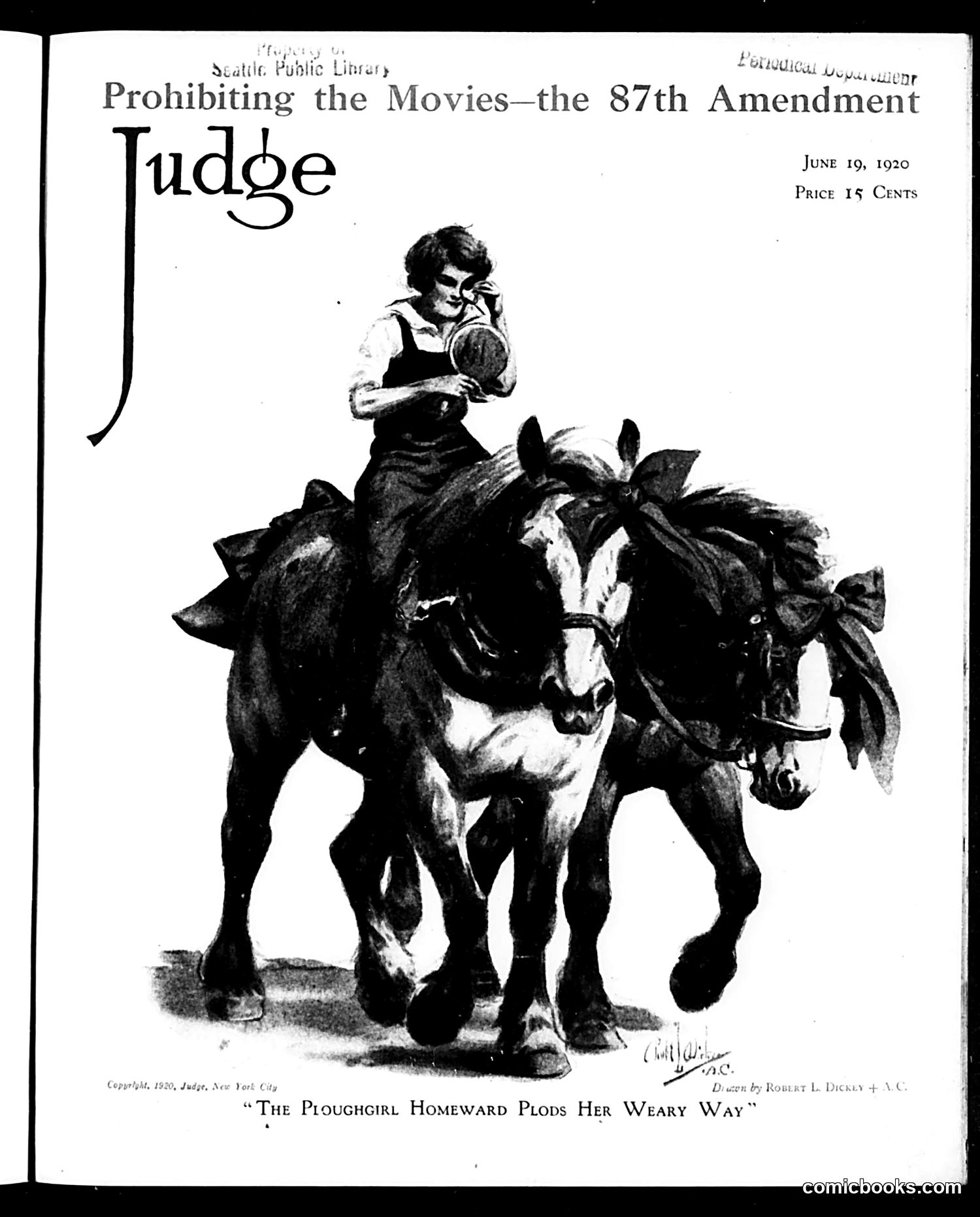
This *Judge* magazine cover from June 19, 1920 satirizes proposed prohibition of motion pictures—the "87th Amendment" referenced in the headline. The illustration shows a young farm girl riding horses homeward, captioned "The Ploughgirl Homeward Plods Her Weary Way." The satire equates movie prohibition with outdated rural labor: just as this ploughgirl represents pre-industrial drudgery, banning movies would return America to joyless, exhausting existence. The image contrasts innocent farm work with modern entertainment, suggesting that prohibiting films would eliminate one of the era's few accessible pleasures for ordinary people. This reflects 1920s debates over film censorship, when moral reformers sought to restrict cinema content or distribution, particularly regarding depictions of vice and sexuality.
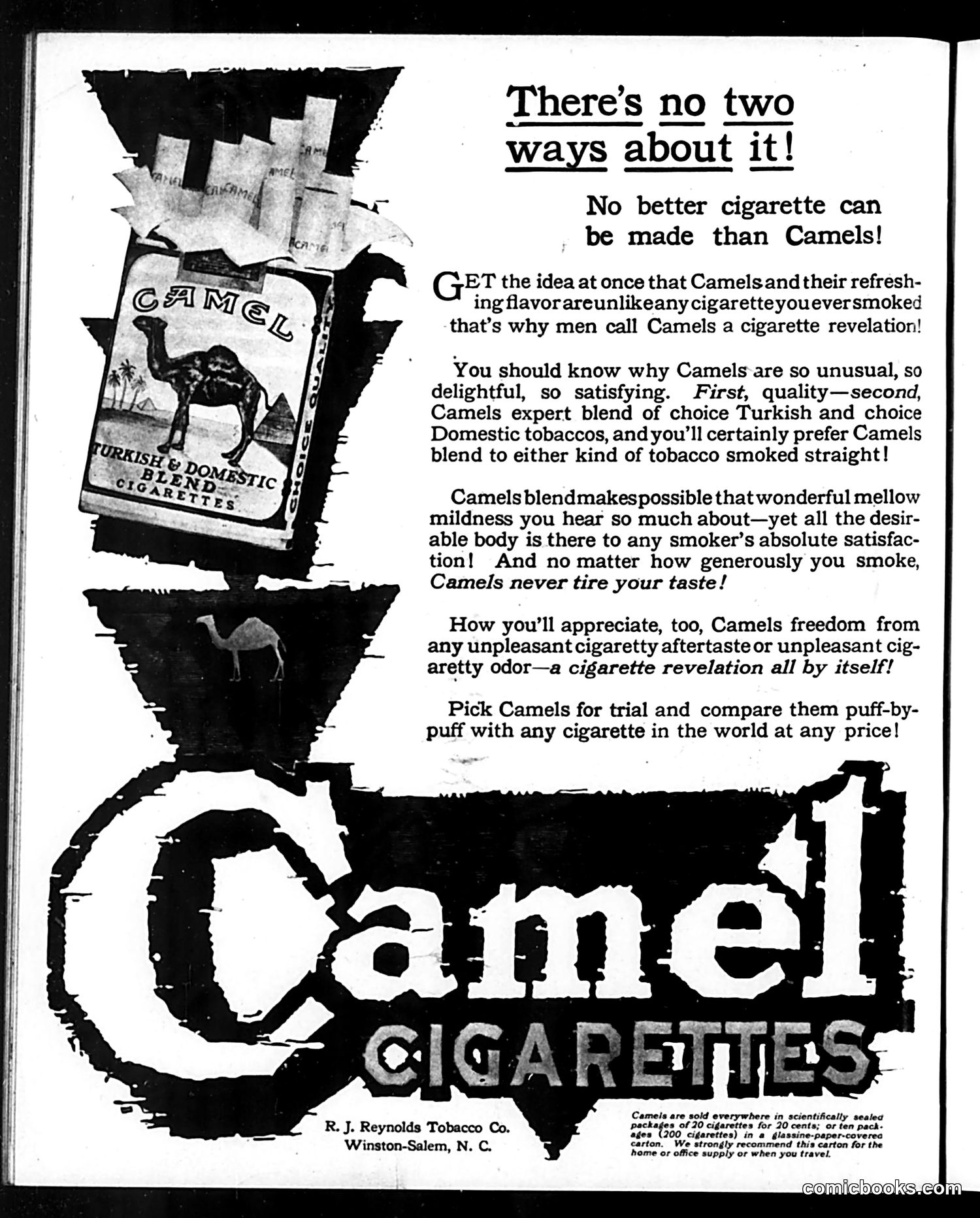
This is not a satirical cartoon page, but rather a **straightforward cigarette advertisement** for Camel cigarettes by R.J. Reynolds Tobacco Co. (Winston-Salem, N.C.). The page features promotional copy claiming Camels are superior due to their "blend of choice Turkish and choice Domestic tobaccos" and emphasizing qualities like "mellow mildness" and absence of "aftertaste or unpleasant cigarette odor." The visual elements include a Camel cigarette package and the iconic camel logo. The ad encourages consumers to compare Camels "puff-by-puff with any cigarette in the world." There is **no political satire or social commentary** here—this is commercial advertising typical of early-to-mid 20th century tobacco marketing, before health warnings were required.
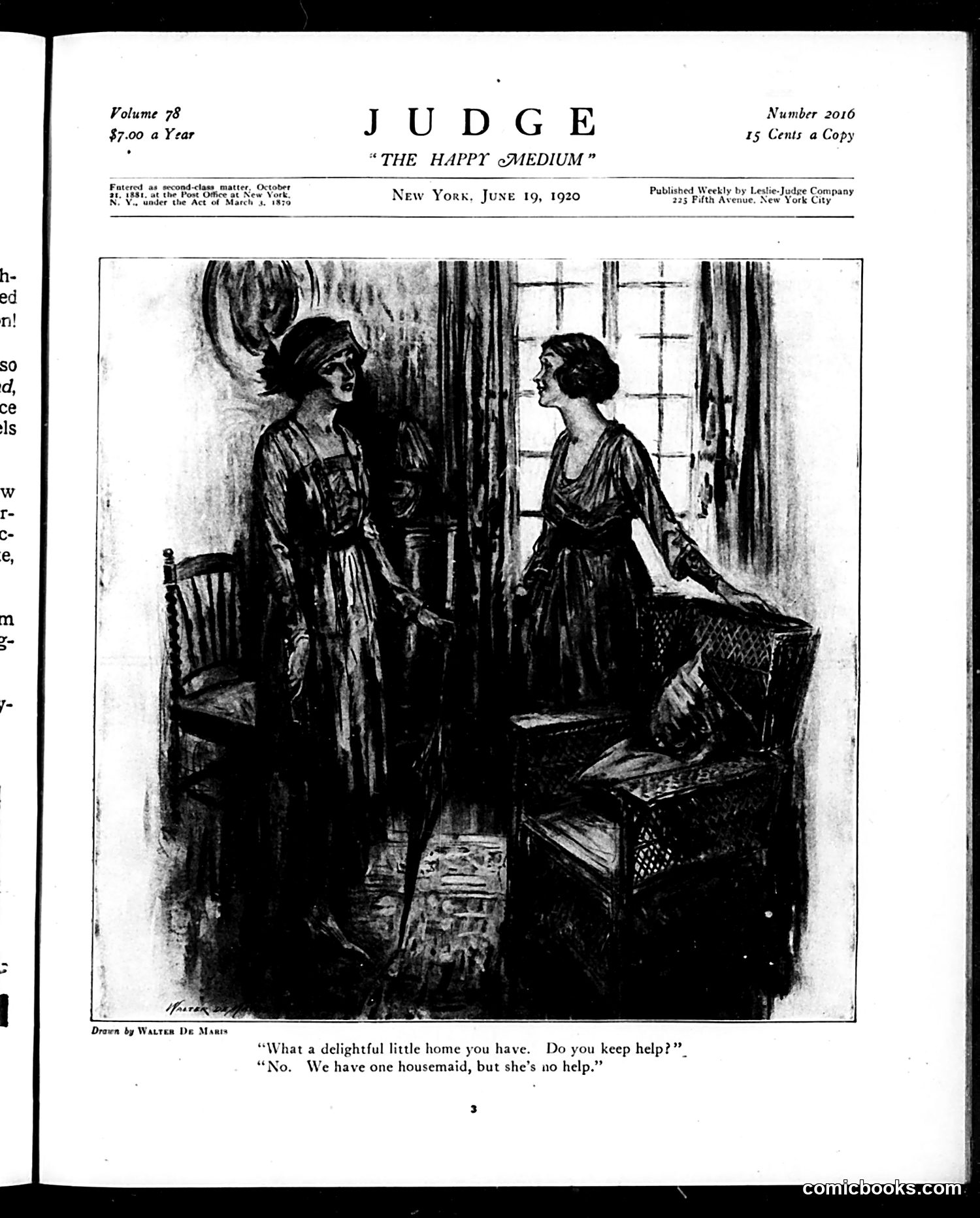
This page features a domestic humor cartoon drawn by Walter De Maris. Two women in 1920s dress converse in a home interior. One admires the other's "delightful little home," asking if she keeps help (hired household servants). The response—"We have one housemaid, but she's no help"—is a simple domestic joke about an incompetent servant. This reflects early 20th-century middle-class anxieties about domestic help. Post-WWI labor shortages made finding reliable household workers difficult, a common source of frustration and humor in period magazines. The joke relies on wordplay: the maid is physically present but practically useless, making her presence ironic rather than beneficial—a relatable complaint for Judge's target audience.
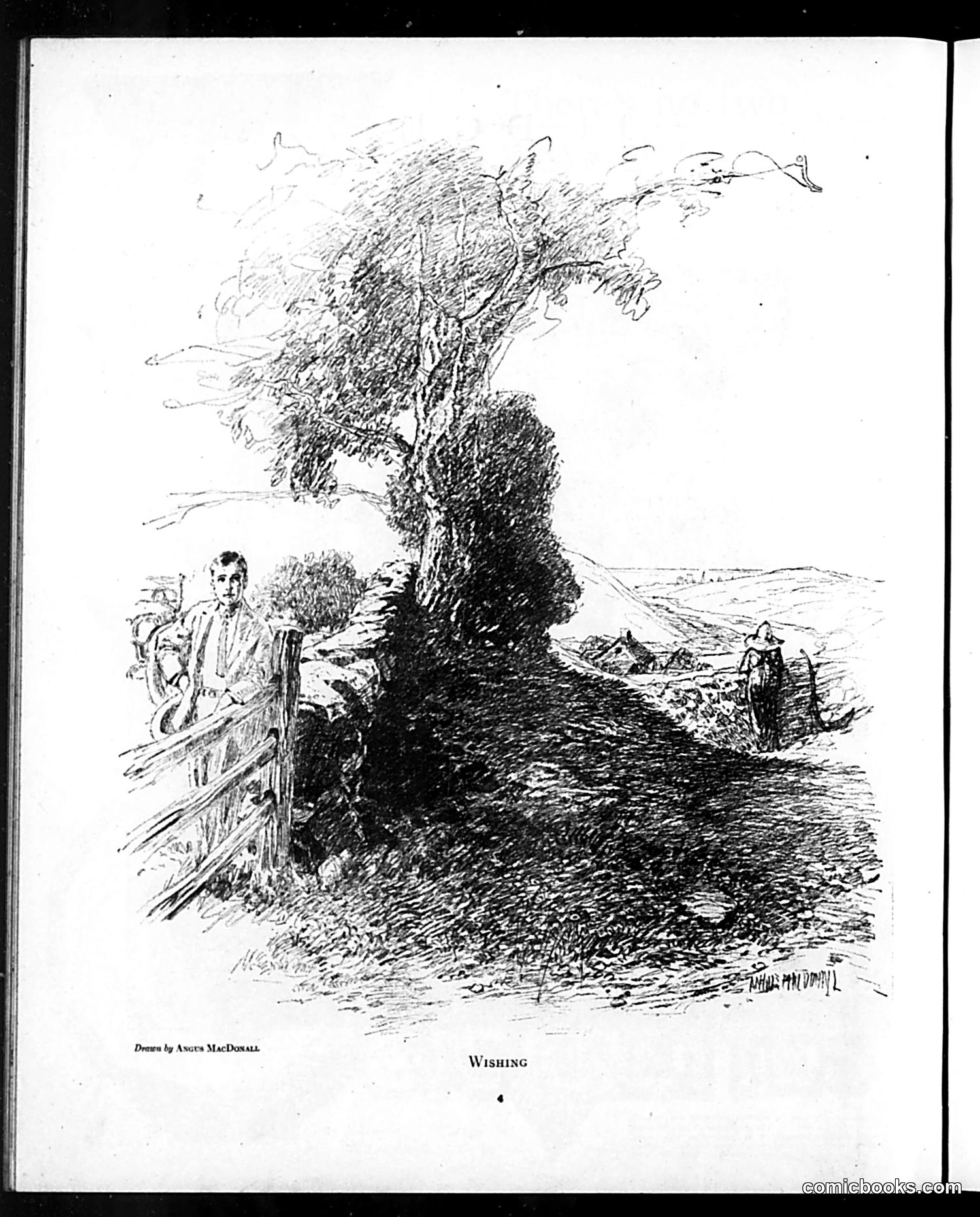
This sketch by Angus MacDonald depicts a rural scene titled "Wishing," showing a man at a wooden fence gazing toward a distant cottage or homestead. The composition suggests nostalgic longing—the figure appears to be a laborer or common man contemplating life beyond his present circumstances. The illustration likely satirizes working-class aspirations or romantic idealization of rural life, common themes in Judge magazine's social commentary. The artistic style and the man's posture convey a sense of yearning or dissatisfaction with his current station. Without additional context about the publication date or accompanying text, the specific political or social target remains unclear, though it appears to mock sentimental idealization of rural existence or unattainable dreams.
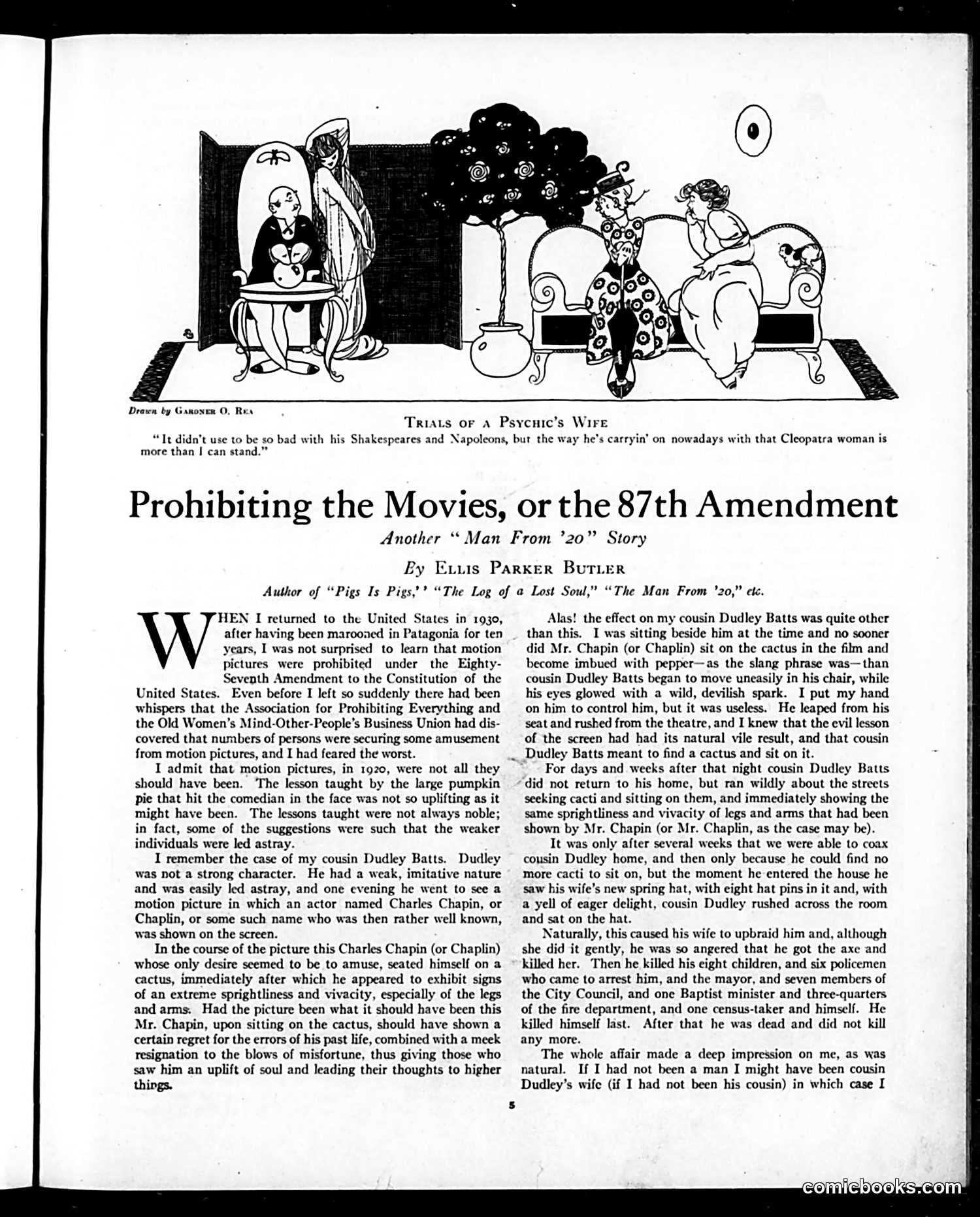
The cartoon titled "Trials of a Psychic's Wife" satirizes a husband obsessed with movies—specifically Charlie Chaplin films. The wife complains he's become insufferable, constantly mimicking Chaplin's mannerisms and sitting on cacti (referencing Chaplin's physical comedy). The accompanying story, "Prohibiting the Movies, or the 87th Amendment," mocks both movie censorship movements and Chaplin's influence on American culture. The author describes how his cousin became so enamored watching Chaplin that he imitated the actor's behaviors at home, ultimately leading to domestic chaos and his wife's violent response. The satire targets 1920s moral panic about cinema's corrupting influence on audiences while also poking fun at Chaplin's then-enormous cultural impact.
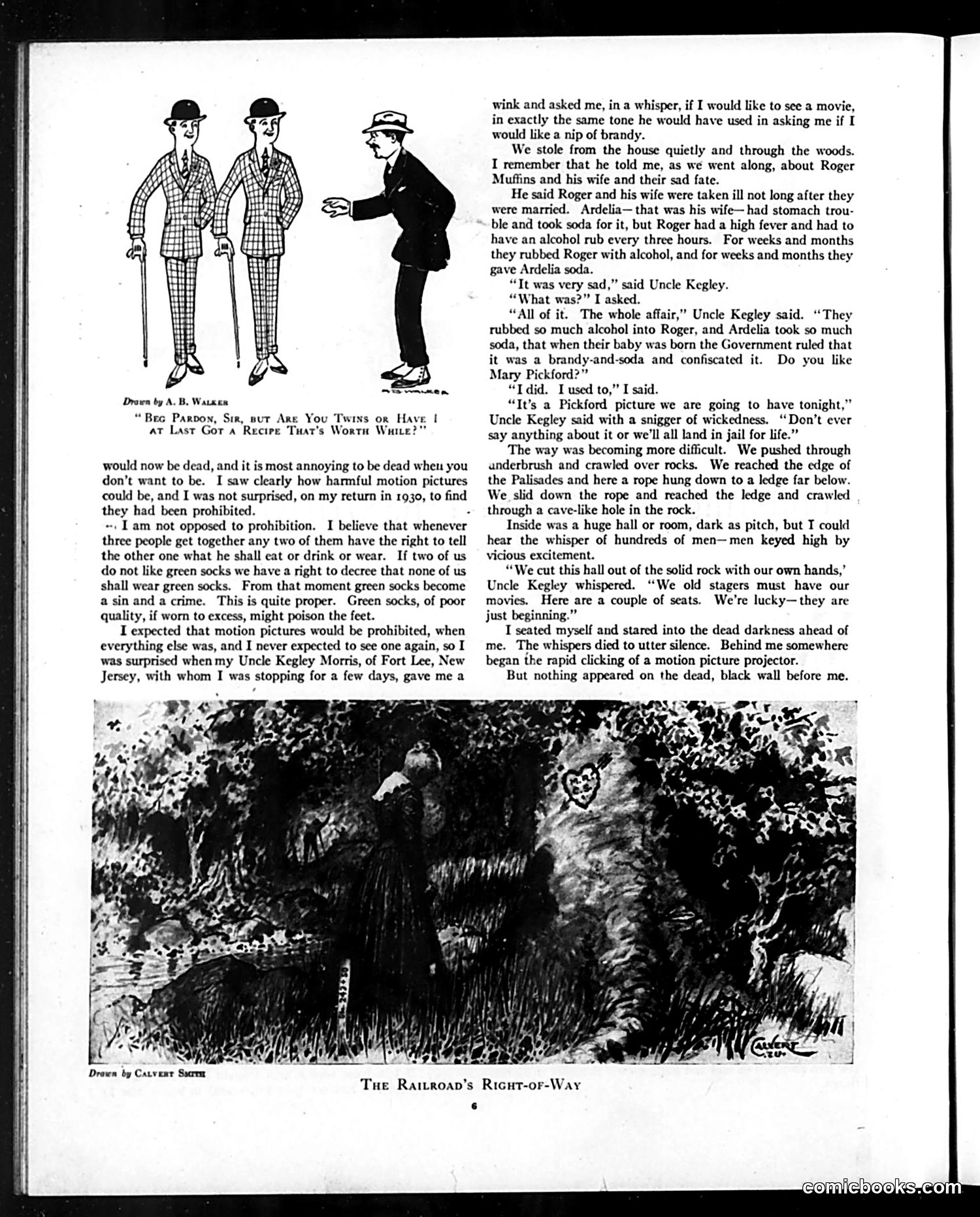
The top cartoon by A.B. Walker, titled "Red Pardon, Sir, but Are You Twins or Have I Just Got a Dizzy Spell?", mocks identical twins or doppelgängers through visual humor—a man addressing two identically-dressed figures. The main text is a story about motion picture prohibition. The narrator opposes banning movies, arguing that three people shouldn't dictate morality for everyone. He references a specific case: Roger and Ardelia Muffins, whose infant was born with an alcohol-related condition after they used soda (containing alcohol) as medicine during prohibition. The narrator calls this a "Pickford picture"—likely referencing Mary Pickford, a famous silent film actress—as commentary on how real-life tragedies become sensationalized entertainment. The bottom illustration by Calvert Smith, "The Railroad's Right-of-Way," depicts a cave scene, though its satirical meaning remains unclear without additional context.
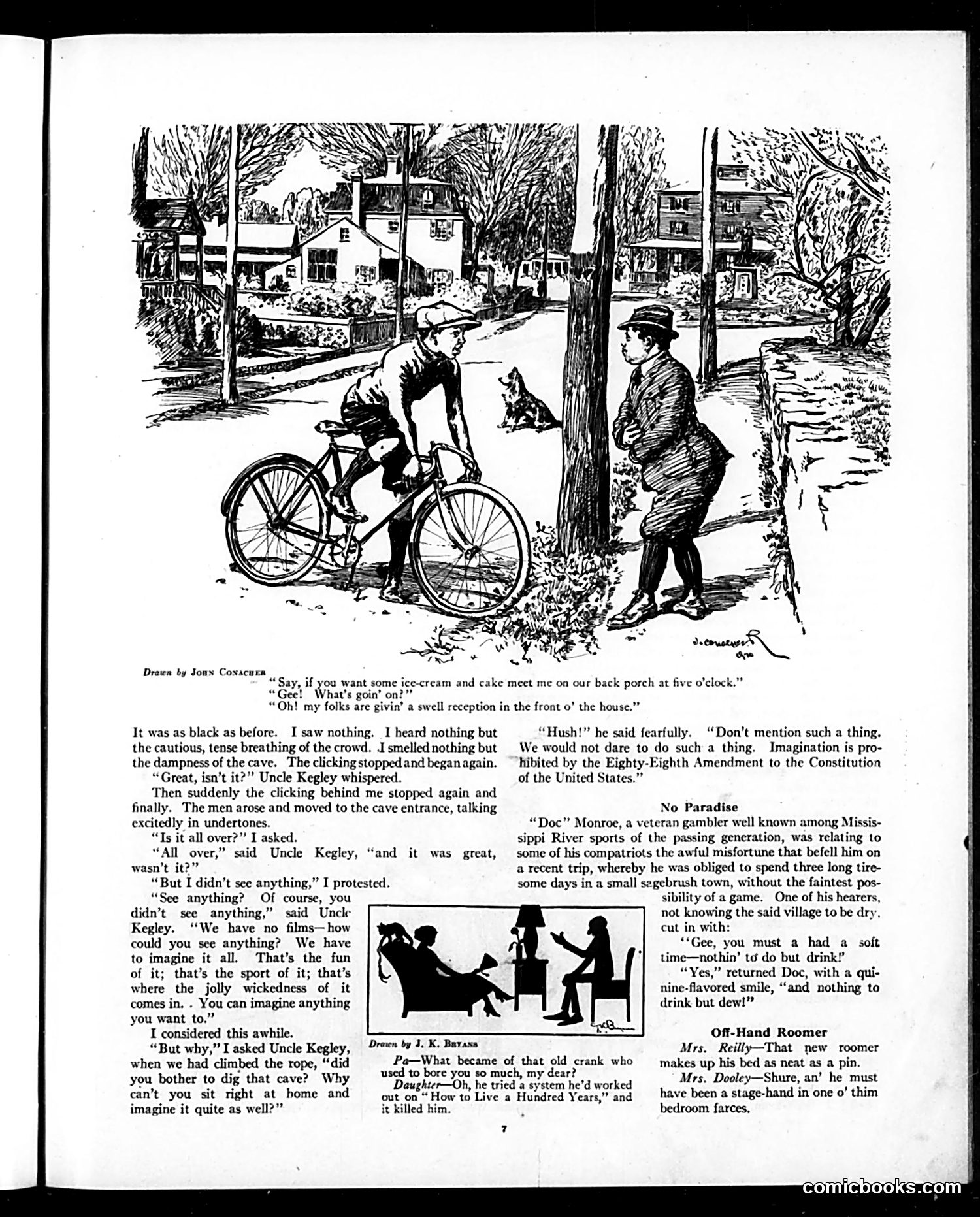
This page contains satirical short stories rather than political cartoons. The main content mocks American culture and attitudes: **"The Cave" story** satirizes people's preference for imagination over reality. Uncle Kegley takes the narrator to a cave to "watch" something invisible—there's nothing to see, yet he claims it's entertaining because "you can imagine anything you want." When the narrator asks why they don't just imagine at home, Kegley replies this is illegal under the fictional "Eighty-Eighth Amendment," satirizing censorship fears and overregulation. **"No Paradise"** jokes about Prohibition (the alcohol ban). A gambler stuck in a "dry" town complains he had nothing to drink but dew—suggesting even in paradise, prohibition would ruin it. **"Off-Hand Roomer"** is a brief joke about a neat roomer who must have worked as a stagehand in "bedroom farces" (suggestive theatrical comedies). The page reflects 1920s-30s American anxieties about censorship, Prohibition, and changing social mores.
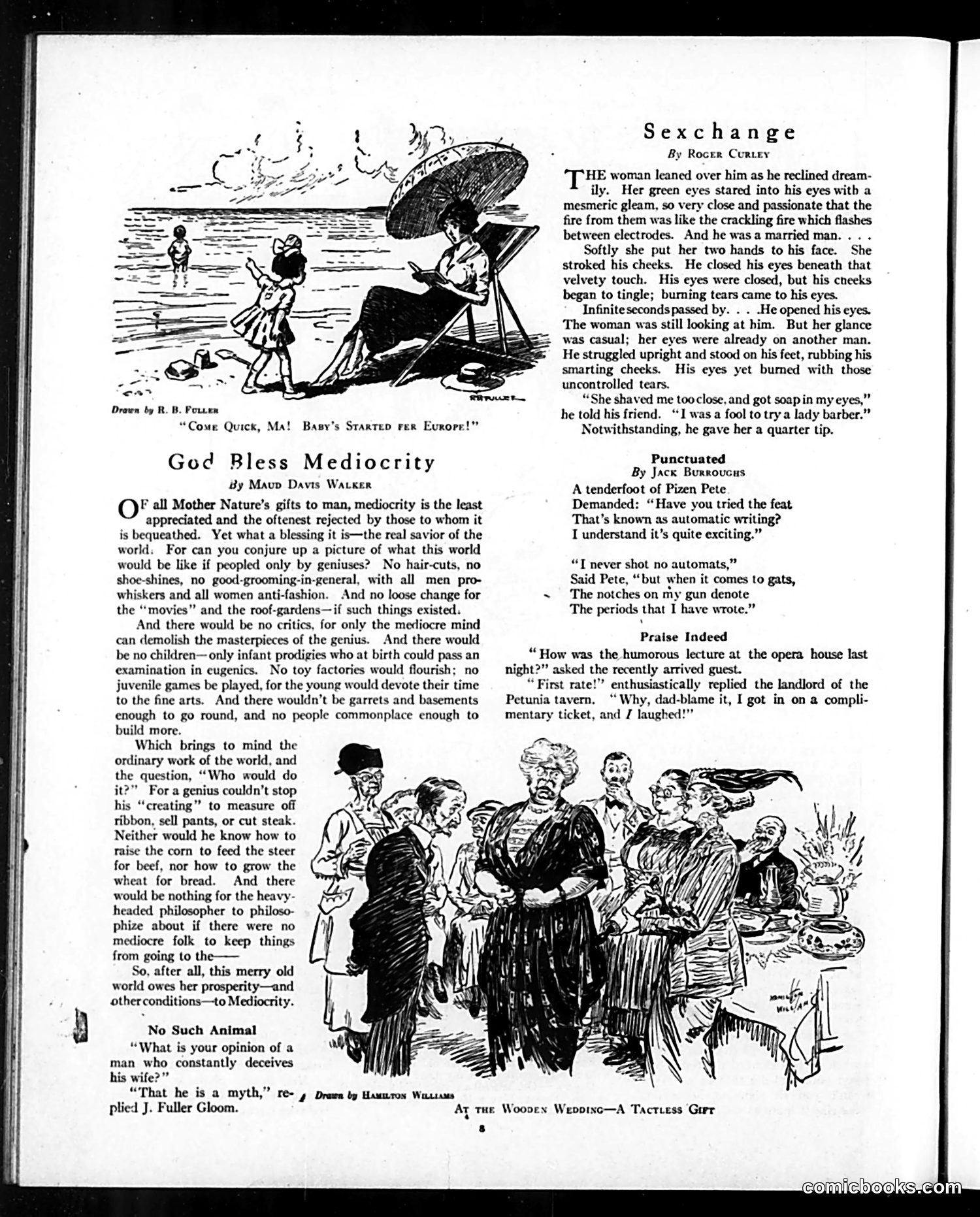
This page contains several short humor pieces typical of early 20th-century satirical magazines: **"God Bless Mediocrity"** is an essay-with-illustration arguing that ordinary people are essential to society. The accompanying cartoon shows a mother at the beach calling her child back—illustrating how mundane family life depends on mediocre folks doing everyday work. The essay's point: geniuses alone couldn't build civilization; someone must cut hair, grow wheat, and perform unglamorous labor. **"Sexchange"** is a brief romantic story with a punchline twist: the passionate moment between a man and woman at the seaside turns out to be a haircut gone wrong—she nicked him shaving, got soap in his eyes, and caused the "tears" he mistook for emotion. **"No Such Animal"** and **"Punctuated"** are short joke items mocking men who cheat on wives and a frontier character's malapropisms about "automatic writing." **"Praise Indeed"** jokes about a cheap tavern owner who received a complimentary opera ticket and enjoyed it anyway. The overall tone reflects Judge's genteel, middle-class humor emphasizing respectability and domesticity.
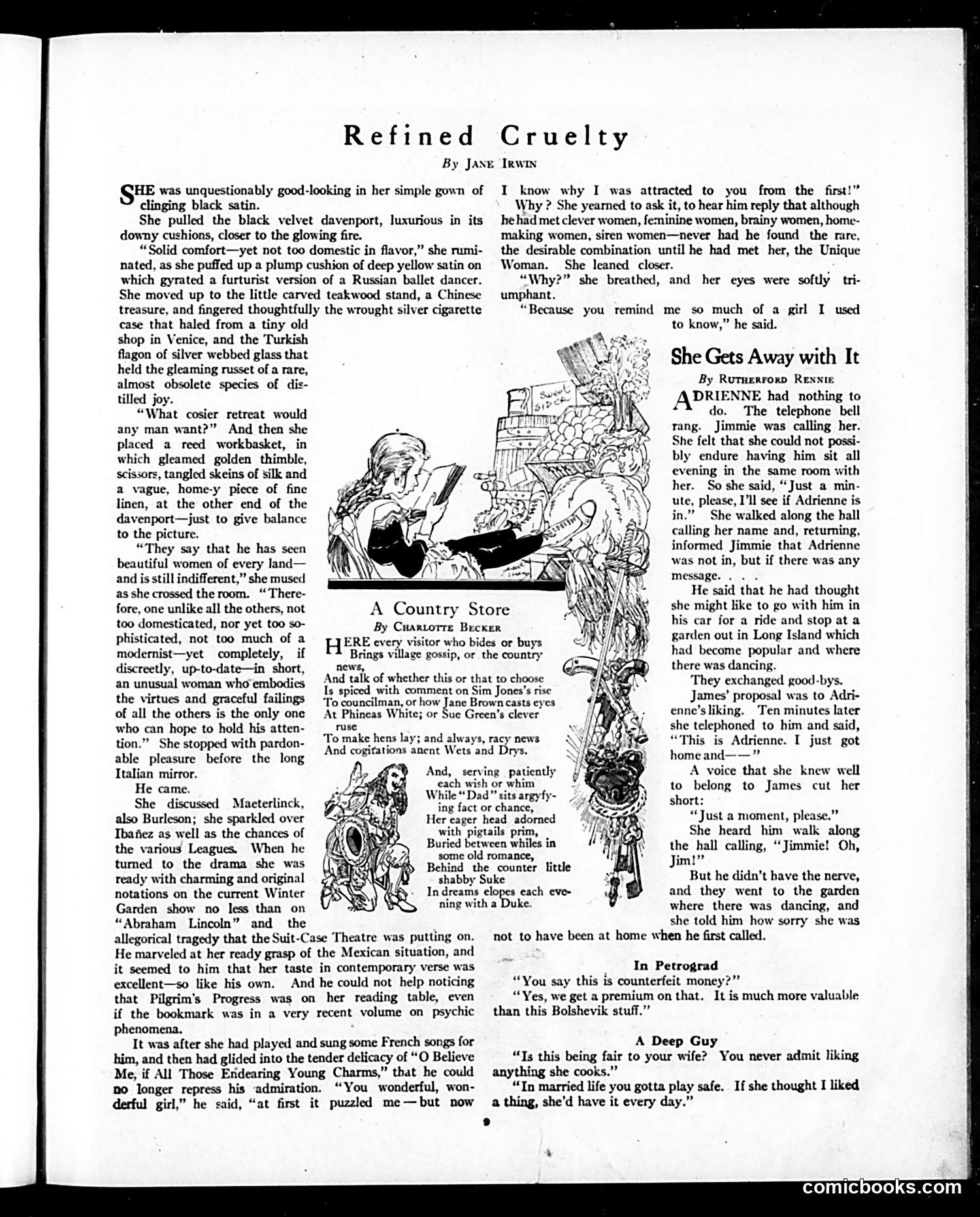
This story satirizes a woman who manipulates a man through carefully constructed artifice. She deliberately stages her apartment and persona—combining intellectual sophistication (Maeterlinck, Mexican politics, French songs) with domestic touches (needlework basket)—to appear uniquely desirable. The cruel irony: when the man finally expresses his attraction, he reveals she reminds him of *someone else entirely*—a girl from his past. Her elaborate performance and calculated self-presentation are rendered meaningless. The satire targets both her calculated seduction strategy and, implicitly, the hollowness of such manufactured appeal. The "refinement" of her cruelty lies in how thoroughly she's invested in a deception that backfires with a single, devastating comment. The page also contains unrelated short stories ("A Country Store," "She Gets Away with It," etc.) typical of Judge magazine's miscellaneous content.
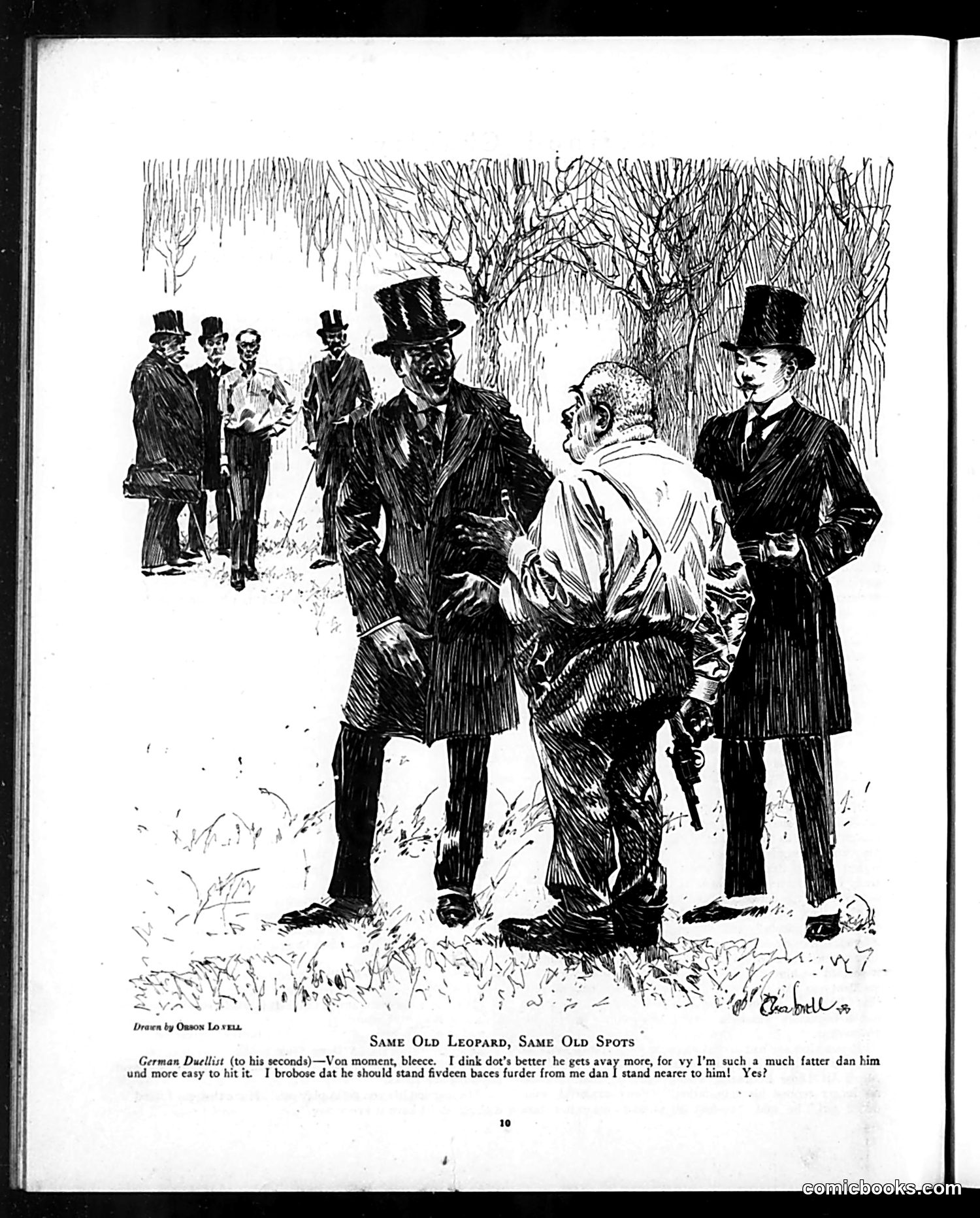
This is a satirical cartoon mocking German dueling culture and German stereotypes. The title "Same Old Leopard, Same Old Spots" suggests unchanging character. The scene depicts a German duellist (identifiable by the exaggerated accent in the dialogue) proposing an unfair duel arrangement: he wants his opponent positioned fifteen paces *farther* away while he stands closer, claiming this is necessary because he's overweight and therefore an easier target. The joke exploits contemporary anti-German sentiment and ridicules both German honor culture (formal dueling) and German hypocrisy—the duellist seeks "fair" advantage through self-serving logic, contradicting dueling's supposed code of honor. The well-dressed seconds observing in the background emphasize the formality of this absurd proposition. The cartoon satirizes how even supposedly noble traditions can be corrupted by self-interest.
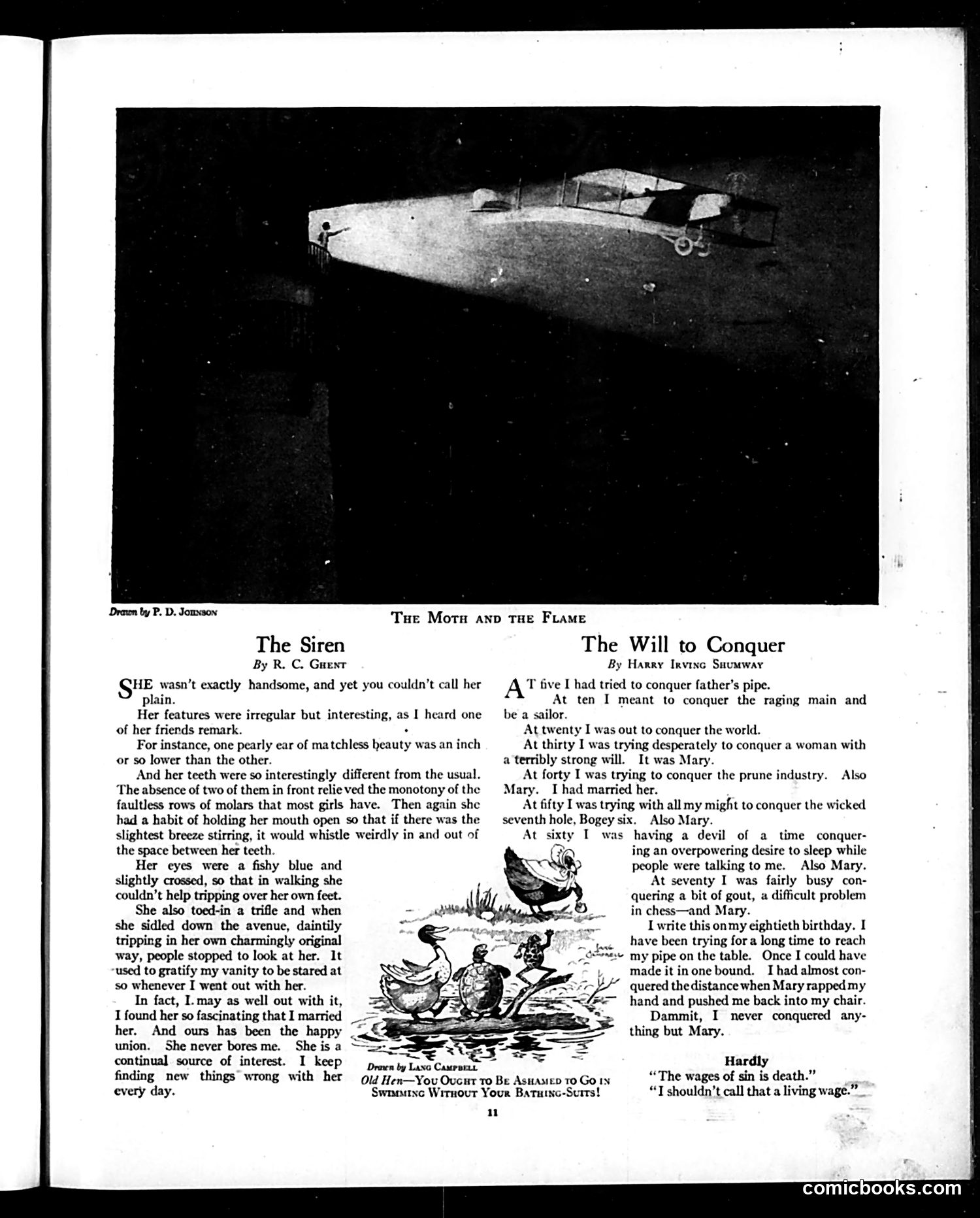
This page contains two humorous short stories with satirical illustrations: **"The Siren"** by R.C. Guest presents a comedic reversal: the narrator describes his wife as physically unattractive (misaligned eyes, missing teeth, poor posture) yet claims fascination with her. The joke satirizes romantic delusion—he's so eager to justify marrying an unappealing woman that he frames her obvious flaws as "interesting" and "fascinating." The illustration (by Lano Campbell) depicts a woman wading in water, likely referencing the "siren" mythology absurdly applied to this ordinary figure. **"The Will to Conquer"** by Harry Irving Shumway uses life progression (age 5 to 80) to satirize masculine ambition. The narrator constantly pursues grand conquests—the world, industry, golf—yet repeatedly fails. The running punchline: he's ultimately conquered nothing except "Mary," his wife, whom he cannot control. This mocks men's inflated self-perception about their accomplishments while hinting that marriage represents defeat rather than victory. Both stories employ self-aware male narrators whose aspirations comically exceed their actual achievements, a common Judge magazine theme mocking contemporary masculine pretensions.
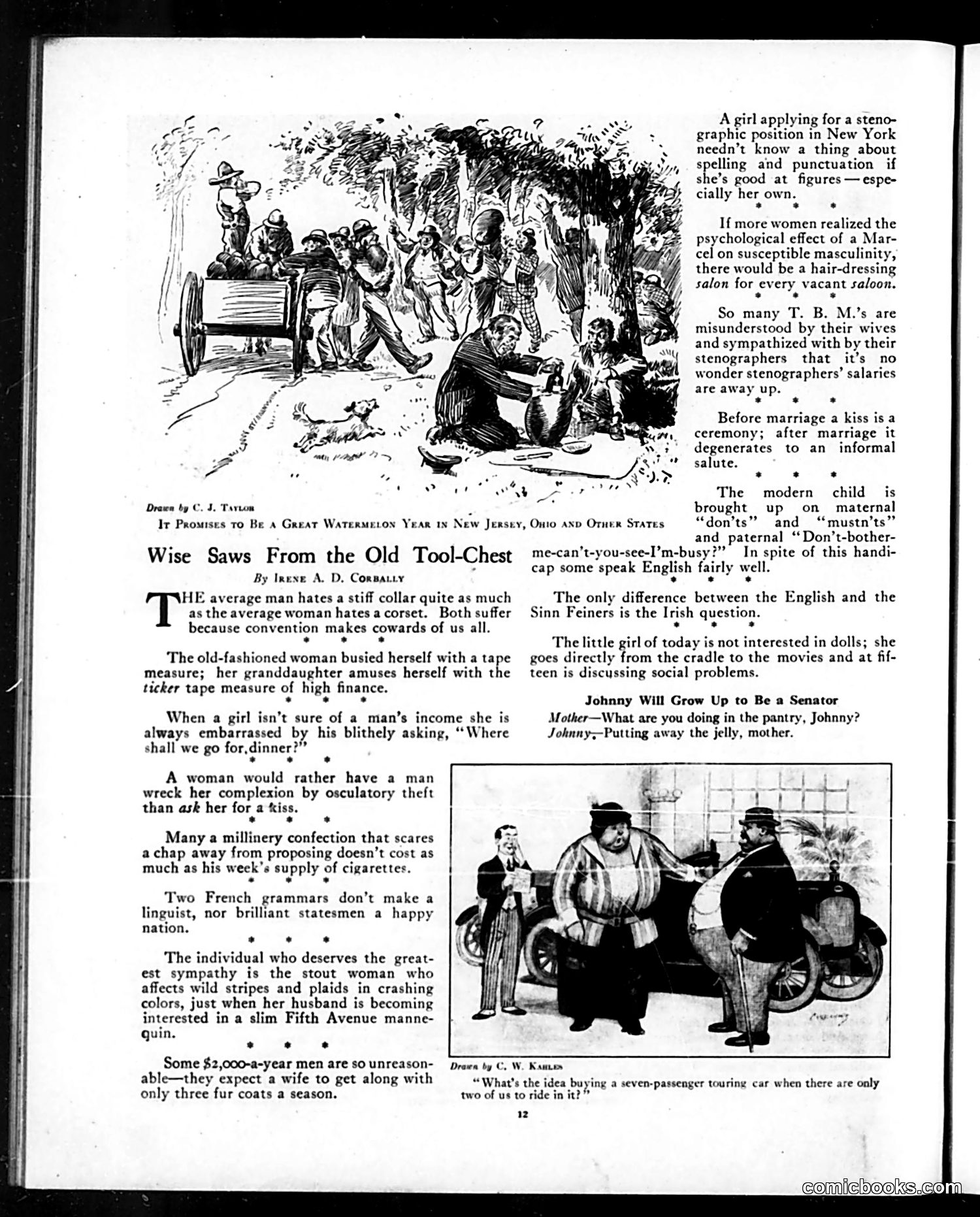
This page from *Judge* magazine contains satirical commentary on early 20th-century American social customs, presented as witty aphorisms ("Wise Saws From the Old Tool-Chest"). **The Humor:** The pieces mock gender relations and social conventions of the era. They target women's fashion obsessions (corsets, Marcel waves for hair), the economics of courtship, stenographers' romantic availability to married businessmen ("T.B.M.'s"), and materialism. One jab references the Irish independence movement ("Sinn Féiners"). **The Cartoons:** The top illustration depicts a watermelon-eating scene, likely playing on racial stereotypes common to 1920s American humor. The lower cartoon shows men with an oversized automobile, joking about wasteful luxury purchases—a commentary on post-WWI consumer excess. **Key Context:** These pieces reflect attitudes about women's limited roles, office hierarchies, and social pretension typical of the 1920s. The constant references to stenographers suggest widespread awareness of office affairs between bosses and their secretaries.
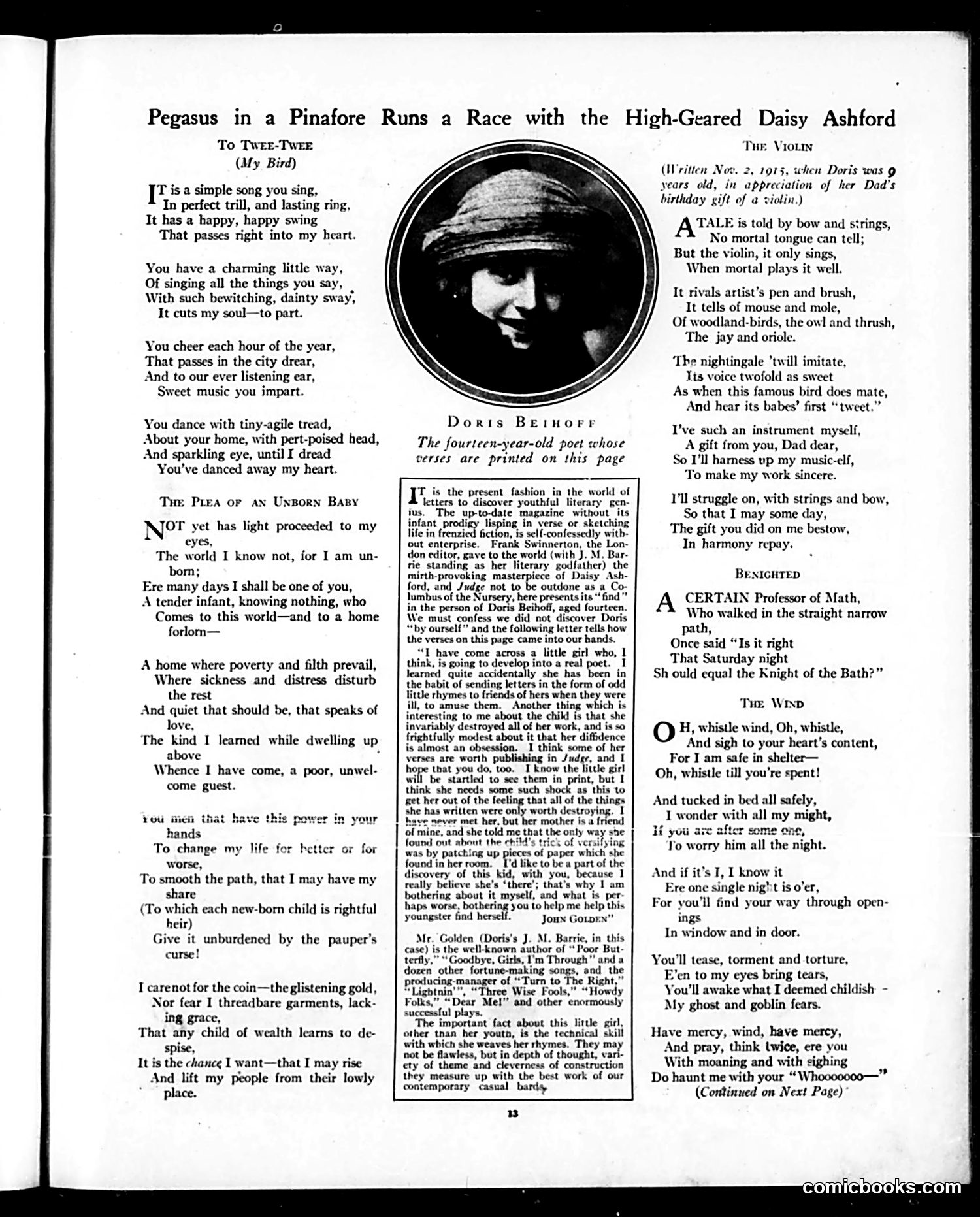
This page celebrates **Doris Belhoff, a fourteen-year-old poet**, presented as Judge magazine's discovery of literary talent. The accompanying letter explains she's been secretly writing verses to ill friends, then destroying her work out of modesty—until a friend (John Golden, a famous songwriter/producer) encouraged publication. The satire is **gentle mockery of the era's trend** of magazines showcasing child prodigies. Judge compares itself to Frank Swinton and J.M. Barrie discovering child author Daisy Ashford, positioning itself as similarly sophisticated in recognizing talent. The poems themselves—"To Twee-Twee," "The Plea of an Unborn Baby," "The Violin," and "Benighted"—are earnest but somewhat saccharine, typical of sentimental Victorian/Edwardian verse. The magazine's tone suggests affectionate amusement at both the girl's earnestness and the literary world's hunger for youthful prodigies, a fashionable trend they're playfully both mocking and participating in.
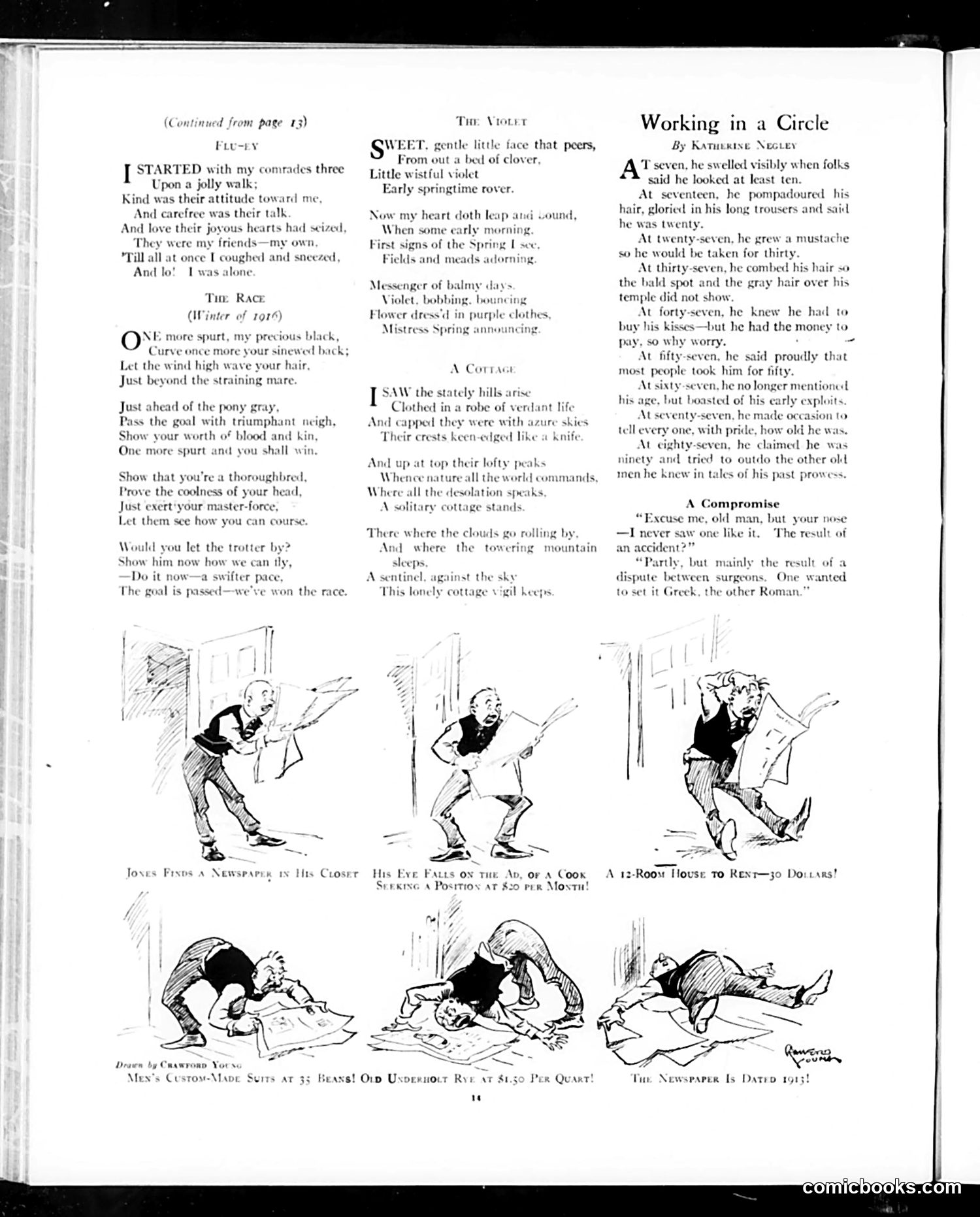
This page features **Katherine Neglev's** satirical essay-poem mocking how men deceive themselves about aging. The "circle" refers to a lifetime of self-delusion: at seventeen, a man exaggerates his maturity; by thirty, he claims to look older to seem distinguished; by fifty, he reverses course, claiming to look younger; finally, in old age, he boasts of youthful exploits to compete with other elderly men—arriving back where he started, fixated on false impressions. The accompanying cartoons (credited to **Cesare Volk**) illustrate men in absurd domestic situations—losing newspapers in closets, seeking cooking positions, renting rooms—visual comedy supporting the text's theme of masculine self-absorption and the ridiculous lengths men go to maintain false impressions throughout their lives. The dated advertisement ("1913") confirms this publication's age.
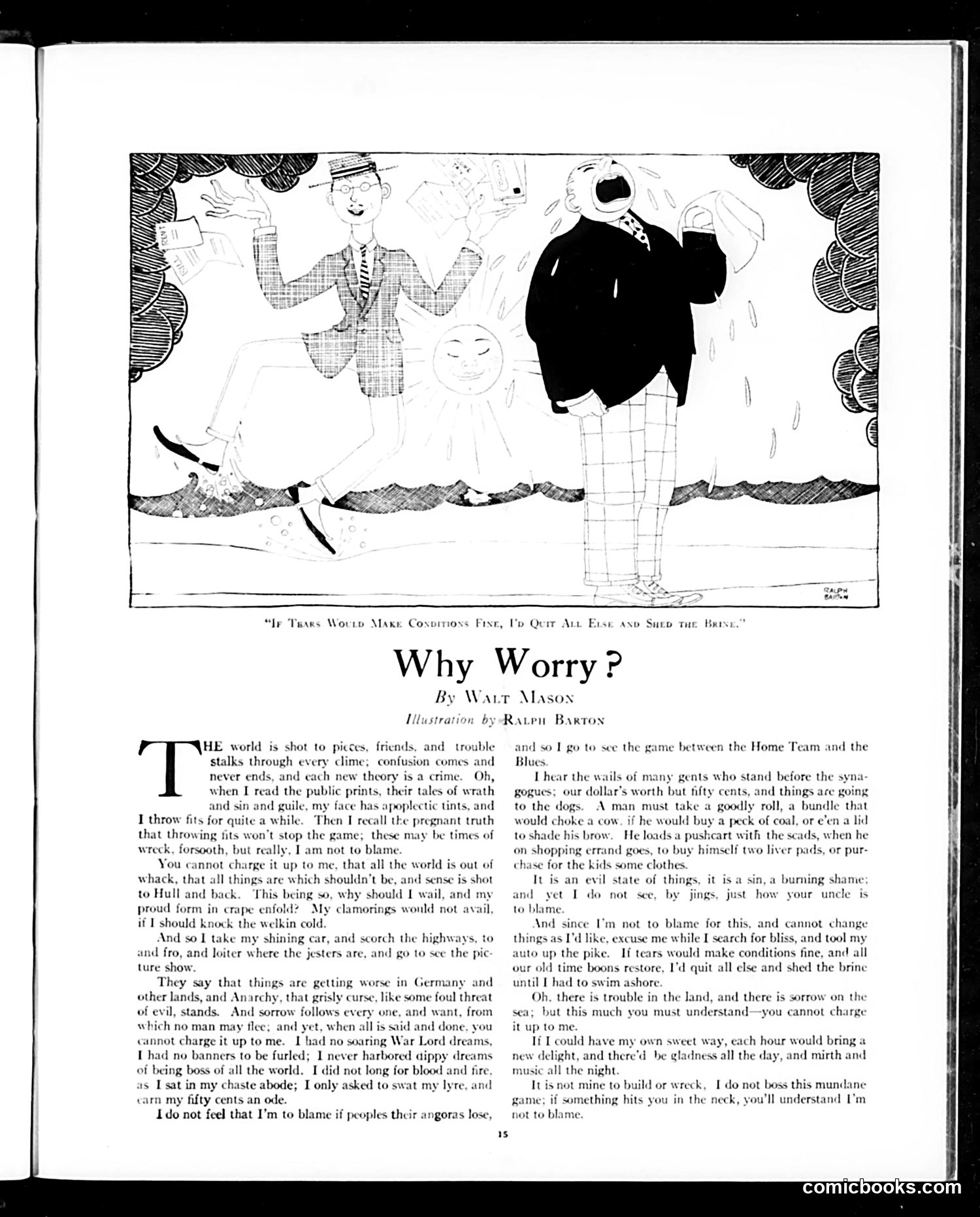
This is a humorous essay-poem by Walt Mason, illustrated by Ralph Barton, addressing widespread anxiety about world conditions circa World War I era. **The Satire:** The narrator adopts an absurdly self-centered philosophy: since he bears no personal responsibility for global problems (war, inflation, poverty, social collapse), he refuses to worry about them. Instead, he escapes to baseball games, car rides, and picture shows. **The Point:** Mason satirizes willful ignorance and apathy during a crisis period. The repeated refrain "you cannot charge it up to me" mocks those who rationalize indifference by claiming powerlessness. References to "War Lord dreams," economic collapse ("our dollar's worth but fifty cents"), and widespread suffering underscore how frivolous this detachment is. **The Illustration:** Shows a carefree man in a car (symbol of leisure) while darker, more concerned figures appear in the background—visually contrasting the narrator's oblivious optimism against surrounding distress. The satire targets complacent citizens who ignore serious problems while seeking personal pleasure.
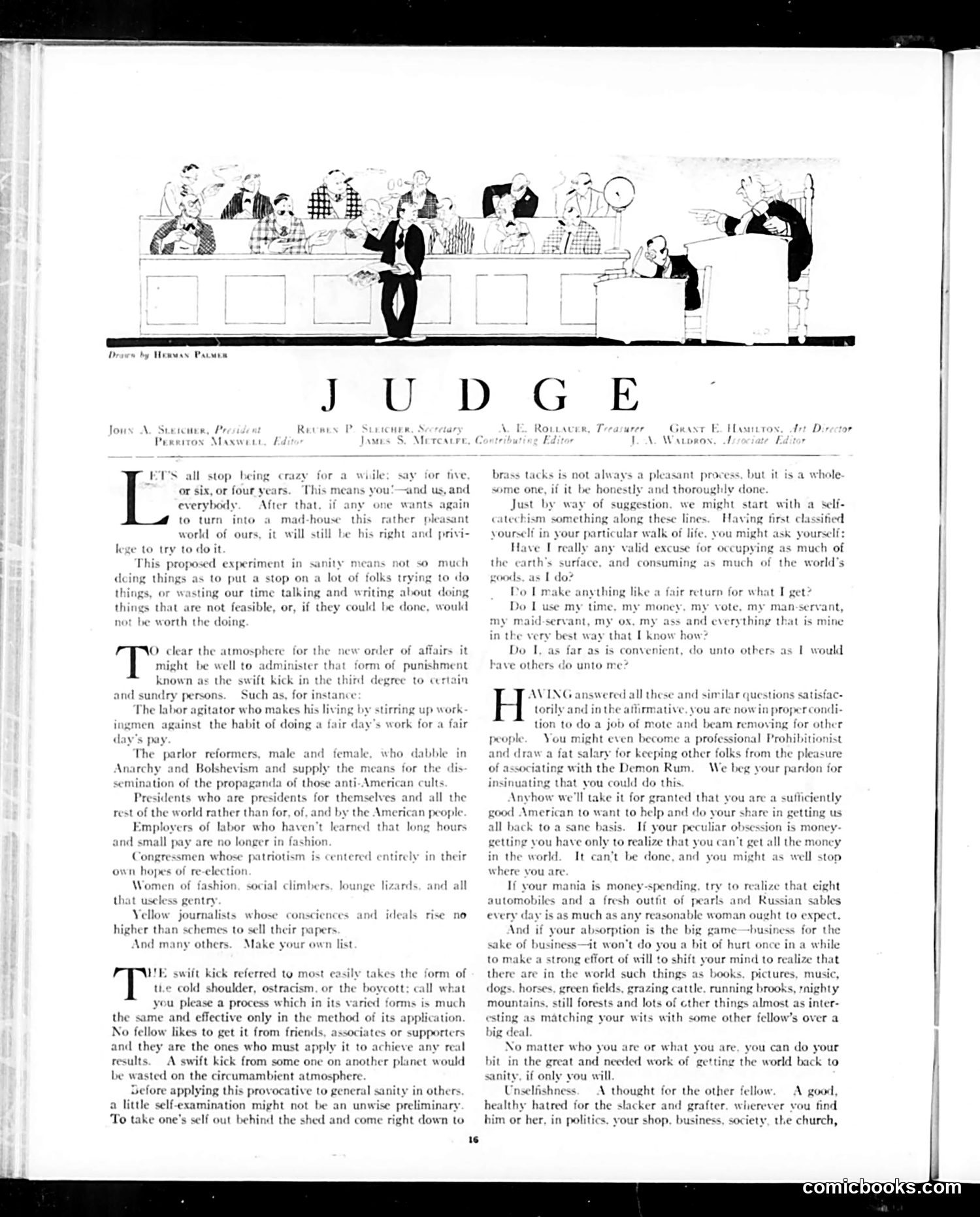
This appears to be the title/masthead page for Judge magazine rather than a political cartoon. The illustration at top shows a courtroom scene with a judge presiding over various figures, likely representing different social types or constituencies. The accompanying editorial text advocates for a national "experiment in sanity"—a call for Americans to stop pursuing impractical reforms and radical ideologies for "five or six, or four years." The author proposes metaphorically administering "swift kicks" (social ostracism) to various targets: labor agitators, parlor reformers promoting "Anarchy and Bolshevism," anti-American politicians, exploitative employers, frivolous society women, and yellow journalists. The piece essentially argues for conservative social conformity and self-examination before criticizing others. It's a reactionary response to Progressive-era radicalism, likely from the 1910s-1920s, using satire to mock reformers while promoting traditional American values and capitalist order.
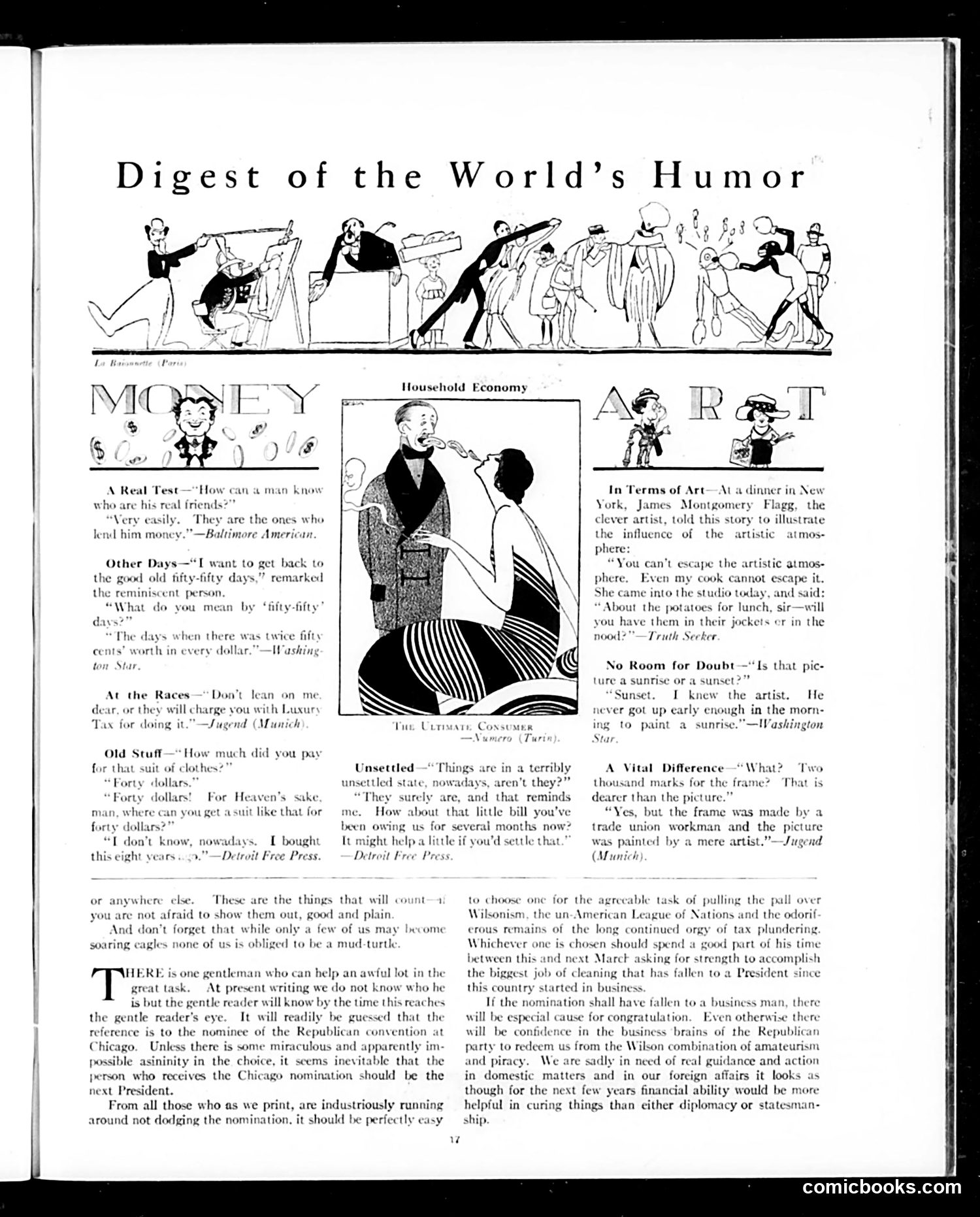
This is a humor compilation page from *Judge* magazine featuring international jokes and comic anecdotes, not political cartoons. The content spans multiple light satirical pieces: **Key Content:** - **"Money"** section jokes about friendship being tested by lending - **"Household Economy"** cartoon shows a couple discussing unsettled debts - **"Art"** anecdotes mock artistic pretension (artist James Montgomery Flagg's story about his cook, and a joke about an artist too lazy to wake early for sunrise paintings) - A **luxury tax joke** about leaning on someone at races - **Inflation humor** lamenting when "fifty cents' worth in every dollar" existed **Larger Editorial Commentary** discusses the upcoming 1920 Republican presidential nomination, arguing the nominee should help address post-WWI challenges: Wilson's League of Nations, tax problems, and need for "business" leadership and "real guidance." The page mixes light humor with serious political subtext—the Republican Party positioning itself as business-competent, anti-Wilson alternative for post-war America.
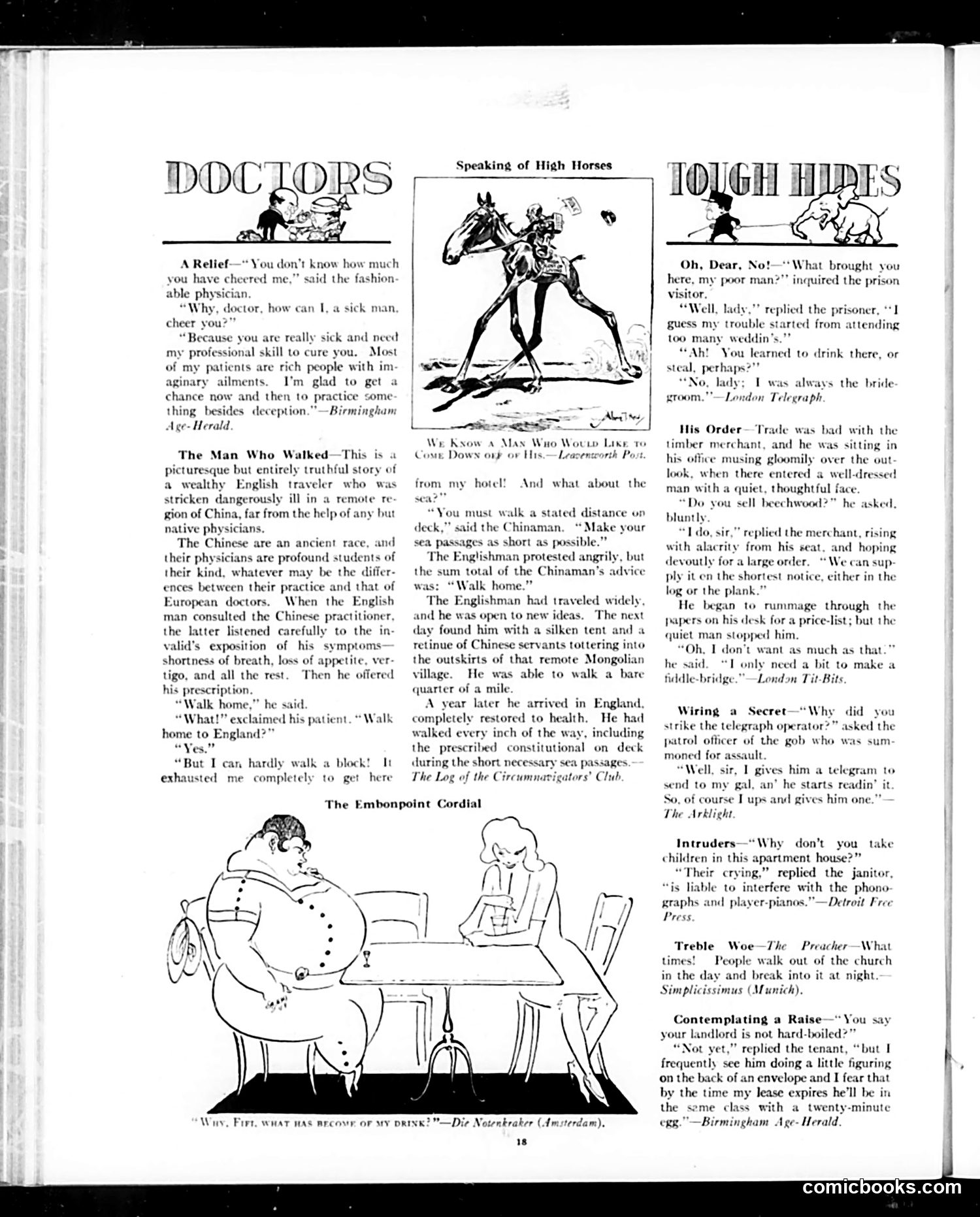
This page contains several brief satirical anecdotes rather than political cartoons. The main points of humor: **"The Man Who Walked"**: Mocks both Western and Eastern medical practices. A wealthy English patient receives counterintuitive Chinese medical advice—simply "walk home." The satire suggests both cultures' physicians rely on dubious prescriptions, though the walking ironically works. **"His Order"**: A timber merchant eagerly prepares to sell beechwood to a well-dressed customer, only to discover the man wants merely "a bit to make a fiddle-bridge"—an absurdly small purchase. The joke ridicules salesmen's misplaced optimism. **"The Embonpoint Cordial"**: The cartoon shows an overweight man at a table; the caption implies he's discussing how much he's drinking. This targets vanity and gluttony. The remaining brief items ("Oh, Dear, No!", "Wiring a Secret," "Intruders," "Treble Woe") are one-liner jokes about prisoners, sailors, janitors, and preachers—working-class humor typical of early 20th-century Judge magazine.
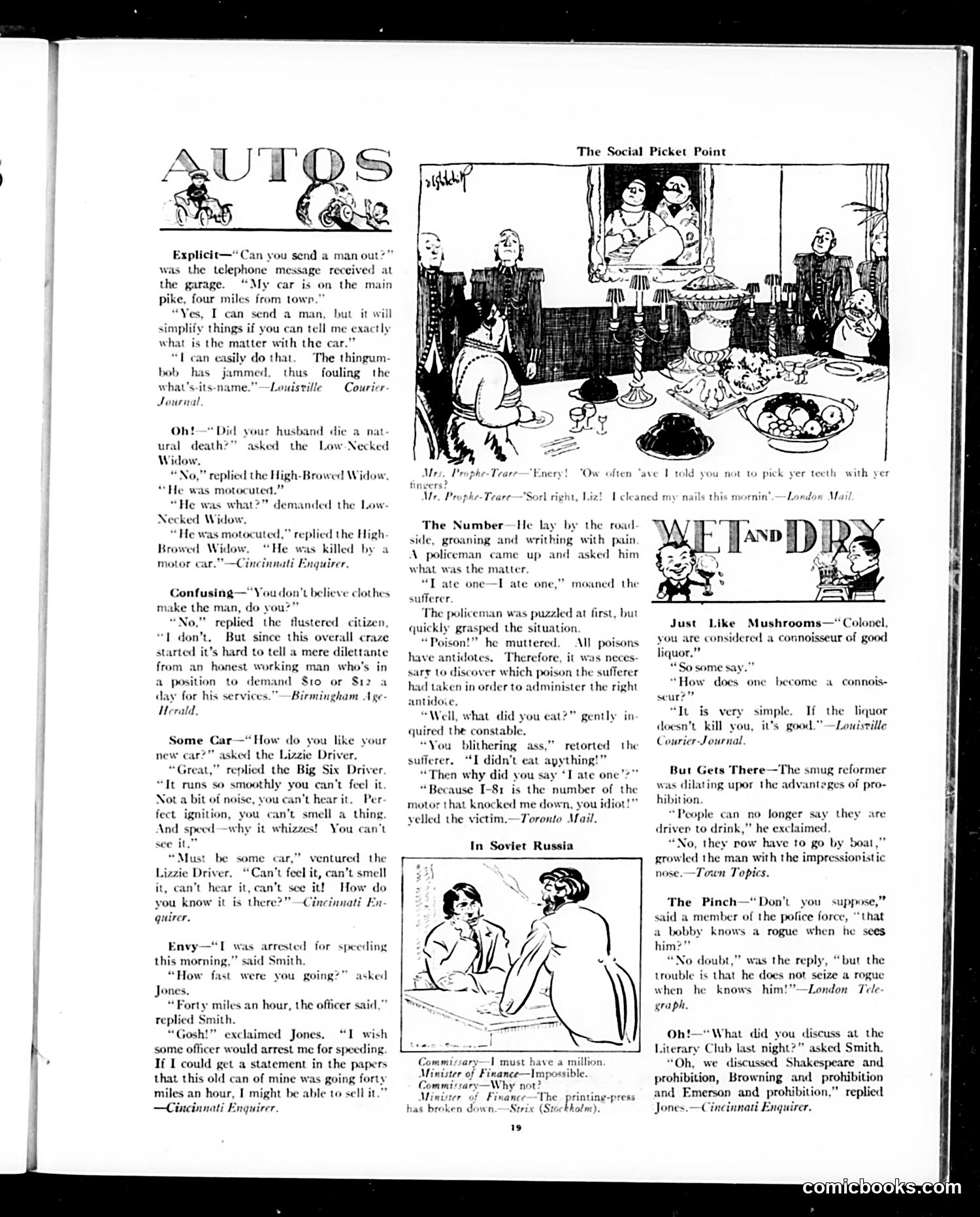
This page collects brief humorous anecdotes satirizing early 20th-century American life, primarily focused on automobiles and social conventions. **Key satirical targets:** 1. **"Explicit"** and **"Some Car"**: Mock the automobile industry's rapid growth and customers' inability to describe mechanical problems or comprehend their own vehicles—suggesting cars are incomprehensible mysteries to ordinary people. 2. **"Confusing"**: Jokes about working-class men wearing overalls during labor unrest; employers can't distinguish genuine workers from middle-class dilettantes, complicating class distinctions. 3. **"Envy"**: Satirizes consumerism and status-seeking—a man wants arrest publicity to sell his worthless car, treating reputation as marketable commodity. 4. **"The Number"**: Dark humor about I-81 motor cars being so dangerous they're identified by accident victims' final words. 5. **Bottom sections** reference Prohibition debates and Soviet economic dysfunction (printing press failure). The overall tone mocks modern consumer culture, technological bewilderment, and social pretense of the Jazz Age era.
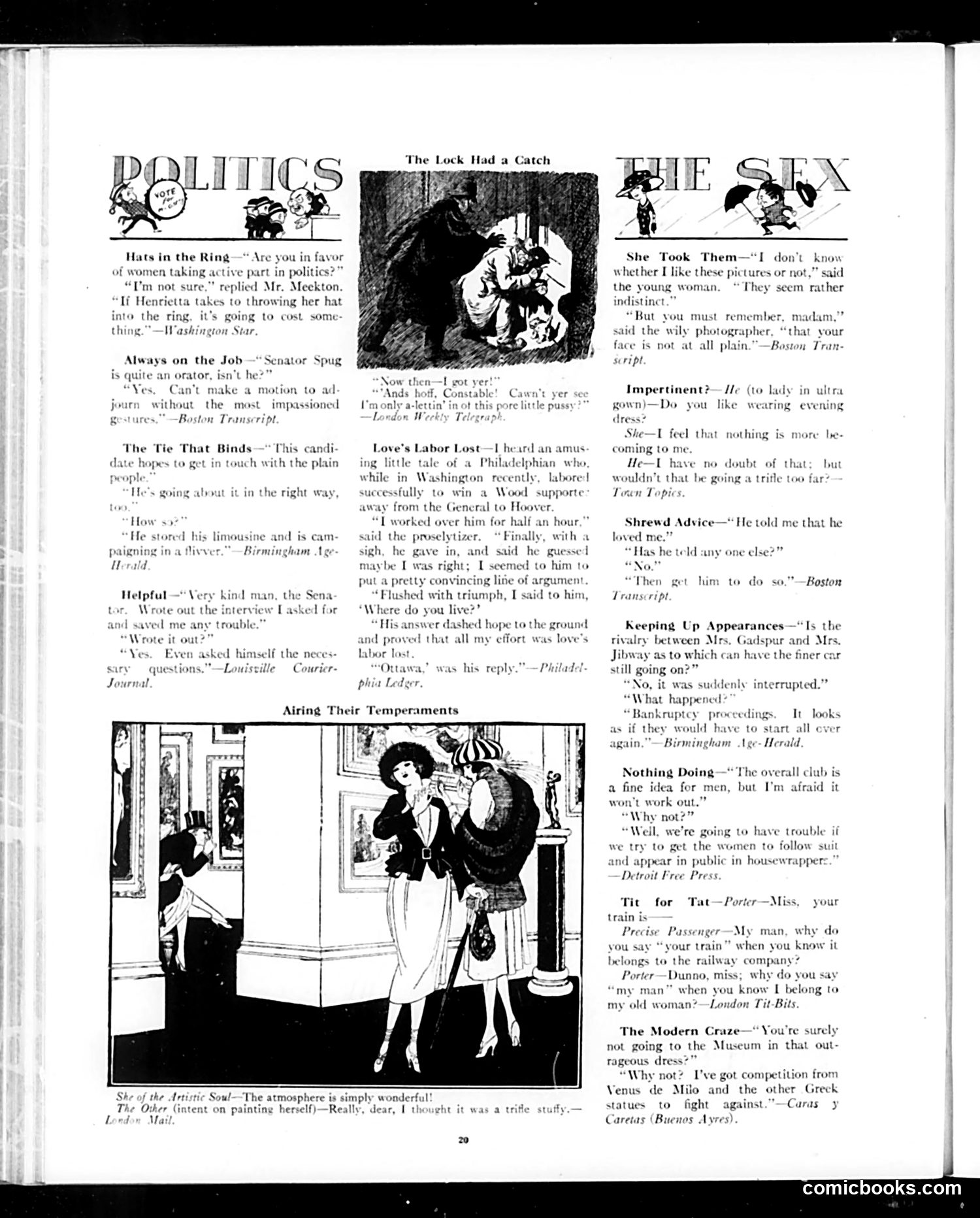
This page contains multiple short satirical vignettes mocking early 20th-century social pretensions and gender politics. **"Hats in the Ring"** jokes about women's political involvement—a husband worries his wife throwing her "hat in the ring" (entering politics) will be expensive. **"The Lock Had a Catch"** satirizes door-to-door evangelists: a missionary spends hours converting a man to his cause, then asks where he lives. The man replies "Ottawa"—implying the effort was wasted on a foreigner. **"She Took Them"** mocks studio photography, where a photographer assures a woman her unflattering pictures look "indistinct" (unclear/artistic). **"Airing Their Temperaments"** (cartoon, center) depicts fashionable women in domestic spaces, suggesting marital discord or feminine dramatic behavior. The remaining items—"Shrewd Advice," "Keeping Up Appearances," "Nothing Doing," and "Tit for Tat"—offer brief joke exchanges about relationships, class anxiety, and gender dynamics typical of period humor.
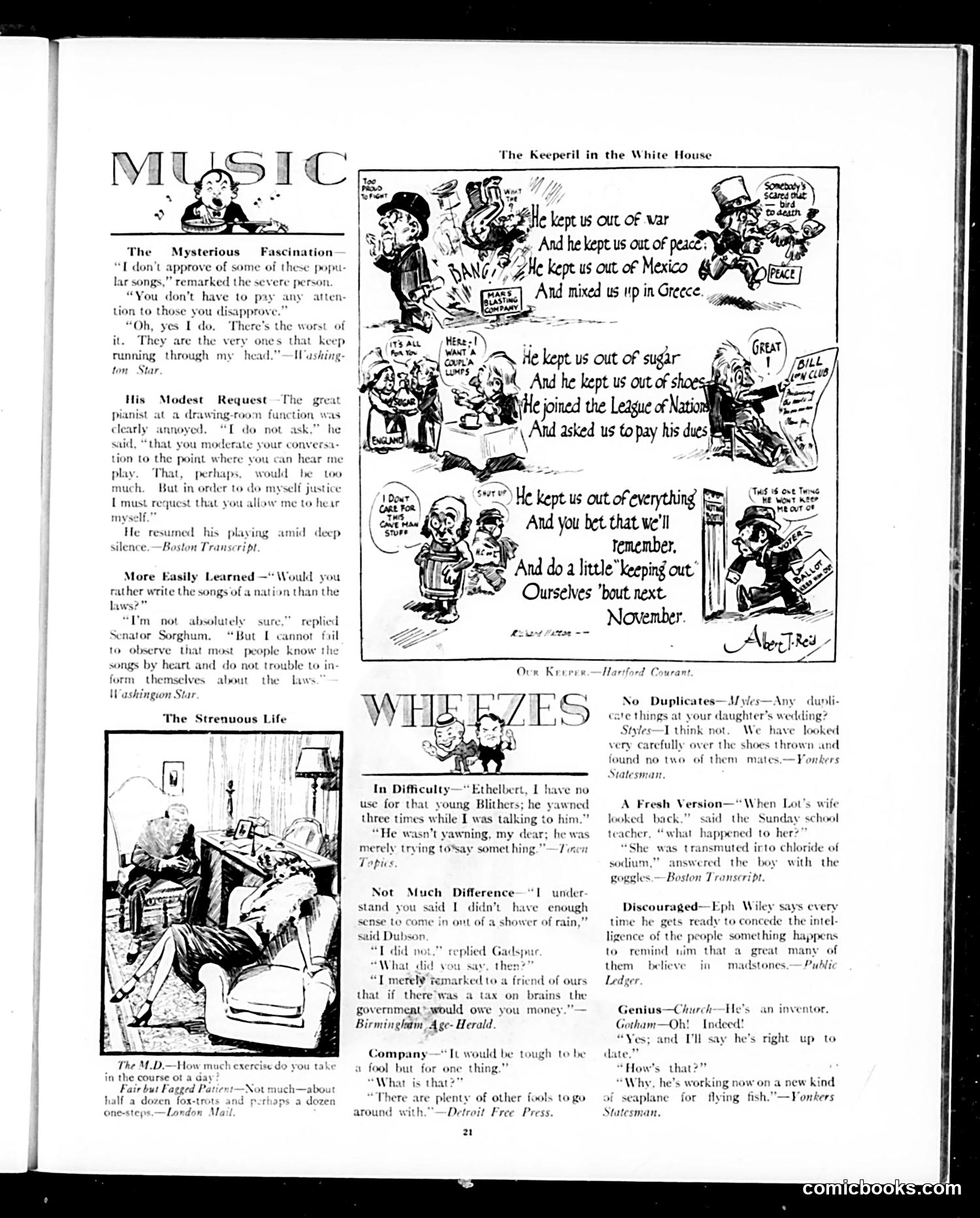
This is a political cartoon satirizing President Woodrow Wilson's foreign policy during World War I. The central figure (Wilson) is depicted singing a song listing things he "kept us out of": war, peace, Mexico, Greece, sugar, shoes, and the League of Nations—while simultaneously asking Americans to "pay his dues." The satire attacks Wilson's contradictory positions: he campaigned on keeping America out of conflict ("He kept us out of war") yet involved the country in various international entanglements. The cartoon mocks his neutrality claims while showing him as demanding sacrifice from Americans. The final verse's ironic twist—that Americans should do their own "keeping out" in November (election day)—suggests voters should reject Wilson's policies. This likely dates from Wilson's 1916 reelection campaign, when his foreign policy record was contested.
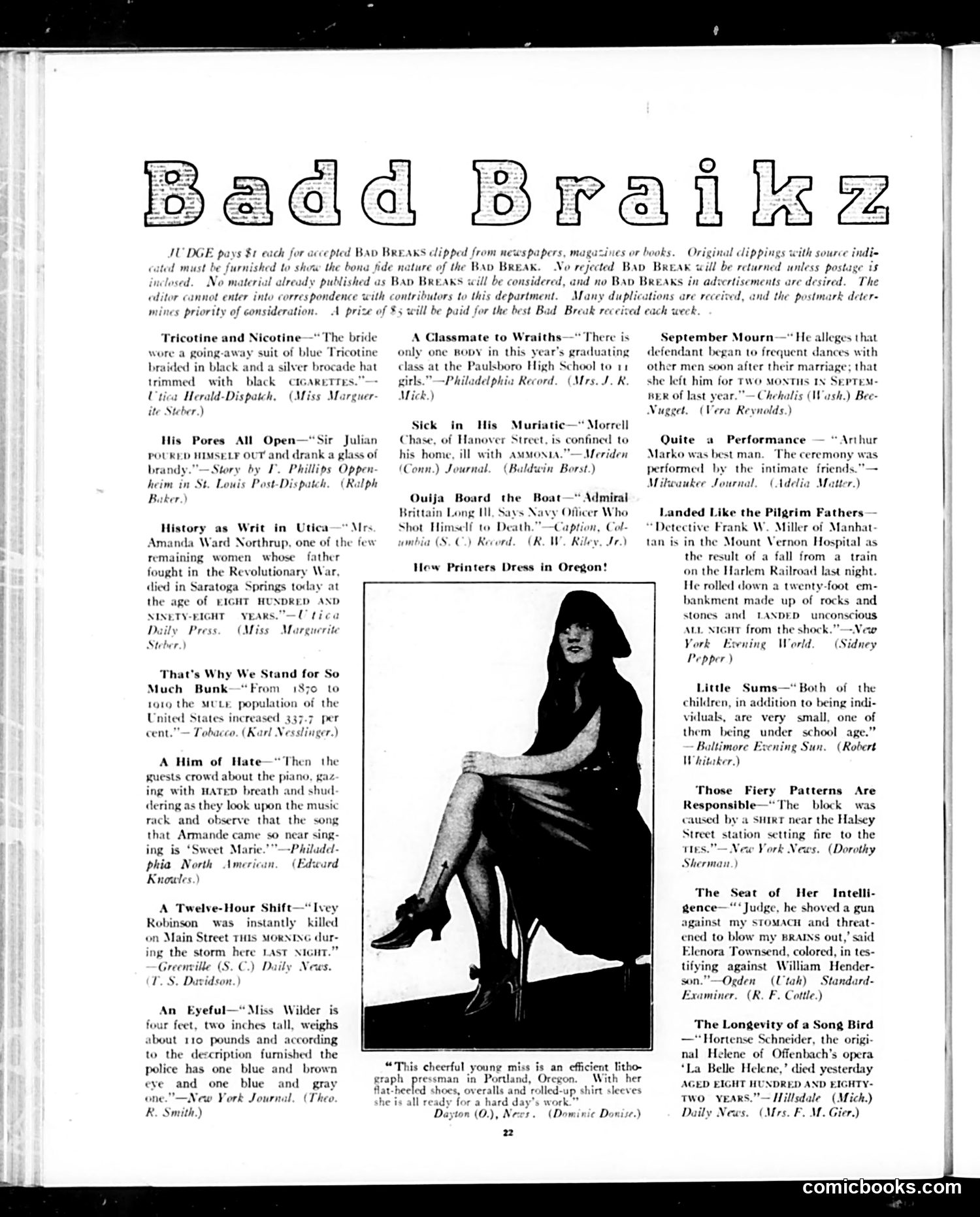
This page showcases **"Bad Breakz,"** Judge magazine's satirical feature mocking absurd newspaper headlines and poorly worded passages. The format is simple: editors collected genuine clippings from real newspapers and magazines, then ridiculed their unintentional humor through brief comedic commentary. The jokes exploit **contradictions and logical absurdities** in published text. Examples include: a bride wearing a suit "braided...with black cigarettes," a woman dying at age 898, and a detective who "rolled down a twenty-foot embankment...unconscious all night." The humor relies on readers catching the **nonsensical or physically impossible** situations created by careless writing or editing in actual newspapers. The accompanying photo appears to be authentic Portland, Oregon material, supporting the feature's claim of using real source material. This was lighthearted media criticism—mocking press incompetence rather than making political points.
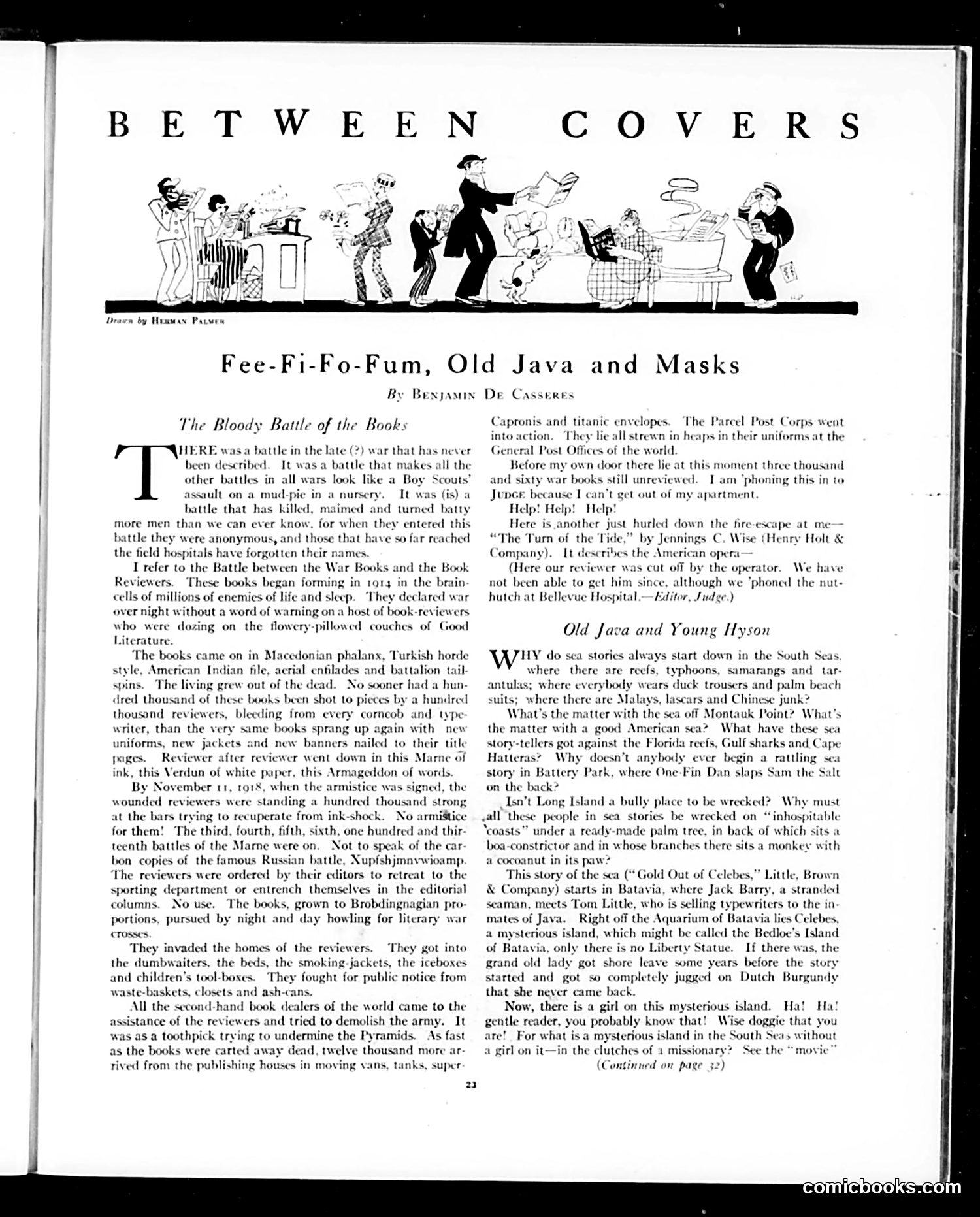
This Judge magazine page satirizes the post-WWI flood of war books overwhelming literary reviewers. The headline article, "The Bloody Battle of the Books" by Benjamin De Casseres, uses mock-military language to describe reviewers literally besieged by endless war memoirs and accounts. The satire depicts book-publishing as warfare: books arrive in "Macedonian phalanx" formations, reviewers suffer "ink-shock," and publishing houses deploy "moving vans, tanks, super" to deliver more volumes. The joke escalates absurdly—books invade homes, hide in dumbwaiters and iceboxes, and a reviewer is apparently killed while being interviewed about "The Turn of the Tide." This reflects genuine 1920s frustration: the market was flooded with war narratives, making serious criticism nearly impossible. The cartoon above shows frantic editorial chaos, visually reinforcing the textual satire about literature overwhelming its gatekeepers.
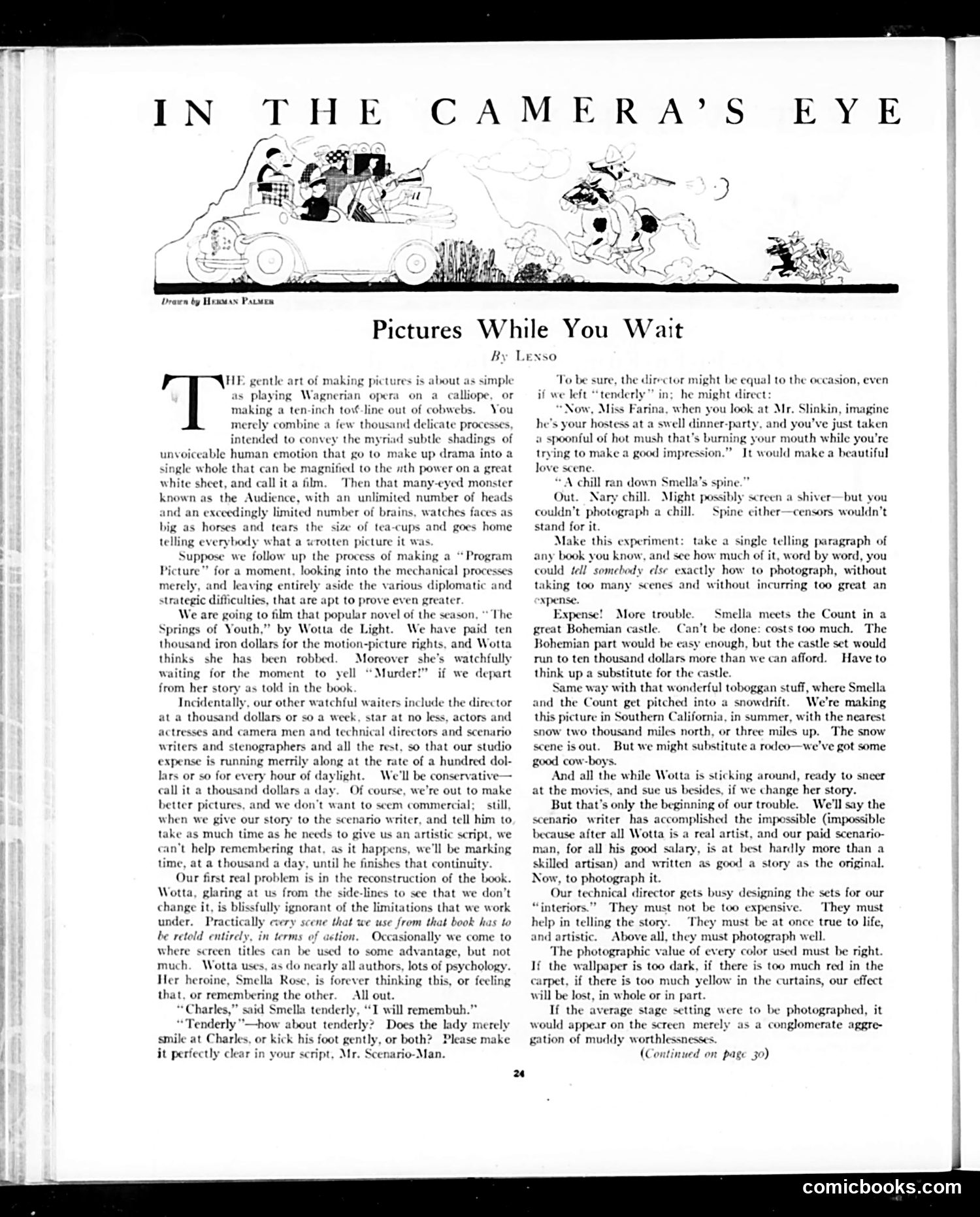
This article by Lexso satirizes the absurdities of early motion-picture production, specifically the adaptation of novels into films. The piece mocks the tension between literary sources and cinematic reality. **Key targets:** - **Authors like "Wotta de Light"**: Represents novelists who sell film rights while remaining vigilant (even hostile) overseers, unwilling to accept necessary changes - **The production system**: Depicts the economic waste of studio filmmaking—hundreds of workers earning "a thousand dollars a day" while waiting for scenario writers to adapt interior psychological moments - **The fundamental problem**: Authors rely on psychology, internal thought ("Smella Rose is forever thinking"), and abstract descriptions like "tenderly" or "a chill ran down her spine"—elements impossible to photograph **The satire's point**: Film cannot literally show thoughts or emotions. Adapting novels requires complete reconception, not literal translation. The cartoon celebrates this creative challenge while mocking the impractical demands of protective authors and the system's enormous waste. The illustration (by Herman Palmer) shows a car full of people and activity—visualizing cinematic action's complexity compared to static text.
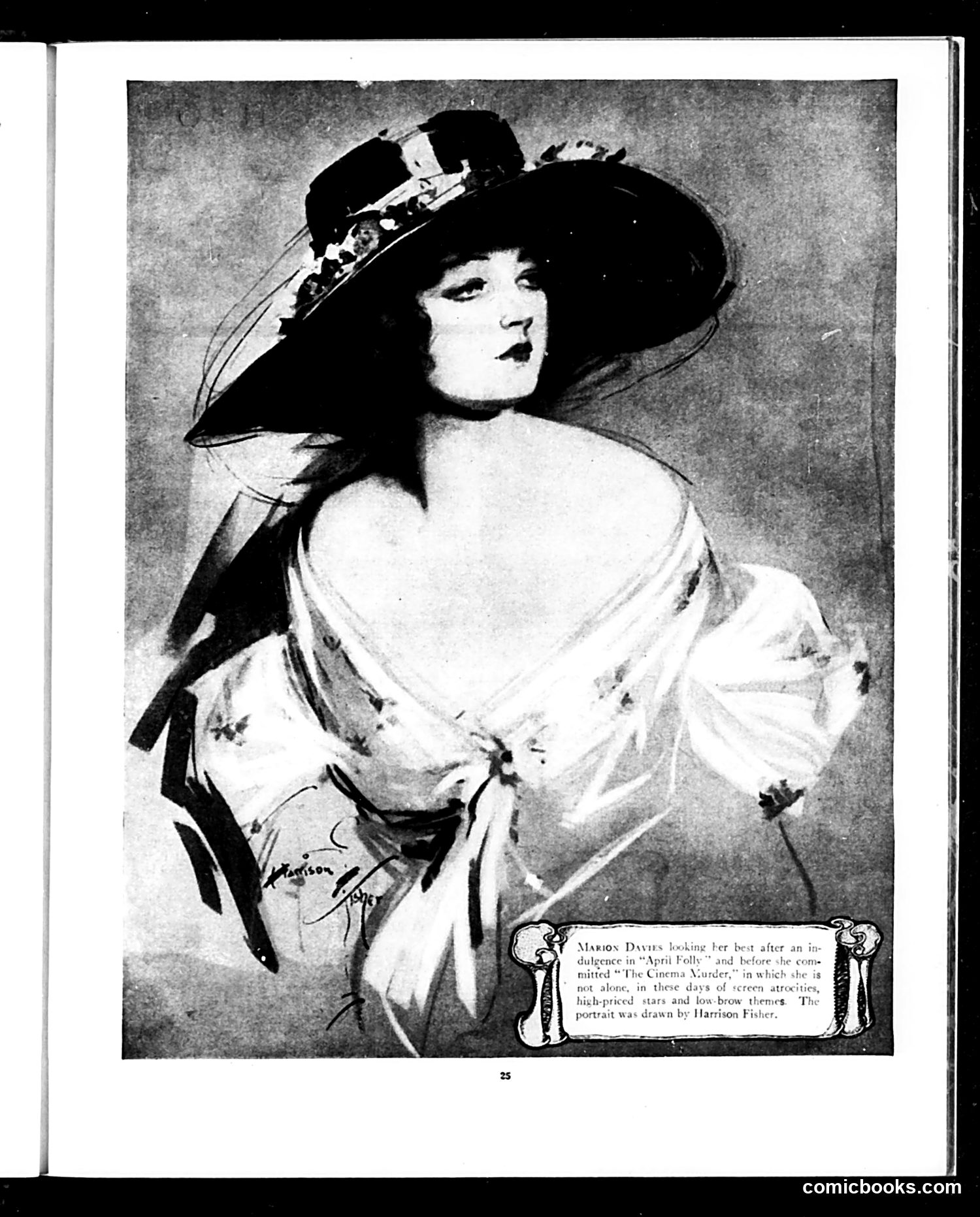
This page features a portrait of Marion Davies, a silent film actress, drawn by Harrison Fisher. The caption references her recent films "April Folly" and "The Cinema Murder," noting that she is "not alone, in these days of screen atrocities, high-priced stars and low-brow themes." The satire targets the film industry's tendency to cast expensive, well-known actors in low-quality or sensationalist pictures. The phrase "screen atrocities" and criticism of "low-brow themes" reflects early 20th-century anxieties about cinema's artistic and moral standards. Judge magazine's commentary suggests that even prominent stars like Davies were appearing in inferior productions—a commentary on commercialism over artistic merit in Hollywood's emerging studio system.
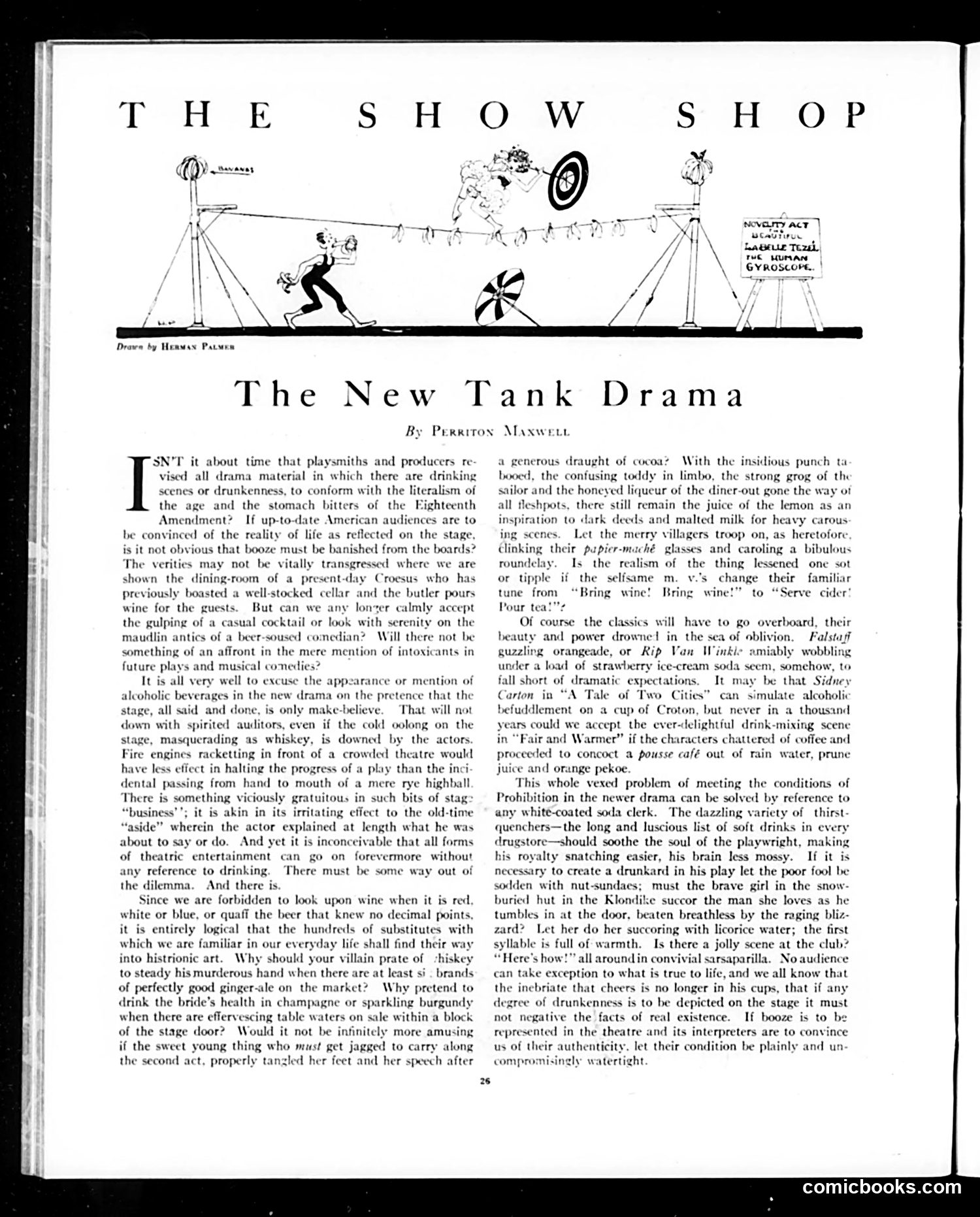
This is a satirical article mocking Prohibition-era theater censorship. The author argues absurdly that since alcohol is now illegal (the 18th Amendment), plays depicting drinking scenes violate realism and must be revised. The satire proposes replacing all alcoholic beverages on stage with substitutes: whiskey becomes oolong tea, champagne becomes ginger-ale or effervescing table water, and drunkenness is achieved through cocoa. The author sarcastically suggests classic scenes—like Sydney Carton's intoxication in *A Tale of Two Cities*—become ridiculous if performed with non-alcoholic substitutes. The illustration shows a vaudeville-style "show shop" setup with performers and equipment, likely depicting the absurdity of these theatrical contortions. The piece ridicules how Prohibition's strict enforcement creates impossible contradictions for theater, which traditionally relied on drinking scenes to convey character and drama. The author's exaggerated "solutions" expose the law's impracticality.
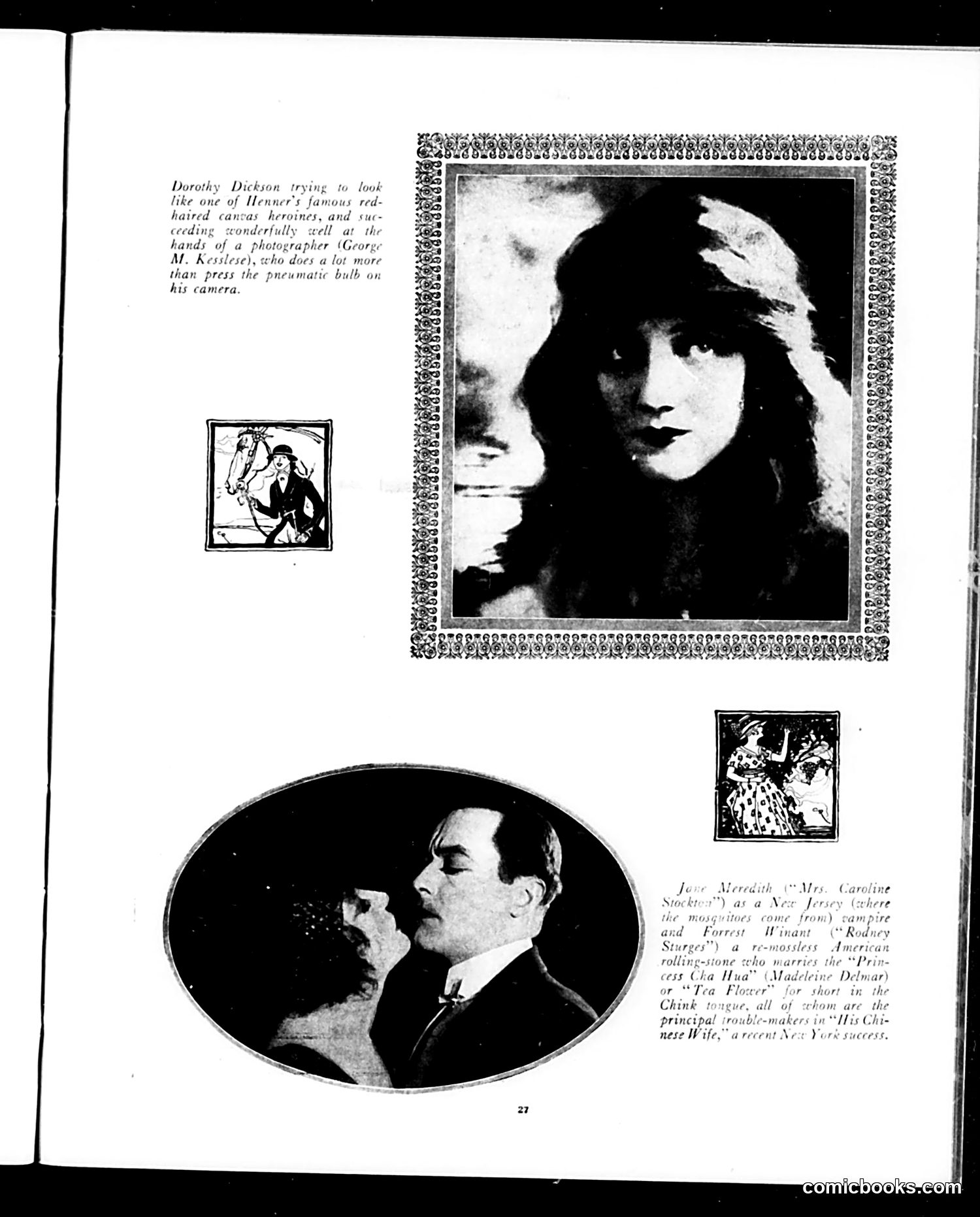
This page features **Dorothy Dickinson**, a performer being photographed by photographer George M. Kesslery. The caption humorously suggests Kesslery makes her look like one of Henner's famous red-haired canvas heroines—referencing **Jean-Jacques Henner**, a 19th-century French painter known for romanticized portraits of women with distinctive red hair. The joke is that Kesslery does far more than simply operate the camera; he manipulates the image to make his subject resemble classical painted beauties. This satirizes the emerging practice of **photographic retouching and artistic enhancement**—photographers positioning themselves as artists who "create" rather than merely document. The lower portrait appears to show an unnamed male figure, likely another entertainment industry figure from the silent film era.
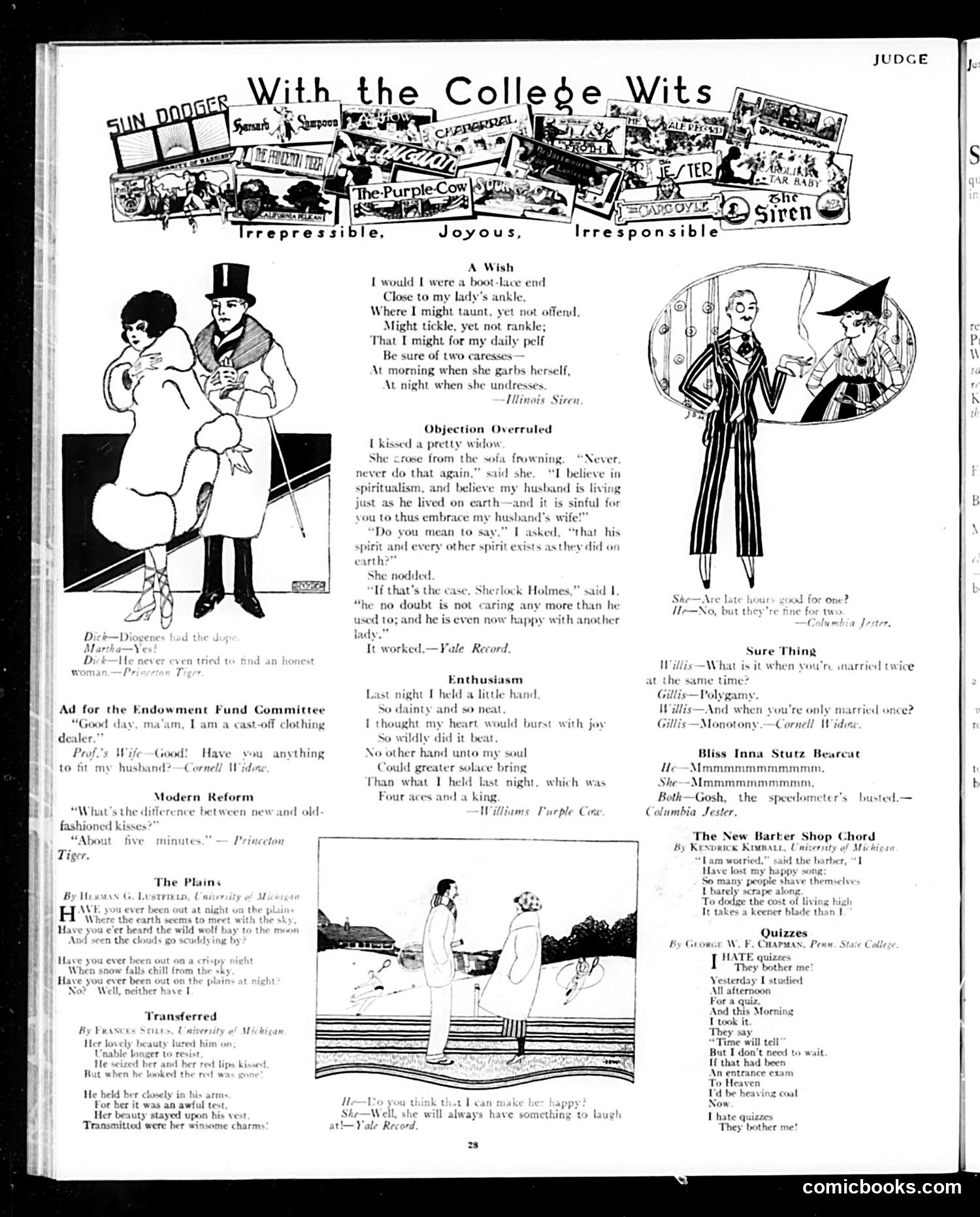
This page collects humorous poetry and jokes from college publications, typical of Judge's "College Wits" humor column. The content reflects early 20th-century collegiate culture and social attitudes. **Key elements:** The cartoons depict romantic/flirtation scenarios common to college humor. One shows a man in formal dress with a woman, illustrating jokes about courtship and marriage. Another features two women in 1920s clothing discussing romantic matters. **The jokes target:** - Marriage and infidelity (the widow spiritualism joke) - Dating anxieties and hand-holding excitement ("Enthusiasm") - Modern courtship confusion ("Sure Thing" - playing on "polygamy" as a joke about simultaneous dating) - Academic life frustrations ("Quizzes") **The satire's point:** These pieces mock both young people's romantic preoccupations and contemporary social conventions around courtship, spiritualism, and education. The humor reflects Jazz Age attitudes—somewhat risqué but fundamentally concerned with traditional romantic outcomes (marriage). The overall tone is lighthearted mockery of college life's predictable romantic dramas and academic frustrations.
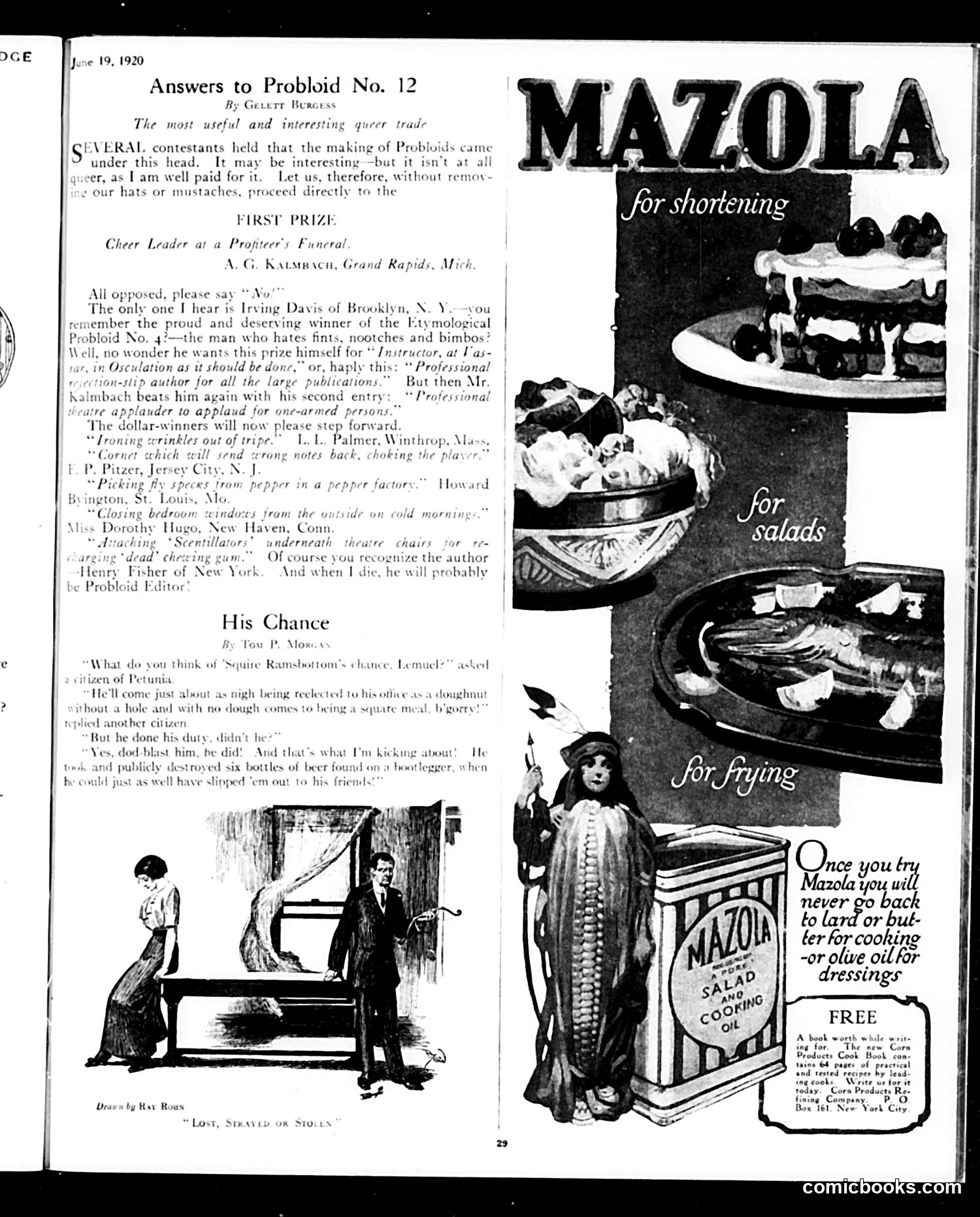
This page showcases **Judge's satirical humor contests** ("Probloids"). The left side presents reader-submitted joke answers to a weekly puzzle, with winners announced. The winning entry—"Cheer Leader at a Profiteer's Funeral"—satirizes war profiteers who enriched themselves during WWI while others died. The joke implies these profiteers deserve mockery even in death. The accompanying cartoon by Ray Roux, titled "Lost, Strayed or Stolen," appears to satirize some contemporary social issue, though the specific reference is unclear from the visible text. **The right side is a Mazola cooking oil advertisement** showing the product's multiple uses (shortening, salads, frying). This represents typical 1920 commercial content inserted into magazines. The page reflects post-WWI American sentiment, with lingering resentment toward profiteers, alongside consumer culture advertising.
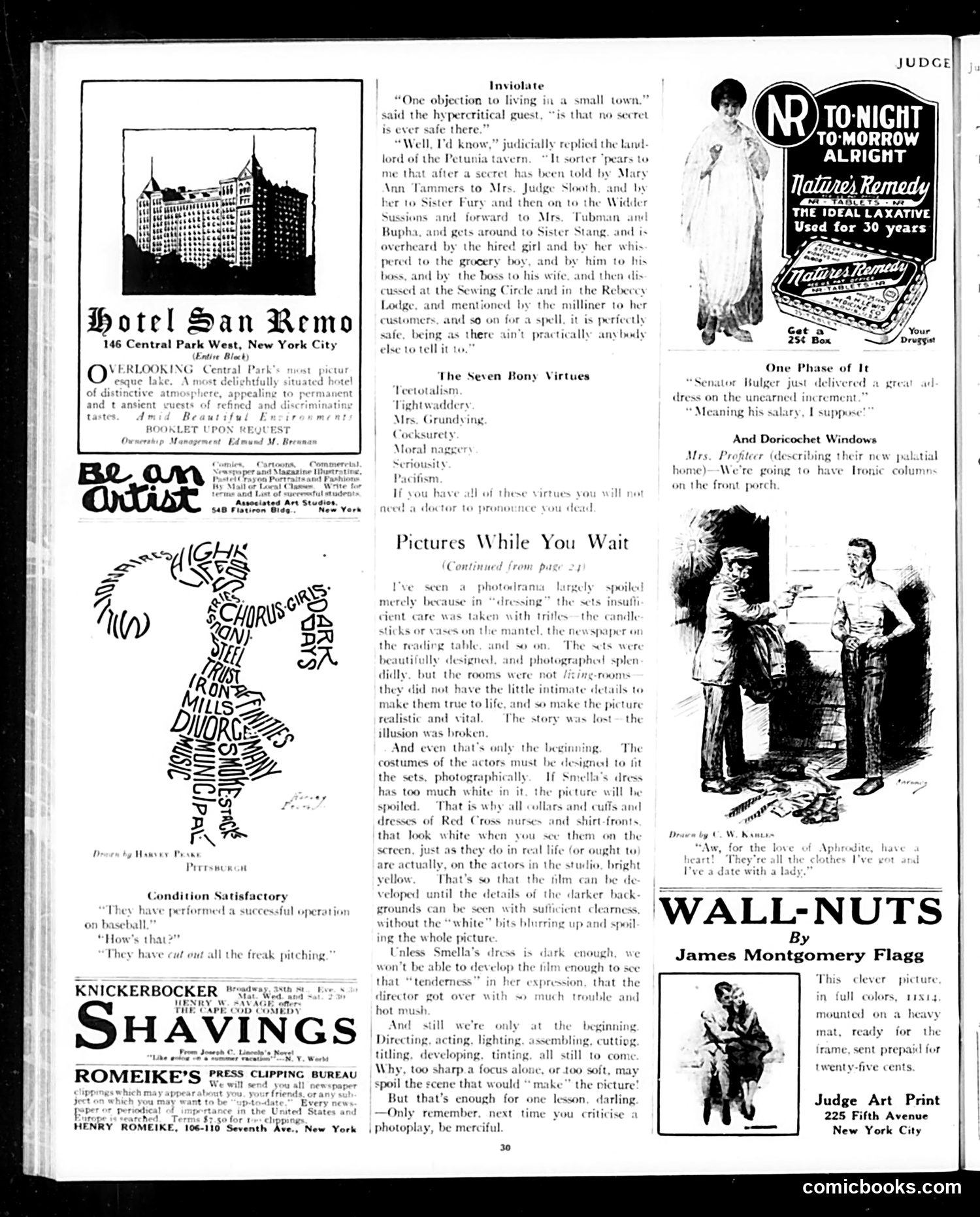
This page from *Judge* contains multiple satirical pieces. The main cartoon, "Inviolate," mocks small-town gossip culture. A hypercritical hotel guest complains that "no secret is ever safe" in small towns—the innkeeper responds by tracing how information spreads: from Mary Van Tammers to the judge's wife to various sisters and servants, ultimately reaching "the grocery boy" and spreading through the town's social network (Sewing Circle, Rebekah Lodge). The joke satirizes how impossible privacy is in tight-knit communities where every whispered confidence cascades through interconnected social channels. The page also includes advertisements (Hotel San Remo, Knickerbocker "Shavings" play, Romeike's Press Clipping Bureau) and an article titled "Pictures While You Wait," discussing film production design challenges—how set dressing and costume details must photograph clearly despite the limitations of early cinema technology.
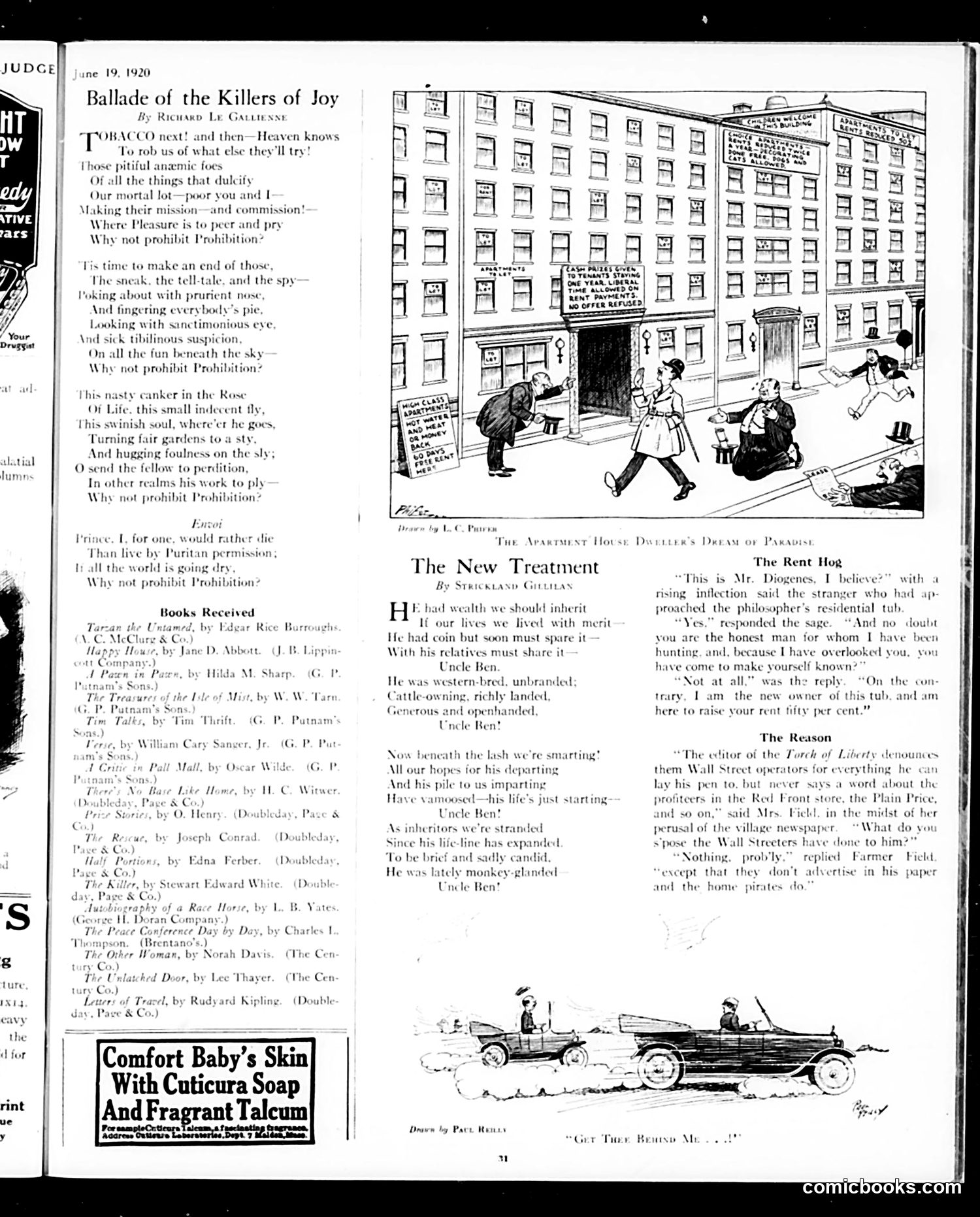
This page satirizes Prohibition and post-war American attitudes. **"Ballade of the Killers of Joy"** is a poem attacking Prohibition advocates—those who spy on and judge others' pleasures. The author sarcastically asks "Why not prohibit Prohibition?" itself, portraying dry-law enforcers as joyless busybodies destroying freedom. **The cartoons** appear to mock wealthy inheritance and modern social friction: - **"The New Treatment"** depicts an uncle who refuses to share his wealth, contradicting expected inheritance practices - **"The Rent Hog"** shows a landlord demanding higher rent from a tenant, satirizing post-war housing exploitation - **"The Reason"** references Wall Street profiteers ignoring newspapers that criticize them The context: 1920 was the first year of Prohibition's enforcement (18th Amendment, 1919). Judge, a conservative publication, opposed it as governmental overreach. The cartoons extend this anti-regulation sentiment to economic matters—attacking both Prohibition enforcers and emerging capitalist greed. The magazine frames these as attacks on American freedom and traditional values.
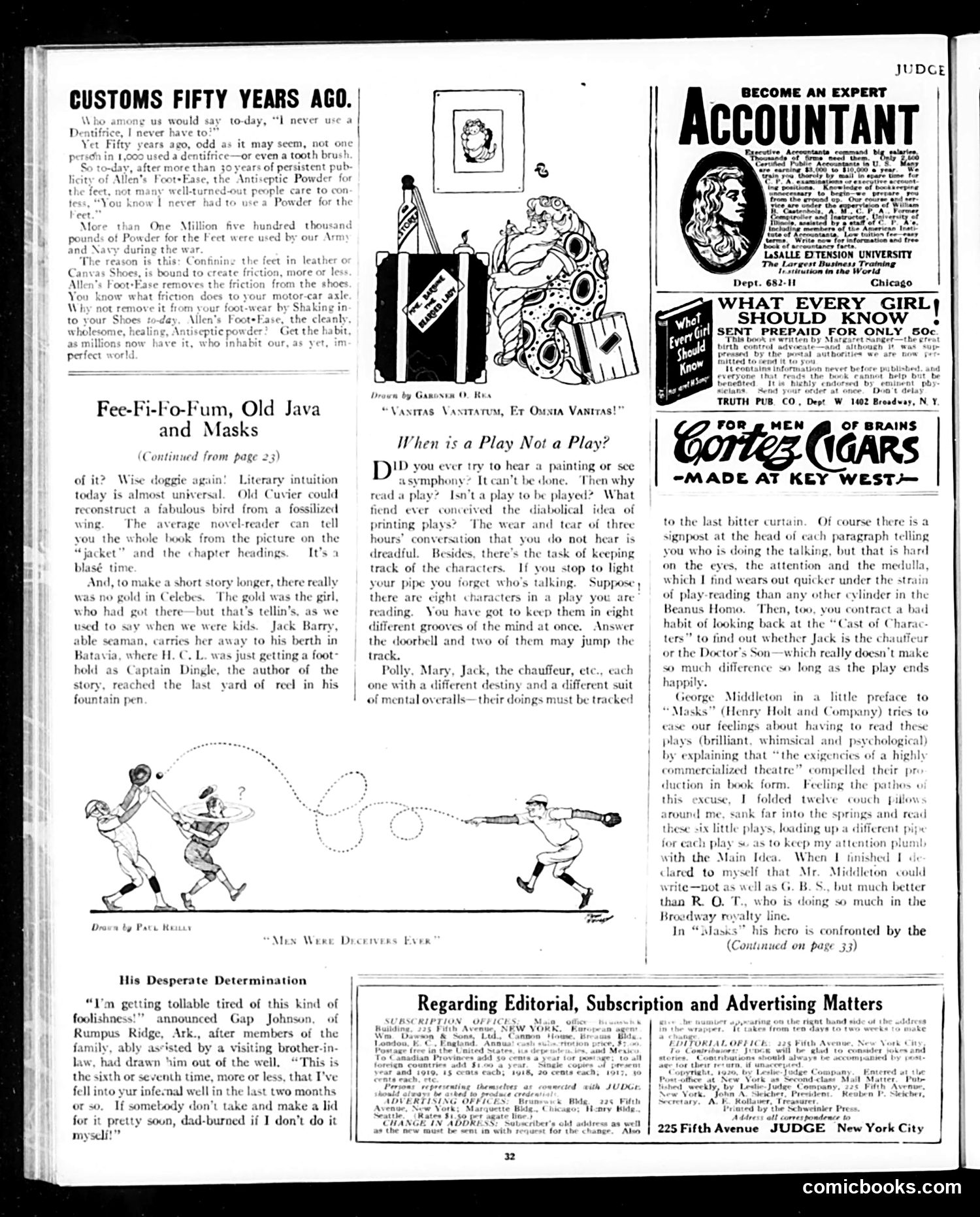
This page from the satirical magazine *Judge* contains multiple unrelated articles and advertisements typical of early 20th-century periodicals. **"Customs Fifty Years Ago"** nostalgically describes everyday items from half a century prior—particularly foot powder and dental powder—emphasizing how such products were commonplace despite modern skepticism about their necessity. **"When is a Play Not a Play?"** critiques the impractical trend of publishing stage plays as books, arguing that reading plays (rather than watching them performed) creates unnecessary cognitive strain trying to track multiple characters and their dialogue without theatrical staging. **"His Desperate Determination"** is a brief humorous anecdote about "Gap Johnson" of Arkansas repeatedly falling into a well, illustrating rustic American comedy. The page also features advertisements for accountancy training, a book about female knowledge, and Cortez cigars—typical commercial content interspersed throughout the magazine. The cartoons use simple line drawings to support the accompanying text humor.
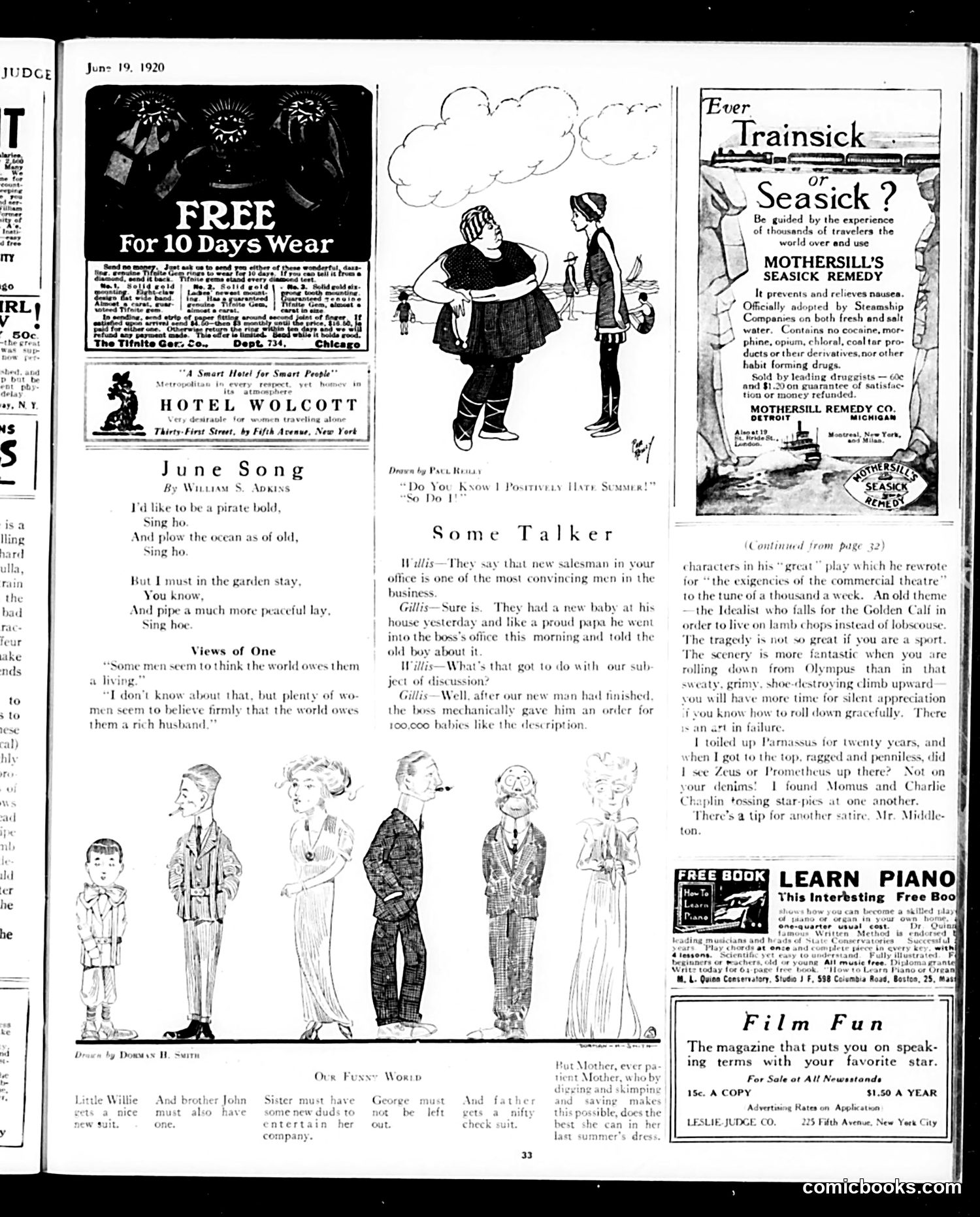
This page is primarily **advertising and light satirical content** rather than political commentary. The main cartoon, "Our Funny World" (drawn by Dorman H. Smith), depicts family members in various social situations with gentle humor about gender roles and propriety—a boy needing new suits, a girl entertaining company, a man needing to "check a suit" (appear respectable). The satire reflects post-WWI social conventions about appearance and behavior. "Some Talker" jokes about a new salesman so persuasive he convinced his boss to order 100,000 babies—absurdist humor about salesmanship. The "June Song" is nostalgic verse about preferring peaceful domesticity to adventure. **Advertisements dominate**: Hotel Wolcott, Mothersill's Seasick Remedy, a piano instruction book, and "Film Fun" magazine. The seasickness remedy advertisement references steamship travel, suggesting 1920s transatlantic tourism was common enough to warrant prominent advertising. This reflects post-WWI American consumer culture and the magazine's function as entertainment for middle-class readers.
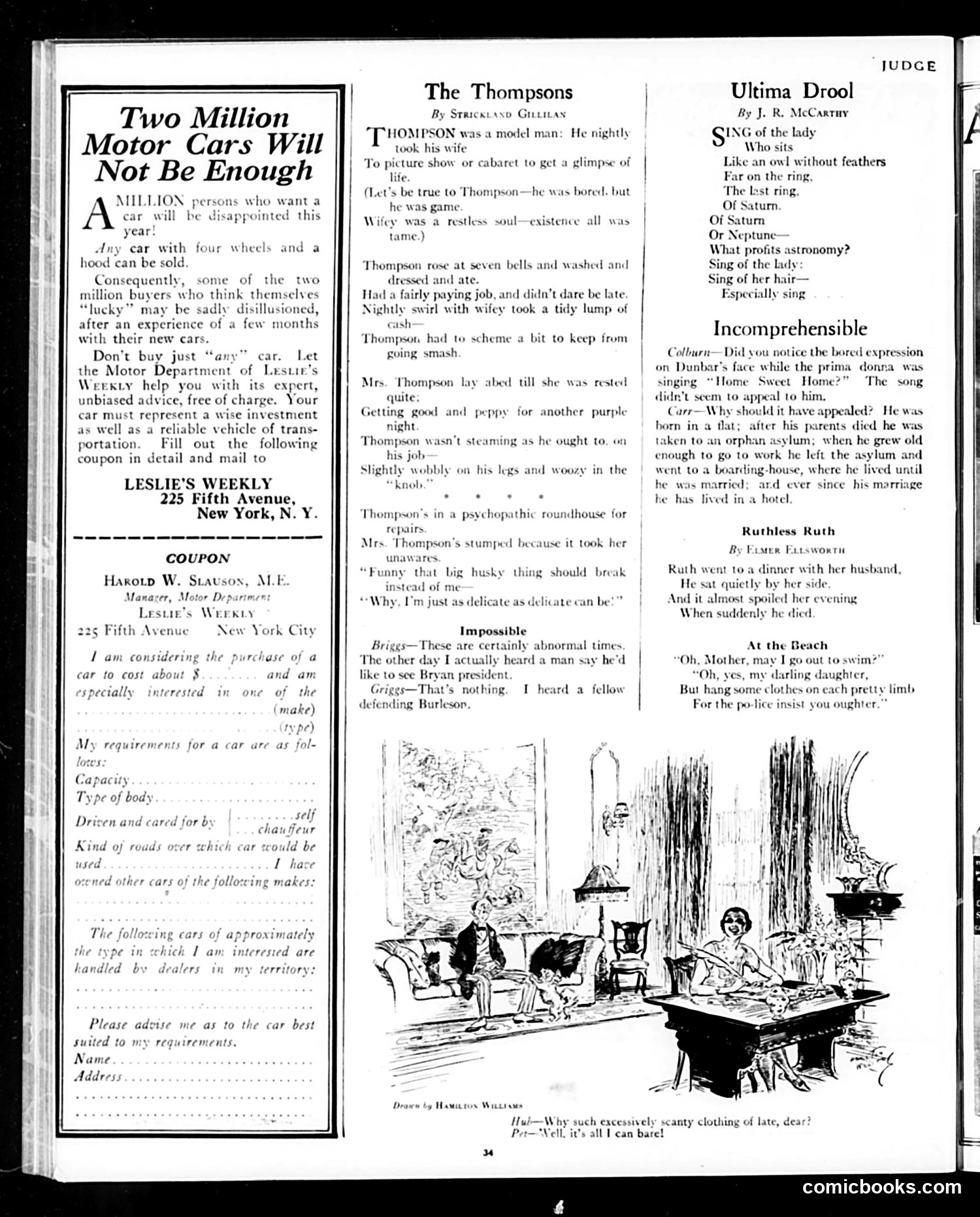
This page contains several short humorous pieces typical of early 20th-century American satire: **"The Thompsons"** is a narrative poem about a married couple's economic struggles. Thompson works a modest job while his restless wife demands entertainment (picture shows, cabarets). He must scheme to avoid financial ruin. The joke culminates when Mrs. Thompson complains about their car breaking down—ironic because *she's* the one causing their money problems through her demands, yet blames *him* for the vehicle's failure. **"Impossible"** presents two men discussing absurd political statements, referencing William Jennings Bryan (three-time presidential candidate) and apparently "Burleson" (likely A.S. Burleson, Postmaster General). **"Ultima Drool"** and other brief poems are light satirical verse on various topics. **The advertisement** promotes Leslie's Weekly's motor department, offering free expert advice to car buyers—reflecting the 1920s auto boom mentioned in the headline about two million cars being sold annually. The overall tone reflects anxieties about consumerism, automobile ownership, and marital discord during the postwar period.
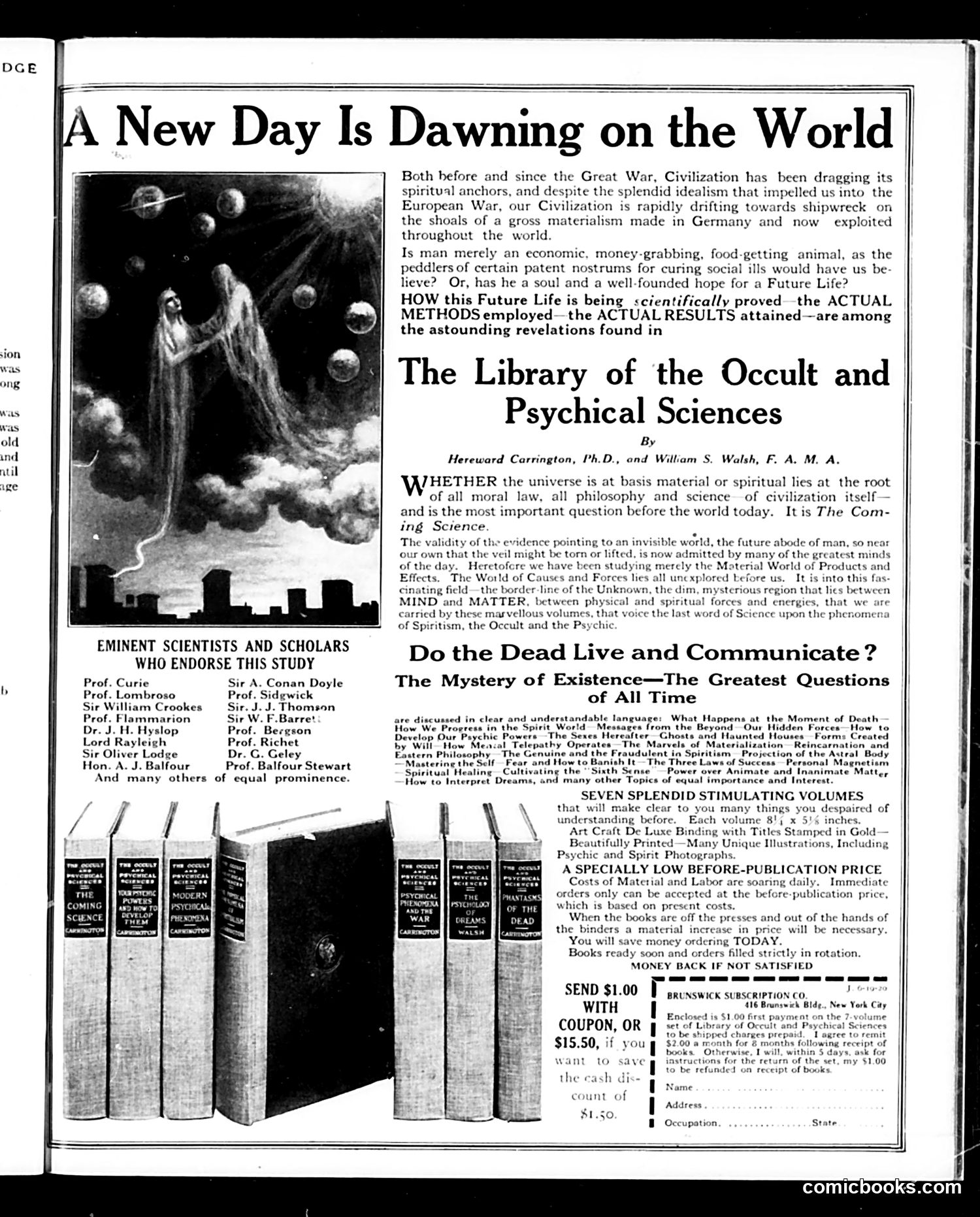
This page is primarily **advertising**, not satire. It promotes "The Library of the Occult and Psychical Sciences," a seven-volume set on spiritualism and the afterlife. The ad exploits post-WWI anxiety, claiming civilization drifts toward "gross materialism made in Germany"—referencing German philosophy blamed for the war. It positions spiritualism as a counterbalance, asking whether humans are merely economic animals or possess souls with "Future Life." The advertisement lists legitimizing endorsements from actual scientists (Curie, Thomson, Conan Doyle), lending credibility to occultism. This reflects early 20th-century "scientific spiritualism"—a movement attempting to validate séances and communication with the dead through scientific language. The "before-publication price" and "money back guarantee" are classic direct-mail sales tactics. The spirit photographs mentioned are historically significant: many spiritualist publications featured faked photographs as evidence of the supernatural, widely accepted before photographic manipulation became understood.
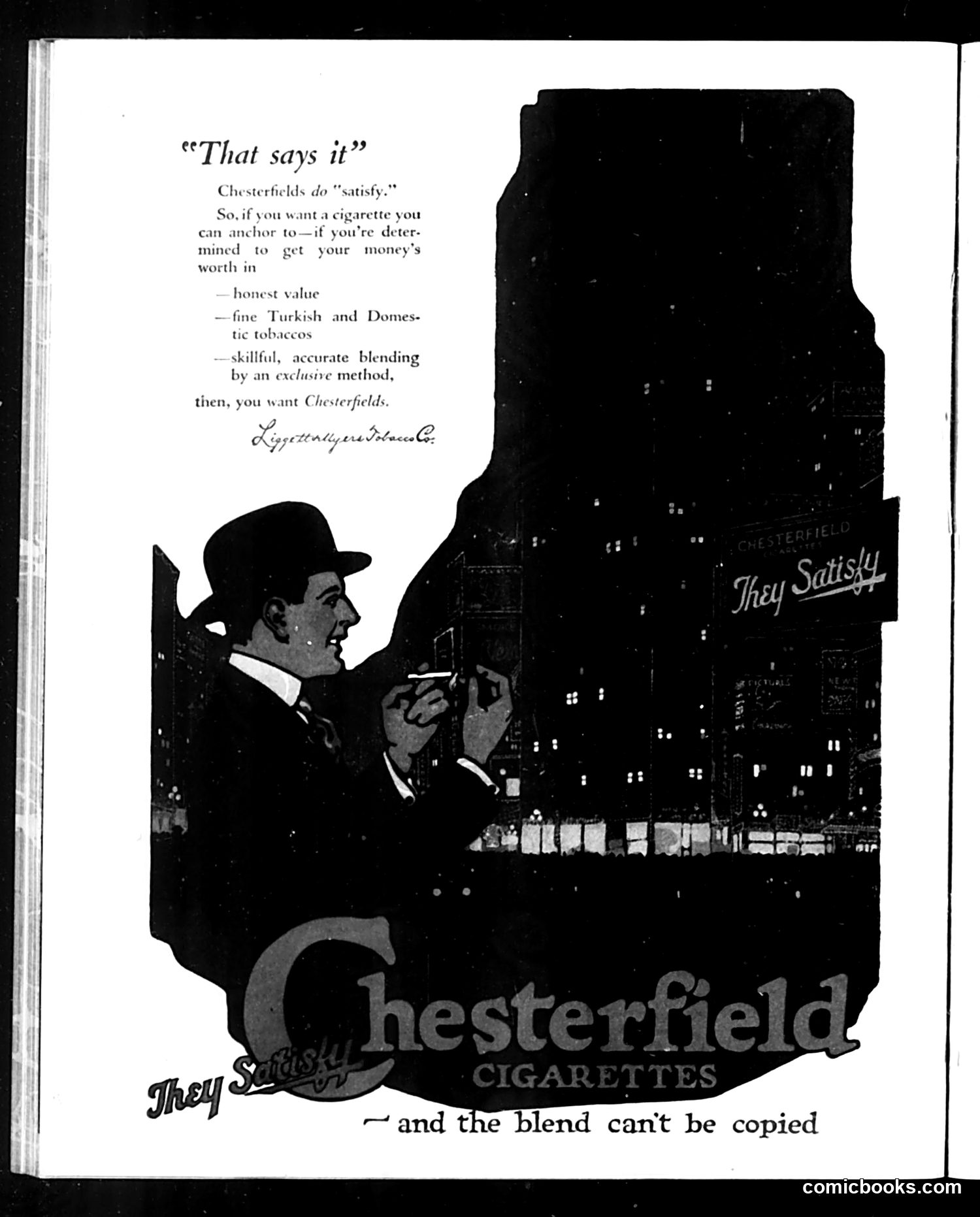
This is a **cigarette advertisement**, not political satire. It promotes Chesterfield cigarettes to a Judge magazine audience (early-to-mid 20th century). The ad features a well-dressed man in a fedora and overcoat, shown against a nighttime city skyline, smoking a cigarette. The visual suggests urban sophistication and masculine appeal. The text emphasizes Chesterfields' selling points: honest value, quality Turkish and domestic tobacco, and a proprietary blending method ("the blend can't be copied"). The repeated phrase "They Satisfy" was Chesterfield's actual advertising slogan. For modern readers: this represents pre-health-warning tobacco advertising that sold cigarettes by emphasizing quality, exclusivity, and lifestyle aspiration—tactics now prohibited. The "exclusive method" claim and inability-to-copy language suggest competitive positioning in a crowded cigarette market.