
Judge, 1920-06-19 · page 23 of 36
Judge — June 19, 1920 — page 23: what you’re looking at
What you’re looking at
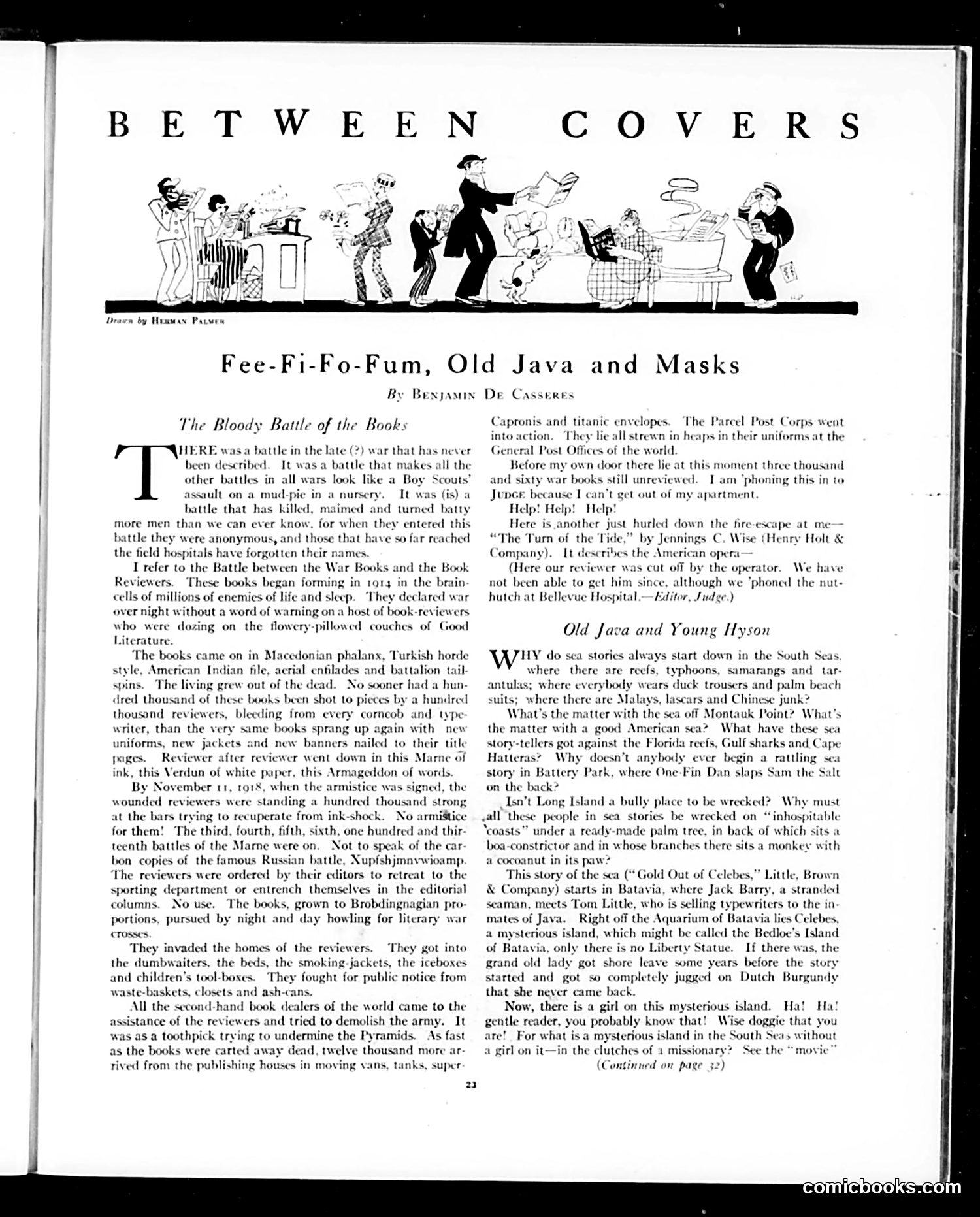
This Judge magazine page satirizes the post-WWI flood of war books overwhelming literary reviewers. The headline article, "The Bloody Battle of the Books" by Benjamin De Casseres, uses mock-military language to describe reviewers literally besieged by endless war memoirs and accounts. The satire depicts book-publishing as warfare: books arrive in "Macedonian phalanx" formations, reviewers suffer "ink-shock," and publishing houses deploy "moving vans, tanks, super" to deliver more volumes. The joke escalates absurdly—books invade homes, hide in dumbwaiters and iceboxes, and a reviewer is apparently killed while being interviewed about "The Turn of the Tide." This reflects genuine 1920s frustration: the market was flooded with war narratives, making serious criticism nearly impossible. The cartoon above shows frantic editorial chaos, visually reinforcing the textual satire about literature overwhelming its gatekeepers.
📄 Transcribed text from this page (OCR, searchable)
Machine-transcribed from the original scan — historical spelling and the odd misread are preserved.
Drawn by Hawes Pauwen Fee-Fi-Fo-Fum, Old Java By The Bloody Battle of the Books HERE was a battle in the late (7) war that has never been described. It was a battle that makes all the other battles in all wars look like a Boy Scouts’ assault on a mud-pie in a nursery. It was (is) a battle t has killed, maimed and tumed batty more men than we can ever know, for when they entered this battle they were anonymous, and those that have so far reached the field hospitals have forgotten their names. I refer to the Batlle between the War Books and the Book Reviewers. These books t n forming in rorg in the brain cells of millions of enemies of life and sleep. They declared war over night without a word of warning on a host of book-reviewers who were dozing on the flowery-pillowed couches of Good Literature. The books came on in Macedonian phalanx, Turkish horde style, American Indian file, aerial enfilades and battalion tail spins. The living grew out of the dead. No sooner had a hun- dred thousand of these books been shot to pieces by a hundred thousand reviewers, bleeding from every corncob and. type writer, than the very same books sprang up again with new uniforms, new jackets and new banners nailed to their title pages. Reviewer after reviewer went down in this Marne ink, this Verdun of white paper, this Armageddon of words. By November 11, ror&, when the armistice was signed, the wounded reviewers were standing a hundred thousand strong at the bars trying to recuperate from ink-shock. No armistice for them! The third, fourth, fifth, sixth, one hundred and thir- teenth battles of the Marne were on. Not to speak of the car bon copies of the famous Russian battle, Xupfshjmavwioamp. The reviewers were ordered by their editors to retreat to the sporting department or entrench themselves in the editorial columns. No use. The books, grown to Brobdingnagian pro- portions, pursued by night and day howling for literary war crosses. They invaded the homes of the reviewers. ‘They got into the dumbwaiters, the beds, the smoking-jackets, the iceboxes and children’s tool-boxes. They fought for public notice from waste-baskets, closets and ash-cans. All the second-hand book dealers of the world came to the ance of the reviewers and tried to demolish the army. It asa toothpick trying to undermine the Pyramids. As fast as the books were carted away dead, twelve thousand more ar- rived from the publishing houses in moving vans, tanks, super Benjamin De 23 and Masks Casseres Capronis and titanic envelopes. The Parcel Post Corps went into action. They lie all strewn in heaps in their uniforms at the General Post Offices of the world. Before my own door there lie at this moment three thousind and sixty war books still unreviewed. Iam ‘phoning this in to Jupce because I can’t get out of my apartment Help! Help! Help! Here is another just hurled down the fire-escape at me— “The Turn of the Tide,” by Jennings C. Wise (Henry Holt 8 Company). Lt describes the American opera— (Here our reviewer was cut off by the ope not been able to get him since, although we hutch at Bellevue Hospital.—Editer, Judge.) stor. We have phoned the nut- Old Java and Young Hyson HY do sca stories always start down in the South Seas, where there are reefs, typhoons, samarangs and _tar- antulas; where everybody wears duck trousers and palm beach suits; where there are Malays, lascars and Chinese junk? What’s the matter with the sea off Montauk Point? What's the matter with a good American sea? What have these sea story-tellers got against the Florida reefs, Gulf sharks and Cape Hatteras? Why doesn’t anybody ever begin a rattling sea story in Battery Park, where One-Fin Dan slaps Sam the Salt on the back? Isn't Long Island a bully place to be wrecked? Why must WI these people in sea stories be wrecked on “inhospitable “coasts” under a ready-made palm tree, in back of which sits a boa-constrictor and in whose branches there sits a monkey with a cocoanut in its paw? This story of the (“Gold Out of Celebes,” Little, Brown & Company) starts in Batavia, where Jack Barry, a stranded seaman, meets Tom Little, who is selling typewriters to the in: mates of Ja’ Right off the Aquarium of Batavia lies Celebes, a mysterious island, which might be called the Bedloe’s Island of Batavia, only there is no Liberty Statue. If there was, the grand old lady got shore leave some years before the story started and got so completely jugged on Dutch Burgundy that she never came back. Now, there is a girl on this mysterious island gentle reader, you probably know that! Wise dogg are! For what is a mysterious island in the South Se: 1 girl on it—in the clutches of 4 missionary? See the (Continued on page 32 Ha! Ha! that you > without