
Judge, 1920-06-19 · page 7 of 36
Judge — June 19, 1920 — page 7: what you’re looking at
What you’re looking at
This page contains satirical short stories rather than political cartoons. The main content mocks American culture and attitudes: **"The Cave" story** satirizes people's preference for imagination over reality. Uncle Kegley takes the narrator to a cave to "watch" something invisible—there's nothing to see, yet he claims it's entertaining because "you can imagine anything you want." When the narrator asks why they don't just imagine at home, Kegley replies this is illegal under the fictional "Eighty-Eighth Amendment," satirizing censorship fears and overregulation. **"No Paradise"** jokes about Prohibition (the alcohol ban). A gambler stuck in a "dry" town complains he had nothing to drink but dew—suggesting even in paradise, prohibition would ruin it. **"Off-Hand Roomer"** is a brief joke about a neat roomer who must have worked as a stagehand in "bedroom farces" (suggestive theatrical comedies). The page reflects 1920s-30s American anxieties about censorship, Prohibition, and changing social mores.
📄 Transcribed text from this page (OCR, searchable)
Machine-transcribed from the original scan — historical spelling and the odd misread are preserved.
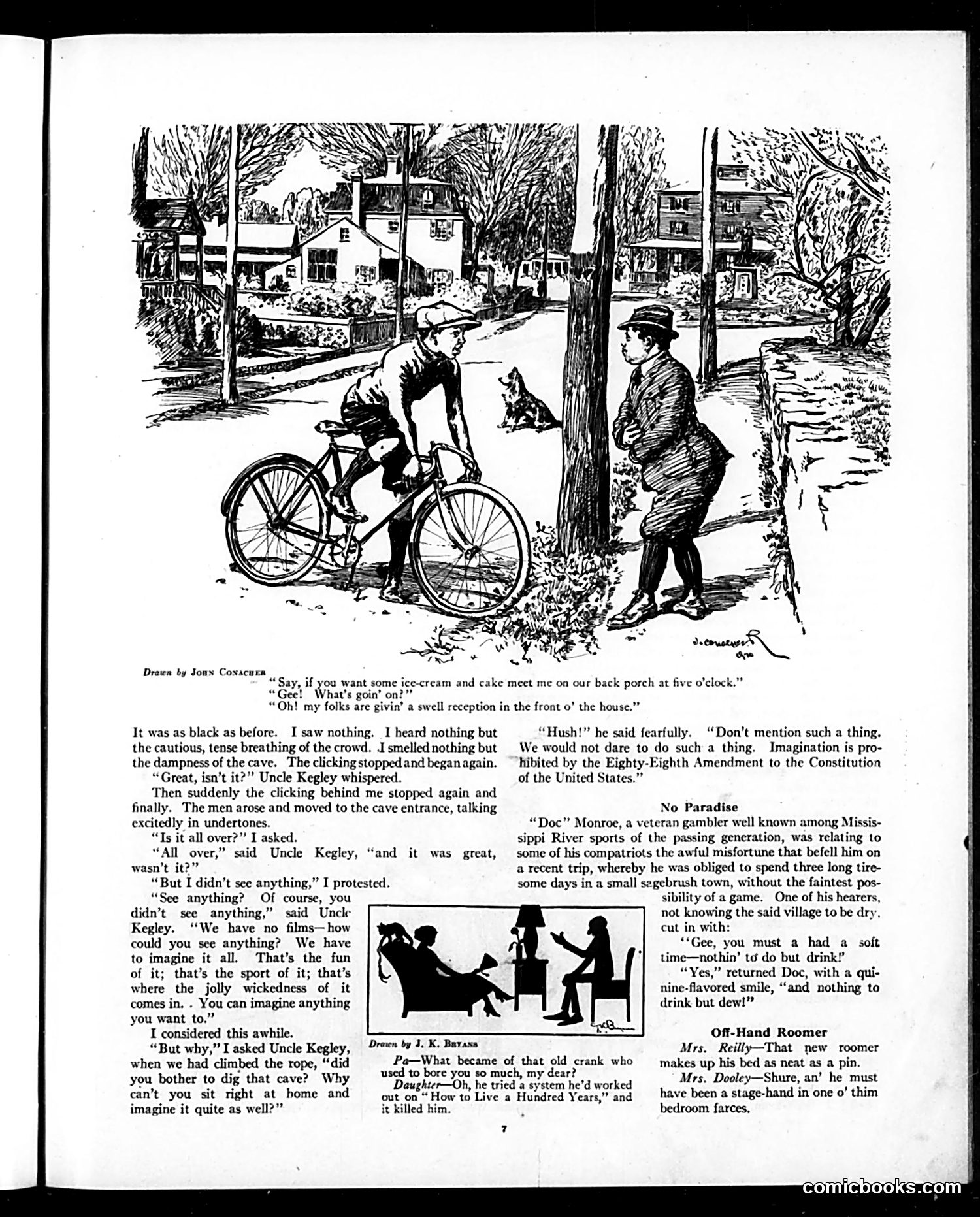
Drawn by Jonx Coxacurn “Gee! What's goin’ on?” “Say, if you want some ice-cream and cake meet me on our back porch at five o'clock.” v “Oh! my folks are givin’ a swell reception in the front o’ the house.” It was as black as before. I saw nothing. I heard nothing but the cautious, tense breathing of the crowd. I smelled nothing but the dampness of the cave. The clicking stopped and began again. “Great, isn’t it?” Uncle Kegley whispered. Then suddenly the clicking behind me stopped again and finally. The men arose and moved to the cave entrance, talking excitedly in undertones. “Ts it all over?” I asked. “All over,” said Uncle Kegley, “and it wasn’t it?” “But I didn’t see anything,” I protested. “See anything? Of course, you didn’t see anything,” said Uncle Kegley. ‘‘We have no films—how could you see anything? We have to imagine it all. That’s the fun of it; that’s the sport of it; that’s where the jolly wickedness of it comes in, . You can imagine anything you want to.” I considered this awhile. “But why,” I asked Uncle Kegley, when we had climbed the rope, “did you bother to dig that cave? Why can’t you sit right at home and imagine it quite as well?” was great, err Drawn by J. K. Buraxs it killed him. Pa—What became of that old crank who used to bore you so much, my dear? Daughter—Oh, he tried a system he'd worked out on “How to Live a Hundred Years,” and “Hush!” he said fearfully. “Don’t mention such a thing. We would not dare to do such a thing. Imagination is pro- hibited by the Eighty-Eighth Amendment to the Constitution of the United States.” No Paradise “Doc” Monroe, a veteran gambler well known among Missis- sippi River sports of the passing generation, was relating to some of his compatriots the awful misfortune that befell him on a recent trip, whereby he was obliged to spend three long tire- some days in a small segebrush town, without the faintest pos- sibility of a game. One of his hearers, not knowing the said village to be dry, 7 cut in with: 1 “*Gee, you must a had a_ soft time—nothin’ to do but drink!’ “Yes,” returned Doc, with a qui- nine-flavored smile, ‘‘and nothing to drink but dew!” Off-Hand Roomer Mrs. Reilly—That pew roomer makes up his bed as neat as a pin. Mrs. Dooley—Shure, an’ he must have been a stage-hand in one o’ thim bedroom farces,