
Judge, 1920-06-19 · page 6 of 36
Judge — June 19, 1920 — page 6: what you’re looking at
What you’re looking at
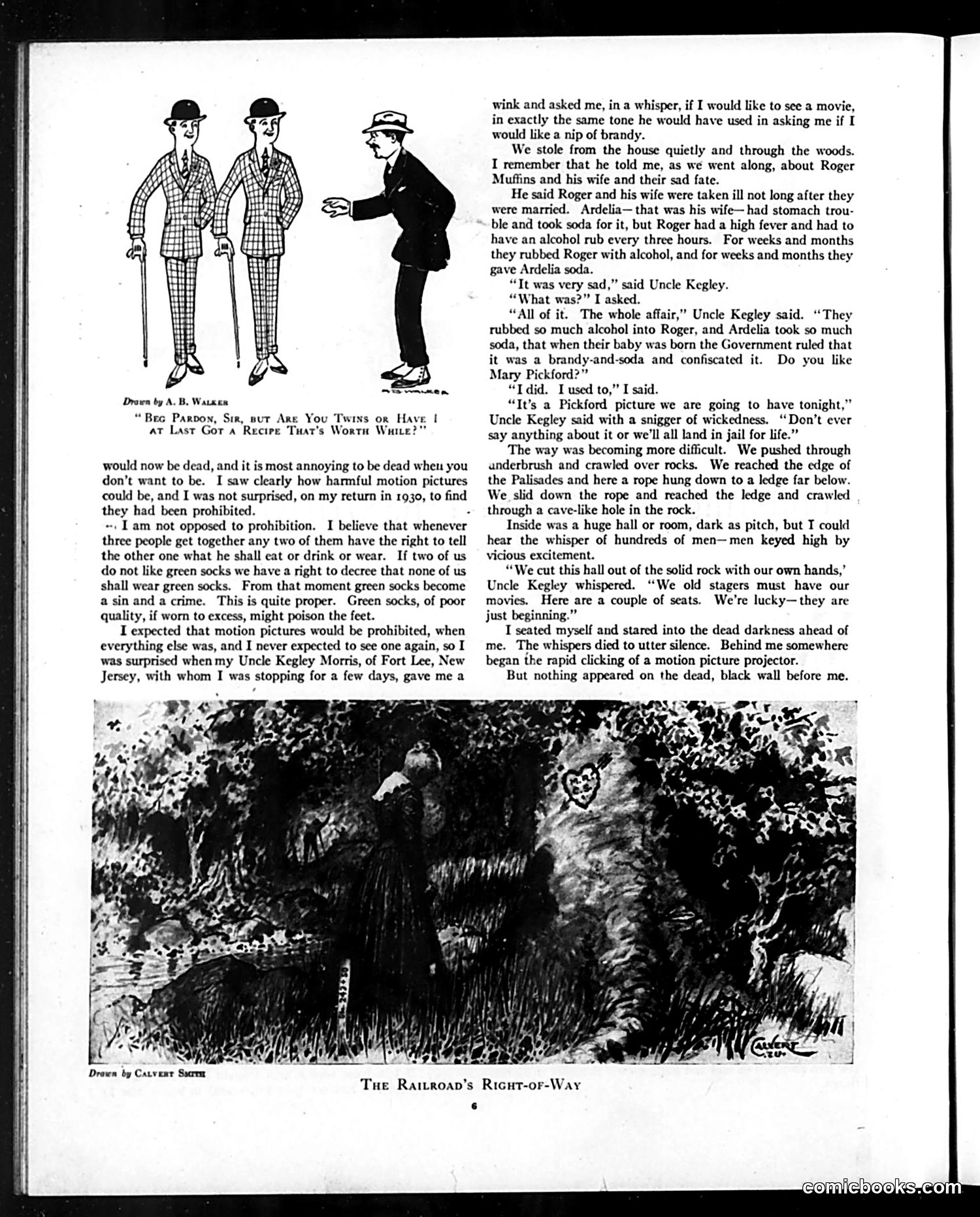
The top cartoon by A.B. Walker, titled "Red Pardon, Sir, but Are You Twins or Have I Just Got a Dizzy Spell?", mocks identical twins or doppelgängers through visual humor—a man addressing two identically-dressed figures. The main text is a story about motion picture prohibition. The narrator opposes banning movies, arguing that three people shouldn't dictate morality for everyone. He references a specific case: Roger and Ardelia Muffins, whose infant was born with an alcohol-related condition after they used soda (containing alcohol) as medicine during prohibition. The narrator calls this a "Pickford picture"—likely referencing Mary Pickford, a famous silent film actress—as commentary on how real-life tragedies become sensationalized entertainment. The bottom illustration by Calvert Smith, "The Railroad's Right-of-Way," depicts a cave scene, though its satirical meaning remains unclear without additional context.
📄 Transcribed text from this page (OCR, searchable)
Machine-transcribed from the original scan — historical spelling and the odd misread are preserved.
erie, saesesees reseseaes: S632 a nen Drawn by A.B. Warxen “Beo Parvon, Sir, sut Are You Twins or Have | at Last Got a Recipe Tuat’s Wort Waite?” would now be dead, and it is most annoying to be dead when you don’t want to be. I saw clearly how harmful motion pictures could be, and I was not surprised, on my return in 1930, to find they had been prohibited. - -. I am not opposed to prohibition. I believe that whenever three people get together any two of them have the right to tell the other one what he shall cat or drink or wear. If two of us do not like green socks we have a right to decree that none of us shall wear green socks. From that moment green socks become asin and a crime. This is quite proper. Green socks, of poor quality, if worn to excess, might poison the feet. I expected that motion pictures would be prohibited, when everything else was, and I never expected to see one again, so I was surprised when my Uncle Kegley Morris, of Fort Lee, New Jersey, with whom I was stopping for a few days, gave me a Drown by Carvent Sscrrm wink and asked me, in a whisper, if I would like to see a movie, in exactly the same tone he would have used in asking me if I would like a nip of brandy. We stole from the house quietly and through the woods. I remember that he told me, as we went along, about Roger Muffins and his wife and their sad fate. He said Roger and his wife were taken ill not long after they were married. Ardelia—that was his wife—had stomach trou- ble and took soda for it, but Roger had a high fever and had to have an alcohol rub every three hours. For weeks and months they rubbed Roger with alcohol, and for weeks and months they gave Ardelia soda. “It was very sad,” said Uncle Kegley. “What was?” I asked. “All of it. The whole affair,” Uncle Kegley said. “They rubbed so much alcohol into Roger, and Ardelia took so much soda, that when their baby was born the Government ruled that it was a brandy-and-soda and confiscated it. Do you like Mary Pickford?” “TI did. L used to,” I said. “It’s a Pickford picture we are going to have tonight,” Uncle Kegley said with a snigger of wickedness. ‘Don’t ever say anything about it or we'll all land in jail for life.” The way was becoming more difficult. We pushed through anderbrush and crawled over rocks. We reached the edge of the Palisades and here a rope hung down to a ledge far below. We slid down the rope and reached the ledge and crawled through a cave-like hole in the rock. Inside was a huge hall or room, dark as pitch, but T could hear the whisper of hundreds of men—men keyed high by vicious excitement. “We cut this hall out of the solid rock with our own hands,’ Uncle Kegley whispered. “We old stagers must have our movies. Here are a couple of seats. We're lucky—they are just beginning.” I seated myself and stared into the dead darkness ahead of me. The whispers died to utter silence. Behind me somewhere began the rapid clicking of a motion picture projector. But nothing appeared on the dead, black wall before me. Tue Rattroan’s Ricut-or-Way