
Judge, 1920-06-19 · page 8 of 36
Judge — June 19, 1920 — page 8: what you’re looking at
What you’re looking at
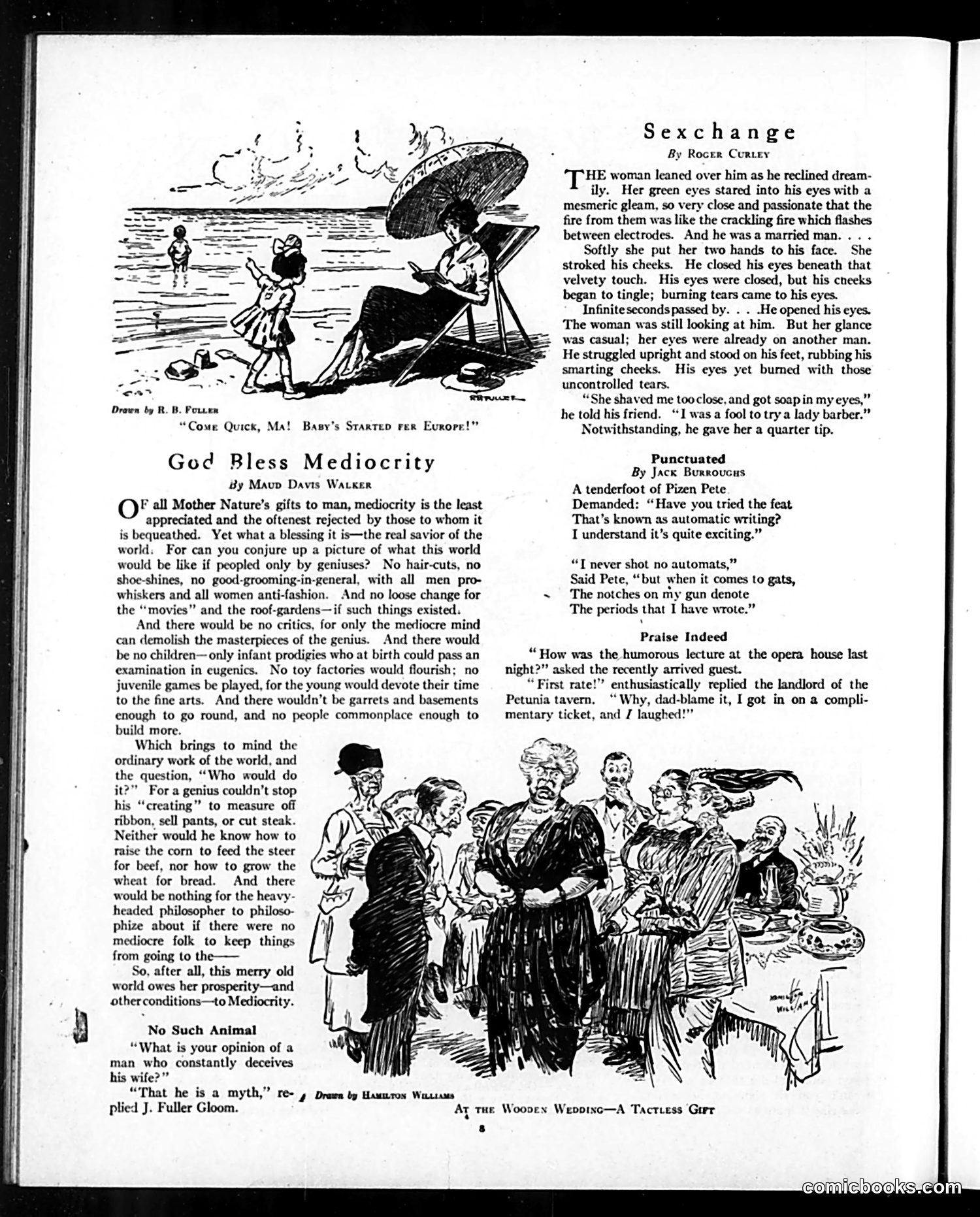
This page contains several short humor pieces typical of early 20th-century satirical magazines: **"God Bless Mediocrity"** is an essay-with-illustration arguing that ordinary people are essential to society. The accompanying cartoon shows a mother at the beach calling her child back—illustrating how mundane family life depends on mediocre folks doing everyday work. The essay's point: geniuses alone couldn't build civilization; someone must cut hair, grow wheat, and perform unglamorous labor. **"Sexchange"** is a brief romantic story with a punchline twist: the passionate moment between a man and woman at the seaside turns out to be a haircut gone wrong—she nicked him shaving, got soap in his eyes, and caused the "tears" he mistook for emotion. **"No Such Animal"** and **"Punctuated"** are short joke items mocking men who cheat on wives and a frontier character's malapropisms about "automatic writing." **"Praise Indeed"** jokes about a cheap tavern owner who received a complimentary opera ticket and enjoyed it anyway. The overall tone reflects Judge's genteel, middle-class humor emphasizing respectability and domesticity.
📄 Transcribed text from this page (OCR, searchable)
Machine-transcribed from the original scan — historical spelling and the odd misread are preserved.
Drawn by R. B. Pouen “Come Quick, Ma! God Bless Mediocrity By Mavup Davis Wacker F all Mother Nature’s gifts to man, mediocrity is the least appreciated and the oftenest rejected by those to whom it is bequeathed. Yet what a blessing it is—the real savior of the world, For can you conjure up a picture of what this world would be like if peopled only by geniuses? No hair-cuts, no shoe-shines, no good-grooming-in-general, with all men pro- whiskers and all women anti-fashion. And no loose change for the “movies” and the roof-gardens—if such things existed. And there would be no critics, for only the mediocre mind can demolish the masterpieces of the genius. And there would be no children— only infant prodigies who at birth could pass an examination in eugenics. No toy factories would flourish; no juvenile games be played, for the young would devote their time to the fine arts. And there wouldn’t be garrets and basements enough to go round, and no people commonplace enough to build more. Which brings to mind the ordinary work of the world, and the question, ‘Who would do it?” Fora genius couldn’t stop his “creating” to measure off ribbon, sell pants, or cut steak. Neither would he know how to raise the corn to feed the steer for beef, nor how to grow the wheat for bread. And there would be nothing for the heavy- headed philosopher to philoso- phize about if there were no mediocre folk to keep things from going to the— So, after all, this merry old world owes her prosperity—and other conditions—to Mediocrity. a) Basy’s Staxteo rer Evrore! No Such Animal “What is your opinion of a man who constantly deceives his wife?” “That he is a myth,” re- 4 Drawa by Haumrox Wa.iss plied J. Fuller Gloom. 8 Sexchange By Rocer Currey HE woman leaned over him as he reclined dream- ily. Her green eyes stared into his eyes with a mesmeric gleam, so very close and passionate that the fire from them was like the crackling fire which flashes between electrodes. And he was a married man. . . . Softly she put her two hands to his face. She stroked his cheeks. He closed his eyes beneath that velvety touch. His eyes were closed, but his cheeks began to tingle; burning tears came to his eyes. Infiniteseconds passed by. . . -He opened his eyes. The woman was still looking at him. But her glance was casual; her eyes were already on another man. He struggled upright and stood on his feet, rubbing his smarting cheeks. His eyes yet burned with those uncontrolled tears. “She shaved me tooclose, and got soap in my eyes,” he told his friend. “1 was fool to try a lady barber.” Notwithstanding, he gave her a quarter tip. Punctuated By Jack Burroucus A tenderfoot of Pizen Pete Demanded: “Have you tried the feat That’s known as automatic writing? I understand it’s quite exciting.” “T never shot no automats,” Said Pete, “but when it comes to gats, The notches on my gun denote The periods that I have wrote.” Praise Indeed “How was the humorous lecture at the opera house last night?” asked the recently arrived guest. “ First rate!” enthusiastically replied the landlord of the Petunia tavern. “ Why, dad-blame it, I got in on a compli- mentary ticket, and J laughed!” Aq tHe Woooes Wepoixc—A Tactiess Gter