
Judge, 1920-06-19 · page 24 of 36
Judge — June 19, 1920 — page 24: what you’re looking at
What you’re looking at
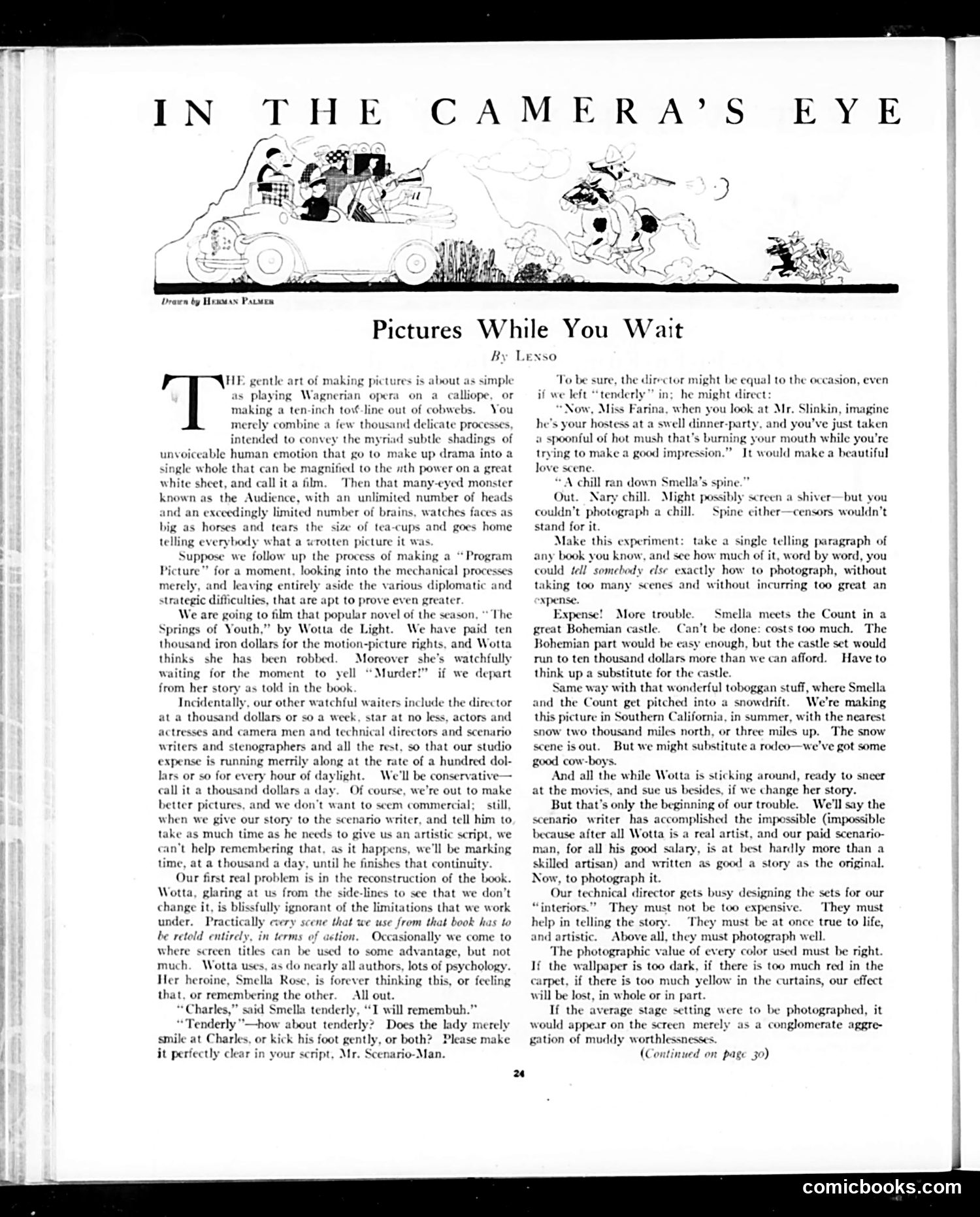
This article by Lexso satirizes the absurdities of early motion-picture production, specifically the adaptation of novels into films. The piece mocks the tension between literary sources and cinematic reality. **Key targets:** - **Authors like "Wotta de Light"**: Represents novelists who sell film rights while remaining vigilant (even hostile) overseers, unwilling to accept necessary changes - **The production system**: Depicts the economic waste of studio filmmaking—hundreds of workers earning "a thousand dollars a day" while waiting for scenario writers to adapt interior psychological moments - **The fundamental problem**: Authors rely on psychology, internal thought ("Smella Rose is forever thinking"), and abstract descriptions like "tenderly" or "a chill ran down her spine"—elements impossible to photograph **The satire's point**: Film cannot literally show thoughts or emotions. Adapting novels requires complete reconception, not literal translation. The cartoon celebrates this creative challenge while mocking the impractical demands of protective authors and the system's enormous waste. The illustration (by Herman Palmer) shows a car full of people and activity—visualizing cinematic action's complexity compared to static text.
📄 Transcribed text from this page (OCR, searchable)
Machine-transcribed from the original scan — historical spelling and the odd misread are preserved.
ton IN THE CAMERA’S Drawn by Hraaeax Parwen Pictures While You Wait B) HE gentle art of making pictures is about as simple as playing Wagnerian opera on a calliope, or making a ten-inch to¢-line out of cobwebs. You merely combine a few thousand delicate processes, intended to convey the myriad subtle shadings of unvoiceable human emotion that go to make up drama into a single whole that can be magnified to the th power on a great white sheet, and call ita film. Then that many-eyed monster known as the Audience, with an unlimited number of heads nd an exccedingly limited number of brains, watches faces as big as horses and tears the size of tea-cups and goes home telling everybody what a wrotten picture it was. Suppose we follow up the process of making a “Program Picture” for a moment, looking into the mechanical processes merely, and leaving entirely aside the various diplomatic and strategic difficulties, that are apt to prove even greater We are going to film that popular novel of the season, “The Springs of Youth,” by Wotta de Light. We have paid ten thousand iron dollars for the motion-picture rights, and Wotta thinks she has been robbed. Moreover she’s watchfully waiting for the moment to yell “Murder!” if we depart from her story as told in the book Incidentally, our other watchful waiters include the director at a thousand dollars or so a week, star at no less, actors and actresses and camera men and technical directors and scenario writers and stenographers and all the rest, so that our studio expense is running merrily along at the rate of a hundred dol- lars or so for every hour of daylight. We'll be conservative— call it a thousand dollars a day, Of course, we're out to make better pictures, and we don’t want to seem commercial; still, when we give our story to the scenario writer, and tell him to take as much time as he needs to give us an artistic script, we can't help remembering that, as it happens, we'll be marking time, at a thousand a day, until he finishes that continuit Our first real problem is in the reconstruction of the book. Wotta, glaring at us from the side-lines to see that we don’t change it, is blissfully ignorant of the limitations that we work under. Practically every scene that we use from that book has to be retold entirely, in terms of astion. Occasionally we come to where screen titles can be used to some advantage, but not much. Wotta uses, as do nearly all authors, lots of psychology. Her heroine, Smella Rose, is forever thinking this, or feelir that, or remembering the other. All out. “Charles,” said Smella tenderly, “1 will remembuh.” Tenderly"—how about tenderly? Does the lady merely smile at Charles, or kick his foot gently, or both? Please make it perfectly clear in your script, Mr. Scenario-Man. Lexso To be sure, the director might be equal to the occasion, even if we left “tenderly” in; he might direct: * Now, Miss Farina, when you look at Mr. Slinkin, imagine he’s your hostess at a swell dinner-party, and you've just taken 2 spoonful of hot mush that’s burning your mouth while you're trying to make a good impression.” It would make a beautiful love scene. * A chill ran down Smella’s spine.” Out. Nary chill. Might possibly screen a shiver—but you couldn't photograph a chill. Spine either—censors wouldn't stand for it Make this experiment: take a single telling paragraph of iy book you know, and see how much of it, word by word, you could fell somebody else exactly how to photograph, without taking too many scenes and without incurring too great an pense. Expense! More trouble. Smella meets the Count in a great Bohemian castle. Can't be done: costs too much. The Bohemian part would be easy enough, but the castle set would run to ten thousand dollars more than we can afford. Have to think up a substitute for the castle. Same way with that wonderful toboggan stuff, where Smella and the Count get pitched into a snowdrift. We're making this picture in Southern California, in summer, with the nearest snow two thousand miles north, or three miles up. The snow scene isout. But we might substitute a rodeo—we've got some good cow-boys. And all the while Wotta is sticking around, ready to sneer at the movies, and sue us besides, if we change her story. But that’s only the beginning of our trouble. We'll say the scenario. writer has accomplished the impossible (impossible because after all Wotta is a real artist, and our paid scenario- man, for all his good js at best hardly more than a skilled artisan) and written as good a story as the original. Now, to photograph it. Our technical director gets busy designing the sets for our “interiors.” They must not be too expensiv They must help in telling the story. They must be at once true to life, and artistic. Above all, they must photograph well. The photographic value of every color used must be right. If the wallpaper is too dark, if there is too much red in the carpet, if there is too much yellow in the curtains, our effect will be lost, in whole or in part. If the average stage setting were to be photographed, it would appear on the screen merely as a conglomerate aggre- tion of muddy worthlessnesses. (Continued on page 30) comicbooks.com